
Life, 1923-01-25 · page 24 of 36
Life — January 25, 1923 — page 24: what you’re looking at
What you’re looking at
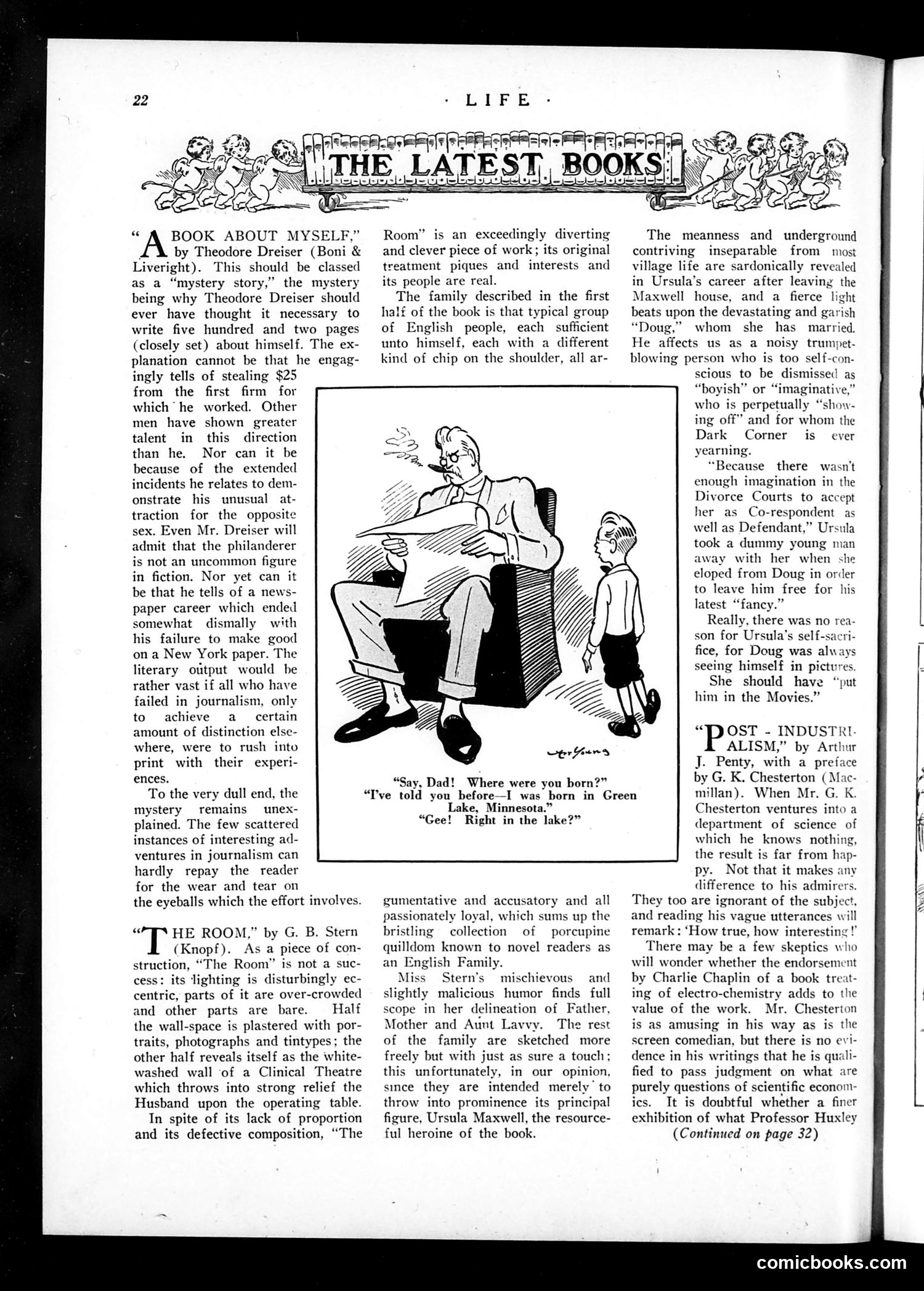
This is a book review page from *Life* magazine. The main cartoon shows a father and child in a simple joke: the child asks where the father was born, and when told "Green Lake, Minnesota," the child mishears it as being born literally "in the lake." The reviews themselves are satirical critiques. The first dismisses Theodore Dreiser's autobiography as unnecessarily lengthy and self-indulgent—mocking his inclusion of minor scandals (stealing $25, romantic exploits, failed journalism career) as unremarkable material stretched across 500+ pages. The reviewer suggests Dreiser has nothing particularly interesting to say about himself. The second review praises G.B. Stern's novel *The Room* despite its structural flaws, highlighting her sharp satirical portrayal of a typical English family—people quarrelsome, argumentative, and chip-on-the-shoulder types. The heroine Ursula is portrayed as resourceful but trapped in an unsatisfying marriage to the shallow "Doug." The satire targets literary pretension and the banality of certain autobiographical and domestic fiction popular in the 1920s-30s.
📄 Transcribed text from this page (OCR, searchable)
Machine-transcribed from the original scan — historical spelling and the odd misread are preserved.
¢ BOOK ABOUT MYSELF,” Z by Theodore Dreiser (Boni & Liveright). This should be classed as a “mystery story,” the mystery being why Theodore Dreiser should ever have thought it necessary to write five hundred and two pages (closely set) about himself. The ex- planation cannot be that he engag- ingly tells of stealing $25 from the first firm for which he worked. Other men have shown greater talent in this direction than he. Nor can it be because of the extended incidents he relates to dem- onstrate his unusual at- traction for the opposite sex. Even Mr. Dreiser will admit that the philanderer is not an uncommon figure in fiction. Nor yet can it be that he tells of a news- paper career which ended somewhat dismally with his failure to make good on a New York paper. The literary output would be rather vast if all who have failed in journalism, only to achieve a_ certain amount of distinction else- where, were to rush into print with their experi- ences. To the very dull end, the mystery remains unex- plained. The few scattered instances of interesting ad- ventures in journalism can hardly repay the reader for the wear and tear on the eyeballs which the effort involves. a HE ROOM,” by G. B. Stern (Knopf). As a piece of con- struction, “The Room” is not a suc- cess: its lighting is disturbingly ec- centric, parts of it are over-crowded and other parts are bare. Half the wall-space is plastered with por- traits, photographs and tintypes; the other half reveals itself as the white- washed wall ‘of a Clinical Theatre which throws into strong relief the Husband upon the operating table. In spite of its lack of proportion and its defective composition, “The Room” is an exceedingly diverting and clever piece of work; its original treatment piques and interests and its people are real. The family described in the first half of the book is that typical group of English people, each sufficient unto himself, each with a different kind of chip on the shoulder, all ar- “Say, Dad! Where were you born?” “I’ve told you before—I was born in Green Lake, Minnesota.” “Gee! Right in the lake?” gumentative and accusatory and all ionately loyal, which sums up the stling collection of porcupine quilldom known to novel readers as an English Family. Miss Stern's mischievous and slightly malicious humor finds full scope in her delineation of Father, Mother and Aunt Lavvy. The rest of the family are sketched more freely but with just as sure a touch; this unfortunately, in our opinion, since they are intended merely’ to throw into prominence its principal figure, Ursula Maxwell, the resource- ful heroine of the book. The meanness and underground contriving inseparable from most village life are sardonically revealed in Ursula’s career after leaving the Maxwell house, and a fierce light beats upon the devastating and garish “Doug,” whom she has married, He affects us as a noisy trun blowing person who is too self. scious to be dismissed “boyish” or “imaginative,” who is perpetually “show- ing off” and for whom the Dark Corner is ever yearning. “Because there wasn't enough imagination in the Divorce Courts to accept her as Co-respondent as well as Defendant,” Ursula took a dummy young man away with her when she eloped from Doug in order to leave him free for his latest “fancy.” Really, there was no rea- son for Ursula’s self-sacri- fice, for Doug was always seeing himself in pictures. She should have “put him in the Movies.” “POST - INDUSTRI- ALISM,” by Arthur J. Penty, with a prefac by G. K. Chesterton (Mac- millan). When Mr. G. K. Chesterton ventures into a department of science of which he knows nothing, the result is far from hap- py. Not that it makes any difference to his admirers. They too are ignorant of the subjec and reading his vague utterances will remark : ‘How true, how interesting !’ There may be a few skeptics who will wonder whether the endorsement by Charlie Chaplin of a book treat- ing of electro-chemistry adds to the value of the work. Mr. Chesterton is as amusing in his way as is the screen comedian, but there is no evi- dence in his writings that he is quali- fied to pass judgment on what are purely questions of scientific econom- ics. It is doubtful whether a finer exhibition of what Professor Huxley (Continued on page 32) Ton comicbooks.com