
Life, 1923-01-25 · page 26 of 36
Life — January 25, 1923 — page 26: what you’re looking at
What you’re looking at
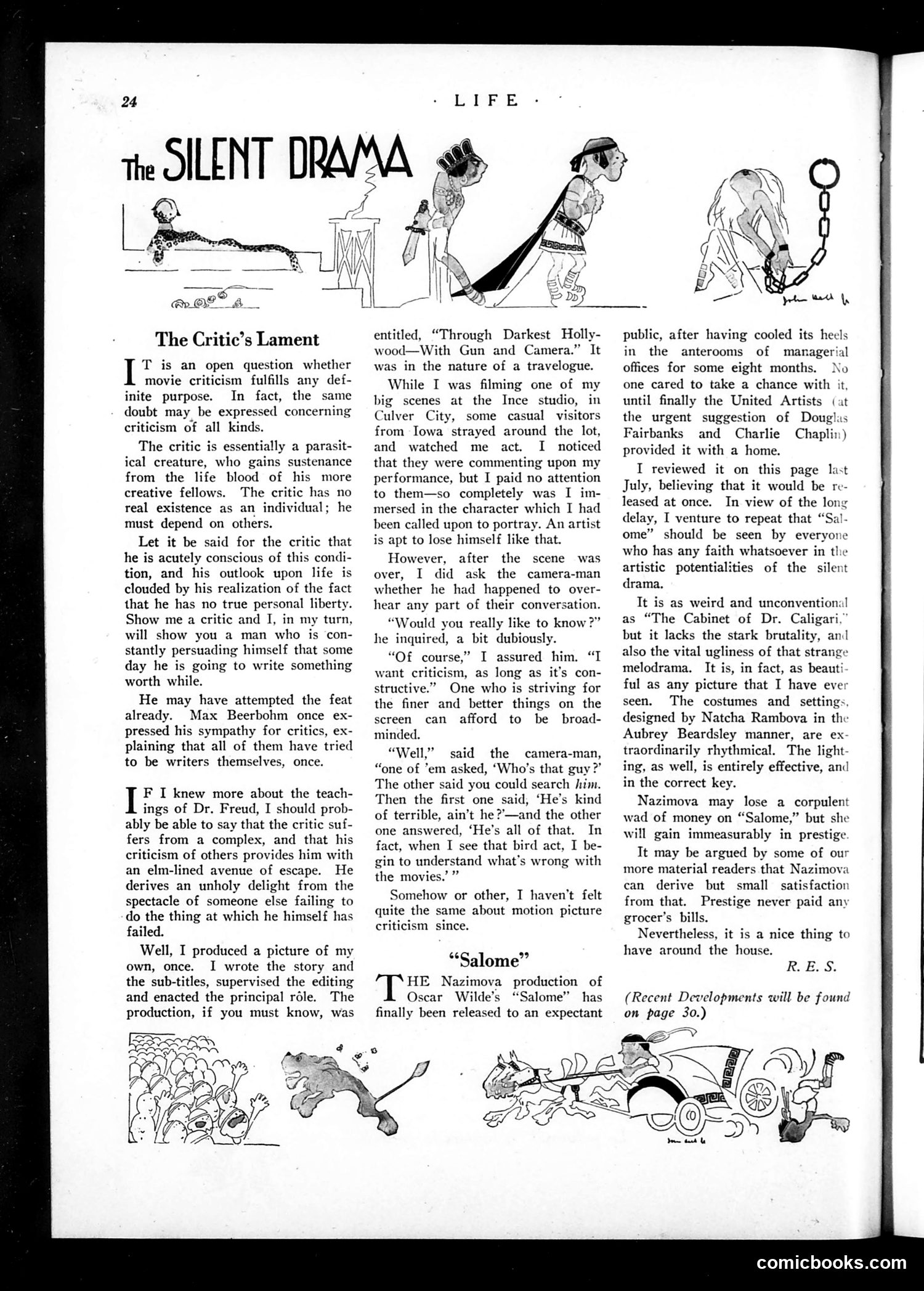
This page from Life magazine contains two articles about silent films, reflecting early 1920s cinema criticism. **"The Critic's Lament"** is a self-deprecating essay by the author (likely a film critic at Life) lamenting the parasitic nature of criticism itself. The piece humorously recounts the author's own failed acting attempt at the Ince studio in Culver City, where Iowa visitors watching him perform concluded he was "terrible" and exemplified "what's wrong with the movies." The satire targets both critics' essential dependency on creators and the author's wounded ego—he sought "constructive criticism" but received brutal honesty instead. **"Salome"** reviews the Nazimova production of Oscar Wilde's play, finally released after eight months in studio limbo. The author praises it as artistically ambitious and beautiful, comparing it favorably to German Expressionist cinema like "The Cabinet of Dr. Caligari," though noting it lacks that film's harsh brutality. The review celebrates the silent medium's artistic potential. The cartoons illustrate silent film tropes and slapstick comedy conventions of the era.
📄 Transcribed text from this page (OCR, searchable)
Machine-transcribed from the original scan — historical spelling and the odd misread are preserved.
24 Ar Oy The Critic’s Lament T is an open question whether movie criticism fulfills any def- inite purpose. In fact, the same doubt may be expressed concerning criticism of all kinds. The critic is essentially a parasit- ical creature, who gains sustenance from the life blood of his more creative fellows. The critic has no real existence as an individual; he must depend on others. Let it be said for the critic that he is acutely conscious of this condi- tion, and his outlook upon life is clouded by his realization of the fact that he has no true personal liberty. Show me a critic and I, in my turn, will show you a man who is con- stantly persuading himself that some day he is going to write something worth while. He may have attempted the feat already. Max Beerbohm once ex- pressed his sympathy for critics, ex- plaining that all of them have tried to be writers themselves, once. F I knew more about the teach- ings of Dr. Freud, I should prob- ably be able to say that the critic suf- fers from a complex, and that his criticism of others provides him with an elm-lined avenue of escape. He derives an unholy delight from the spectacle of someone else failing to do the thing at which he himself has failed. Well, I produced a picture of my own, once. I wrote the story and the sub-titles, supervised the editing and enacted the principal réle. The production, if you must know, was entitled, “Through Darkest Holly- wood—With Gun and Camera.” It was in the nature of a travelogue. While I was filming one of my big scenes at the Ince studio, in Culver City, some casual visitors from Iowa strayed around the lot, and watched me act. I noticed that they were commenting upon my performance, but I paid no attention to them—so completely was I im- mersed in the character which I had been called upon to portray. An artist is apt to lose himself like that. However, after the scene was over, I did ask the camera-man whether he had happened to over- hear any part of their conversation. “Would you really like to know?” he inquired, a bit dubiously. “Of course,” I assured him. “I want criticism, as long as it’s con- structive.” One who is striving for the finer and better things on the screen can afford to be broad- minded. “Well,” said the camera-man, “one of ’em asked, ‘Who's that guy?’ The other said you could search him. Then the first one said, ‘He’s kind of terrible, ain’t he ?’—and the other one answered, ‘He's all of that. In fact, when I see that bird act, I be- gin to understand what's wrong with the movies.’ ” Somehow or other, I haven't felt quite the same about motion picture criticism since. “Salome” HE Nazimova production of Oscar Wilde’s “Salome” has finally been released to an expectant public, after having cooled its heels in the anterooms of managerial offices for some eight months. No one cared to take a chance with it, until finally the United Artists (at the urgent suggestion of Douglas Fairbanks and Charlie Chaplin) provided it with a home. I reviewed it on this page last July, believing that it would be re- leased at once. In view of the long delay, I venture to repeat that “Sal- ome” should be seen by everyone who has any faith whatsoever in the artistic potentialities of the silent drama, Tt is as weird and unconventional as “The Cabinet of Dr. Caligari,” but it lacks the stark brutality, and also the vital ugliness of that strange melodrama. It is, in fact, as beauti ful as any picture that I have ever seen. The costumes and settings, designed by Natcha Rambova in the Aubrey Beardsley manner, are ex- traordinarily rhythmical. The light- ing, as well, is entirely effective, and in the correct key. Nazimova may lose a corpulent wad of money on “Salome,” but she will gain immeasurably in prestige. Tt may be argued by some of our more material readers that Nazimova can derive but small satisfaction from that. Prestige never paid any grocer’s bills. Nevertheless, it is a nice thing to have around the house. RES. (Recent Developments will be found on page 30.) => comicbooks.com