
Life, 1923-01-25 · page 20 of 36
Life — January 25, 1923 — page 20: what you’re looking at
What you’re looking at
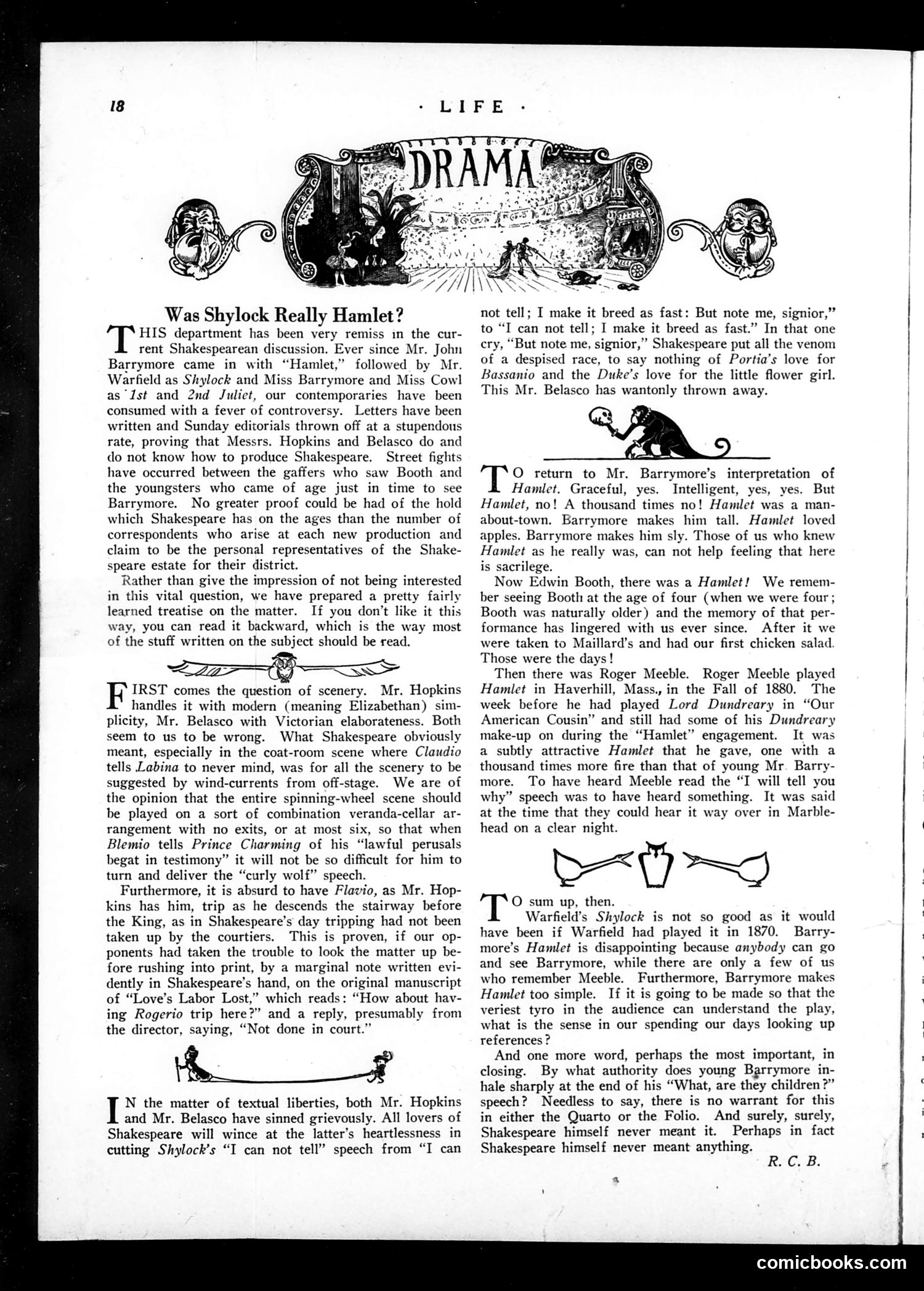
This article satirizes the heated public debates erupting over contemporary theatrical productions of Shakespeare, particularly John Barrymore's *Hamlet* and David Belasco's *Shylock* staging. The piece mocks serious theater critics and Shakespeare scholars by deliberately writing absurd, nonsensical "analysis." The satire works by inventing fake textual details (a "coat-room scene," characters named "Labina" and "Flavio," marginal notes about "tripping"), fabricating spurious arguments about Elizabethan staging practices, and making deliberately illogical points—such as criticizing Barrymore for making Hamlet tall when the "real" Hamlet loved apples. The humor targets how passionately audiences and critics defended different productions, claiming personal authority over Shakespeare's "true" intent. By writing deliberately bad criticism, Life mocks the pretentiousness of theater commentary and the street-fighting fervor these productions inspired among different generational camps of Shakespeare devotees.
📄 Transcribed text from this page (OCR, searchable)
Machine-transcribed from the original scan — historical spelling and the odd misread are preserved.
Was Shylock Really Hamlet? HIS department has been very remiss in the cur- rent Shakespearean discussion. Ever since Mr. John Barrymore came in with “Hamlet,” followed by Mr. Warfield as Shylock and Miss Barrymore and Miss Cowl as “1st and 2nd Juliet, our contemporaries have been consumed with a fever of controversy. Letters have been written and Sunday editorials thrown off at a stupendous rate, proving that Messrs. Hopkins and Belasco do and do not know how to produce Shakespeare. Street fights have occurred between the gaffers who saw Booth and the youngsters who came of age just in time to see Barrymore. No greater proof could be had of the hold which Shakespeare has on the ages than the number of correspondents who arise at each new production and claim to be the personal representatives of the Shake- speare estate for their district. Rather than give the impression of not being interested in this vital question, we have prepared a pretty fairly learned treatise on the matter. If you don’t like it this way, you can read it backward, which is the way most of the stuff written on the subject should be read. SO IRST comes the question of scenery. Mr. Hopkins handles it with modern (meaning Elizabethan) sim- plicity, Mr. Belasco with Victorian elaborateness. Both seem to us to be wrong. What Shakespeare obviously meant, especially in the coat-room scene where Claudio tells Labina to never mind, was for all the scenery to be suggested by wind-currents from off-stage. We are of the opinion that the entire spinning-wheel scene should be played on a sort of combination veranda-cellar ar- rangement with no exits, or at most six, so that when Blemio tells Prince Charming of his “lawful perusals begat in testimony” it will not be so difficult for him to turn and deliver the “curly wolf” speech. Furthermore, it is absurd to have Flavio, as Mr. Hop- kins has him, trip as he descends the stairway before the King, as in Shakespeare’s day tripping had not been taken up by the courtiers. This is proven, if our op- ponents had taken the trouble to look the matter up be- fore rushing into print, by a marginal note written evi- dently in Shakespeare's hand, on the original manuscript of “Love’s Labor Lost,” which reads: “How about hav- ing Rogerio trip here?” and a reply, presumably from the director, saying, “Not done in court.” RK e# N the matter of textual liberties, both Mr. Hopkins and Mr. Belasco have sinned grievously. All lovers of Shakespeare will wince at the latter’s heartlessness in cutting Shylock’s “I can not tell” speech from “I can not tell; I make it breed as fast: But note me, signior,” to “I can not tell; I make it breed as fast.” In that one cry, “But note me, signior,” Shakespeare put all the venom of a despised race, to say nothing of Portia’s love for Bassanio and the Duke’s love for the little flower girl. This Mr. Belasco has wantonly thrown away. O return to Mr. Barrymore’s interpretation of Hanilet. Graceful, yes. Intelligent, yes, yes. But Hamlet, no! A thousand times no! Hamlet was a man- about-town. Barrymore makes him tall. Hamlet loved apples. Barrymore makes him sly. Those of us who knew Hamlet as he really was, can not help feeling that here is sacrilege. Now Edwin Booth, there was a Hamlet! We remem- ber seeing Booth at the age of four (when we were four ; Booth was naturally older) and the memory of that per- formance has lingered with us ever since. After it we were taken to Maillard’s and had our first chicken salad. Those were the days! Then there was Roger Meeble. Roger Meeble played Hamlet in Haverhill, Mass., in the Fall of 1880. The week before he had played Lord Dundreary in “Our American Cousin” and still had some of his Dundreary make-up on during the “Hamlet” engagement. It was a subtly attractive Hamlet that he gave, one with a thousand times more fire than that of young Mr. Barry- more. To have heard Meeble read the “I will tell you why” speech was to have heard something. It was said at the time that they could hear it way over in Marble- head on a clear night. b=) O sum up, then. Warfield’s Shylock is not so good as it would have been if Warfield had played it in 1870. Barry- more’s Hamlet is disappointing because anybody can go and see Barrymore, while there are only a few of us who remember Meeble. Furthermore, Barrymore makes Hamlet too simple. If it is going to be made so that the veriest tyro in the audience can understand the play, what is the sense in our spending our days looking up references ? And one more word, perhaps the most important, in closing. By what authority does young Barrymore in- hale sharply at the end of his “What, are they children?” speech? Needless to say, there is no warrant for this in either the Quarto or the Folio. And surely, surely, Shakespeare himself never meant it. Perhaps in fact Shakespeare himself never meant anything. R.C. B. 3 comicbooks.com