
Life, 1923-01-25 · page 22 of 36
Life — January 25, 1923 — page 22: what you’re looking at
What you’re looking at
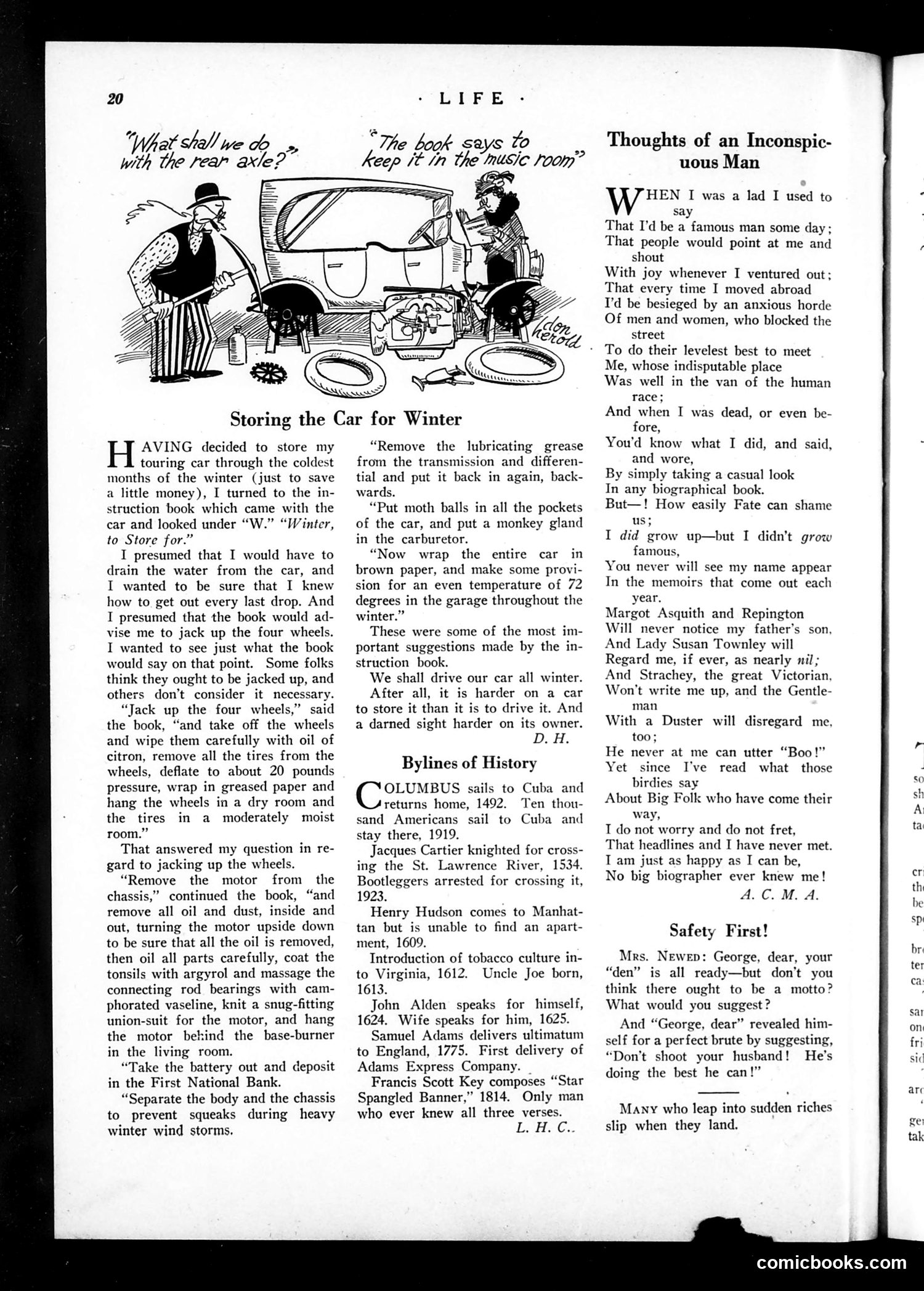
## Main Cartoon: "Storing the Car for Winter" The cartoon satirizes overly complicated automobile instruction manuals. A couple argues about car storage while surrounded by scattered parts and dishes. The humor comes from the absurd written instructions that follow—which escalate into ridiculous advice like removing the motor entirely, depositing the battery in a bank, wrapping the car in brown paper, and putting a "monkey gland in the carburetor." The joke mocks how manufacturers' instructions often overcomplicate simple tasks, treating car owners as incompetent. ## "Bylines of History" This humorous chronology pairs historical events with modern (1920s) parallels, usually showing decline or ironic contrast: Columbus's voyage versus Americans staying in Cuba (1919); dignified exploration versus modern bootlegging during Prohibition. It satirizes contemporary American society's perceived degradation. ## "Thoughts of an Inconspicuous Man" A melancholic poem about an ordinary person who dreamed of fame but became nobody—never appearing in biographies or memoirs. It's gentle social satire about average life's anonymity.
📄 Transcribed text from this page (OCR, searchable)
Machine-transcribed from the original scan — historical spelling and the odd misread are preserved.
20 es frat tal! we oo», RA the rear “axle ? * LIFE - ‘@ The book says to Keep It in the nsic roo? G ey Storing the Car for Winter AVING decided to store my touring car through the coldest months of the winter (just to save a little money), I turned to the in- struction book which came with the car and looked under “W.” “Winter, to Store for.” I presumed that I would have to drain the water from the car, and I wanted to be sure that I knew how to get out every last drop. And I presumed that the book would ad- vise me to jack up the four wheels. I wanted to see just what the book would say on that point. Some folks think they ought to be jacked up, and others don’t consider it necessary. “Jack up the four wheels,” said the book, “and take off the wheels and wipe them carefully with oil of citron, remove all the tires from the wheels, deflate to about 20 pounds pressure, wrap in greased paper and hang the wheels in a dry room and the tires in a moderately moist room.” That answered my question in re- gard to jacking up the wheels. “Remove the motor from the chassis,” continued the book, “and remove all oil and dust, inside and out, turning the motor upside down to be sure that all the oil is removed, then oil all parts carefully, coat the tonsils with argyrol and massage the connecting rod bearings with cam- phorated vaseline, knit a snug-fitting union-suit for the motor, and hang the motor behind the base-burner in the living room. “Take the battery out and deposit in the First National Bank. “Separate the body and the chassis to prevent squeaks during heavy winter wind storms. “Remove the lubricating grease from the transmission and differen- tial and put it back in again, back- wards. “Put moth balls in all the pockets of the car, and put a monkey gland in the carburetor. “Now wrap the entire car in brown paper, and make some provi- sion for an even temperature of 72 degrees in the garage throughout the winter.” These were some of the most im- portant suggestions made by the in- struction book. We shall drive our car all winter. After all, it is harder on a car to store it than it is to drive it. And a darned sight harder on its owner. D..H. Bylines of History OLUMBUS sails to Cuba and returns home, 1492. Ten thou- sand Americans sail to Cuba and stay there, 1919. Jacques Cartier knighted for cross- ing the St. Lawrence River, 1534. Bootleggers arrested for crossing it, 1923. Henry Hudson comes to Manhat- tan but is unable to find an apart- ment, 1609. Introduction of tobacco culture in- to Virginia, 1612. Uncle Joe born, 1613. John Alden speaks for himself, 1624. Wife speaks for him, 1625. Samuel Adams delivers ultimatum to England, 1775. First delivery of Adams Express Company. Francis Scott Key composes “Star Spangled Banner,” 1814. Only man who ever knew all three verses. ENA C.. Thoughts of an Inconspic- uous Man HEN I was a lad I used to say That I'd be a famous man some day; That people would point at me and shout With joy whenever I ventured out; That every time I moved abroad I'd be besieged by an anxious horde Of men and women, who blocked the street To do their levelest best to meet Me, whose indisputable place Was well in the van of the human race; And when I was dead, or even be- fore, You'd know what I did, and said, and wore, By simply taking a casual look In any biographical book. But—! How easily Fate can shame us; I did grow up—but I didn’t grow famous, You never will see my name appear In the memoirs that come out each year. Margot Asquith and Repington Will never notice my father’s son, And Lady Susan Townley will Regard me, if ever, as nearly nil; And Strachey, the great Victorian, Won't write me up, and the Gentle- man With a Duster will disregard me, too; He never at me can utter “Boo!” Yet since I've read what those birdies say About Big Folk who have come their way, T do not worry and do not fret, That headlines and I have never met. I am just as happy as I can be, No big biographer ever knew me! A.C. M. A. Safety First! Mrs. Newep: George, dear, your “den” is all ready—but don’t you think there ought to be a motto? What would you suggest? And “George, dear” revealed him- self for a perfect brute by suggesting, “Don't shoot your husband! He's doing the best he can!” Many who leap into sudden riches slip when they land. comicbooks.com So 1 sh ta cr th be ge tak