
A complete issue · 36 pages · 1923
Life — January 18, 1923
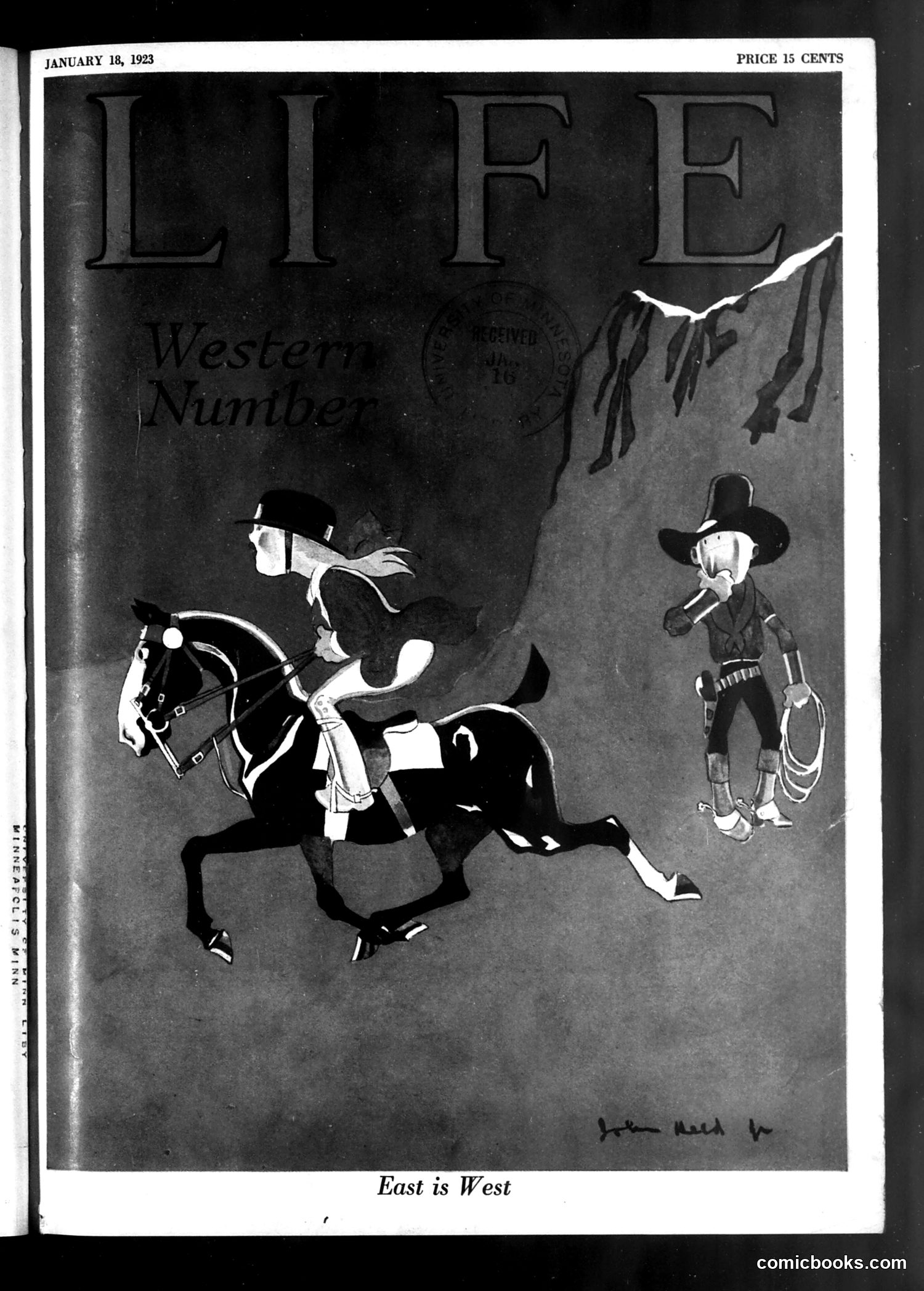
This is the "Western Number" issue's cover, illustrated with the caption "East is West." The image depicts a collision between two cultural archetypes: a cowboy on horseback (representing the American West) confronting a person in formal Eastern dress with a bowler hat. The cowboy appears to be moving aggressively toward the Eastern figure, suggesting conflict or tension between these two American regions or lifestyles. The title "East is West" inverts the expected geography, likely satirizing how Western frontier imagery had become commercialized and adopted by Eastern city culture during the 1920s—the Jazz Age when Western themes were fashionable entertainment despite Eastern audiences' unfamiliarity with actual frontier life.
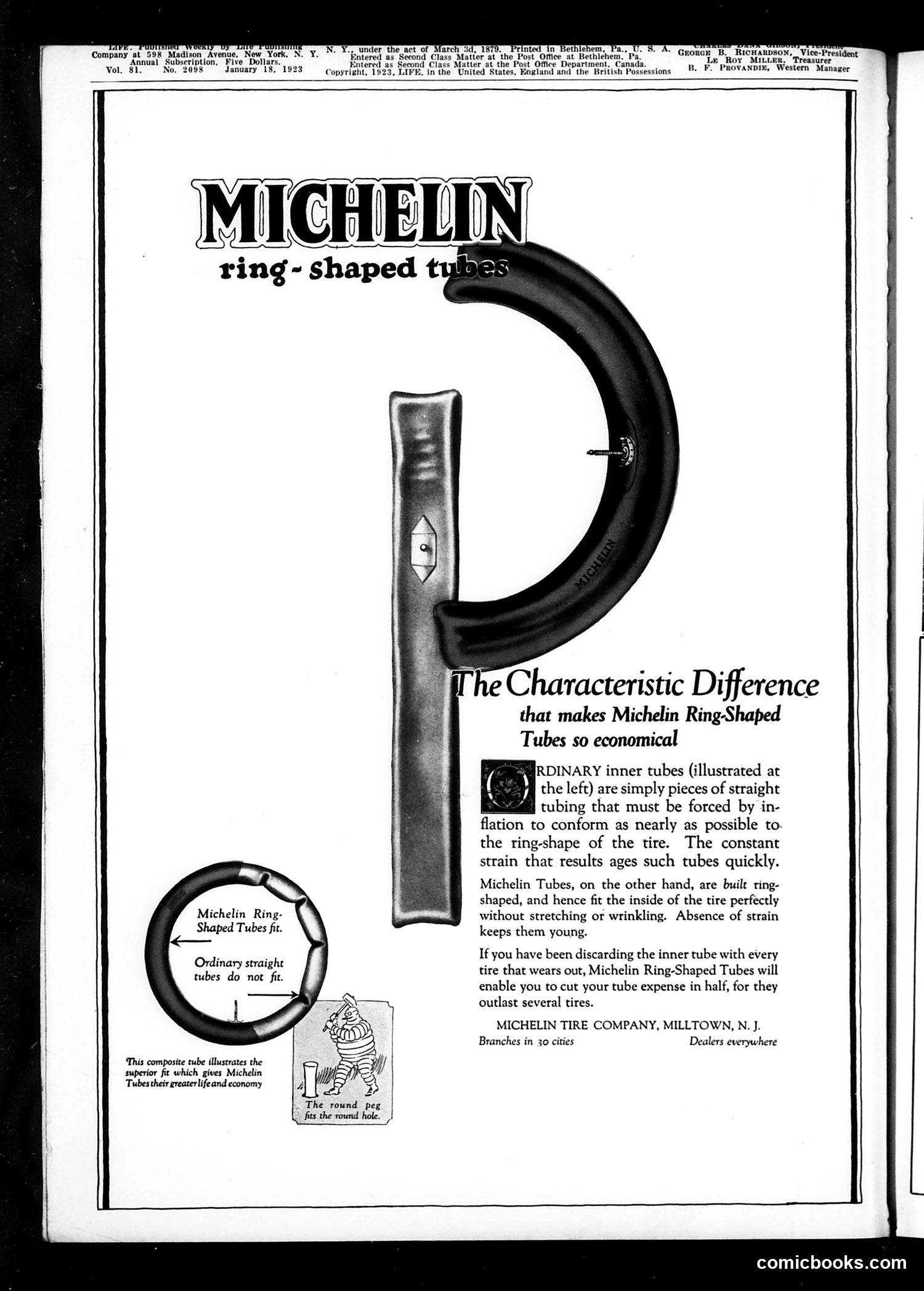
This page is **primarily a Michelin tire advertisement**, not political satire or commentary. The ad promotes Michelin's "ring-shaped tubes" for tires. The central visual compares two inner tube designs: ordinary straight tubes (shown on the left) that must be forced to fit a tire's curved shape, causing strain and aging; versus Michelin's ring-shaped tubes (illustrated prominently) that naturally conform to the tire's interior without stretching or wrinkling. The Bibendum character (the rotund "Michelin Man" mascot, visible at bottom) reinforces the brand identity. The advertisement's "characteristic difference" is framed as an economic advantage—claiming Michelin tubes last longer, reducing replacement costs. This is a straightforward product-differentiation marketing pitch aimed at cost-conscious consumers, circa 1923.
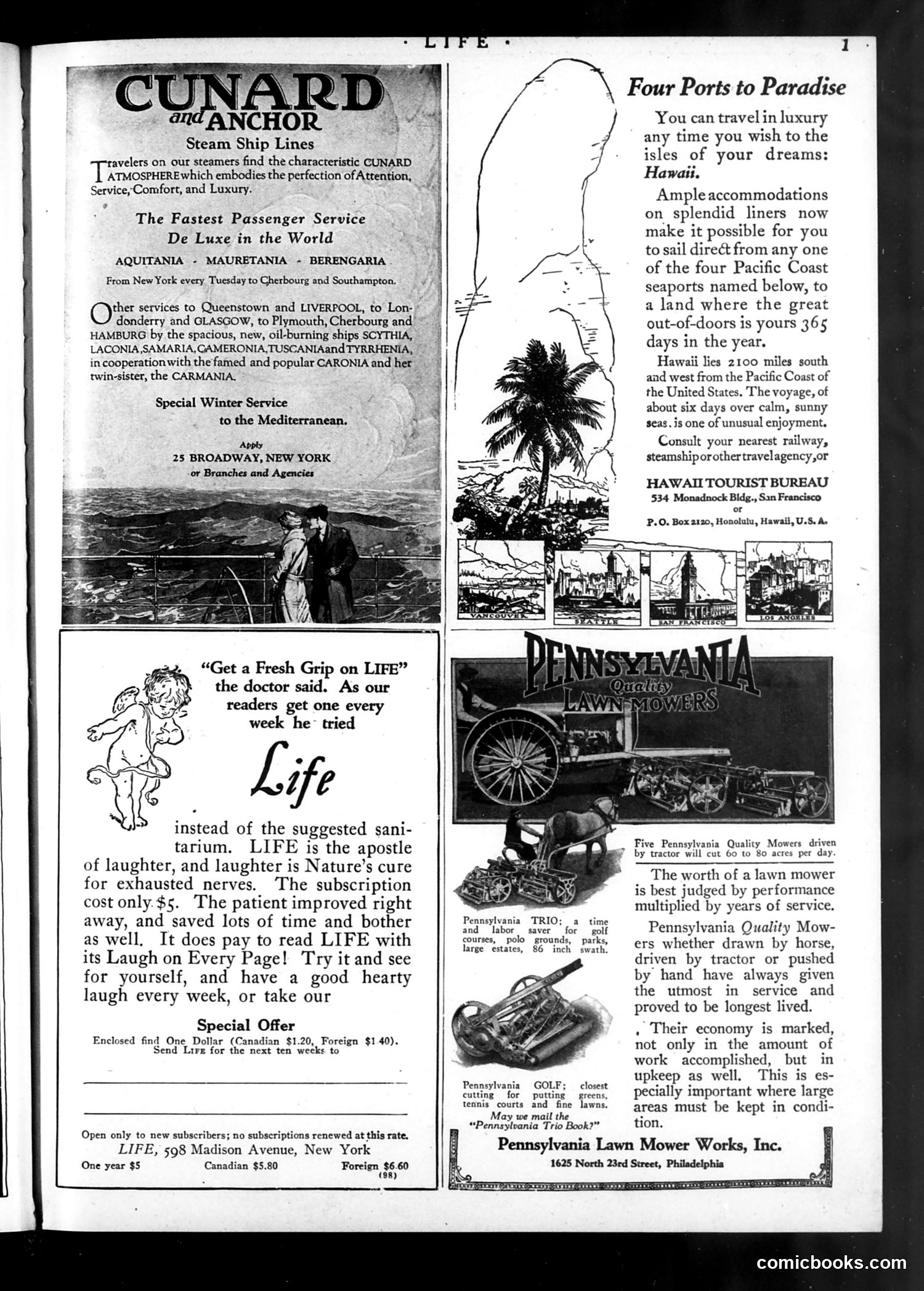
This page is primarily **advertising**, not satirical content. It contains four distinct ads: 1. **Cunard Steam Ship Lines**: Promotes luxury ocean travel to Europe and the Mediterranean, featuring the ships Aquitania, Mauretania, and Berengaria. 2. **Hawaii Tourist Bureau**: Advertises six-day voyages to Hawaii from Pacific Coast ports, promoting year-round tropical travel. 3. **Life Magazine Subscription**: A self-promotional ad featuring a cherub figure, with the tagline "Get a Fresh Grip on LIFE." It pitches the magazine as a cure for exhausted nerves, costing $5 annually. 4. **Pennsylvania Lawn Mower Works**: Showcases quality lawn mowers for golf courses and estates, emphasizing durability and service. The page reflects 1920s consumer culture and leisure travel advertising aimed at affluent readers.
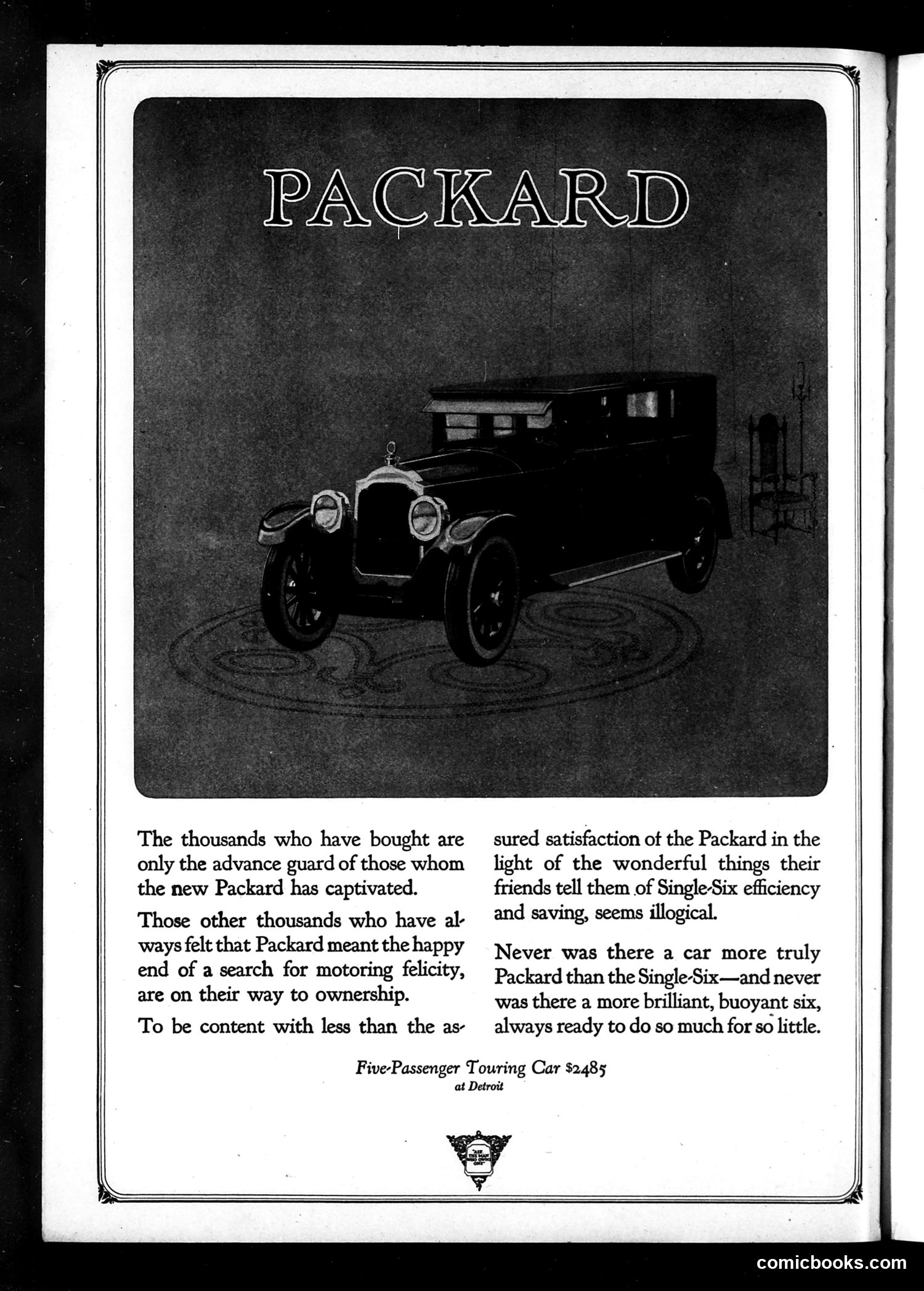
This is **not a political cartoon or satire**—it's a straightforward advertisement for the Packard automobile, specifically the "Single-Six" model priced at $2,485 in Detroit. The ad uses aspirational language typical of 1920s luxury car marketing, claiming that thousands of Packard owners have found "motoring felicity" and that the Single-Six is "more truly Packard than" any previous model, capable of doing "so much for so little." The image shows a black touring car of the era rendered in a formal, dignified style. This appears to be a standard magazine advertisement targeting affluent readers who could afford premium automobiles.
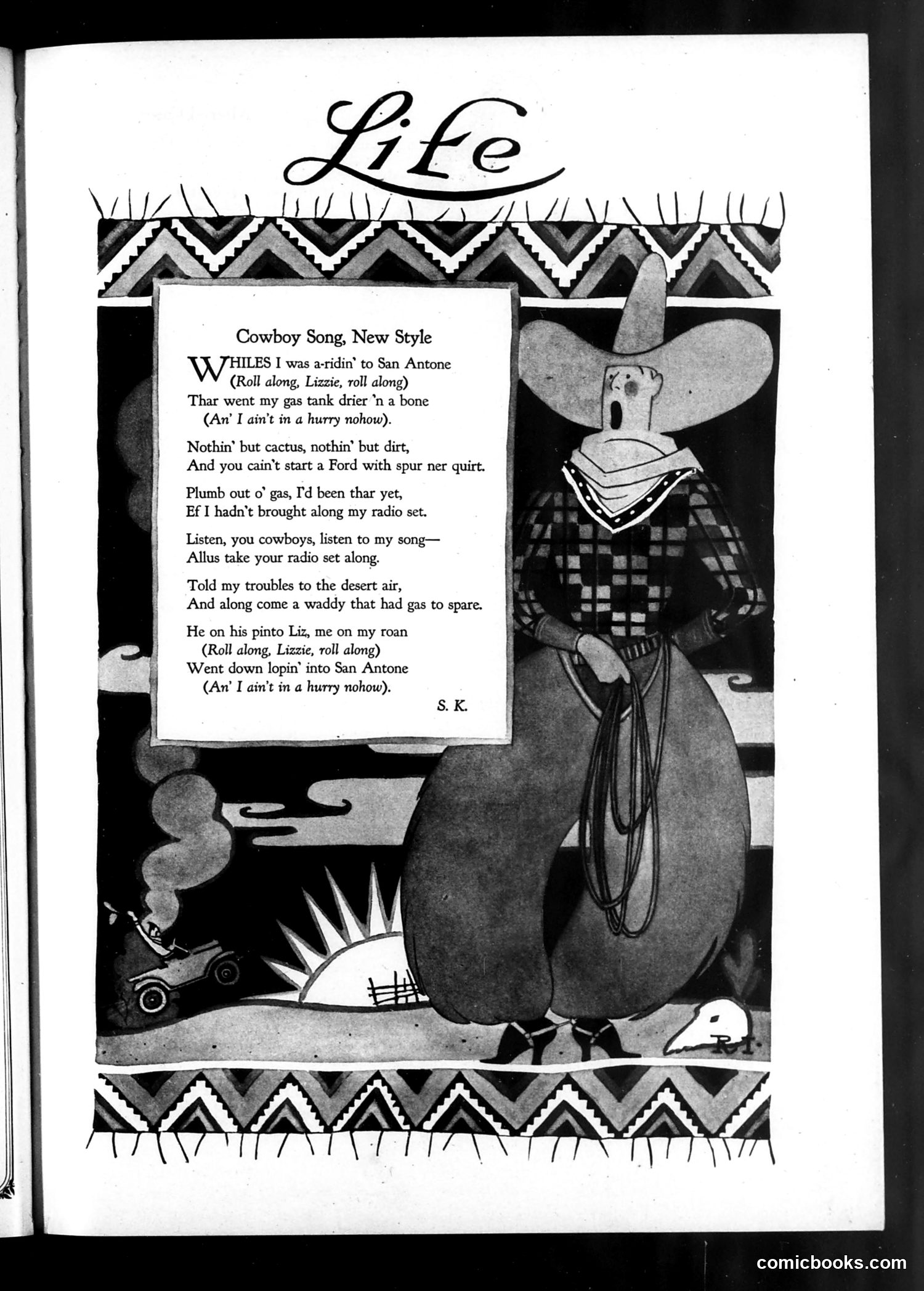
This is a humorous poem by S.K. that parodies traditional cowboy ballads by transplanting them into the modern era (the 1920s-30s, based on Life magazine's publication period). The central joke: instead of classic Western hardships, the narrator complains about mundane modern problems—a broken gas tank, inability to start a Ford automobile, and lack of a radio. References to "San Antone" and traditional cowboy language ("a-ridin'," "pinto Liz," "roan") contrast absurdly with mechanical complaints. The cartoon illustration shows an exaggerated cowboy figure with a coiled rope, emphasizing the anachronism. The satire gently mocks how modern conveniences (cars, radios) have invaded and altered even romanticized frontier mythology, making "cowboys" face contemporary frustrations rather than authentic Western challenges.
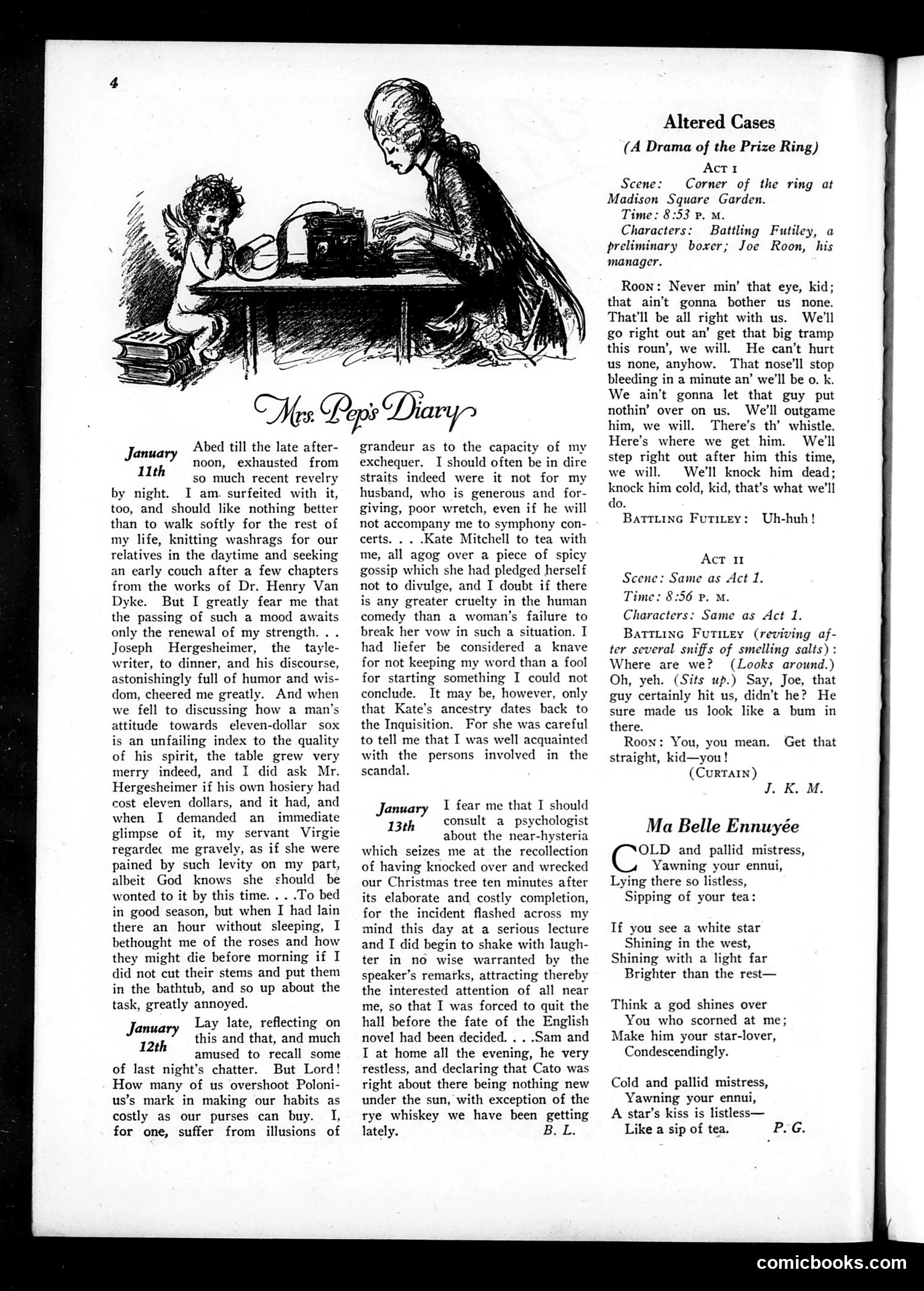
This page contains **three distinct literary/theatrical pieces**, not political cartoons: 1. **"Mrs. Pep's Diary"** (left): A satirical diary entry from January 12th mocking upper-class social pretensions. The author complains about trivial domestic matters (knocked-over Christmas trees, gossip) while affecting high cultural concern, satirizing the vapid concerns of wealthy society women. 2. **"Altered Cases (A Drama of the Prize Ring)"** (right): A theatrical sketch set at Madison Square Garden featuring boxing characters "Battling Futley" and "Joe Roon," apparently satirizing prize-fighting culture and its associated scandals or disputes. 3. **"Ma Belle Ennuyée"** (bottom right): A brief poem mocking aristocratic ennui and affected world-weariness. The page is **literature/satire-focused**, not political commentary.
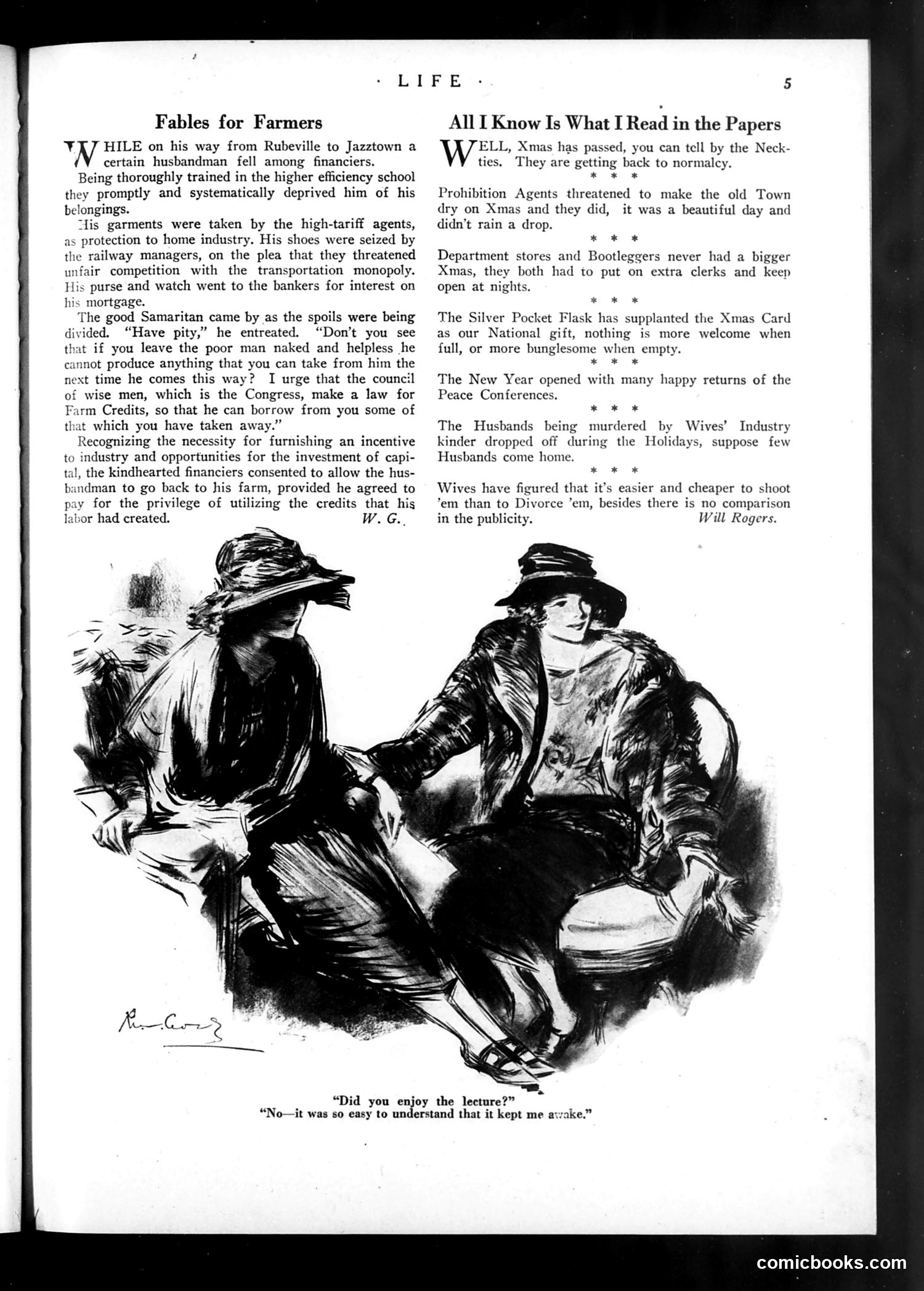
This page contains two distinct sections: **Left: "Fables for Farmers"** — A satirical story about a husbandman exploited by high-tariff agents, railway managers, and bankers who strip him of his garments and possessions. A "good Samaritan" (likely representing sympathetic politicians) argues for reform, proposing farm credit legislation. The moral critiques exploitative financial practices targeting agricultural workers. **Right: "All I Know Is What I Read in the Papers"** — Brief social commentary items about post-Christmas normalcy, Prohibition enforcement, gift-giving trends, and marriage dynamics, including a dark joke about wives preferring shooting husbands to divorce. **Illustration:** Two women in conversation—one asking if the other enjoyed lectures; the response being they were too difficult to understand. This appears to be a separate joke about intellectual accessibility rather than connected to the main content.
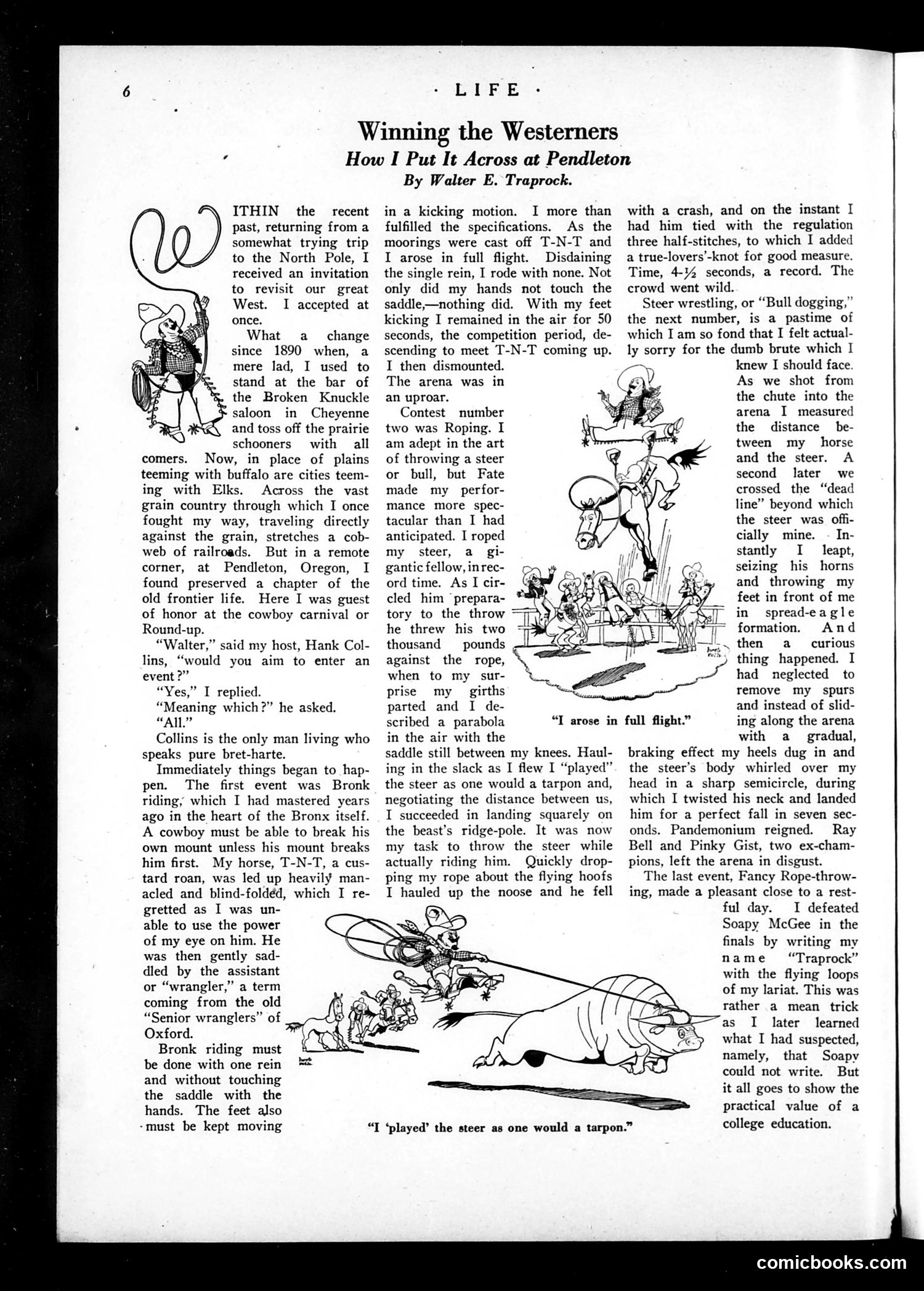
This page from *Life* magazine features "Winning the Westerners: How I Put It Across at Pendleton" by Walter E. Traprock, a humorous first-person account of entering a rodeo competition. The article describes Traprock's attempt at bronc riding and steer wrestling at Pendleton, Oregon's famous rodeo. The cartoons illustrate his mishaps: one shows him being thrown dramatically skyward while riding a bucking steer, another depicts him wrestling with the animal. The humor derives from an Eastern urbanite's incompetence at Western ranch skills. References to "Soapy McGee" and defeating a competitor through trickery suggest Traprock employed cunning rather than legitimate cowboy ability. The article satirizes both Eastern pretension and Western rodeo culture, with illustrations emphasizing the absurdity of city folk attempting brutal frontier activities.
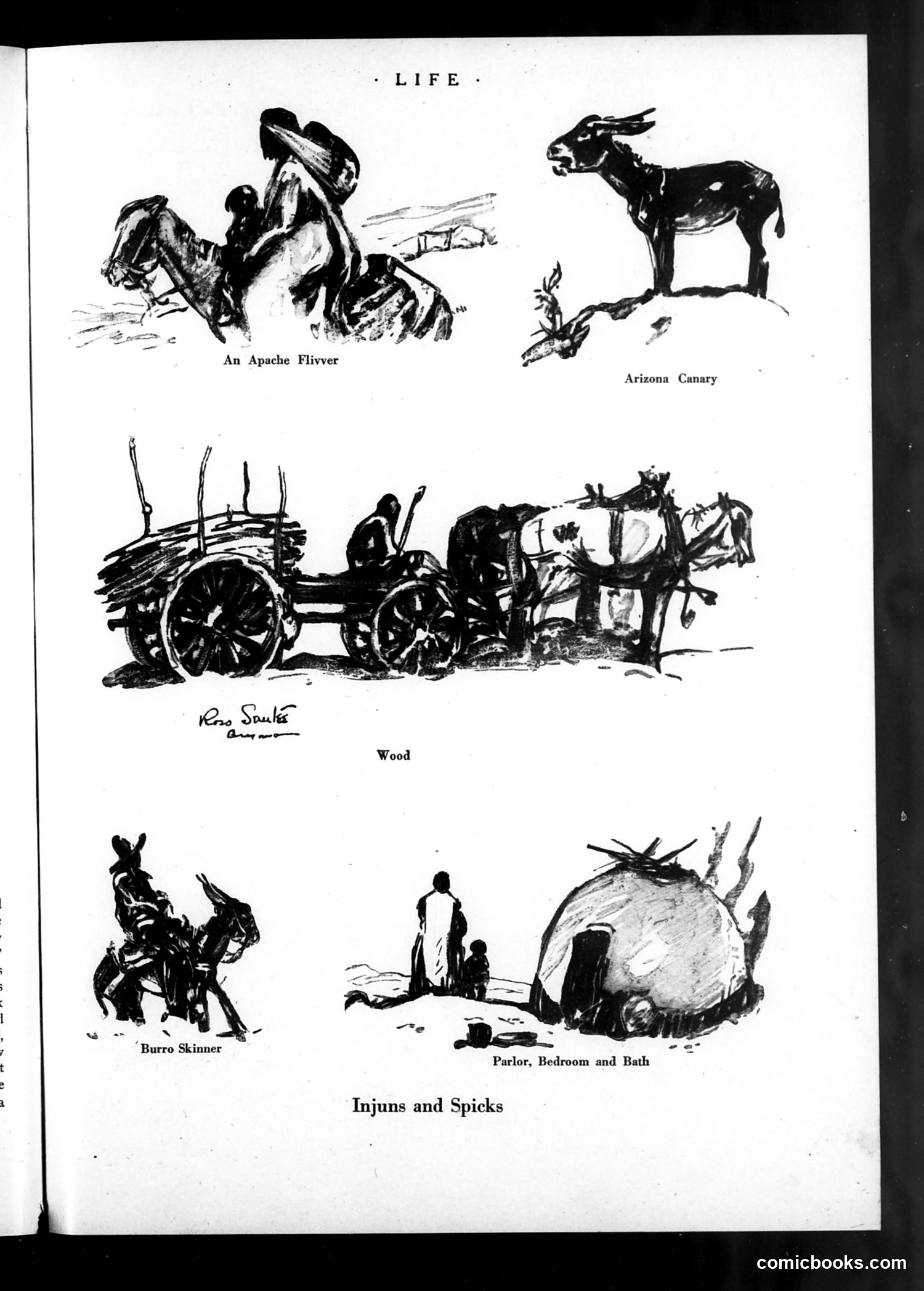
This page from *Life* magazine presents six illustrations labeled "Injuns and Spicks," depicting what appear to be ethnic stereotypes of Native Americans and Hispanic peoples in the American Southwest. The sketches show: an "Apache Flyver" (playing on "Flivver," a Model T Ford reference), an "Arizona Canary" (a burro), a wood-hauling scene, a "Burro Skinner" (burro driver), and a dwelling labeled "Parlor, Bedroom and Bath." The humor relies on crude stereotyping—contrasting primitive living conditions and modes of transportation with upper-class American terminology ("Parlor, Bedroom and Bath"). The title itself uses period slurs. This reflects early 20th-century satirical conventions that mocked marginalized groups through caricature and contrast between their circumstances and white middle-class standards. It's representative of deeply offensive racial humor considered acceptable in that era's mainstream publications.
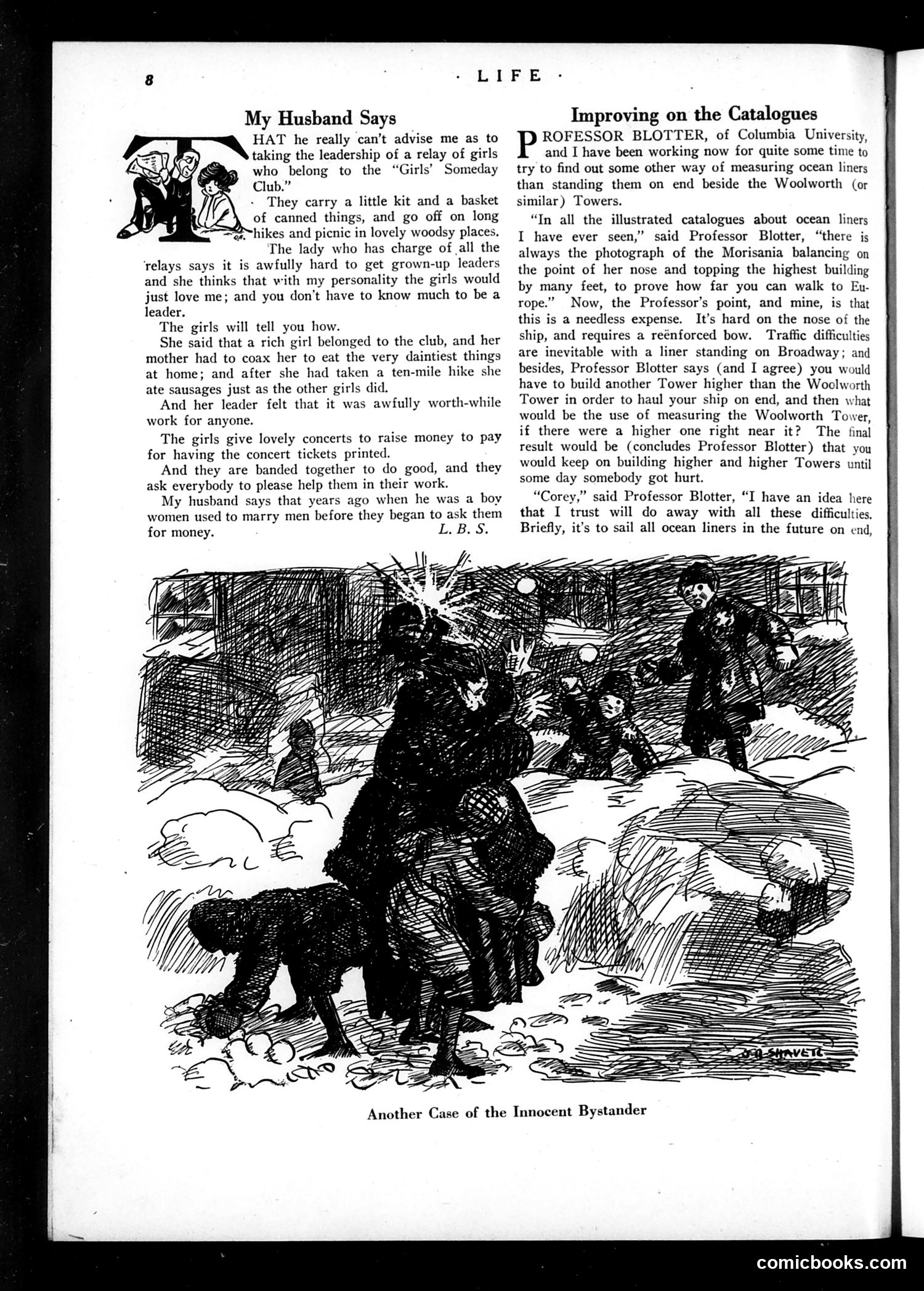
This page contains two separate pieces: **"My Husband Says"** (left): A domestic advice column where a woman describes her husband's skepticism about her leading a "Girls' Someday Club"—an organization that takes young girls on hikes and outings. His concern: she lacks experience and the girls need proper leadership. The satire mocks traditional gender attitudes about women's competence in leadership roles, suggesting husbands doubted wives' abilities to organize or lead activities, even recreational ones. **"Improving on the Catalogues"** (right): A technical discussion with Professor Blotter about measuring ocean liners using the Morisania building as reference. The satire pokes fun at impractical scientific methods and urban measurement schemes. **"Another Case of the Innocent Bystander"** (bottom cartoon): A sketch showing an adult and children in winter, apparently depicting an innocent person caught in some awkward situation—the specific scenario remains unclear from context.
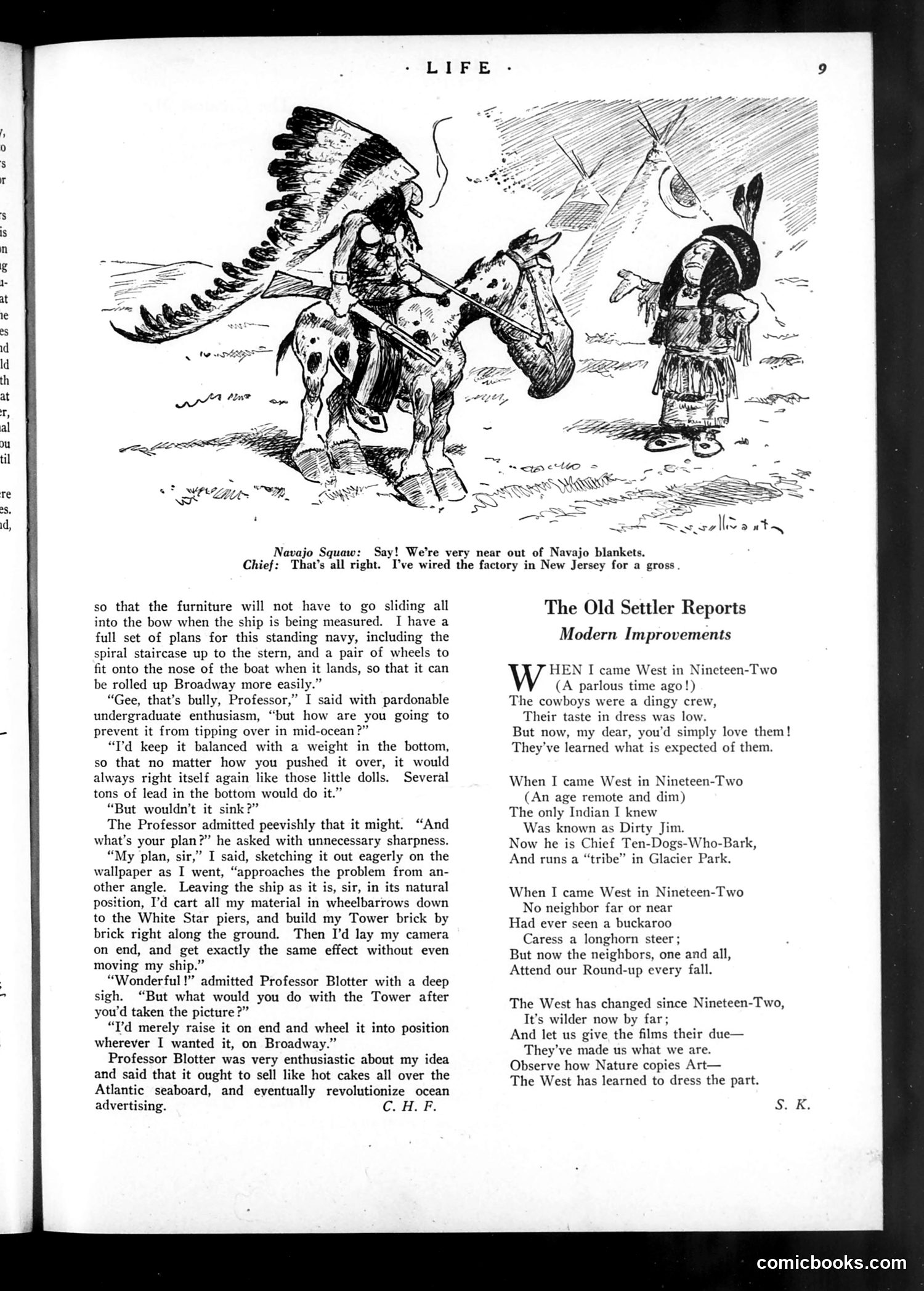
**The Cartoon:** The illustration depicts a Native American chief on horseback with an elaborate feathered headdress, speaking to a Native American woman standing beside him. The caption reads: "Navajo Square: Say! We're very near out of Navajo blankets. Chief: That's all right. I've wired the factory in New Jersey for a gross." **The Satire:** This cartoon mocks the commercialization and inauthenticity of Native American crafts. The joke's premise is absurd: a supposedly traditional chief ordering mass-produced "Navajo" blankets from a New Jersey factory rather than having them handmade. This satirizes both the appropriation of Native American cultural products and the irony of "authentic" indigenous goods actually being factory-manufactured imitations sold to tourists—a common early-20th-century practice.
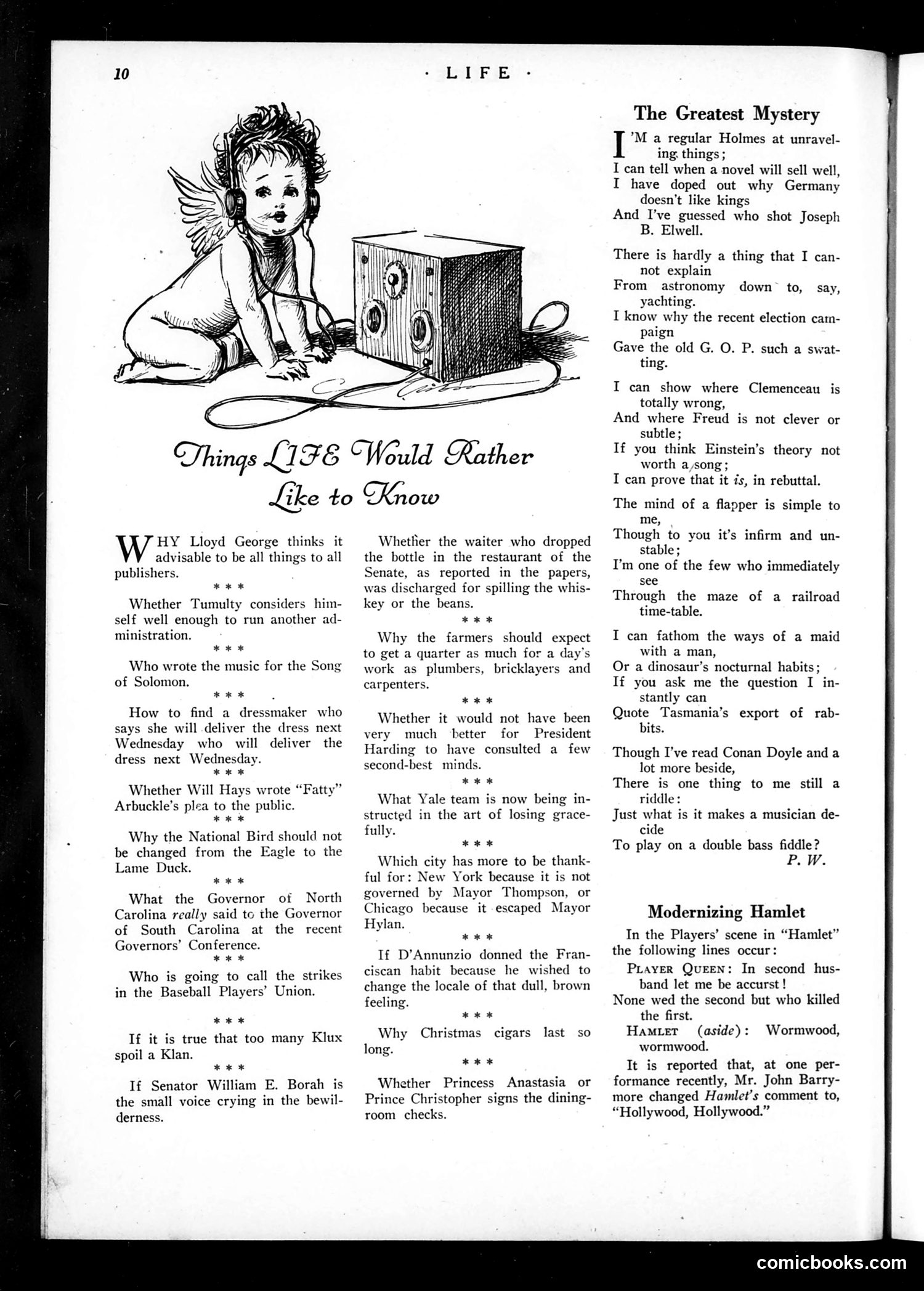
The main illustration shows a cherub/cupid figure playing with a radio receiver, captioned "Things LIFE Would Rather Like to Know." This introduces a humorous list of contemporary mysteries and social commentary. The text references several 1920s-30s figures and topics: Lloyd George (British PM), Tammany Hall (NYC political machine), President Harding, Einstein's theory, Clemenceau, and Freud. The list satirizes current events—election campaigns, labor disputes (plumbers/carpenters earning disputes), and cultural phenomena like Christmas cigars and the Yale debate team. "Modernizing Hamlet" section jokes about a recent theatrical production where actor John Barrymore apparently altered the famous line to "Hollywood, Hollywood"—mocking Hollywood's growing cultural influence over classic literature. The overall tone is sophisticated, topical satire targeting educated readers familiar with contemporary politics and culture.
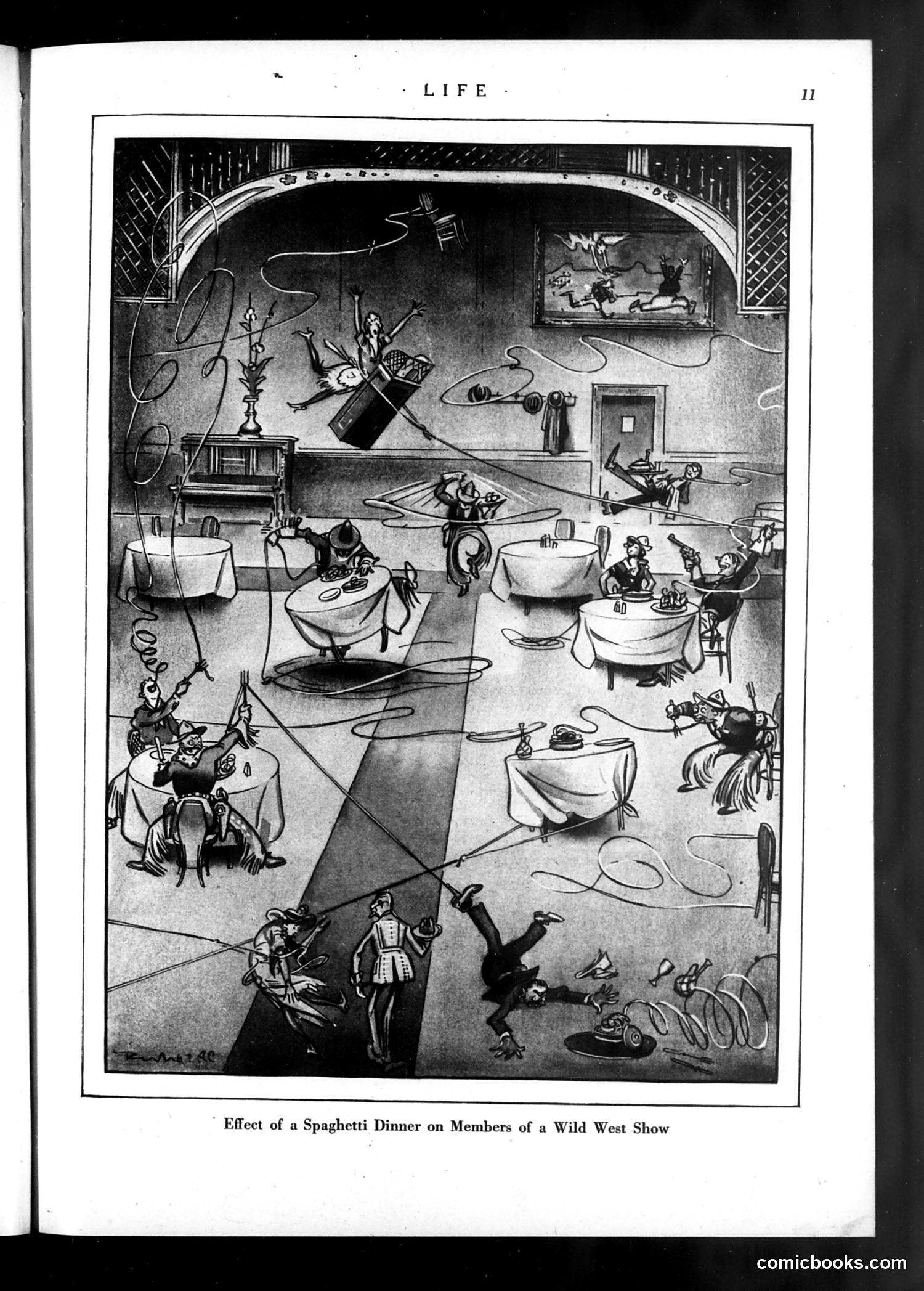
This humorous illustration satirizes the chaos that ensues when performers from a traveling Wild West show consume spaghetti—a Italian pasta dish that would have been exotic and unfamiliar to most Americans in the early 20th century. The cartoon depicts acrobats, performers, and show members in various states of comedic mayhem throughout an indoor venue. The joke plays on two things: the supposed incompatibility between rough-and-tumble Western performers and refined Italian cuisine, and the slapstick humor of spaghetti's inherent messiness—the long noodles create tangled, chaotic situations. This reflects period attitudes that treated non-American cuisines as curious novelties capable of causing amusing disorder.
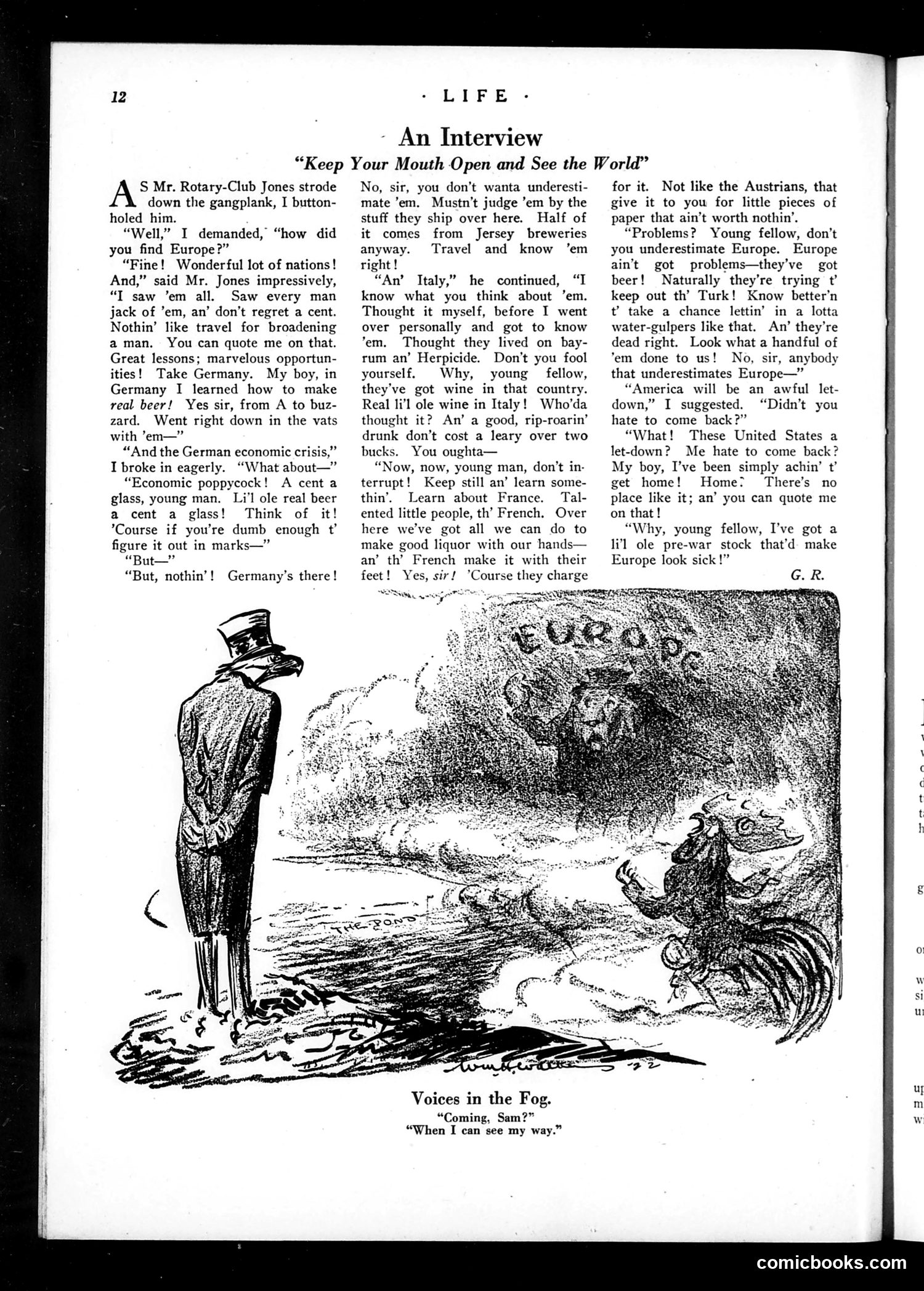
This page presents an interview between a Rotary Club member (Mr. Jones) and an unnamed traveler about European observations. The traveler describes economic hardship across Europe—German breweries, Italian wine production, and French liquor manufacturing—humorously suggesting these industries demonstrate each nation's struggles. The cartoon below, titled "Voices in the Fog," depicts a figure in top hat standing alone while voices call from the fog. The dialogue "Coming, Sam?" and "When I can see my way" suggests uncertainty or hesitation about direction—likely political allegory about American foreign policy or isolationism regarding European affairs. The satire critiques both European economic conditions and American reluctance to engage with European problems during the interwar period.
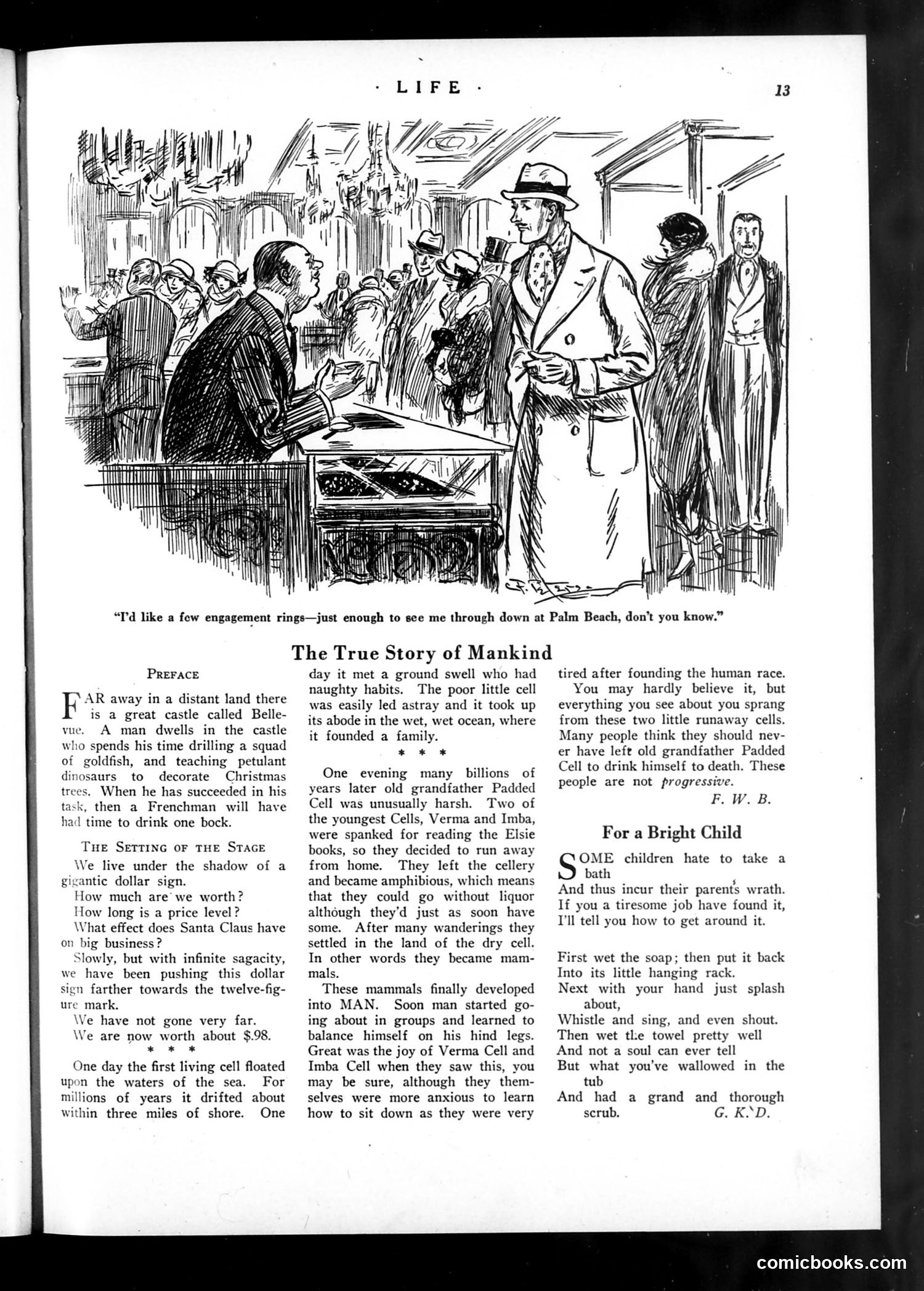
**The Cartoon:** The top illustration shows a man in a fedora and overcoat at what appears to be a pawn shop or jewelry counter, speaking to a clerk. The caption reads: "I'd like a few engagement rings—just enough to see me through down at Palm Beach, don't you know." **The Satire:** This jokes about wealthy men frequenting Palm Beach (a luxury resort destination) who serially pawn engagement rings—presumably from broken engagements or affairs—to fund their leisure spending. The humor targets the casual infidelity and financial irresponsibility of privileged men, suggesting they view engagement rings as mere commodities to liquidate rather than serious commitments. It satirizes both upper-class excess and the disposable nature of relationships among the elite. **The Articles Below** appear unrelated, discussing evolutionary biology and children's bathing etiquette.
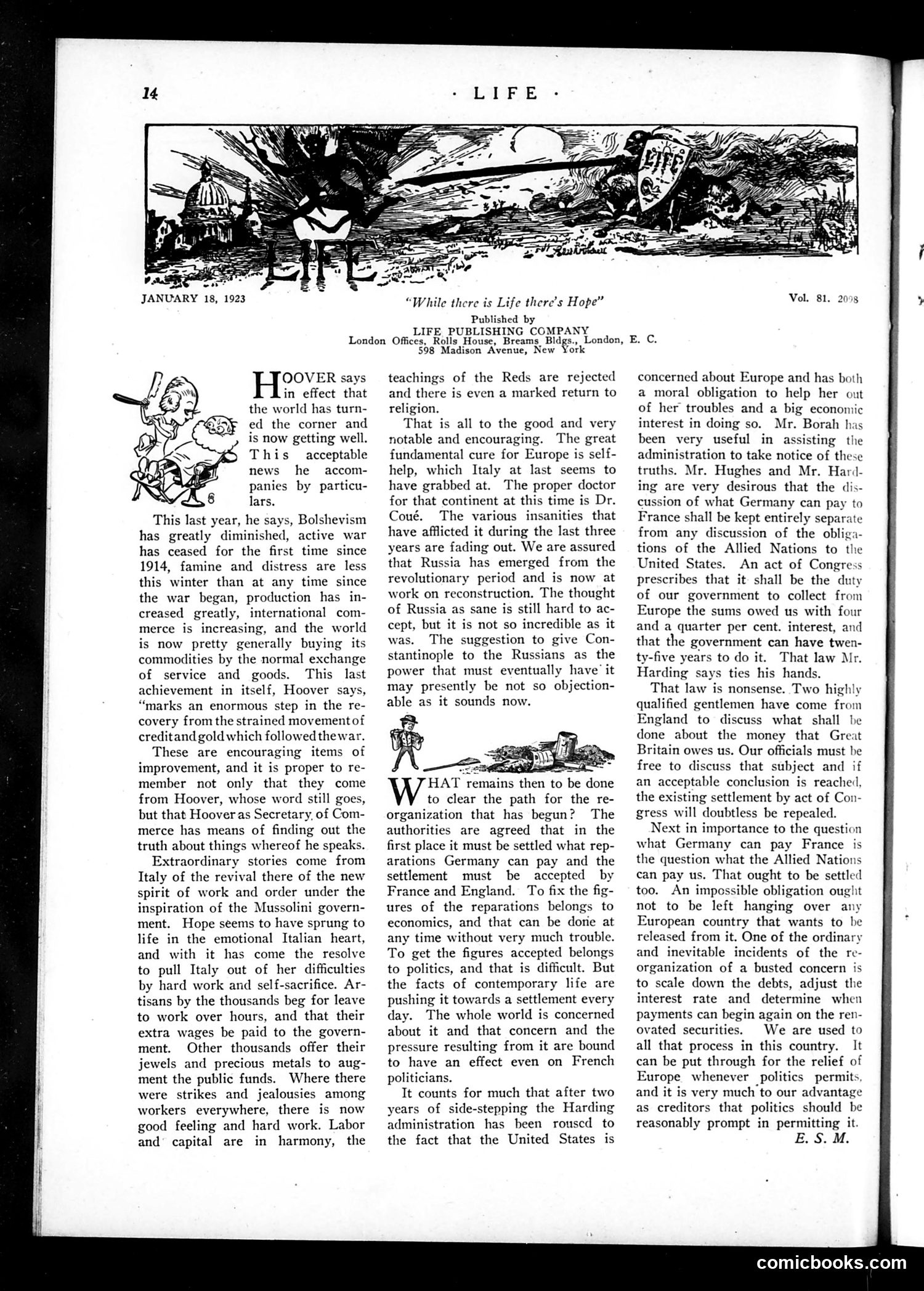
This January 18, 1923 *Life* page features political commentary on post-WWI Europe. The main illustration (upper left) appears to show a figure labeled "HOOVER" discussing economic recovery—likely Herbert Hoover, then Secretary of Commerce. The article praises recent improvements: Bolshevism has diminished, production increased, and international commerce is growing. The piece credits this to "hard work and self-sacrifice." The central cartoon depicts figures discussing European reparations and debt settlements. The text emphasizes that Germany's payment capacity must be determined through economics, not politics, and that France and Britain must accept realistic figures. The author argues the U.S. should remain involved in resolving European financial chaos to benefit American creditors. The satire targets the messy politics surrounding post-war financial obligations among Allied nations.
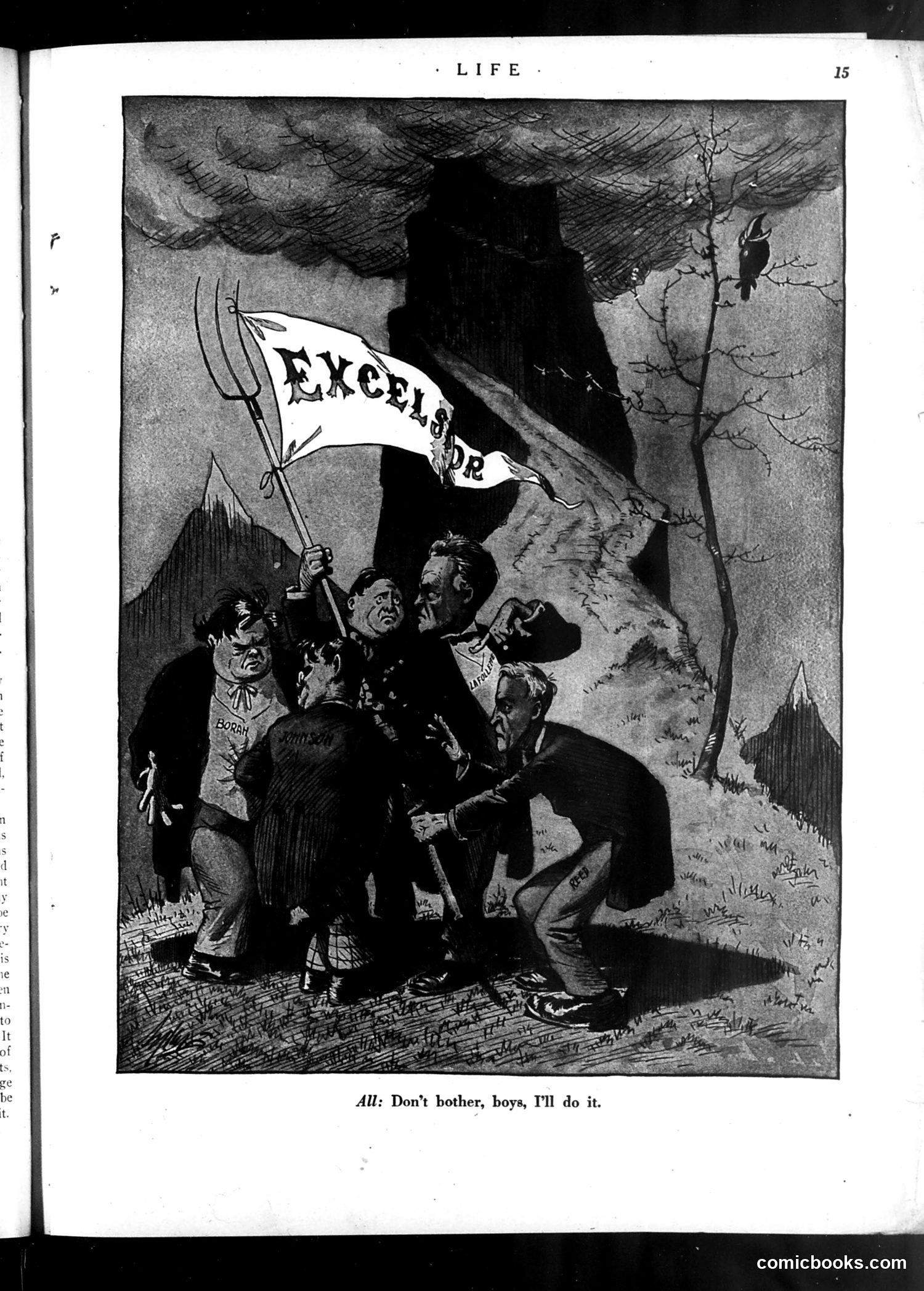
This is a satirical cartoon from *Life* magazine showing a group of men gathered around a banner reading "EXCELSIOR" (meaning "ever upward/excellence"). The figures appear to be political or business leaders of the era, depicted in caricatured form. One man holds a trident (a classical symbol of power), while the group stands before a dark, ominous tower or structure against a stormy sky. The caption reads: "All: Don't bother, boys, I'll do it." The cartoon satirizes ambitious or power-seeking figures who claim they alone can accomplish great things. The "Excelsior" banner and classical imagery mock grandiose aspirations, while the dark setting suggests danger or hubris. Without clearer identification of the specific figures or historical context provided, the precise political targets remain unclear, but the satire targets overconfident leadership or monopolistic ambition.
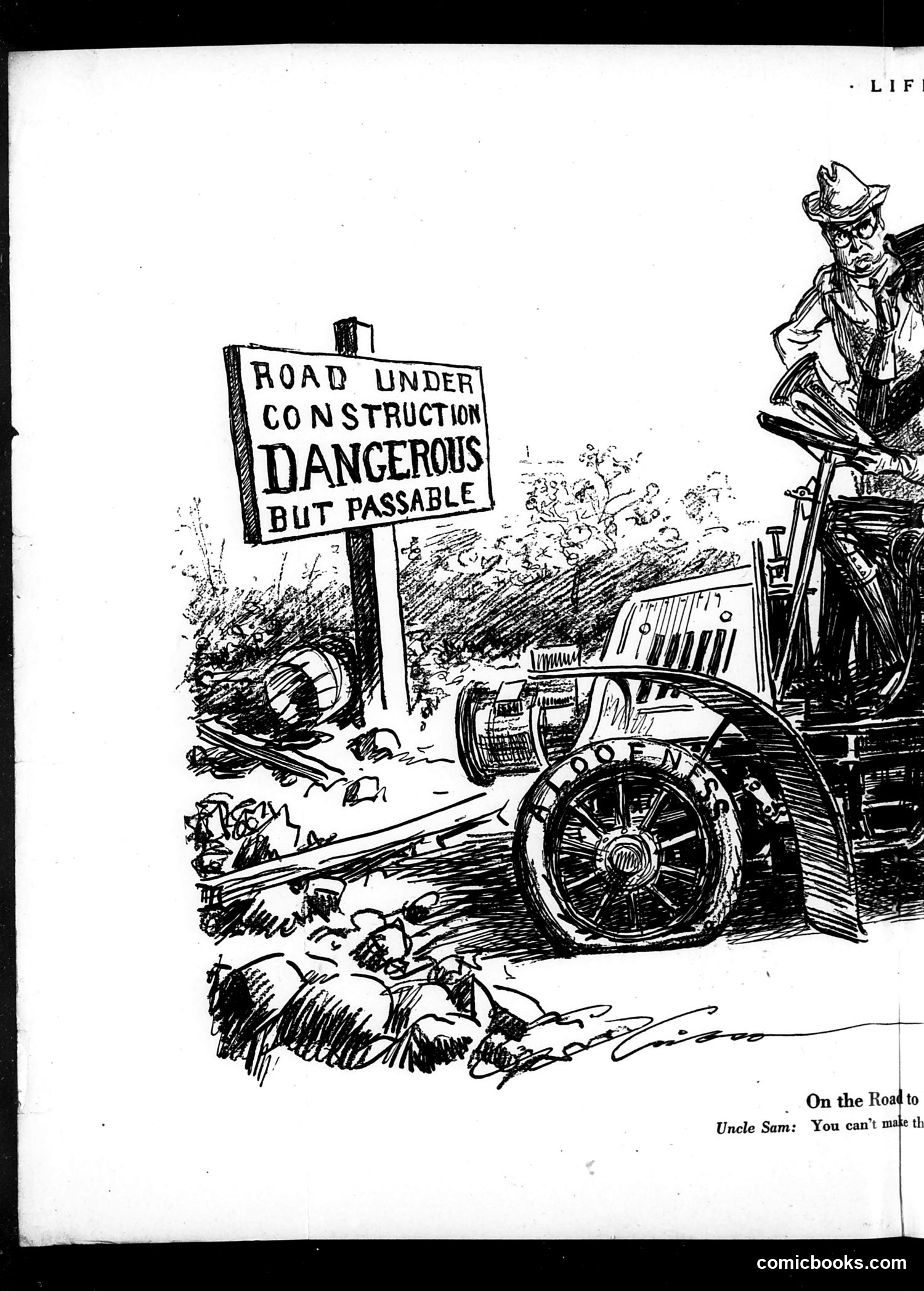
This cartoon depicts Uncle Sam (identifiable by his distinctive starred hat and goatee) encountering a road construction sign reading "ROAD UNDER CONSTRUCTION / DANGEROUS BUT PASSABLE." The sign appears to reference infrastructure challenges or bureaucratic obstacles facing America. The cartoon satirizes the condition of American roads—likely during the early-to-mid 20th century when road infrastructure was a significant public concern. The wrecked vehicles shown suggest the dangers posed by poorly maintained roads under construction. Uncle Sam's presence implies commentary on federal responsibility for maintaining infrastructure. The "dangerous but passable" sign captures the satirical point: Americans must navigate hazardous conditions despite government involvement, critiquing either inadequate infrastructure investment or mismanagement of public works projects. The incomplete OCR text prevents fuller interpretation of any accompanying commentary.
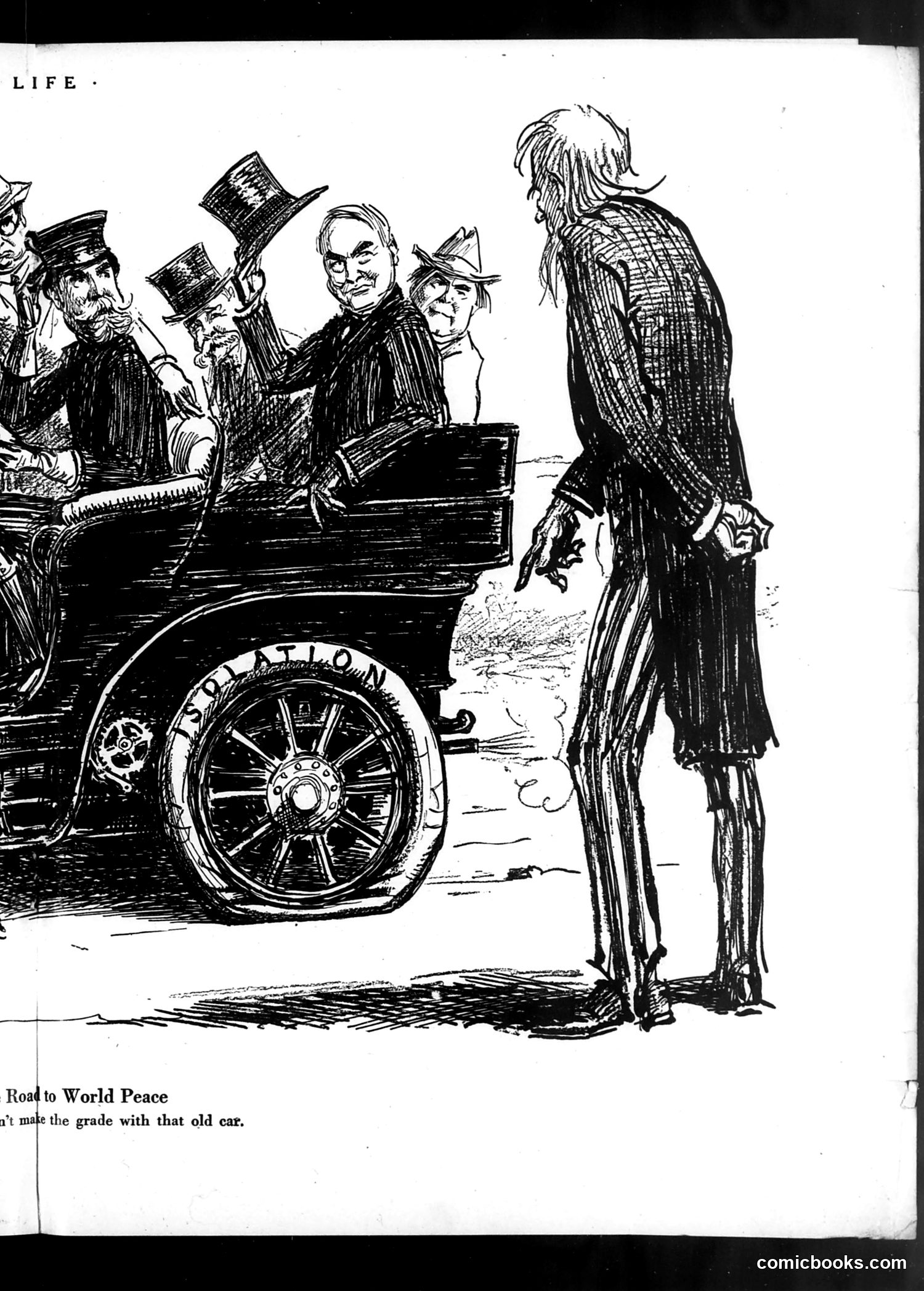
This political cartoon satirizes post-World War I peace efforts. A decrepit, overloaded automobile labeled "PEACE" struggles uphill, driven by figures in top hats who appear to be Allied leaders or diplomats. On the right stands a gaunt, skeletal figure—likely representing Death or War itself—observing their struggle. The joke is sardonic: the men trying to establish lasting peace are using an inadequate, broken-down vehicle. The caption's incomplete text ("won't make the grade with that old car") suggests their efforts will fail because they're relying on obsolete methods or worn-out diplomacy. The skeletal figure waiting suggests conflict will inevitably return. This reflects contemporary skepticism about whether post-WWI peace agreements could actually prevent future wars.
This page reviews two Broadway productions: Clemence Dane's "Will Shakespeare" and "Rose Briar." The main satire concerns "Will Shakespeare," which portrays the Bard as an ordinary, somewhat foolish man rather than a genius. The reviewer finds this oddly comforting—if Shakespeare could write "Hamlet" while being "just a plain, ordinary cuckoo," it reassures lesser mortals. The play's strength lies in its female cast (Winifred Lenihan, Katharine Cornell, Haidee Wright), without whom Shakespeare appears merely a bald man who "palled around" with Kit Marlowe. The second section mocks Booth Tarkington's lyric-writing in "Rose Briar," quoting awkward scansion ("Who gave you the rose in your coat-lapel?"). The reviewer sarcastically compares it unfavorably even to vaudeville performer Charlie Case's crude humor. Actress Billie Burke receives gentle ribbing for her affected performance style, compared to Eva Tanguay's theatrical mannerisms—a critique the reviewer notes ironically hasn't changed her in three years.
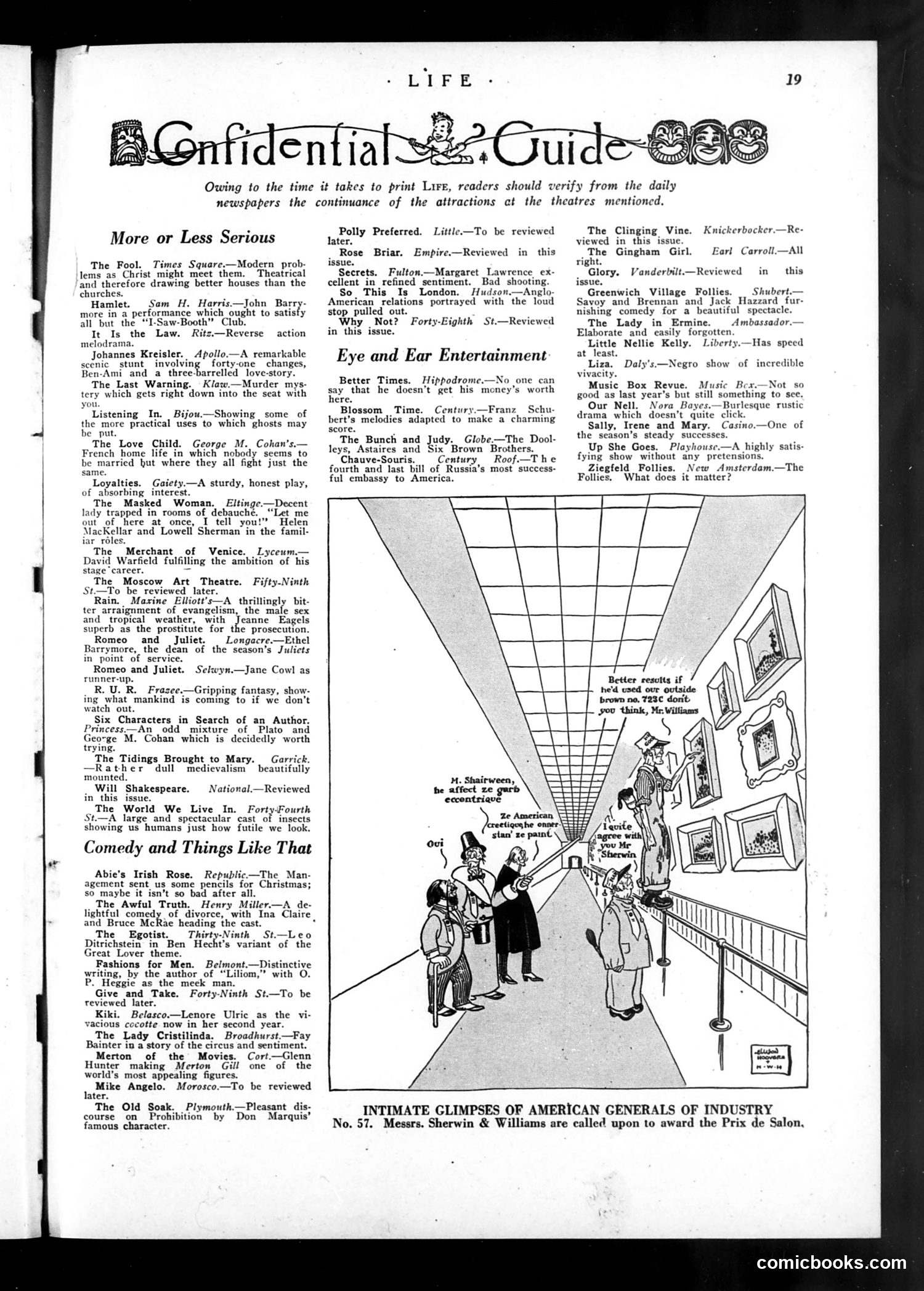
This page from Life magazine contains theater reviews and a satirical cartoon about American industry executives. **The Cartoon:** Titled "Intimate Glimpses of American Generals of Industry," it depicts Messrs. Sherwin & Williams (paint manufacturers) in an art gallery. The joke plays on "generals" — a pun conflating military rank with industrial leadership. The two businessmen stand before expensive paintings while speech bubbles mock their aesthetic appreciation, with one saying he'd prefer "better recitals if he'd come over outside between acts." The satire suggests wealthy industrialists lack genuine cultural refinement despite their ability to purchase art, a common Jazz Age critique of nouveau riche pretension and the gap between money and taste. **Context:** This reflects 1920s skepticism toward industrialists' social status and cultural authority.
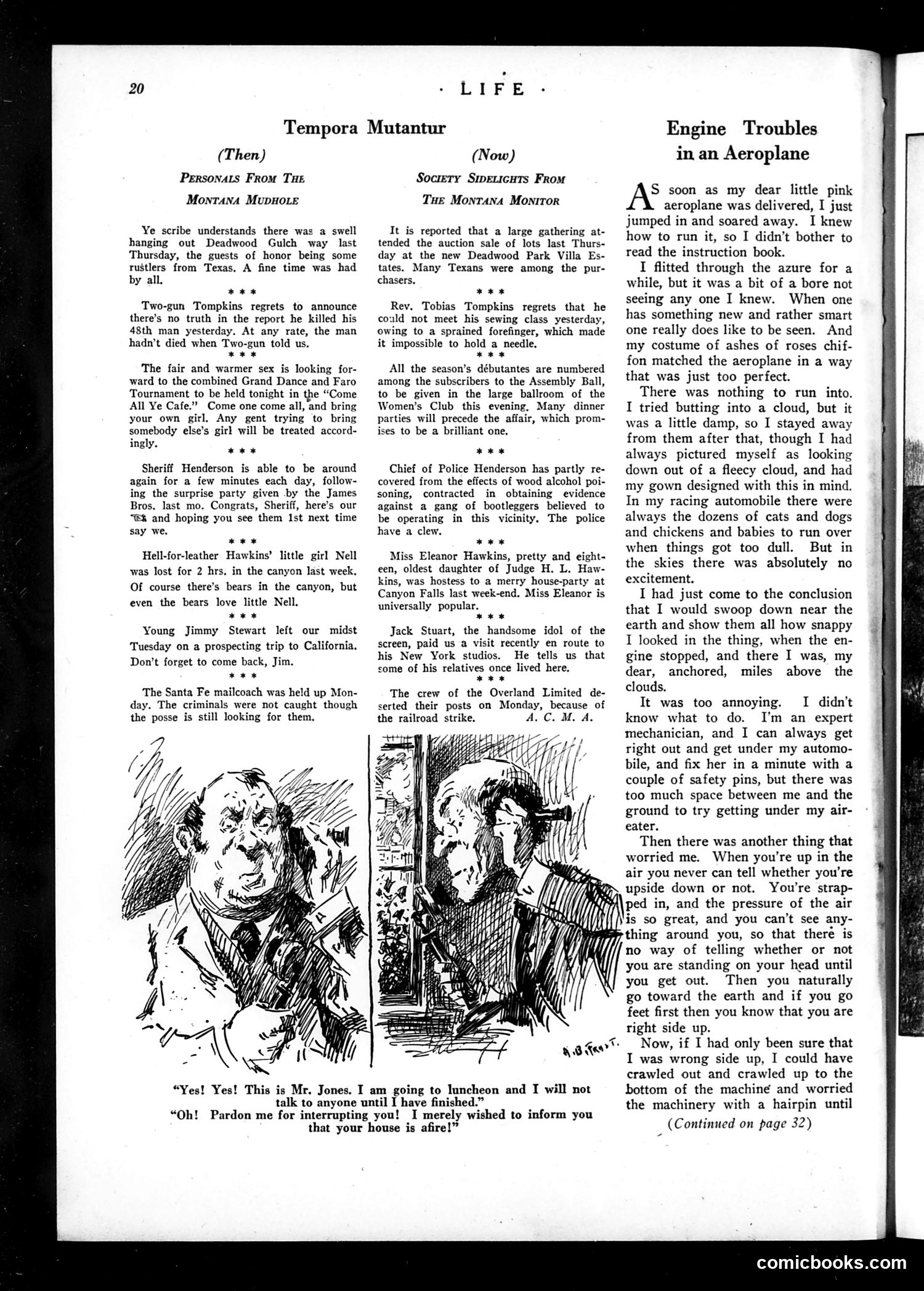
This page satirizes the transformation of the American West from its "wild" frontier past to modern civilization. The left column ("Then") presents exaggerated Old West stereotypes: outlaws, sheriffs recovering from gang violence, saloon dances, and frontier hardships. The right column ("Now") shows the same Montana town's refined present: real estate development, church sewing circles, debutante balls, and respectable society. The humor lies in the absurdist contrast—rough characters like "Two-gun Tompkins" become Reverend Tompkins hosting sewing classes; the sheriff's violent past becomes evidence-gathering against Prohibition bootleggers. A cartoon below depicts two figures in heated conversation, illustrating social pretension. The accompanying story "Engine Troubles in an Aeroplane" mocks a frivolous woman pilot more concerned with her fashionable outfit than actually learning to operate her aircraft—satirizing both new technology adoption and women's perceived superficiality. The satire suggests modernization hasn't brought wisdom, just different forms of human folly.
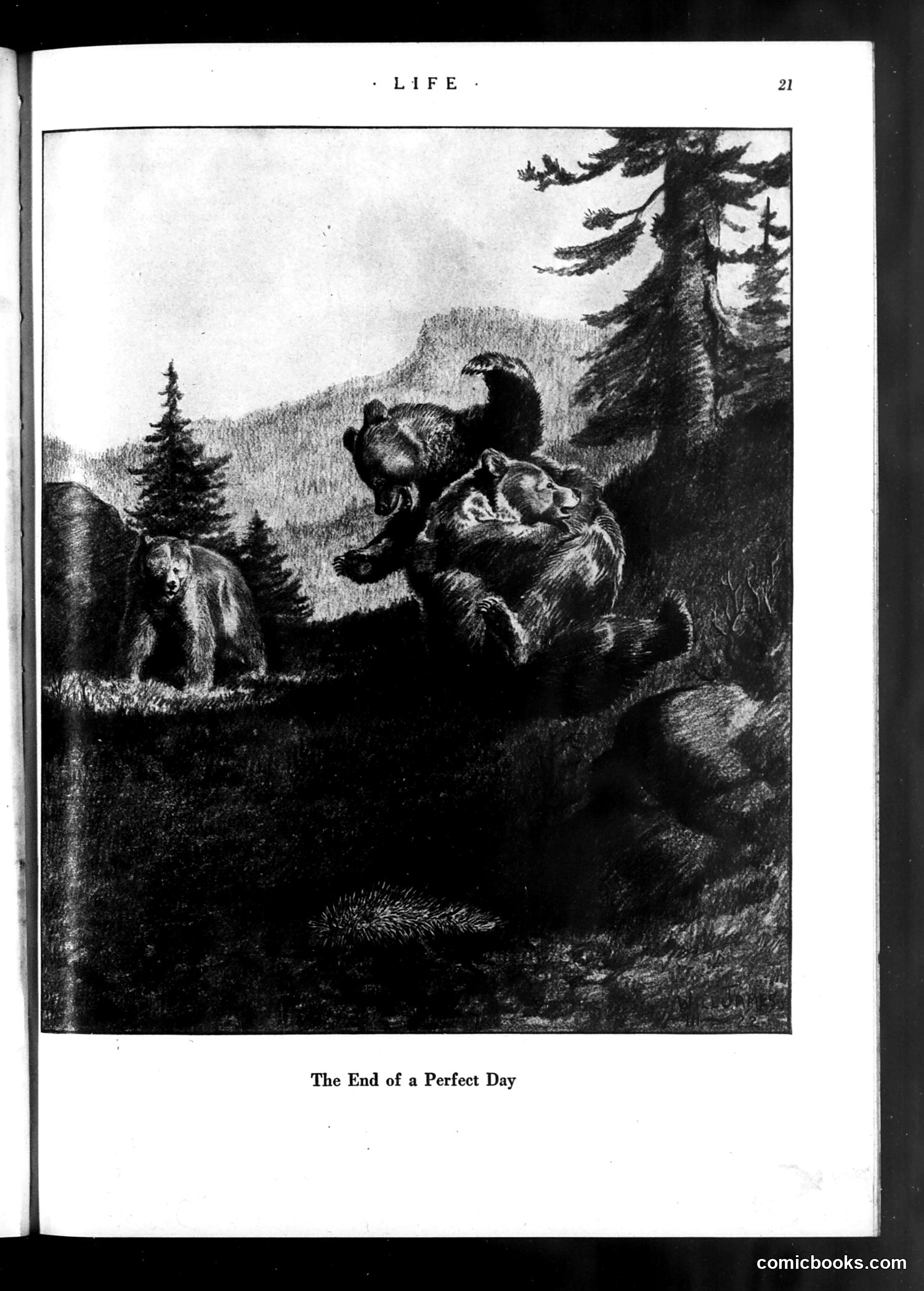
This illustration depicts bears in a forested mountain setting, with one bear appearing to hold or examine something (possibly food or prey) while others are nearby. The caption "The End of a Perfect Day" suggests irony or dark humor about the bears' contentment. Without additional context from the magazine, the exact satirical target is unclear. However, this could represent: - A commentary on wildlife/nature (perhaps poaching or hunting practices) - Social satire using bears as anthropomorphic stand-ins for human behavior - Commentary on contentment derived from questionable activities The dramatic chiaroscuro style and composition emphasize the scene's significance, but the specific political or social reference remains unclear without knowing Life magazine's publication date and contemporary events.
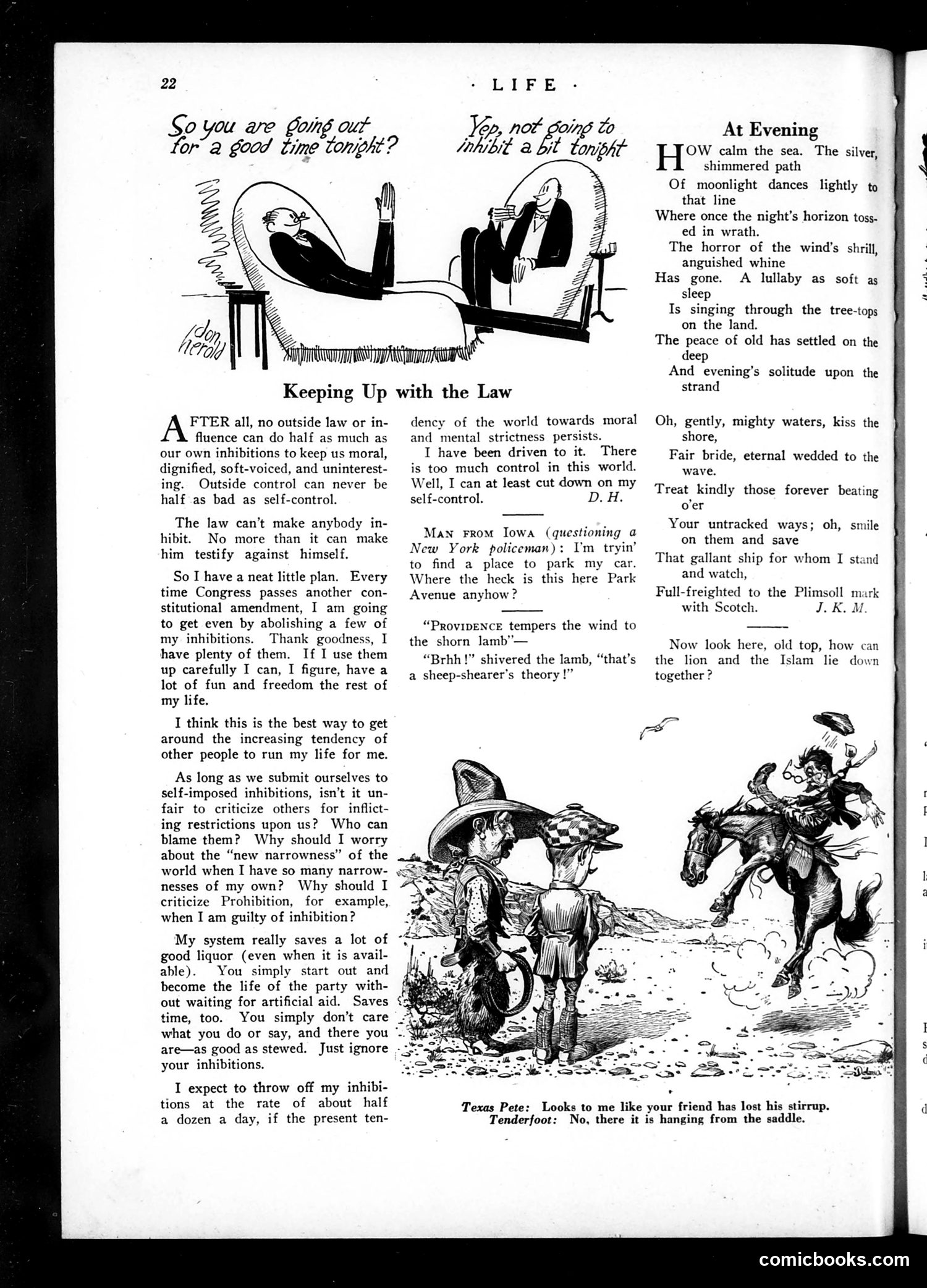
This page contains social satire about **Prohibition and personal freedom**. The main article "Keeping Up with the Law" mocks the era's increasing government regulation—particularly Prohibition (the constitutional amendment banning alcohol, 1920-1933). The author sarcastically proposes that since Congress restricts behavior through amendments, he'll "abolish" his own personal inhibitions in retaliation, suggesting he'll behave recklessly and drink excessively. The accompanying cartoons offer lighter humor: one depicts a Midwesterner asking a New York cop where to park on Park Avenue (playing on regional stereotypes); another shows sheep-shearing philosophy; the bottom Western scene involves characters discussing a lost stirrup. The page reflects **1920s-1930s tension** between government control and individual liberty, with the author sarcastically inverting moral arguments—suggesting self-imposed restraint makes external regulation hypocritical. This captures contemporary resistance to Prohibition among educated, urban readers.
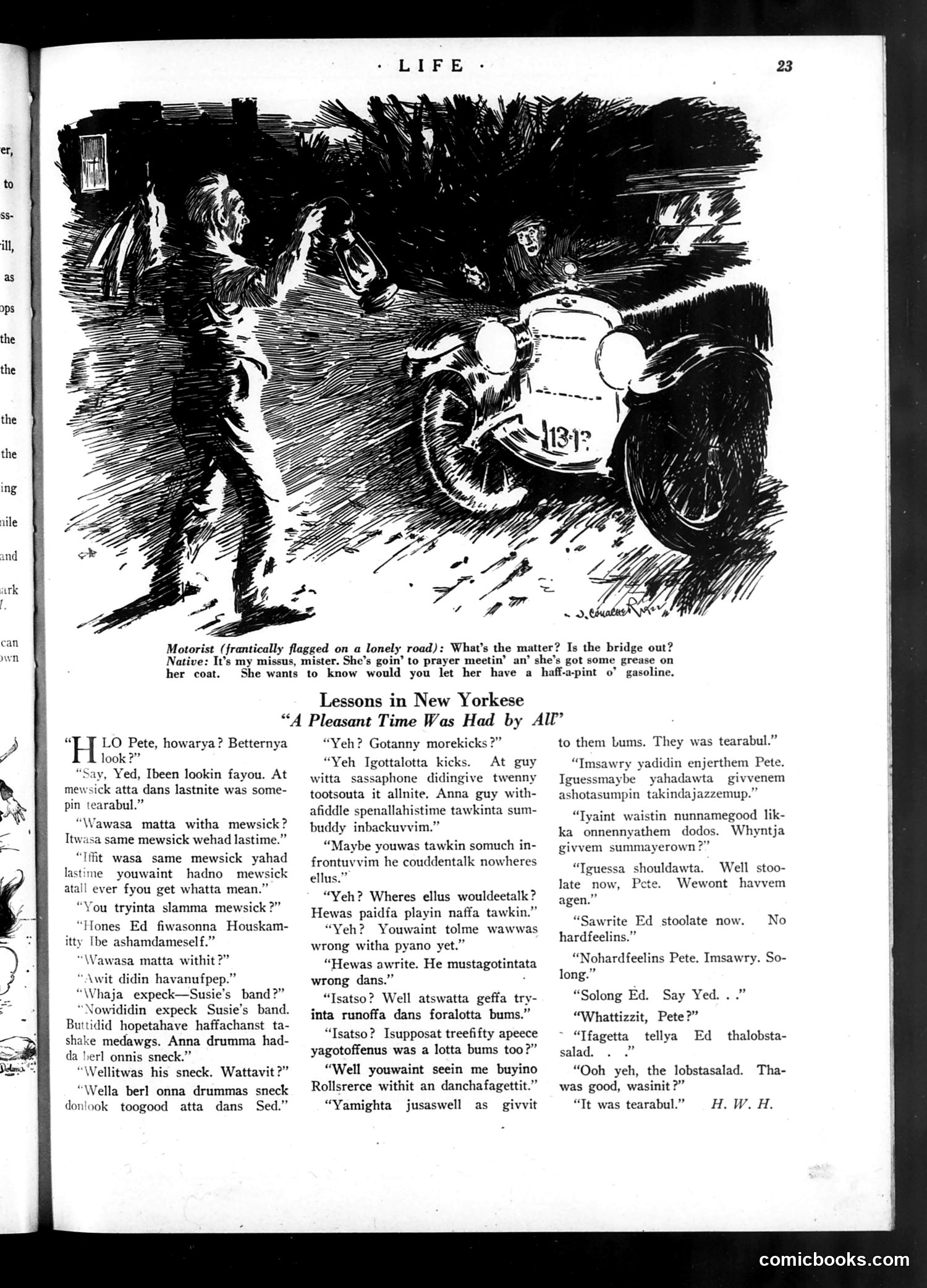
**The Cartoon:** The top illustration depicts a motorist stopped by a rural man on a lonely road. The "native" explains his wife needs gasoline—specifically "a haff-a-pint"—to clean grease off her coat before attending prayer meeting. The humor relies on the contrast between the urgent, frantic tone of the motorist's questions ("Is the bridge out?") and the mundane, domestic reason for the roadside flag-down. **"Lessons in New Yorkese":** The text below is a comedic dialogue between two men ("Pete" and "Ed") discussing a disappointing musical performance they attended. It satirizes New York working-class speech patterns of the era—heavy use of dropped g's, slurred words, and fractured grammar ("mewsick," "tawkin," "dods," "tearabul"). The joke is twofold: it mocks both the casual brutality of their critique (complaining about musicians' performance) and their malapropism-laden dialect itself. The piece ends with Pete forgetting to mention he hated the lobster salad too—a final joke about their general dissatisfaction despite attending what was supposed to be "A Pleasant Time."
This Life magazine page reviews three silent films, comparing their entertainment value to technical accuracy. **"Dr. Jack"** stars Harold Lloyd, whom the critic ranks above Charlie Chaplin for consistency, though Chaplin achieved greater artistic heights. Lloyd's "horn-rimmed spectacles" persona and reliable output make him the commanding figure in comedy films. **"The Headless Horseman"** adapts Washington Irving's classic tale with Will Rogers, photographed beautifully but failing dramatically—the critic suggests literary works don't necessarily translate to screen, discouraging originality in filmmaking. **"Wild Horses"** section critiques films depicting wealthy "society" subjects. The critic notes producers struggle authentically portraying Fifth Avenue drawing rooms or Long Island high society, despite attempts. "High Speed Lee," photographed on location with actual Social Register extras, achieves perfect atmosphere but fails in plot and entertainment. The reverse problem occurs elsewhere—inaccurate but entertaining films prove superior. The critic laments this tension between realism and engagement.
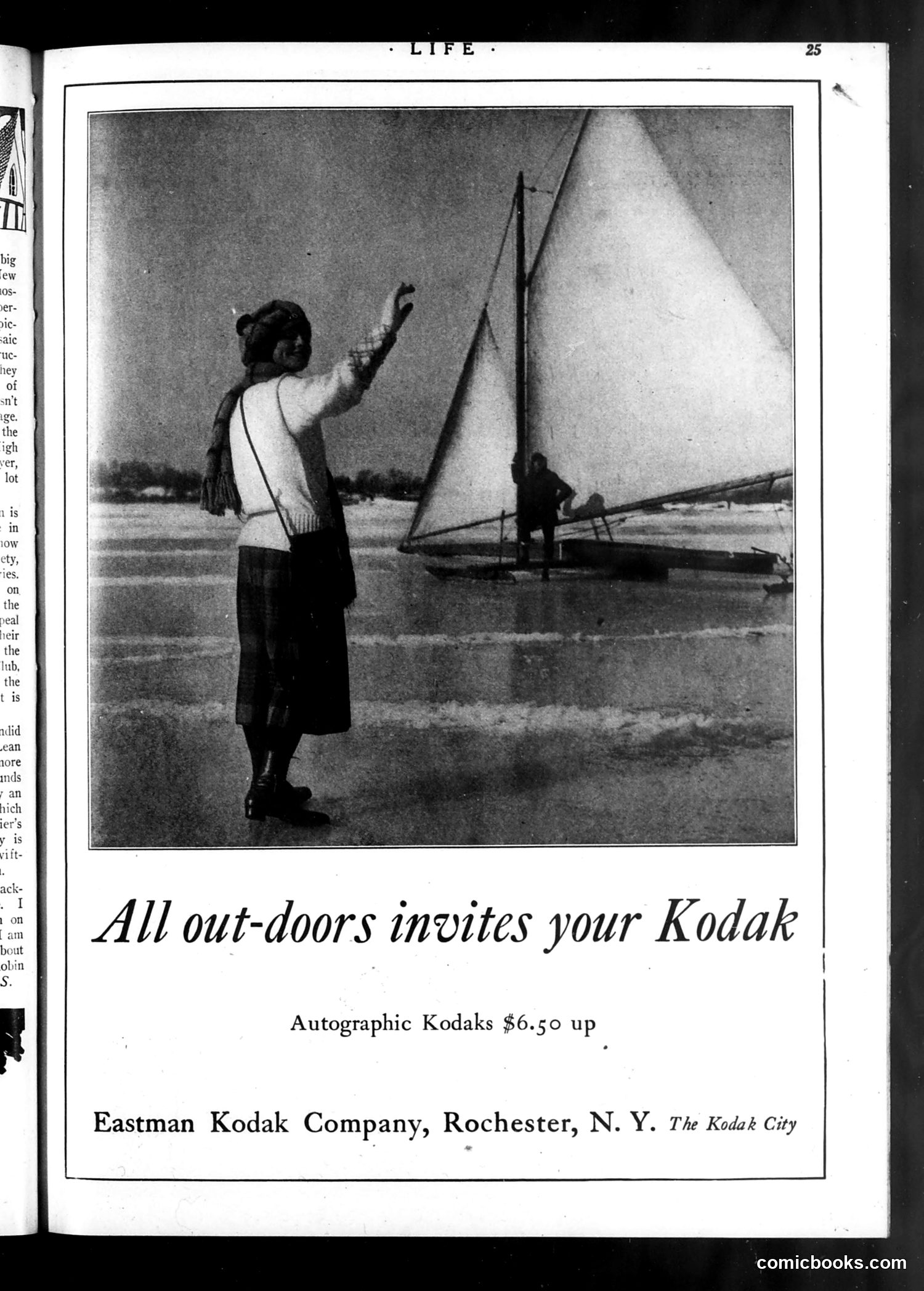
This is an advertisement rather than satire or political commentary. It promotes Eastman Kodak's "Autographic Kodaks" cameras, priced from $6.50 upward. The image shows a woman in 1920s attire standing on a beach, gesturing toward a sailboat in the water. A man can be seen near the boat. The ad's message—"All out-doors invites your Kodak"—encourages recreational photography as part of outdoor leisure activities. This reflects the era's marketing push to popularize personal camera ownership among middle-class consumers. The beach scene with sailing represents leisure and freedom, positioning photography as essential to capturing such experiences. The ad positions Kodak cameras as affordable, portable tools for documenting everyday moments, a relatively new concept at the time.
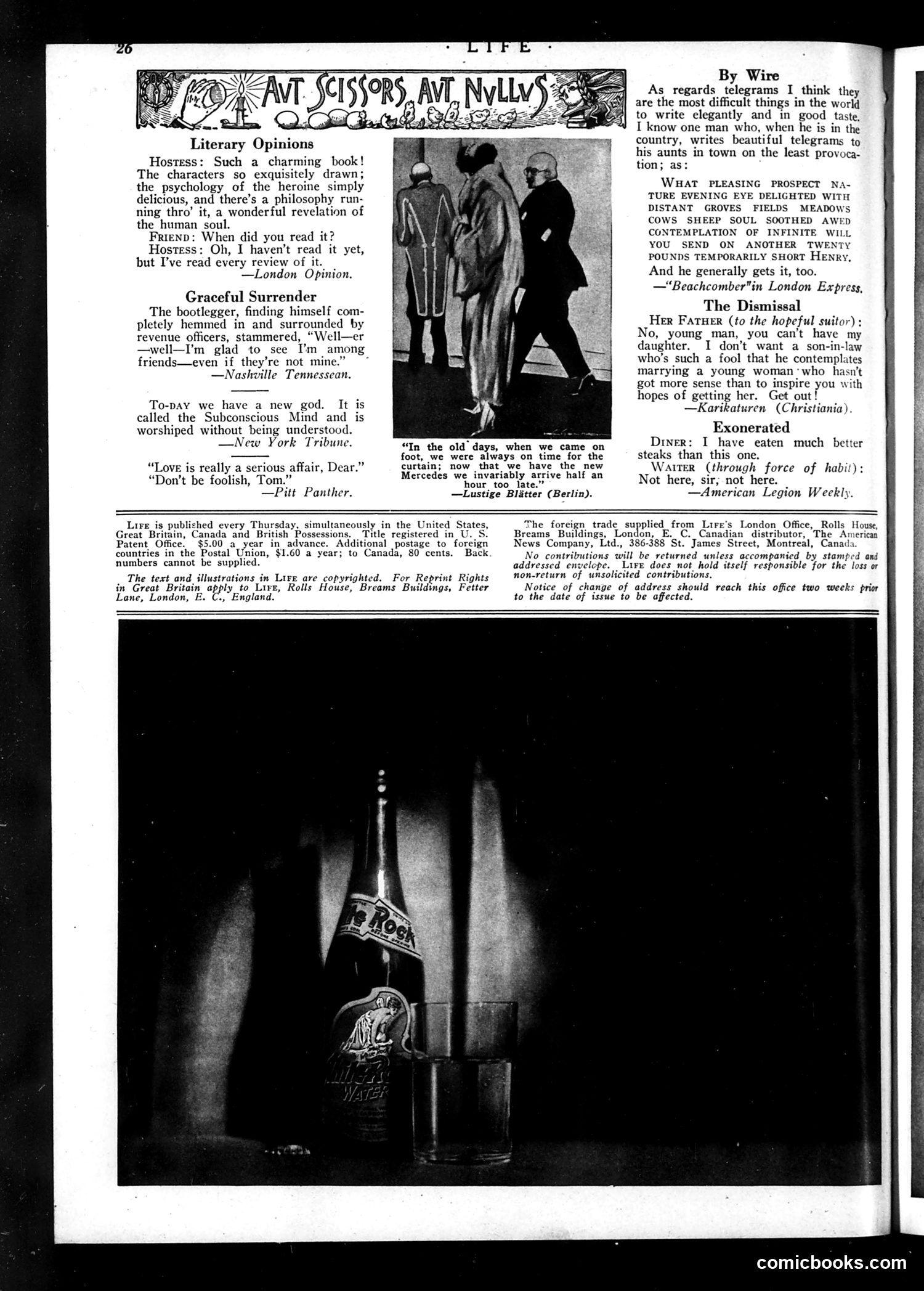
This page contains several satirical short pieces typical of early 20th-century humor magazines: **"Literary Opinions"** mocks pretentious book discussion—a hostess praises a novel she admits she hasn't read, only the reviews. The satire targets cultural posturing among the social elite. **"Graceful Surrender"** jokes about Prohibition enforcement: a bootlegger (illegal alcohol distributor) caught by revenue officers makes a dark quip about being "among friends," implying corruption in law enforcement. **"Mercedes" cartoon** satirizes how new automobiles make people *late* despite their speed—they're so enjoyable owners linger before departing, contradicting the efficiency they promise. **"By Wire"** celebrates someone who writes elegantly formal telegrams to extract money from relatives, exploiting their emotional response to flowery language. The remaining pieces mock social pretension, failed romance, and restaurant culture. The overall theme: satirizing human vanity, hypocrisy, and the gap between appearance and reality—characteristic of Life's satirical mission in this era.
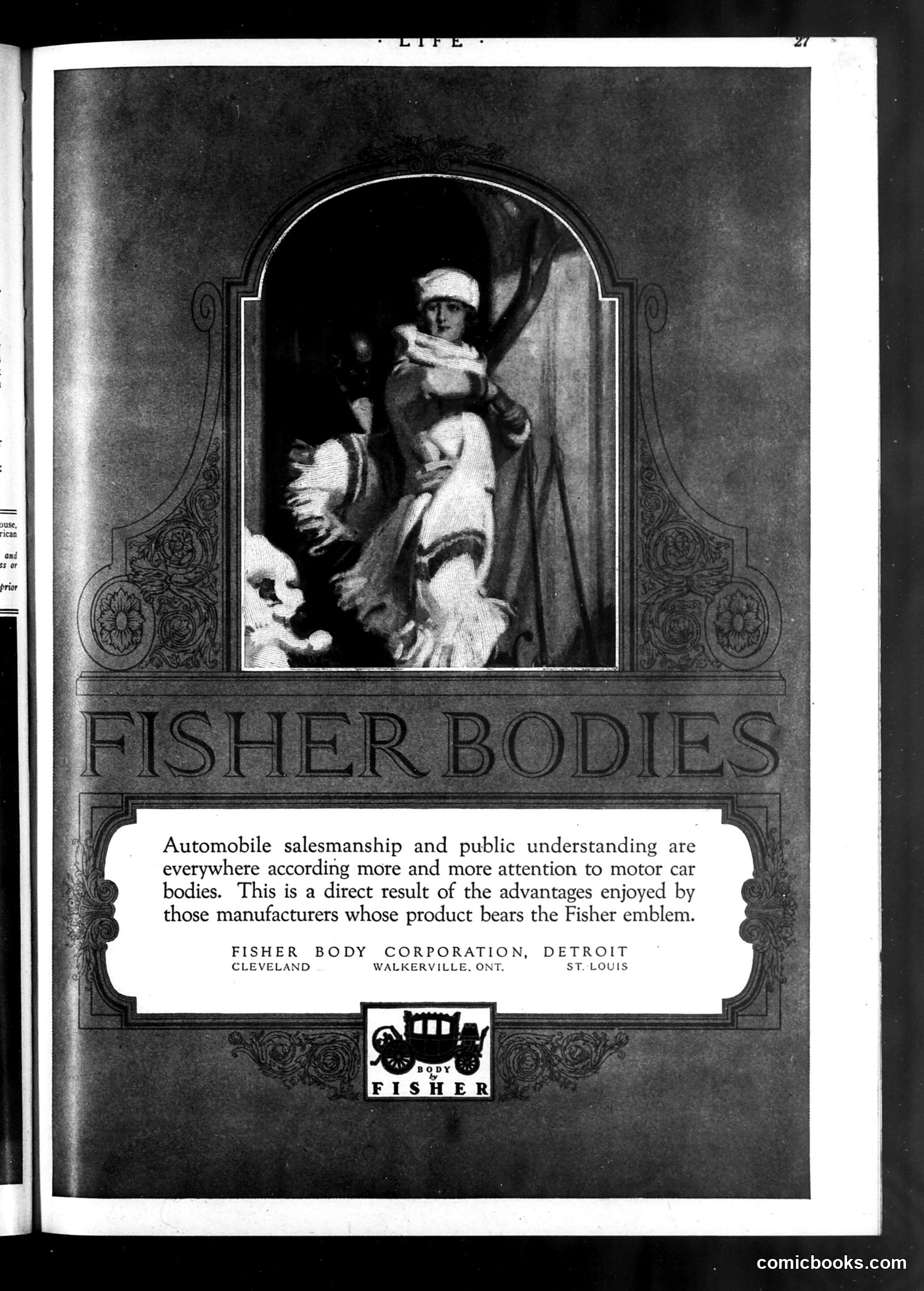
This is a **Fisher Body Corporation advertisement**, not satire or political commentary. The page promotes Fisher's automobile bodies to manufacturers and dealers. The image shows a woman with a child at a window, likely meant to evoke domestic comfort and aspirational family life—associating Fisher bodies with quality and safety. The decorative frame and classical styling lend prestige to the product. The text argues that automobile salesmanship increasingly depends on body quality, and manufacturers using Fisher bodies gain competitive advantages. This reflects early automotive industry competition (1920s-era), when car bodies were becoming a significant selling point separate from mechanical components. The advertisement targets manufacturers and dealers, not consumers directly, emphasizing that Fisher's reputation drives sales success.
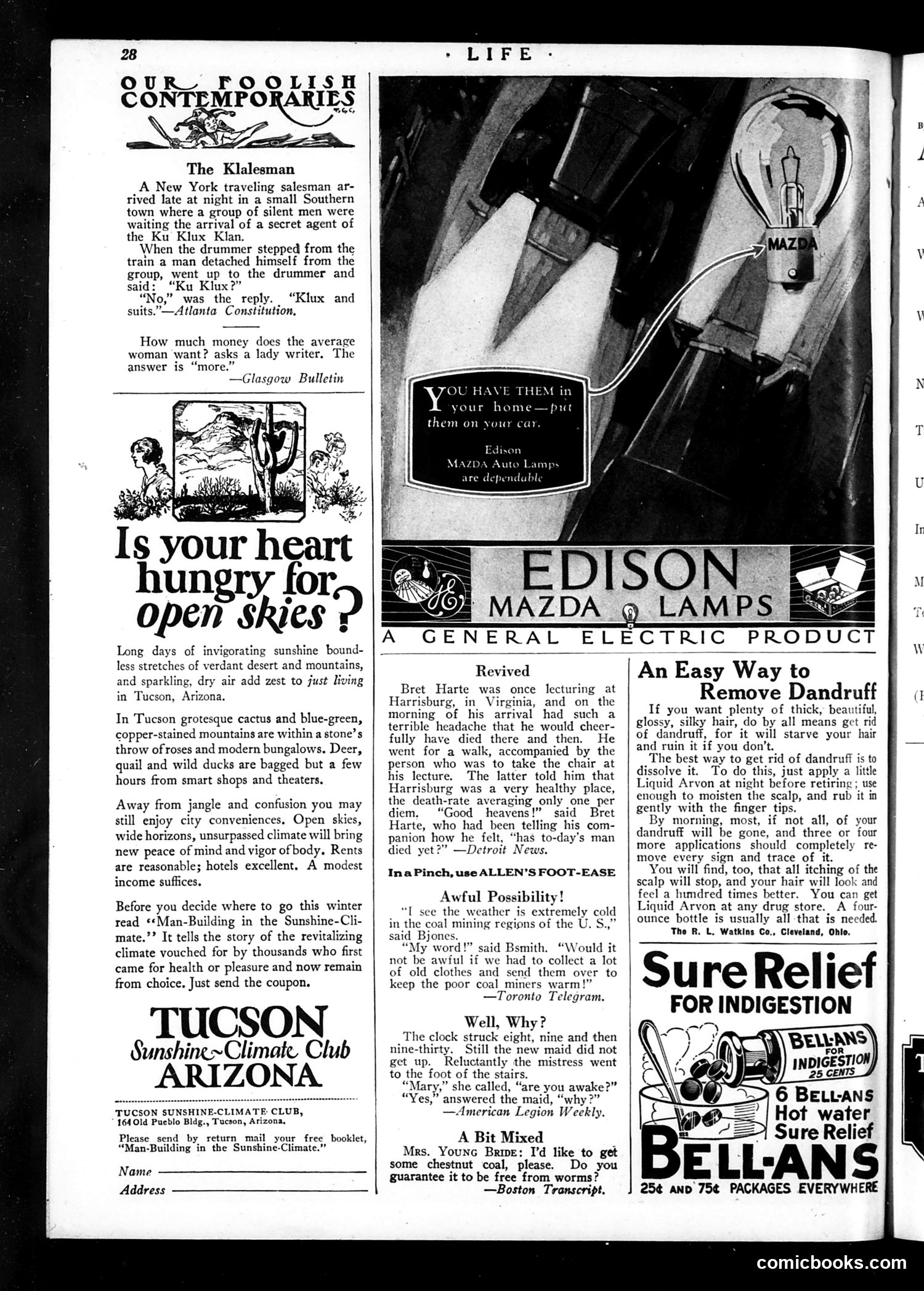
This page combines humor with advertising typical of early 20th-century Life magazine. **The Klalesman cartoon** satirizes the Ku Klux Klan through wordplay. A New York traveling salesman arriving in a Southern town is mistaken for a KKK secret agent. When confronted with "Ku Klux?", he replies "No...Klux and suits"—he's a clothing salesman. The joke mocks the KKK by reducing their supposed mystique to a simple misunderstanding, while also suggesting the Klan's suspicious, secretive culture in the South. **Other content** includes period humor snippets (anecdotes about Bret Harte, a confused maid, a woman asking about "chestnut coal with no worms") and advertisements for Edison Mazda lamps, dandruff treatment, and Tucson's health tourism. The Klalesman joke reflects 1920s American attitudes—treating the KKK as ridiculous rather than genuinely threatening, though the Klan was actively violent during this era.
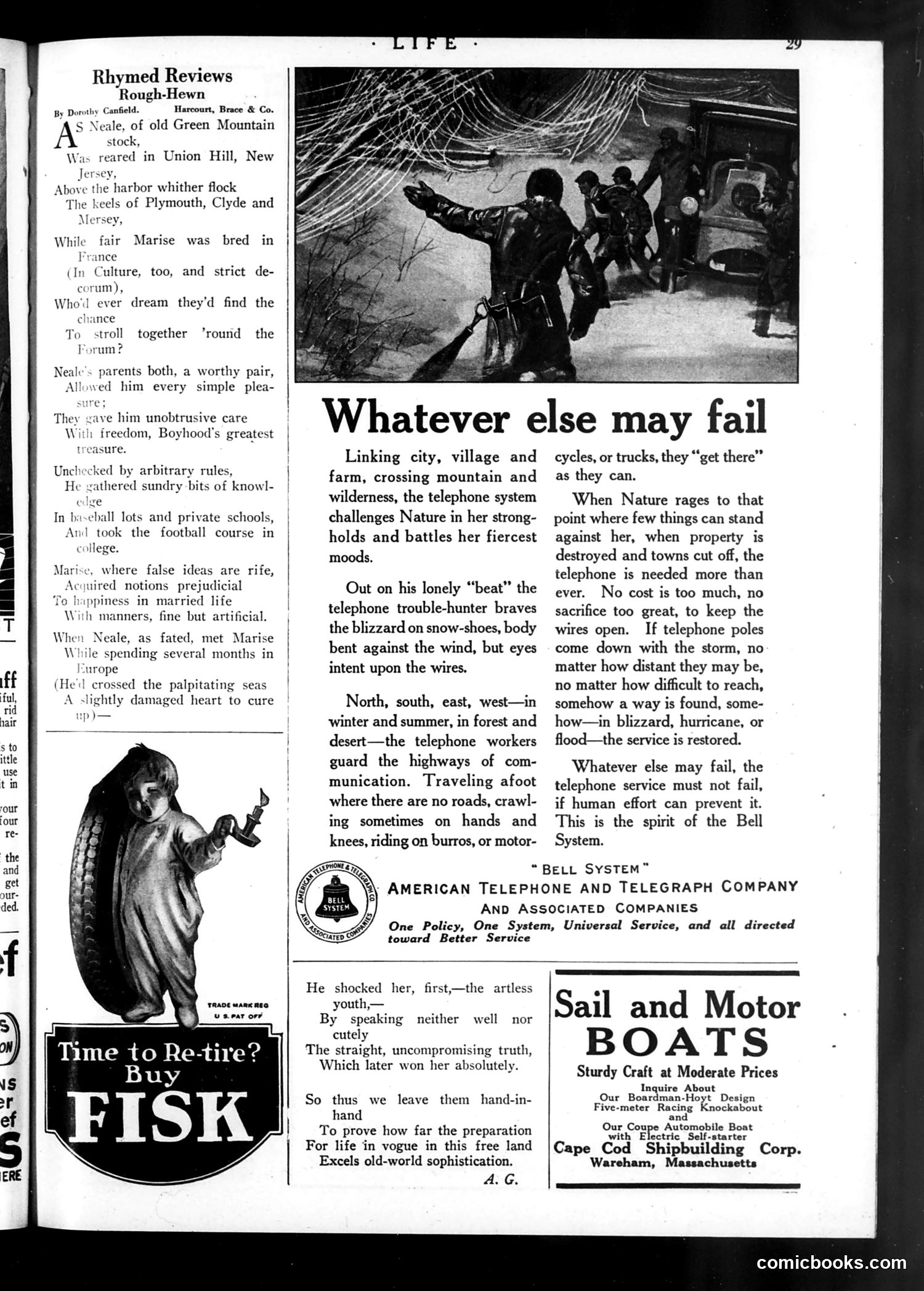
This page contains a **book review in verse** (left) and a **Bell Telephone System advertisement** (center/right). **The Rhymed Review** satirizes contrasting national character types: Neale, a roughhewn American boy raised freely in New Jersey with unstructured education, versus Marise, a refined French girl trained in artificial manners and European sophistication. The joke is that when they meet in Europe, Neale's artless honesty and American straightforwardness win her over—suggesting American authenticity triumphs over Old World pretension. This reflects 1920s-era American confidence in democratic informality versus European artificiality. **The Bell Advertisement** uses dramatic imagery (telephone workers battling nature in blizzards, mountains, deserts) to celebrate telephone infrastructure as essential American progress. The messaging emphasizes reliability and sacrifice: "Whatever else may fail, the telephone service must not fail." Both pieces celebrate American exceptionalism—one through individual character, one through technological achievement—typical of the era's optimistic nationalism.
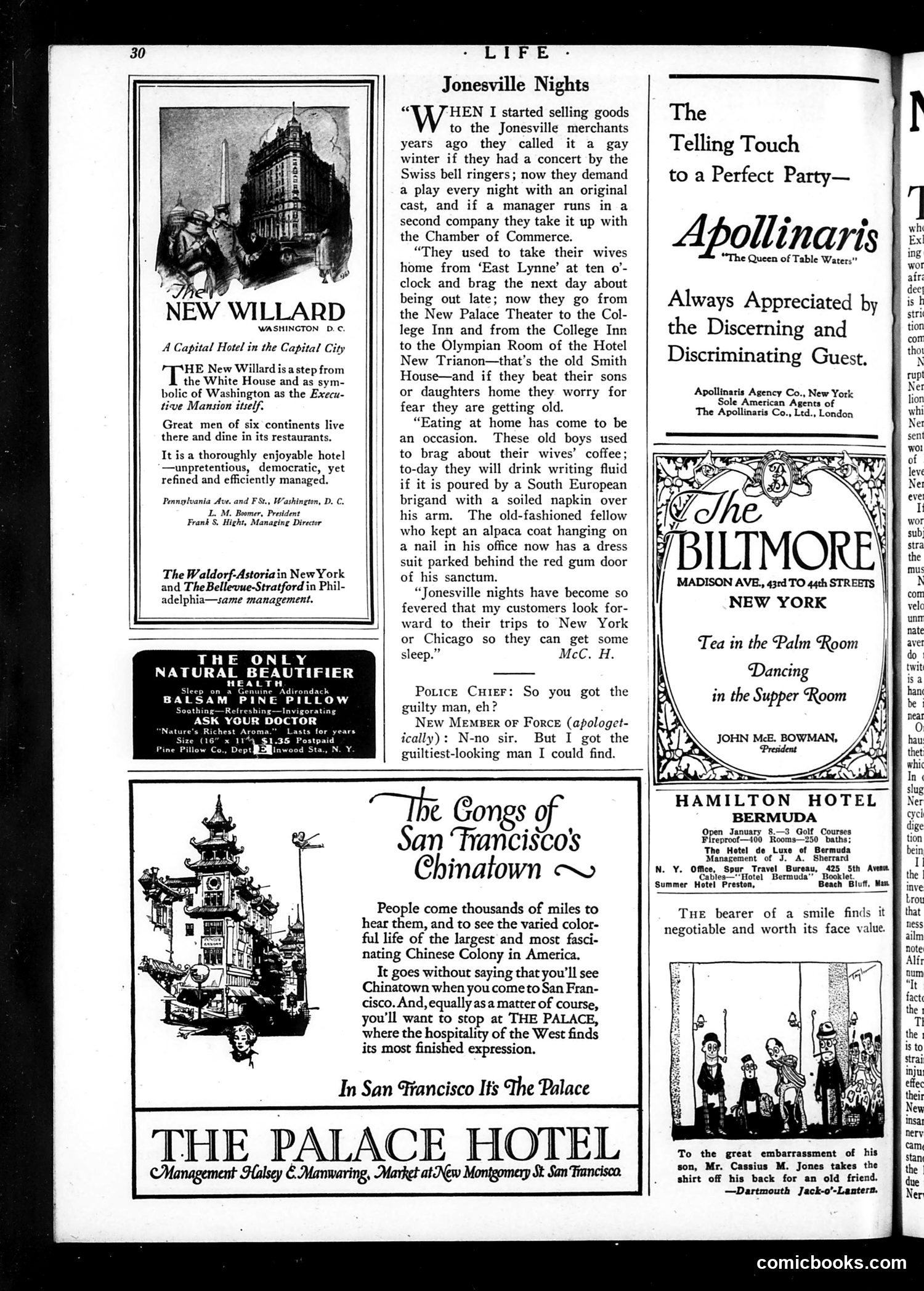
This page is primarily **advertisements for hotels and consumer products**, with one satirical piece titled "Jonesville Nights." The satire depicts how small-town American life has changed. A merchant describes how Jonesville residents—once satisfied with modest entertainments like Swiss bell-ringers—now demand nightly theatrical productions. The joke critiques the town's escalating desires: residents formerly bragged about staying out late to see *East Lynne*; now they circuit between multiple venues (Palace Theater, College Inn, Hotel New Trianon). Similarly, wives' homemade coffee has been replaced by appreciation for "writing fluid" served by continental waiters. The punchline suggests that constant entertainment and status-seeking have made locals so restless they escape to New York or Chicago just to sleep. The cartoon (labeled "Police Chief") is a brief joke about catching a criminal—the officer admits he found the "guiltiest-looking man" rather than actual evidence of guilt. The remaining content consists of hotel advertisements (**New Willard**, **The Biltmore**, **The Palace Hotel**, **Hamilton Hotel**) and product ads (**Apollinaris water**, **Balsam Pine Pillow**).
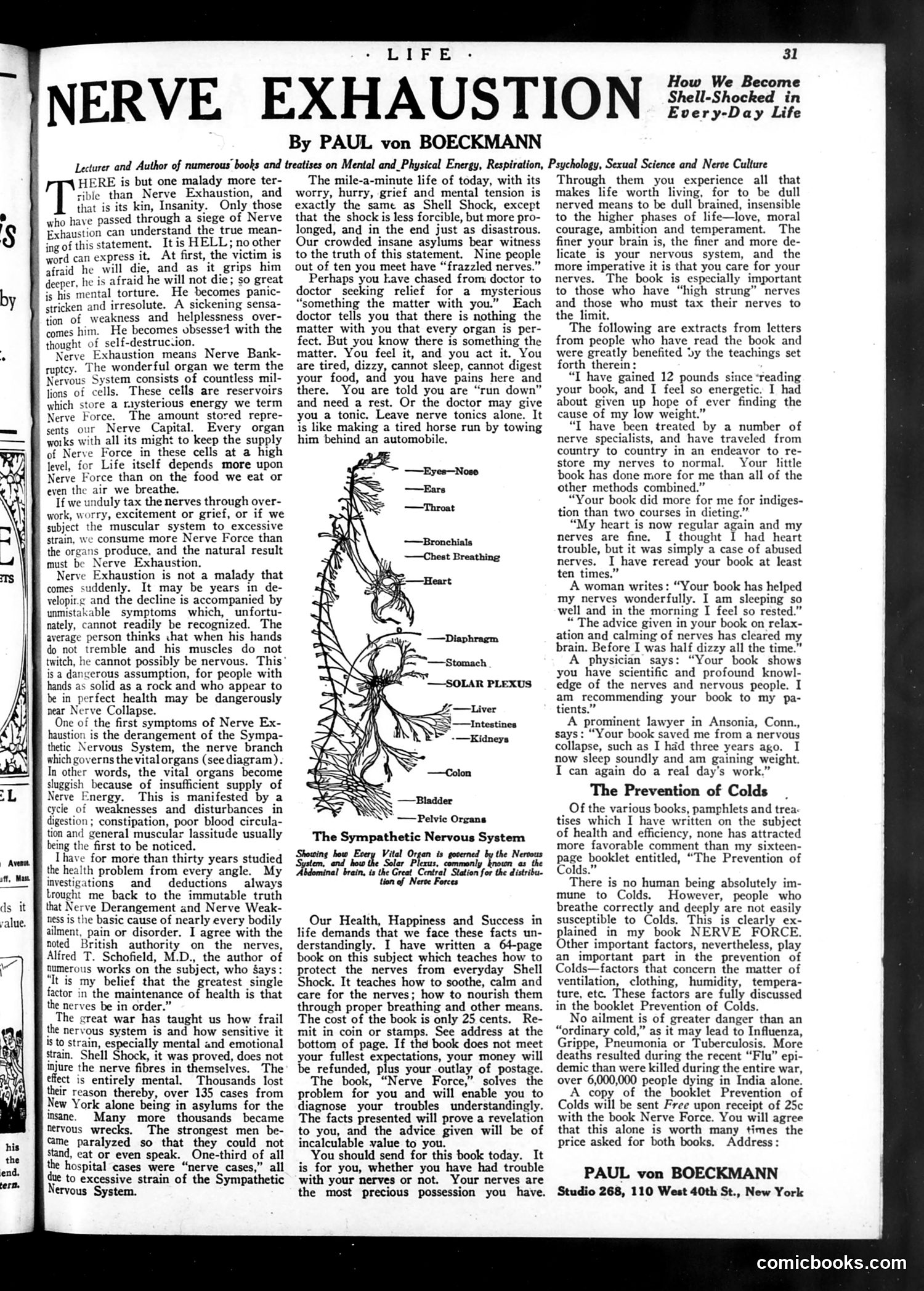
This is not a cartoon but a **health/medical advice article** from Life magazine. The page features educational content rather than satire. The article discusses "nerve exhaustion"—a condition the author compares to "shell shock" from World War I. Von Boeckmann, a lecturer on mental and physical health, argues that nervous system depletion causes various ailments. He uses the metaphor of "nerve bankruptcy," claiming the nervous system is a reservoir of "nerve force" that depletes under stress, worry, and overwork. The diagram shows the **sympathetic nervous system** and vital organs it governs. The article references WWI shell shock (a recognized psychological condition from trench warfare) to legitimize his claims about civilian nerve exhaustion. He concludes by promoting his book "Nerve Force" as a solution. This represents **early 20th-century pseudoscientific health promotion**—mixing legitimate observations about stress with unproven theories about "nerve energy," a common approach in popular health writing of that era.
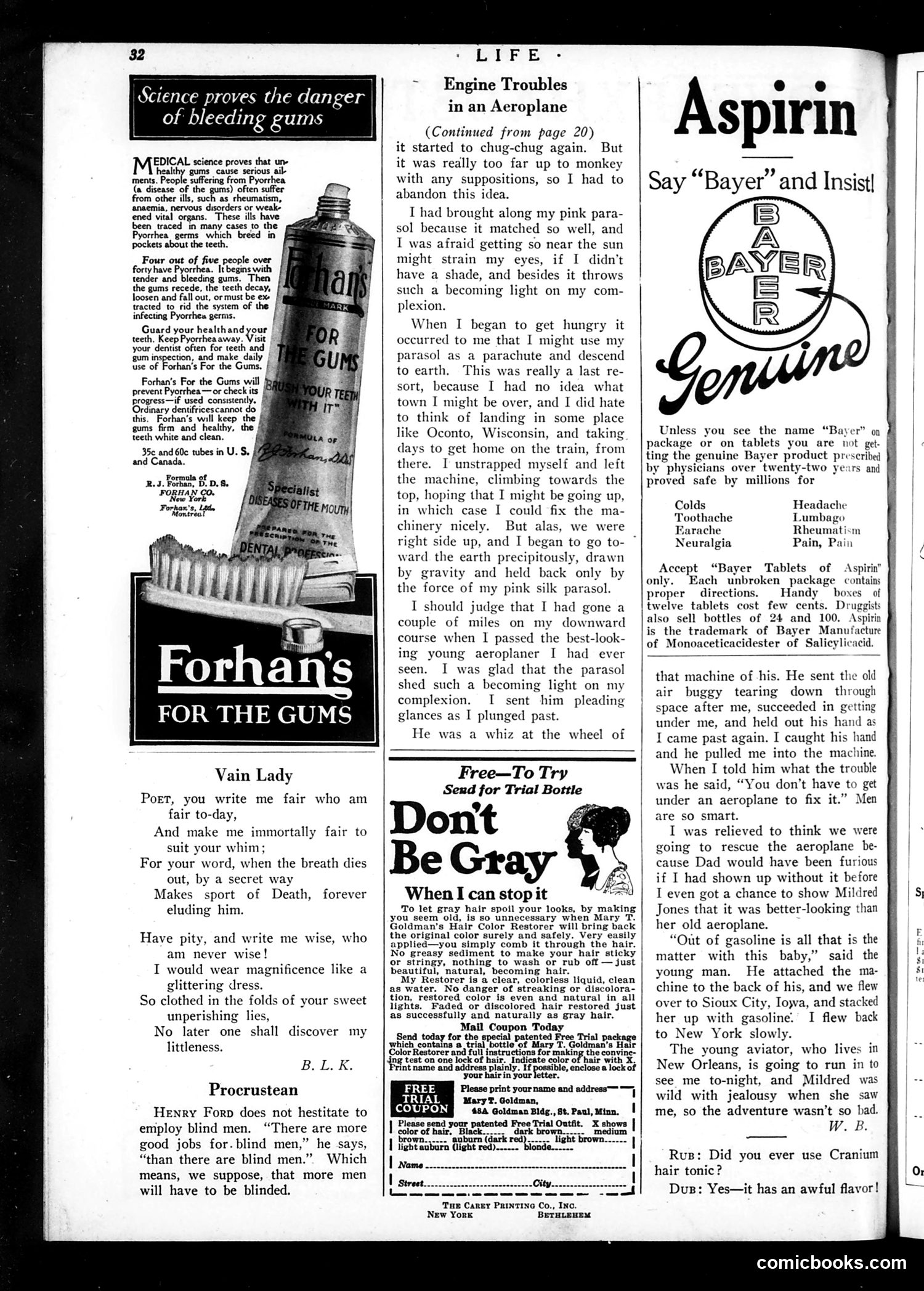
This page contains **advertisements and literary content** rather than political cartoons, reflecting early 20th-century concerns: **Advertisements reveal contemporary anxieties:** - **Forhan's For the Gums** exploits medical fears about pyorrhea (gum disease), claiming it causes serious ailments—reflecting the era's tendency to exaggerate product benefits. - **Mary T. Goldman's Hair Color Restorer** targets vanity and age anxiety, promising natural-looking results. - **Bayer Aspirin** emphasizes the importance of buying the genuine branded product. **Literary content includes:** - A humorous first-person narrative about an airplane mishap, featuring a woman using a pink parasol as a parachute—satirizing both aviation's novelty and female frivolity. - A poem ("Vain Lady") about feminine vanity and mortality. - A brief satirical note on **Henry Ford**, suggesting his employment of blind workers implies society will eventually produce more blind people—dark commentary on industrial labor practices and social Darwinism. The page reflects 1910s-20s preoccupations: nascent aviation, gender roles, consumer anxiety, and industrial-age concerns.
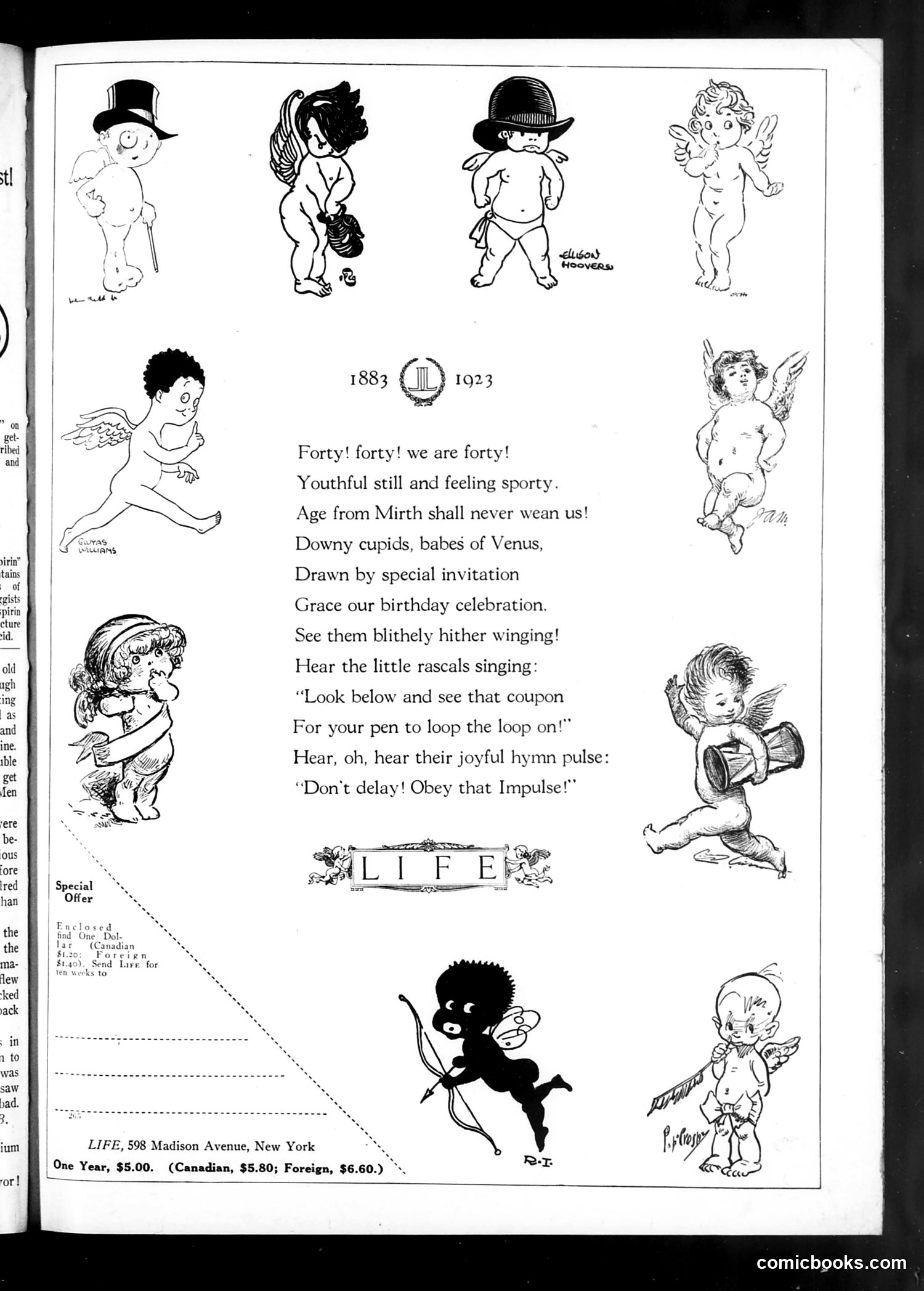
This is a promotional page celebrating **Life magazine's 40th birthday** in 1923. The cherubs and cupids surrounding the central poem are whimsical, classical references to youth and fertility—playing on the pun that despite being "forty," the magazine remains "youthful still and feeling sporty." The cherubs carry objects suggesting Life's content and appeals: top hats (sophistication), wings (freedom/flight), and musical instruments (entertainment). Their song urges readers to use the subscription coupon below to "loop the loop"—a contemporary phrase for taking action/committing. The overall tone is lighthearted self-promotion: Life positions itself as eternally young and vital, not aged or stodgy. The artwork style and cherub imagery reflect the magazine's satirical, illustrative character. This is essentially a birthday advertisement wrapped in classical allusion and gentle humor, encouraging subscriptions at $5.00 yearly.
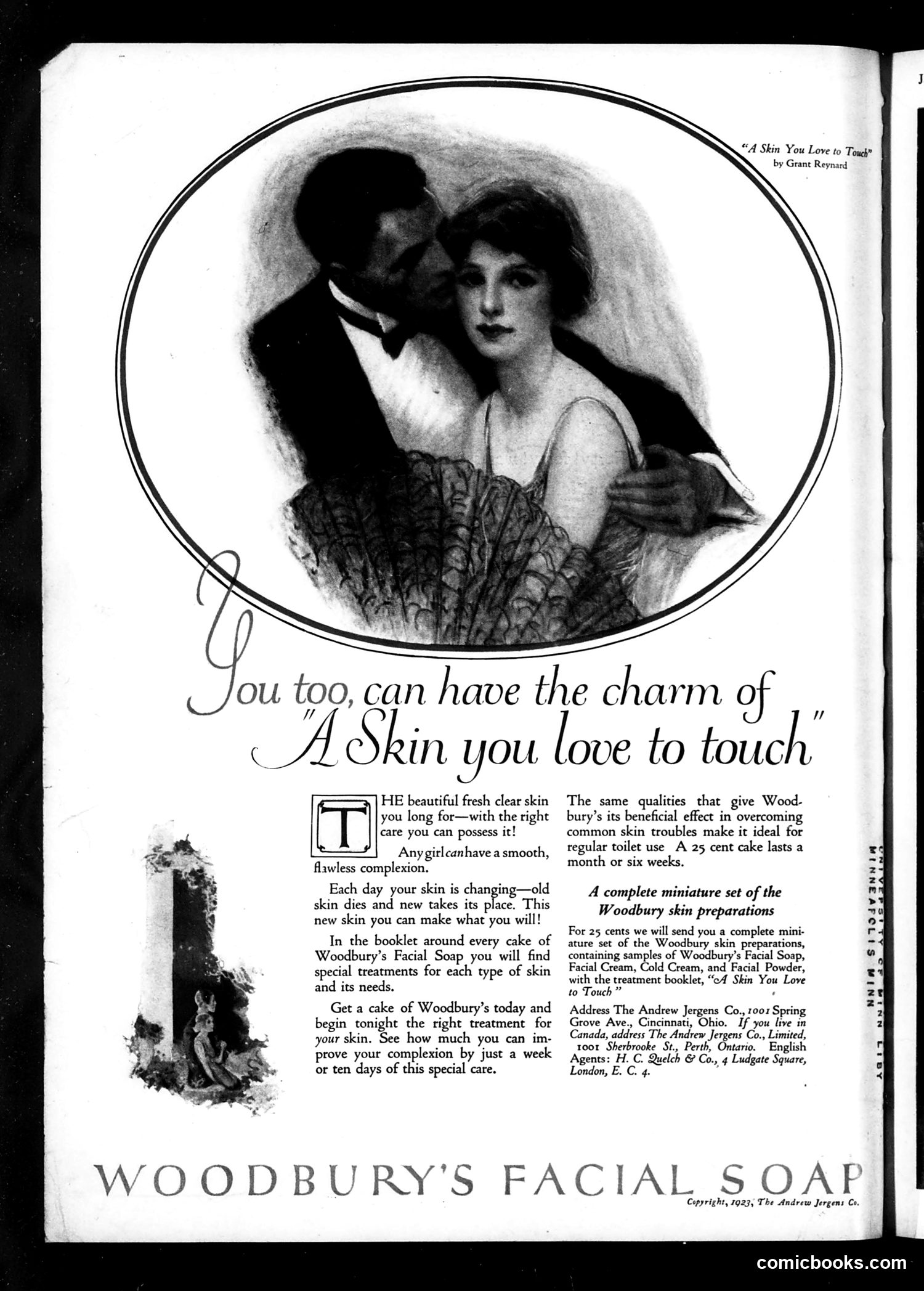
This is not a political cartoon or satire—it's a **cosmetics advertisement** for Woodbury's Facial Soap from 1923. The page contains an illustrated vignette by artist Grant Reynard showing an intimate moment between a man and woman, captioned "A Skin You Love to Touch." The ad employs the marketing strategy common to 1920s beauty advertising: promising women that proper skincare can dramatically improve their appearance and romantic appeal. The text emphasizes that skin naturally regenerates daily, so with "right treatment," any girl can achieve a "smooth, flawless complexion." The illustration and copy work together to suggest that beautiful skin leads to romantic desirability—the man's attention in the image reinforces the product's promise. The offer of a miniature sample set for 25 cents was a standard promotional tactic to encourage trial purchases. There is no satire here; this represents straightforward period advertising linking feminine beauty, skincare products, and romantic success—a connection advertisers exploited extensively during this era.