
Life, 1923-01-18 · page 16 of 36
Life — January 18, 1923 — page 16: what you’re looking at
What you’re looking at
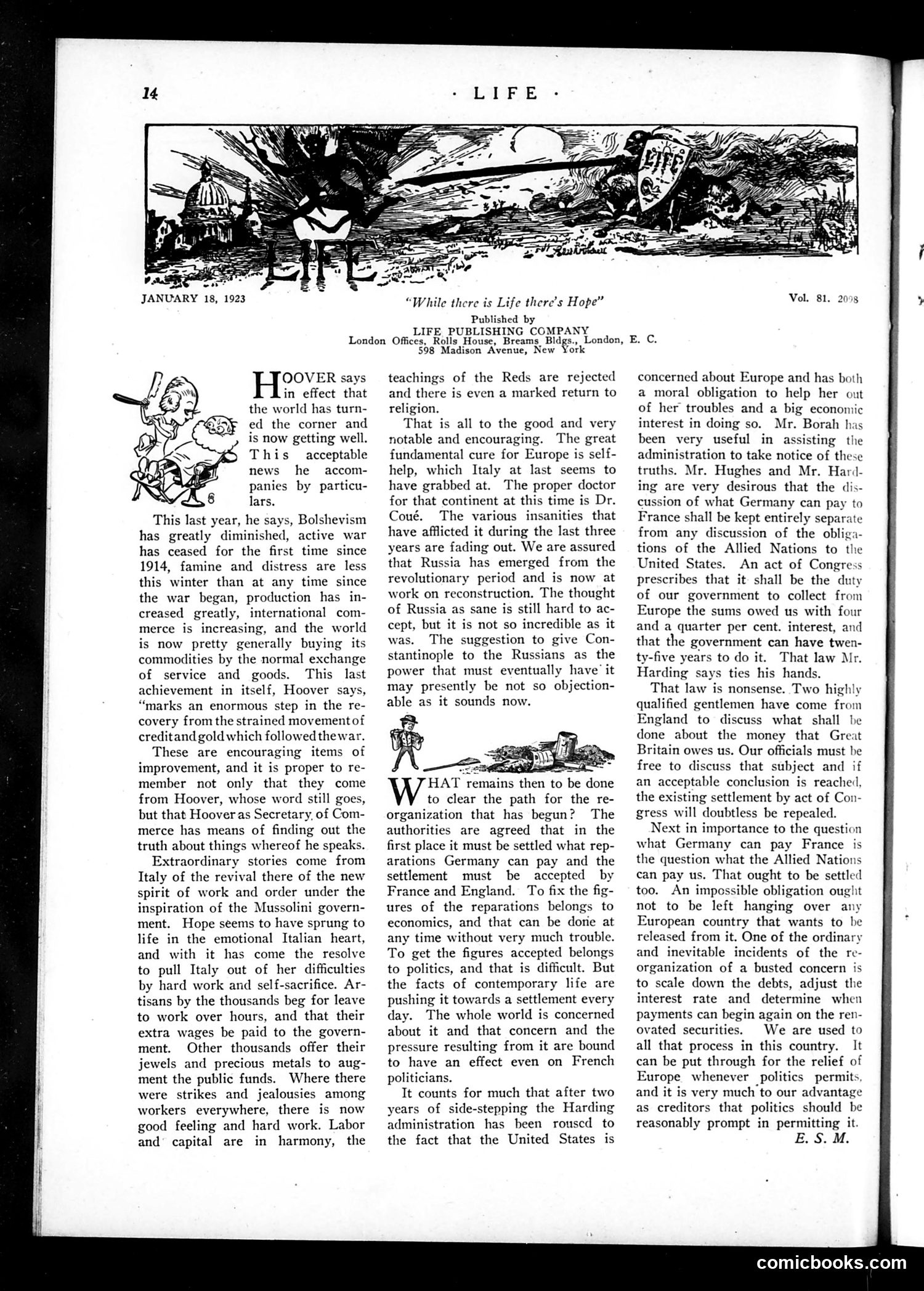
This January 18, 1923 *Life* page features political commentary on post-WWI Europe. The main illustration (upper left) appears to show a figure labeled "HOOVER" discussing economic recovery—likely Herbert Hoover, then Secretary of Commerce. The article praises recent improvements: Bolshevism has diminished, production increased, and international commerce is growing. The piece credits this to "hard work and self-sacrifice." The central cartoon depicts figures discussing European reparations and debt settlements. The text emphasizes that Germany's payment capacity must be determined through economics, not politics, and that France and Britain must accept realistic figures. The author argues the U.S. should remain involved in resolving European financial chaos to benefit American creditors. The satire targets the messy politics surrounding post-war financial obligations among Allied nations.
📄 Transcribed text from this page (OCR, searchable)
Machine-transcribed from the original scan — historical spelling and the odd misread are preserved.
JANUARY 18, 1923 “While there is Life there’s Hope” Published by IFE PUBLISHING COMPANY LI London Offices, Rolls House, Breams Bldgs., London, E. C. OOVER says in effect that fi i) % 2) 3 the world has turn- \ GE ed the corner and ee is now getting well. Eres eS NS This _ acceptable news he accom- panies by particu- 8 lars. This last year, he says, Bolshevism has greatly diminished, active war has ceased for the first time since 1914, famine and distress are less this winter than at any time since the war began, production has in- creased greatly, international com- merce is increasing, and the world is now pretty generally buying its commodities by the normal exchange of service and goods. This last achievement in itself, Hoover says, “marks an enormous step in the re- covery from the strained movement of creditand gold which followed thewar. These are encouraging items of improvement, and it is proper to re- member not only that they come from Hoover, whose word still goes, but that Hooveras Secretary, of Com- merce has means of finding out the truth about things whereof he speaks. Extraordinary stories come from Italy of the revival there of the new spirit of work and order under the inspiration of the Mussolini govern- ment. Hope seems to have sprung to life in the emotional Italian heart, and with it has come the resolve to pull Italy out of her difficulties by hard work and self-sacrifice. Ar- tisans by the thousands beg for leave to work over hours, and that their extra wages be paid to the govern- ment. Other thousands offer their jewels and precious metals to aug- ment the public funds. Where there were strikes and jealousies among workers everywhere, there is now good feeling and hard work. Labor and’ capital are in harmony, the 598 Madison Avenue, New York teachings of the Reds are rejected and there is even a marked return to religion. That is all to the good and very notable and encouraging. The great fundamental cure for Europe is self- help, which Italy at last seems to have grabbed at. The proper doctor for that continent at this time is Dr. Coué. The various insanities that have afflicted it during the last three years are fading out. We are assured that Russia has emerged from the revolutionary period and is now at work on reconstruction. The thought of Russia as sane is still hard to ac- cept, but it is not so incredible as it was. The suggestion to give Con- stantinople to the Russians as the power that must eventually have’ it may presently be not so objection- able as it sounds now. HAT remains then to be done to clear the path for the re- organization that has begun? The authorities are agreed that in the first place it must be settled what rep- arations Germany can pay and the settlement must be accepted by France and England. To fix the fig- ures of the reparations belongs to economics, and that can be dorie at any time without very much trouble. To get the figures accepted belongs to politics, and that is difficult. But the facts of contemporary life are pushing it towards a settlement every day. The whole world is concerned about it and that concern and the pressure resulting from it are bound to have an effect even on French politicians. It counts for much that after two years of side-stepping the Harding administration has been roused to the fact that the United States is concerned about Europe and has both a moral obligation to help her out of her troubles and a big economic interest in doing so. Mr. Borah has been very useful in assisting the administration to take notice of these truths. Mr. Hughes and Mr. Hard- ing are very desirous that the dis- cussion of what Germany can pay to France shall be kept entirely separate from any discussion of the obliga- tions of the Allied Nations to the United States. An act of Congress prescribes that it shall be the duty of our government to collect from Europe the sums owed us with four and a quarter per cent. interest, and that the government can have twen- ty-five years to do it. That law Mr. Harding says ties his hands. That law is nonsense. Two highly qualified gentlemen have come from England to discuss what shall be done about the money that Great Britain owes us. Our officials must be free to discuss that subject and if an acceptable conclusion is reached, the existing settlement by act of Con- gress will doubtless be repealed. Next in importance to the question what Germany can pay France is the question what the Allied Nations can pay us. That ought to be settled too. An impossible obligation ought not to be left hanging over any European country that wants to be released from it. One of the ordinary and inevitable incidents of the re- organization of a busted concern is to scale down the debts, adjust the interest rate and determine when payments can begin again on the ren- ovated securities. We are used to all that process in this country. It can be put through for the relief of Europe whenever politics permits. and it is very much to our advantage as creditors that politics should be reasonably prompt in permitting it. E. S. M. comicbooks.com mai hue