
Life, 1923-01-18 · page 21 of 36
Life — January 18, 1923 — page 21: what you’re looking at
What you’re looking at
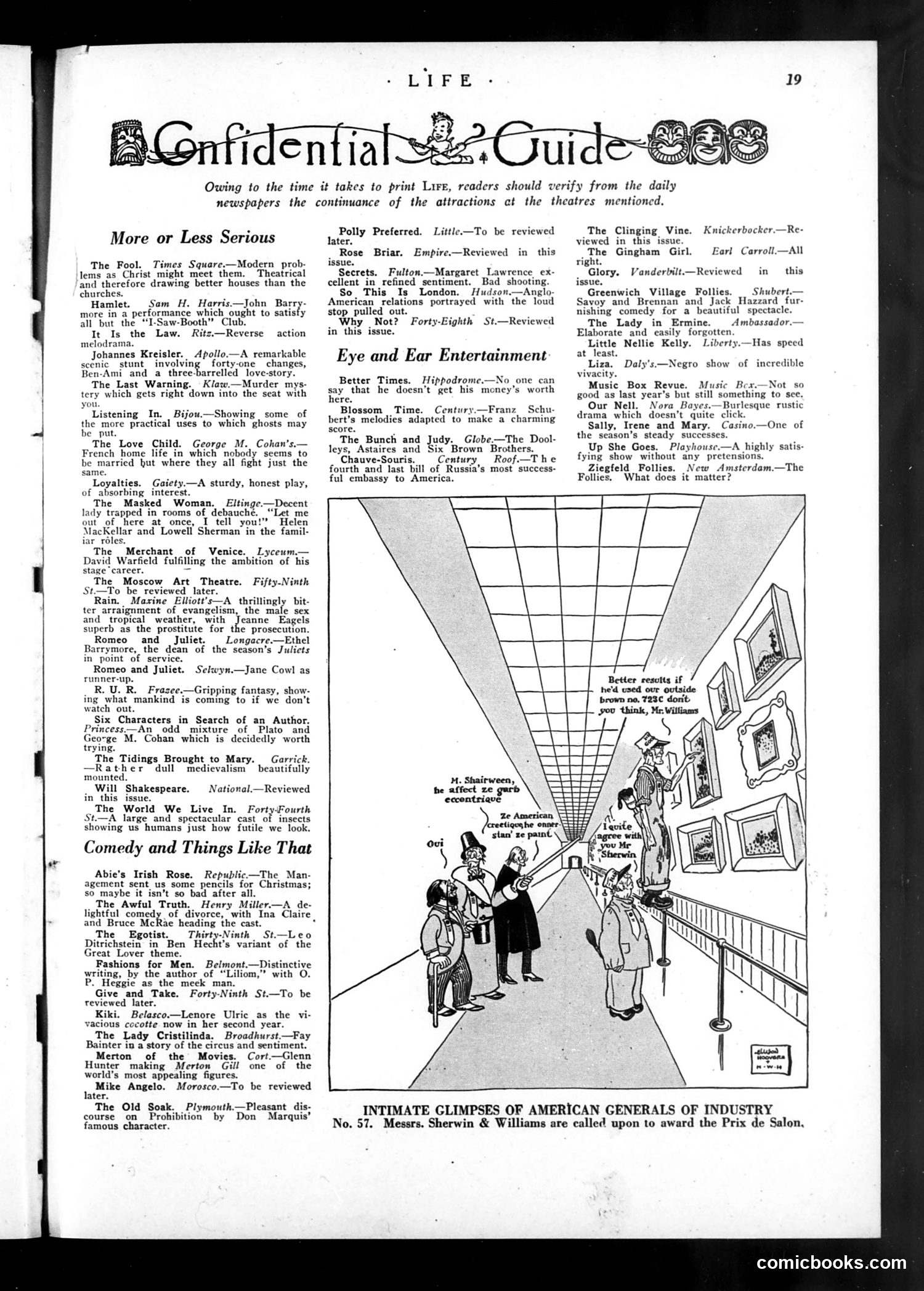
This page from Life magazine contains theater reviews and a satirical cartoon about American industry executives. **The Cartoon:** Titled "Intimate Glimpses of American Generals of Industry," it depicts Messrs. Sherwin & Williams (paint manufacturers) in an art gallery. The joke plays on "generals" — a pun conflating military rank with industrial leadership. The two businessmen stand before expensive paintings while speech bubbles mock their aesthetic appreciation, with one saying he'd prefer "better recitals if he'd come over outside between acts." The satire suggests wealthy industrialists lack genuine cultural refinement despite their ability to purchase art, a common Jazz Age critique of nouveau riche pretension and the gap between money and taste. **Context:** This reflects 1920s skepticism toward industrialists' social status and cultural authority.
📄 Transcribed text from this page (OCR, searchable)
Machine-transcribed from the original scan — historical spelling and the odd misread are preserved.
More or Less Serious The Fool. Times Square.—Modern prob- lems as Christ might meet them. Theatrical and therefore drawing better houses than the churches. Hamlet. Sam H. Harris—John Barr} more in a performance which ought to satisfy all. but the “I-Saw-Booth” Club. It Is the Law. Rits.—Reverse melodrama. Johannes Kreisler. Apollo.—A remarkable scenic stunt involving forty-one chang: Ben-Ami and a. three-barrelled love story. The Last Warning. Klaw.—Murder mys- tery which gets right down into the seat with y action Listening In. Bijow.—Showing some of the more practical uses to which ghosts may be put. The Love Child. George M. Cohan’s.— French home life in which nobody seems to be married but where they all fight just the same. Loyalties. Gaiety.—A sturdy, honest play, of absorbing interest. The Masked Woman. Eltinge.—Decent lady trapped in rooms of debauché. “Let me t of here at once, I tell you!” Helen Kellar and Lowell Sherman in the famil- jar roles. The Merchant of Venice. Lyceum.— David Warfield fulfilling the ambition of his stage “career. The Moscow Art Theatre. Fifty-Ninth St—To be reviewed later. Rain. Maxine Elliott's—A thrillingly bit- ter arraignment of evangelism, the male sex and tropical weather, with Jeanne Eagels superb as the prostitute for the prosecution. Romeo and Juliet. — Longacre.—Ethel Barrymore, the dean of the season’s Julicts in point of service. Romeo and Juliet. runner-up. R. U. R._ Frazee.—Gripping fantasy, show- ing ‘what mankind is coming to if we don’t watch out. Six Characters in Search of an Author. Princess—An odd mixture of Plato and Geo-ge M. Cohan which is decidedly worth trying. The Tidings Brought to Mary. —Rather dull medievalism mounted. _ Will Shakespeare. in this issue. _The World We Live In. Forty-Fourth St—A large and spectacular ‘cast of insects showing us humans just how futile we look. Comedy and Things Like That Abie's Irish Rose. Republic—The Man- agement sent us some pencils for Christmas; 50 maybe it isn’t so bad after all. The Awful Truth. Henry Miller—A de- Selwyn.—Jane Cowl as Garrick. beautifully National.—Reviewed lightful comedy of divorce, with Ina Claire a a and Bruce McRae heading the cast. ‘The Egotist. Thirty-Ninth St.—Leo Ditrichstein in Ben Hecht’s variant of the Great Lover theme. Fashions for Men. Belmont.—Distinctive writing, by the author of “Liliom,” with O. Heggie as the meek man. Give and Take. Forty-Ninth St.—To be reviewed later. Kiki. Belasco.—Lenore Ulric as the vi- vacious cocotte now in her second year. The Lady Cristilinda. Broadhurst—Fay Bainter in a story of the circus and sentiment. Merton of the Movies. Cort.—Glenn Hunter making Merton Gill one of the world’s most appealing figures. Mike Angelo. Morosco.—To be reviewed later. The Old Soak. Plymouth.—Pleasant dis- course on Prohibition by Don Marquis’ famous character. Owing to the time it takes to print Lire, readers should verify from the daily newspapers the continuance of the attractions ct the theatres mentioned. Polly Preferred. later. Rose Briar. issue. Secrets. cellent in refined sentiment. So This Is London. American relations portrayed with stop pulled out. Why Not? in this issue. Little—To be reviewed Empire—Reviewed in this Fulton.—Margaret Lawrence ex- Bad. shooting. Hudson.—Anglo- he loud Forty-Eighth St.—Reviewed Eye and Ear Entertainment Better Times. Hippodrome.—No one can say that he doesn’t get his money's worth here. Blossom Time. Century.—Franz Schu- bert’s melodies adapted to make a charming score. : The Bunch and Judy. Globe.—The Dool- leys, Astaires and Six Brown Brothers. Chauve-Souris. Century Roof.—The fourth and last bill of Russia’s most success- ful embassy to America. The Clinging Vine. Knickerbocker—Re- viewed in this issue. The Gingham Girl. right. _ Glory. issue. Greenwich Village Follies. — Shubert— Savoy and Brennan and Jack Hazzard fur- nishing comedy for a beautiful spectacle. The Lady in Ermine. Ambassador.— Elaborate and easily forgotten Little Nellie Kelly. Liberty.—Has speed at least. Liza. vivacity. Music Box Revue. Music Bex.—Not so good as last year’s but still something to see. Our Nell, Nora Bayes.—Burlesque rustic drama which doesn’t quite Sally, Irene and Mary. Cas the season’s steady successes. Up She Goes. Playhouse.— fying show without any pre Ziegfeld Follies. New Amsterdam—The Follies, What does it matter? Earl Carroll.—All Vanderbilt—Reviewed in this Daly's.—Negro show of incredible —One of highly satis- 8, Better resvtts if he'd used our outside brown no, 723¢ dont M. Shairween, he affect ze garb eccontriqve INTIMATE GLIMPSES OF AMERICAN GENERALS OF INDUSTRY No. 57. Messrs. Sherwin & Williams are called upon to award the Prix de Salon, comicbooks.com