
Life, 1923-01-18 · page 26 of 36
Life — January 18, 1923 — page 26: what you’re looking at
What you’re looking at
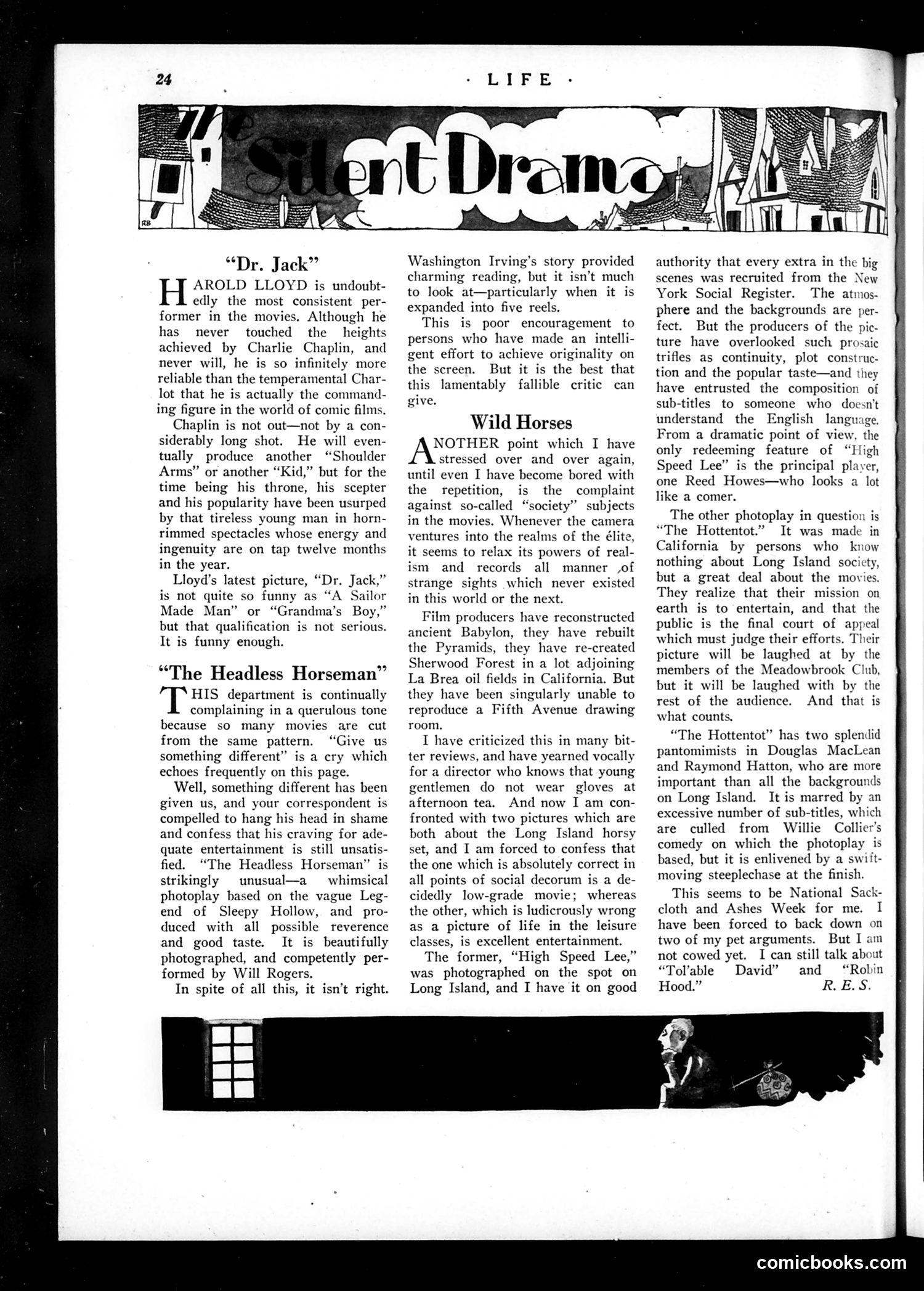
This Life magazine page reviews three silent films, comparing their entertainment value to technical accuracy. **"Dr. Jack"** stars Harold Lloyd, whom the critic ranks above Charlie Chaplin for consistency, though Chaplin achieved greater artistic heights. Lloyd's "horn-rimmed spectacles" persona and reliable output make him the commanding figure in comedy films. **"The Headless Horseman"** adapts Washington Irving's classic tale with Will Rogers, photographed beautifully but failing dramatically—the critic suggests literary works don't necessarily translate to screen, discouraging originality in filmmaking. **"Wild Horses"** section critiques films depicting wealthy "society" subjects. The critic notes producers struggle authentically portraying Fifth Avenue drawing rooms or Long Island high society, despite attempts. "High Speed Lee," photographed on location with actual Social Register extras, achieves perfect atmosphere but fails in plot and entertainment. The reverse problem occurs elsewhere—inaccurate but entertaining films prove superior. The critic laments this tension between realism and engagement.
📄 Transcribed text from this page (OCR, searchable)
Machine-transcribed from the original scan — historical spelling and the odd misread are preserved.
“Dr. Jack” H AROLD LLOYD is undoubt- edly the most consistent per- former in the movies. Although he has never touched the heights achieved by Charlie Chaplin, and never will, he is so infinitely more reliable than the temperamental Char- lot that he is actually the command- ing figure in the world of comic films. Chaplin is not out—not by a con- siderably long shot. He will even- tually produce another “Shoulder Arms” or another “Kid,” but for the time being his throne, his scepter and his popularity have been usurped by that tireless young man in horn- rimmed spectacles whose energy and ingenuity are on tap twelve months in the year. Lloyd's latest picture, “Dr. Jack,” is not quite so funny as “A Sailor Made Man” or “Grandma’s Boy,” but that qualification is not serious. It is funny enough. “The Headless Horseman” HIS department is continually complaining in a querulous tone because so many movies are cut from the same pattern. “Give us something different” is a cry which echoes frequently on this page. Well, something different has been given us, and your correspondent is compelled to hang his head in shame and confess that his craving for ade- quate entertainment is still unsatis- fied. “The Headless Horseman” is strikingly unusual—a —_ whimsical photoplay based on the vague Leg- end of Sleepy Hollow, and pro- duced with all possible reverence and good taste. It is beautifully photographed, and competently per- formed by Will Rogers. In spite of all this, it isn’t right. Washington Irving’s story provided charming reading, but it isn’t much to look at—particularly when it is expanded into five reels. This is poor encouragement to persons who have made an intelli- gent effort to achieve originality on the screen. But it is the best that this lamentably fallible critic can give. Wild Horses NOTHER point which I have stressed over and over again, until even I have become bored with the repetition, is the complaint against so-called “society” subjects in the movies. Whenever the camera ventures into the realms of the élite, it seems to relax its powers of real- ism and records all manner ,of strange sights which never existed in this world or the next. Film producers have reconstructed ancient Babylon, they have rebuilt the Pyramids, they have re-created Sherwood Forest in a lot adjoining La Brea oil fields in California. But they have been singularly unable to reproduce a Fifth Avenue drawing room. I have criticized this in many bit- ter reviews, and have yearned vocally for a director who knows that young gentlemen do not wear gloves at afternoon tea. And now I am con- fronted with two pictures which are both about the Long Island horsy set, and I am forced to confess that the one which is absolutely correct in all points of social decorum is a de- cidedly low-grade movie; whereas the other, which is ludicrously wrong as a picture of life in the leisure classes, is excellent entertainment. The former, “High Speed Lee,” was photographed on the spot on Long Island, and I have it on good authority that every extra in the big scenes was recruited from the New York Social Register. The atmos- phere and the backgrounds are per- fect. But the producers of the pic- ture have overlooked such prosaic trifles as continuity, plot construc- tion and the popular taste—and they have entrusted the composition of sub-titles to someone who doesn't understand the English language. From a dramatic point of view, the only redeeming feature of “High Speed Lee” is the principal player, one Reed Howes—who looks a lot like a comer. The other photoplay in question is “The Hottentot.” It was made in California by persons who know nothing about Long Island society, but a great deal about the movies. They realize that their mission on earth is to entertain, and that the public is the final court of appeal which must judge their efforts. Their picture will be laughed at by the members of the Meadowbrook Club, but it will be laughed with by the rest of the audience. And that is what counts, “The Hottentot” has two splendid pantomimists in Douglas MacLean and Raymond Hatton, who are more important than all the backgrounds on Long Island. It is marred by an excessive number of sub-titles, which are culled from Willie Coll comedy on which the photopla based, but it is enlivened by a swiit- moving steeplechase at the finish. This seems to be National Sack- cloth and Ashes Week for me. I have been forced to back down on two of my pet arguments. But I am not cowed yet. I can still talk about “Tol’able David” and “Robin Hood.” RES. comicbooks.com