
Life, 1923-01-18 · page 20 of 36
Life — January 18, 1923 — page 20: what you’re looking at
What you’re looking at
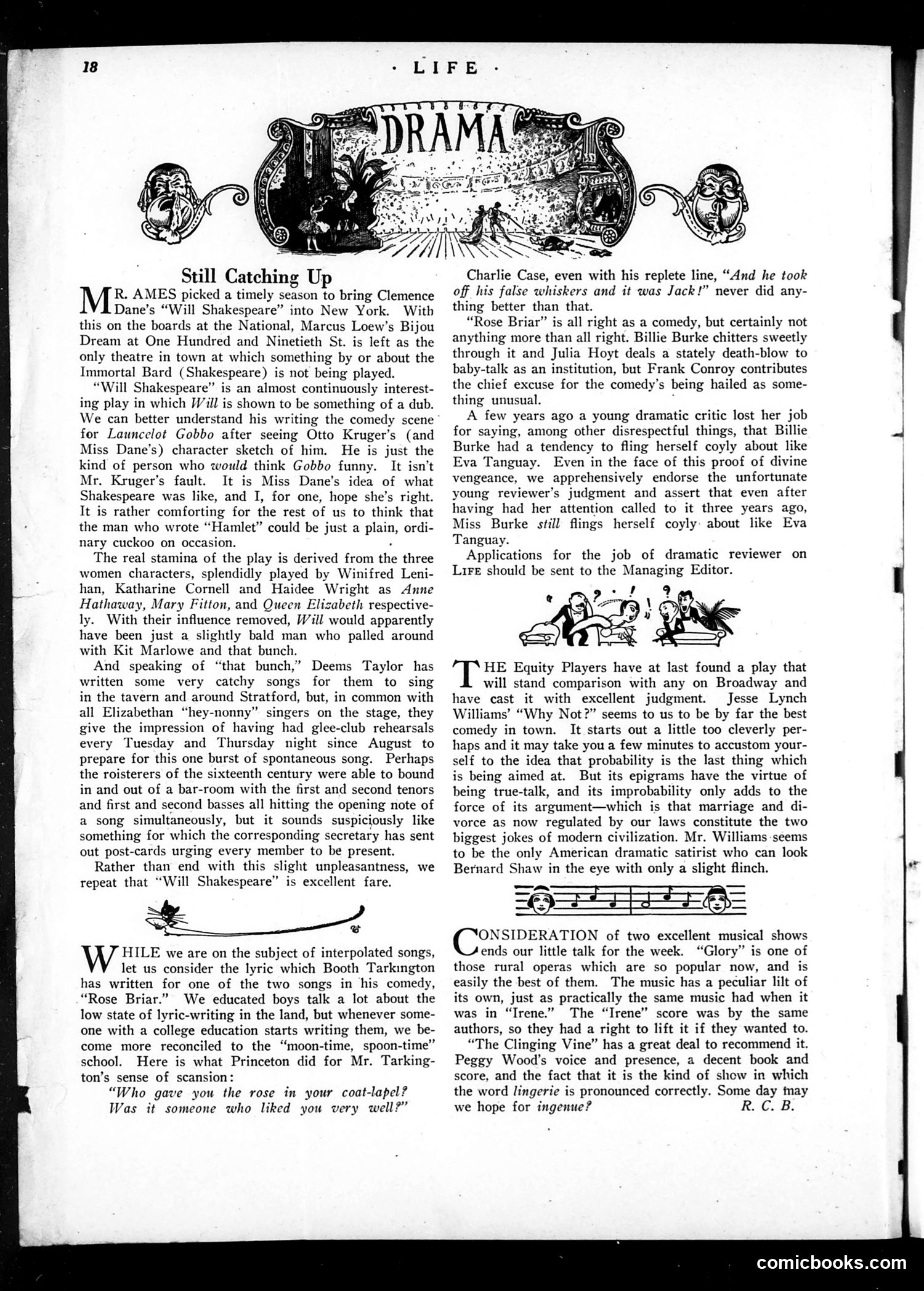
This page reviews two Broadway productions: Clemence Dane's "Will Shakespeare" and "Rose Briar." The main satire concerns "Will Shakespeare," which portrays the Bard as an ordinary, somewhat foolish man rather than a genius. The reviewer finds this oddly comforting—if Shakespeare could write "Hamlet" while being "just a plain, ordinary cuckoo," it reassures lesser mortals. The play's strength lies in its female cast (Winifred Lenihan, Katharine Cornell, Haidee Wright), without whom Shakespeare appears merely a bald man who "palled around" with Kit Marlowe. The second section mocks Booth Tarkington's lyric-writing in "Rose Briar," quoting awkward scansion ("Who gave you the rose in your coat-lapel?"). The reviewer sarcastically compares it unfavorably even to vaudeville performer Charlie Case's crude humor. Actress Billie Burke receives gentle ribbing for her affected performance style, compared to Eva Tanguay's theatrical mannerisms—a critique the reviewer notes ironically hasn't changed her in three years.
📄 Transcribed text from this page (OCR, searchable)
Machine-transcribed from the original scan — historical spelling and the odd misread are preserved.
Still Catching Up R. AMES picked a timely season to bring Clemence Dane’s “Will Shakespeare” into New York. With this on the boards at the National, Marcus Loew’s Bijou Dream at One Hundred and Ninetieth St. is left as the only theatre in town at which something by or about the Immortal Bard (Shakespeare) is not being played. “Will Shakespeare” is an almost continuously interest- ing play in which Will is shown to be something of a dub. We can better understand his writing the comedy scene for Launcelot Gobbo after seeing Otto Kruger’s (and Miss Dane’s) character sketch of him. He is just the kind of person who would think Gobbo funny. It isn’t Mr. Kruger’s fault. It is Miss Dane’s idea of what Shakespeare was like, and I, for one, hope she’s right. It is rather comforting for the rest of us to think that the man who wrote “Hamlet” could be just a plain, ordi- nary cuckoo on occasion. . The real stamina of the play is derived from the three women characters, splendidly played by Winifred Leni- han, Katharine Cornell and Haidee Wright as Anne Hathaway, Mary Fitton, and Queen Elizabeth respective- ly. With their influence removed, Will would apparently have been just a slightly bald man who palled around with Kit Marlowe and that bunch. And speaking of “that bunch,” Deems Taylor has written some very catchy songs for them to sing in the tavern and around Stratford, but, in common with all Elizabethan “hey-nonny” singers on the stage, they give the impression of having had glee-club rehearsals every Tuesday and Thursday night since August to prepare for this one burst of spontaneous song. Perhaps the roisterers of the sixteenth century were able to bound in and out of a bar-room with the first and second tenors and first and second basses all hitting the opening note of a song simultaneously, but it sounds suspiciously like something for which the corresponding secretary has sent out post-cards urging every member to be present. Rather than end with this slight unpleasantness, we repeat that “Will Shakespeare” is excellent fare. & 7 HILE we are on the subject of interpolated songs, let us consider the lyric which Booth Tarkington has written for one of the two songs in his comedy, “Rose Briar.” We educated boys talk a lot about the low state of lyric-writing in the land, but whenever some- one with a college education starts writing them, we be- come more reconciled to the “moon-time, spoon-time” school. Here is what Princeton did for Mr. Tarking- ton’s sense of scansion: “Who gave you the rose in your coat-lapel? Was it someone who liked you very well?” Charlie Case, even with his replete line, “And he took off his false whiskers and it was Jack!” never did any- thing better than that. “Rose Briar” is all right as a comedy, but certainly not anything more than all right. Billie Burke chitters sweetly through it and Julia Hoyt deals a stately death-blow to baby-talk as an institution, but Frank Conroy contributes the chief excuse for the comedy’s being hailed as some- thing unusual. . A few years ago a young dramatic critic lost her job for saying, among other disrespectful things, that Billie Burke had a tendency to fling herself coyly about like Eva Tanguay. Even in the face of this proof of divine vengeance, we apprehensively endorse the unfortunate young reviewer’s judgment and assert that even after having had her attention called to it three years ago, Miss Burke still flings herself coyly: about like Eva Tanguay. Applications for the job of dramatic reviewer on Lire should be sent to the Managing Editor. HE Equity Players have at last found a play that will stand comparison with any on Broadway and have cast it with excellent judgment. Jesse Lynch Williams’ “Why Not?” seems to us to be by far the best comedy in town. It starts out a little too cleverly per- haps and it may take you a few minutes to accustom your- self to the idea that probability is the last thing which is being aimed at. But its epigrams have the virtue of being true-talk, and its improbability only adds to the force of its argument—which is that marriage and di- vorce as now regulated by our laws constitute the two biggest jokes of modern civilization. Mr. Williams seems to be the only American dramatic satirist who can look Bernard Shaw in the eye with only a slight flinch. IONSIDERATION of two excellent musical shows ends our little talk for the week. “Glory” is one of those rural operas which are so popular now, and is easily the best of them. The music has a peculiar lilt of its own, just as practically the same music had when it was in “Irene.” The “Irene” score was by the same authors, so they had a right to lift it if they wanted to. “The Clinging Vine” has a great deal to recommend it. Peggy Wood's voice and presence, a decent book and score, and the fact that it is the kind of show in which the word lingerie is pronounced correctly. Some day may we hope for ingenue? R. CoB. comicbooks.com