
Life, 1923-01-18 · page 11 of 36
Life — January 18, 1923 — page 11: what you’re looking at
What you’re looking at
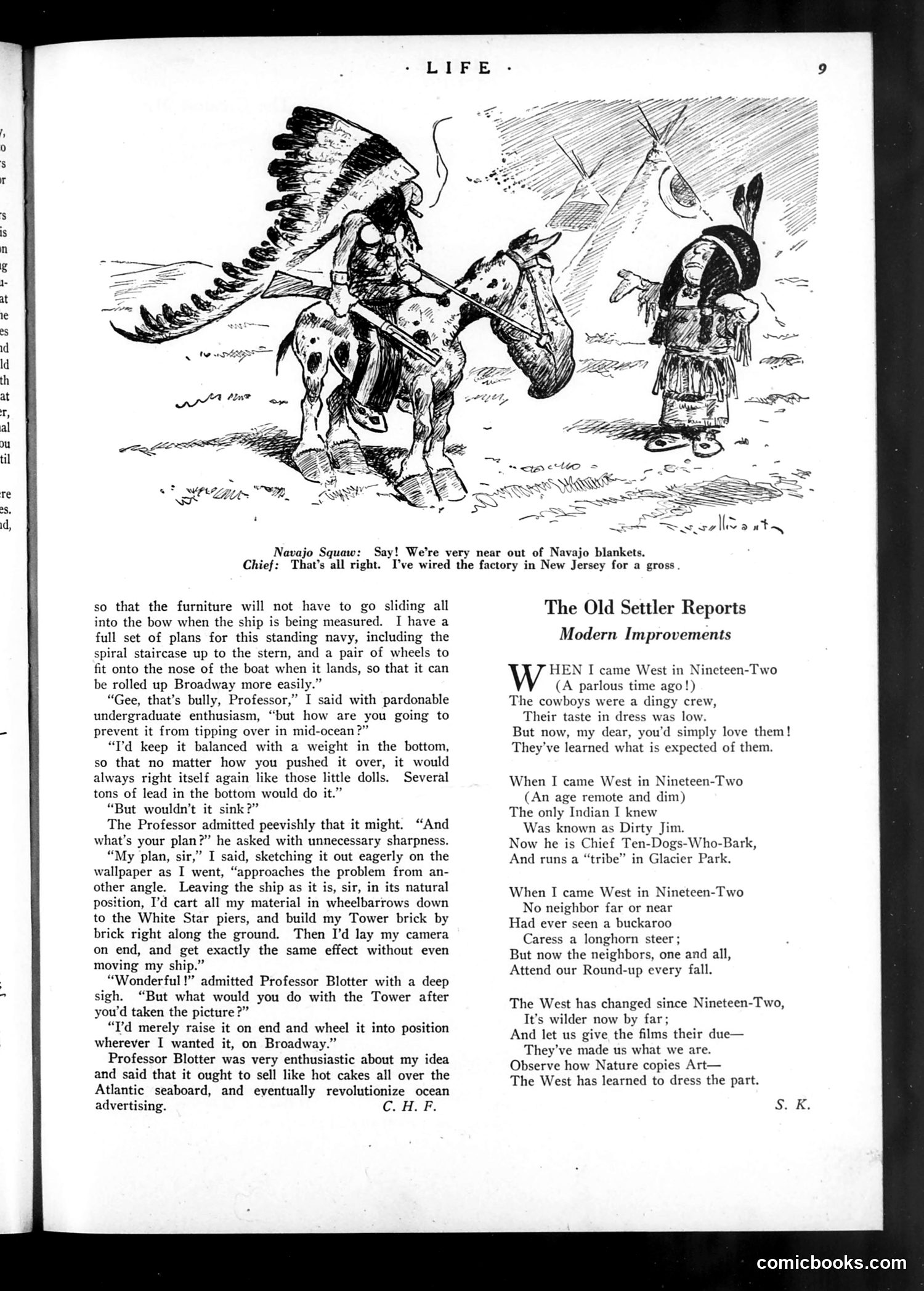
**The Cartoon:** The illustration depicts a Native American chief on horseback with an elaborate feathered headdress, speaking to a Native American woman standing beside him. The caption reads: "Navajo Square: Say! We're very near out of Navajo blankets. Chief: That's all right. I've wired the factory in New Jersey for a gross." **The Satire:** This cartoon mocks the commercialization and inauthenticity of Native American crafts. The joke's premise is absurd: a supposedly traditional chief ordering mass-produced "Navajo" blankets from a New Jersey factory rather than having them handmade. This satirizes both the appropriation of Native American cultural products and the irony of "authentic" indigenous goods actually being factory-manufactured imitations sold to tourists—a common early-20th-century practice.
📄 Transcribed text from this page (OCR, searchable)
Machine-transcribed from the original scan — historical spelling and the odd misread are preserved.
qa ctoo = SWOT Navajo Squaw: Say! We're very near out of Navajo blankets. Chief: That’s all right. I’ve wired the factory in New Jersey for a gross. so that the furniture will not have to go sliding all into the bow when the ship is being measured. I have a full set of plans for this standing navy, including the spiral staircase up to the stern, and a pair of wheels to fit onto the nose of the boat when it lands, so that it can be rolled up Broadway more easily.” “Gee, that’s bully, Professor,” I said with pardonable undergraduate enthusiasm, “but how are you going to prevent it from tipping over in mid-ocean?” “I'd keep it balanced with a weight in the bottom, so that no matter how you pushed it over, it would always right itself again like those little dolls. Several tons of lead in the bottom would do it.” “But wouldn't it sink?” The Professor admitted peevishly that it might. “And what’s your plan?” he asked with unnecessary sharpness. “My plan, sir,” I said, sketching it out eagerly on the wallpaper as I went, “approaches the problem from an- other angle. Leaving the ship as it is, sir, in its natural position, I’d cart all my material in wheelbarrows down to the White Star piers, and build my Tower brick by brick right along the ground. Then I'd lay my camera on end, and get exactly the same effect without even moving my ship.” “Wonderful!” admitted Professor Blotter with a deep sigh. “But what would you do with the Tower after you'd taken the picture?” “I'd merely raise it on end and wheel it into position wherever I wanted it, on Broadway.” Professor Blotter was very enthusiastic about my idea and said that it ought to sell like hot cakes all over the Atlantic seaboard, and eventually revolutionize ocean advertising. C. H. F. The Old Settler Reports Modern Improvements HEN I came West in Nineteen-Two (A parlous time ago!) The cowboys were a dingy crew, Their taste in dress was low. But now, my dear, you'd simply love them! They've learned what is expected of them. When I came West in Nineteen-Two (An age remote and dim) The only Indian I knew Was known as Dirty Jim. Now he is Chief Ten-Dogs-Who-Bark, And runs a “tribe” in Glacier Park, When I came West in Nineteen-Two No neighbor far or near Had ever seen a buckaroo Caress a longhorn steer ; But now the neighbors, one and all, Attend our Round-up every fall. The West has changed since Nineteen-Two, It’s wilder now by far; And let us give the films their due— They’ve made us what we are. Observe how Nature copies Art— The West has learned to dress the part. comicbooks.com