
A complete issue · 36 pages · 1922
Life — November 30, 1922
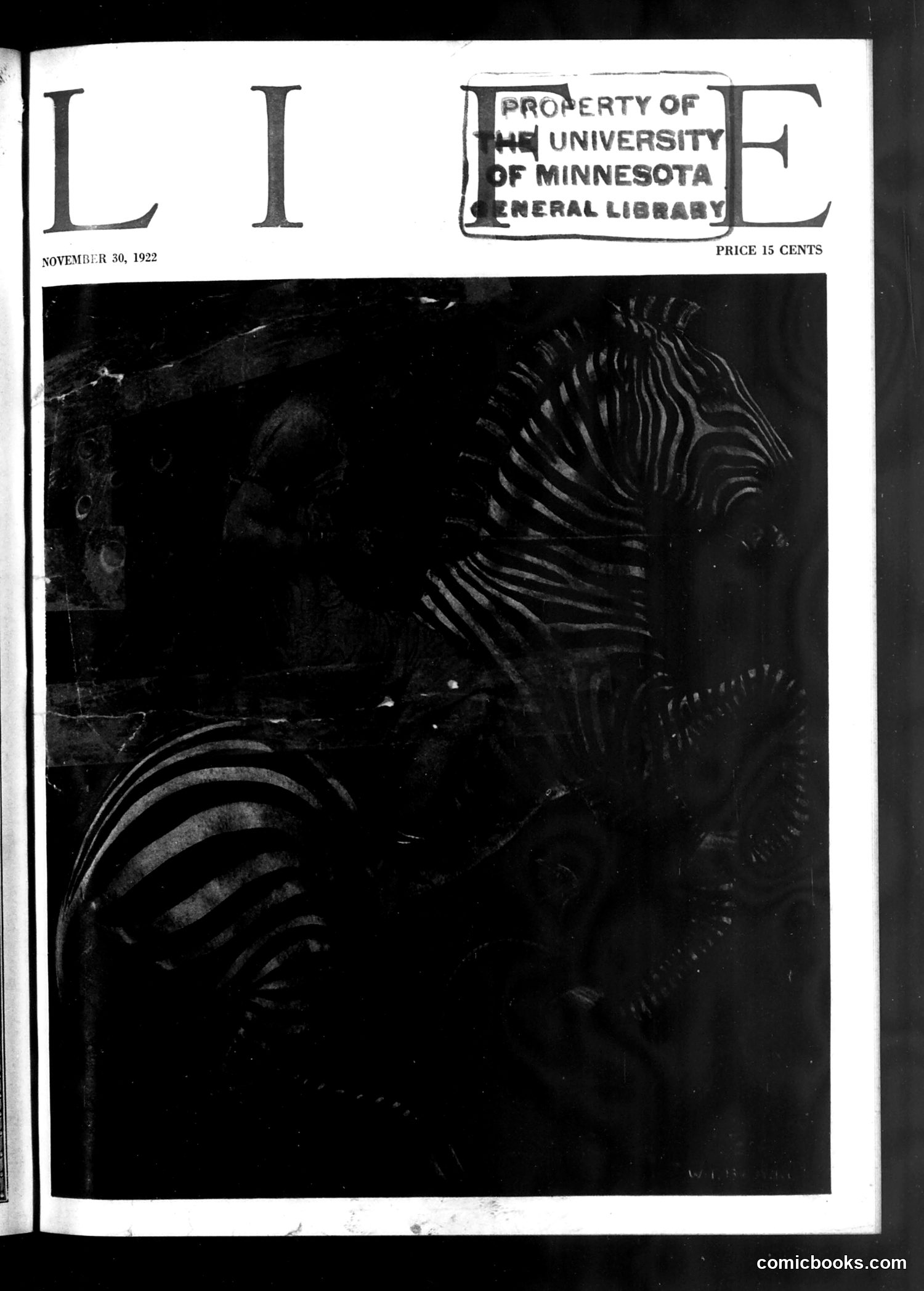
I can see this is the cover of *Life* magazine from November 30, 1922 (price 15 cents), but the image itself is quite dark and difficult to interpret with certainty. The photograph appears to show zebras—their distinctive striped patterns are visible—though the lighting and image quality make specific details hard to discern. Without clearer text or caption visible on this cover page, I cannot confidently identify what satirical or political point the editors intended. *Life* was known for humorous commentary on contemporary events, but without legible accompanying text explaining the cover's meaning, I cannot accurately explain what social or political reference this zebra imagery was meant to convey to 1922 readers.
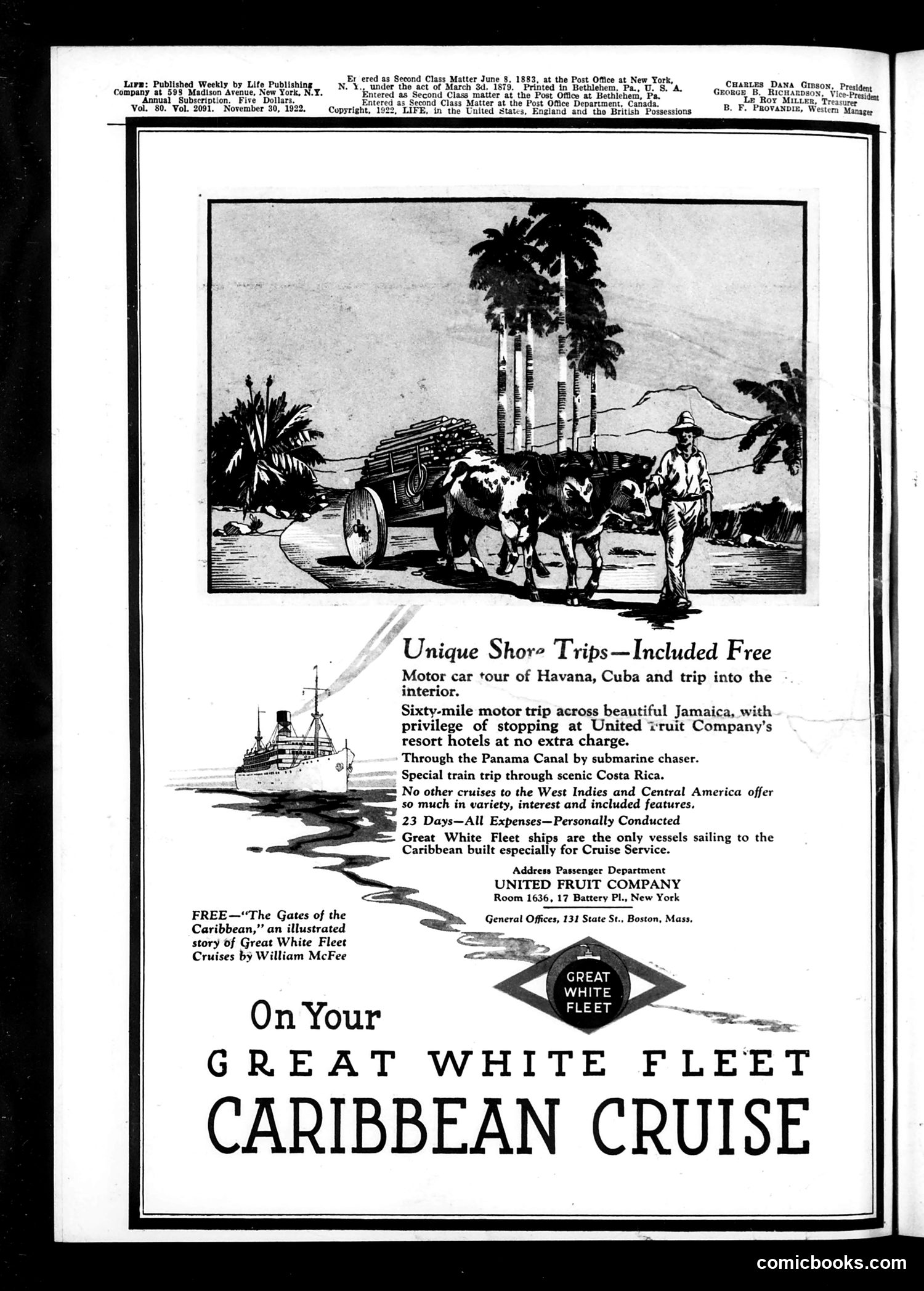
This page is **primarily an advertisement**, not satirical content. It advertises the Great White Fleet's Caribbean cruise service offered by the United Fruit Company. The ad features an illustrated scene of a motorized tour in a tropical setting (likely Cuba or Jamaica, based on the text), with palm trees and a cart pulled by oxen. The image promises "Unique Shore Trips—Included Free" featuring motor tours, a 60-mile Jamaica trip, a Panama Canal transit, and a Costa Rica train journey. The 23-day cruise is billed as all-inclusive and personally conducted. A ship illustration and the company's logo appear lower on the page. This represents early 20th-century cruise marketing emphasizing exotic travel and leisure—a luxury service for wealthy Americans exploring the Caribbean and Central America.
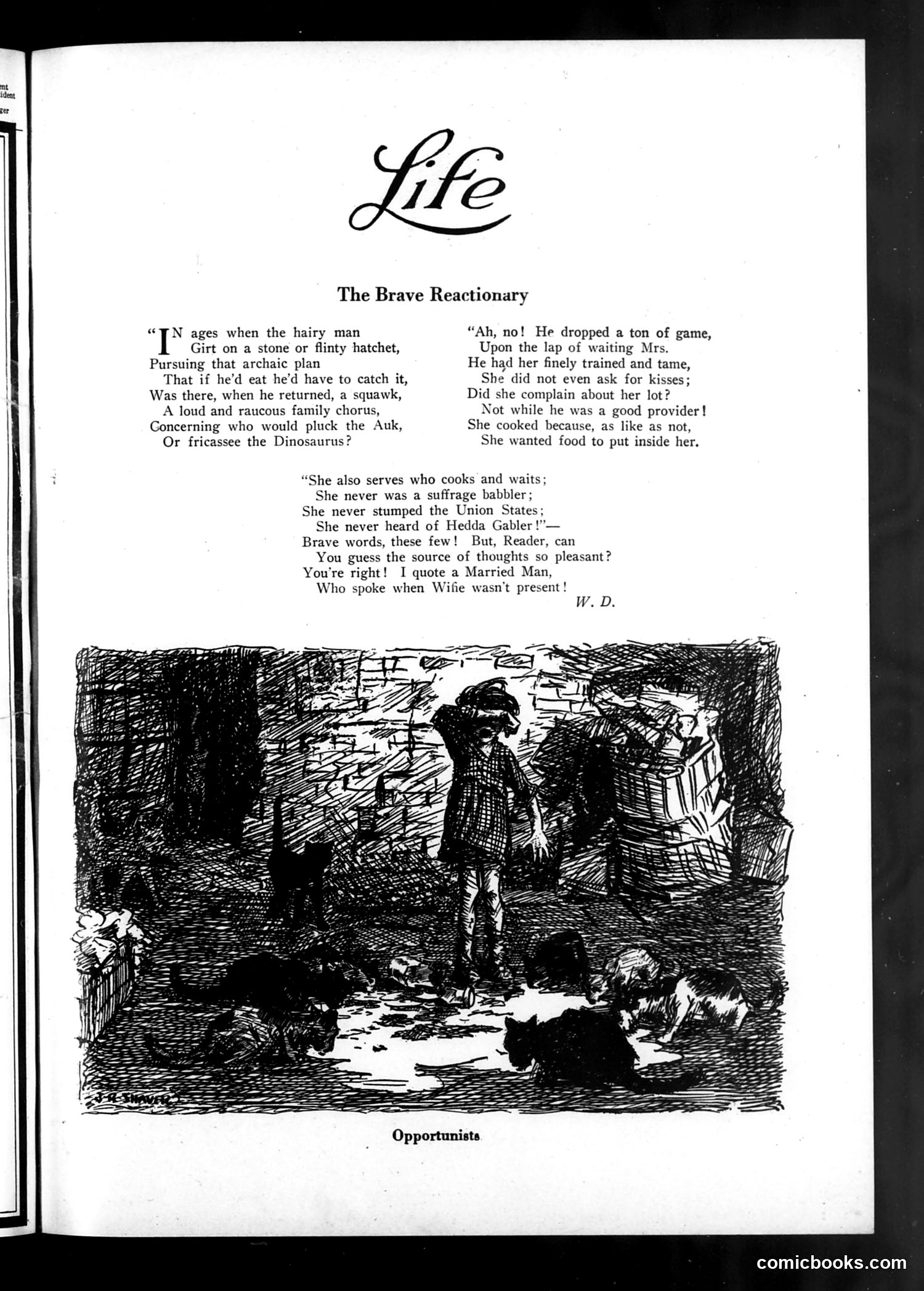
This satirical poem and illustration critique a man who pursues outdated, "archaic" pursuits (hunting dinosaurs, catching auks) while his wife manages domestic life without complaint. The poem mocks his nostalgic resistance to modernity—he ignores suffrage movements ("never was a suffrage babbler"), dismisses progressive figures ("never heard of Hedda Gabler"), and remains willfully ignorant of contemporary issues. The illustration titled "Opportunist" shows a man standing among what appear to be animals or figures in a domestic setting, likely depicting the contradiction between his claimed bravery and his actual passivity. The satire targets conservative men who resist social progress while their wives silently enable their lifestyle through traditional homemaking. The poem's attribution to "W.D." and the "Married Man" framing suggests this criticizes masculine reactionism in the face of early 20th-century social reform.
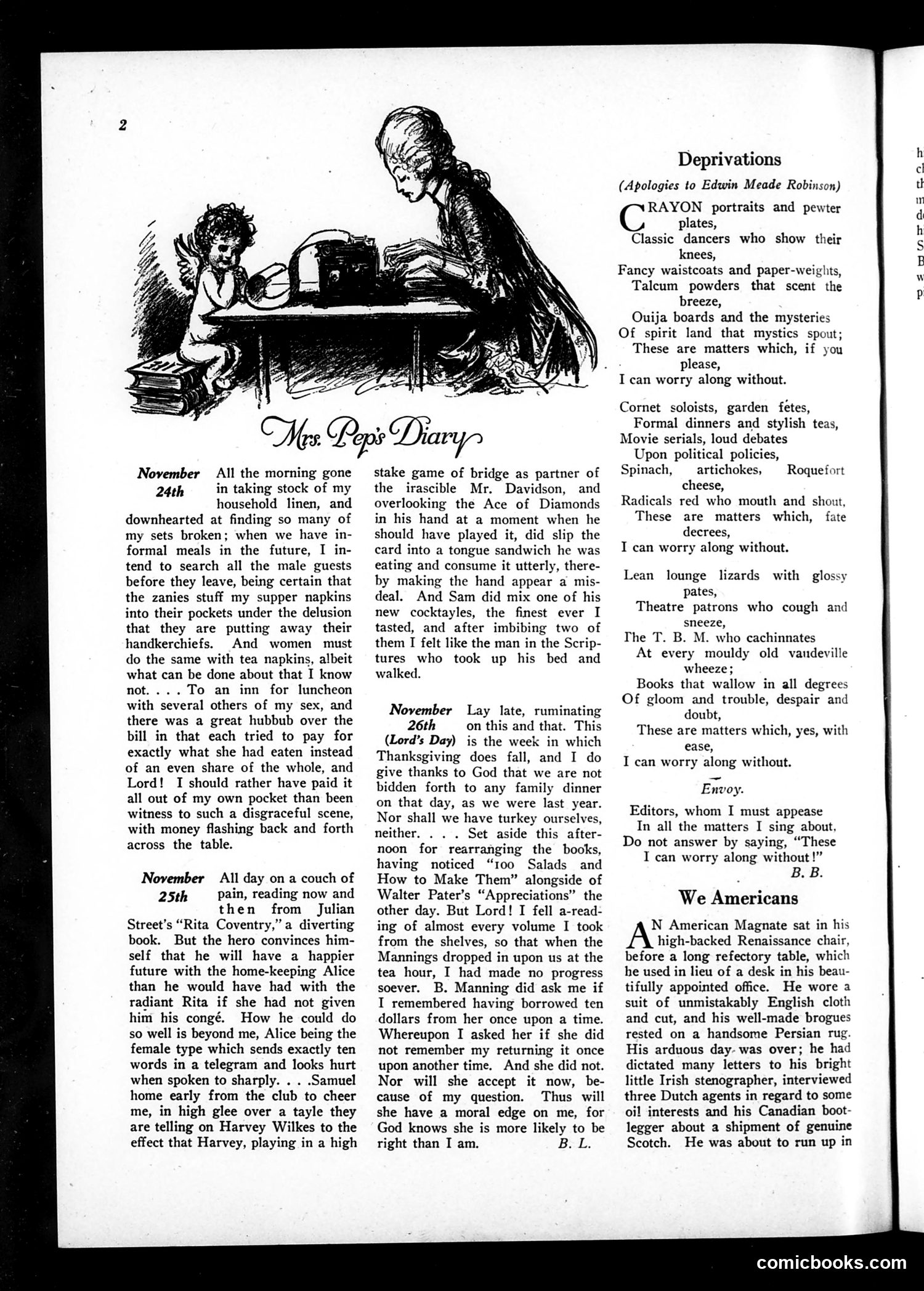
The page contains two sections. **Mrs. Pep's Diary** presents domestic complaints from November 1924-25, satirizing household management—servants pocketing napkins, damaged linens, and financial disputes over shared dinner costs. The adjacent poem **"Deprivations (Apologies to Edwin Meade Robinson)"** is social satire listing trivial modern concerns upper-class readers needn't worry about: Ouija boards, cornet soloists, lousy theater patrons, and books about despair. The title and structure mock Robinson's serious poetry by applying it to frivolous anxieties. **"We Americans"** begins a separate piece about an American diplomat's pretentious behavior at a formal dinner, apparently critiquing American social pretension abroad. The satire targets genteel domestic complaints and class-based anxieties.
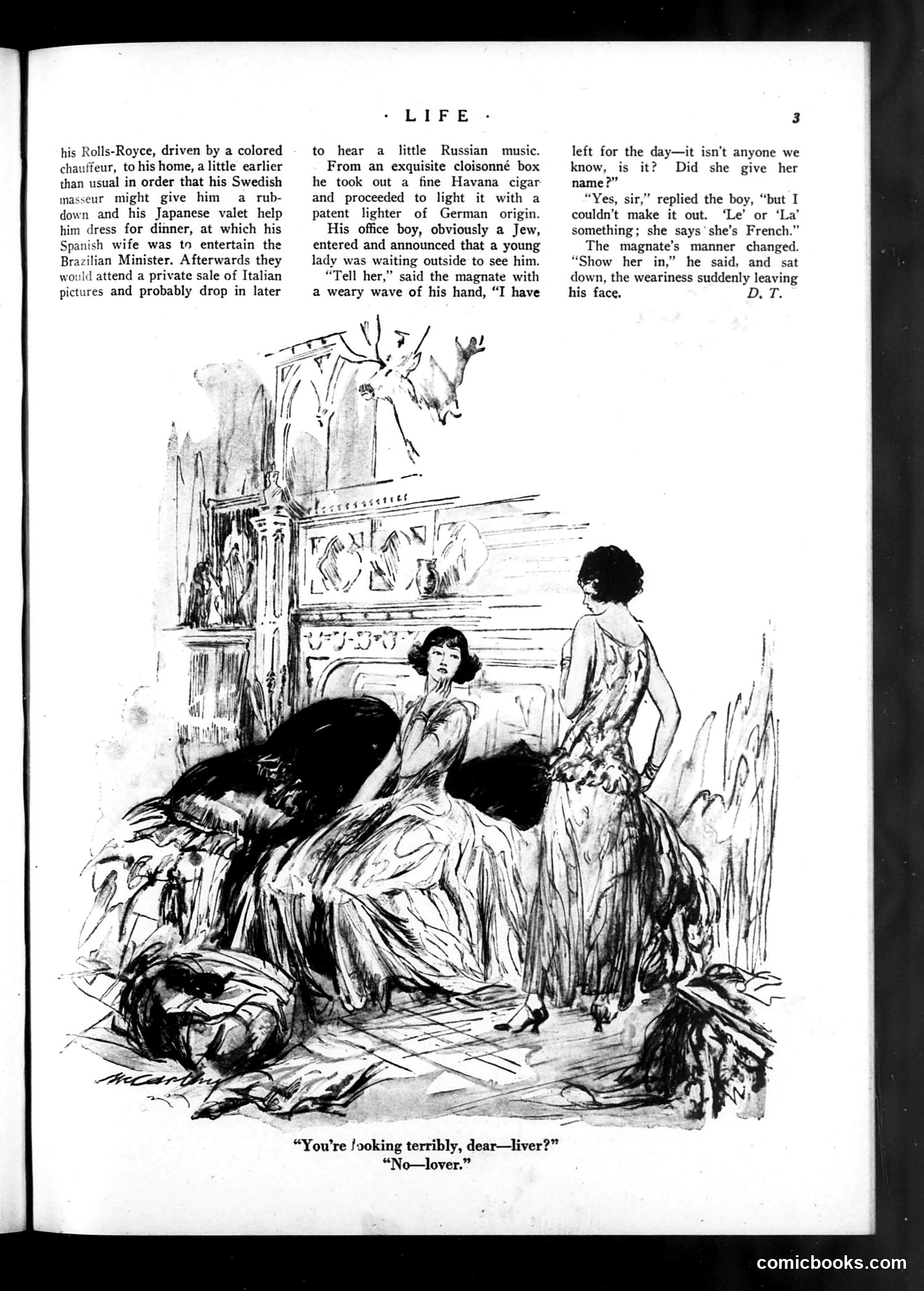
This page from *Life* magazine contains a satirical story and illustration about a wealthy man's romantic entanglement. The narrative describes a man with a Rolls-Royce and a colored chauffeur attending a Brazilian Minister's event, then hearing Russian music from a cloisonné box and lighting a Havana cigar with a German lighter—details emphasizing his cosmopolitan affectations and wealth. The accompanying illustration shows an intimate bedroom scene. The caption reads: "You're looking terribly, dear—liver?" / "No—lover." The satire targets upper-class hypocrisy and infidelity. The joke plays on "liver" (illness) versus "lover" (affair), suggesting the woman's exhaustion stems from an extramarital relationship rather than health problems. The detailed setup mocking the protagonist's pretentious lifestyle makes the moral failing more pointed.
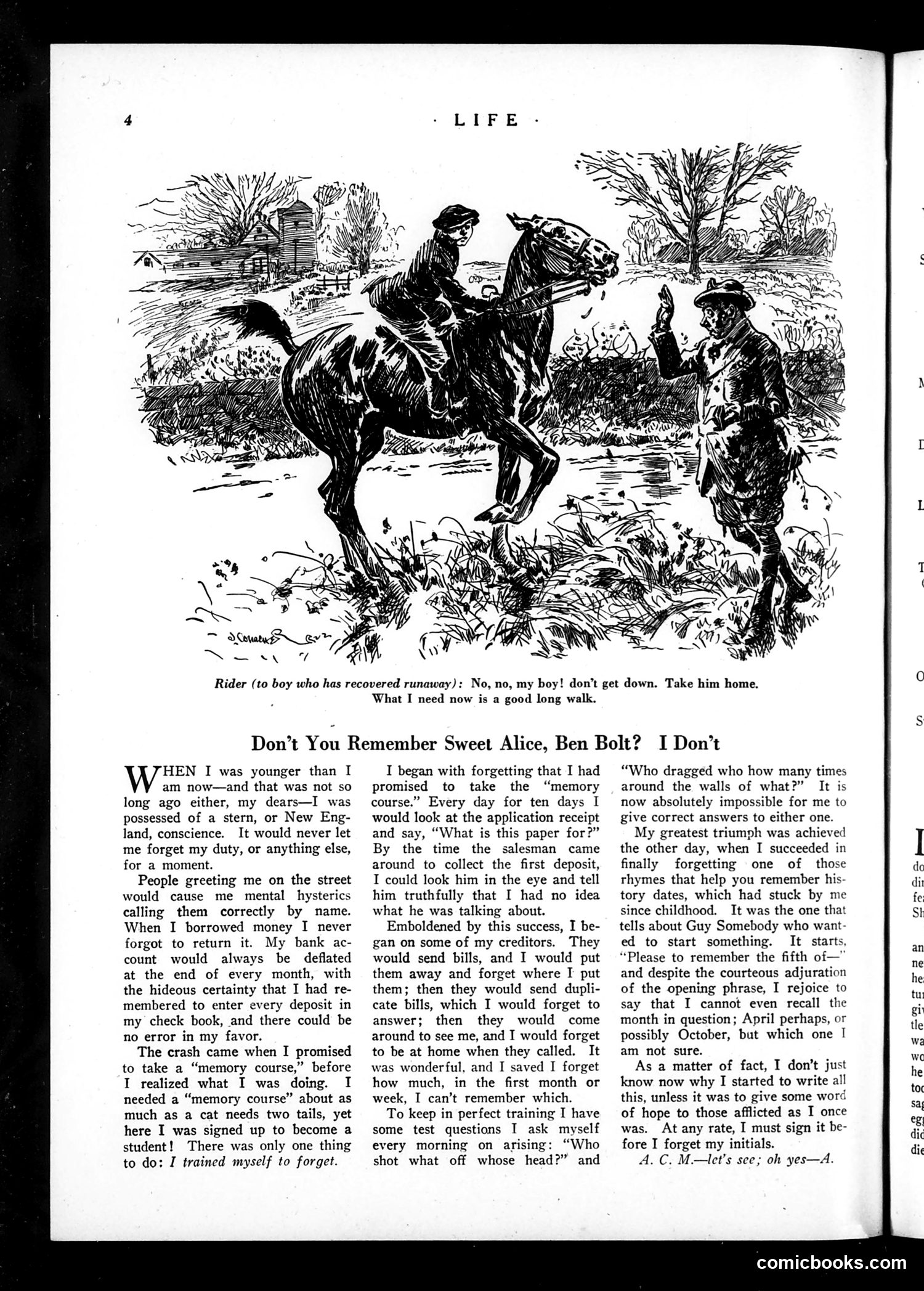
The illustration shows a man on horseback meeting another man on foot in a rural setting. The caption reads: "Rider (to boy who has recovered runaway): 'No, no, my boy! don't get down. Take him home. What I need now is a good long walk.'" This is a humorous domestic scene rather than political satire. The joke plays on the irony of someone who has just recovered a runaway horse—which would normally be exhausting—saying he now needs a walk to relax. The implication is that riding the spirited horse was so strenuous that the rider needs *more* walking to recover. The accompanying article, "Don't You Remember Sweet Alice, Ben Bolt?" is a nostalgic essay about memory and forgetfulness, unrelated to the cartoon.
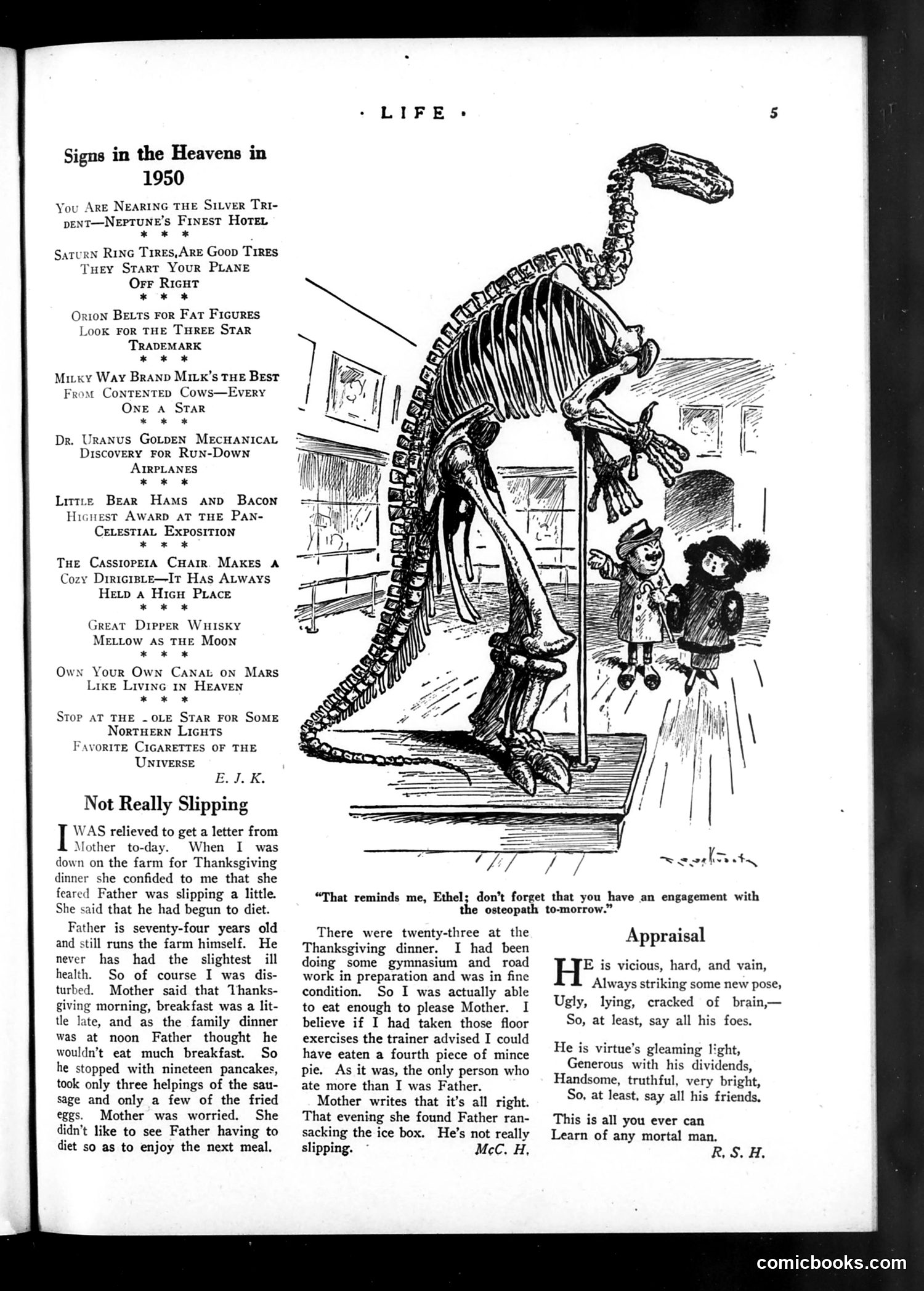
This 1950 *Life* magazine page contains humorous fake advertisements ("Signs in the Heavens in 1950") — absurdist product pitches disguised as celestial prophecies — and two separate pieces below. The main illustration shows a dinosaur skeleton in what appears to be a museum, with two children looking up at it. The caption jokes about an "engagement with the osteopath tomorrow," playing on the skeleton's obviously broken/misaligned posture. Below are two short prose pieces: "Not Really Slipping" (about an elderly farmer's health), and "Appraisal" (character sketches in verse form). These appear to be humorous vignettes rather than political commentary—typical *Life* magazine fare mixing satire, domesticity, and mild social observation without specific contemporary references.
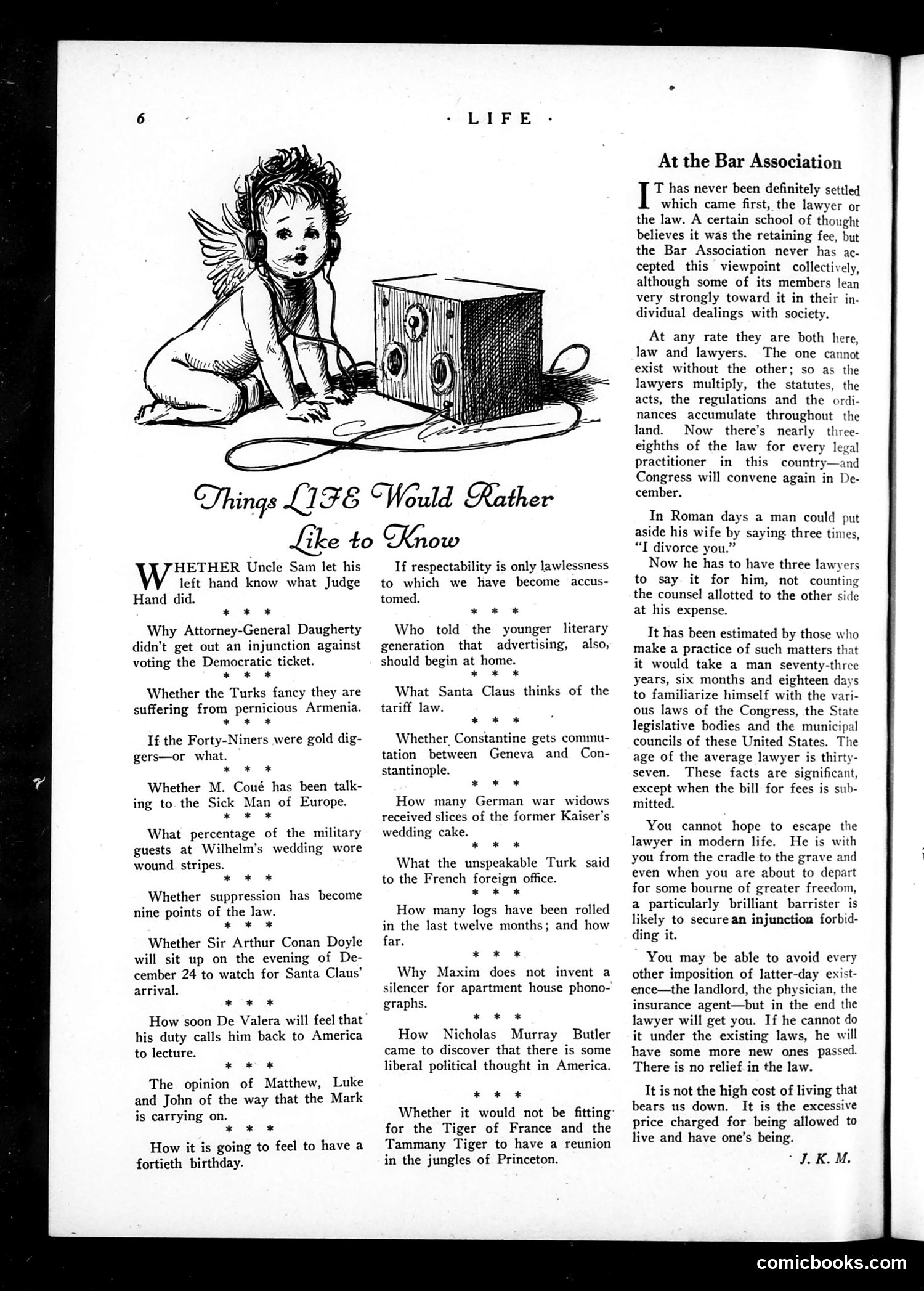
This page satirizes lawyers and the legal profession circa early 20th century. The left column presents "Things LIFE Would Rather Like to Know"—a series of humorous questions mocking contemporary legal and political figures, though most are too obscure or dated to identify specifically without additional context. The main article (right) argues that lawyers are unavoidable in modern life and increasingly expensive. It notes that becoming familiar with America's vast body of law takes lawyers 33+ years, and that legal fees are the true burden of modern existence—not the cost of living itself. The illustration shows a cherub or baby with a gramophone, though its connection to the text is unclear.
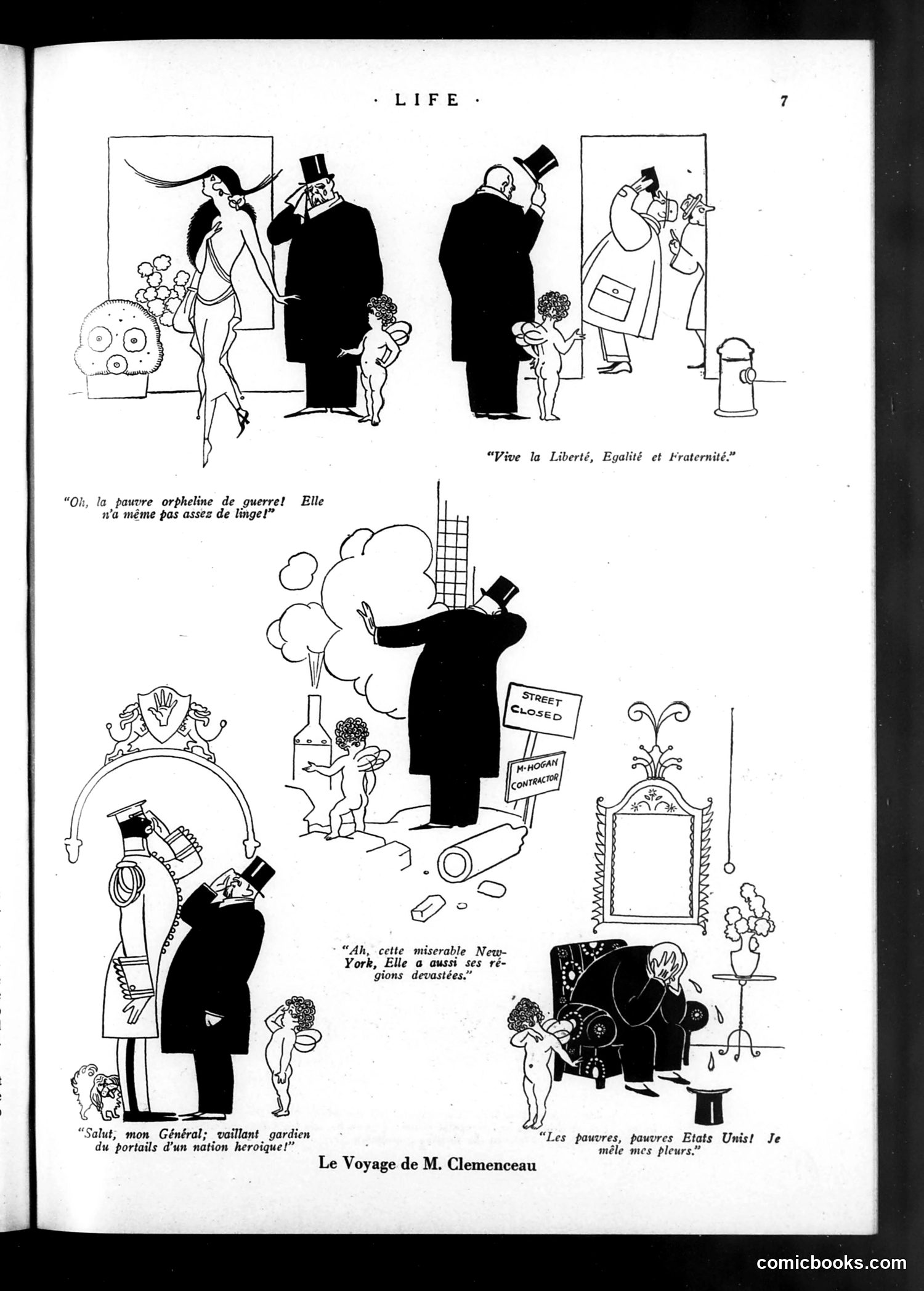
This page satirizes Georges Clemenceau's post-WWI activities through French captions and cartoon vignettes. The title translates to "The Voyage of M. Clemenceau." The cartoons depict Clemenceau (the tall figure in top hat) encountering various post-war scenes: wealth disparity, construction/rebuilding efforts, and social upheaval. One caption references "war orphans" lacking even angels' help; another mocks New York's poverty amid wealth. The satire critiques how Clemenceau, France's wartime leader, navigated the chaotic post-war landscape—balancing military victory with social disorder, reconstruction chaos, and America's involvement (references to "United States"). The cherubs and allegorical imagery contrast idealistic revolutionary rhetoric ("Liberty, Equality, Fraternity") against grim reality. This appears to be American satirical commentary on French post-WWI reconstruction challenges.
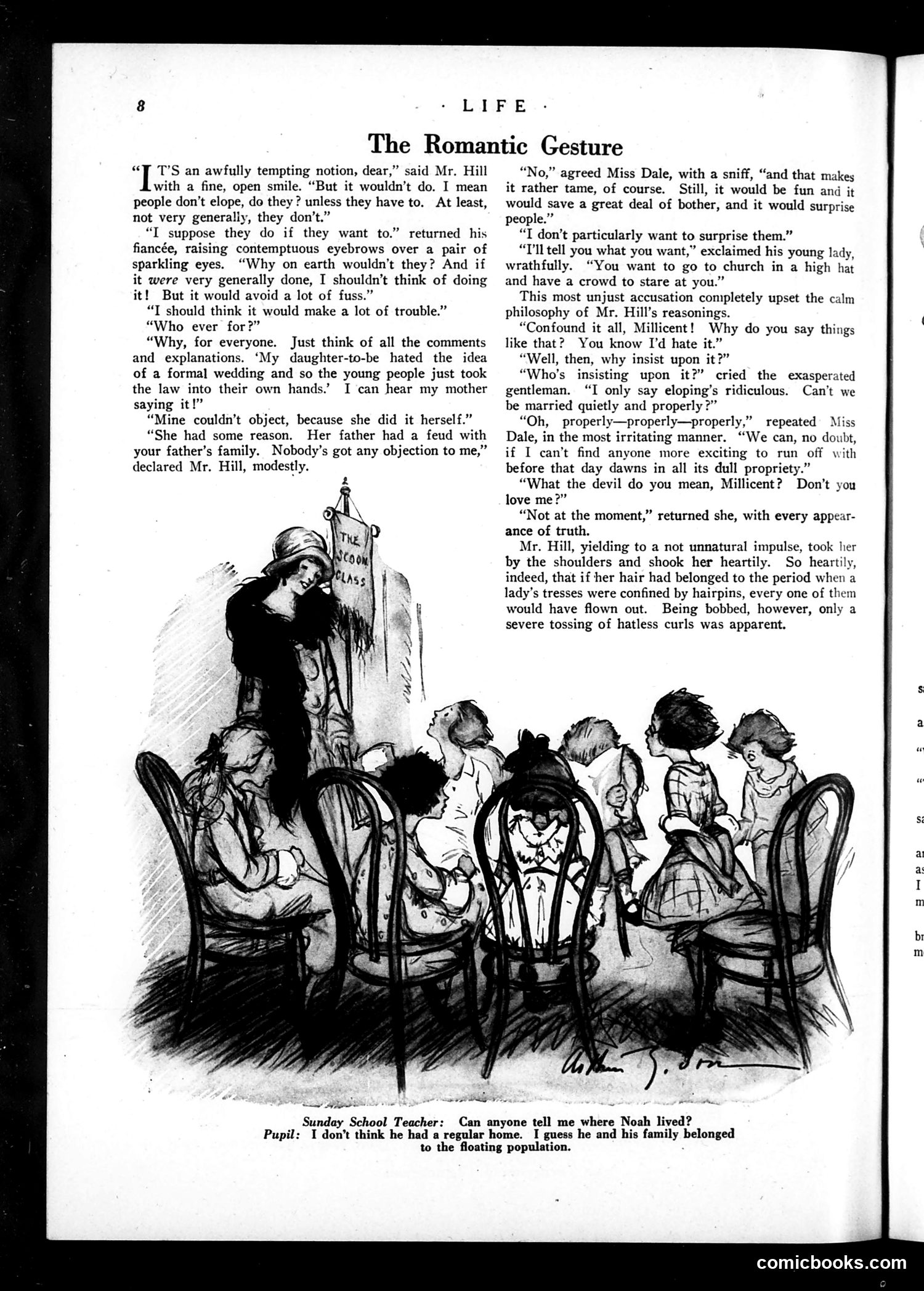
This page satirizes romantic elopement and unconventional weddings. Mr. Hill argues that couples should elope rather than endure formal weddings with their families present. Miss Dale counters that elopement is "ridiculous" and prefers a proper church ceremony. The cartoon below illustrates the joke: a Sunday School teacher asks pupils where Noah lived, expecting a biblical answer. A student replies Noah and his family "belonged to the floating population"—a pun equating Noah's ark with vagrant communities of the era who lived on boats/barges. The satire mocks both romantic rebellion (eloping) and the absurd literalism of children's responses to religious instruction. The page appears from early-to-mid 20th century Life magazine's humor section.
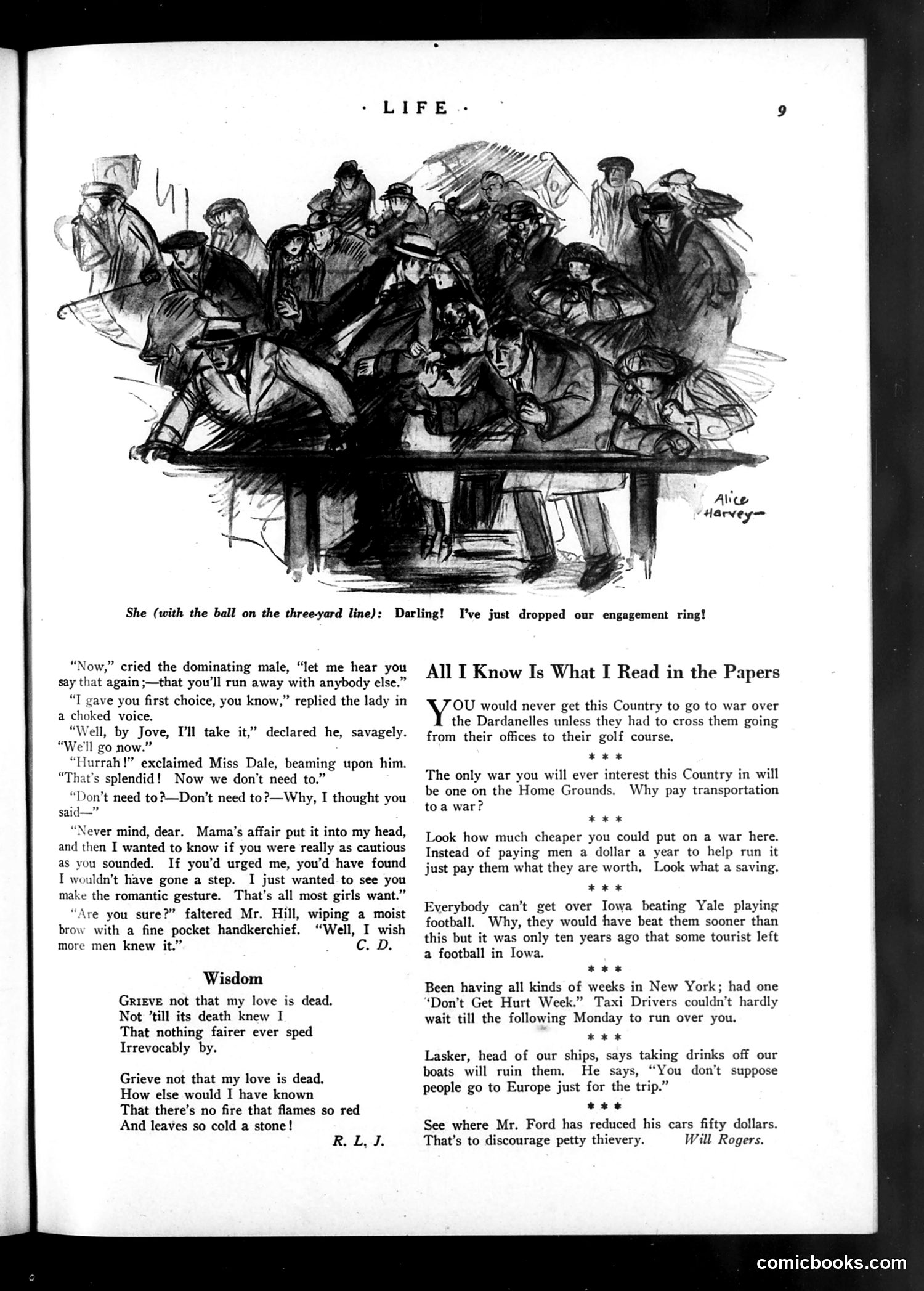
This page from *Life* magazine contains satirical commentary on American society during what appears to be the World War I era. The cartoon at top depicts a crowded social scene where a woman announces she's broken her engagement ring. The accompanying dialogue satirizes upper-class romance and materialism. The column "All I Know Is What I Read in the Papers" offers sharp social criticism through brief quips: - It mocks the wealthy for avoiding war by staying in offices and playing golf - It satirizes the economic logic of war, suggesting it's cheaper than normal commerce - It ridicules American preoccupation with sports (Yale football, Iowa football) over serious matters - It includes jokes about New York social life and Mr. Ford's car price reductions The tone is cynical about American priorities during wartime—critiquing both wealthy avoidance of sacrifice and public distraction from serious issues.
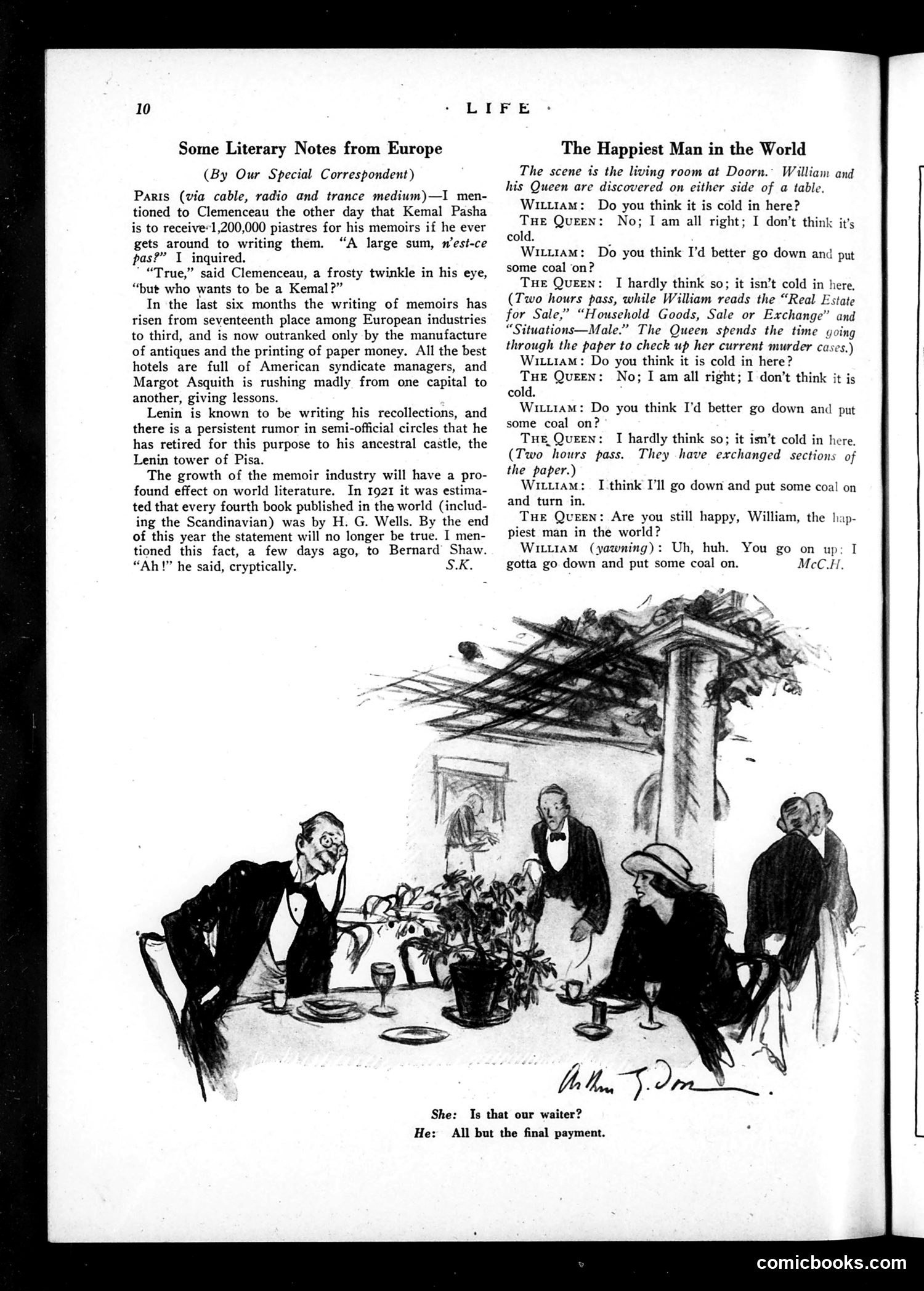
This page contains two distinct pieces: 1. **"Some Literary Notes from Europe"**: A column by a Paris correspondent discussing European literary matters, including Clemenceau's memoir publication and the growth of the memoir industry. 2. **"The Happiest Man in the World"**: A comic dialogue between William and his Queen at their home in Doorn (likely referring to exiled German Kaiser Wilhelm II). The joke centers on William repeatedly insisting on going downstairs to put coal on the fire despite the Queen's assurances it's not cold—depicting him as obsessive or henpecked. The accompanying cartoon shows a dinner scene with the caption: "She: Is that our waiter? / He: All but the final payment"—a joke about unpaid servants or debts.
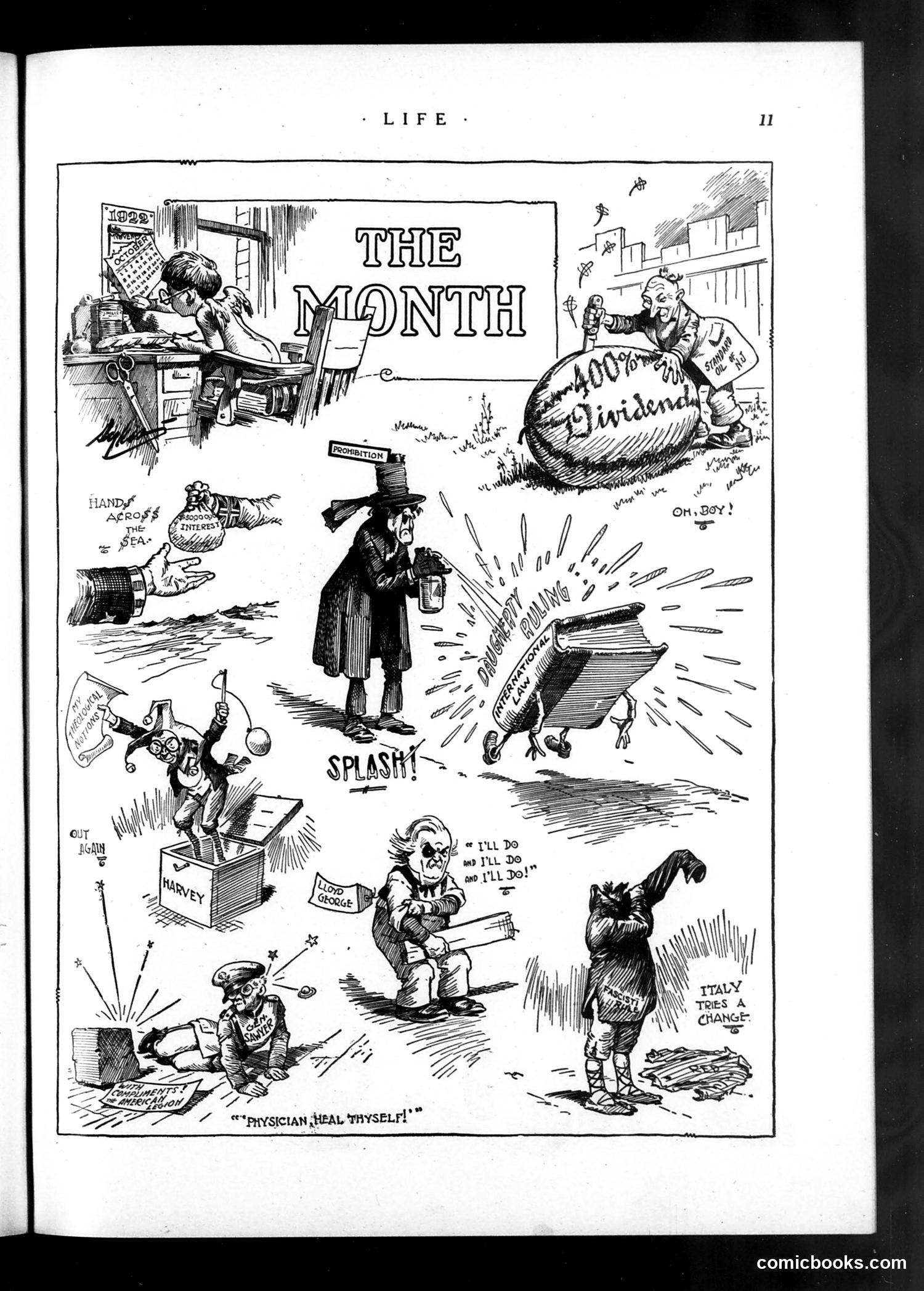
This Life magazine page presents a satirical overview of current events through multiple vignettes. The central figure appears to be a Prohibition enforcement officer standing amid chaos—a "Splash!" suggesting the failure of alcohol prohibition policies. Key depicted issues include: - **Dividend bubble**: A large inflated bubble labeled "Dividends" with a figure riding it, satirizing stock market speculation - **Prohibition enforcement**: The central officer amid destruction, suggesting the policy's ineffectiveness - **Political figures**: Various caricatured characters representing contemporary politicians or public figures - **"Physician, heal thyself!"**: The caption suggests governmental hypocrisy—authorities unable to solve problems they create The overall theme mocks 1920s American social and economic policies, particularly Prohibition's unintended consequences and financial speculation preceding the era's economic troubles.
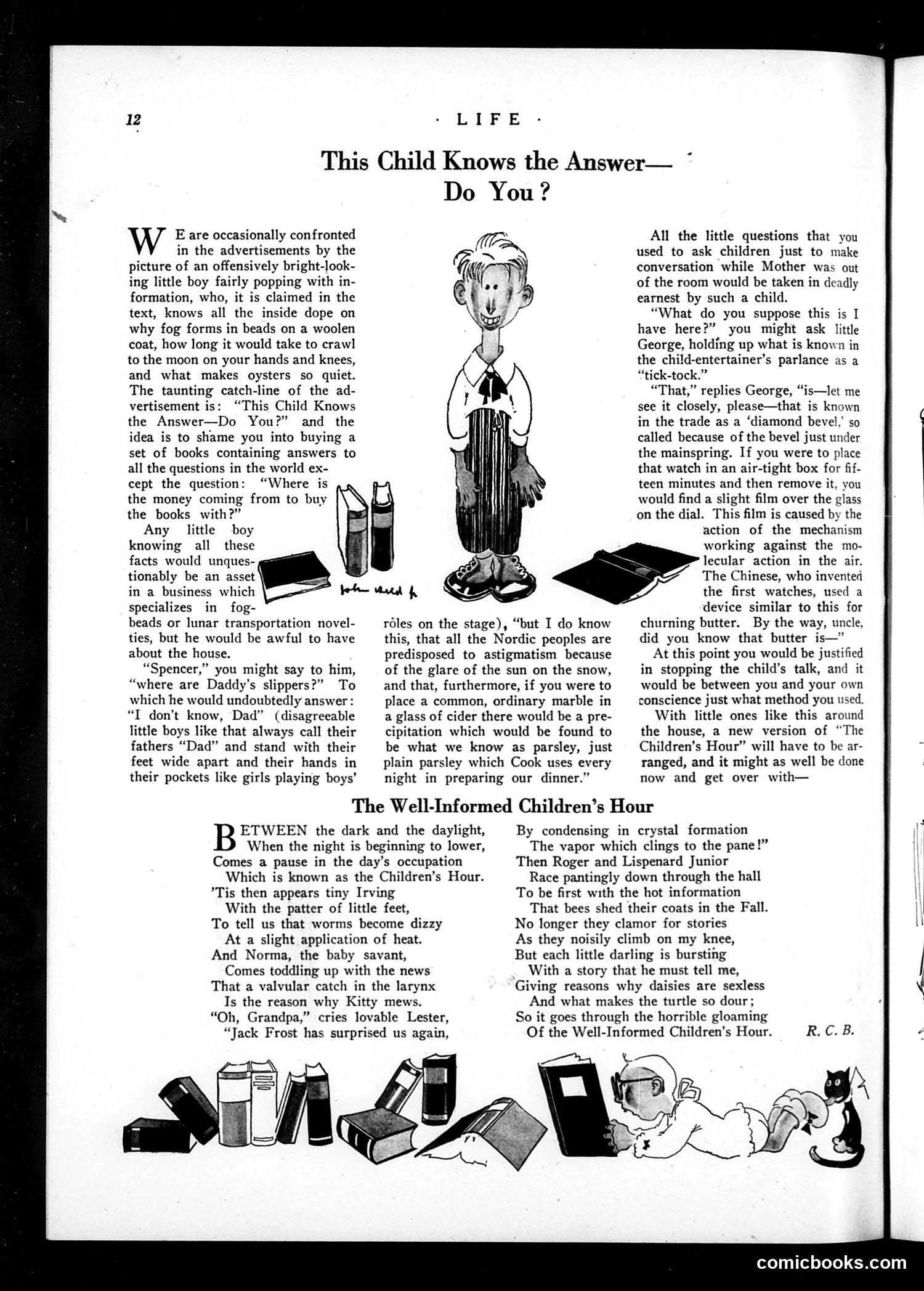
This satirical piece mocks children's encyclopedic answer books—popular reference works promising to explain everyday mysteries. The cartoon character represents the stereotypical "bright child" who memorizes facts from such books and enthusiastically recites them to beleaguered adults. The satire targets how these children become insufferable know-it-alls, pedantically explaining phenomena (why fog forms, oyster behavior, etc.) with unwarranted confidence. The article playfully warns adults that such a child in the house would become an unbearable nuisance. The second section, "The Well-Informed Children's Hour," appears to be humorous verse about the "Children's Hour"—that pause between dark and daylight when children demand entertainment and facts from exhausted parents and servants.
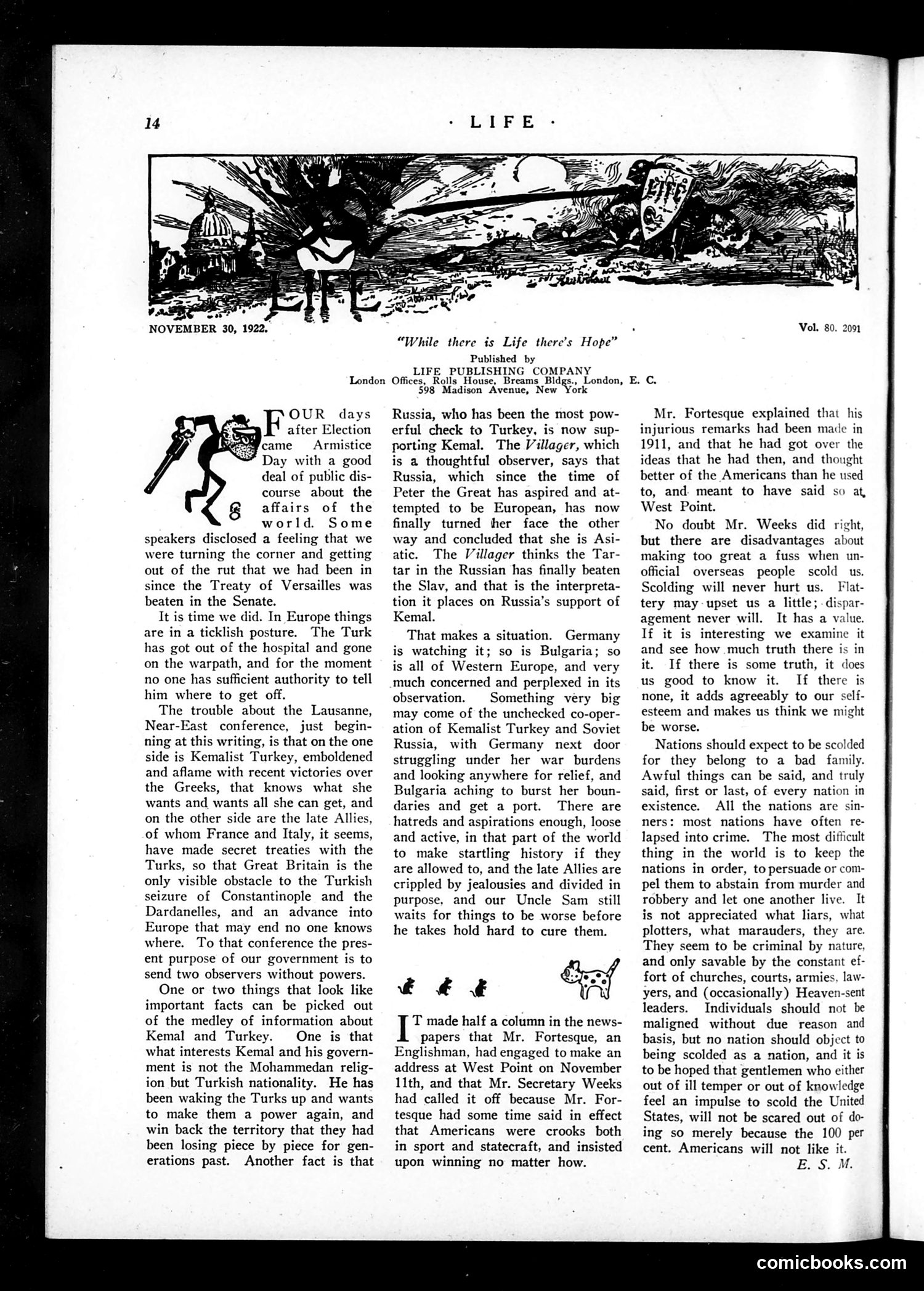
This November 1922 *Life* page discusses the Lausanne Near-East conference and Turkey's position. The cartoon at top (artist unclear) depicts chaotic diplomatic turmoil, likely representing the unstable situation in the Ottoman Empire's aftermath. The main text criticizes how post-war treaties and secret agreements between Allied powers have created confusion. It focuses on **Kemal's Turkey** as a powerful emerging force that has beaten Soviet Russia and is shifting toward Asia rather than Europe. The piece argues that unnamed Western diplomats (possibly **Mr. Fortesque**, an Englishman mentioned) have made inflammatory remarks about American sportsmen and stateraft, causing diplomatic friction. The author urges restraint: nations shouldn't scold each other, as most have criminal histories. The satire targets both diplomatic incompetence and jingoistic American pride.
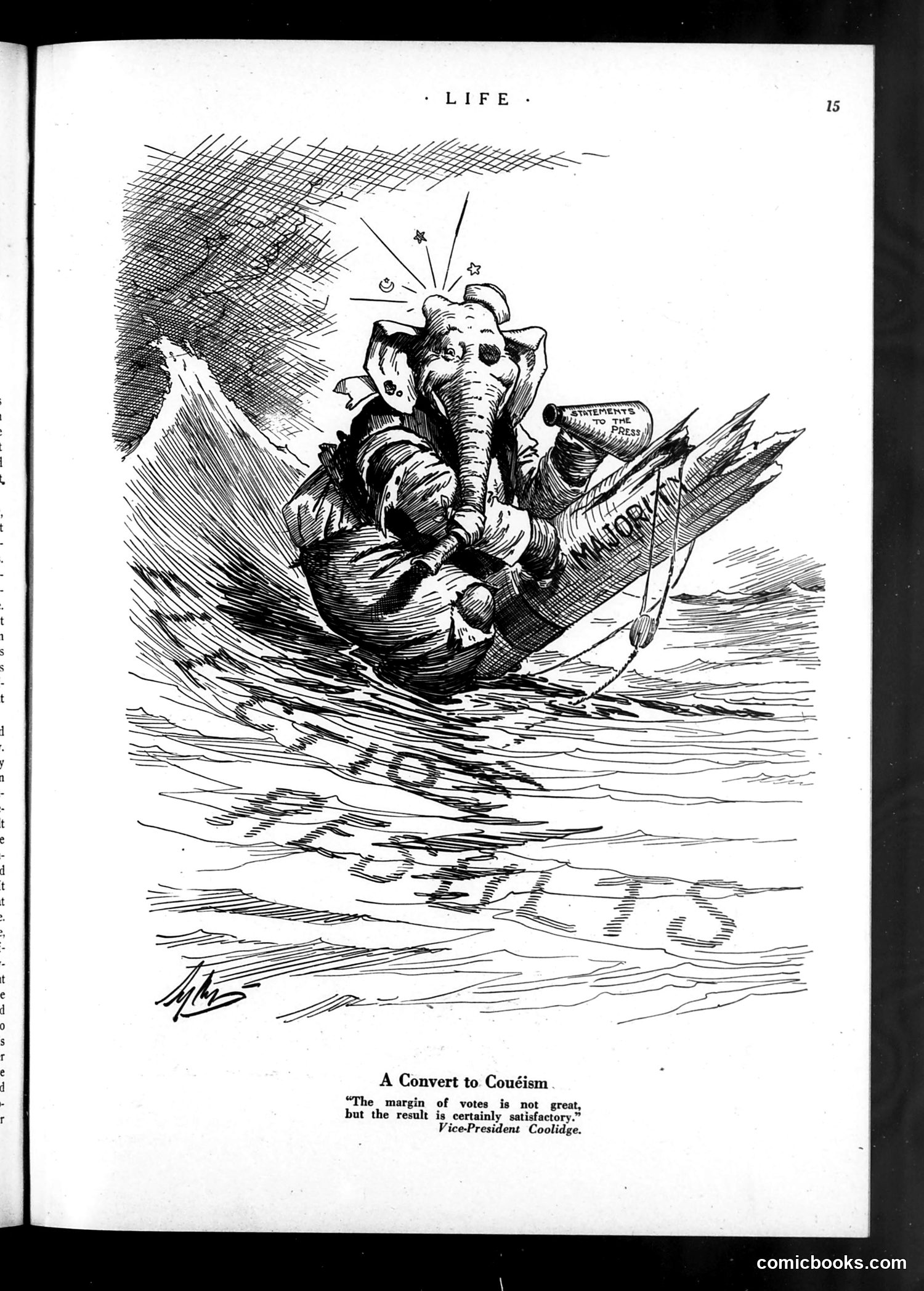
This cartoon satirizes Vice-President Calvin Coolidge's optimistic interpretation of election results. The image depicts an elephant (Republican Party symbol) precariously balanced on a tightrope over turbulent waters, appearing to struggle while stars circle its head—suggesting dizziness or difficulty. The satire targets Coolidge's quote claiming satisfaction despite a narrow electoral margin. "Couéism" refers to Émile Coué's popular self-help philosophy of positive thinking ("Every day, in every way, I am getting better and better"). The cartoonist mocks Coolidge for employing similar self-deluding optimism—declaring victory while the Republican Party's actual position appears dangerously unstable. The elephant's precarious predicament contradicts his complacent statement, exposing the gap between political reality and rhetoric.
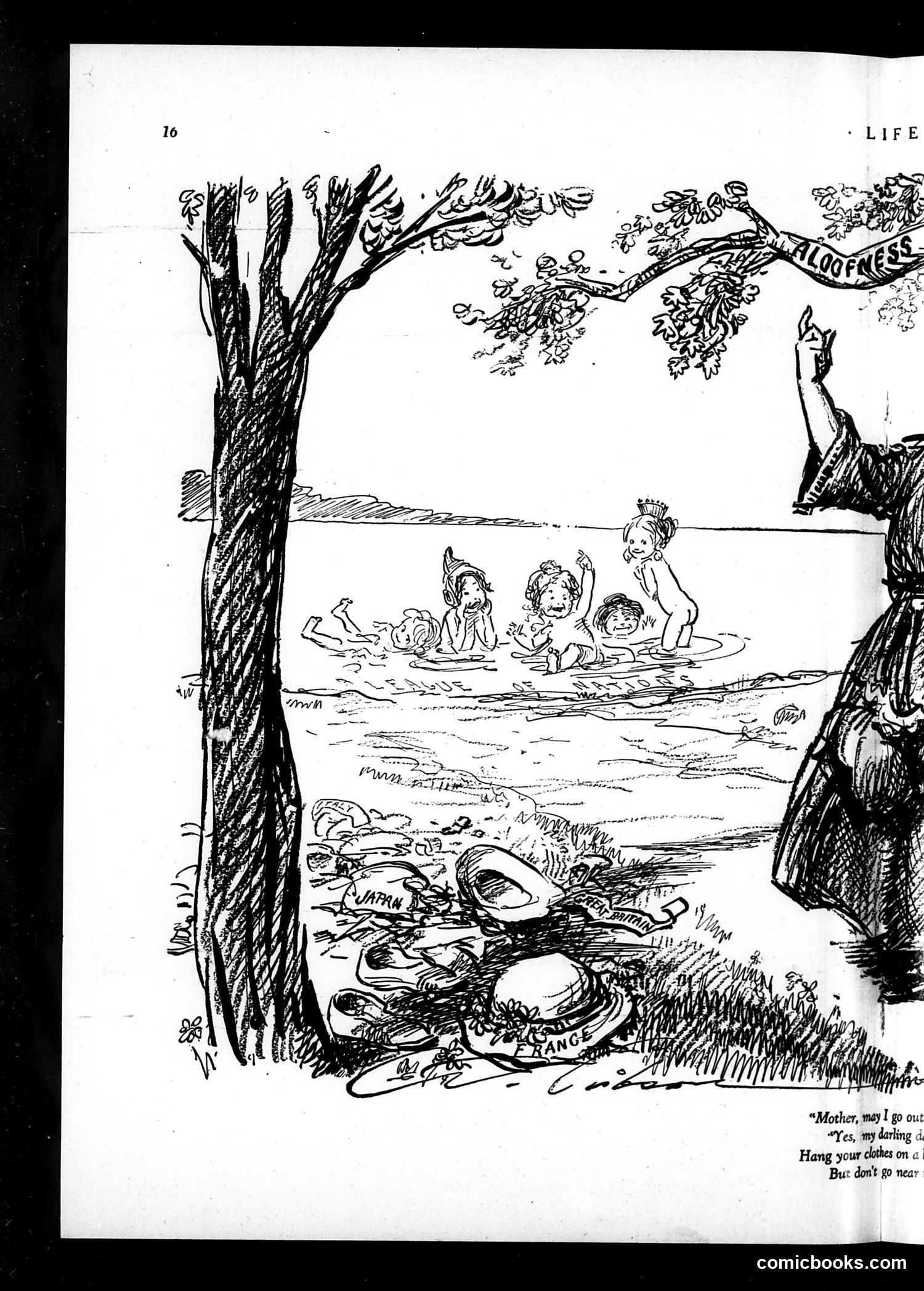
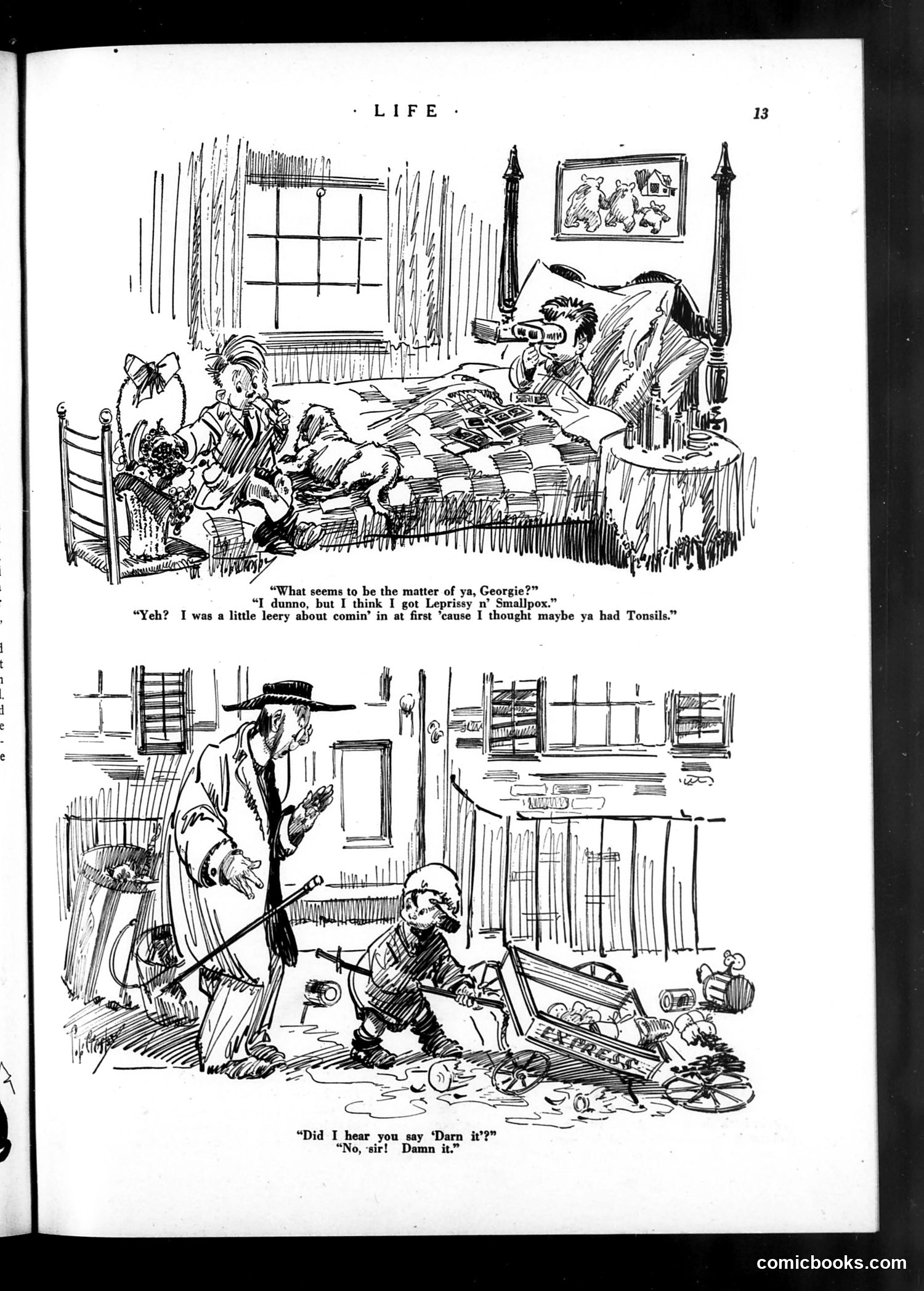
This is a single cartoon satirizing children's water safety. It shows children playing in a body of water (appears to be a pond or stream) while discarded clothing and what look like hats litter the foreground. The partially visible caption suggests a mother granting permission for outdoor play with safety instructions about hanging clothes and avoiding certain areas—likely a reference to the folk rhyme "Mary, Mary, Quite Contrary" or similar period cautionary verse about water dangers. The scattered garments in the foreground create dark humor by suggesting children who ignored warnings, possibly implying drowning or disappearance. This appears to be satirizing how children ignore parental safety advice regarding water hazards—a common social concern in early-to-mid 20th century American life.
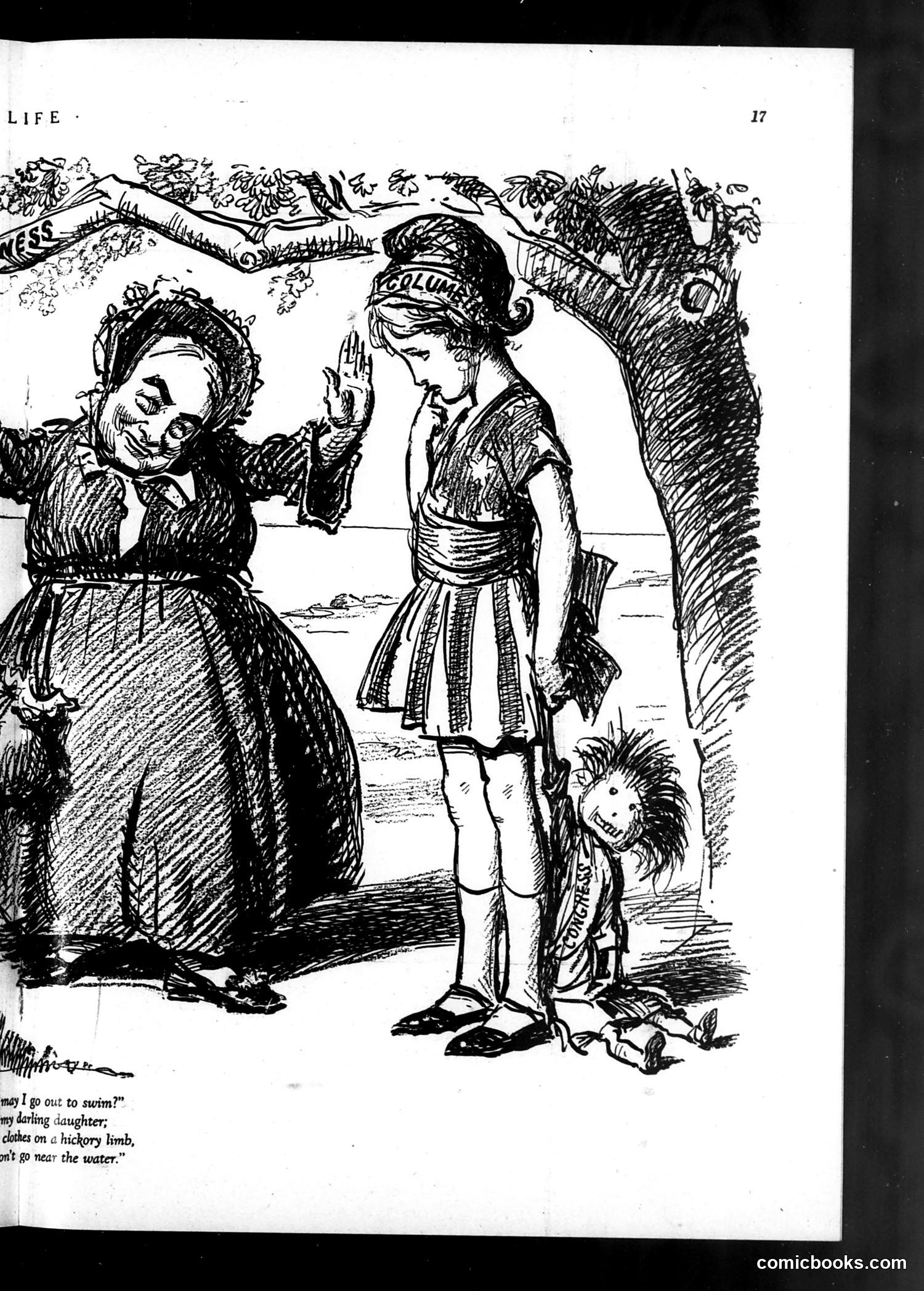
This page shows a single illustration depicting a mother and daughter in what appears to be an outdoor, rural setting. The mother wears a bonnet and long dress; the daughter is dressed more simply with a headband. The visible text is a fragment of dialogue about swimming restrictions—the mother warns her daughter not to go near the water, instructing her to leave clothes on a hickory limb (a tree branch). The satire likely comments on **parental overprotectiveness or outdated moral restrictions on children's freedom**, particularly regarding girls' independence and physical activity. The "hickory limb" reference suggests rural/working-class settings. Without the full caption or context from Life magazine, I cannot identify the specific political or social target of this particular joke with certainty.
This is a theater review column critiquing four Broadway productions. The satirical opening mocks the reviewer's newfound humility about theater, using exaggerated piety ("dressed in a gingham frock and sunbonnet"). The reviews cover: 1. **"Rain"** — An adaptation of Somerset Maugham's story about a prostitute named Sadie Thompson. The reviewer notes cynical expectations that the Baptist audience would demand sanitizing the material, but praises Jeanne Eagels' performance despite her not appearing physically worn-down enough for the role. 2. **"Merton of the Movies"** — Glenn Hunter plays a delusional film extra. The reviewer emphasizes Hunter's tragic performance transforms comedic source material into something genuinely poignant and emotionally affecting. 3. **Musical comedies** — Brief mentions of "Up She Goes" and "Little Nellie Kelly." The satire targets theatrical pretension and audience expectations—particularly how "respectable" audiences demand moral redemption narratives, and how skilled actors can elevate material through nuanced performance.
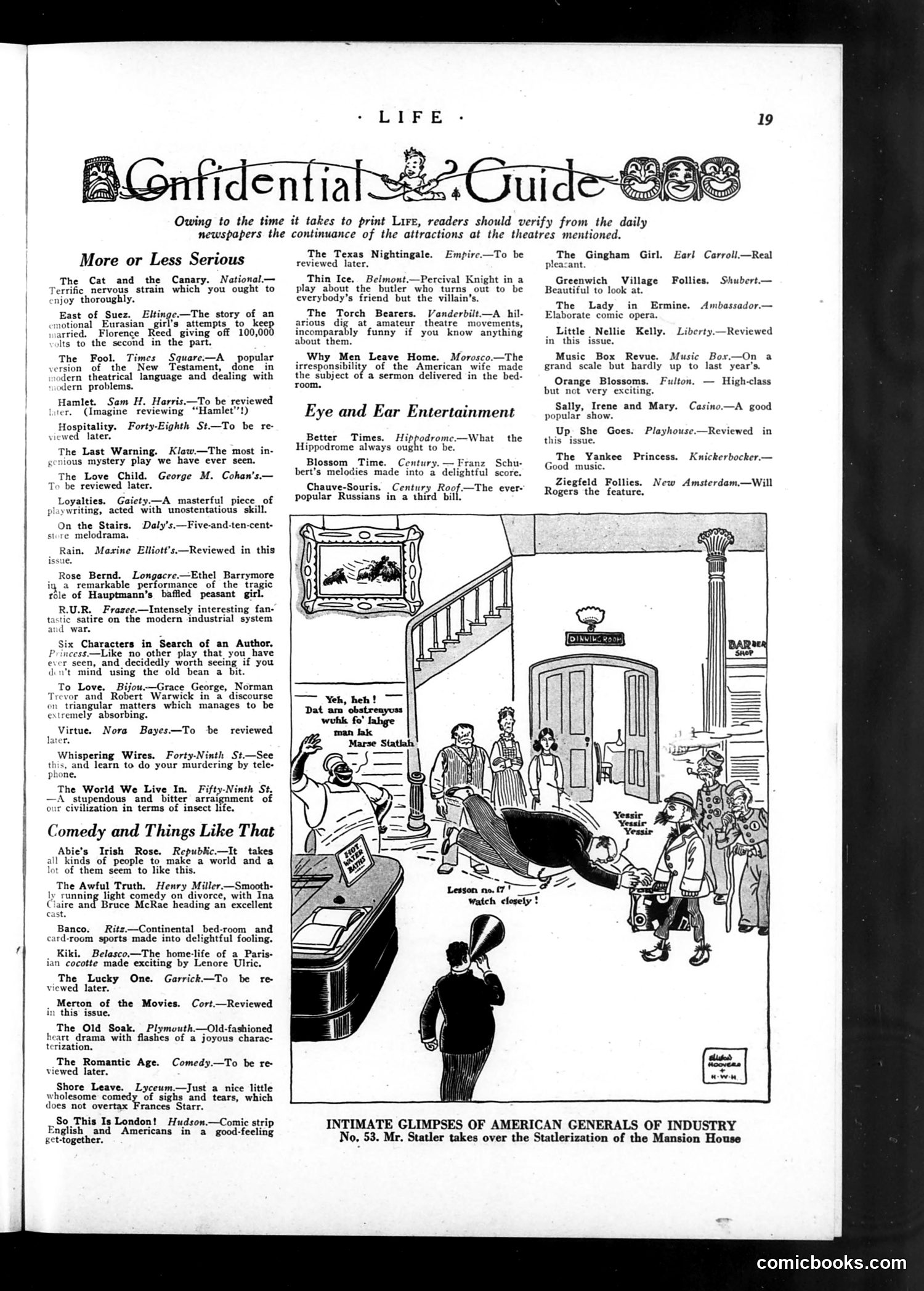
This page from Life magazine (a satirical publication, not the modern photo magazine) is primarily a **theater guide and review section**, not a political cartoon. It lists Broadway shows with brief, witty critical descriptions—the magazine's signature style of combining entertainment listings with sharp commentary. The only illustration shows a domestic scene labeled "Lesson No. 17—Watch closely!" depicting what appears to be a family or group of people in a home interior, likely satirizing contemporary domestic life or marital relations (common Life themes of this era). The theater reviews themselves are the "satire"—using clever wordplay and sardonic observations about each production. For example, "The Fool" is described as "A popular version of the New Testament, done in modern theatrical language," and "Why Men Leave Home" sarcastically notes it makes "The irresponsibility of the American wife" into a sermon. This reflects 1920s Broadway culture and the magazine's role as arbiter of taste for educated urban audiences.
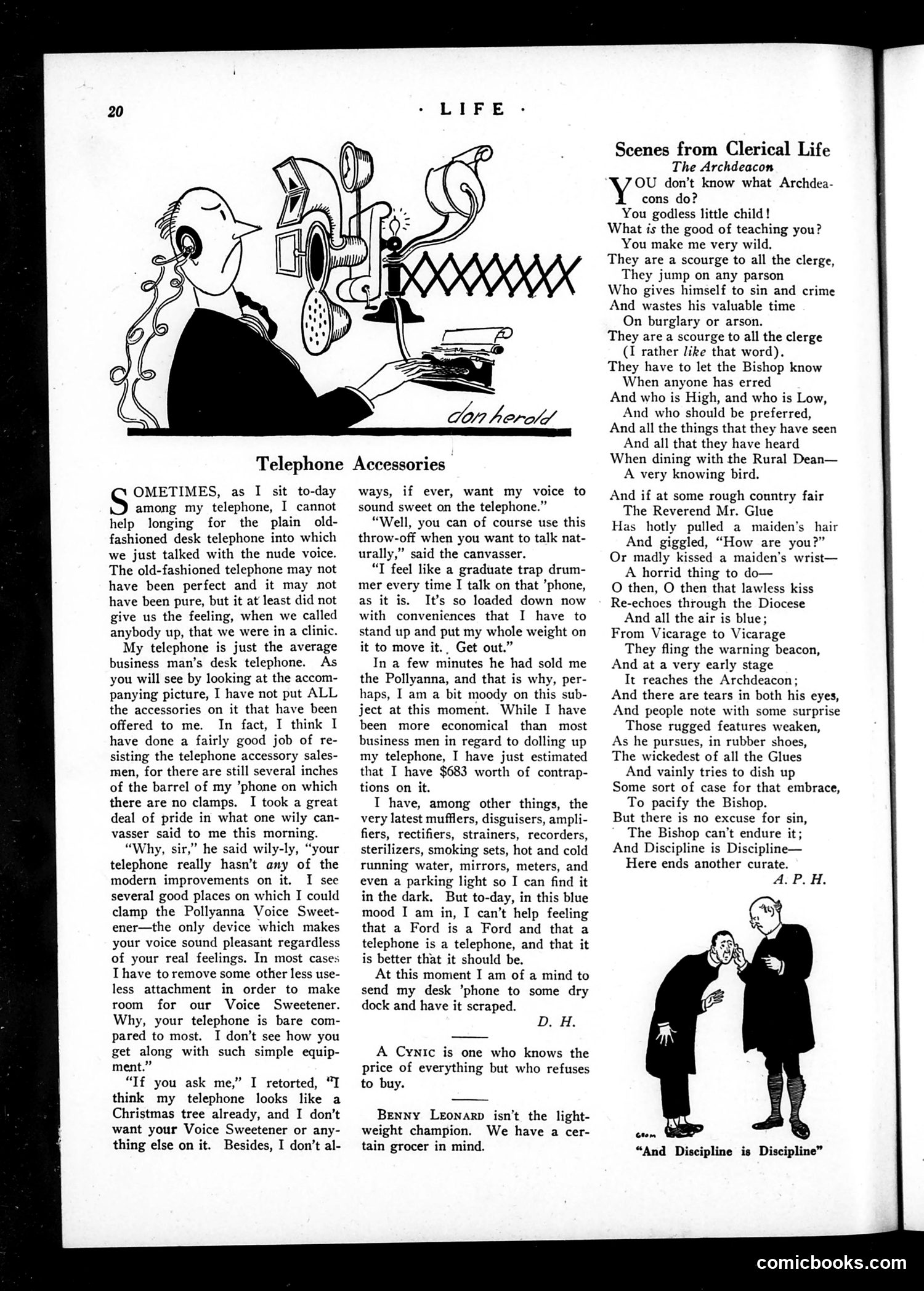
This page from *Life* magazine contains two satirical pieces: **"Telephone Accessories"** mocks the aggressive selling of unnecessary telephone gadgets. The author complains that salesmen have pressured him into purchasing $683 worth of add-ons—mufflers, amplifiers, recorders, mirrors, parking lights, even "hot and cold running water"—for his desk telephone. He's frustrated that a simple tool has become overcomplicated. The cartoon depicts a man buried under absurd telephone contraptions. The satire targets consumerism and manipulative sales tactics: the canvasser's compliment ("your telephone is bare") is deliberately designed to trigger a purchase despite the customer's resistance. **"Scenes from Clerical Life"** is a humorous poem about archdeacons—Anglican church officials responsible for discipline. It presents them as meddlesome bureaucrats who monitor other clergy members' behavior, report infractions to bishops, and obsess over hierarchical church rankings. The tone is gently mocking of institutional church administration. Both pieces reflect early-20th-century anxieties about technology proliferation and institutional bureaucracy.
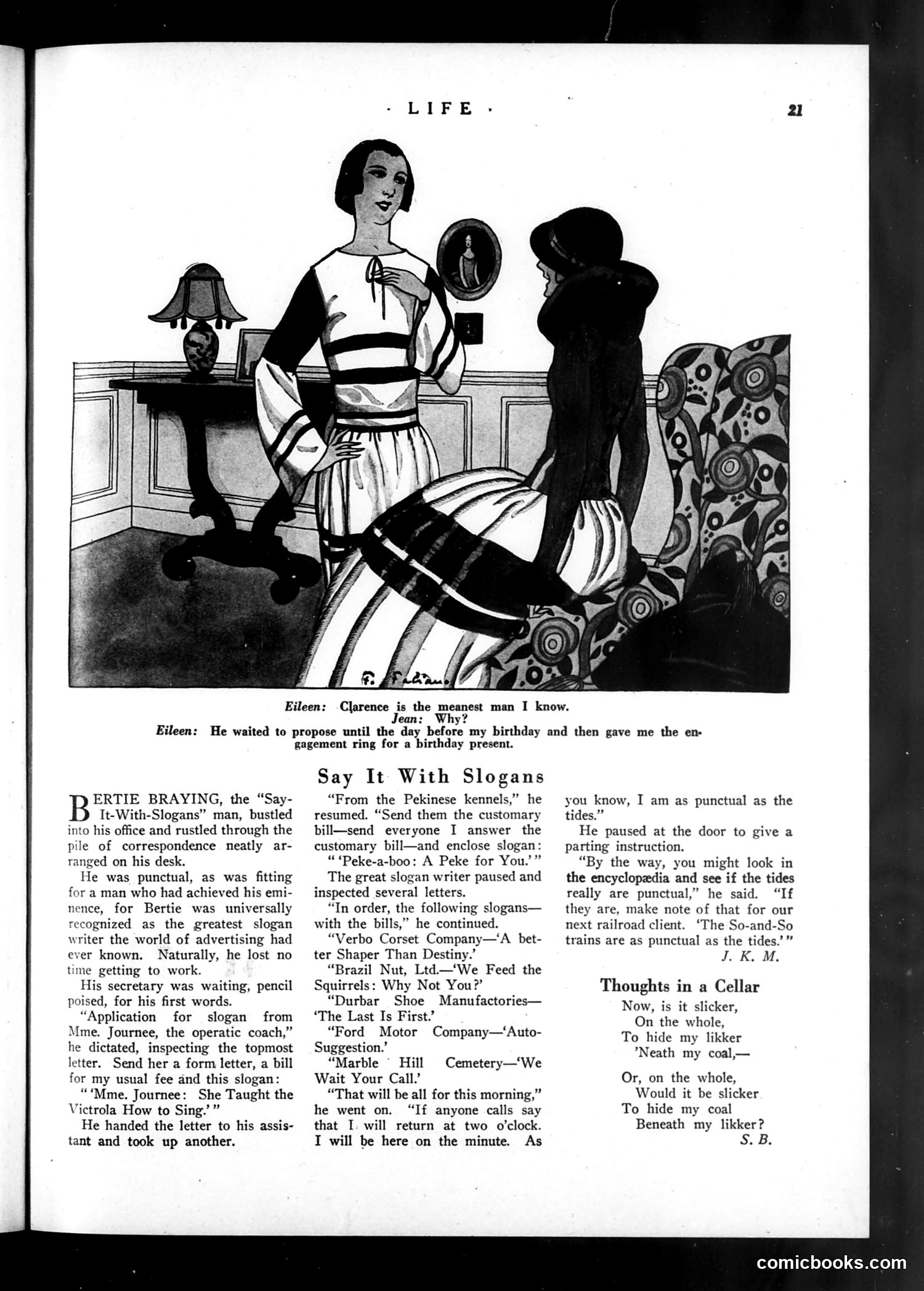
This page contains two satirical pieces: **"Say It With Slogans"** is a humorous story about Bertie Braying, a famous advertising slogan writer. The satire mocks both the advertising industry and the absurdity of catchy slogans. Bertie churns out ridiculous taglines (like "Peke-a-boo: A Peke for You" for dog breeders) with mechanical precision, treating them as profound wisdom. The joke's payoff comes when Bertie claims to be "as punctual as the tides"—then admits he doesn't actually know if tides are punctual. This punctures his pretentious authority, suggesting that advertisers and copywriters create impressive-sounding but meaningless claims. The accompanying cartoon shows a domestic scene where a woman complains her fiancé is "mean"—he timed his proposal for the day before her birthday so the engagement ring could serve as both gifts. It's gentle satire on romantic (in)sensibility. **"Thoughts in a Cellar"** is a light poem about Prohibition-era hiding spots for illegal liquor during alcohol's ban.
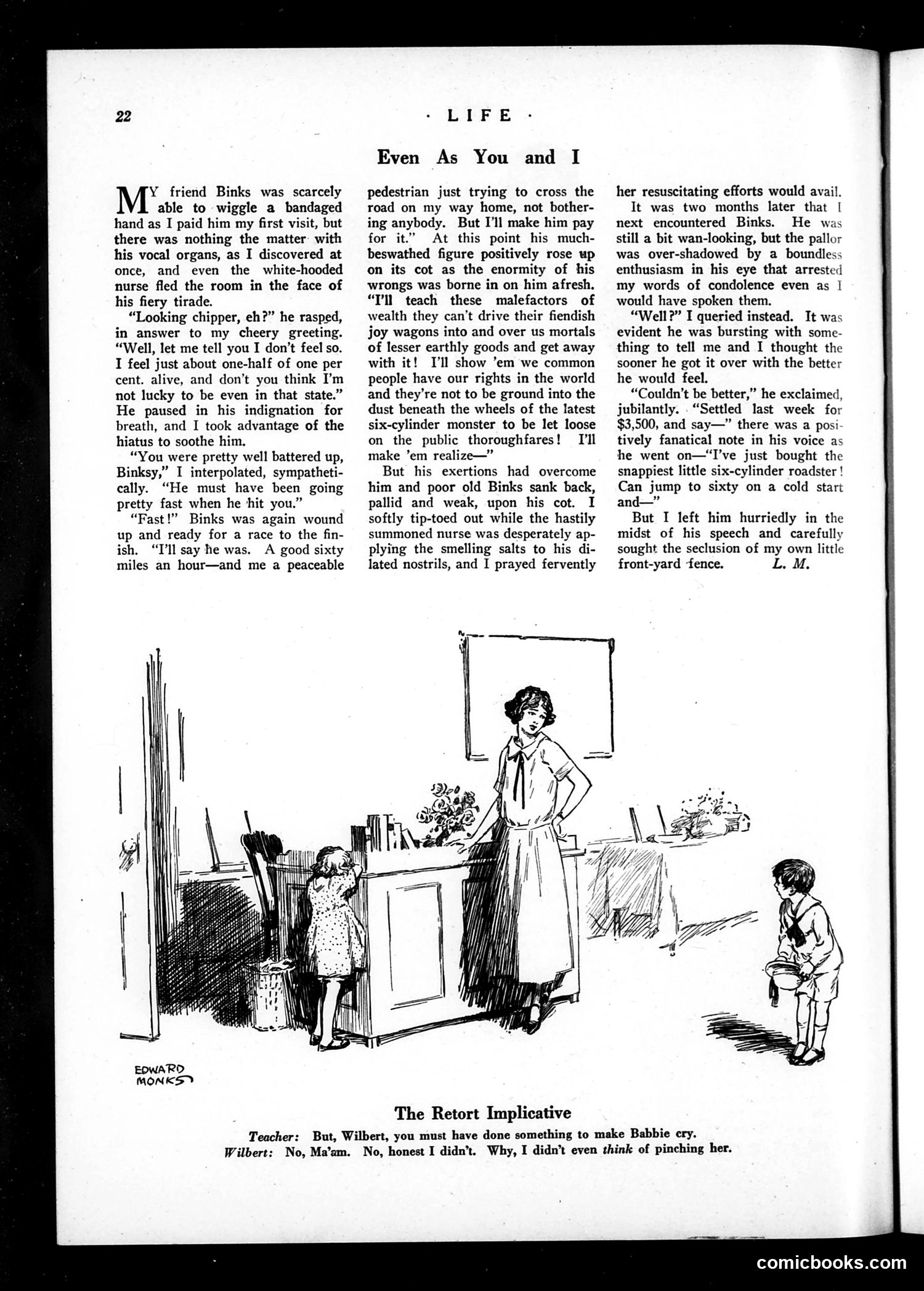
This story satirizes the American litigation culture of the early 20th century. A pedestrian named Binks is hit by a wealthy person's automobile and sustains serious injuries. Initially, he's righteous and angry, ranting about holding "malefactors of wealth" accountable and defending common people's rights. Two months later, the narrator encounters a transformed Binks: he's settled the lawsuit for $3,500 and used the money to purchase a luxurious six-cylinder roadster—the very type of vehicle that injured him. The irony is biting: Binks's indignation about reckless wealthy drivers has evaporated, replaced by enthusiasm for the status symbol that struck him down. The accompanying cartoon ("The Retort Implicative") shows a child denying wrongdoing by claiming innocence of specific misbehavior, illustrating how people rationalize behavior through narrow technical denials. Together, these pieces mock how financial settlements corrupt moral outrage and how people justify contradictory behavior.
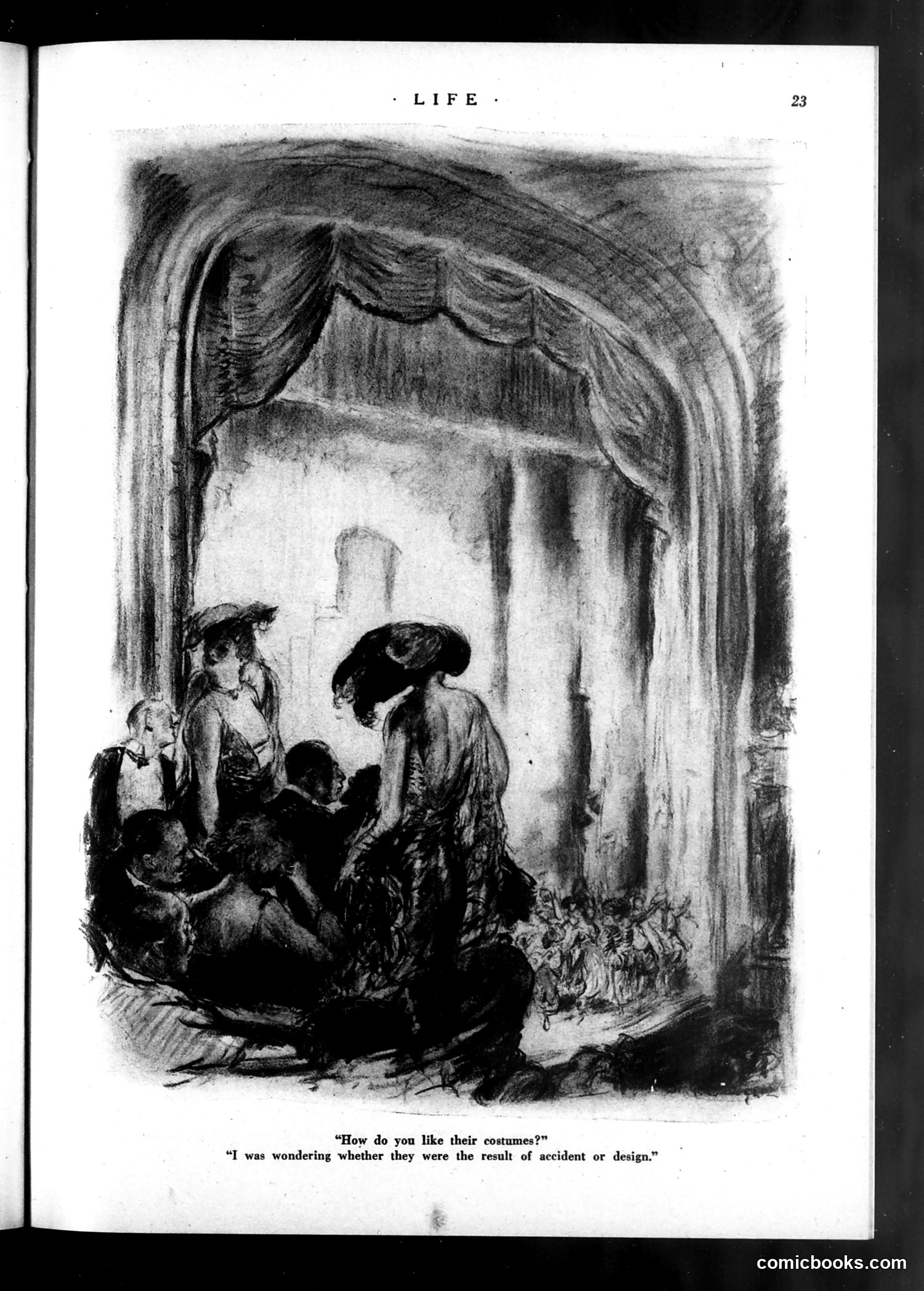
This *Life* magazine cartoon satirizes theatrical or operatic costume design. Two observers discuss performers' costumes, with one character questioning whether the garments resulted from deliberate artistic choice ("design") or mishap ("accident"). The joke targets either: 1. **Avant-garde theater** - mocking experimental or abstract costume choices that seemed haphazard or nonsensical to conventional audiences 2. **Poorly-executed productions** - suggesting costumes look so ill-fitting or bizarre they appear accidental rather than intentionally created The arched theatrical setting and elaborate drapery establish an opera house or stage context. Without a specific date or production reference visible, the exact theatrical target remains unclear, but the satire mocks the disconnect between artists' pretensions and public perception of their work.
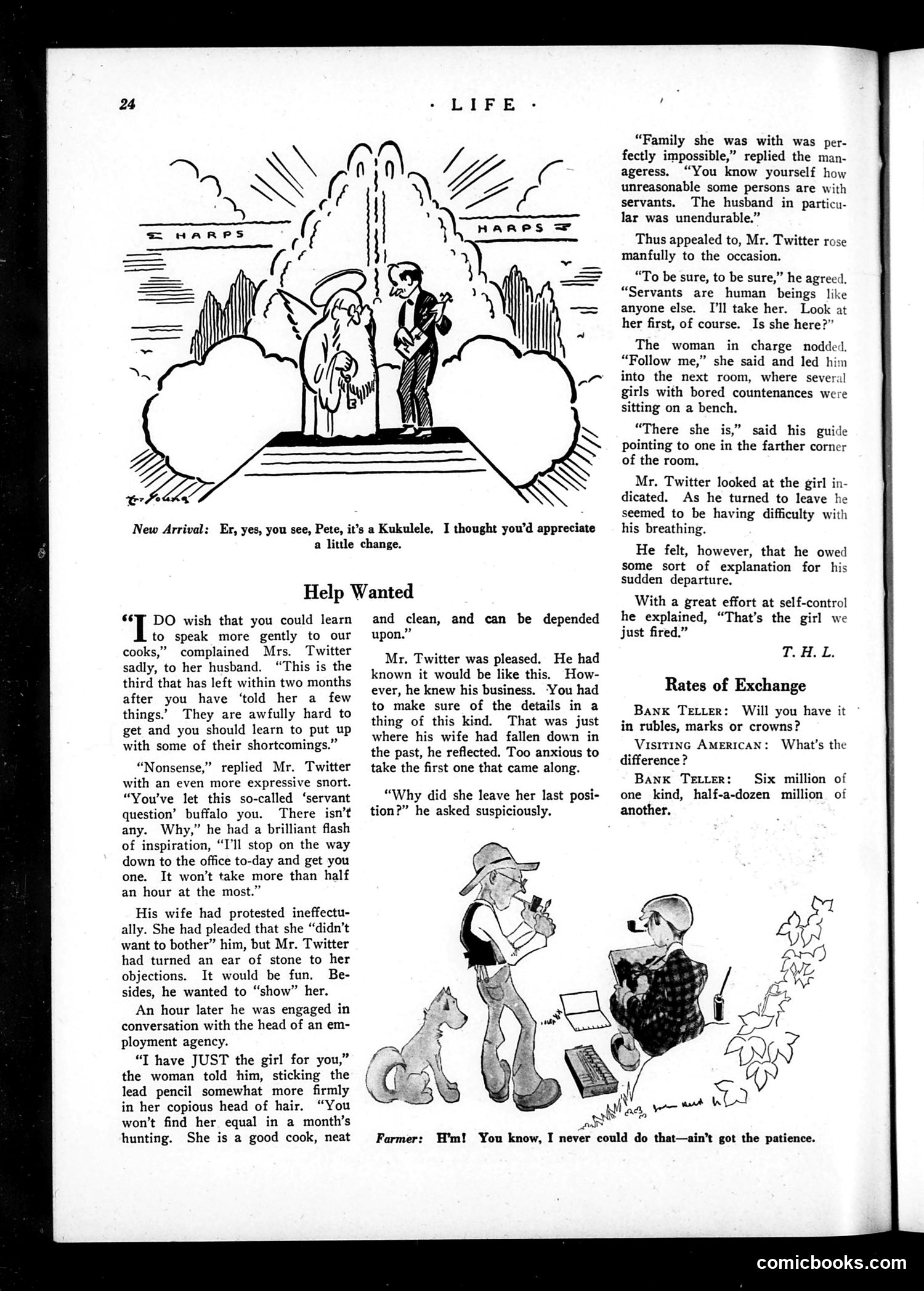
This story satirizes the arrogance of Mr. Twitter, a man convinced he can easily solve the "servant problem" (hiring domestic help) despite his wife's warnings that he's difficult to work for. The joke's irony: Mr. Twitter dismisses his wife's concerns, confidently visits an employment agency, and hires a cook without meeting her first. When shown the girl, he suddenly realizes—with visible distress—that she's the very servant *he* had just fired. The punchline exposes his hypocrisy: he blamed his wife for servant turnover while being the actual problem himself. The surrounding items include a brief "Rates of Exchange" joke about post-WWI currency inflation (millions of marks or rubles equaling small American amounts), and a cartoon about a farmer lacking patience—likely referencing agricultural labor shortages.
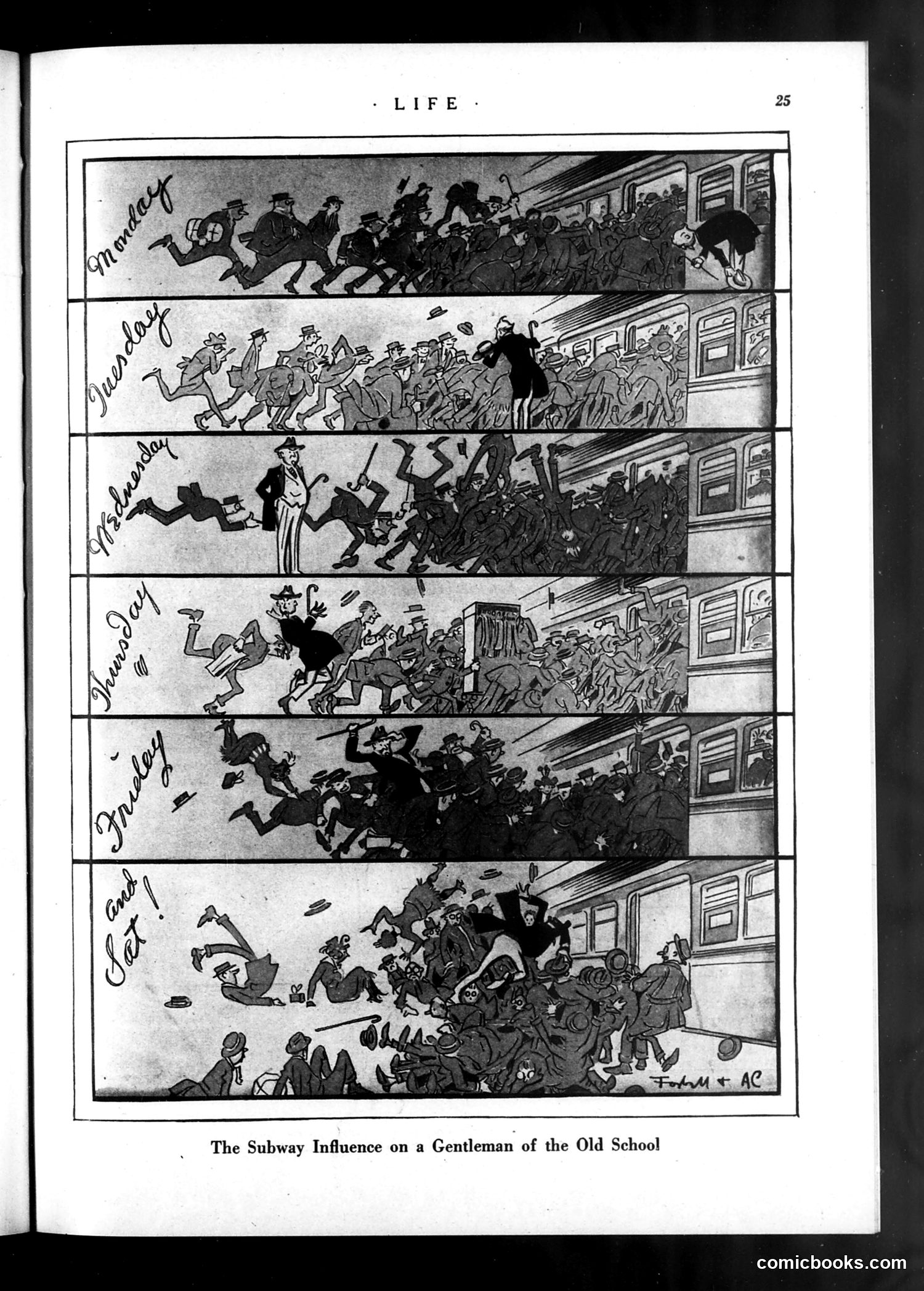
This six-panel satirical comic depicts the progressive corruption of a well-dressed gentleman through exposure to subway travel. Each panel is labeled with a day of the week (Monday through Saturday), showing the man's appearance and behavior deteriorating as he commutes. He begins orderly and composed but gradually becomes disheveled, aggressive, and crude—pushing, shoving, and fighting with other passengers. By Saturday, he's entangled in a chaotic brawl at platform level. The satire mocks how urban transit supposedly degrades even refined individuals. It reflects early 20th-century anxieties about how modern city life and crowded public spaces corrupted social manners and civility. The "Old School" gentleman represents traditional gentility, undermined by the rough-and-tumble realities of mass transportation.
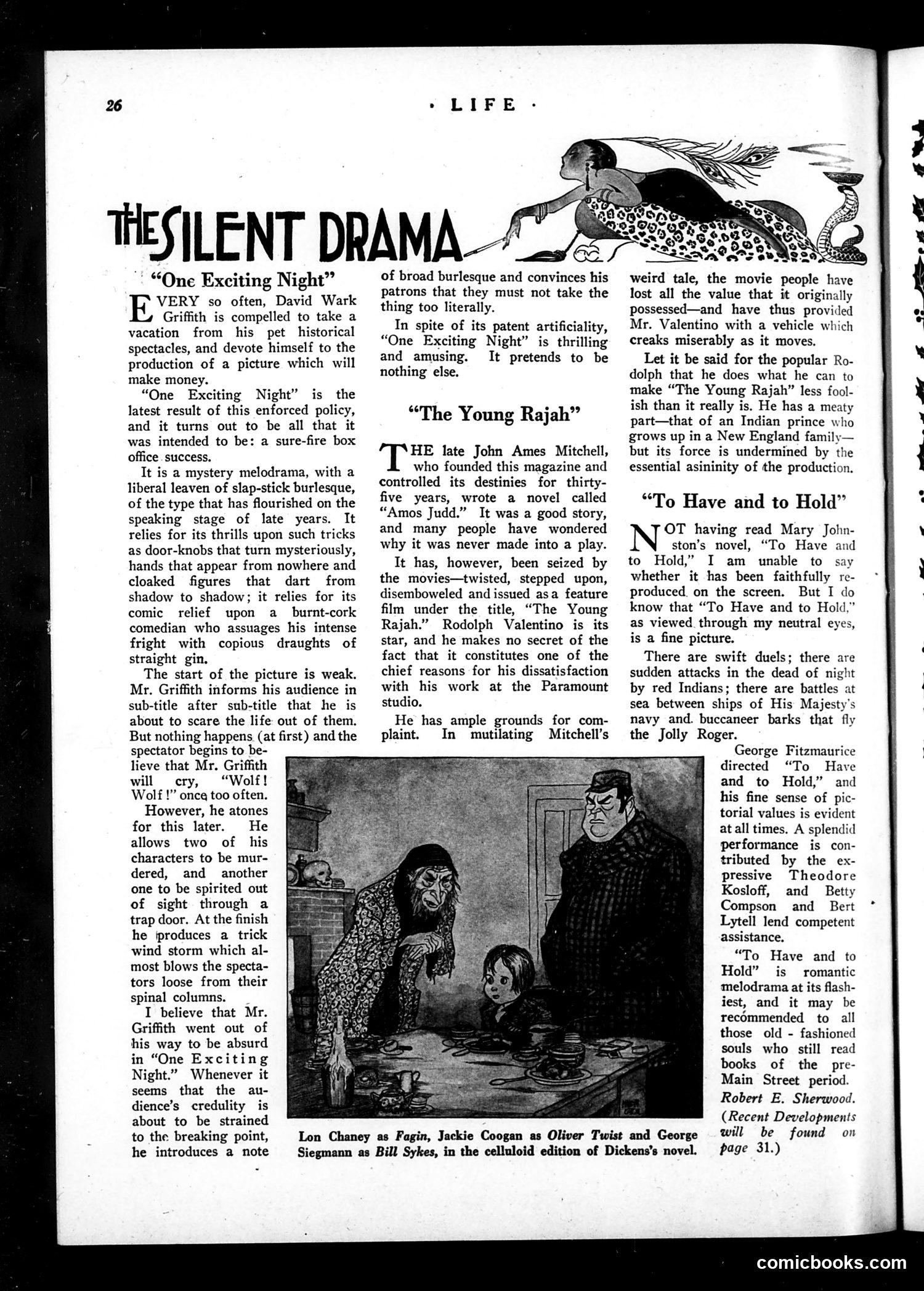
This page reviews three silent films for a general audience. The main content critiques D.W. Griffith's "One Exciting Night"—a mystery melodrama that sacrifices Griffith's usual historical "spectacles" for commercial box-office appeal. The reviewer notes it uses standard melodramatic tricks (mysterious doorknobs, cloaked figures) and "burnt-cork" comedy (a racist caricature of a frightened Black servant character), criticizing its artificiality while acknowledging its entertainment value. The page also reviews "The Young Rajah" (starring Rudolph Valentino), which adapted John Ames Mitchell's novel into what the critic considers a botched adaptation, and "To Have and to Hold," praised for George Fitzmaurice's direction and Theodore Kosloff's performance, featuring period action scenes with duels and naval battles. The image shows a scene from one of these films depicting characters in period costume.
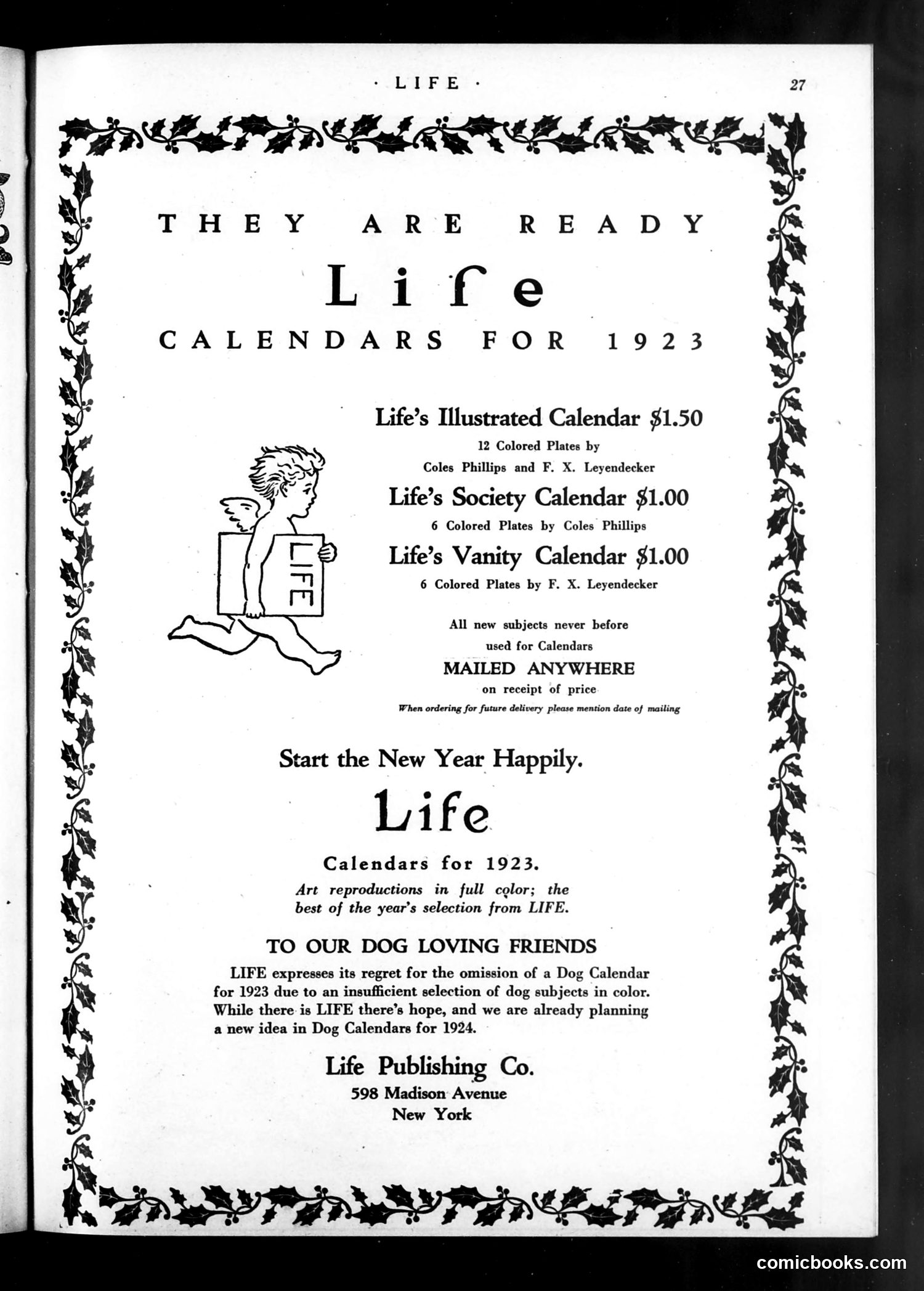
This is primarily a **title/advertisement page** for Life Publishing Company's 1923 calendar offerings. The decorative holly border and central illustration of a cherub-like figure holding a calendar frame establish a festive New Year theme. The page advertises three calendar products at different price points ($1.50, $1.00, $1.00), featuring artwork by noted illustrators Coles Phillips and F.X. Leyendecker—popular commercial artists of the era. The most notable content is a **humorous apology to dog-loving readers**: Life regrets omitting a dog calendar due to insufficient colored dog artwork available, but promises one for 1924. This self-deprecating joke suggests the magazine valued reader feedback and animal-themed content, while subtly acknowledging limitations in their 1923 art inventory. The overall message: purchase Life's calendars to "Start the New Year Happily."
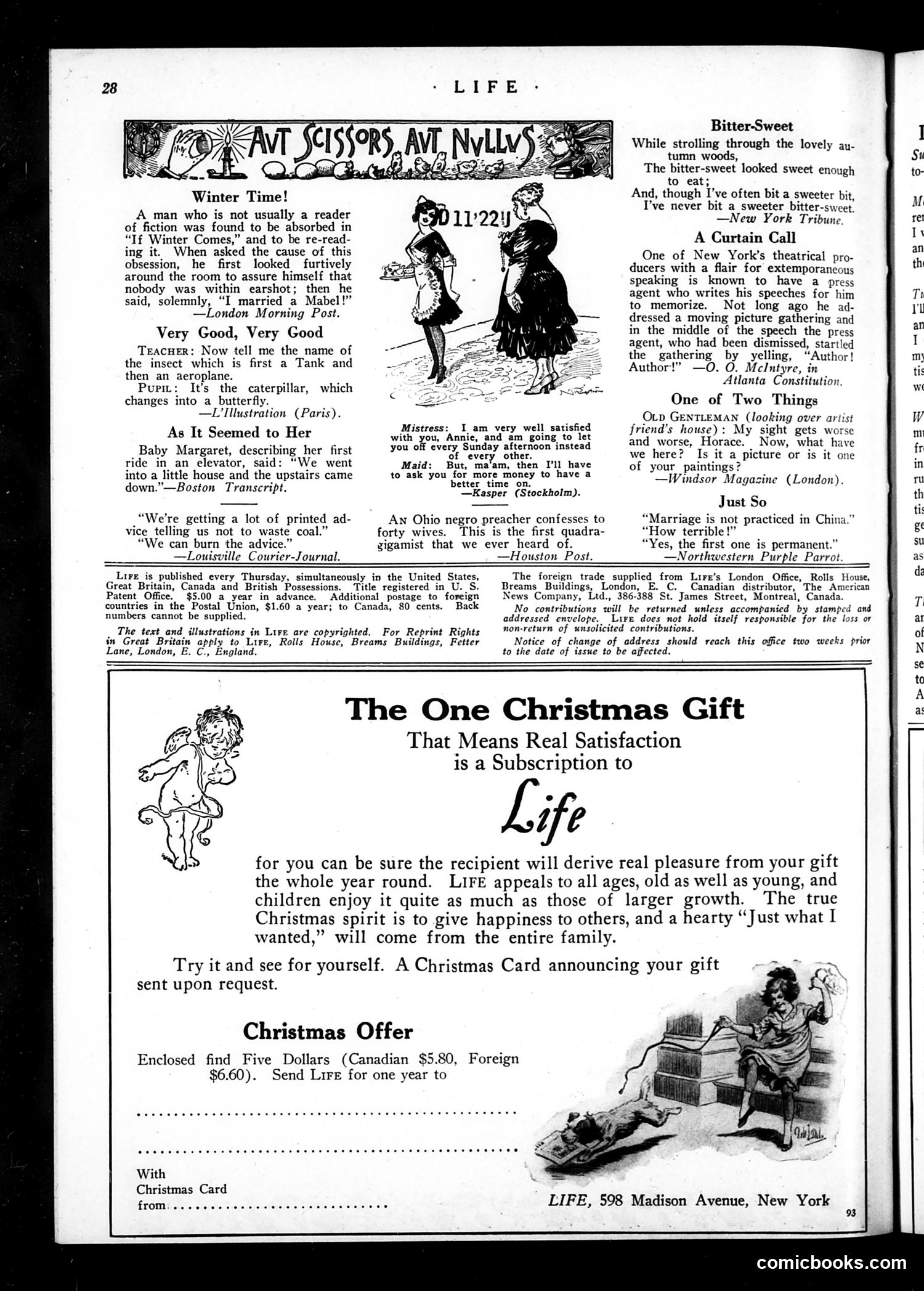
This page from *Life* magazine comprises mostly **short humorous anecdotes and jokes** rather than political cartoons. The content reflects early 20th-century Anglo-American domestic humor: **Key jokes include:** - A man obsessively rereading "If Winter Comes" because he "married a Mabel"—satirizing wives as the source of male woes - A child describing an elevator as "a little house" where "the upstairs came down"—poking fun at children's literal interpretations - A domestic servant negotiating higher wages in exchange for restricted free time—reflecting class tensions - Marriage jokes about infidelity and permanence **The cartoon** (top center) shows two women in conversation, illustrating one of these anecdotes. The page primarily serves as filler content advertising *Life*'s Christmas subscription offer. These brief jokes target middle-class audiences with familiar domestic situations—marital discord, servant negotiations, children's misunderstandings—representative of *Life*'s satirical focus on everyday social observation rather than political commentary.
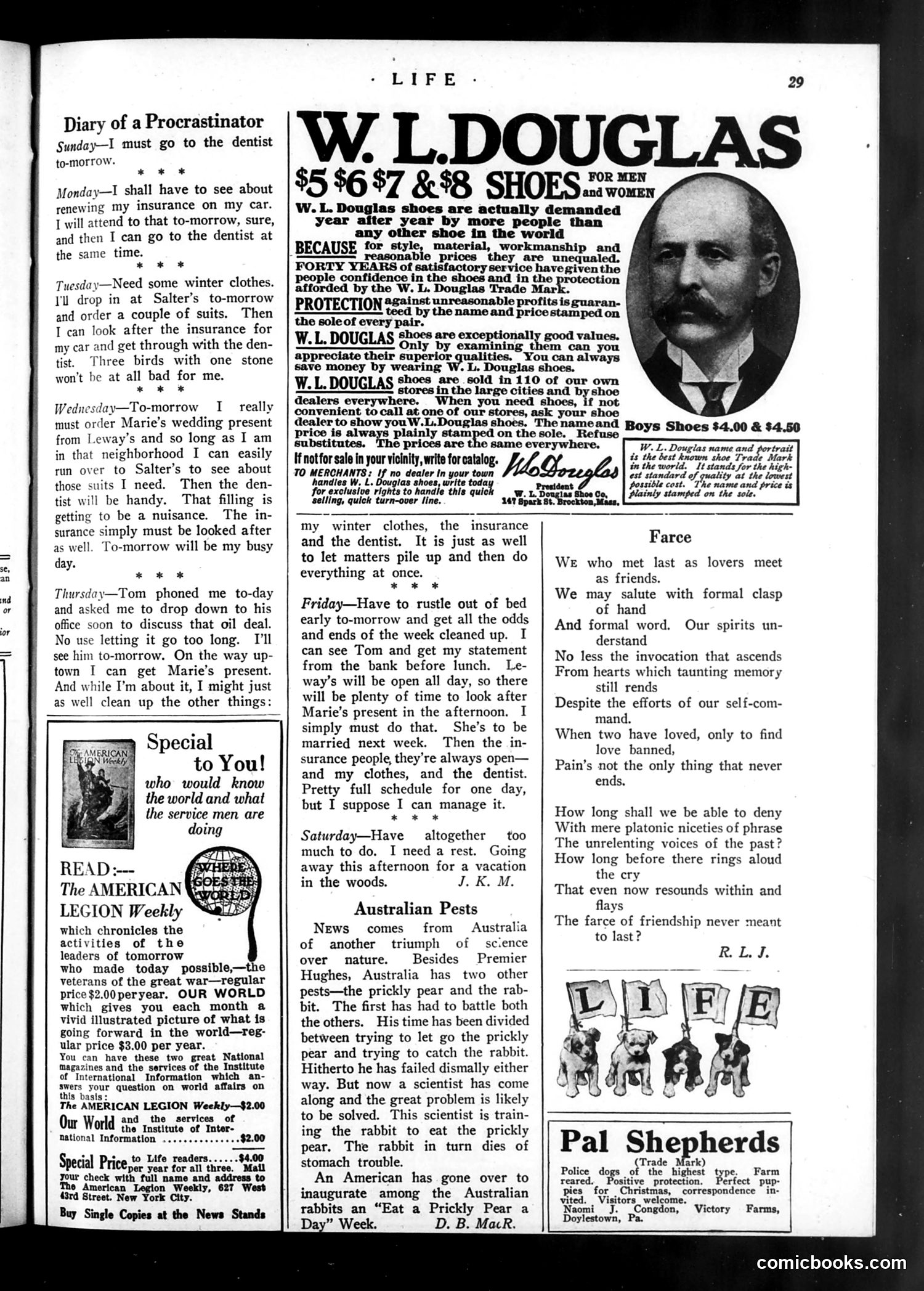
This humorous column mocks the chronic procrastinator who perpetually delays tasks by promising to accomplish multiple errands "tomorrow." Each day's entry reveals the same pattern: the narrator plans to handle dentist appointments, car insurance, shopping, and a wedding gift—but keeps deferring everything. The satire targets a recognizable human weakness: the false logic of bundling tasks ("three birds with one stone") as justification for endless postponement. By Friday, nothing has been done, yet the narrator still believes tomorrow will be the day. The joke's humor lies in its relatability and the protagonist's self-deception. Modern readers would recognize this as an early satirical take on procrastination—a timeless human tendency that remains relevant today, though now we might associate it with email inboxes and digital task lists rather than dentist visits and insurance paperwork. The rest of the page contains period advertisements (W.L. Douglas shoes) and other content, unremarkable for historical analysis.
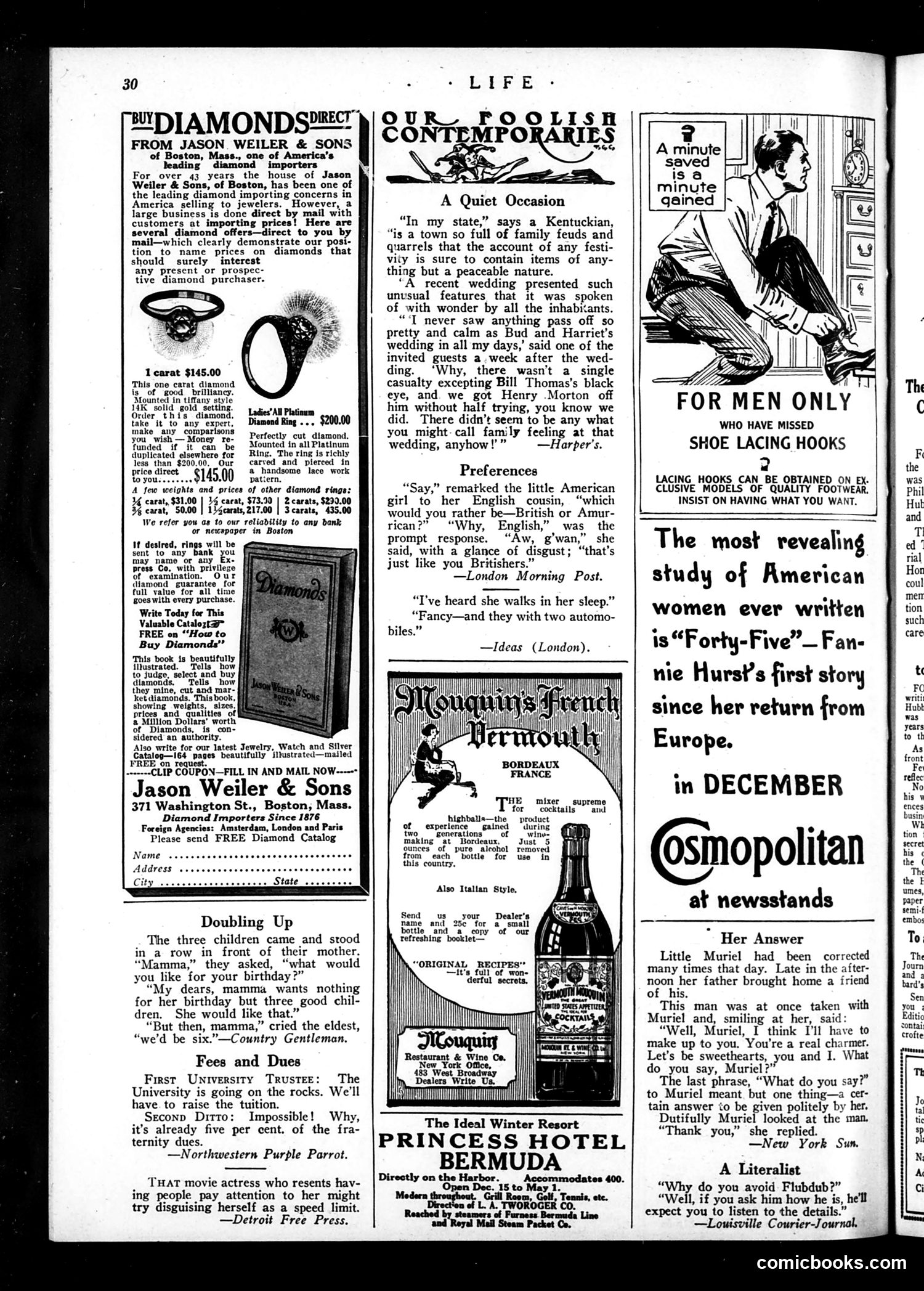
This page is primarily **advertising and humor**, not political cartoons. The dominant content is a diamond sales advertisement from Jason Weiler & Sons (Boston), emphasizing direct mail purchasing at "importing prices"—a pitch leveraging the company's 43-year reputation to bypass traditional jewelers. Below this are three brief **humorous anecdotes**: 1. "Doubling Up"—a joke about children offering mother nothing for her birthday except themselves, leading to a math pun (three children become six when combined with the mother). 2. "Fees and Dues"—satire on university financial desperation, raising tuition when already at "five per cent of fraternity dues." 3. A quip about a movie actress disliking attention, comparing her to a speed limit. The remaining content includes literary excerpts (a Kentucky wedding story emphasizing unusual civility despite regional feuding) and magazine advertisements for Moquin vermouth and the Princess Hotel, Bermuda. **No significant political messaging or social satire is evident**—this reflects typical 1920s-era Life magazine content mixing consumer advertising with light comedic filler.
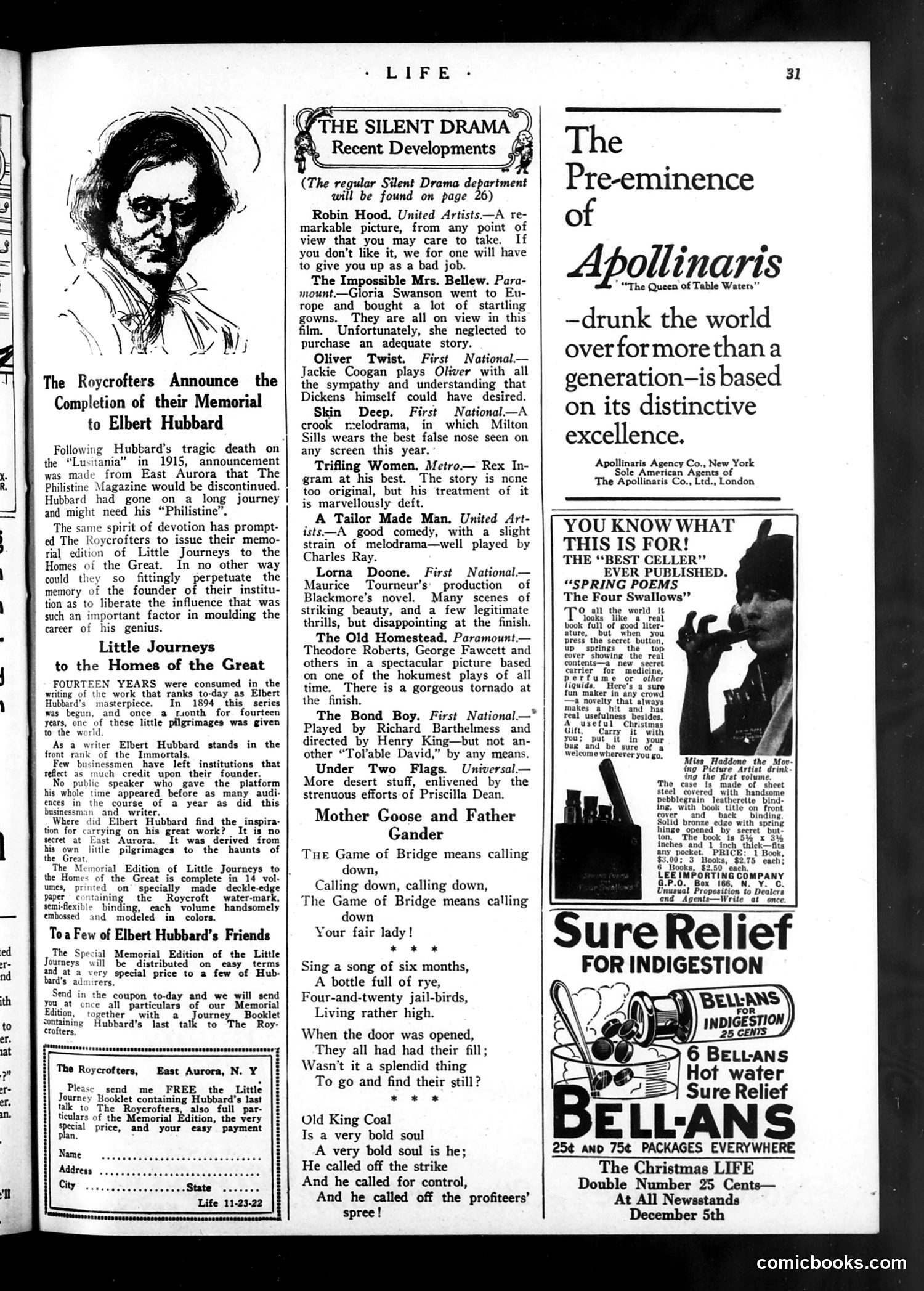
This page primarily features **promotional content** rather than satire or cartoons. The main article announces The Roycrofters' completion of a memorial edition of Elbert Hubbard's *Little Journeys to the Homes of the Great*—a 14-volume work. Hubbard, an influential writer and founder of The Roycrofters arts-and-crafts community, died in 1915 on the *Lusitania*. The portrait sketch shows Hubbard himself. The page includes a subscription coupon offering easy payment terms for the Memorial Edition. The remaining space contains **film reviews** for silent movies (Jackie Coogan's *Oliver Twist*, Gloria Swanson's *The Impossible Mrs. Bellew*, etc.)—standard entertainment criticism typical of Life's coverage. There is no political satire visible on this page. It functions primarily as a memorial advertisement combined with entertainment reporting.
This is primarily a **table of contents/advertising page** rather than a political cartoon. The page announces upcoming content in Ainsley's Magazine, including Dorothy Parker's "In Broadway Playhouses" column and May Edginton's serial "The Man Hunt," alongside stories by various authors. The only substantive literary content is **Parker's piece** on the left, which appears to be a humorous short story about feet in bed on a cold night—describing the struggle to push frozen feet under blankets. The narrative is deliberately overwrought, using dramatic language ("the very teeth of the cold") to comic effect for mundane discomfort. The right side includes a poem titled **"More or Less True"** (credited C.W.) using comparative metaphors: "As Woman to the Man" concludes a series of analogies. The remainder consists of period **advertisements** for Murine eye drops and Cortez cigars. No political satire or caricature is present on this page.
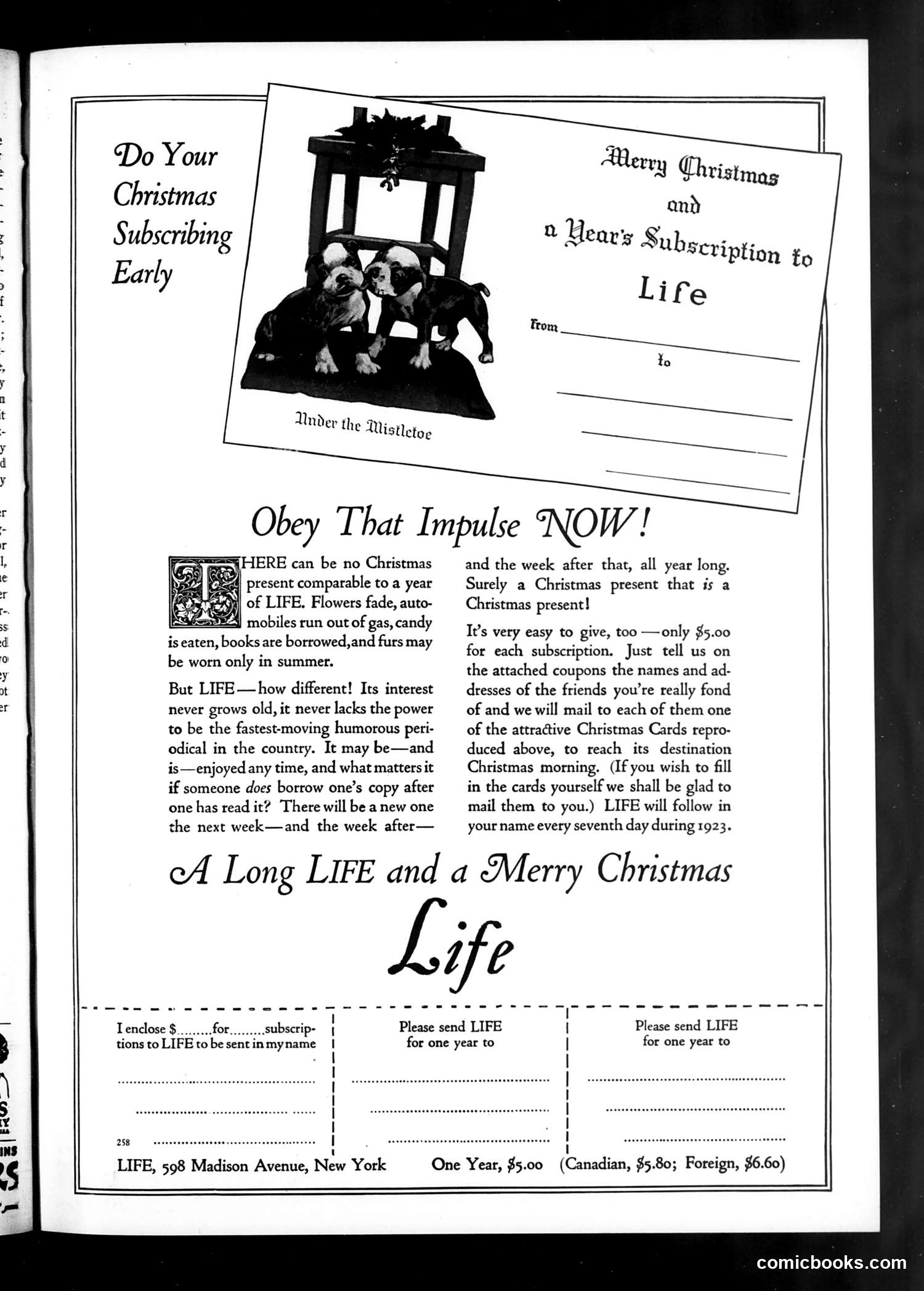
This is primarily a **subscription advertisement** for *Life* magazine, not a political cartoon. The page promotes gift subscriptions for Christmas 1922/1923. The imagery features two dogs under mistletoe as a charming holiday motif—a generic Christmas reference with no satirical intent. The ad's humor is mild and commercial: it argues that *Life* magazine makes a superior gift compared to perishable items (flowers, candy) or depreciating goods (automobiles, furs) because it provides year-round entertainment. The pitch emphasizes that *Life* is a "humorous periodical"—meaning it contains jokes and satirical content—making it perpetually enjoyable. At $5 per subscription, readers could gift subscriptions to friends; *Life* would mail decorative Christmas cards announcing the gift. The detachable coupons at the bottom are order forms. This appears to be standard holiday advertising rather than editorial content or political satire.
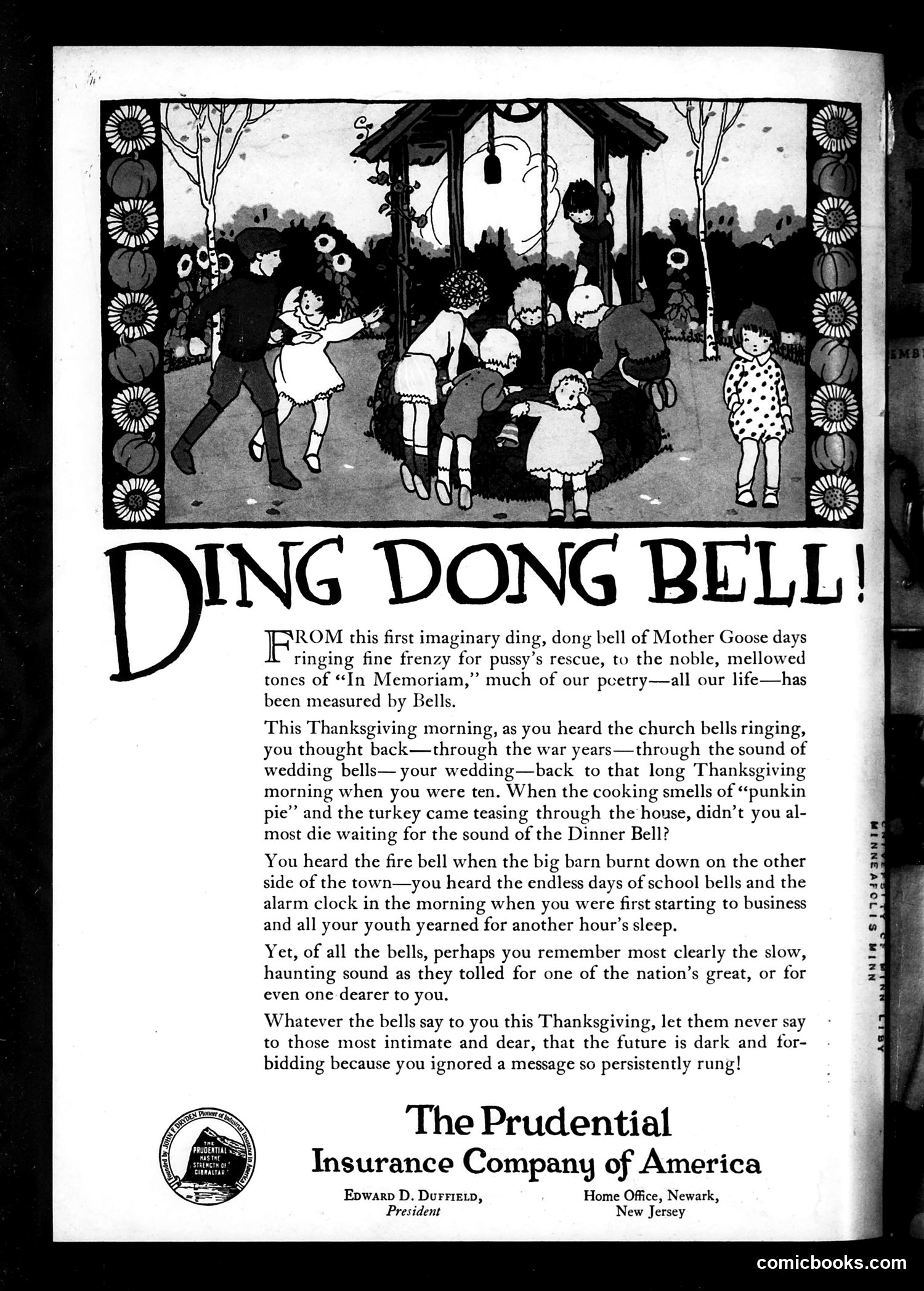
This is a **Prudential Insurance advertisement** disguised as inspirational editorial content, not satire or political commentary. The illustration shows children playing around a gazebo or bell tower in a pastoral setting—visualizing the nursery rhyme "Ding Dong Bell." The text uses nostalgic *symbolism*: church bells, fire bells, school bells, and funeral bells as metaphors for life's major moments (weddings, disasters, education, death). The message appeals to readers' emotional memories. The advertisement's actual pitch appears in the final paragraph: it warns that ignoring messages (likely about insurance/financial protection) will lead to a "dark and forbidding" future for "those most intimate and dear"—a veiled threat that failing to buy insurance will harm one's family. This is **emotional manipulation disguised as poetry**: Prudential leverages nostalgia and fear of loss to sell life insurance by suggesting that protecting loved ones financially is a moral obligation, not merely a consumer choice.