
Life, 1922-11-30 · page 8 of 36
Life — November 30, 1922 — page 8: what you’re looking at
What you’re looking at
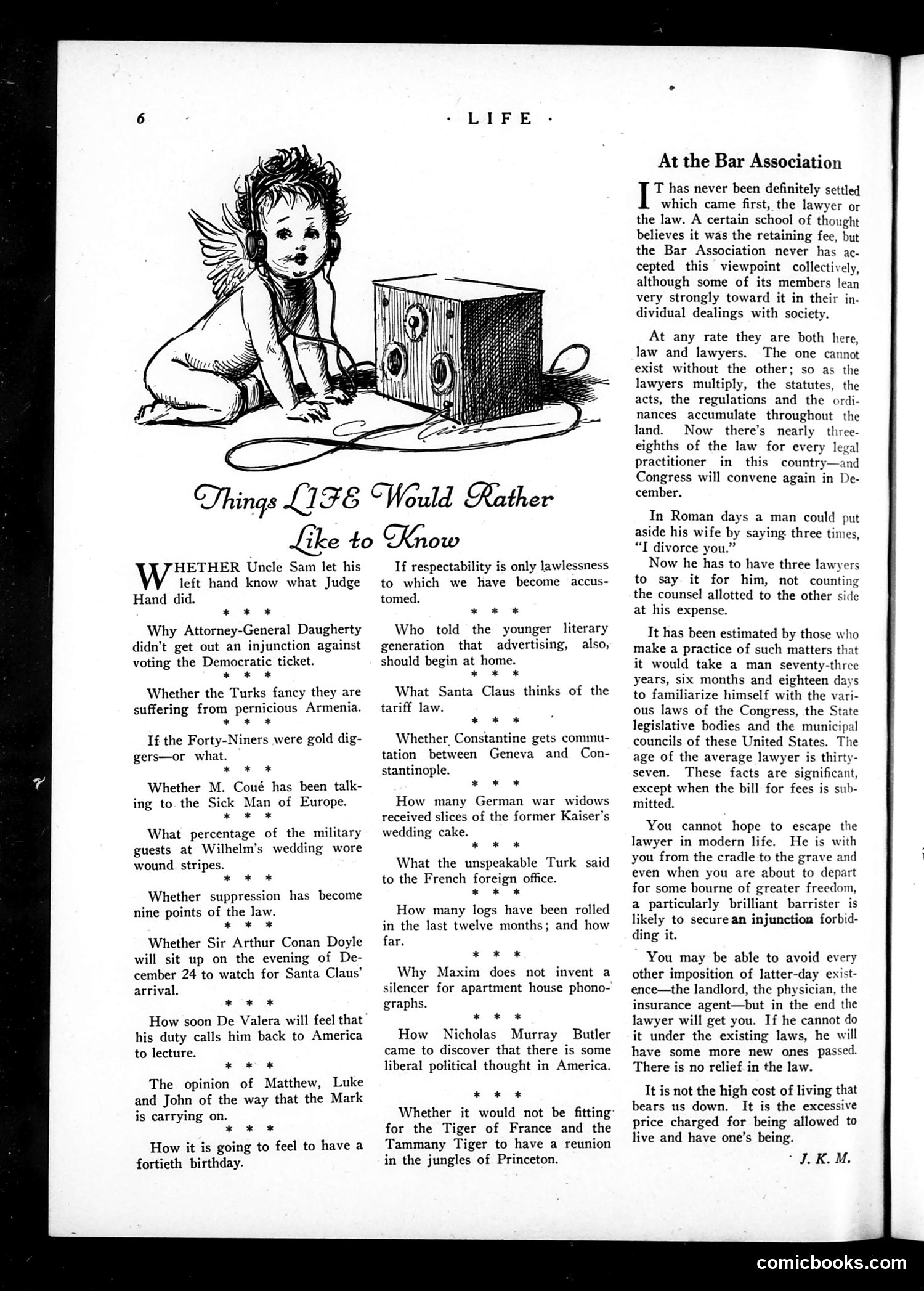
This page satirizes lawyers and the legal profession circa early 20th century. The left column presents "Things LIFE Would Rather Like to Know"—a series of humorous questions mocking contemporary legal and political figures, though most are too obscure or dated to identify specifically without additional context. The main article (right) argues that lawyers are unavoidable in modern life and increasingly expensive. It notes that becoming familiar with America's vast body of law takes lawyers 33+ years, and that legal fees are the true burden of modern existence—not the cost of living itself. The illustration shows a cherub or baby with a gramophone, though its connection to the text is unclear.
📄 Transcribed text from this page (OCR, searchable)
Machine-transcribed from the original scan — historical spelling and the odd misread are preserved.
Things Mi FE Would Rather Like to Know HETHER Uncle Sam let his left hand know what Judge Hand did. **_ * * Why Attorney-General Daugherty didn’t get out an injunction against voting the Democratic ticket. x = & Whether the Turks fancy they are suffering from pernicious Armenia. * * * If the Forty-Niners were gold dig- gers—or what. * oe * Whether M. Coué has been talk- ing to. the Sick Man of Europe. * * * What percentage of the military guests at Wilhelm’s wedding wore wound stripes. * * * Whether suppression has become nine points of the law. * * * Whether Sir Arthur Conan Doyle will sit up on the evening of De- cember 24 to watch for Santa Claus’ arrival. ek How soon De Valera will feel that his duty calls him back to America to lecture. * * * The opinion of Matthew, Luke and John of the way that the Mark is carrying on. * * * How it is going to feel to have a fortieth birthday. If respectability is only lawlessness to which we have become accus- tomed. * * * Who told the younger literary generation that advertising, also, should begin at home. * * * What Santa Claus thinks of the tariff law. * * * Whether, Constantine gets commu- tation between Geneva and Con- stantinople. * * * How many German war widows received slices of the former Kaiser's wedding cake. * * * What the unspeakable Turk said to the French foreign office. * * * How many logs have been rolled in the last twelve months; and how far. * * * Why Maxim does not invent a silencer for apartment house phono- graphs. * * * How Nicholas Murray Butler came to discover that there is some liberal political thought in America. * * % Whether it would not be fitting: for the Tiger of France and the Tammany Tiger to have a reunion in the jungles of Princeton. At the Bar Association T has never been definitely settled which came first, the lawyer or the law. A certain school of thought believes it was the retaining fee, but the Bar Association never has ac- cepted this viewpoint collectively, although some of its members lean very strongly toward it in their in- dividual dealings with society. At any rate they are both here, law and lawyers. The one cannot exist without the other; so as the lawyers multiply, the statutes, the acts, the regulations and the ordi- nances accumulate throughout the land. Now there’s nearly three- eighths of the law for every legal practitioner in this country—and Congress will convene again in De- cember. In Roman days a man could put aside his wife by saying three times, “T divorce you.” Now he has to have three lawyers to say it for him, not counting the counsel allotted to the other side at his expense. It has been estimated by those who make a practice of such matters that it would take a man seventy-three years, six months and eighteen days to familiarize himself with the vari- ous laws of the Congress, the State legislative bodies and the municipal councils of these United States. The age of the average lawyer is thirty- seven. These facts are significant, except when the bill for fees is sub- mitted. You cannot hope to escape the lawyer in modern life. He is with you from the cradle to the grave and even when you are about to depart for some bourne of greater freedom, a particularly brilliant barrister is likely to secure an injunction forbid- ding it. You may be able to avoid every other imposition of latter-day exist- ence—the landlord, the physician, the insurance agent—but in the end the lawyer will get you. If he cannot do it under the existing laws, he will have some more new ones passed. There is no relief in the law. It is not the high cost of living that bears us down. It is the excessive price charged for being allowed to live and have one’s being. “JLK.M. comicbooks.com