
Life, 1922-11-30 · page 14 of 36
Life — November 30, 1922 — page 14: what you’re looking at
What you’re looking at
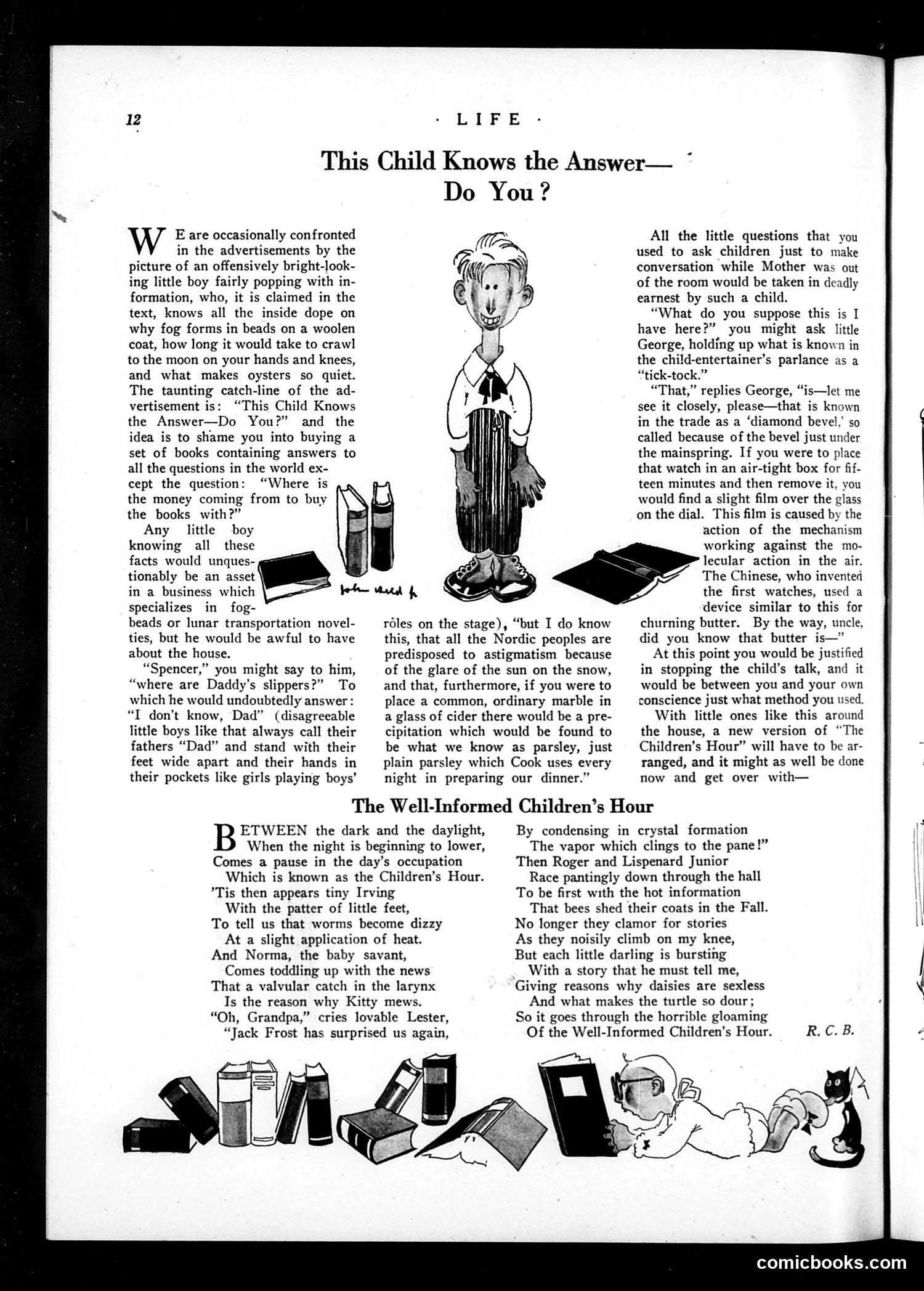
This satirical piece mocks children's encyclopedic answer books—popular reference works promising to explain everyday mysteries. The cartoon character represents the stereotypical "bright child" who memorizes facts from such books and enthusiastically recites them to beleaguered adults. The satire targets how these children become insufferable know-it-alls, pedantically explaining phenomena (why fog forms, oyster behavior, etc.) with unwarranted confidence. The article playfully warns adults that such a child in the house would become an unbearable nuisance. The second section, "The Well-Informed Children's Hour," appears to be humorous verse about the "Children's Hour"—that pause between dark and daylight when children demand entertainment and facts from exhausted parents and servants.
📄 Transcribed text from this page (OCR, searchable)
Machine-transcribed from the original scan — historical spelling and the odd misread are preserved.
LIFE This Child Knows the Answer— E are occasionally confronted in the advertisements by the picture of an offensively bright-look- ing little boy fairly popping with in- formation, who, it is claimed in the text, knows all the inside dope on why fog forms in beads on a woolen coat, how long it would take to crawl to the moon on your hands and knees, and what makes oysters so quiet. The taunting catch-line of the ad- vertisement is: “This Child Knows the Answer—Do You?” and the idea is to shame you into buying a set of books containing answers to all the questions in the world ex- cept the question: “Where is the money coming from to buy the books with?” Any little boy knowing all these facts would unques- tionably be an asset in a business which specializes in fog- beads or lunar transportation novel- roles on the stage), “but I do know All the little questions that you used to ask children just to make conversation while Mother was out of the room would be taken in deadly earnest by such a child. “What do you suppose this is I have here?” you might ask little George, holding up what is known in the child-entertainer’s parlance as a “tick-tock.” “That,” replies George, “is—let me see it closely, please—that is known in the trade as a ‘diamond bevel,’ so called because of the bevel just under the mainspring. If you were to place that watch in an air-tight box for fif- teen minutes and then remove it, you would find a slight film over the glass on the dial. This film is caused by the action of the mechanism working against the mo- lecular action in the air. The Chinese, who invented the first watches, used a device similar to this for churning butter. By the way, uncle, ties, but he would be awful to have about the house. “Spencer,” you might say to him, “where are Daddy’s slippers?” To which he would undoubtedly answer : “I don’t know, Dad” (disagreeable little boys like that always call their fathers “Dad” and stand with their feet wide apart and their hands in their pockets like girls playing boys’ this, that all the Nordic peoples are predisposed to astigmatism because of the glare of the sun on the snow, and that, furthermore, if you were to place a common, ordinary marble in a glass of cider there would be a pre- cipitation which would be found to be what we know as parsley, just plain parsley which Cook uses every night in preparing our dinner.” did you know that butter is—” At this point you would be justified in stopping the child’s talk, and it would be between you and your own conscience just what method you used, With little ones like this around the house, a new version of “The Children’s Hour” will have to be ar- ranged, and it might as well be done now and get over with— The Well-Informed Children’s Hour ETWEEN the dark and the daylight, When the night is beginning to lower, Comes a pause in the day’s occupation Which is known as the Children’s Hour. ’Tis then appears tiny Irving With the patter of little feet, To tell us that worms become dizzy At a slight application of heat. And Norma, the baby savant, Comes toddling up with the news That a valvular catch in the larynx Is the reason why Kitty mews. “Oh, Grandpa,” cries lovable Lester, “Jack Frost has surprised us again, By condensing in crystal formation The vapor which clings to the pane!” Then Roger and Lispenard Junior Race pantingly down through the hall To be first with the hot information That bees shed their coats in the Fall. No longer they clamor for stories As they noisily climb on my knee, But each little darling is bursting With a story that he must tell me, Giving reasons why daisies are sexless And what makes the turtle so dour; So it goes through the horrible gloaming Of the Well-Informed Children’s Hour. comicbooks.com