
Life, 1922-11-30 · page 21 of 36
Life — November 30, 1922 — page 21: what you’re looking at
What you’re looking at
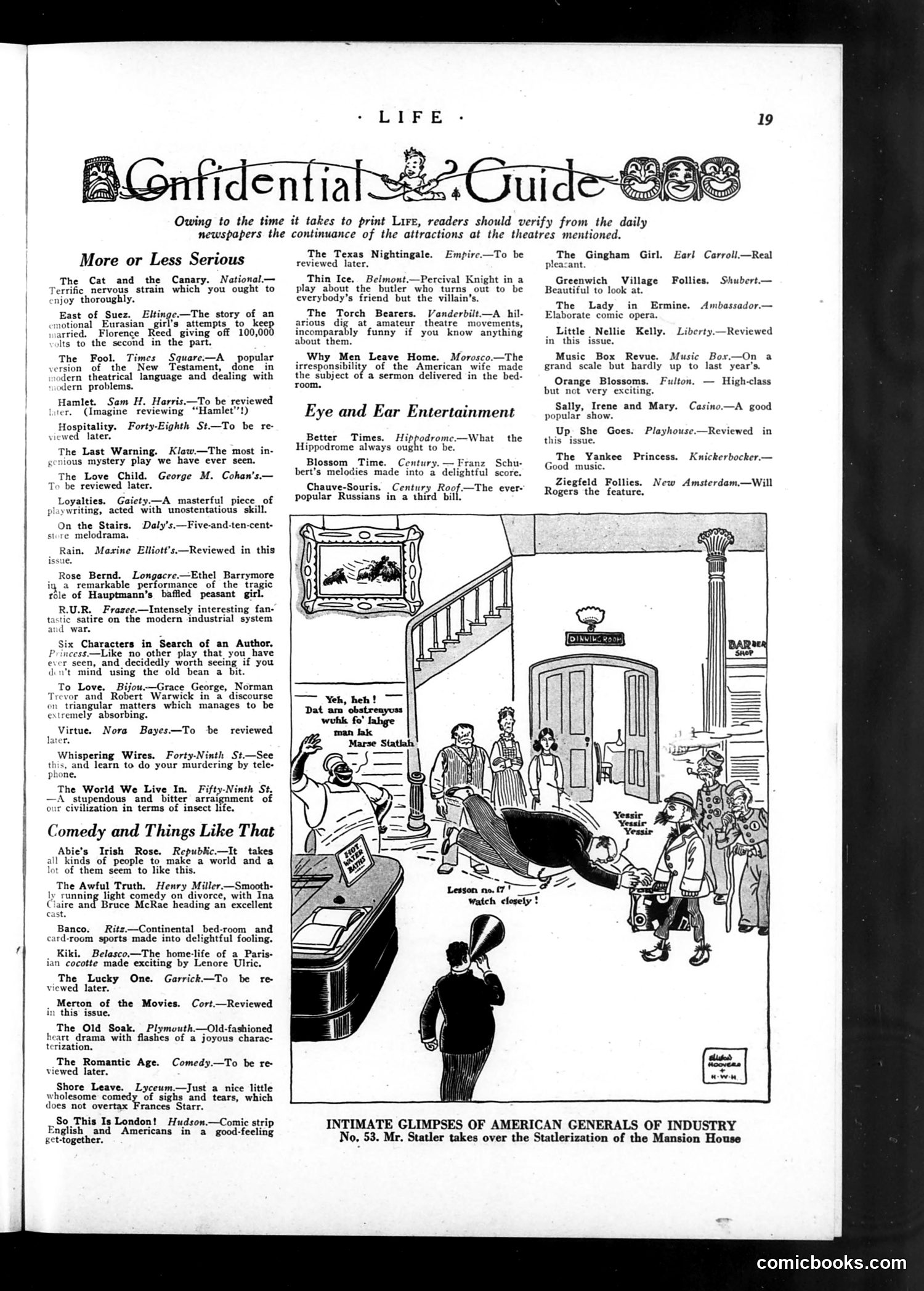
This page from Life magazine (a satirical publication, not the modern photo magazine) is primarily a **theater guide and review section**, not a political cartoon. It lists Broadway shows with brief, witty critical descriptions—the magazine's signature style of combining entertainment listings with sharp commentary. The only illustration shows a domestic scene labeled "Lesson No. 17—Watch closely!" depicting what appears to be a family or group of people in a home interior, likely satirizing contemporary domestic life or marital relations (common Life themes of this era). The theater reviews themselves are the "satire"—using clever wordplay and sardonic observations about each production. For example, "The Fool" is described as "A popular version of the New Testament, done in modern theatrical language," and "Why Men Leave Home" sarcastically notes it makes "The irresponsibility of the American wife" into a sermon. This reflects 1920s Broadway culture and the magazine's role as arbiter of taste for educated urban audiences.
📄 Transcribed text from this page (OCR, searchable)
Machine-transcribed from the original scan — historical spelling and the odd misread are preserved.
19 Owing to the time it takes to print Lire, readers should verify from the daily newspapers the continuance of the attractions at the theatres mentioned. More or Less Serious The Cat and the Canary. National.— Terrific, nervous strain which you ought to njoy thoroughly. East of Suez. Eltinge—The story of an cnotional Eurasian girl's attempts to_ keep arried. Florence Reed giving off 100,000 ‘Its to the second in the part. The Fool. Times Square—A popular version of the New Testament, done in dern theatrical language and dealing with xlern problems. Hamlet. Sam H. Harris.—To be reviewed cr. (Imagine reviewing “Hamlet’’!) Forty-Eighth St—To be re- Hospitality. viewed later. The Last Warning. Klaw.—The most in- genious mystery play we have ever seen. The Love Child. George M. Cohan’s.— To be reviewed later. Loyalties. Gaiety—A masterful piece of playwriting, acted with unostentatious skill. On the Stairs. store melodrama, Maxine Elliott's—Reviewed in this Daly’s.—Five-and-ten-cent- Rain, issue. Rose Bernd. Longacre—Ethel Barrymore ig a remarkable performance of the tragic role of Hauptmann’s baffled peasant girl. R.U.R, Frazce.—Intensely interesting fan- tastic satire on the modern industrial system and war. Six Characters in Search of an Author. Princess—Like no other play that you have ever seen, and decidedly worth seeing if you don't mind using the old bean a bit. To Love. Bijou.—Grace George, Norman Trevor and Robert Warwick in a discourse on triangular matters which manages to be extremely absorbing. Bayes—To be Virtue. Nora reviewed Whispering Wires. Forty-Ninth St—See this, and learn to do your murdering by tele- phone. The World We Live In. Fifty-Ninth St, —A stupendous and bitter arraignment of r civilization in terms of insect life. Comedy and Things Like That Abie’s Irish Rose. Republic.—It takes all kinds of people to make a world and a lot of them seem to like this. The Awful Truth. Henry Miller—Smooth- ly running light comedy on divorce, with Ina Caire and Bruce McRae heading an excellent cast. Banco. Ritz.—Continental bed-room and card-room sports made into delightful fooling. , Kiki. Belasco—The home-life of a_Paris- ian cocotte made exciting by Lenore Ulric. The Lucky One. Garrick—To be re viewed later. Merton of the Movies. Cort.—Reviewed in this issue. The Old Soak. Plymouth.—Old-fashioned heart drama with flashes of a joyous charac- terization, The Romantic Age. viewed later. Shore Leave. Comedy.—To be re- Lyceum.—Just a nice little wholesome comedy of sighs and tears, which does not overtax Frances Starr. So This Is London! Hudson.—Comic strip English and Americans in a good-feeling get-together. The Texas Nightingale. reviewed later. Thin Ice. Belmont.—Percival Knight in a play about the butler who turns out to be everybody's friend but the villain’s. The Torch Bearers. Vanderbilt—A hil- arious dig at_ amateur theatre movements, incomparably funny if you know anything about them. _ Why Men Leave Home. Morosco.—The irresponsibility of the American wife made the subject of a sermon delivered in the bed- room. Empire.—To be Eye and Ear Entertainment Better Times. Hippodrome—What the Hippodrome always ought to be. Blossom Time. Century.— Franz Schu- bert’s melodies made into a delightful score. Chauve-Souris. Century Ro popular Russians in a third bill. ‘The ever- The Gingham Girl. pleazant. Earl Carroll.—Real Greenwich Village Follies. Shubert.— Beautiful to look at. The Lady in Ermine. Ambassador.— Elaborate comic opera. Little Nellie Kelly. in this issue. Music Box Revue. Music Bor—On a grand scale but hardly up to last year’s Liberty.—Reviewed Orange Blossoms. Fulton. — High-class but not very exciting. Sally, Irene and Mary. popular’ show. Up. She Goes. this issue. The Yankee Princess. Good music, Ziegfeld Follies. Rogers the feature. Casino—A good Playhouse.—Reviewed in Knickerbocker.— New Amsterdam.—Will INTIMATE GLIMPSES OF AMERICAN GENERALS OF INDUSTRY No, 53. Mr. Statler takes over the Statlerization of the Mansion House comicbooks.com