
Life, 1922-11-30 · page 16 of 36
Life — November 30, 1922 — page 16: what you’re looking at
What you’re looking at
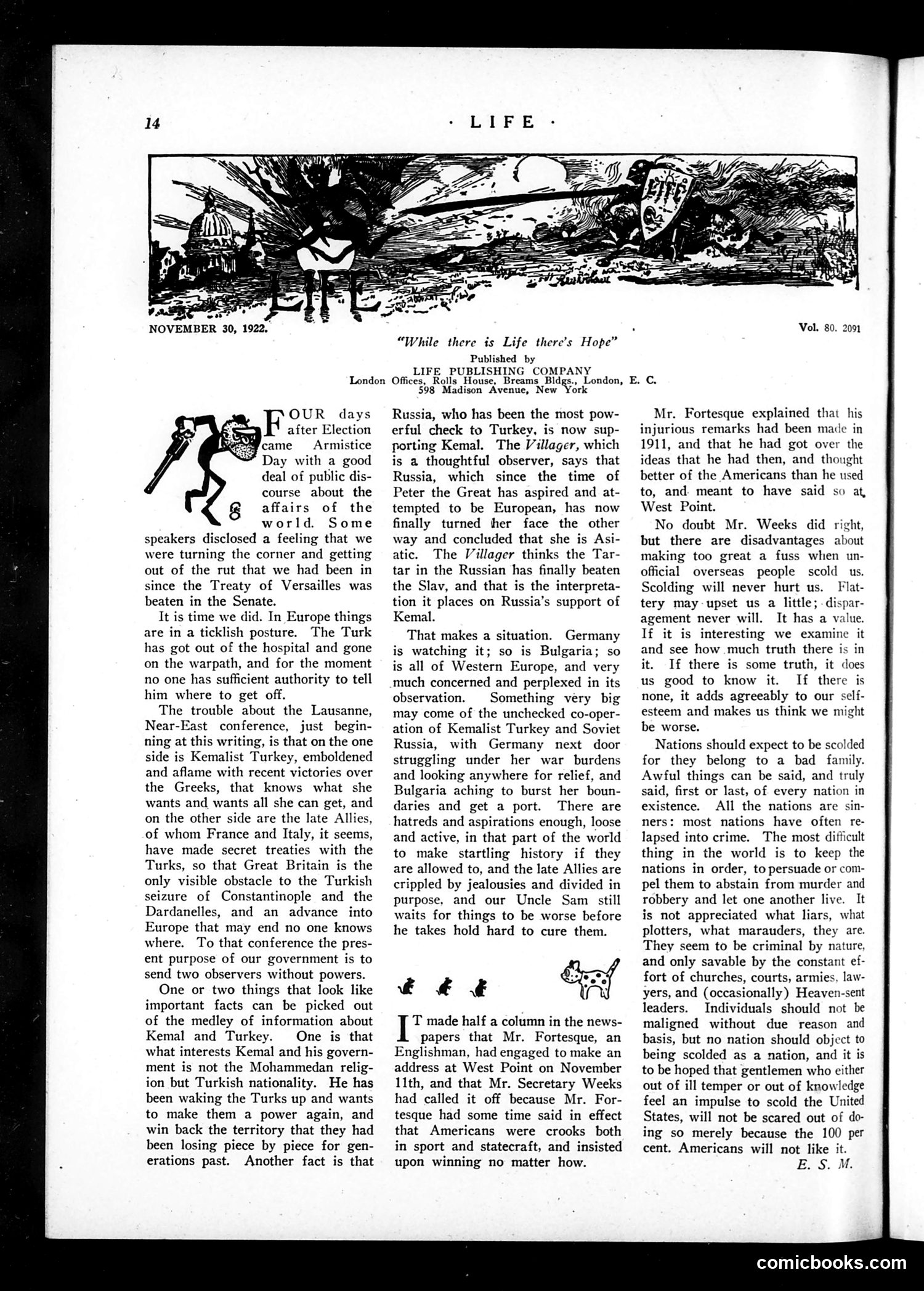
This November 1922 *Life* page discusses the Lausanne Near-East conference and Turkey's position. The cartoon at top (artist unclear) depicts chaotic diplomatic turmoil, likely representing the unstable situation in the Ottoman Empire's aftermath. The main text criticizes how post-war treaties and secret agreements between Allied powers have created confusion. It focuses on **Kemal's Turkey** as a powerful emerging force that has beaten Soviet Russia and is shifting toward Asia rather than Europe. The piece argues that unnamed Western diplomats (possibly **Mr. Fortesque**, an Englishman mentioned) have made inflammatory remarks about American sportsmen and stateraft, causing diplomatic friction. The author urges restraint: nations shouldn't scold each other, as most have criminal histories. The satire targets both diplomatic incompetence and jingoistic American pride.
📄 Transcribed text from this page (OCR, searchable)
Machine-transcribed from the original scan — historical spelling and the odd misread are preserved.
NOVEMBER 30, 1922, ay “While there is Life there’s Hope” Published by LIFE PUBLISHING COMPANY Vol. 80. 2091 London Offices, Rolls House, Breams Bldgs. London, E. C. 5 rk OUR days after Election Armistice Day with a good deal of public dis- course about the affairs of the world. Some speakers disclosed a feeling that we were turning the corner and getting out of the rut that we had been in since the Treaty of Versailles was beaten in the Senate. It is time we did. In Europe things are in a ticklish posture. The Turk has got out of the hospital and gone on the warpath, and for the moment no one has sufficient authority to tell him where to get off. The trouble about the Lausanne, Near-East conference, just begin- ning at this writing, is that on the one side is Kemalist Turkey, emboldened and aflame with recent victories over the Greeks, that knows what she wants and wants all she can get, and on the other side are the late Allies, of whom France and Italy, it seems, have made secret treaties with the Turks, so that Great Britain is the only visible obstacle to the Turkish seizure of Constantinople and the Dardanelles, and an advance into Europe that may end no one knows where. To that conference the pres- ent purpose of our government is to send two observers without powers. One or two things that look like important facts can be picked out of the medley of information about Kemal and Turkey. One is that what interests Kemal and his govern- ment is not the Mohammedan relig- ion but Turkish nationality. He has been waking the Turks up and wants to make them a power again, and win back the territory that they had been losing piece by piece for gen- erations past. Another fact is that 98 Madison Avenue, New Yor Russia, who has been the most pow- erful check to Turkey, is now sup- porting Kemal. The Villager, which is a thoughtful observer, says that Russia, which since the time of Peter the Great has aspired and at- tempted to be European, has now finally turned her face the other way and concluded that she is Asi- atic. The Villager thinks the Tar- tar in the Russian has finally beaten the Slav, and that is the interpreta- tion it places on Russia’s support of Kemal. That makes a situation. Germany is watching it; so is Bulgaria; so is all of Western Europe, and very much concerned and perplexed in its observation. Something very big may come of the unchecked co-oper- ation of Kemalist Turkey and Soviet Russia, with Germany next door struggling under her war burdens and looking anywhere for relief, and Bulgaria aching to burst her boun- daries and get a port. There are hatreds and aspirations enough, loose and active, in that part of the world to make startling history if they are allowed to, and the late Allies are crippled by jealousies and divided in purpose, and our Uncle Sam still waits for things to be worse before he takes hold hard to cure them. ft € € Caf T made half a column in the news- papers that Mr. Fortesque, an Englishman, had engaged to make an address at West Point on November llth, and that Mr. Secretary Weeks had called it off because Mr. For- tesque had some time said in effect that Americans were crooks both in sport and statecraft, and insisted upon winning no matter how. Mr. Fortesque explained that his injurious remarks had been made in 1911, and that he had got over the ideas that he had then, and thought better of the Americans than he used to, and. meant to have said so at, West Point. No doubt Mr. Weeks did right, but there are disadvantages about making too great a fuss when un- official overseas people scold us. Scolding will never hurt us. Flat- tery may-upset us a little; -dispar- agement never will. It has a value. If it is interesting we examine it and see how much truth there is in it. If there is some truth, it does us good to know it. If there is none, it adds agreeably to our self- esteem and makes us think we might be worse. Nations should expect to be scolded for they belong to a bad family. Awful things can be said, and truly said, first or last, of every nation in existence. All the nations are sin- ners: most nations have often re- lapsed into crime. The most difficult thing in the world is to keep the nations in order, to persuade or com- pel them to abstain from murder and robbery and let one another live. It is not appreciated what liars, what plotters, what marauders, they are. They seem to be criminal by nature, and only savable by the constant ef- fort of churches, courts, armies, law- yers, and (occasionally) Heaven-sent leaders. Individuals should not be maligned without due reason and basis, but no nation should object to being scolded as a nation, and it is to be hoped that gentlemen who either out of ill temper or out of knowledge feel an impulse to scold the United States, will not be scared out of do- ing so merely because the 100 per cent. Americans will not like it. E. S. M. comicbooks.com