
Life, 1922-11-30 · page 24 of 36
Life — November 30, 1922 — page 24: what you’re looking at
What you’re looking at
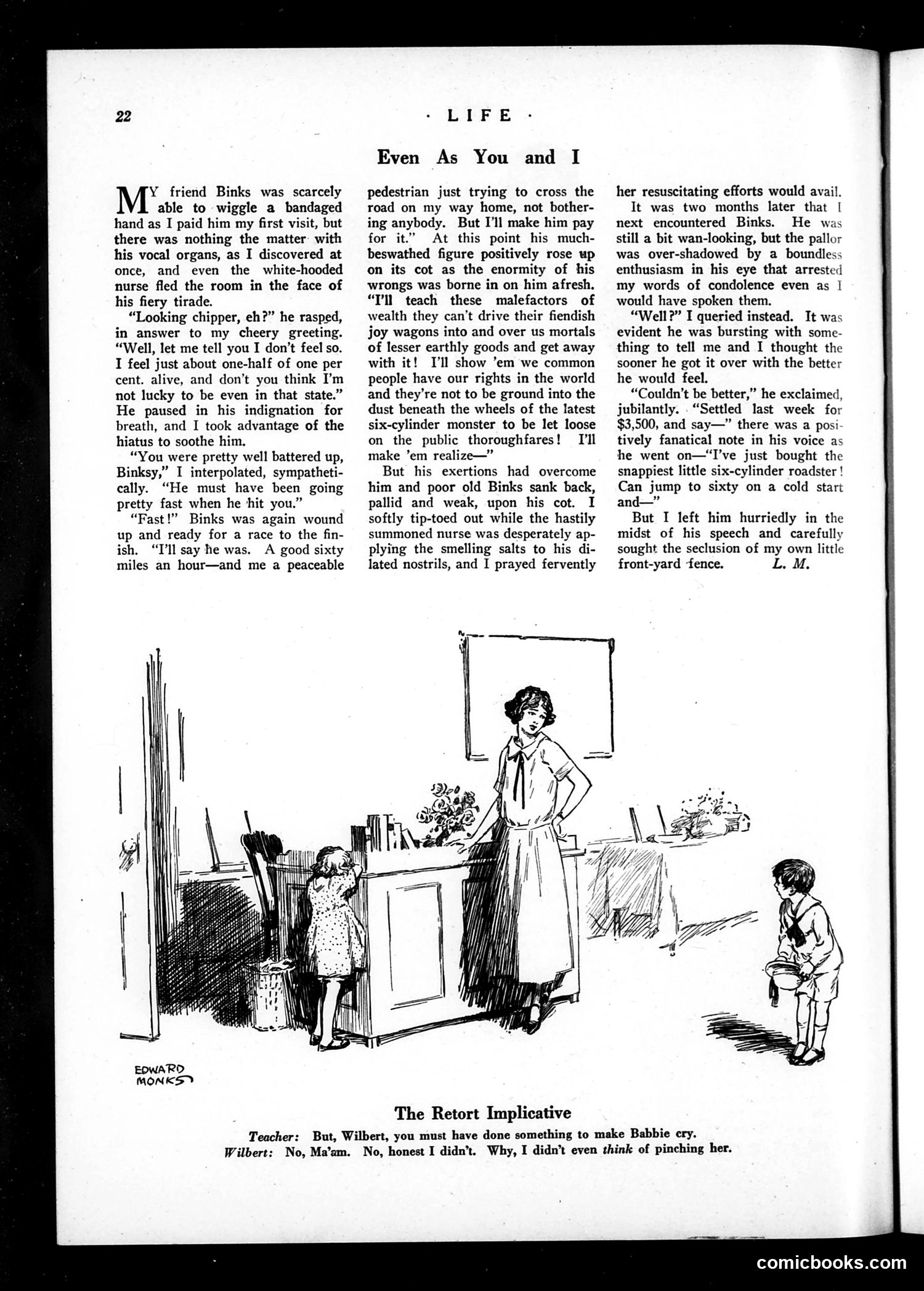
This story satirizes the American litigation culture of the early 20th century. A pedestrian named Binks is hit by a wealthy person's automobile and sustains serious injuries. Initially, he's righteous and angry, ranting about holding "malefactors of wealth" accountable and defending common people's rights. Two months later, the narrator encounters a transformed Binks: he's settled the lawsuit for $3,500 and used the money to purchase a luxurious six-cylinder roadster—the very type of vehicle that injured him. The irony is biting: Binks's indignation about reckless wealthy drivers has evaporated, replaced by enthusiasm for the status symbol that struck him down. The accompanying cartoon ("The Retort Implicative") shows a child denying wrongdoing by claiming innocence of specific misbehavior, illustrating how people rationalize behavior through narrow technical denials. Together, these pieces mock how financial settlements corrupt moral outrage and how people justify contradictory behavior.
📄 Transcribed text from this page (OCR, searchable)
Machine-transcribed from the original scan — historical spelling and the odd misread are preserved.
Y friend Binks was scarcely able to wiggle a bandaged hand as I paid him my first visit, but there was nothing the matter with his vocal organs, as I discovered at once, and even the white-hooded nurse fled the room in the face of his fiery tirade. “Looking chipper, eh?” he rasped, in answer to my cheery greeting. “Well, let me tell you I don’t feel so. I feel just about one-half of one per cent. alive, and don’t you think I’m not lucky to be even in that state.” He paused in his indignation for breath, and I took advantage of the hiatus to soothe him. “You were pretty well battered up, Binksy,” I interpolated, sympatheti- cally. “He must have been going pretty fast when he ‘hit you.” “Fast!” Binks was again wound up and ready for a race to the fin- ish. “I'll say he was. A good sixty miles an hour—and me a peaceable Teacher: LIFE - Even As You and I pedestrian just trying to cross the road on my way home, not bother- ing anybody. But I’ll make him pay for it.” At this point his much- beswathed figure positively rose up on its cot as the enormity of his wrongs was borne in on him afresh, ‘T'll_ teach these malefactors of wealth they can’t drive their fiendish joy wagons into and over us mortals of lesser earthly goods and get away with it! I'll show ’em we common people have our rights in the world and they’re not to be ground into the dust beneath the wheels of the latest six-cylinder monster to be let loose on the public thoroughfares! I'll make ’em realize—” But his exertions had overcome him and poor old Binks sank back, pallid and weak, upon his cot. I softly tip-toed out while the hastily summoned nurse was desperately ap- plying the smelling salts to his di- lated nostrils, and I prayed fervently The Retort Implicative her resuscitating efforts would avail. It was two months later that | next encountered Binks. He was still a bit wan-looking, but the pallor was over-shadowed by a boundless enthusiasm in his eye that arrested my words of condolence even as I would have spoken them. “Well?” I queried instead. It was evident he was bursting with some- thing to tell me and I thought the sooner he got it over with the better he would feel. “Couldn't be better,” he exclaimed, jubilantly. . “Settled last week for $3,500, and say—” there was a posi tively fanatical note in his voice as he went on—‘I’ve just bought the snappiest little six-cylinder roadster ! Can jump to sixty on a cold start and—” But I left him hurriedly in the midst of his speech and carefully sought the seclusion of my own little front-yard fence. L. M. But, Wilbert, you must have done something to make Babbie cry. Wilbert: No, Ma’am. No, honest I didn’t. Why, I didn’t even think of pinching her. comicbooks.com