
Life, 1922-11-30 · page 6 of 36
Life — November 30, 1922 — page 6: what you’re looking at
What you’re looking at
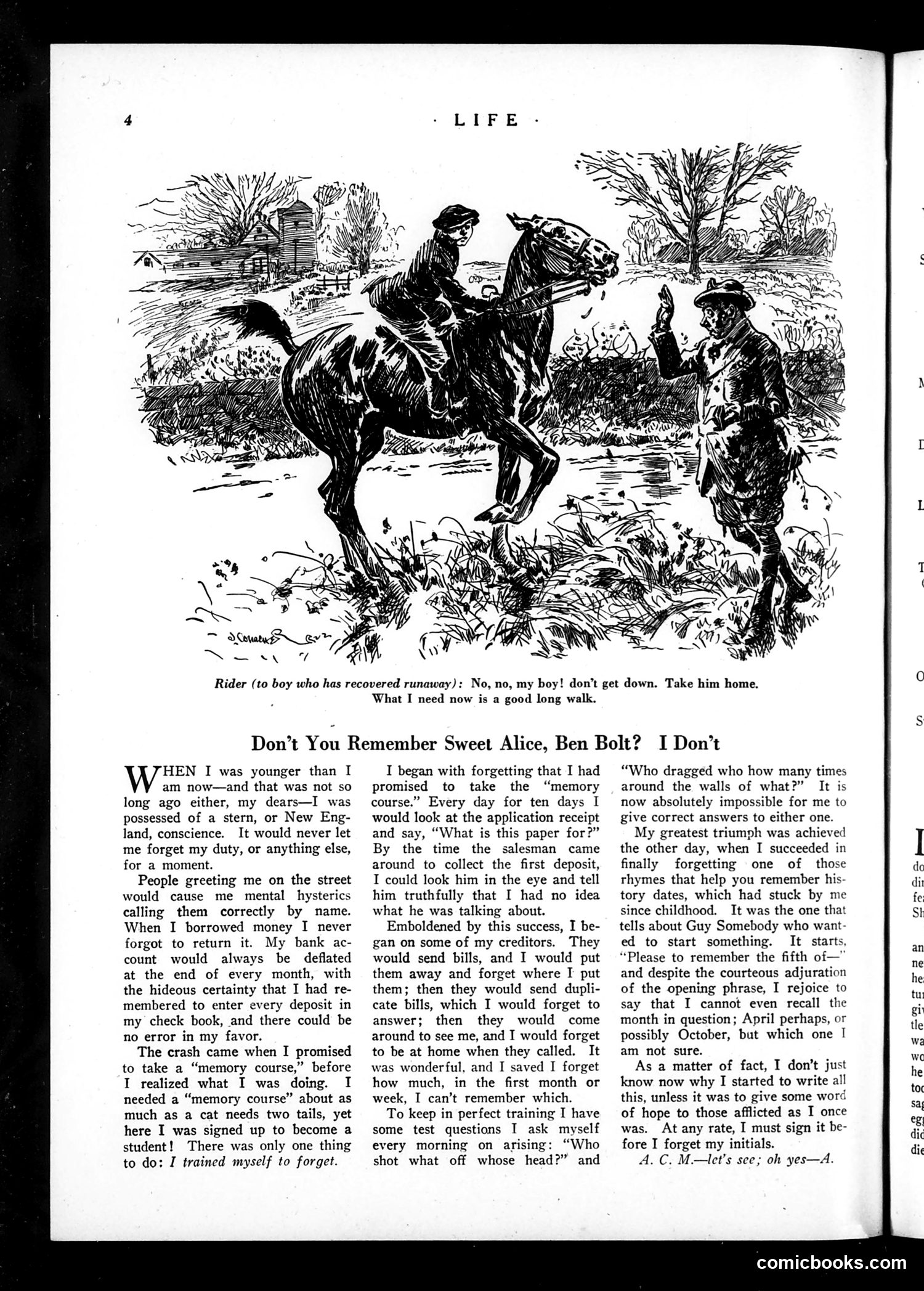
The illustration shows a man on horseback meeting another man on foot in a rural setting. The caption reads: "Rider (to boy who has recovered runaway): 'No, no, my boy! don't get down. Take him home. What I need now is a good long walk.'" This is a humorous domestic scene rather than political satire. The joke plays on the irony of someone who has just recovered a runaway horse—which would normally be exhausting—saying he now needs a walk to relax. The implication is that riding the spirited horse was so strenuous that the rider needs *more* walking to recover. The accompanying article, "Don't You Remember Sweet Alice, Ben Bolt?" is a nostalgic essay about memory and forgetfulness, unrelated to the cartoon.
📄 Transcribed text from this page (OCR, searchable)
Machine-transcribed from the original scan — historical spelling and the odd misread are preserved.
Rider (to boy who has recovered runaway): No, no, my boy! don’t get down. Take him home. What I need now is a good long walk. Don’t You Remember Sweet Alice, Ben Bolt? I Don’t HEN I was younger than I am now—and that was not so long ago either, my dears—I was possessed of a stern, or New Eng- land, conscience. It would never let me forget my duty, or anything else, for a moment. People greeting me on the street would cause me mental hysterics calling them correctly by name. When I borrowed money I never forgot to return it. My bank ac- count would always be deflated at the end of every month, with the hideous certainty that I had re- membered to enter every deposit in my check book, and there could be no error in my favor. The crash came when I promised to take a “memory course,” before I realized what I was doing. I needed a “memory course” about as much as a cat needs two tails, yet here I was signed up to become a student! There was only one thing to do: I trained myself to forget. I began with forgetting that I had promised to take the “memory course.” Every day for ten days I would look at the application receipt and say, “What is this paper for?” By the time the salesman came around to collect the first deposit, I could look him in the eye and tell him truthfully that I had no idea what he was talking about. Emboldened by this success, I be- gan on some of my creditors. They would send bills, and I would put them away and forget where I put them; then they would send dupli- cate bills, which I would forget to answer; then they would come around to see me, and I would forget to be at home when they called. It was wonderful, and I saved I forget how much, in the first month or week, I can’t remember which. To keep in perfect training I have some test questions I ask myself every morning on arising: “Who shot what off whose head?” and “Who dragged who how many times around the walls of what?” It is now absolutely impossible for me to give correct answers to either one. My greatest triumph was achieved the other day, when I succeeded in finally forgetting one of those rhymes that help you remember his- tory dates, which had stuck by me since childhood. It was the one that tells about Guy Somebody who want- ed to start something. It starts, “Please to remember the fifth of—" and despite the courteous adjuration of the opening phrase, I rejoice to say that I cannot even recall the month in question; April perhaps, or possibly October, but which one | am not sure. As a matter of fact, I don’t just know now why I started to write all this, unless it was to give some word of hope to those afflicted as I once was. At any rate, I must sign it be- fore I forget my initials. A. C. M.—let’s see; oh yes—A. comicbooks.com