
Life, 1922-11-30 · page 28 of 36
Life — November 30, 1922 — page 28: what you’re looking at
What you’re looking at
This page reviews three silent films for a general audience. The main content critiques D.W. Griffith's "One Exciting Night"—a mystery melodrama that sacrifices Griffith's usual historical "spectacles" for commercial box-office appeal. The reviewer notes it uses standard melodramatic tricks (mysterious doorknobs, cloaked figures) and "burnt-cork" comedy (a racist caricature of a frightened Black servant character), criticizing its artificiality while acknowledging its entertainment value. The page also reviews "The Young Rajah" (starring Rudolph Valentino), which adapted John Ames Mitchell's novel into what the critic considers a botched adaptation, and "To Have and to Hold," praised for George Fitzmaurice's direction and Theodore Kosloff's performance, featuring period action scenes with duels and naval battles. The image shows a scene from one of these films depicting characters in period costume.
📄 Transcribed text from this page (OCR, searchable)
Machine-transcribed from the original scan — historical spelling and the odd misread are preserved.
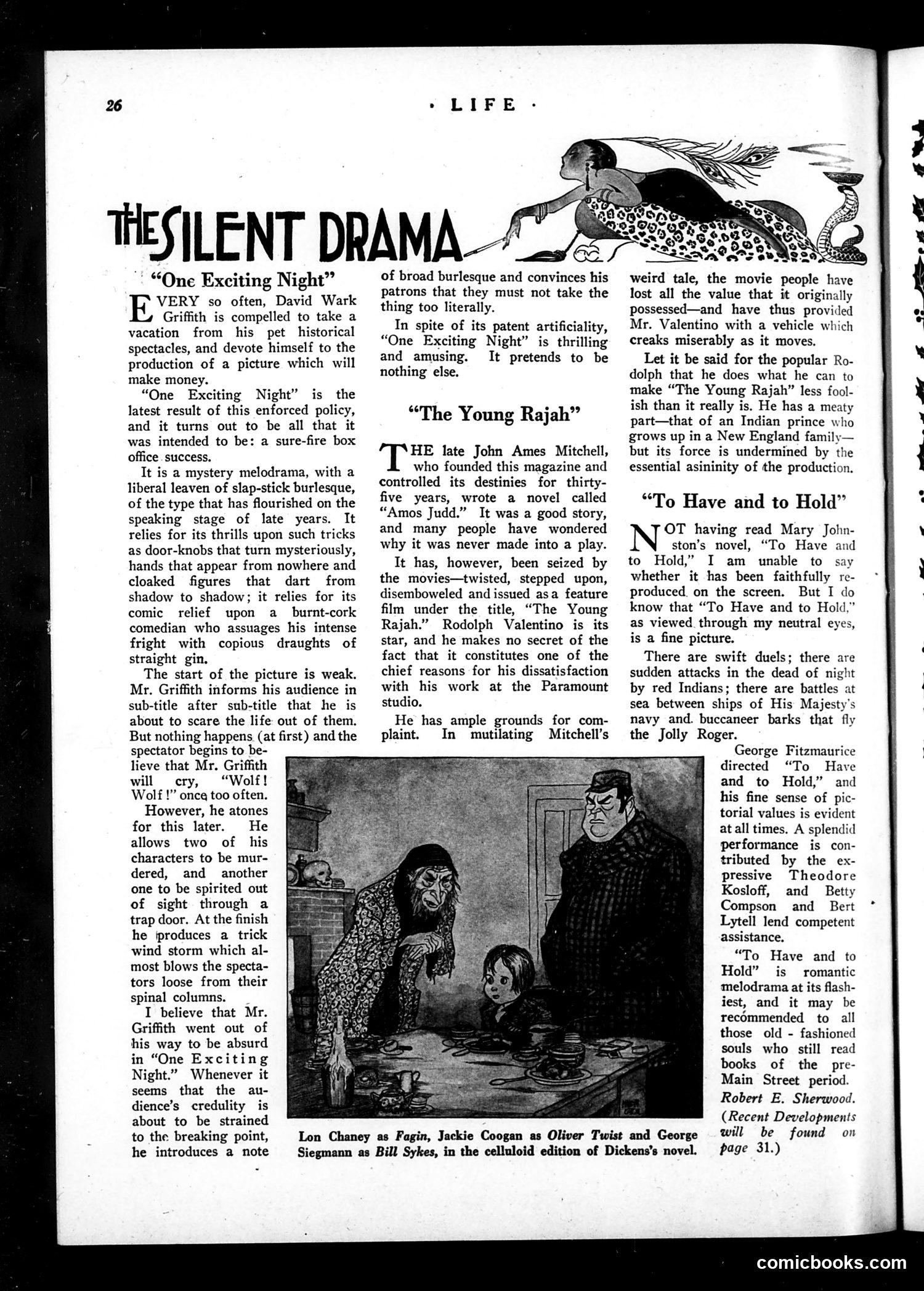
“One Exciting Night” VERY so often, David Wark Griffith is compelled to take a vacation from his pet historical spectacles, and devote himself to the production of a picture which will make money. “One Exciting Night” is the latest result of this enforced policy, and it turns out to be all that it was intended to be: a sure-fire box office. success. It is a mystery melodrama, with a liberal leaven of slap-stick burlesque, of the type that has flourished on the speaking stage of late years. It relies for its thrills upon such tricks as door-knobs that turn mysteriously, hands that appear from nowhere and cloaked figures that dart from shadow to shadow; it relies for its comic relief upon a_ burnt-cork comedian who assuages his intense fright with copious draughts of straight gin, The start of the picture is weak. Mr. Griffith informs his audience in sub-title after sub-title that he is about to scare the life out of them. But nothing happens (at first) and the spectator begins to be- lieve that Mr. Griffith will cry, “Wolf! Wolf !” once too often. However, he atones for this later. He allows two of his characters to be mur- dered, and another one to be spirited out of sight through a trap door. At the finish he iproduces a trick wind storm which al- most blows the specta- tors loose from their spinal columns. I believe that Mr. Griffith went out of his way to be absurd in “One Exciting Night.” Whenever it seems that the au- dience’s credulity is about to be strained to the breaking point, he introduces a note of broad burlesque and convinces his patrons that they must not take the thing too literally. In spite of its patent artificiality, “One Exciting Night” is thrilling and amusing. It pretends to be nothing else. “The Young Rajah” HE late John Ames Mitchell, who founded this magazine and controlled its destinies for thirty- five years, wrote a novel called “Amos Judd.” It was a good story, and many people have wondered why it was never made into a play. It has, however, been seized by the movies—twisted, stepped upon, disemboweled and issued asa feature film under the title, “The Young Rajah.” Rodolph Valentino is its star, and he makes no secret of the fact that it constitutes one of the chief reasons for his dissatisfaction with his work at the Paramount studio. He has ample grounds for com- plaint. In mutilating Mitchell’s weird tale, the movie people have lost all the value that it originally possessed—and have thus provided Mr. Valentino with a vehicle which creaks miserably as it moves. Let it be said for the popular Ro- dolph that he does what he can to make “The Young Rajah” less fool- ish than it really is. He has a meaty part—that of an Indian prince who grows up in a New England family— but its force is undermined by the essential asininity of the production. “To Have and to Hold” OT having read Mary John- ston’s novel, “To Have and to Hold,” I am unable to say whether it has been faithfully re- produced. on the screen. But I do know that “To Have and to Hold,” as viewed. through my neutral eyes, is a fine picture. There are swift duels; there are sudden attacks in the dead of night by red Indians; there are battles at sea between ships of His Majesty's navy and. buccaneer barks that fly the Jolly Roger. George Fitzmaurice directed “To Have and to Hold,” and his fine sense of pic- torial values is evident at all times. A splendid performance is con- tributed by the ex- pressive Theodore Kosloff, and Betty Compson and Bert Lytell lend competent assistance, “To Have and to Hold” is romantic melodrama at its flash- iest, and it may be recommended to all those old - fashioned souls who still read books of the pre- Main Street period. Robert E. Sherwood. (Recent Developments Lon Chaney as Fagin, Jackie Coogan as Oliver Twist and George will be found on Siegmann as Bill Sykes, in the celluloid edition of Dickens’s novel. page 31.) comicbooks.com at ln hr hCUtl!lhClUe! U2 et Ce OS OO