
A complete issue · 36 pages · 1922
Life — October 26, 1922
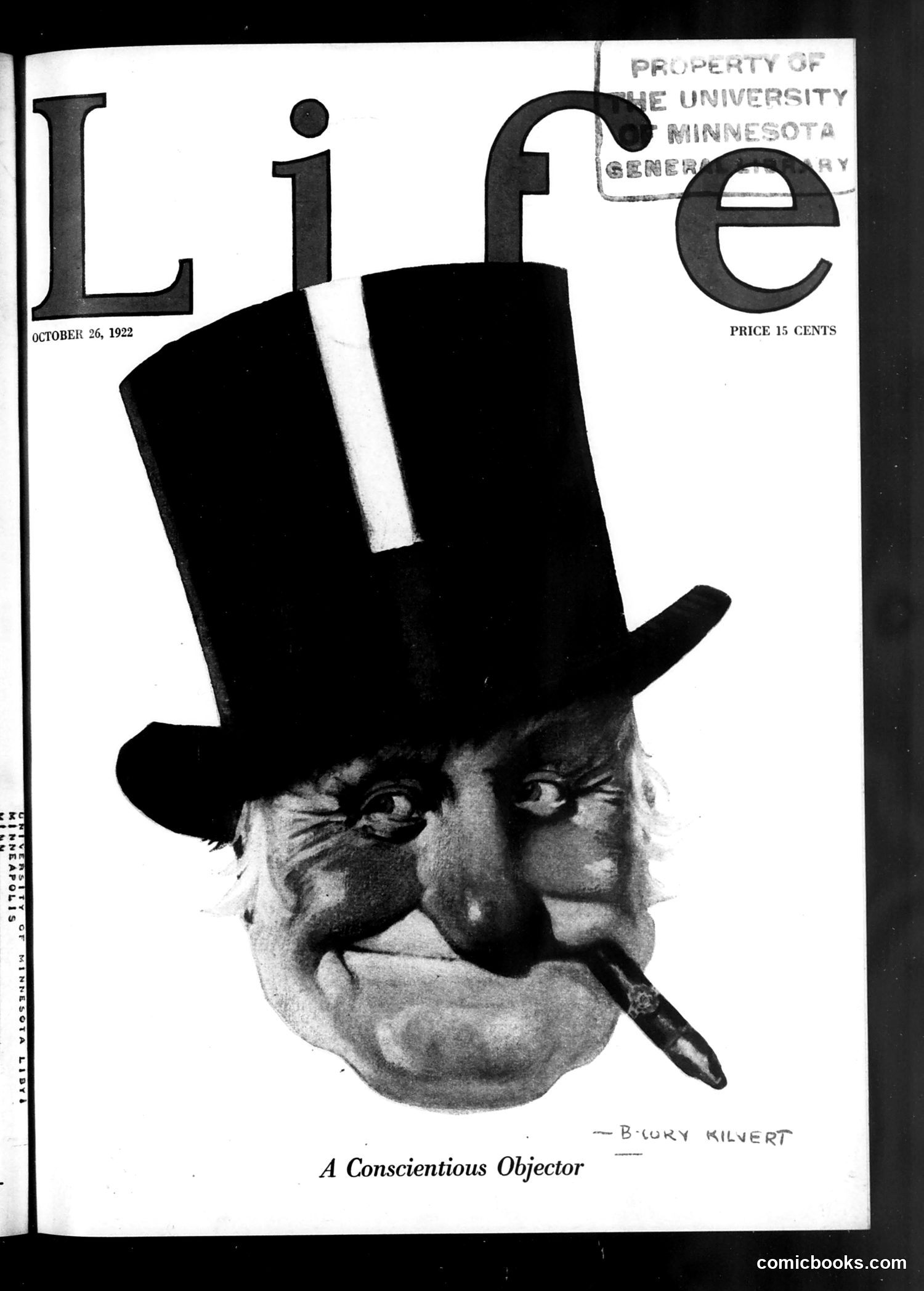
This cover features a caricatured face wearing a tall top hat, smoking a pipe, with the caption "A Conscientious Objector" credited to artist B. Dort Kilvert. The figure appears to represent someone who refused military service on moral or political grounds—a "conscientious objector." The exaggerated, somewhat grotesque facial features and sneering expression suggest satire: the cartoonist is mocking this person's stance. The upside-down positioning of the letters "L-i-f-e" (with the head rotated 180 degrees) reinforces the satirical inversion of values. In 1922, conscientious objection remained controversial in post-WWI America. This cover likely ridicules pacifists or draft resisters from the recent war, portraying them as absurd or morally backwards figures worthy of public mockery.
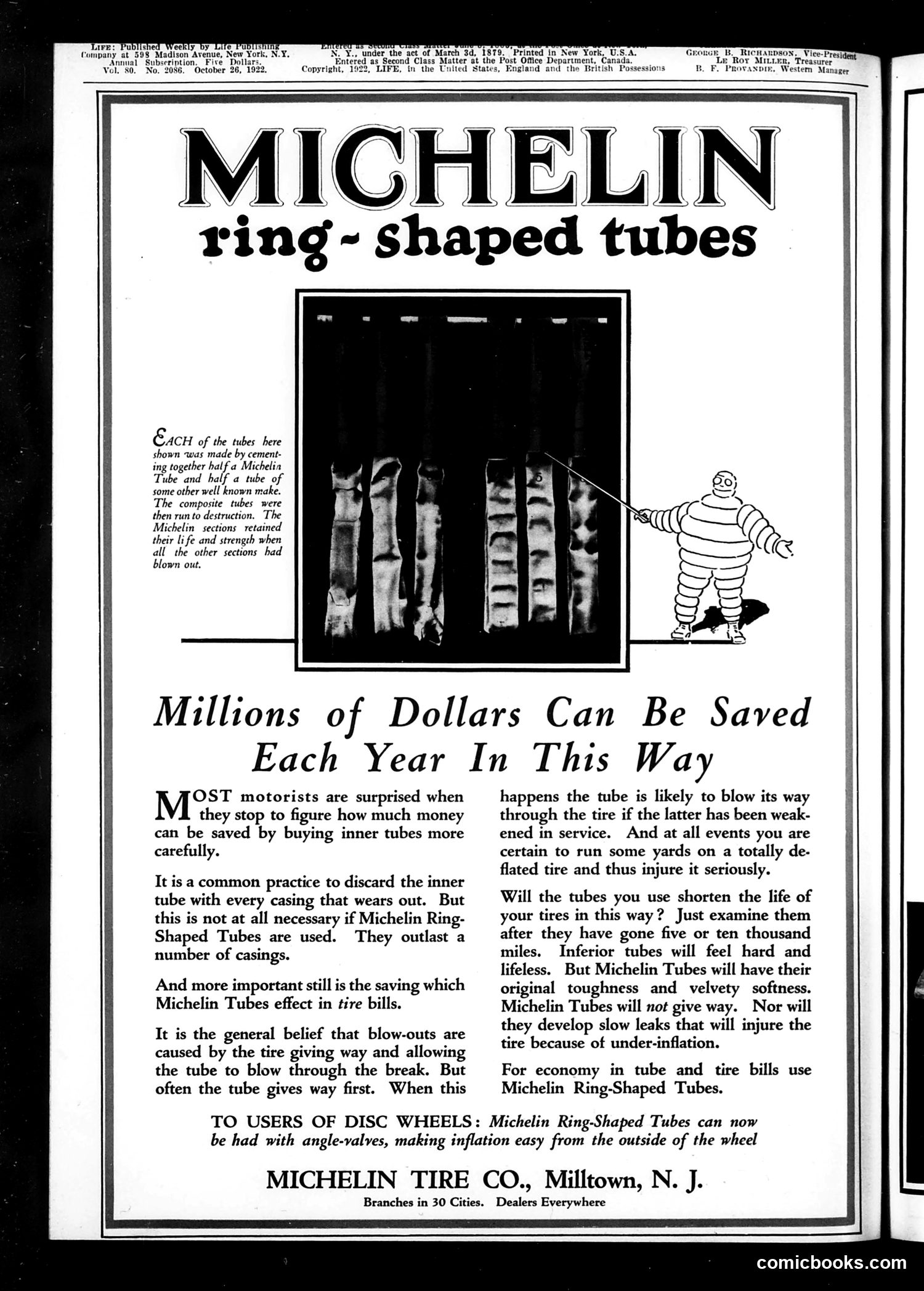
This is **not a political cartoon or satire**, but rather a **straightforward product advertisement** for Michelin Ring-Shaped Tubes (inner tubes for tires). The page features the Michelin Man mascot (the rotund, bandage-wrapped figure on the right) demonstrating the product. The central image shows cross-sections of composite tire tubes, illustrating their construction from Michelin tubes bonded with other materials. The advertisement's argument is economic: motorists waste money replacing inner tubes with every tire casing failure. Michelin Ring-Shaped Tubes last longer, outliving multiple casings, thus saving "millions of dollars each year." The text emphasizes durability and reliability compared to inferior competitors. This represents early 20th-century consumer advertising, using the famous Michelin Man character to promote tire durability and value.
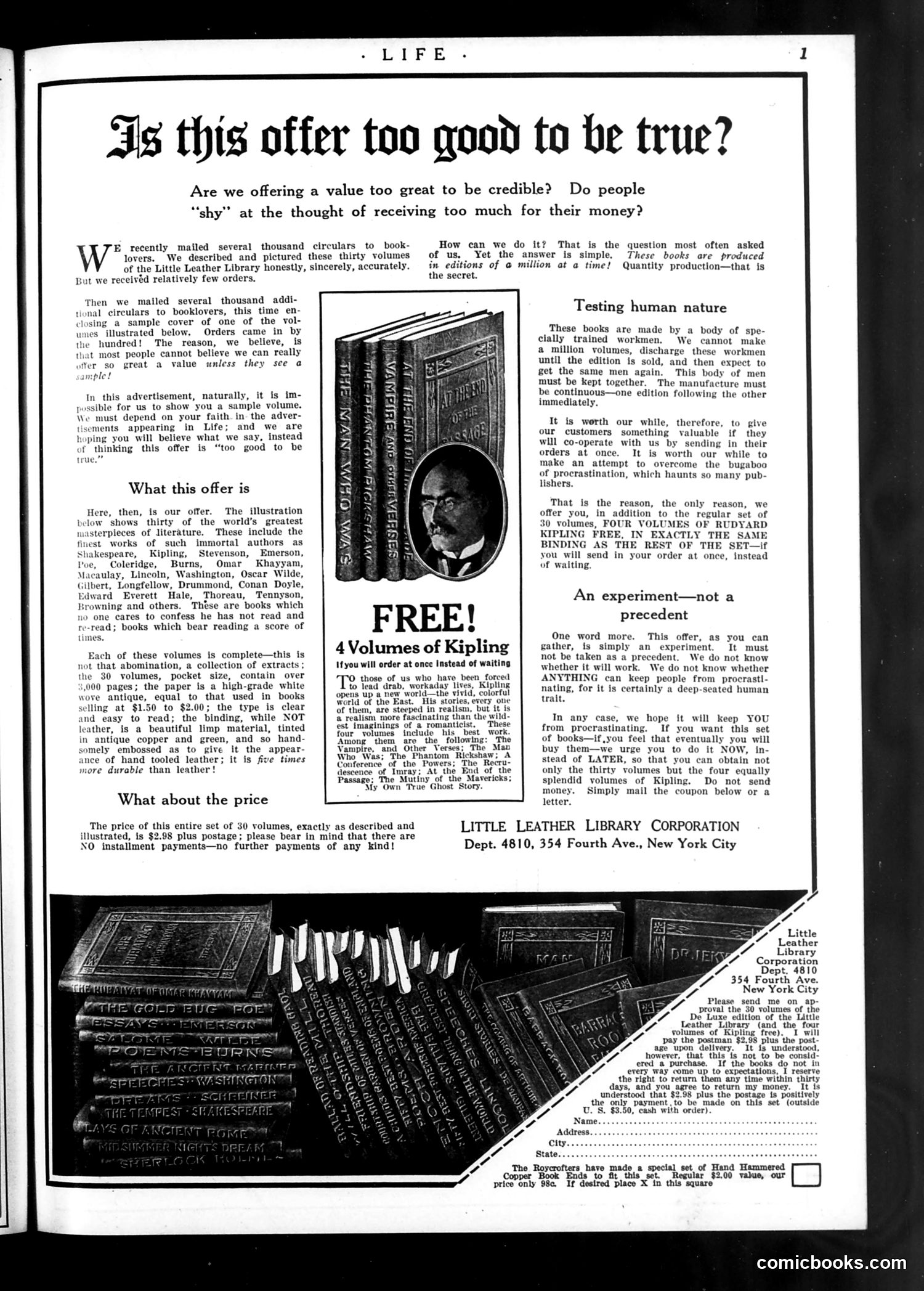
This page is primarily **advertising, not satire or political commentary**. It's a promotional piece by the Little Leather Library Corporation for a 30-volume set of classic literature. The headline "Is this offer too good to be true?" is a rhetorical marketing question addressing consumer skepticism about the deal's value. The advertisement acknowledges potential doubt—people might assume such an offer is a scam—then reassures readers by explaining the economics: mass production allows low prices without sacrificing quality. The portrait appears to be **Rudyard Kipling**, as the promotion specifically mentions "4 Volumes of Kipling" offered free with the set. There is **no political cartoon or satire here**—this is straightforward early-20th-century direct-mail marketing emphasizing affordability and legitimacy.
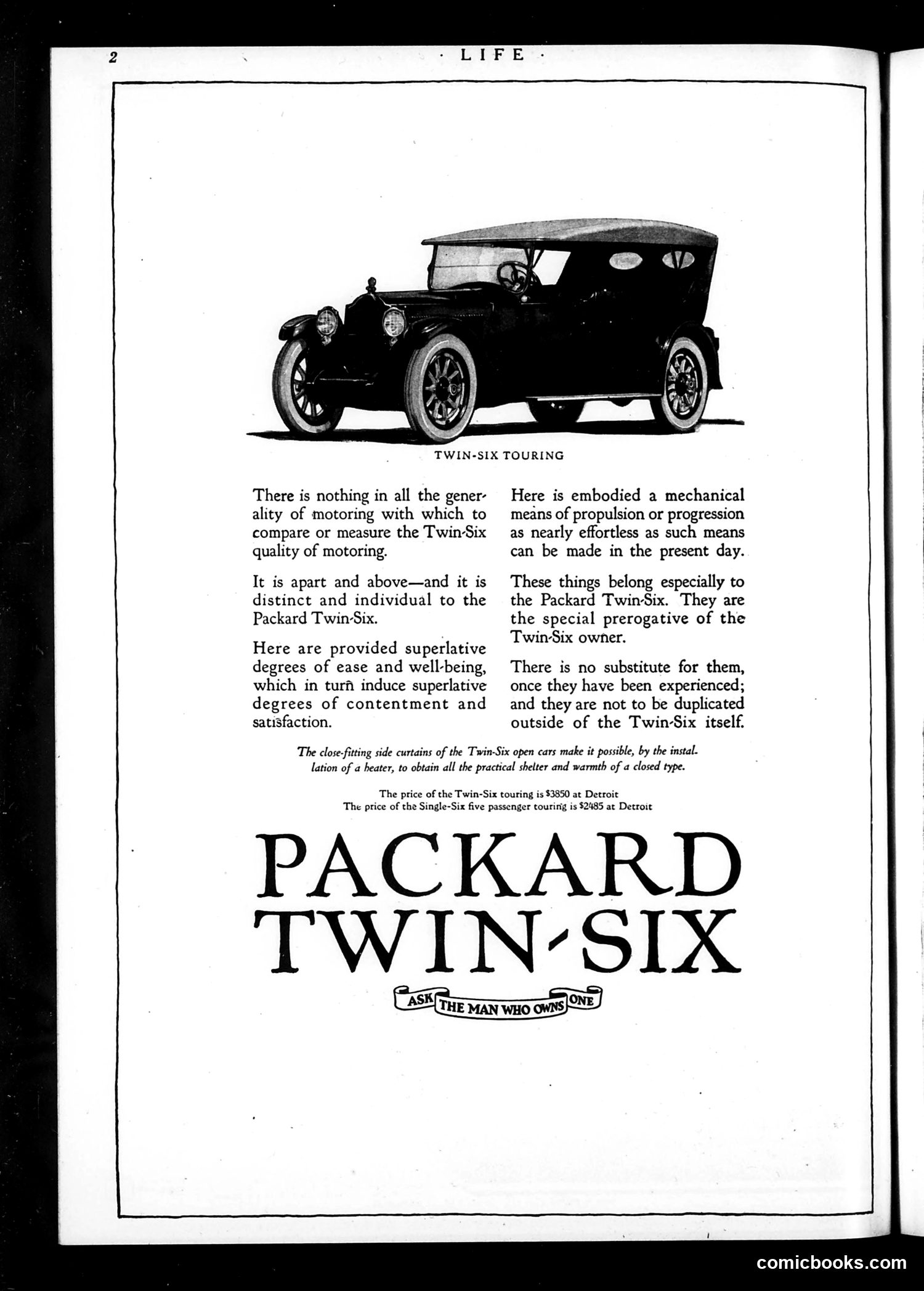
This page is **advertising, not satire or political commentary**. It's a full-page advertisement for the Packard Twin-Six automobile, published in *Life* magazine. The ad features a black-and-white illustration of a luxury touring car and promotional text emphasizing the vehicle's superior engineering and comfort. Key selling points include effortless mechanical propulsion, ease of operation, and passenger well-being. Pricing information is provided: the Twin-Six touring model costs $3,850 in Detroit, while a single-seat touring version costs $2,885. The tagline "Ask the Man Who Owns" was Packard's actual advertising slogan during this era, establishing brand prestige through owner testimonials. There are no political figures, caricatures, or satirical commentary on this page—it's purely commercial advertising typical of early automotive industry marketing.
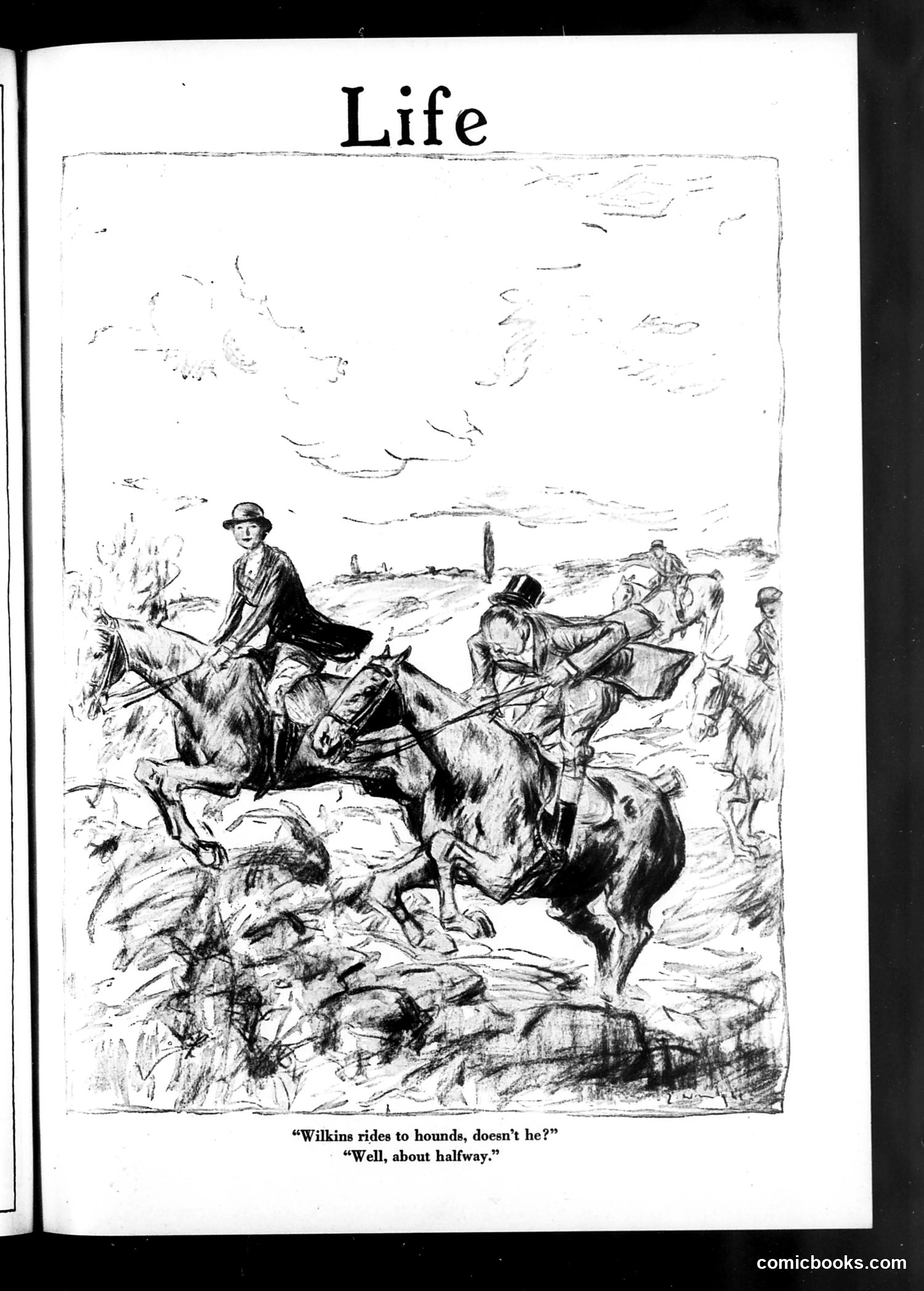
This illustration depicts a fox-hunting scene, a traditional English leisure activity popular among the upper classes. The caption's dialogue—"Wilkins rides to hounds, doesn't he?" / "Well, about halfway"—is a joke about competence and commitment. The humor suggests that "Wilkins" is an unreliable or inadequate horseman who participates in fox hunts but only manages to keep up for part of the ride before falling behind or dropping out. The punchline mocks both his horsemanship and his pretensions to belong among serious hunters. This type of satire was typical of *Life* magazine's social commentary, poking fun at would-be members of the upper class who couldn't fully master its traditional pursuits and status markers.
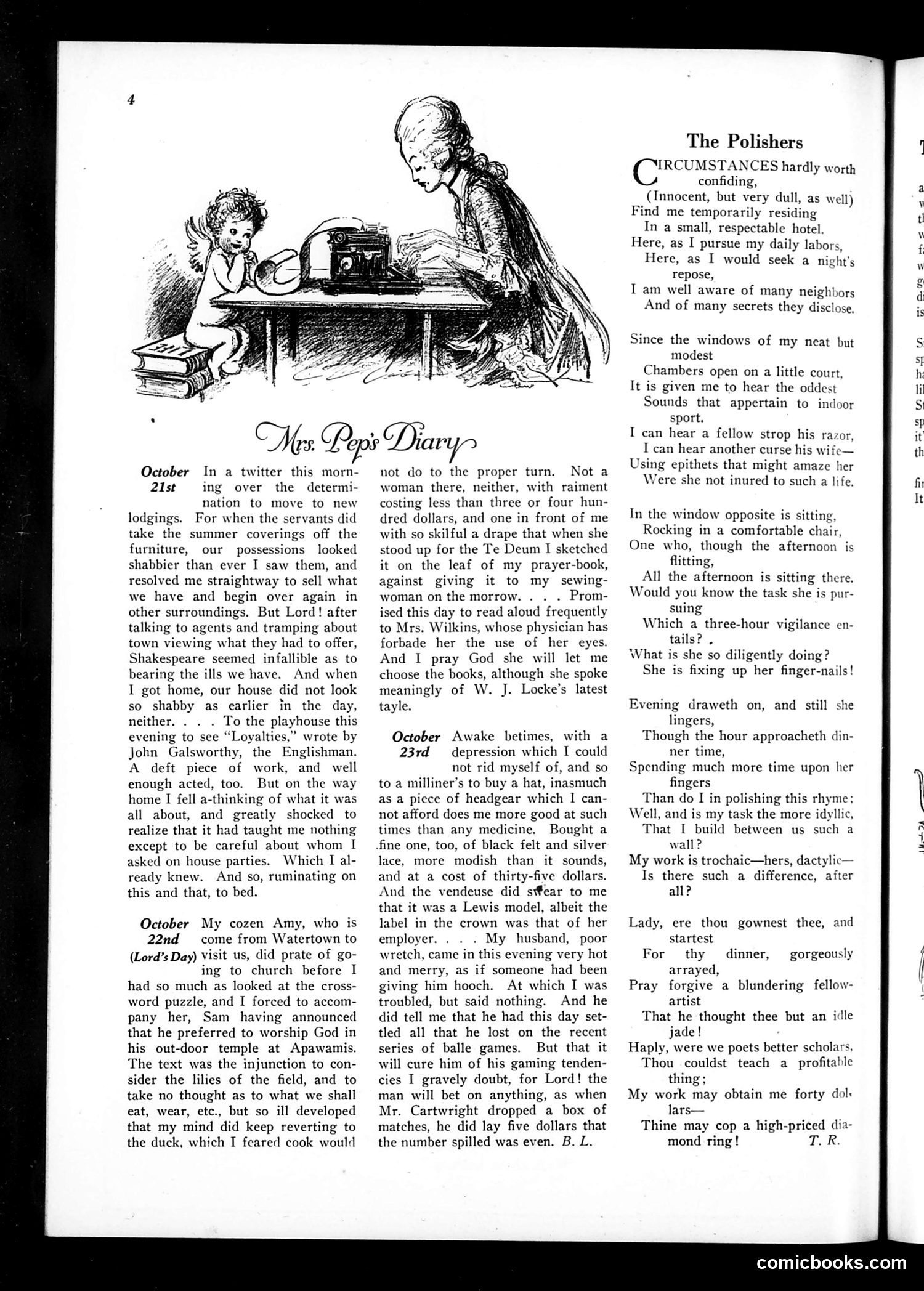
This page features a satirical diary entry mocking middle-class domestic life and female leisure activities. The illustration shows a woman at a table with what appears to be a polishing device, watched by a man—likely depicting the tedious, trivial occupations that satirize women's daily concerns. The diary entries from October describe shopping for hats, observing neighbors through windows, fixing fingernails, and polishing a ring—activities presented as absurdly consuming women's attention and time. The text sardonically contrasts these trivial pursuits with weightier concerns like church attendance and proper morality. The satire targets Victorian-era domesticity, suggesting that women of leisure occupied themselves with superficial concerns while claiming moral superiority. It's social criticism of upper-middle-class women's constrained roles and the gap between their pretensions and actual activities.
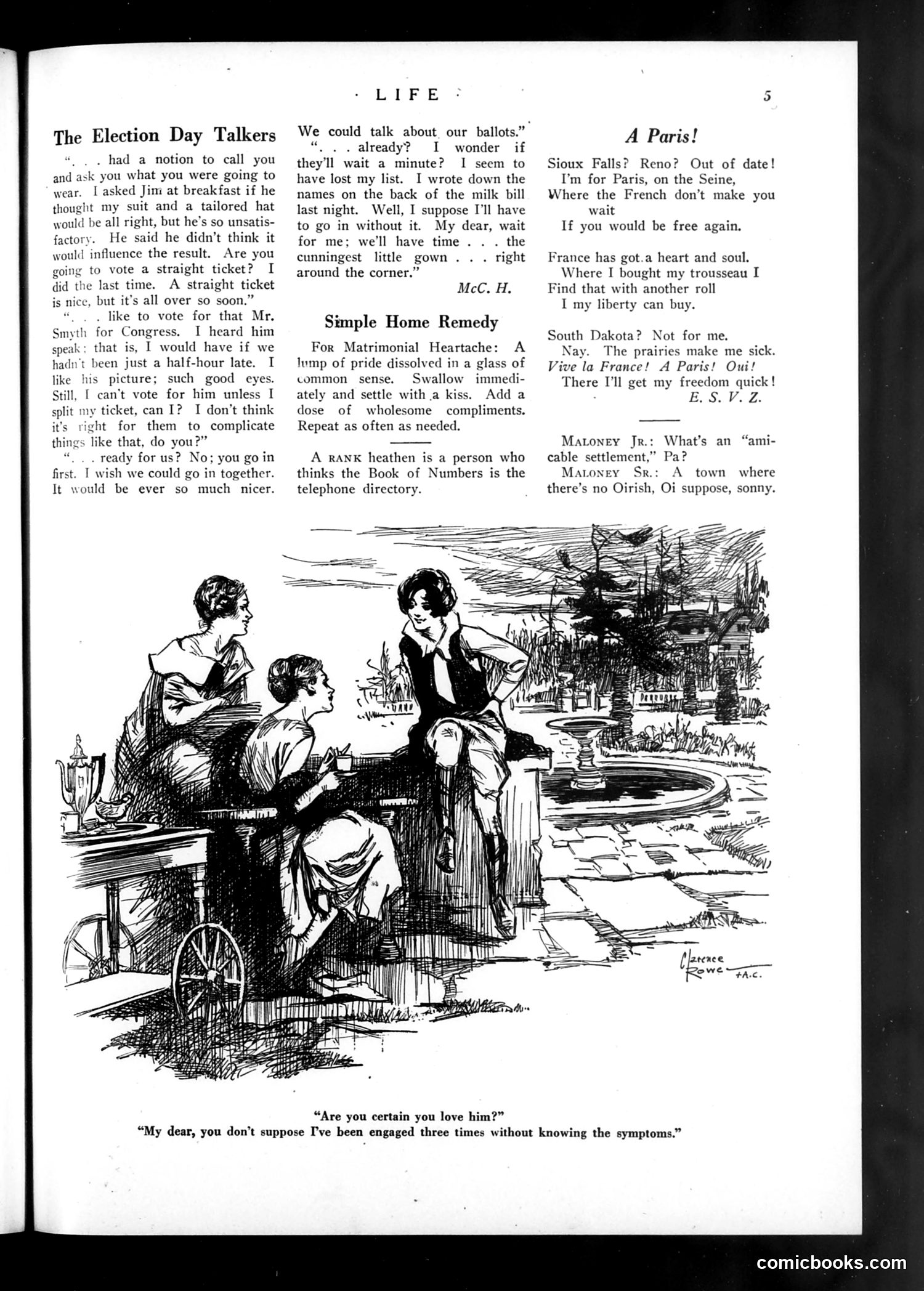
This page contains three satirical pieces about early 20th-century American social life: **"The Election Day Talkers"** mocks people who discuss voting but lack commitment—one character admits he nearly voted for Mr. Smyth for Congress but didn't because he arrived late. **"Simple Home Remedy"** offers absurdist advice for marital disputes, suggesting a "lump of pride dissolved" and a kiss as treatment. **The main cartoon** depicts three fashionable women by a riverside or canal (possibly Paris, given the background architecture), captioned with humorous dialogue about marriage. One woman jokes about being engaged three times without knowing the symptoms, satirizing both women's marriage prospects and casual attitudes toward commitment in the period. The overall tone mocks bourgeois social pretensions and romantic/political flightiness.
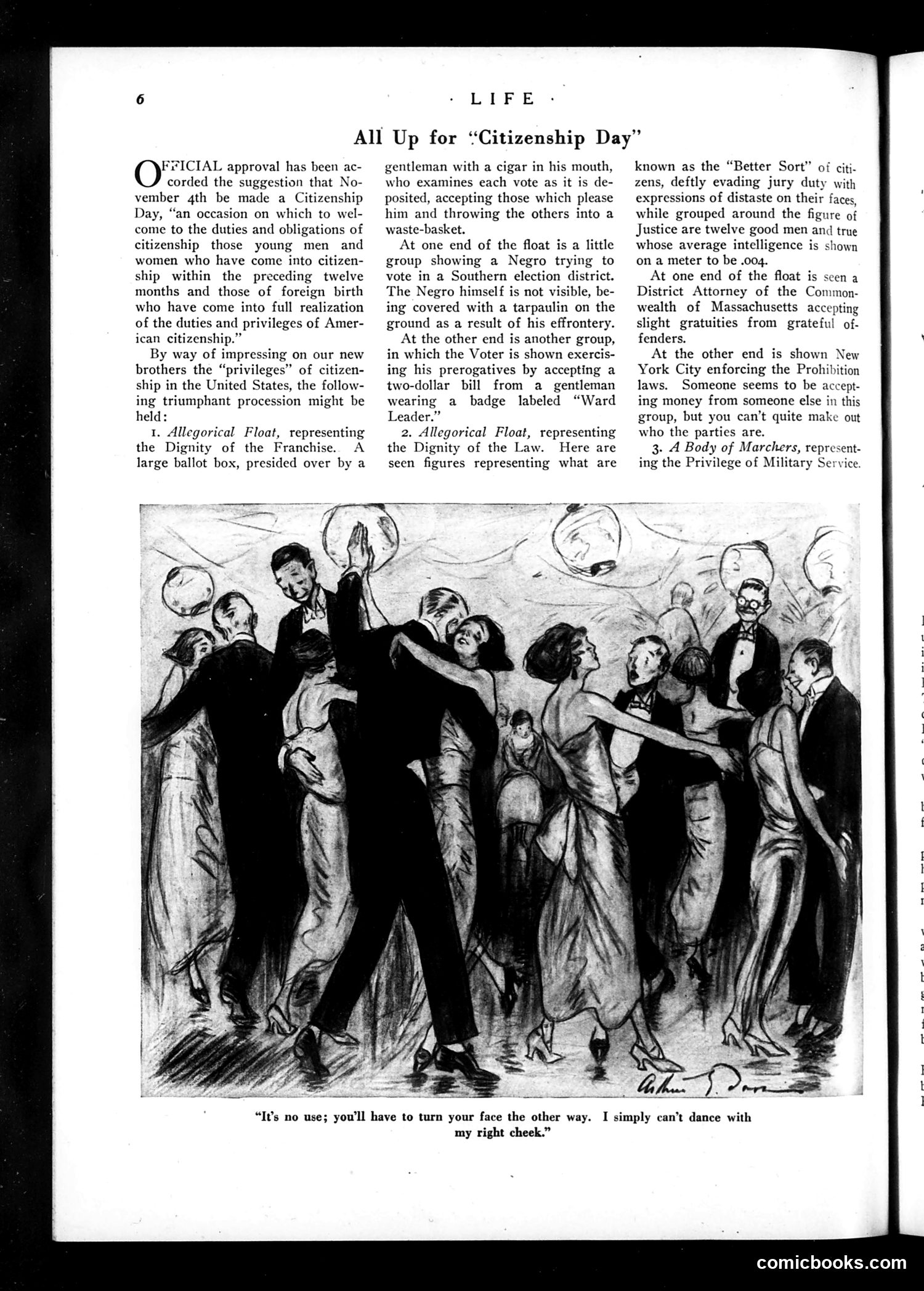
This satirical piece critiques a "Citizenship Day" parade celebrating naturalized citizens' rights. The text describes allegorical floats representing civic concepts like "Dignity of the Franchise" and "Dignity of the Law." The cartoon depicts a social dance scene where a man refuses to dance with a woman, telling her: "It's no use; you'll have to turn your face the other way. I simply can't dance with my right cheek." The satire appears to mock the hypocrisy of celebrating citizenship and civic equality while maintaining social discrimination and segregation—the man's refusal to engage with the woman despite formal citizenship rights granted. The specific reference to "right cheek" suggests an unwillingness to show face or publicly associate, undercutting the parade's patriotic message about equal civic participation.
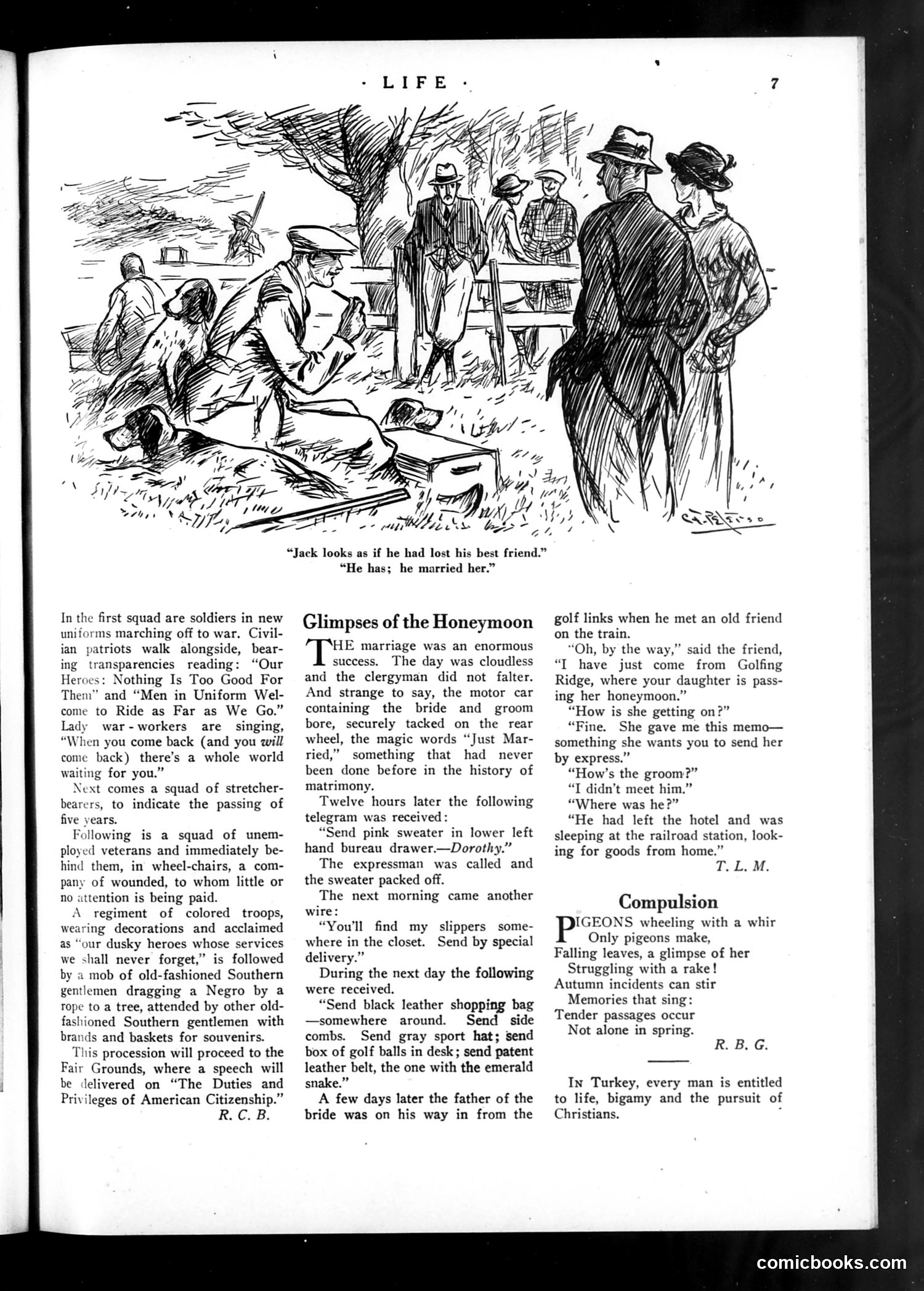
This satirical cartoon illustrates the contrast between romantic expectations and marital reality. The sketch shows a newlywed couple (Jack and his bride) surrounded by onlookers, with the caption: "Jack looks as if he had lost his best friend. He has; he married her." The joke exploits a common turn-of-the-century trope: marriage as the loss of male independence and bachelor freedom. The groom's dejected posture humorously suggests that gaining a wife means losing one's former carefree life and male companionship. The accompanying text describes honeymoon logistics—telegrams requesting clothing and items to be sent—highlighting the practical complications of early 20th-century travel that undercut romantic notions. The satire targets conventional attitudes toward matrimony as simultaneously desirable and emasculating.
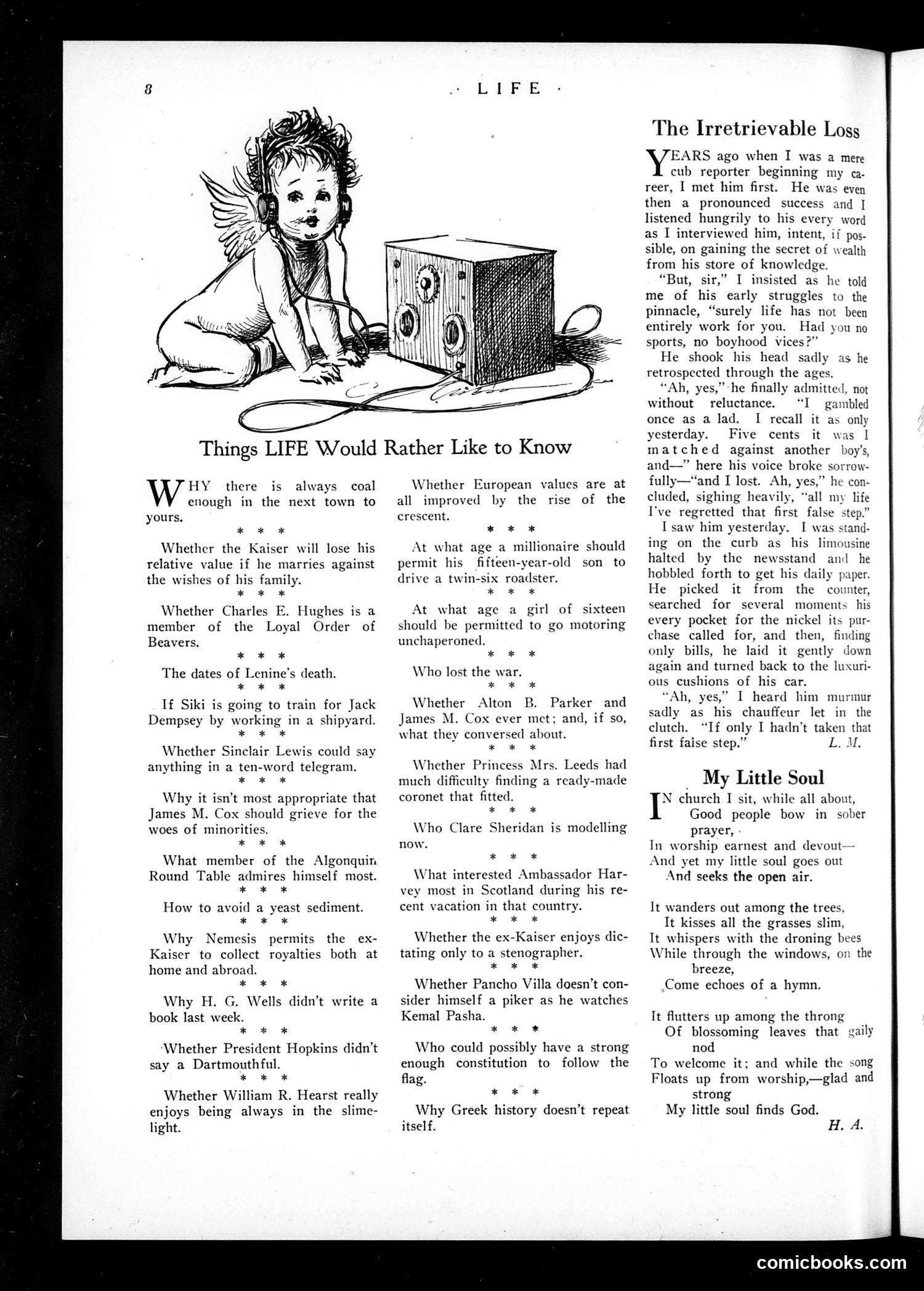
This page from *Life* magazine contains a satirical illustration titled "Things LIFE Would Rather Like to Know"—a recurring feature listing absurd, topical questions poking fun at contemporary public figures and events. The cherub illustration ("Things LIFE Would Rather Like to Know") is decorative framing for humorous questions about real people and events, likely from the 1910s-1920s era based on references to the Kaiser, Lenin, and Pancho Villa. The adjacent essay "My Little Soul" by H.A. is unrelated—a sentimental poem about spiritual reflection during church. The satirical questions target specific figures (ex-Kaiser, James M. Cox, Princess Leeds) and absurd situations, exemplifying *Life*'s approach of mocking the famous and powerful through pointed, often rhetorical questioning rather than direct commentary.
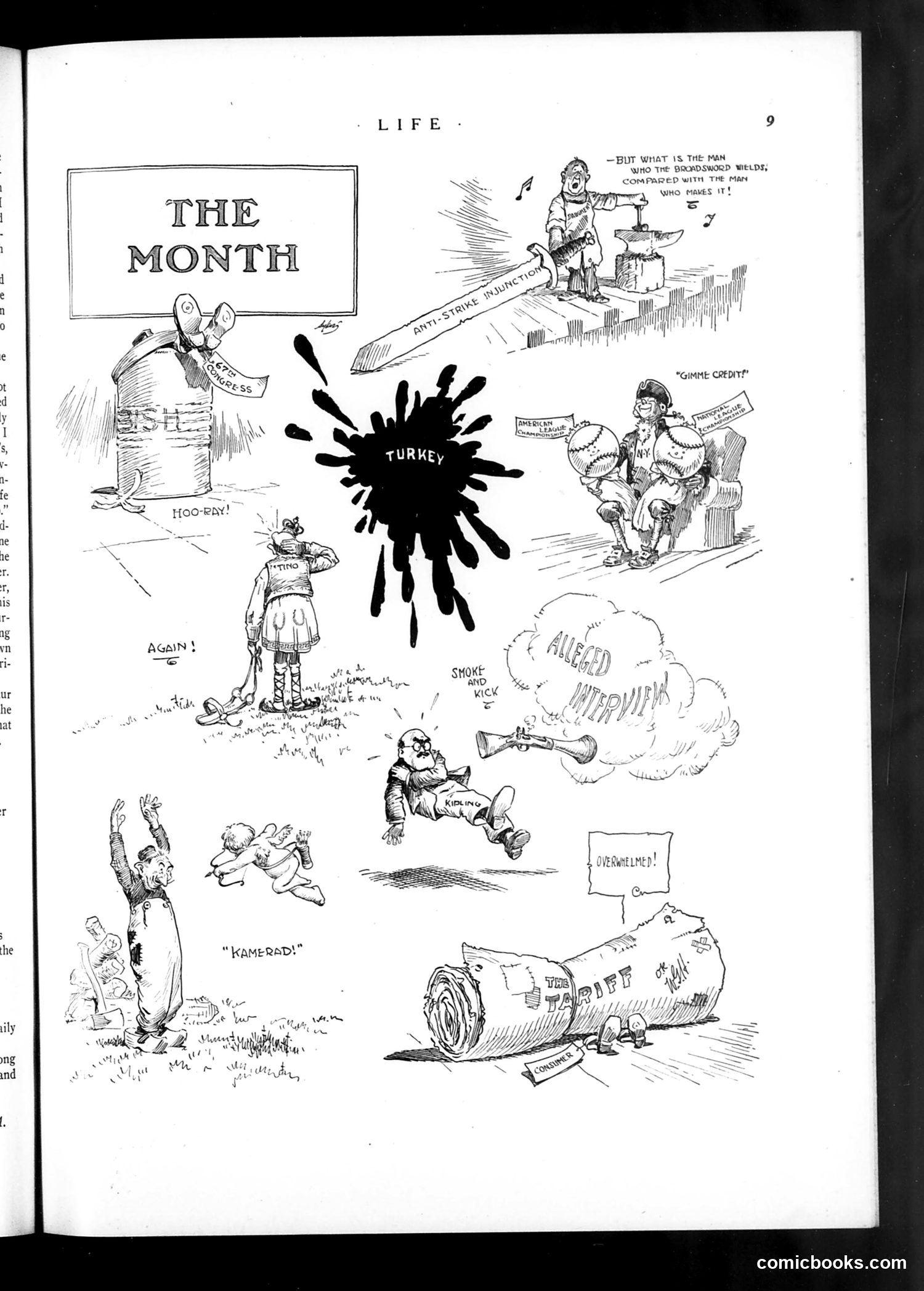
This page presents satirical sketches commenting on contemporary events, with "Turkey" as the central focus—likely referring to the Ottoman Empire's political instability or international conflicts of the era. The cartoons employ exaggerated caricatures and absurdist scenarios: figures are shown in compromising positions ("Kameered!"), military personnel react to chaos, and various character types respond to turbulent situations. References include "Anti-Strike Injunction" (labor disputes), "Gimme Credit" (financial concerns), and "Smoke & Wick" (unclear reference). The overall tone satirizes political incompetence, social disorder, and economic instability. Without a specific date visible, the exact historical moment remains unclear, but the page reflects Life's typical approach: mocking governmental failures and social upheaval through grotesque illustration and caustic humor targeting contemporary power structures and public figures.
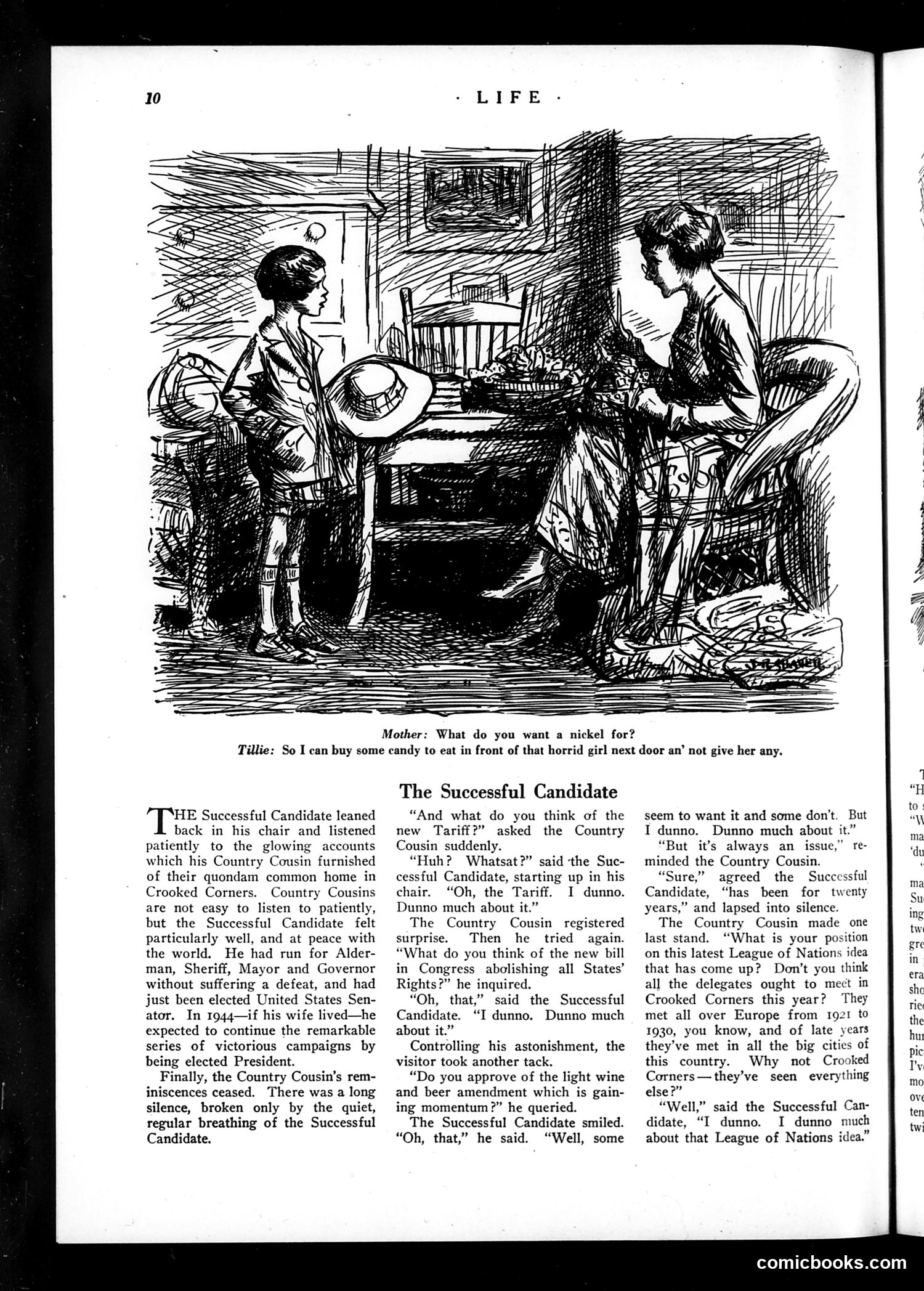
This satirical piece mocks a political candidate whose success relies on avoiding substantive positions. When questioned about policy—the "new Tariff," Congressional "States' Rights," and the League of Nations—he responds only with "I dunno. Dunno much about it." The humor targets candidates who win elections through charm and ambiguity rather than actual policy knowledge or commitment. His Country Cousin visitor serves as the everyman, registering surprise that evasion is an effective political strategy. The cartoon likely references 1920s American politics, when isolationism and protectionism dominated debates. The satire suggests that successful politicians deliberately avoid clear positions to appeal to disparate voters—a timeless critique of political non-answers that remains relevant today.
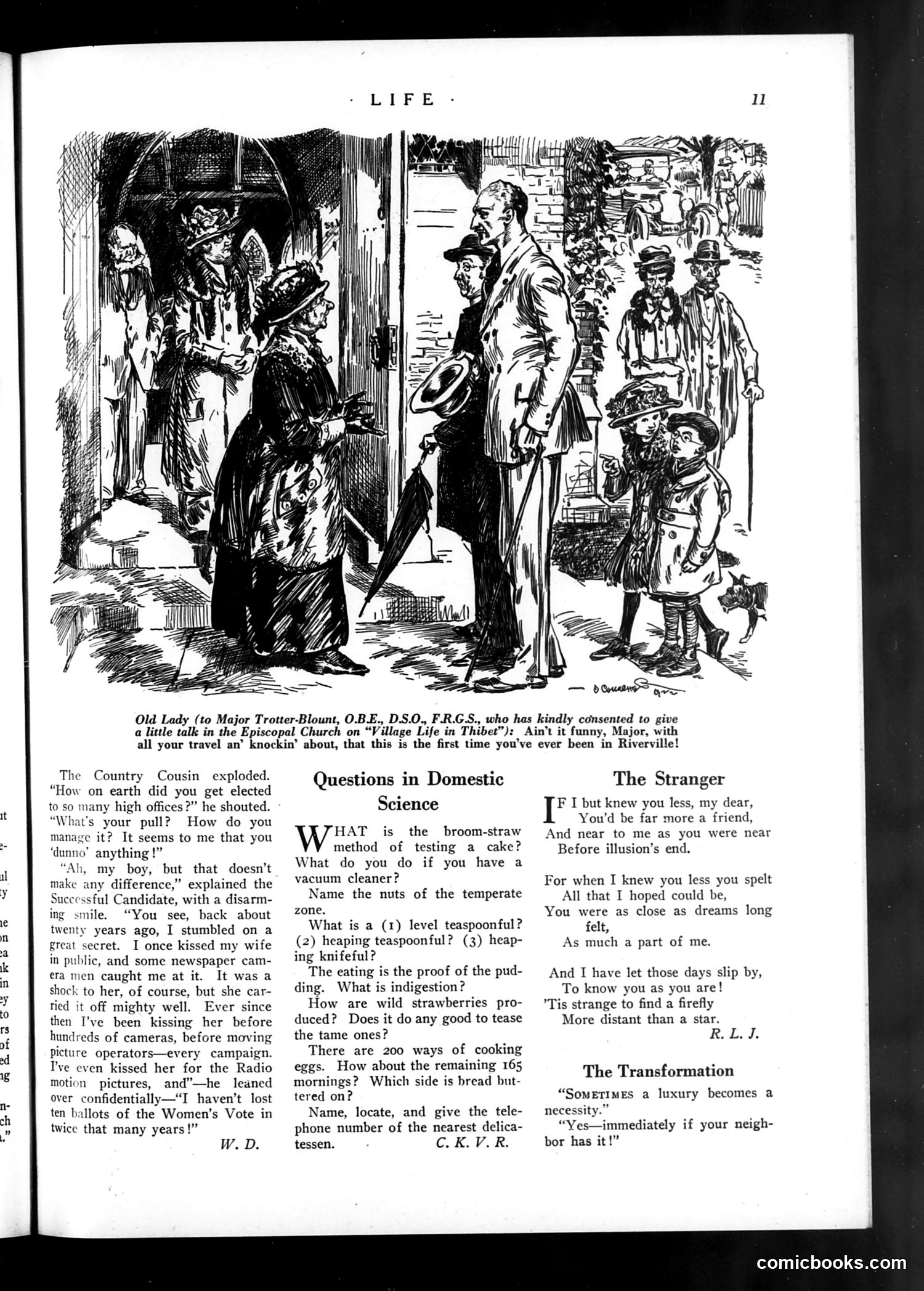
The main cartoon depicts an elderly woman ("Old Lady") speaking with Major Troiter-Blount, O.B.E., D.S.O., F.R.G.S.—a decorated British military officer—outside an Episcopal church. The caption indicates she's about to give a talk on "Village Life in Tibet." The satire mocks the British upper-class tendency to assume exotic authority. The joke is that this woman, despite her "travel and knockin' about," is apparently delivering her first talk in Riverdale (likely a suburb), yet claims expertise on Tibetan village life. The cartoon ridicules both her pretension to knowledge and the military officer's polite credence to her authority. The page also contains domestic humor Q&A ("Questions in Domestic Science") and poetry, typical of Life's satirical-literary format.
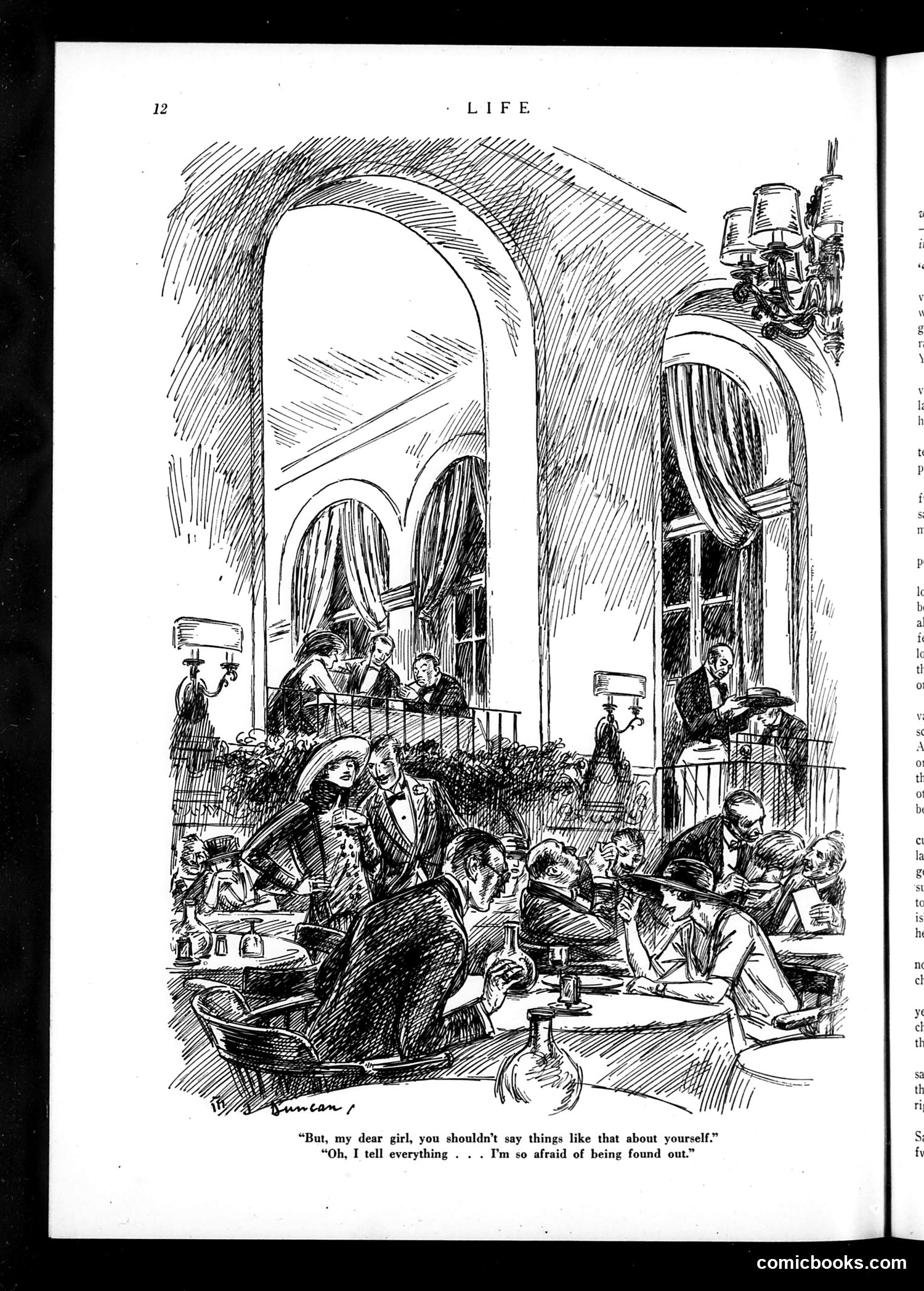
This is a single-panel cartoon depicting a scene in what appears to be an upscale restaurant or café, with a large arched doorway and multiple diners. The humor centers on a dialogue between a man and woman. The man says, "But, my dear girl, you shouldn't say things like that about yourself." The woman responds, "Oh, I tell everything . . . I'm so afraid of being found out." The joke satirizes social anxiety and confession—specifically, the woman's compulsive honesty stems from fear of secrets being discovered, so she preemptively reveals everything. It's commentary on a particular type of social neurosis: the anxious person who overshares to prevent worse revelations. The cartoon captures early-to-mid 20th century attitudes about social propriety and psychological vulnerability in public settings.
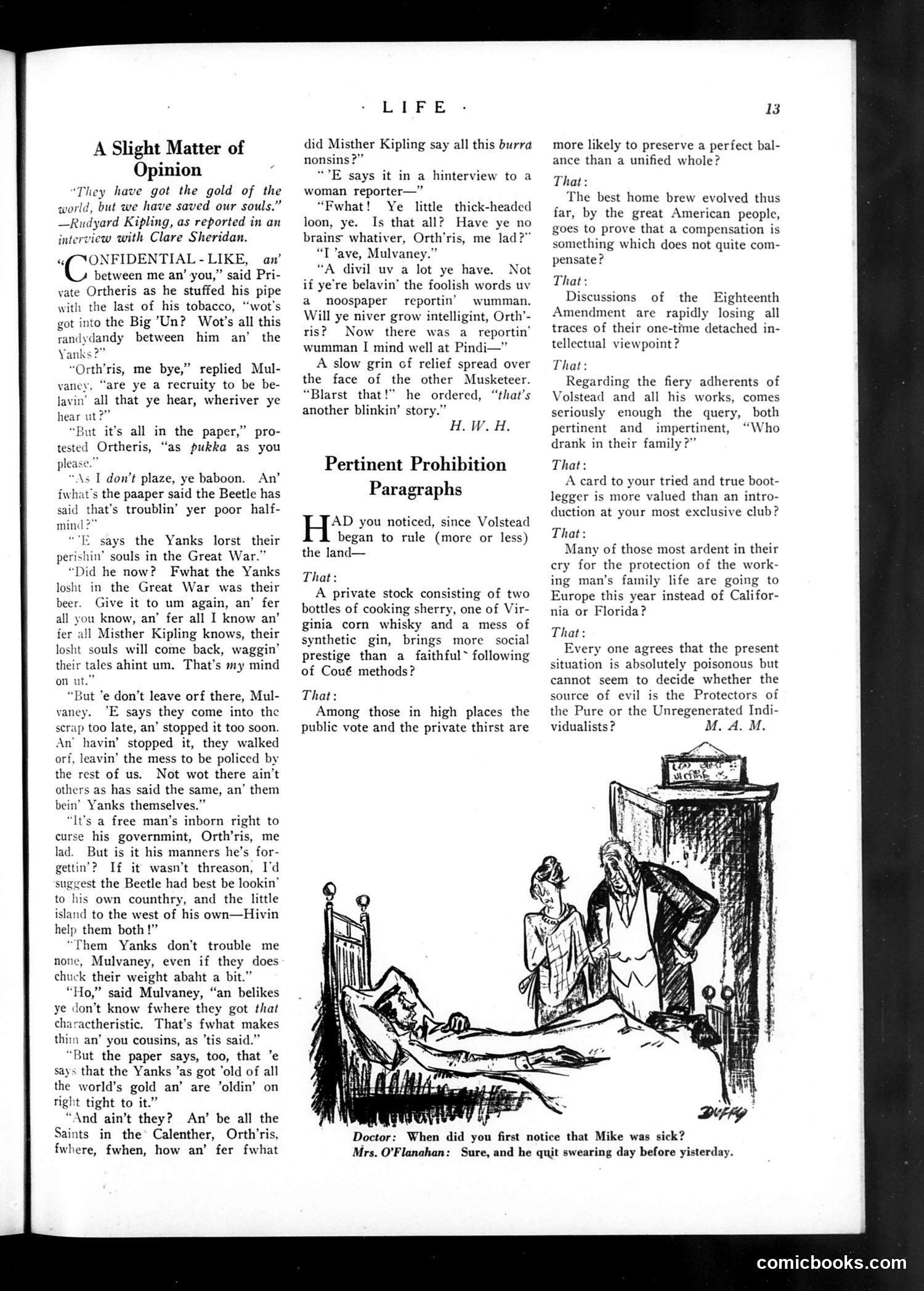
This page contains satirical commentary on Prohibition-era America. The main cartoon shows a doctor and Mrs. O'Flanahan, with the joke hinging on Mike's sudden illness and immediate cessation of swearing—implying he's hung over from illegal alcohol consumption. The text sections mock various political and social debates: Rudyard Kipling's dismissive comments about women reporters, arguments about American home brewing versus European methods, and heated disputes over Prohibition's merits. The "Pertinent Prohibition Paragraphs" section presents opposing viewpoints on whether Prohibition protects working families or represents government overreach by "Protectors of the Pure." The satire targets the hypocrisy and cultural divisions Prohibition created in 1920s America.
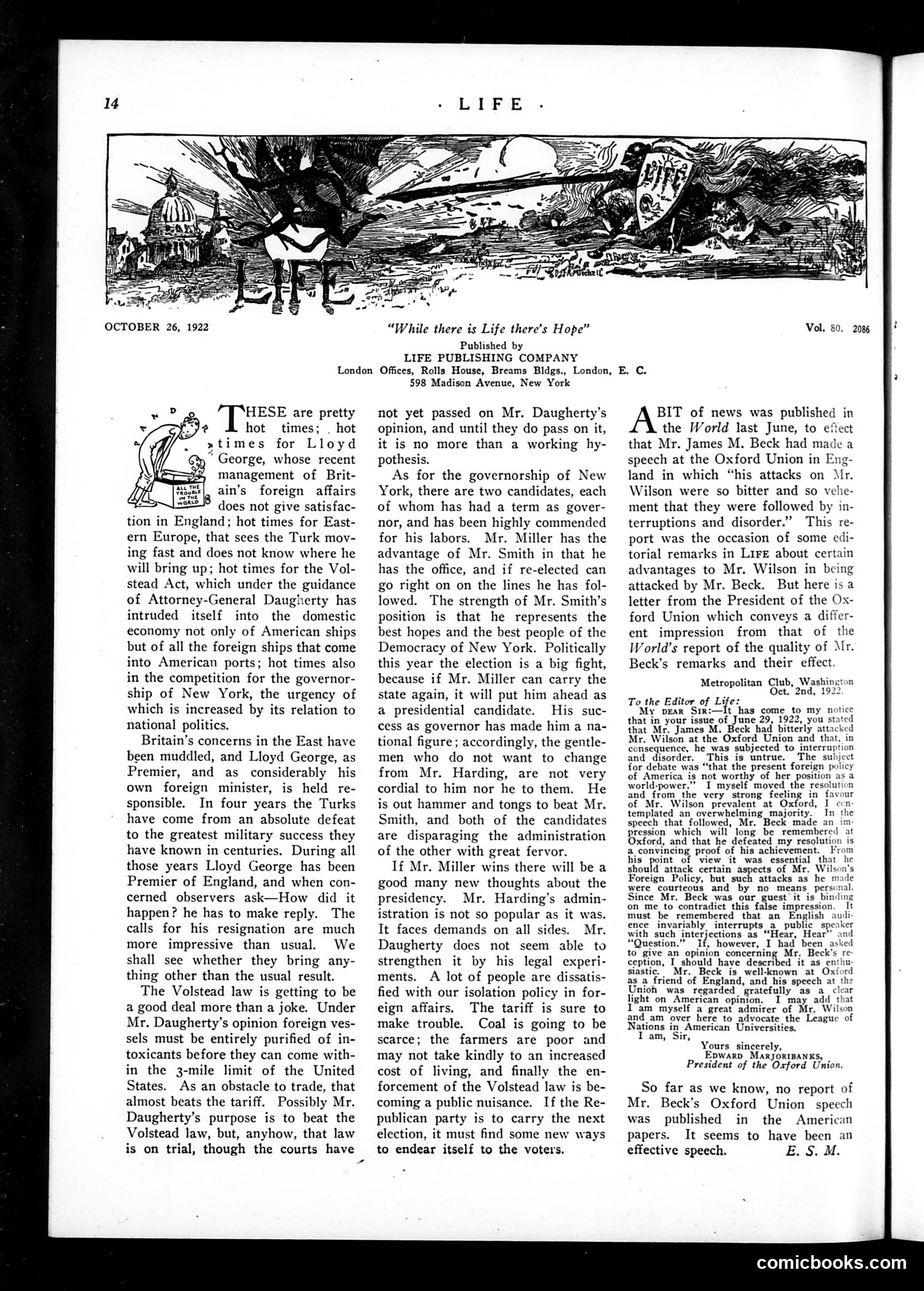
This October 26, 1922 Life page discusses hot political issues of the moment. The main text criticizes Attorney-General Daugherty's management of British affairs during the Greco-Turkish conflict and discusses New York's gubernatorial race between candidates Miller and Smith. The editorial also addresses the Volstead Act (Prohibition), which the author suggests is becoming unpopular and difficult to enforce. There's commentary on tariffs, coal shortages, and farmers' economic hardship. A separate letter from Edward Markham, President of the Oxford Union, defends Mr. Beck against attacks by James M. Beck, noting the criticism was "bitter" but followed by interruptions—suggesting contentious debate at the prestigious British debating society. The cartoon at top appears satirical but its specific subject is unclear from this image alone.
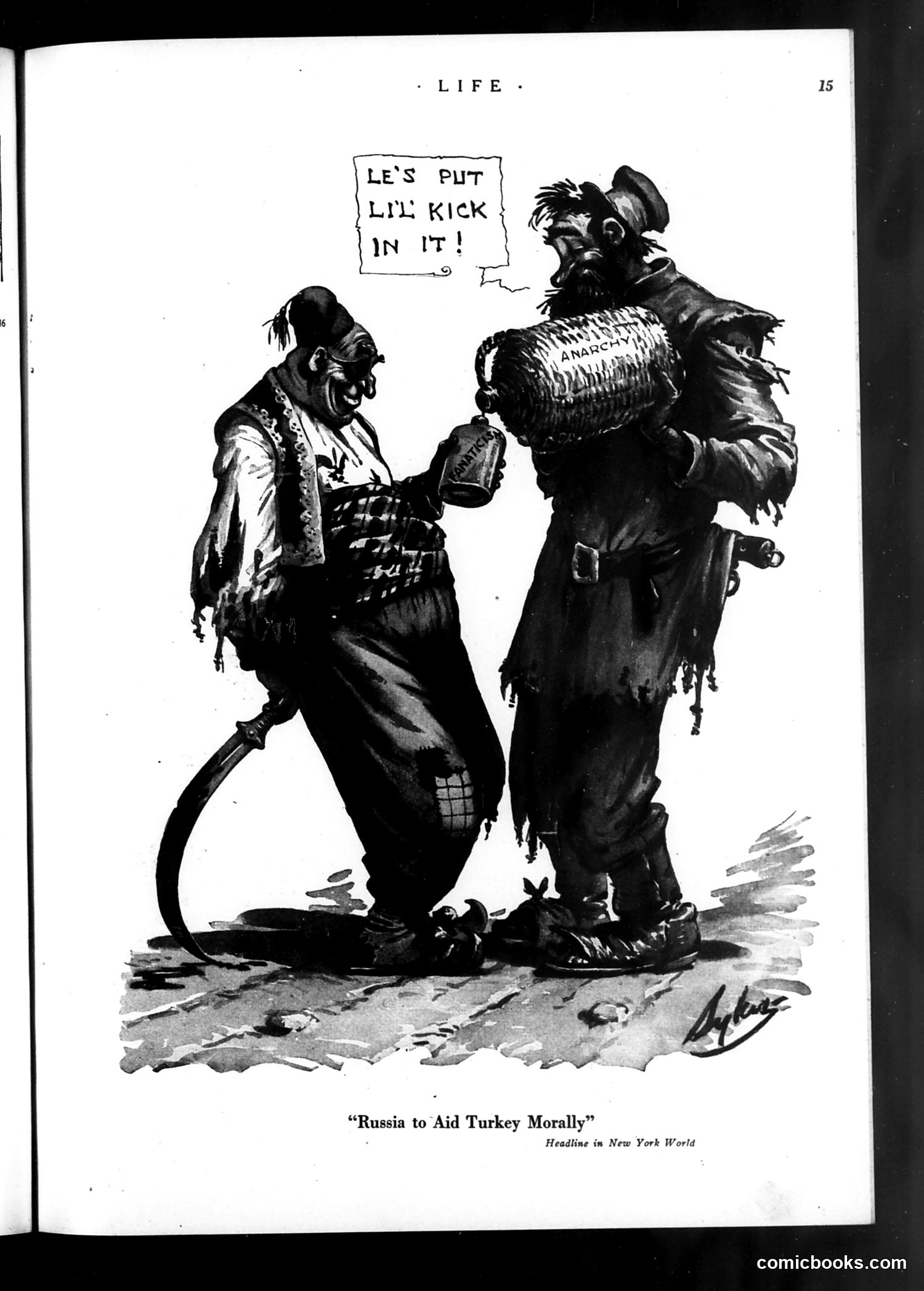
This satirical cartoon comments on a contemporary newspaper headline claiming "Russia to Aid Turkey Morally." The image depicts two caricatured figures—likely representing Russia (left) and another nation—with exaggerated features suggesting they're portrayed as disreputable or untrustworthy characters. One holds a bomb or anarchist device labeled "ANARCHY." The dialogue "Let's put lil' kick in it!" mocks the absurdity of Russia providing "moral" aid while associated with anarchism and violence. The satire lies in the contradiction: Russia, characterized here as chaotic and dangerous, offering moral guidance is portrayed as darkly comedic. The cartoon likely dates to an early 20th-century moment of Russian-Turkish diplomatic relations, when Russia was viewed suspiciously in American media, particularly regarding revolutionary movements and anarchist associations. The joke targets both Russia's credibility and the naïveté of the newspaper's framing.
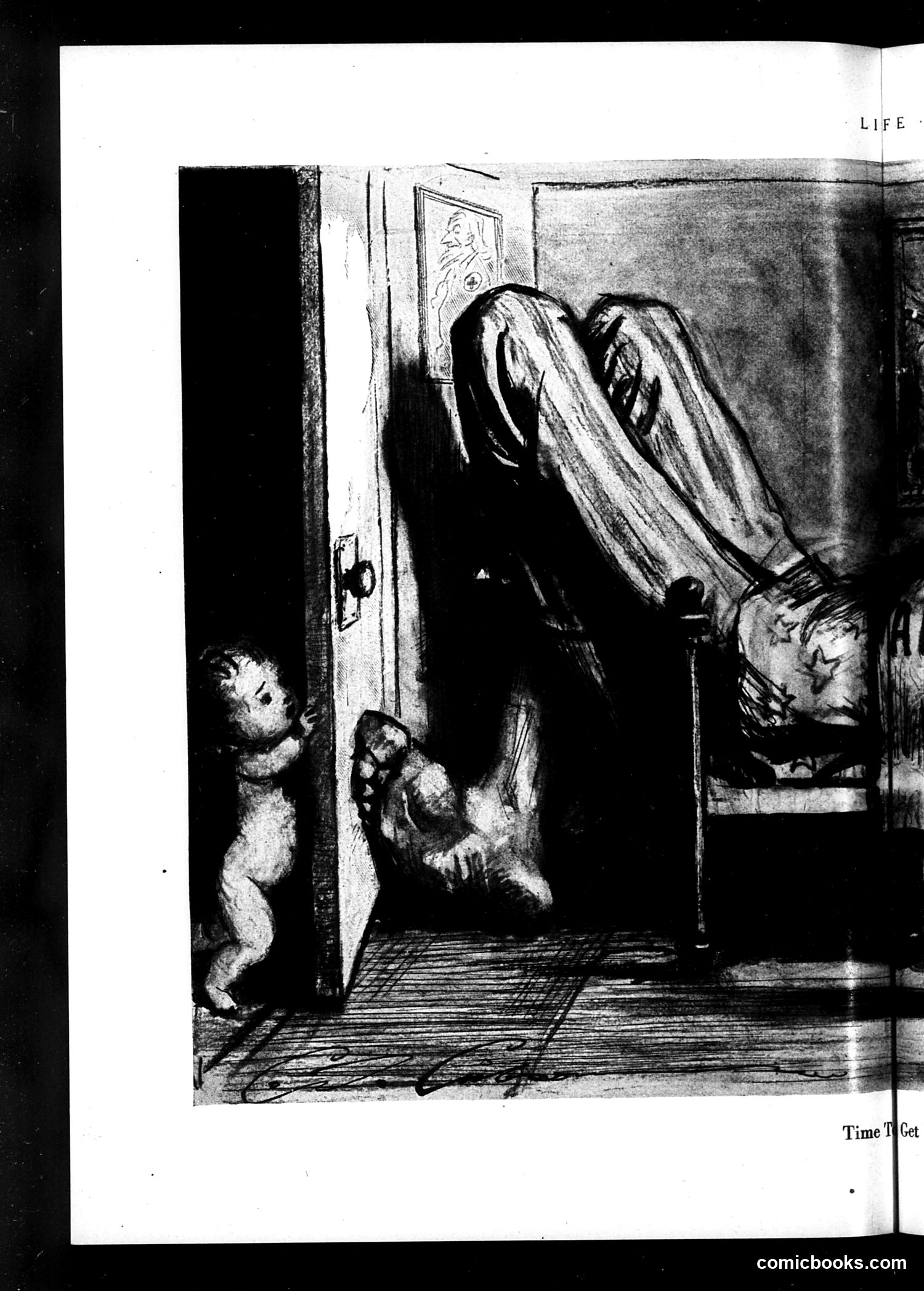
This appears to be a satirical illustration from *Life* magazine showing a domestic scene with religious or moral undertones. The image depicts what seems to be a cherub or cupid-like figure on the left observing two robed, veiled figures (possibly representing nuns or religious figures in traditional habit) tending to a child on the right. A portrait hangs on the wall in the background. The partial caption reads "Time T Get," suggesting this comments on timing or readiness for something—possibly a social commentary about religious institutions, child-rearing, education, or institutional care practices of the era. Without the complete text or publication date visible, the specific satire remains unclear, though the composition suggests critique of institutional or religious authority's relationship to children and family life.
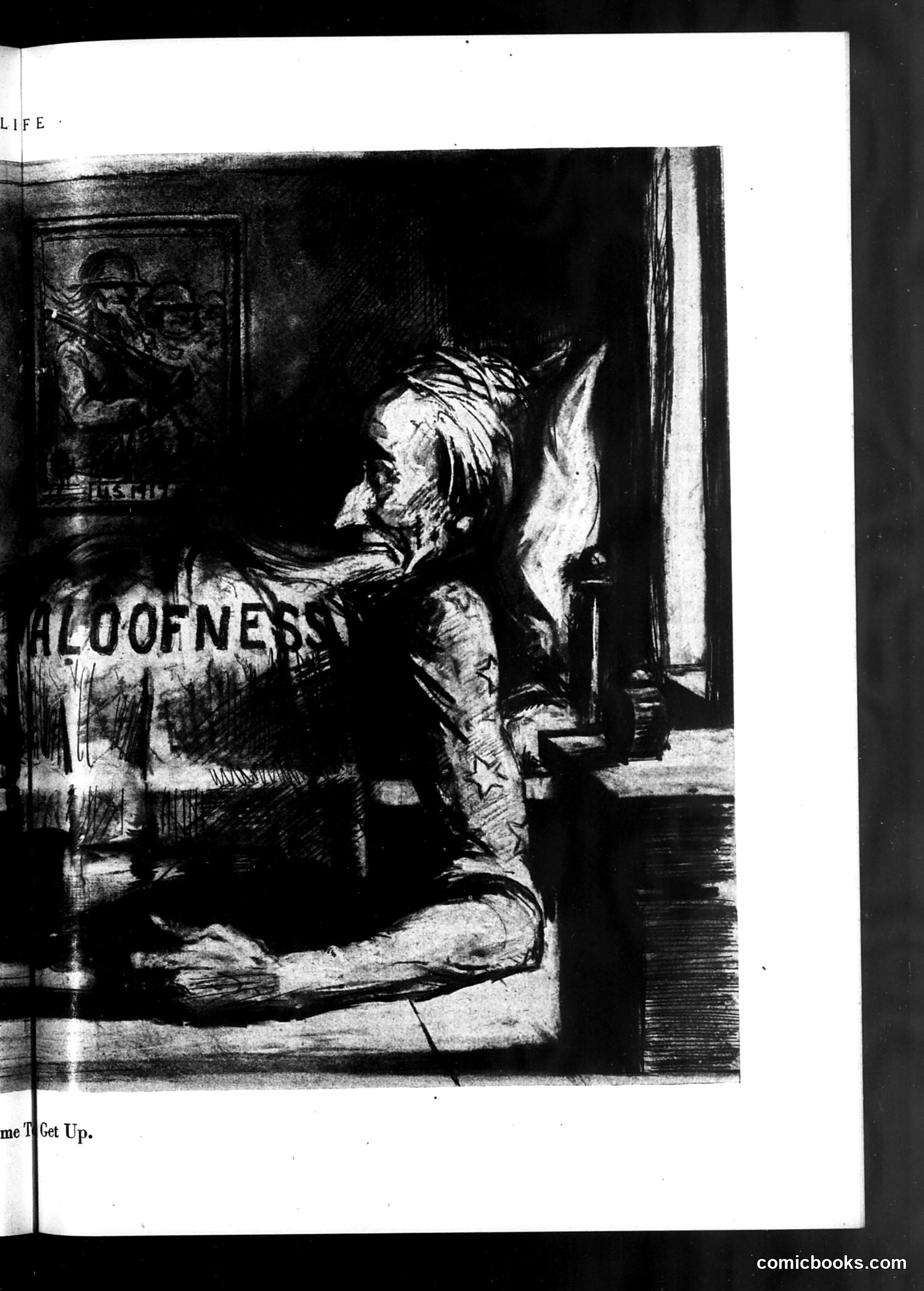
This appears to be a satirical etching or drawing from *Life* magazine showing a figure in distress or poverty—suggested by tattered clothing and a thin, worn appearance. The figure sits in what looks like a sparse interior space with a window visible. The watermark reading "ALOFNESS" is visible on the clothing, though its exact meaning in context is unclear—it may be a symbolic label or artist's mark. The partial caption at bottom reads "...me T Get Up," suggesting themes of hardship, struggle, or social commentary on poverty and economic conditions. Without additional page context or clearer OCR text, the specific political or social targets of this satire remain uncertain, though it clearly addresses working-class or impoverished conditions.
This 1920s theater review satirizes the craze for Russian vaudeville acts touring America. The author complains that after the initial novelty of Mikhail Balieff's Chauve-Souris company from the Bat Theatre, New York is now flooded with competing Russian troupes—including another "Revue Russe" at the Booth Theatre and performers like soprano Maria Kousnezoff. The satire targets two problems: (1) repetitive, poorly-constructed acts where performers stretch thin material by endless repeats, and (2) the American public's uncritical enthusiasm for anything labeled "exotic" or Russian. The author mocks typical Russian comedy routines (the "Donka" sketch with mugging and polka-singing) as artless and predictable. The joke concludes with mock surrender: if Russian entertainment will dominate the season, he'll capitalize on it by teaching his own children exaggerated Russian mannerisms and costumes to start a competing "Russian Frolic." The piece reflects post-WWI American ambivalence toward Russian culture—fascinated yet skeptical of its substance.
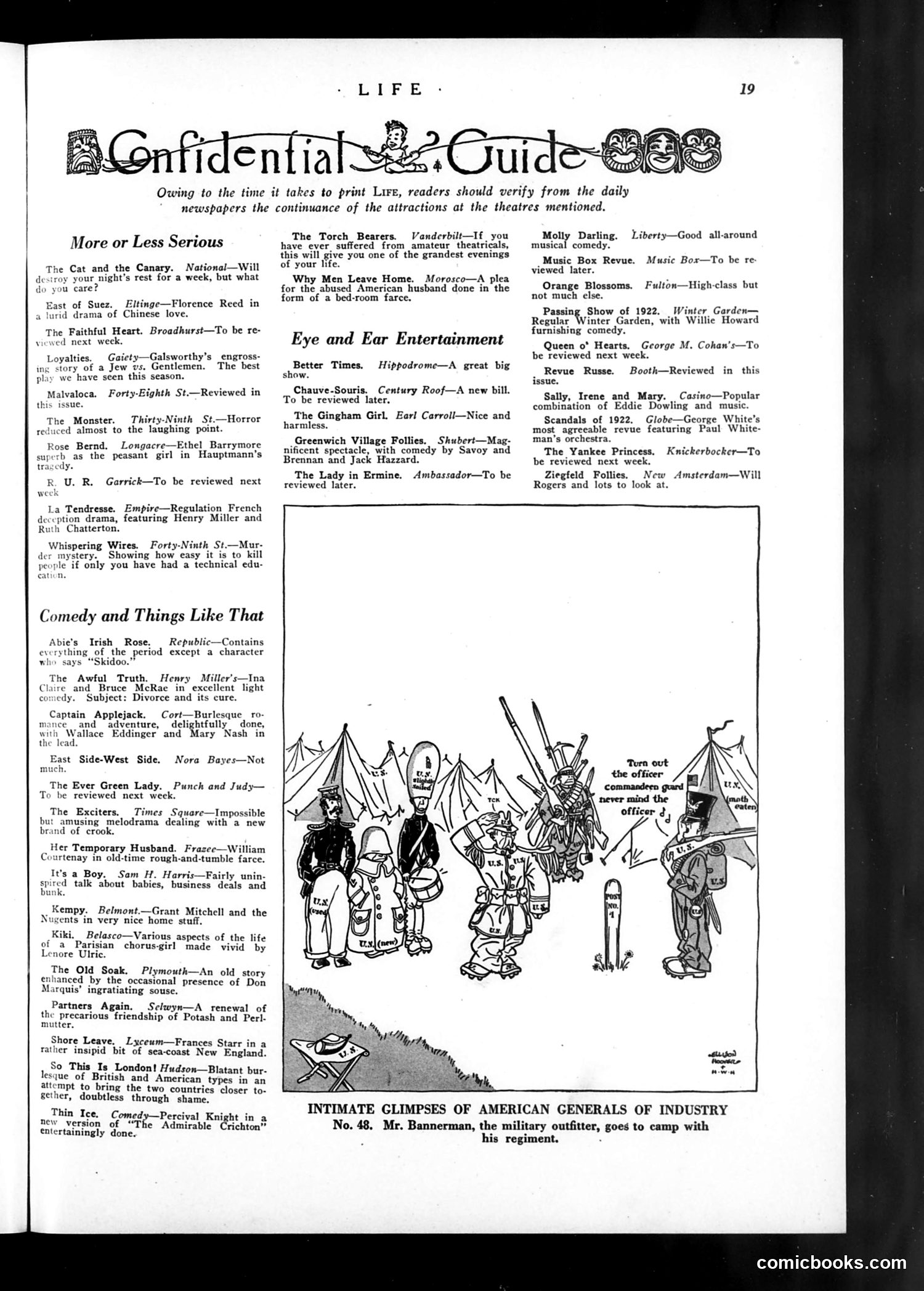
This page from Life magazine is primarily a theater review guide for Broadway shows circa 1922. The main cartoon at bottom depicts a military camp scene labeled "Mr. Bannerman, the military outfitter, goes to camp with his regiment." The satire appears to mock the commercialization of military life—a "military outfitter" bringing supply goods to soldiers. The cartoon likely critiques how American businessmen profited from military operations, or satirizes the blurred line between civilian commerce and military necessity. The caption's reference to "Generals of Industry" (visible above) suggests Life is sarcastically equating wealthy businessmen with military leaders, implying they wielded comparable power in American society during the post-WWI period. The theatrical advertisements dominate the page, reflecting Life's dual function as both satirical commentary and entertainment guide for New York's affluent readers.
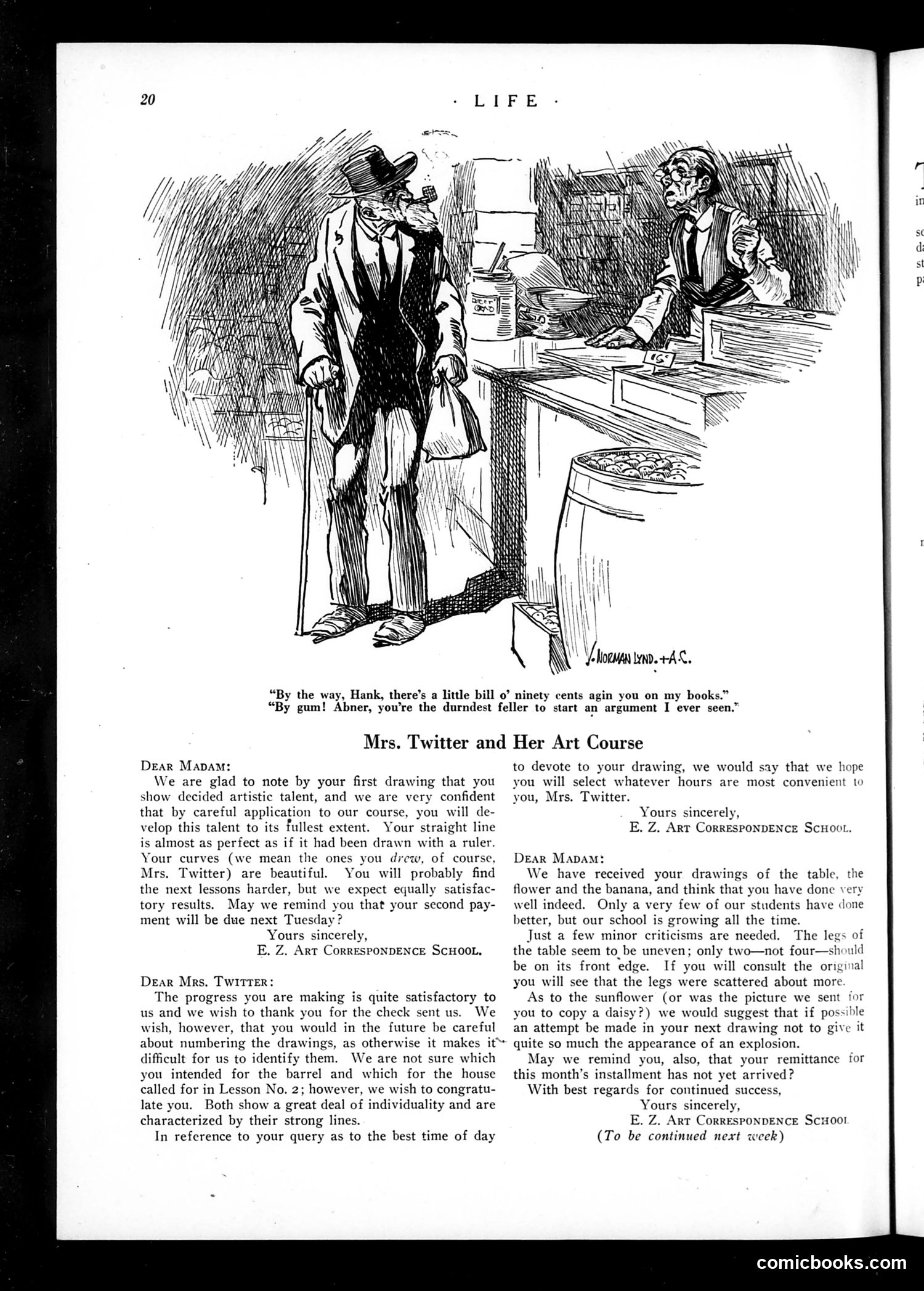
This page satirizes mail-order art correspondence schools, which were common early-20th-century scams targeting amateur artists. The cartoon depicts a rural dispute over a 90-cent debt, while the main content mocks "E.Z. Art Correspondence School" through fictional letters with a student named Mrs. Twitter. The satire is sharp: the school praises obviously terrible drawings with backhanded compliments ("straight line is almost as perfect as if it had been drawn with a ruler"), then can't distinguish between her barrel and house drawings. They gently mock her sunflower as looking like "an explosion" while repeatedly requesting payment. The joke targets both the fraudulent school's low standards and desperate bill-collecting, and Mrs. Twitter's delusion that she has artistic talent. The correspondence school format itself—promising easy home instruction—was a known racket of the era.
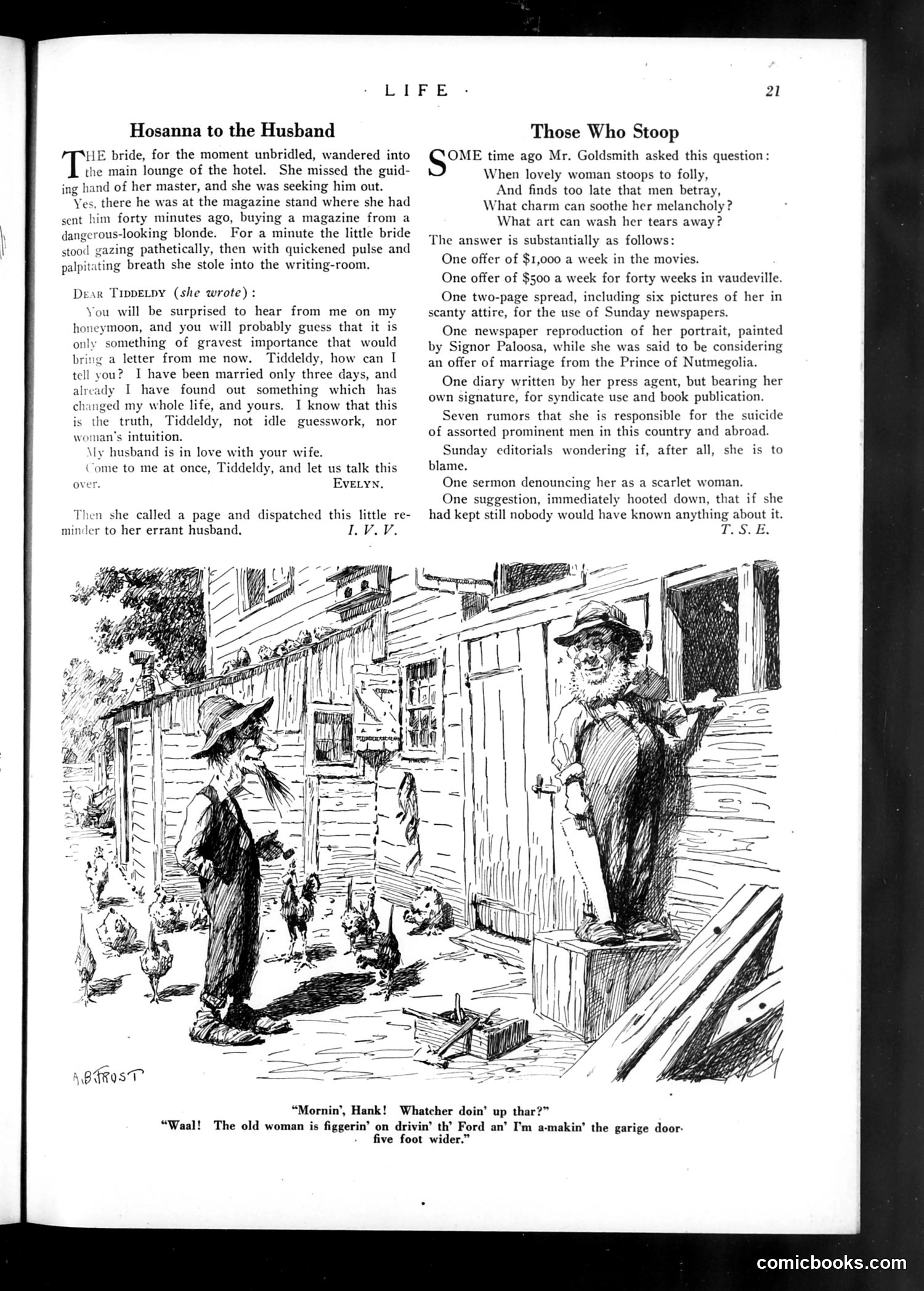
This page contains two satirical pieces mocking early 20th-century social conventions: **"Hosanna to the Husband"** depicts a newlywed bride discovering her groom flirting with a blonde at a magazine stand. In jealous response, she writes a letter to a friend accusing her husband of being in love with the friend's wife—a absurd escalation meant to ridicule the bride's dramatic, irrational behavior and the melodramatic nature of honeymoon expectations. **"Those Who Stoop"** sarcastically catalogs the various financial and publicity opportunities available to women who fall into scandal or "folly" (romantic disgrace)—movie contracts, vaudeville bookings, newspaper spreads in revealing attire, serialized diaries, and manufactured rumors. The satire mocks how scandal paradoxically becomes profitable, and how women's misfortune gets commodified and exploited by the press. The bottom cartoon humorously depicts rural domestic life, with a man widening his garage door to accommodate his wife's new Ford automobile—reflecting changing gender roles and women's increasing independence through motor vehicles.
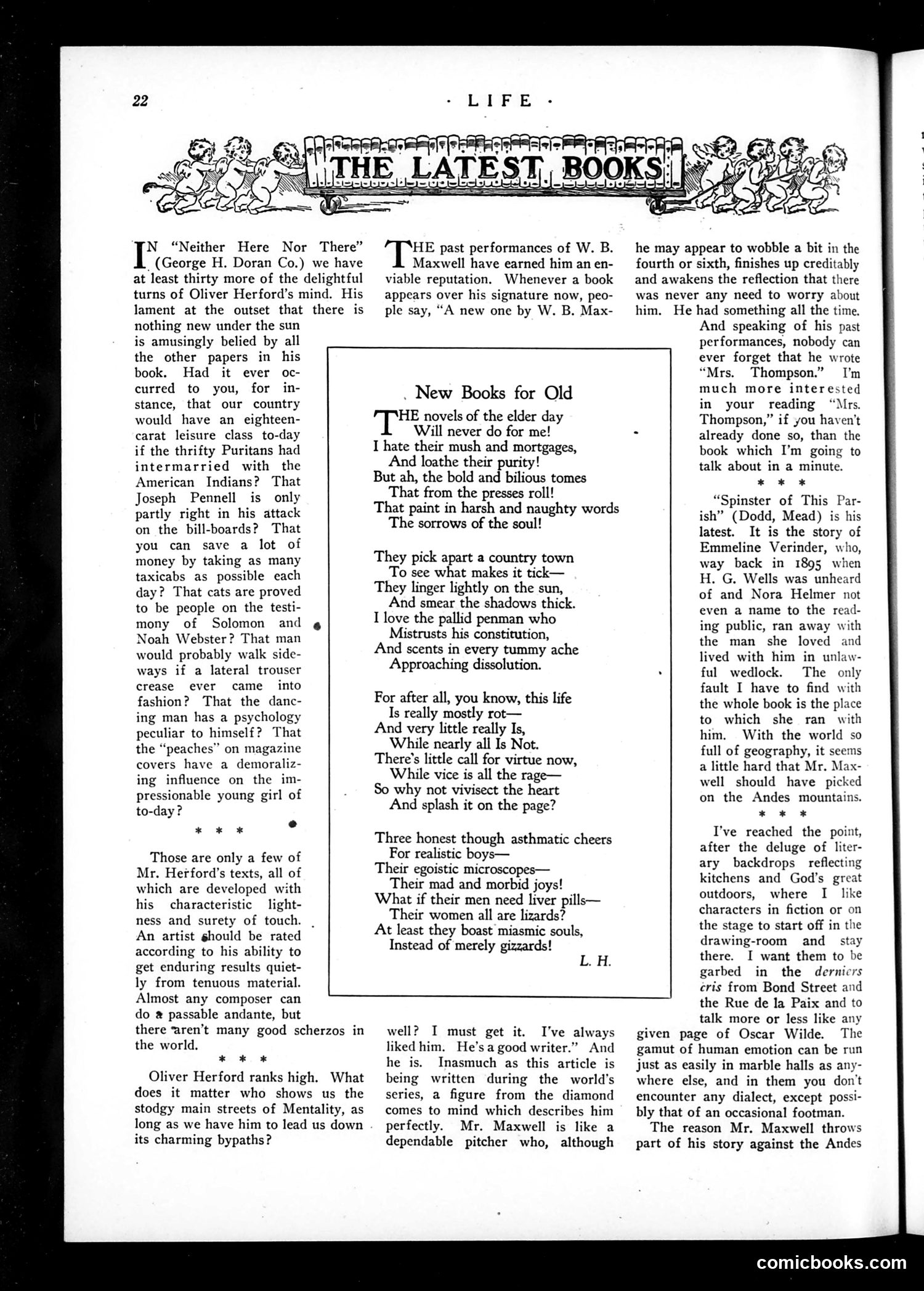
This page presents literary criticism from *Life* magazine's "The Latest Books" section. It reviews three works: **Oliver Herford's "Neither Here Nor There"** — The critic praises Herford's witty essay collection, celebrating his ability to find humor in mundane observations (Puritan intermarriage with Native Americans, billboard advertising, taxicabs, fashion quirks). The review uses sophisticated literary language, praising his skill at extracting "enduring results quietly from tenuous material." **A poem "New Books for Old"** (attributed L.H.) — This satirizes modern readers' rejection of Victorian literature ("mush and mortgages," "purity"), celebrating instead contemporary "realistic" novels depicting cynicism, illness, and moral decay—a jab at early 20th-century literary trends emphasizing psychological complexity and social criticism over Victorian sentimentality. **W.B. Maxwell's "Spinster of This Parish"** — The critic praises Maxwell's latest novel about a woman who abandoned respectability in 1895 to elope, only mildly faulting the exotic Andes setting. The page demonstrates how *Life* positioned itself as a venue for intellectual book criticism alongside satire.
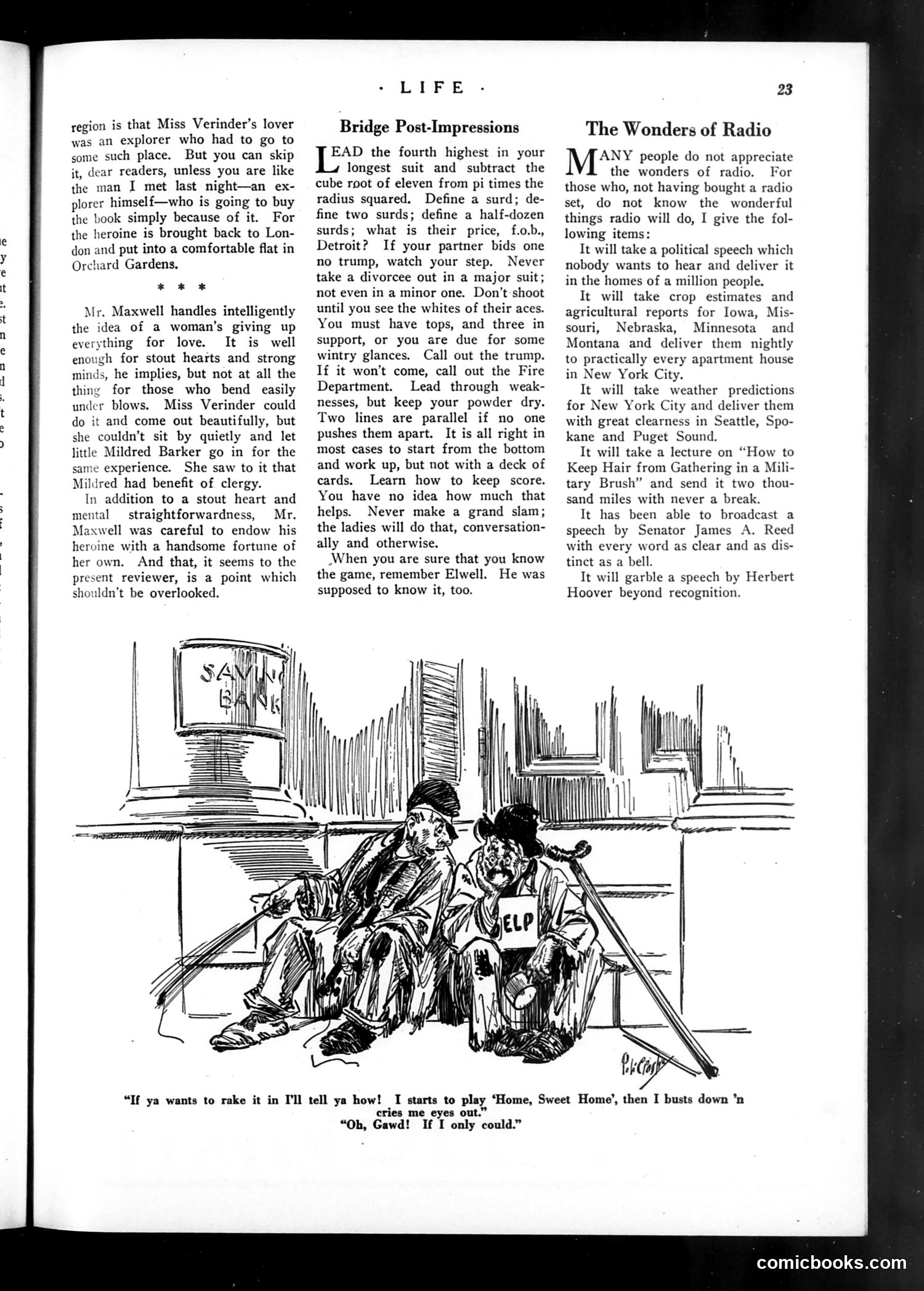
This page from *Life* magazine contains three distinct satirical pieces typical of the publication's humor: **The cartoon** depicts a street musician at a "Savings Bank" window playing emotional songs ("Home, Sweet Home") to manipulate passersby into giving money. The joke mocks both the musician's manipulative sentimentality and the gullible public's susceptibility to cheap emotional appeals. **"Bridge Post-Impressions"** satirizes bridge players by mixing card-game instructions with absurd mathematical and logical impossibilities, mocking the pretentious complexity bridge players attach to their hobby. **"The Wonders of Radio"** is political satire celebrating radio's broadcasting capabilities while delivering pointed criticism of specific politicians. It praises Senator James A. Reed's clarity while mockingly suggesting that Herbert Hoover's speeches become incomprehensible when broadcast—likely referencing Hoover's reputation as a poor public speaker before his presidency (he became president in 1929). The page exemplifies *Life*'s characteristic blend of social commentary, political jabs, and absurdist humor aimed at educated American readers.
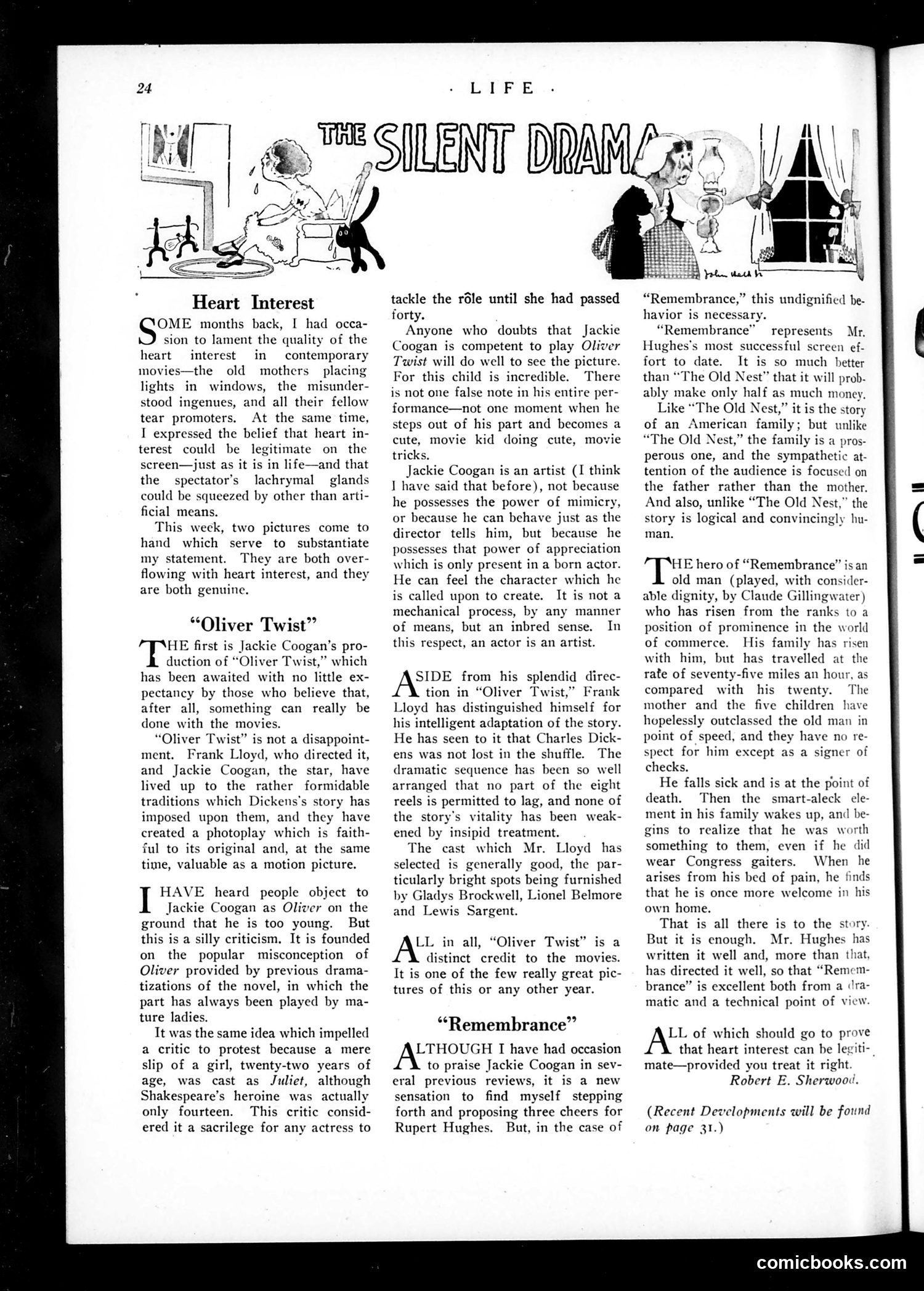
This page contains two film reviews from Life magazine's "Silent Drama" section, critiquing recent motion pictures. The first review praises Jackie Coogan's performance in *Oliver Twist*, directed by Frank Lloyd. The critic defends casting the child actor in the lead role against objections that he's too young, arguing that previous stage adaptations wrongly featured adult actresses. Coogan is praised as a genuine artist who authentically inhabits the character rather than performing tricks. The second review celebrates Rupert Hughes's film *Remembrance*, which centers on an aging businessman who falls gravely ill. The plot emphasizes domestic sentiment—the man finds renewed welcome in his family after his illness makes him realize his earlier indifference to them. Both reviews celebrate "heart interest" (emotional resonance) achieved through genuine artistic merit rather than artificial sentimentality. The critic contrasts this with earlier tear-jerking cinema clichés like "old mothers placing lights in windows."
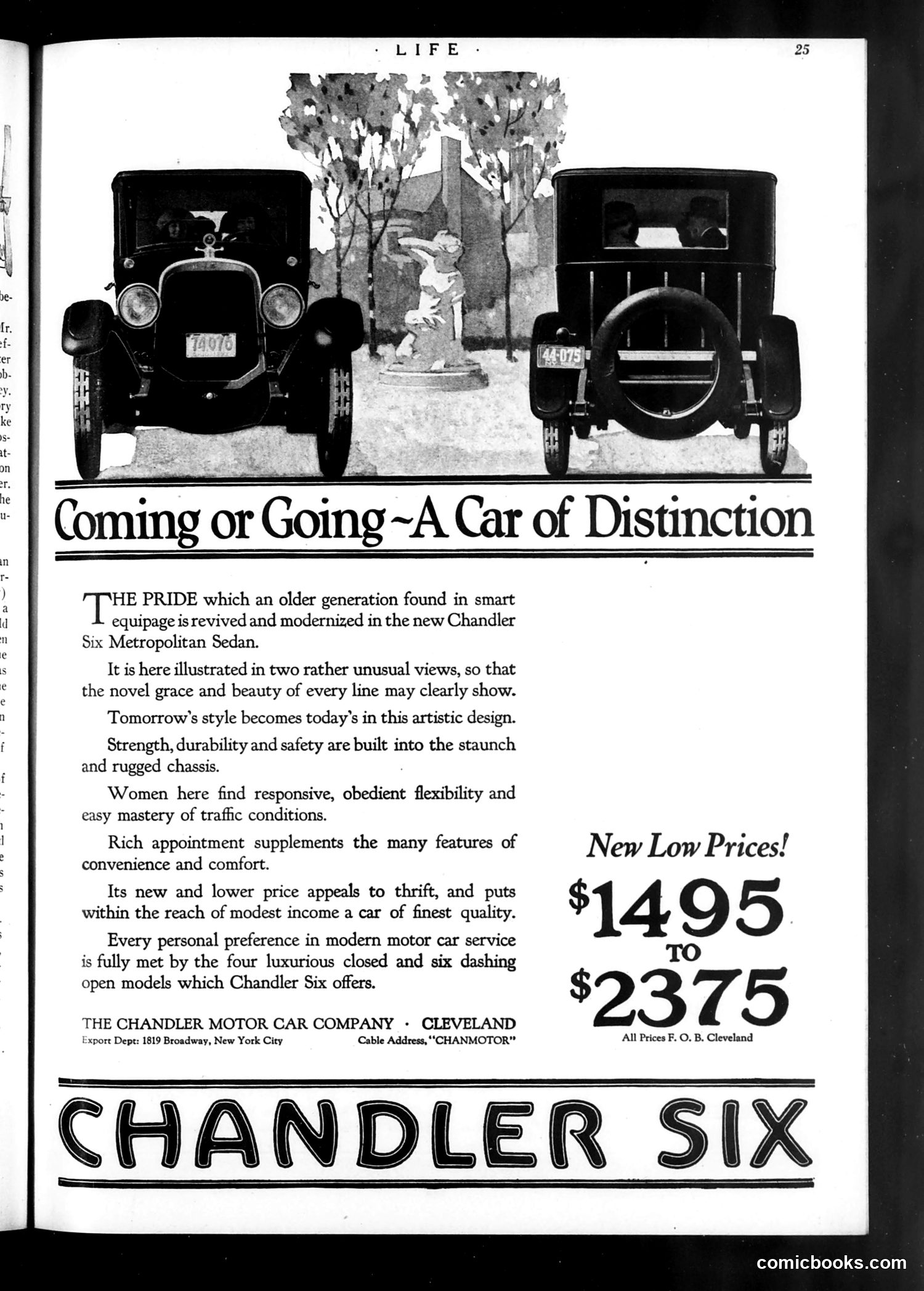
This is primarily a **automobile advertisement**, not political satire. The page shows two front-view photographs of the Chandler Six automobile—one approaching, one departing—to highlight its stylish design from all angles. The marketing pitch emphasizes modernization of luxury ("the pride which an older generation found in smart equipage is revived and modernized"). It targets both affluent buyers (emphasizing "rich appointment" and style) and middle-class buyers (highlighting the "new low prices" of $1495–$2375). A notably gendered appeal appears: the text states "Women here find responsive, obedient flexibility and easy mastery of traffic conditions"—language reflecting 1920s assumptions about female drivers needing user-friendly vehicles. The advertisement presents the car as bridging past elegance with modern affordability and reliability, positioning it as accessible luxury for the aspiring middle class during the automobile boom era.
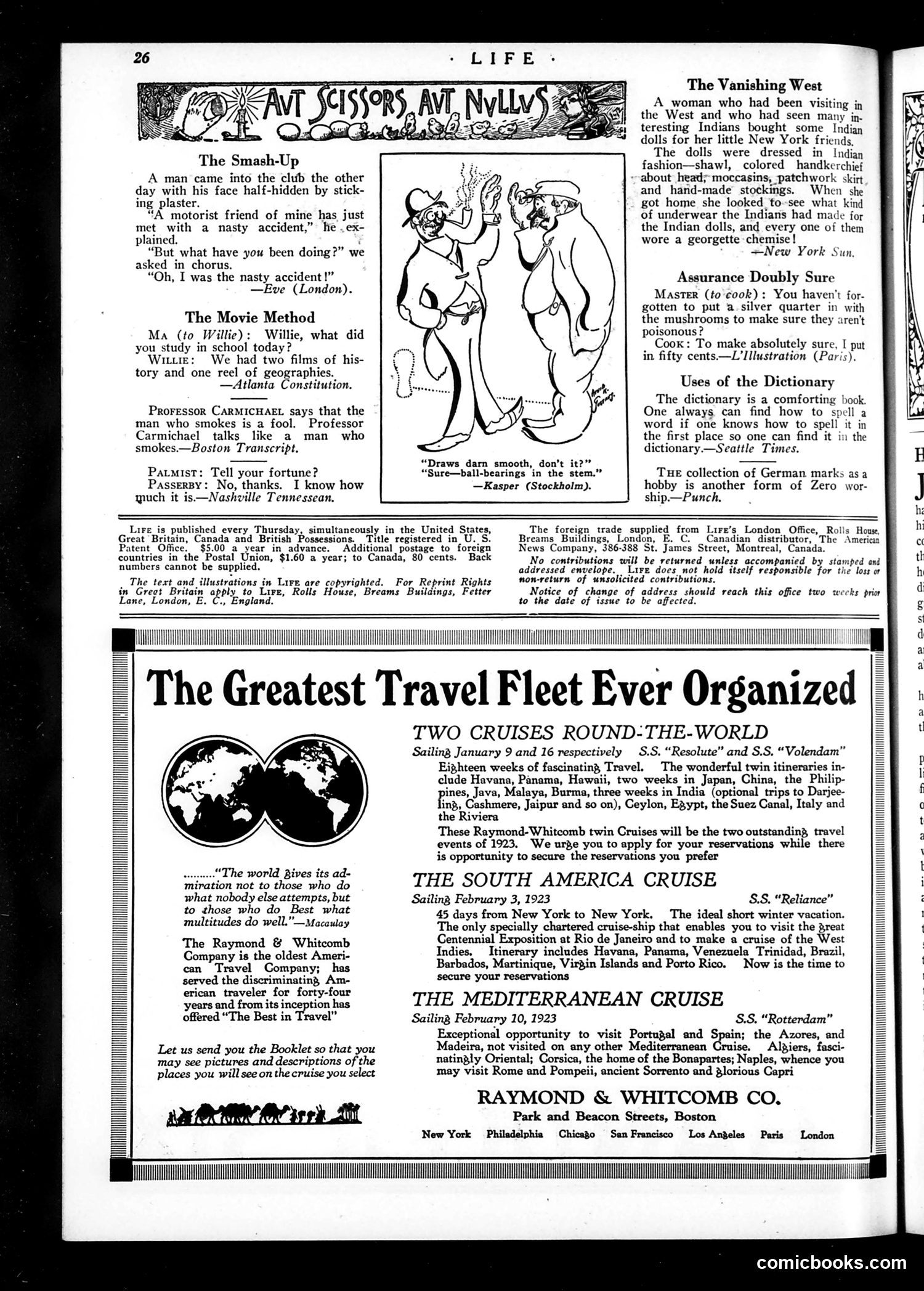
This page contains several brief humorous anecdotes typical of Life's satirical format, plus a major travel advertisement. **The humor pieces** are light observational jokes: "The Smash-Up" plays on word confusion (the speaker *was* the accident); "The Movie Method" satirizes education reduced to film reels; Professor Carmichael's hypocrisy is mocked; and a palmist joke comments on predictable fortune-telling. **"The Vanishing West"** satirizes the gap between romanticized Native American imagery and modern American reality—Indian dolls wear authentic dress externally but georgette (fashionable 1920s) undergarments, suggesting cultural assimilation or the artificiality of "authentic" tourist goods. **The dominant advertisement** promotes Raymond & Whitcomb Company's luxury world cruises (1923), featuring two "round-the-world" journeys. This reflects the post-WWI leisure economy and American prosperity of the 1920s—travel marketed as accessible to middle/upper-class readers. The page illustrates Life's dual function: satirizing contemporary society while selling aspirational consumer experiences to readers.
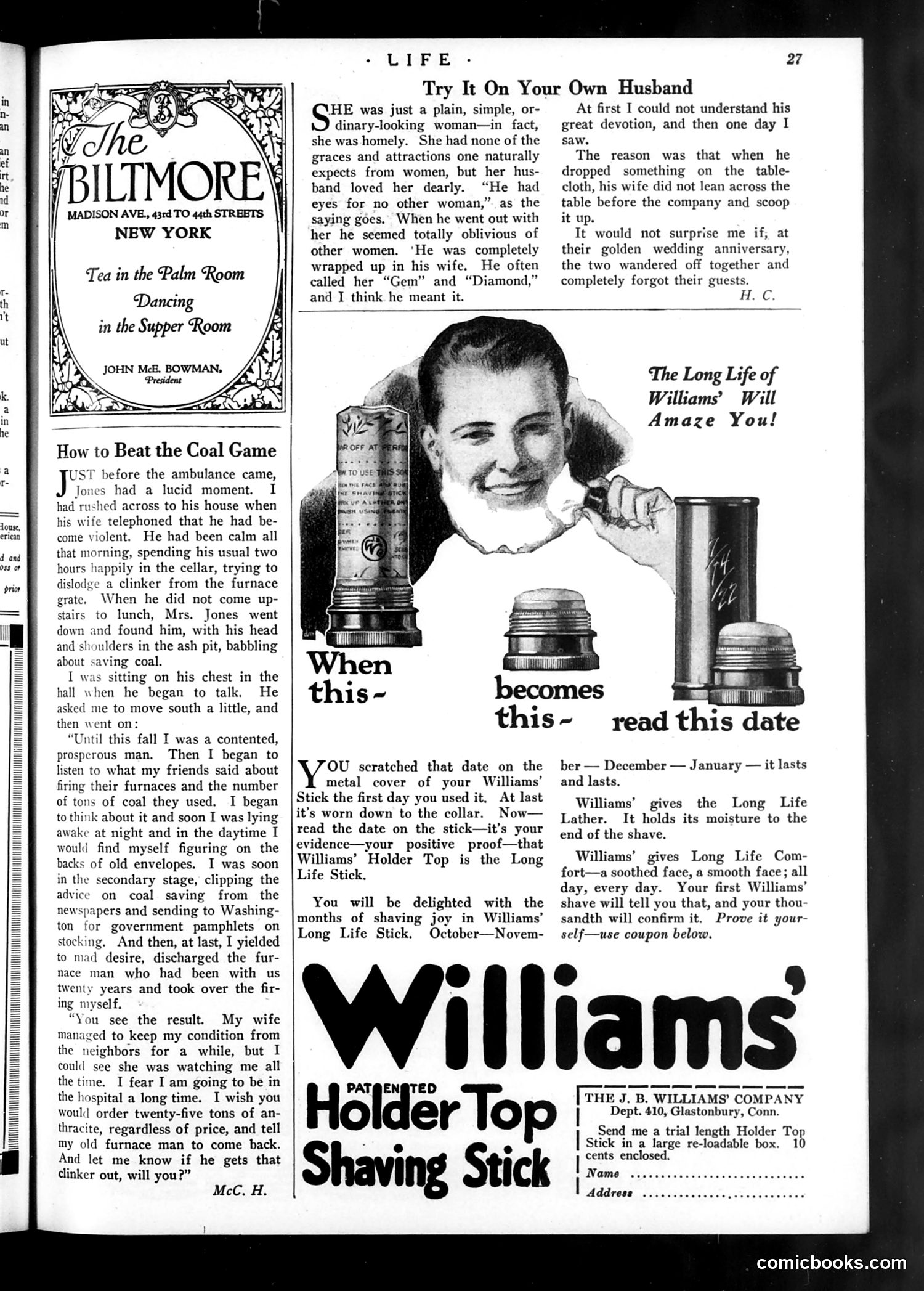
This page contains two satirical articles and an advertisement: **"How to Beat the Coal Game"** satirizes post-WWI coal-saving mania. A man becomes obsessed with fuel conservation advice from newspapers and government pamphlets, eventually firing his long-time furnace man to manage the coal himself. The obsession drives him to madness—he's found delirious in his basement ash pit. The satire mocks how ordinary citizens became fixated on wartime/postwar conservation measures to an unhealthy degree. **"Try It On Your Own Husband"** offers relationship advice: a homely woman's husband adores her because she's considerate—she doesn't lean across the table to grab dropped items in front of guests. The piece suggests that devotion comes from thoughtful behavior, not appearance. **The Advertisement** promotes Williams' Holder Top Shaving Stick, emphasizing its long-lasting quality by showing how users scratch the date on the metal cover to track longevity through multiple months. All three pieces reflect early 1920s concerns: wartime anxiety, gender dynamics, and consumer product durability.
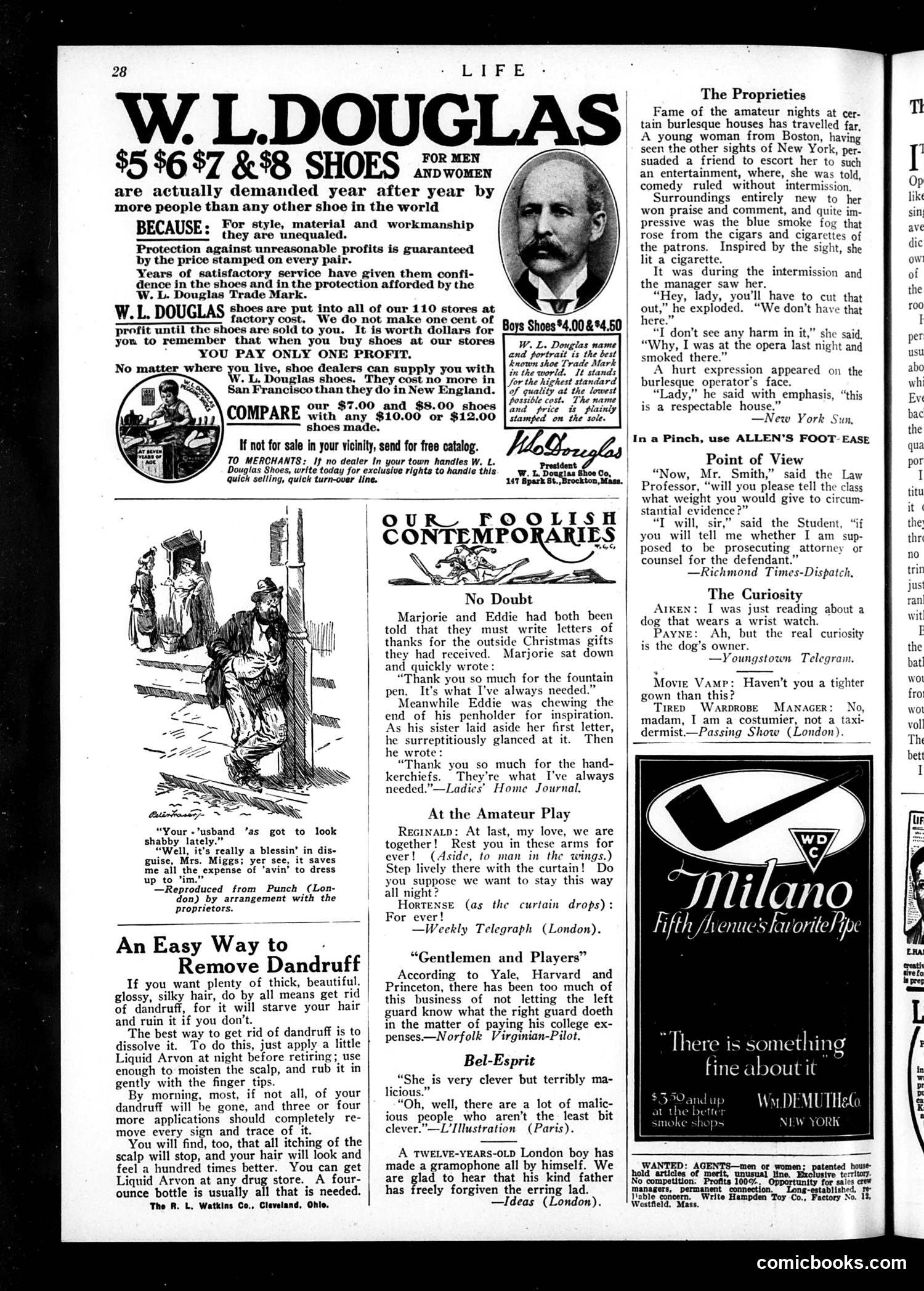
This page is primarily **advertising and humor content**, not political cartoons. ## Main Elements: **W.L. Douglas Shoes Advertisement** dominates the upper half—a major brand promoting affordable, quality footwear ($5-$8) sold through their own stores to eliminate middleman profits. The ad emphasizes value and transparency in pricing. ## Comic Sections ("Our Foolish Contemporaries"): These are reprinted jokes from other publications satirizing everyday life: - **"No Doubt"**: Humor about children copying homework—Eddie plagiarizes his sister's thank-you note, showing lack of originality. - **"An Amateur Play"**: Actors breaking character mid-scene, revealing theatrical pretense and impatience. - **"Gentlemen and Players"**: Commentary on college athletic programs allegedly not enforcing consistent rules across players. - **"Bel-Esprit"**: Wordplay about clever but malicious people versus merely malicious ones. These are lighthearted social observations rather than political satire—typical early-20th-century magazine humor about manners, education, and human nature.
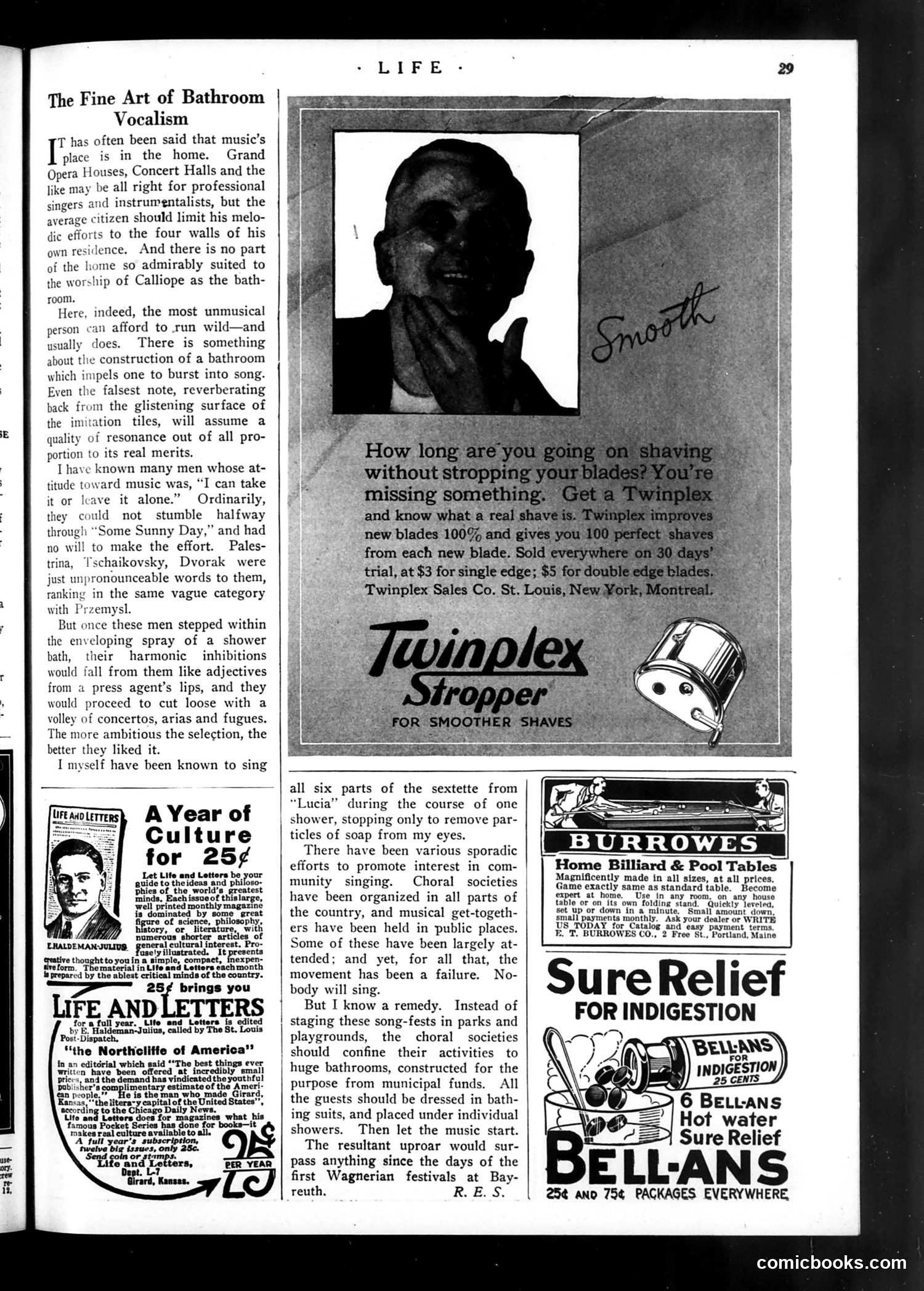
This is a humorous essay (not a political cartoon) about why people spontaneously sing in bathrooms. The author observes that ordinary men who claim indifference to serious classical music—names like Palestrina, Tchaikovsky, and Dvorak mean nothing to them—suddenly burst into elaborate operatic performances (like the sextette from Donizetti's "Lucia") when showering. The joke: bathroom acoustics give even terrible singers an illusory sense of quality, causing uninhibited vocal performances. The author's satirical "remedy" is that cities should build large municipal bathrooms so choral societies can finally succeed by harnessing this bathroom-singing impulse. It's gentle social satire about American musical pretension and the gap between public cultural indifference and private bathroom behavior—a relatable, timeless observation about human nature dressed in period-specific classical music references.
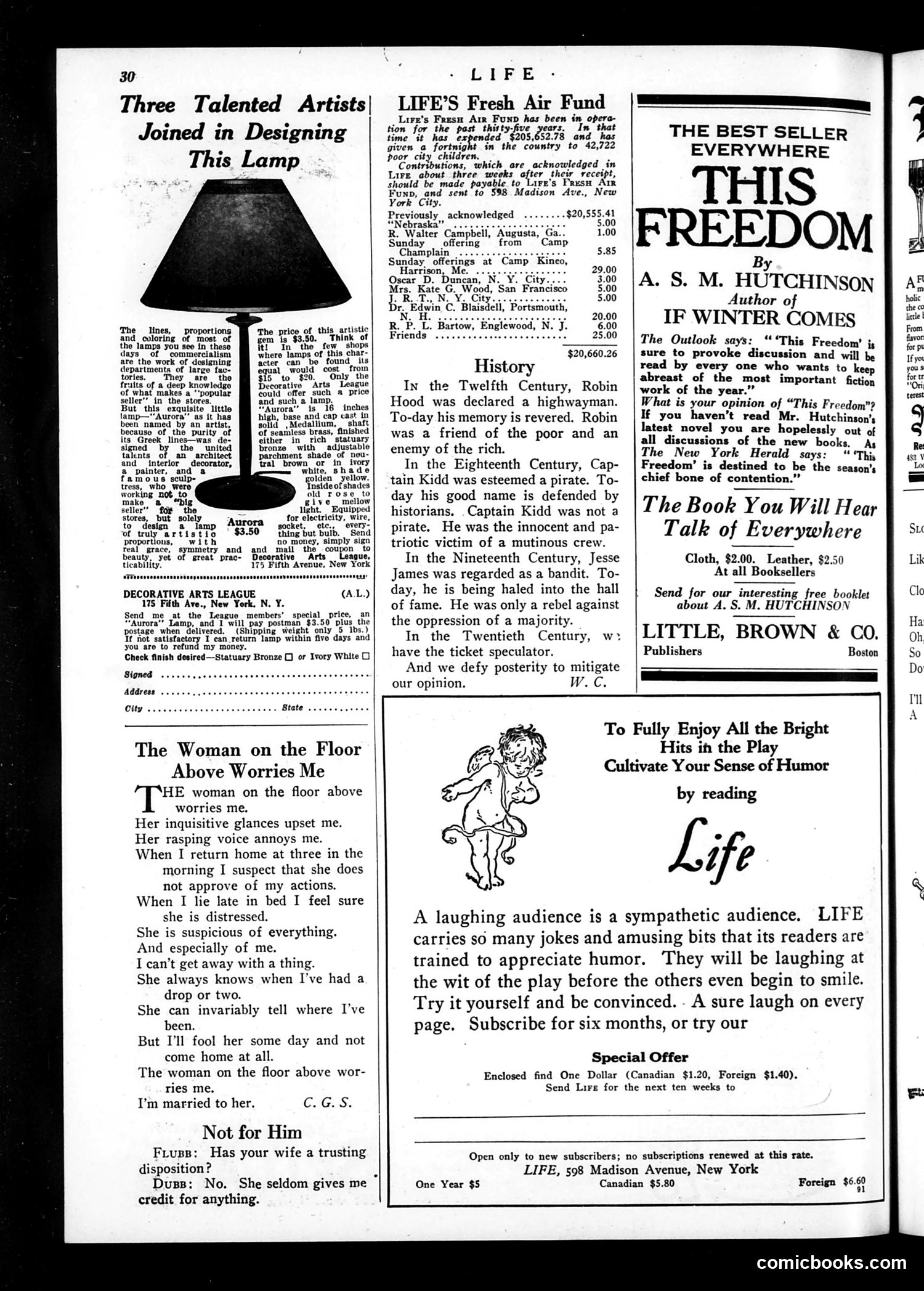
This page mixes advertisements, poetry, and satirical commentary typical of Life's format. **The Lamp Advertisement**: Three artists collaborated on an "Aurora" lamp design, emphasizing artistic merit over mass-production commercialism—a dig at 1920s industrial manufacturing prioritizing profit over aesthetics. **"The Woman on the Floor Above Worries Me"**: A humorous poem about a nosy upstairs neighbor whose scrutiny annoys the speaker—until the punchline reveals he's married to her. The joke plays on domestic tension and surveillance in close quarters. **"Not for Him"**: A brief joke about marital distrust—the wife never credits her husband with anything, suggesting wives withhold praise from husbands. **"History" Section**: A satirical piece arguing that society rehabilitates outlaws' reputations over time (Robin Hood, Captain Kidd, Jesse James), then uses this pattern to mock "ticket speculators" of the current era—implying they're modern-day criminals society will someday lionize. The page reflects early-20th-century concerns: industrial design quality, urban apartment living, gender dynamics, and economic inequality.
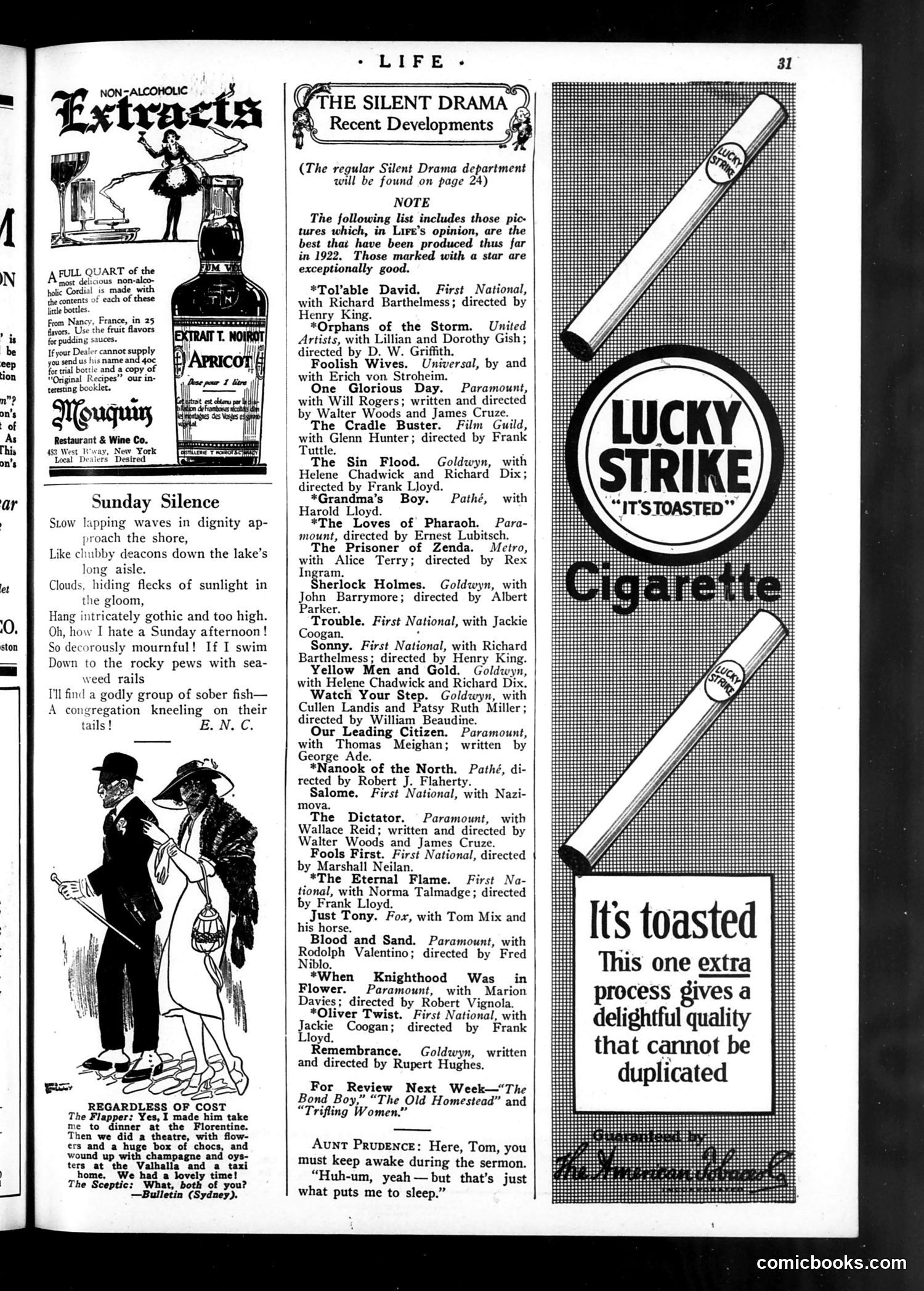
This page mixes editorial content with advertising. **"The Silent Drama"** section reviews 1922 films, with asterisks marking exceptional pictures—typical film criticism for the era when silent cinema dominated entertainment. The **cartoon "Regardless of Cost"** satirizes the "Flapper" phenomenon: a young woman boasts of expensive dating—fine dining, theater, chocolates, champagne—portraying 1920s youth culture's conspicuous consumption. Her male companion's skeptical response ("What, both of you?") suggests he doubts such extravagance or questions her honesty. The **"Sunday Silence" poem** is sentimental verse about the dreariness of Sunday afternoons, contrasting peaceful nature with melancholy mood. The **Lucky Strike advertisement** promotes cigarettes using the slogan "It's toasted"—a common early cigarette marketing claim suggesting superior quality through a special manufacturing process. The page reflects 1920s preoccupations: post-war youth rebellion, cinema's cultural prominence, and advertising's growing sophistication.
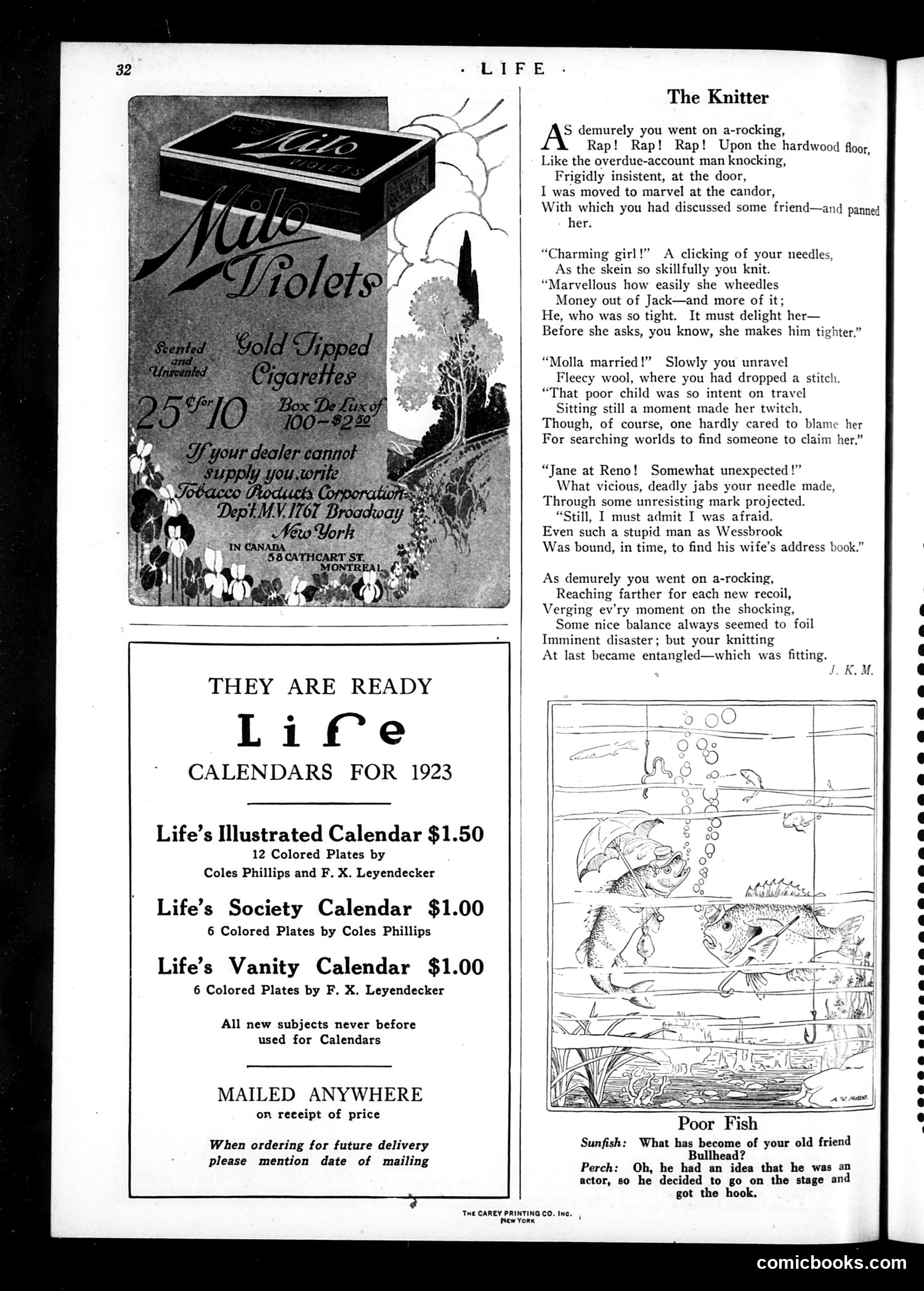
This page combines advertising and two satirical pieces from 1923's *Life* magazine. **"The Knitter"** is a poem mocking female gossip. A woman sits knitting while viciously criticizing her friends—gossiping about a woman who manipulates men financially, another friend's failed marriage, and a woman (Jane) divorcing at Reno (then famous for easy divorces). The satire lies in the contrast: she appears demurely domestic while her needles metaphorically "stab" her absent friends with cutting remarks. The final image of her knitting becoming "entangled" suggests divine comeuppance for her cattiness. **"Poor Fish"** is a visual pun: a sunfish asks a perch about their mutual friend "Bullhead." The perch explains Bullhead got "the hook" after deciding to become an actor—a play on fishing terminology suggesting failure and removal from the scene. Both pieces use gentle mockery of 1920s social types: gossiping women and would-be actors.
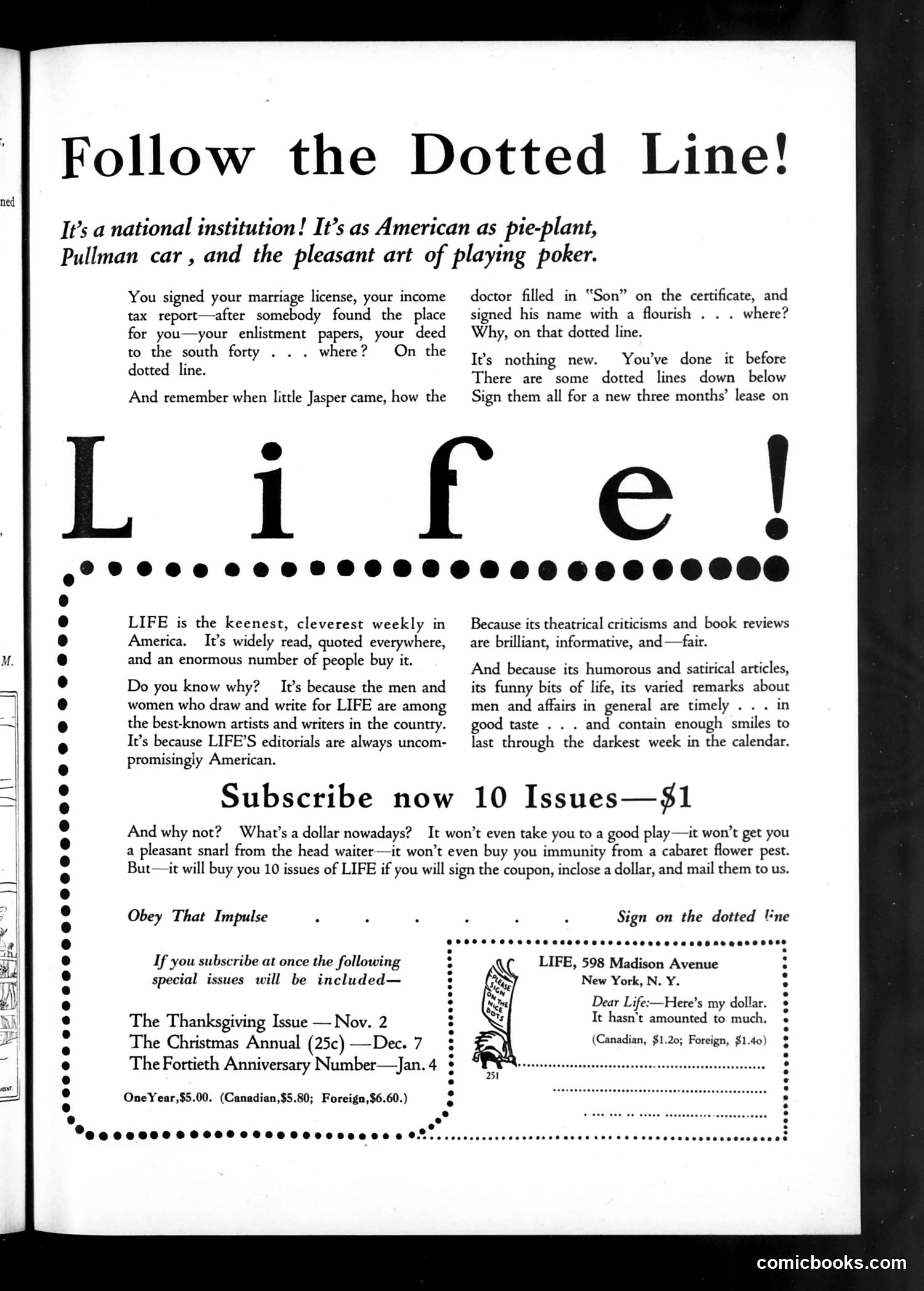
This is a subscription advertisement for *Life*, the American satirical weekly magazine. The page uses humor to encourage subscriptions at $1 for 10 issues—positioning signing the dotted line as quintessentially American, comparing it to other life milestones (marriage licenses, tax forms, birth certificates). The satire mocks the ubiquity of bureaucratic dotted lines in American life while promoting *Life*'s content: theater criticism, book reviews, humorous and satirical articles about men, women, and current affairs. The advertisement emphasizes that *Life* employs top-tier artists and writers and maintains "uncompromisingly American" standards. The coupon at right invites readers to complete the transaction—ironically, by signing yet another dotted line. Special issues (Thanksgiving, Christmas, 40th Anniversary) are offered as incentives. The tone throughout is self-aware and playful about advertising itself while celebrating American consumer culture and literary sophistication.
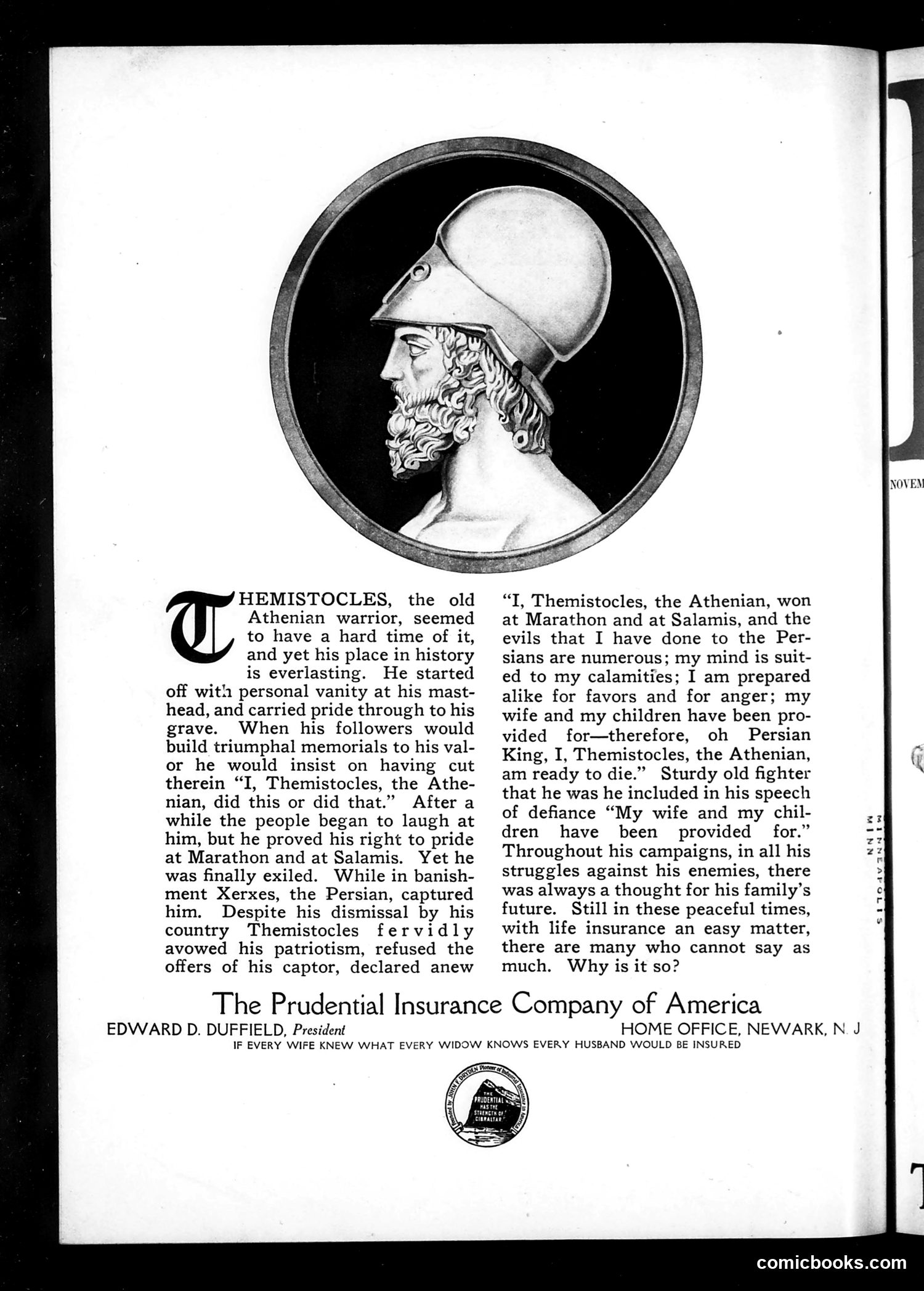
This is a **life insurance advertisement** disguised as historical narrative, not a political cartoon. The page uses **Themistocles**, the ancient Athenian general, as a moral exemplar. The text emphasizes that despite his personal vanity and eventual exile, Themistocles consistently ensured his wife and children were "provided for"—even when facing execution by the Persian King Xerxes. **The advertising pitch**: The ad argues that if an ancient warrior, facing death in a foreign land, prioritized his family's financial security, modern American men should certainly purchase life insurance during peacetime when "it's an easy matter." The tagline—"If every wife knew what every widow knows, every husband would be insured"—suggests widows understand too late the financial devastation of an uninsured husband's death. **The satire/persuasion**: By elevating life insurance to the level of classical virtue and patriotic duty, Prudential appeals to masculine pride and family responsibility—making insurance seem not merely practical but *morally necessary*.