
Life, 1922-10-26 · page 24 of 36
Life — October 26, 1922 — page 24: what you’re looking at
What you’re looking at
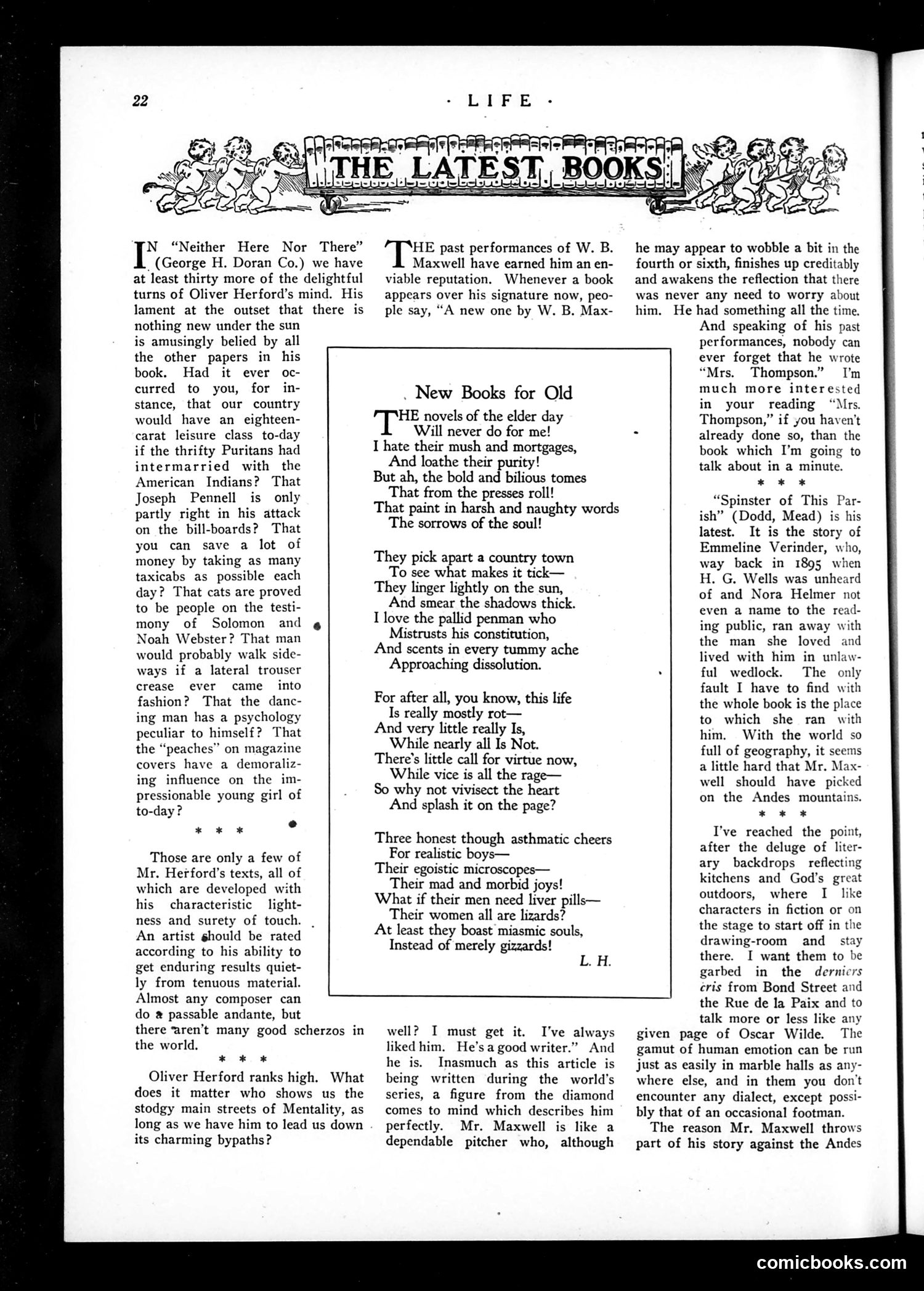
This page presents literary criticism from *Life* magazine's "The Latest Books" section. It reviews three works: **Oliver Herford's "Neither Here Nor There"** — The critic praises Herford's witty essay collection, celebrating his ability to find humor in mundane observations (Puritan intermarriage with Native Americans, billboard advertising, taxicabs, fashion quirks). The review uses sophisticated literary language, praising his skill at extracting "enduring results quietly from tenuous material." **A poem "New Books for Old"** (attributed L.H.) — This satirizes modern readers' rejection of Victorian literature ("mush and mortgages," "purity"), celebrating instead contemporary "realistic" novels depicting cynicism, illness, and moral decay—a jab at early 20th-century literary trends emphasizing psychological complexity and social criticism over Victorian sentimentality. **W.B. Maxwell's "Spinster of This Parish"** — The critic praises Maxwell's latest novel about a woman who abandoned respectability in 1895 to elope, only mildly faulting the exotic Andes setting. The page demonstrates how *Life* positioned itself as a venue for intellectual book criticism alongside satire.
📄 Transcribed text from this page (OCR, searchable)
Machine-transcribed from the original scan — historical spelling and the odd misread are preserved.
N “Neither Here Nor There” _ (George H. Doran Co.) we have at least thirty more of the delightful turns of Oliver Herford’s mind. His lament at the outset that there is nothing new under the sun is amusingly belied by all the other papers in his book. Had it ever oc- curred to you, for in- stance, that our country would have an eighteen- carat leisure class to-day if the thrifty Puritans had intermarried with the American Indians? That Joseph Pennell is only partly right in his attack on the bill-boards? That you can save a lot of money by taking as many taxicabs as possible each day? That cats are proved to be people on the testi- mony of Solomon and Noah Webster? That man would probably walk side- ways if a lateral trouser crease ever came into fashion? That the danc- ing man has a psychology peculiar to himself? That the “peaches” on magazine covers have a demoraliz- ing influence on the im- pressionable young girl of to-day? * * * Those are only a few of Mr. Hefford’s texts, all of which are developed with his characteristic light- ness and surety of touch. | An artist should be rated according to his ability to get enduring results quiet- ly from tenuous material. Almost any composer can do @ passable andante, but there ‘aren’t many good scherzos in the world. * ok * Oliver Herford ranks high. What does it matter who shows us the stodgy main streets of Mentality, as long as we have him to lead us down its charming bypaths? ‘HE past performances of W. B. Maxwell have earned him an en- viable reputation. Whenever a book appears over his signature now, peo- ple say, “A new one by W. B. Max- . New Books for Old T= novels of the elder day Will never do for me! I hate their mush and mortgages, And loathe their purity! But ah, the bold and bilious tomes That from the presses roll! That paint in harsh and naughty words The sorrows of the soul! They pick apart a country town To see what makes it tick— They linger lightly on the sun, And smear the shadows thick. I love the pallid penman who Mistrusts his constitution, And scents in every tummy ache Approaching dissolution. For after all, you know, this life Is really mostly rot-— And very little really Is, While nearly all Is Not. There's little call for virtue now, While vice is all the rage— So why not vivisect the heart And splash it on the page? Three honest though asthmatic cheers For realistic boys— Their egoistic microscopes— Their mad and morbid joys! What if their men need liver pills— Their women all are lizards? At least they boast miasmic souls, Instead of merely gizzards! L. H. he may appear to wobble a bit in the fourth or sixth, finishes up creditably and awakens the reflection that there was never any need to worry about him. He had something all the time. And speaking of his past performances, nobody can ever forget that he wrote “Mrs. Thompson.” I’m much more interested in your reading “Mrs. Thompson,” if you haven't already done so, than the book which I’m going to talk about in a minute. ie © “Spinster of This Par- ish” (Dodd, Mead) is his latest. It is the story of Emmeline Verinder, who, way back in 1895 when H. G. Wells was unheard of and Nora Helmer not even a name to the read- ing public, ran away with the man she loved and lived with him in unlaw- ful wedlock. The only fault I have to find with the whole book is the place to which she ran with him. With the world so full of geography, it seems a little hard that Mr. Max- well should have picked on the Andes mountains. * * * I've reached the point, after the deluge of liter- ary backdrops reflecting kitchens and God’s great outdoors, where I like characters in fiction or on the stage to start off in the drawing-room and_ stay there. I want them to be garbed in the dernicrs cris from Bond Street and well? I must get it. I’ve always liked him. He’sa good writer.” And he is. Inasmuch as this article is being written during the world’s series, a figure from the diamond comes to mind which describes him perfectly. Mr. Maxwell is like a dependable pitcher who, although the Rue de la Paix and to talk more or less like any given page of Oscar Wilde. The gamut of human emotion can be run just as easily in marble halls as any- where else, and in them you don't encounter any dialect, except possi- bly that of an occasional footman. The reason Mr. Maxwell throws part of his story against the Andes comicbooks.com