
Life, 1922-10-26 · page 20 of 36
Life — October 26, 1922 — page 20: what you’re looking at
What you’re looking at
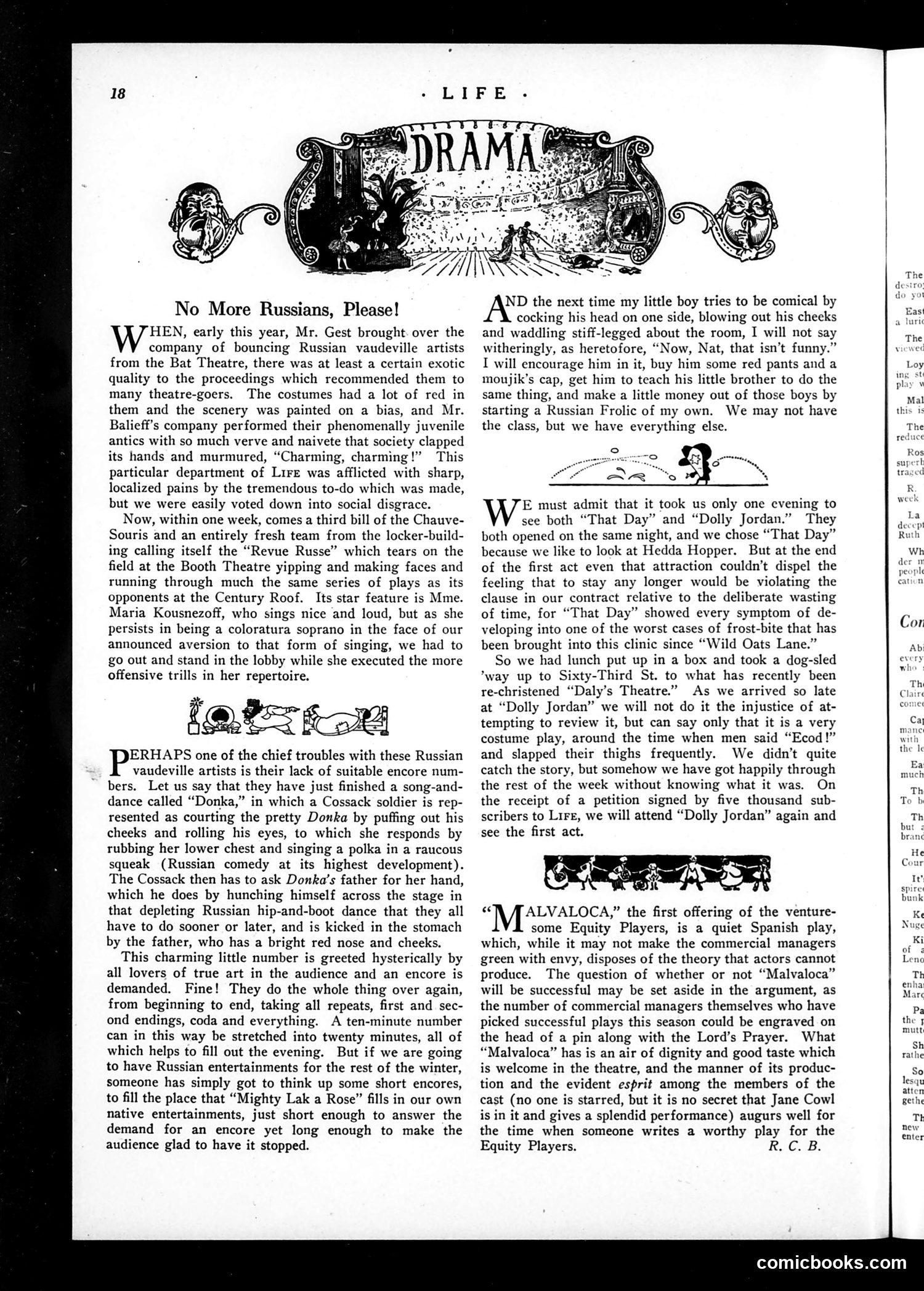
This 1920s theater review satirizes the craze for Russian vaudeville acts touring America. The author complains that after the initial novelty of Mikhail Balieff's Chauve-Souris company from the Bat Theatre, New York is now flooded with competing Russian troupes—including another "Revue Russe" at the Booth Theatre and performers like soprano Maria Kousnezoff. The satire targets two problems: (1) repetitive, poorly-constructed acts where performers stretch thin material by endless repeats, and (2) the American public's uncritical enthusiasm for anything labeled "exotic" or Russian. The author mocks typical Russian comedy routines (the "Donka" sketch with mugging and polka-singing) as artless and predictable. The joke concludes with mock surrender: if Russian entertainment will dominate the season, he'll capitalize on it by teaching his own children exaggerated Russian mannerisms and costumes to start a competing "Russian Frolic." The piece reflects post-WWI American ambivalence toward Russian culture—fascinated yet skeptical of its substance.
📄 Transcribed text from this page (OCR, searchable)
Machine-transcribed from the original scan — historical spelling and the odd misread are preserved.
No More Russians, Please! HEN, early this year, Mr. Gest brought. over the company of bouncing Russian vaudeville artists from the Bat Theatre, there was at least a certain exotic quality to the proceedings which recommended them to many theatre-goers. The costumes had a lot of red in them and the scenery was painted on a bias, and Mr. Balieff’s company performed their phenomenally juvenile antics with so much verve and naivete that society clapped its hands and murmured, “Charming, charming!” This particular department of Lire was afflicted with sharp, localized pains by the tremendous to-do which was made, but we were easily voted down into social disgrace. Now, within one week, comes a third bill of the Chauve- Souris and an entirely fresh team from the locker-build- ing calling itself the “Revue Russe” which tears on the field at the Booth Theatre yipping and making faces and running through much the same series of plays as its opponents at the Century Roof. Its star feature is Mme. Maria Kousnezoff, who sings nice and loud, but as she persists in being a coloratura soprano in the face of our announced aversion to that form of singing, we had to go out and stand in the lobby while she executed the more offensive trills in her repertoire. [@2= kor ERHAPS one of the chief troubles with these Russian vaudeville artists is their lack of suitable encore num- bers. Let us say that they have just finished a song-and- dance called “Donka,” in which a Cossack soldier is rep- resented as courting the pretty Donka by puffing out his cheeks and rolling his eyes, to which she responds by rubbing her lower chest and singing a polka in a raucous squeak (Russian comedy at its highest development). The Cossack then has to ask Donka’s father for her hand, which he does by hunching himself across the stage in that depleting Russian hip-and-boot dance that they all have to do sooner or later, and is kicked in the stomach by the father, who has a bright red nose and cheeks. This charming little number is greeted hysterically by all lovers of true art in the audience and an encore is demanded. Fine! They do the whole thing over again, from beginning to end, taking all repeats, first and sec- ond endings, coda and everything. A ten-minute number can in this way be stretched into twenty minutes, all of which helps to fill out the evening. But if we are going to have Russian entertainments for the rest of the winter, someone has simply got to think up some short encores, to fill the place that “Mighty Lak a Rose” fills in our own native entertainments, just short enough to answer the demand for an encore yet long enough to make the audience glad to have it stopped. ND the next time my little boy tries to be comical by cocking his head on one side, blowing out his cheeks and waddling stiff-legged about the room, I will not say witheringly, as heretofore, “Now, Nat, that isn’t funny.” I will encourage him in it, buy him some red pants and a moujik’s cap, get him to teach his little brother to do the same thing, and make a little money out of those boys by starting a Russian Frolic of my own. We may not have the class, but we have everything else. E must admit that it took us only one evening to see both “That Day” and “Dolly Jordan.” They both opened on the same night, and we chose “That Day” because we like to look at Hedda Hopper. But at the end of the first act even that attraction couldn’t dispel the feeling that to stay any longer would be violating the clause in our contract relative to the deliberate wasting of time, for “That Day” showed every symptom of de- veloping into one of the worst cases of frost-bite that has been brought into this clinic since “Wild Oats Lane.” So we had lunch put up in a box and took a dog-sled ’way up to Sixty-Third St. to what has recently been re-christened “Daly’s Theatre.” As we arrived so late at “Dolly Jordan” we will not do it the injustice of at- tempting to review it, but can say only that it is a very costume play, around the time when men said “Ecod!” and slapped their thighs frequently. We didn’t quite catch the story, but somehow we have got happily through the rest of the week without knowing what it was. On the receipt of a petition signed by five thousand sub- scribers to Lire, we will attend “Dolly Jordan” again and see the first act. “ ALVALOCA,” the first offering of the venture- some Equity Players, is a quiet Spanish play, which, while it may not make the commercial managers green with envy, disposes of the theory that actors cannot produce. The question of whether or not “Malvaloca” will be successful may be set aside in the argument, as the number of commercial managers themselves who have picked successful plays this season could be engraved on the head of a pin along with the Lord’s Prayer. What “Malvaloca” has is an air of dignity and good taste which is welcome in the theatre, and the manner of its produc- tion and the evident esprit among the members of the cast (no one is starred, but it is no secret that Jane Cowl is in it and gives a splendid performance) augurs well for the time when someone writes a worthy play for the Equity Players. R..¢. B. comicbooks.com