
Life, 1922-10-26 · page 9 of 36
Life — October 26, 1922 — page 9: what you’re looking at
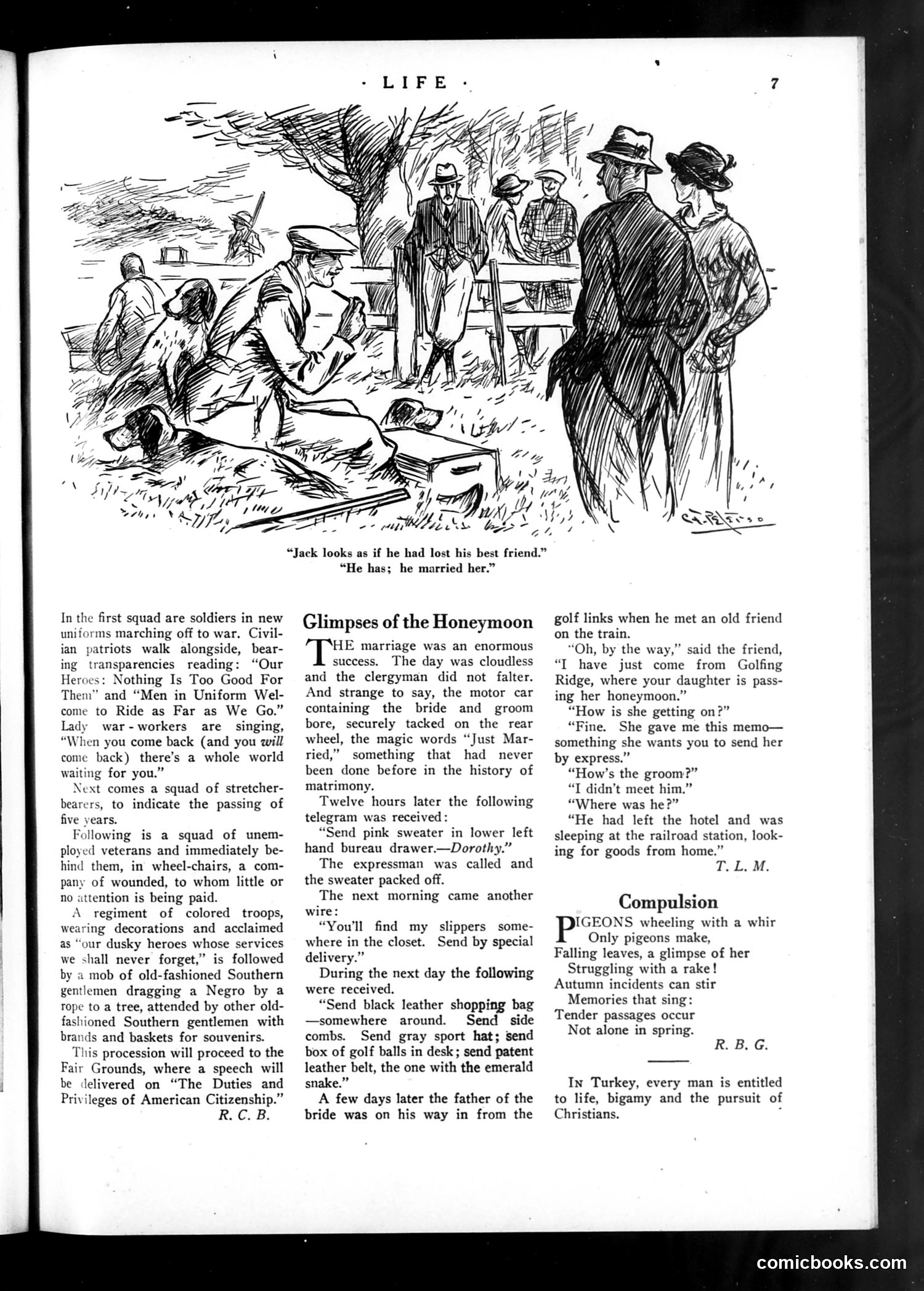
What you’re looking at
This satirical cartoon illustrates the contrast between romantic expectations and marital reality. The sketch shows a newlywed couple (Jack and his bride) surrounded by onlookers, with the caption: "Jack looks as if he had lost his best friend. He has; he married her." The joke exploits a common turn-of-the-century trope: marriage as the loss of male independence and bachelor freedom. The groom's dejected posture humorously suggests that gaining a wife means losing one's former carefree life and male companionship. The accompanying text describes honeymoon logistics—telegrams requesting clothing and items to be sent—highlighting the practical complications of early 20th-century travel that undercut romantic notions. The satire targets conventional attitudes toward matrimony as simultaneously desirable and emasculating.
📄 Transcribed text from this page (OCR, searchable)
Machine-transcribed from the original scan — historical spelling and the odd misread are preserved.
In the first squad are soldiers in new uniforms marching off to war. Civil- ian patriots walk alongside, bear- ing transparencies reading: “Our Heroes: Nothing Is Too Good For Them” and “Men in Uniform Wel- come to Ride as Far as We Go.” Lady war-workers are singing, “When you come back (and you will come back) there’s a whole world waiting for you.” Next comes a squad of stretcher- bearers, to indicate the passing of five years. Following is a squad of unem- ployed veterans and immediately be- hind them, in wheel-chairs, a com- pany of wounded, to whom little or no attention is being paid. A regiment of colored troops, wearing decorations and acclaimed as “our dusky heroes whose services we shall never forget,” is followed by a mob of old-fashioned Southern gentlemen dragging a Negro by a rope to a tree, attended by other old- fashioned Southern gentlemen with brands and baskets for souvenirs. This procession will proceed to the Fair Grounds, where a speech will be delivered on “The Duties and Privileges of American Citizenship.” R. C. B. -- he 4) a) yb “Jack looks as if he had lost his best friend.” “He has; he married her.” Glimpses of the Honeymoon HE marriage was an enormous success. The day was cloudless and the clergyman did not falter. And strange to say, the motor car containing the bride and groom bore, securely tacked on the rear wheel, the magic words “Just Mar- ried,” something that had never been done before in the history of matrimony. Twelve hours later the following telegram was received: “Send pink sweater in lower left hand bureau drawer.—Dorothy.” The expressman was called and the sweater packed off. The next morning came another wire: “You'll find my slippers some- where in the closet. Send by special delivery.” During the next day the following were received. “Send black leather shopping bag —somewhere around. Send _ side combs. Send gray sport hat; send box of golf balls in desk; send patent leather belt, the one with the emerald snake.” A few days later the father of the bride was on his way in from the Yt" TAWA, Mi af + , ‘ golf links when he met an old friend on the train. “Oh, by the way,” said the friend, “I have just come from Golfing Ridge, where your daughter is pass- ing her honeymoon.” “How is she getting on?” “Fine. She gave me this memo— something she wants you to send her by express.” “How’s the groom?” “T didn’t meet him.” “Where was he?” “He had left the hotel and was sleeping at the railroad station, look- ing for goods from home.” T. L. M. Compulsion IGEONS wheeling with a whir Only pigeons make, Falling leaves, a glimpse of her Struggling with a rake! Autumn incidents can stir Memories that sing: Tender passages occur Not alone in spring. R. B. G. In Turkey, every man is entitled to life, bigamy and the pursuit of Christians. . comicbooks.com