
Life, 1922-10-26 · page 8 of 36
Life — October 26, 1922 — page 8: what you’re looking at
What you’re looking at
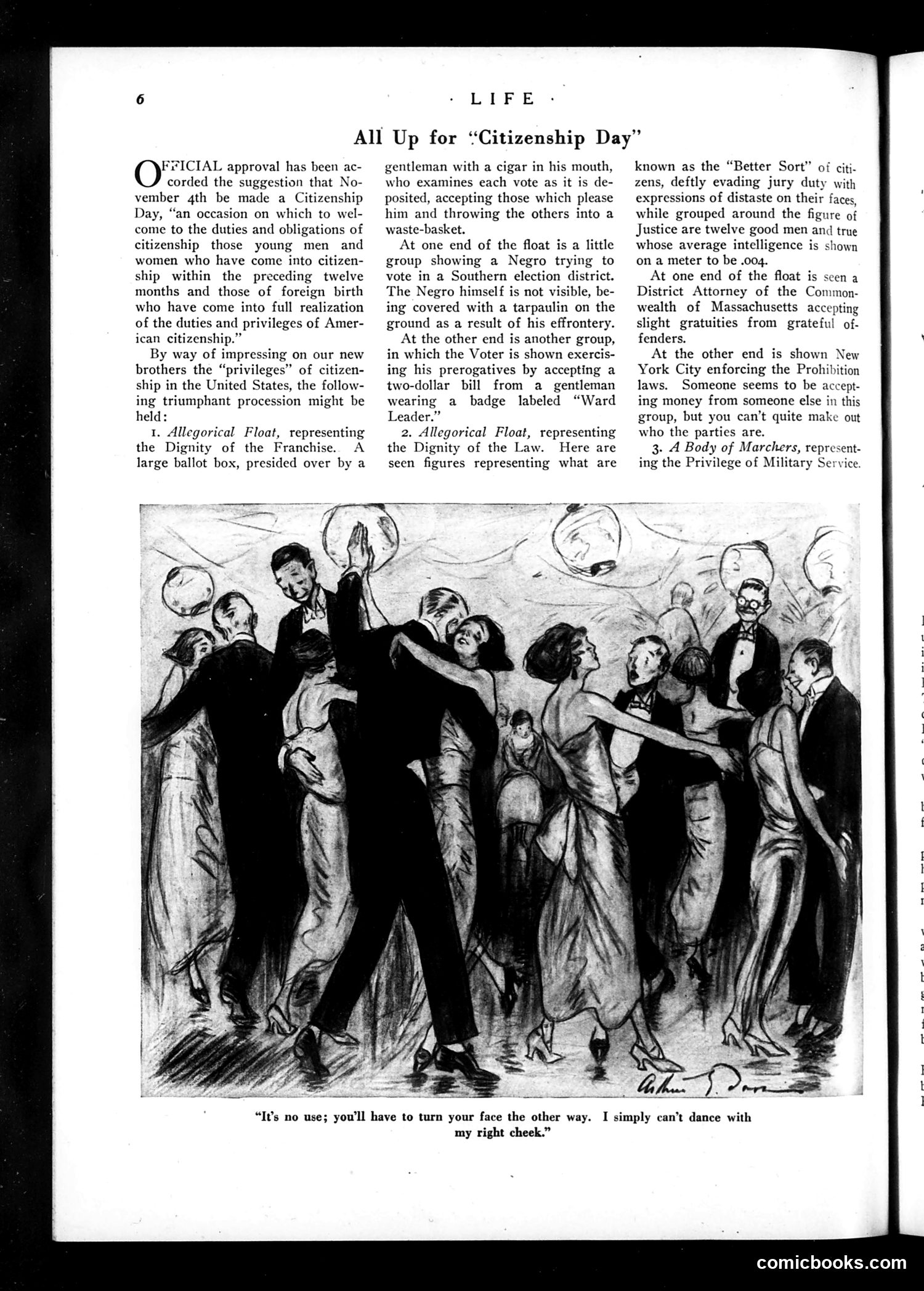
This satirical piece critiques a "Citizenship Day" parade celebrating naturalized citizens' rights. The text describes allegorical floats representing civic concepts like "Dignity of the Franchise" and "Dignity of the Law." The cartoon depicts a social dance scene where a man refuses to dance with a woman, telling her: "It's no use; you'll have to turn your face the other way. I simply can't dance with my right cheek." The satire appears to mock the hypocrisy of celebrating citizenship and civic equality while maintaining social discrimination and segregation—the man's refusal to engage with the woman despite formal citizenship rights granted. The specific reference to "right cheek" suggests an unwillingness to show face or publicly associate, undercutting the parade's patriotic message about equal civic participation.
📄 Transcribed text from this page (OCR, searchable)
Machine-transcribed from the original scan — historical spelling and the odd misread are preserved.
LIFE All Up for “Citizenship Day” O FICIAL approval has been ac- corded the suggestion that No- vember 4th be made a Citizenship Day, “an occasion on which to wel- come to the duties and obligations of citizenship those young men and women who have come into citizen- ship within the preceding twelve months and those of foreign birth who have come into full realization of the duties and privileges of Amer- ican citizenship.” By way of impressing on our new brothers the “privileges” of citizen- ship in the United States, the follow- ing triumphant procession might be held: 1. Allegorical Float, representing the Dignity of the Franchise. A large ballot box, presided over by a “It’s no use; you'll have to turn your face the other way. gentleman with a cigar in his mouth, who examines each vote as it is de- posited, accepting those which please him and throwing the others into a waste-basket. At one end of the float is a little group showing a Negro trying to vote in a Southern election district. The Negro himself is not visible, be- ing covered with a tarpaulin on the ground as a result of his effrontery. At the other end is another group, in which the Voter is shown exercis- ing his prerogatives by accepting a two-dollar bill from a gentleman wearing a badge labeled “Ward Leader.” 2. Allegorical Float, representing the Dignity of the Law. Here are seen figures representing what are my right cheek.” known as the “Better Sort” of citi- zens, deftly evading jury duty with expressions of distaste on their faces, while grouped around the figure of Justice are twelve good men and true whose average intelligence is shown on a meter to be .004. At one end of the float is seen a District Attorney of the Common- wealth of Massachusetts accepting slight gratuities from grateful of- fenders. At the other end is shown New York City enforcing the Prohibition laws. Someone seems to be accept- ing money from someone else in this group, but you can’t quite make out who the parties are. 3. A Body of Marchers, represent- ing the Privilege of Military Servi I simply can’t dance with comicbooks.com