
Life, 1922-10-26 · page 16 of 36
Life — October 26, 1922 — page 16: what you’re looking at
What you’re looking at
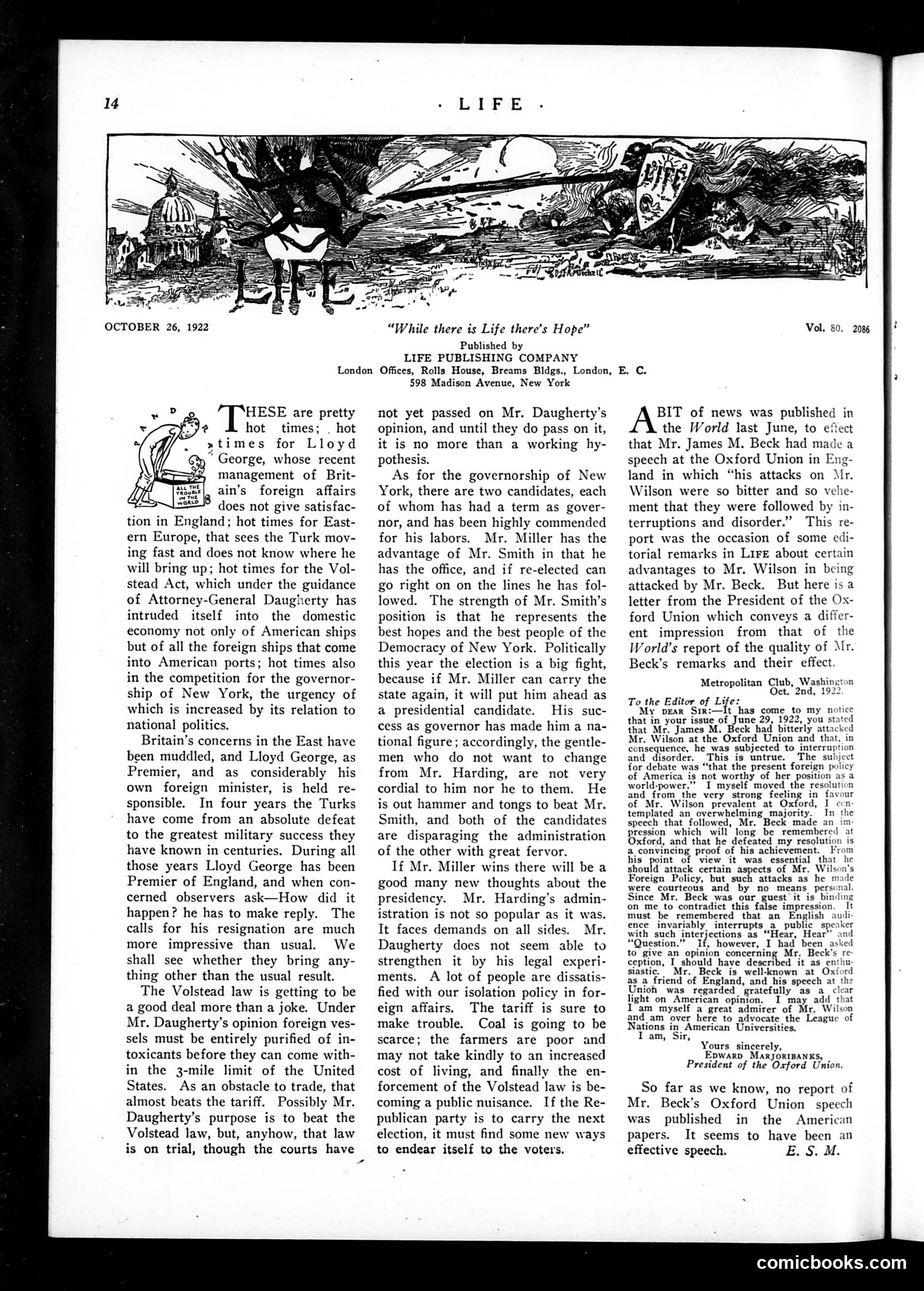
This October 26, 1922 Life page discusses hot political issues of the moment. The main text criticizes Attorney-General Daugherty's management of British affairs during the Greco-Turkish conflict and discusses New York's gubernatorial race between candidates Miller and Smith. The editorial also addresses the Volstead Act (Prohibition), which the author suggests is becoming unpopular and difficult to enforce. There's commentary on tariffs, coal shortages, and farmers' economic hardship. A separate letter from Edward Markham, President of the Oxford Union, defends Mr. Beck against attacks by James M. Beck, noting the criticism was "bitter" but followed by interruptions—suggesting contentious debate at the prestigious British debating society. The cartoon at top appears satirical but its specific subject is unclear from this image alone.
📄 Transcribed text from this page (OCR, searchable)
Machine-transcribed from the original scan — historical spelling and the odd misread are preserved.
OCTOBER 26, 1922 “While there is Life there’s Hope” Published by LIFE PUBLISHING COMPANY Vol. 80. 2086 London Offices, Rolls House, Breams Bldgs., London, E. C. HESE are pretty fe hot times; . hot »times for Lloyd “ George, whose recent management of Brit- ain’s foreign affairs does not give satisfac- tion in England; hot times for East- ern Europe, that sees the Turk mov- ing fast and does not know where he will bring up; hot times for the Vol- stead Act, which under the guidance of Attorney-General Daugherty has intruded itself into the domestic economy not only of American ships but of all the foreign ships that come into American ports; hot times also in the competition for the governor- ship of New York, the urgency of which is increased by its relation to national politics. Britain’s concerns in the East have been muddled, and Lloyd George, as Premier, and as considerably his own foreign minister, is held re- sponsible. In four years the Turks have come from an absolute defeat to the greatest military success they have known in centuries. During all those years Lloyd George has been Premier of England, and when con- cerned observers ask—How did it happen? he has to make reply. The calls for his resignation are much more impressive than usual. We shall see whether they bring any- thing other than the usual result. The Volstead law is getting to be a good deal more than a joke. Under Mr. Daugherty’s opinion foreign ves- sels must be entirely purified of in- toxicants before they can come with- in the 3-mile limit of the United States. As an obstacle to trade, that almost beats the tariff. Possibly Mr. Daugherty’s purpose is to beat the Volstead law, but, anyhow, that law is on trial, though the courts have 598 Madison Avenue, New York not yet passed on Mr. Daugherty’s opinion, and until they do pass on it, it is no more than a working hy- pothesis. As for the governorship of New York, there are two candidates, each of whom has had a term as gover- nor, and has been highly commended for his labors. Mr. Miller has the advantage of Mr. Smith in that he has the office, and if re-elected can go right on on the lines he has fol- lowed. The strength of Mr. Smith’s position is that he represents the best hopes and the best people of the Democracy of New York. Politically this year the election is a big fight, because if Mr. Miller can carry the state again, it will put him ahead as a presidential candidate. His suc- cess as governor has made him a na- tional figure ; accordingly, the gentle- men who do not want to change from Mr. Harding, are not very cordial to him nor he to them. He is out hammer and tongs to beat Mr. Smith, and both of the candidates are disparaging the administration of the other with great fervor. If Mr. Miller wins there will be a good many new thoughts about the presidency. Mr. Harding’s admin- istration is not so popular as it was. It faces demands on all sides. Mr. Daugherty does not seem able to strengthen it by his legal experi- ments. A lot of people are dissatis- fied with our isolation policy in for- eign affairs, The tariff is sure to make trouble. Coal is going to be scarce; the farmers are poor and may not take kindly to an increased cost of living, and finally the en- forcement of the Volstead law is be- coming a public nuisance. If the Re- publican party is to carry the next election, it must find some new ways to endear itself to the voters. BIT of news was published in the World last June, to eftect that Mr. James M. Beck had made a speech at the Oxford Union in Eng- land in which “his attacks on Mr. Wilson were so bitter and so vehe- ment that they were followed by in- terruptions and disorder.” This re- port was the occasion of some edi- torial remarks in Lire about certain advantages to Mr. Wilson in being attacked by Mr. Beck. But here is a letter from the President of the Ox- ford Union which conveys a di ent impression from that of the World’s report of the quality of Mr. Beck’s remarks and their effect. Metropolitan Club, Washi Oct. 21 ind, 19 To the Editor of Life: My pear Sir:—It has come to my notice that in your issue of June 29, 1922, you stated that Mr. James M. Beck had bitterly attacked Mr. Wilson at the Oxford Union and that, in consequence, he was subjected to interruption and disorder. This is untrue. The sub for debate was “that the present foreign po of America is not worthy of her position world-power.” I myself moved the reso and from the very strong feeling in of Mr. Wilson prevalent at Oxford, I con templated an overwhelming majority. In the speech that followed, Mr. Beck made an im: pression which will long be remembered at Oxford, and that he defeated my resolution is a convincing proof of his achievement. From his point of view it was essential that he should attack certain ects of Mr. Wilson's Foreign Policy, but such attacks as he made were courteous and by no means Since Mr. Beck was our guest it on me to contradict this false impr must be remembered that an Eng! ence invariably interrupts a public 5 with such interjections as “Hear, Hear’ “Question.” If, however, I had been to give an opinion concerning Mr, Beck’ ception, I should have described it as siastic. Mr. Beck is well-known at Oxi as a friend of England, and his speech at the Unioh was regarded ‘gratefully as a clear light on American opinion. I may add that I am myself a great admirer of Mr. Wilson and_am over here to advocate the League of Nations in American Universities. T am, Sir, Yours sincerely, Epwarp MarjortBanxs, President of the Oxford Union. So far as we know, no report of Mr. Beck’s Oxford Union speech was published in the American papers. It seems to have been an effective speech. EB. S. M. comicbooks.com