
Life, 1922-10-26 · page 26 of 36
Life — October 26, 1922 — page 26: what you’re looking at
What you’re looking at
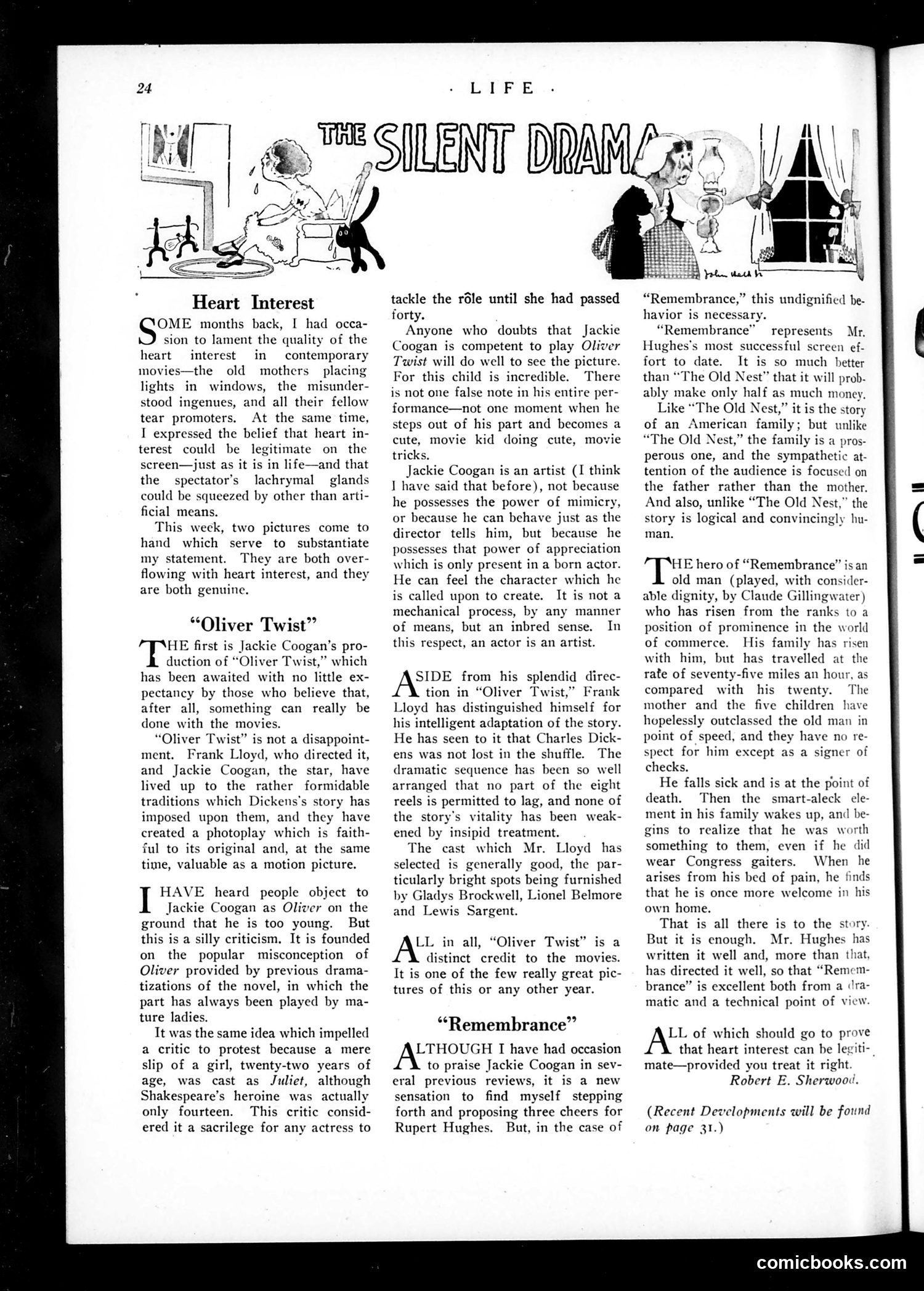
This page contains two film reviews from Life magazine's "Silent Drama" section, critiquing recent motion pictures. The first review praises Jackie Coogan's performance in *Oliver Twist*, directed by Frank Lloyd. The critic defends casting the child actor in the lead role against objections that he's too young, arguing that previous stage adaptations wrongly featured adult actresses. Coogan is praised as a genuine artist who authentically inhabits the character rather than performing tricks. The second review celebrates Rupert Hughes's film *Remembrance*, which centers on an aging businessman who falls gravely ill. The plot emphasizes domestic sentiment—the man finds renewed welcome in his family after his illness makes him realize his earlier indifference to them. Both reviews celebrate "heart interest" (emotional resonance) achieved through genuine artistic merit rather than artificial sentimentality. The critic contrasts this with earlier tear-jerking cinema clichés like "old mothers placing lights in windows."
📄 Transcribed text from this page (OCR, searchable)
Machine-transcribed from the original scan — historical spelling and the odd misread are preserved.
Heart Interest OME months back, I had occa- sion to lament the quality of the heart interest in contemporary movies—the old mothers placing lights in windows, the misunder- stood ingenues, and all their fellow tear promoters. At the same time, I expressed the belief that heart in- terest could be legitimate on the screen—just as it is in life—and that the spectator’s lachrymal glands could be squeezed by other than arti- ficial means. This week, two pictures come to hand which serve to substantiate my statement. They are both over- flowing with heart interest, and they are both genuine. “Oliver Twist” HE first is Jackie Coogan’s pro- duction of “Oliver Twist,” which has been awaited with no little ex- pectancy by those who believe that, after all, something can really be done with the movies. “Oliver Twist” is not a disappoint- ment. Frank Lloyd, who directed it, and Jackie Coogan, the star, have lived up to the rather formidable traditions which Dickens's story has imposed upon them, and they have created a photoplay which is faith- ful to its original and, at the same time, valuable as a motion picture. HAVE heard people object to Jackie Coogan as Oliver on the ground that he is too young. But this is a silly criticism, It is founded on the popular misconception of Oliver provided by previous drama- tizations of the novel, in which the part has always been played by ma- ture ladies. It was the same idea which impelled a critic to protest because a mere slip of a girl, twenty-two years of age, was cast as Juliet, although Shakespeare’s heroine was actually only fourteen. This critic consid- ered it a sacrilege for any actress to tackle the rdle until she had passed forty. Anyone who doubts that Jackie Coogan is competent to play Oliver Twist will do well to see the picture. For this child is incredible. There is not one false note in his entire per- formance—not one moment when he steps out of his part and becomes a cute, movie kid doing cute, movie tricks. Jackie Coogan is an artist (I think I have said that before), not because he possesses the power of mimicry, or because he can behave just as the director tells him, but because he possesses that power of appreciation which is only present in a born actor. He can feel the character which he is called upon to create. It is not a mechanical process, by any manner of means, but an inbred sense. In this respect, an actor is an artist. SIDE from his splendid direc- tion in “Oliver Twist,” Frank Lloyd has distinguished himself for his intelligent adaptation of the story. He has seen to it that Charles Dick- ens was not lost in the shuffle. The dramatic sequence has been so well arranged that no part of the eight reels is permitted to lag, and none of the story’s vitality has been weak- ened by insipid treatment. The cast which Mr. Lloyd has selected is generally good, the par- ticularly bright spots being furnished by Gladys Brockwell, Lionel Belmore and Lewis Sargent. LL in all, “Oliver Twist” is a distinct credit to the movies. It is one of the few really great pic- tures of this or any other year. “Remembrance” LTHOUGH TI have had occasion to praise Jackie Coogan in sev- eral previous reviews, it is a new sensation to find myself stepping forth and proposing three cheers for Rupert Hughes. But, in the case of “Remembrance,” this undignified be- havior is necessary. “Remembrance” represents Mr, Hughes's most successful screen ef- fort to date. It is so much better than “The Old Nest” that it will prob- ably make only half as much money. Like “The Old Nest,” it is the story of an American family; but unlike “The Old Nest,” the family is a pros- perous one, and the sympathetic at- tention of the audience is focused on the father rather than the mother. And also, unlike “The Old Nest,” the story is logical and convincingly hu- man. Te hero of “Remembrance” is an old man (played, with consider- able dignity, by Claude Gillingwater) who has risen from the ranks to a position of prominence in the world of commerce. His family has risen with him, but has travelled at the rate of seventy-five miles an hour, as compared with his twenty. The mother and the five children have hopelessly outclassed the old man in point of speed, and they have no re- spect for him except as a signer of checks. He falls sick and is at the point of death. Then the smart-aleck ele- ment in his family wakes up, and be- gins to realize that he was worth something to them, even if he did wear Congress gaiters. When he arises from his bed of pain, he finds that he is once more welcome in his own home. That is all there is to the story. But it is enough. Mr. Hughes has written it well and, more than that, has directed it well, so that “Remem- brance” is excellent both from a «ra- matic and a technical point of view. LL of which should go to prove that heart interest can be legiti- mate—provided you treat it right Robert E. Sherwood. (Recent Developments will be found on page 31.) comicbooks.com