
A complete issue · 36 pages · 1922
Life — October 19, 1922
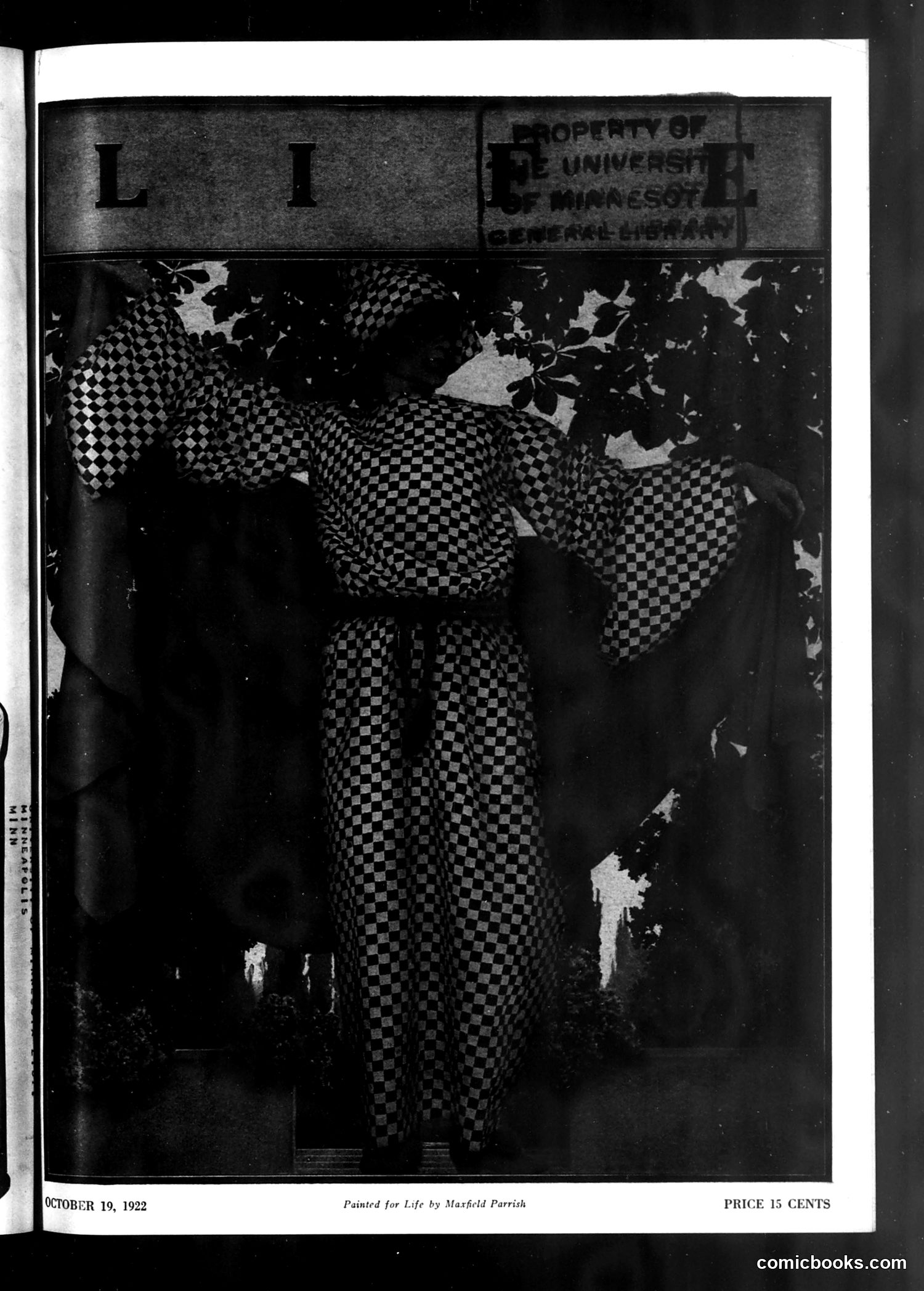
This page features artwork titled "Painted for Life by Maxfield Parrish," the renowned illustrator. The image shows a stylized figure in a checkered costume against a decorative background with floral and patterned elements. Without clearer OCR text identifying the specific subject, I cannot definitively explain what political or social commentary this illustration conveys. The checkered pattern clothing and artistic style are characteristic of Parrish's decorative work from this era. The page appears to be primarily an art feature rather than a political cartoon. To accurately identify the satirical intent or reference, additional context about the article's title and accompanying text would be necessary.
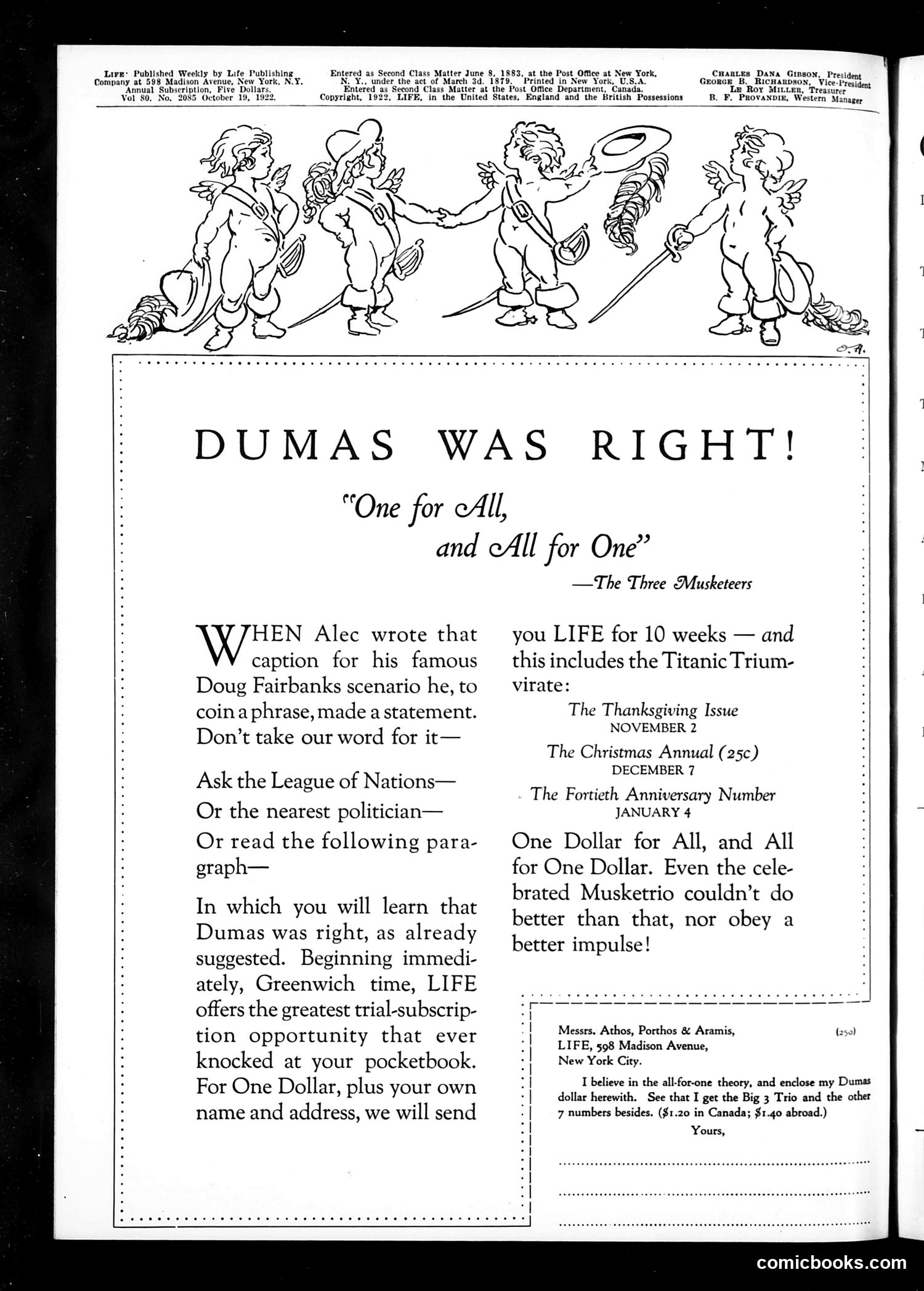
This page is primarily a **subscription advertisement** for *Life* magazine, not political satire. The heading "DUMAS WAS RIGHT!" references Alexandre Dumas's famous motto from *The Three Musketeers*: "One for All, and All for One." The four cherub figures at the top appear decorative rather than caricatures of specific people. The ad promotes a trial subscription offer: one dollar gets readers 10 weeks of *Life*, including special issues (Thanksgiving, Christmas, Anniversary numbers). The advertisement plays on Dumas's motto to suggest that this subscription deal represents mutual benefit—readers get quality content affordably while *Life* gains subscribers. The phrasing "One Dollar for All, and All for One Dollar" is a commercial adaptation of the literary reference, positioning the subscription as a fair bargain for everyone involved.
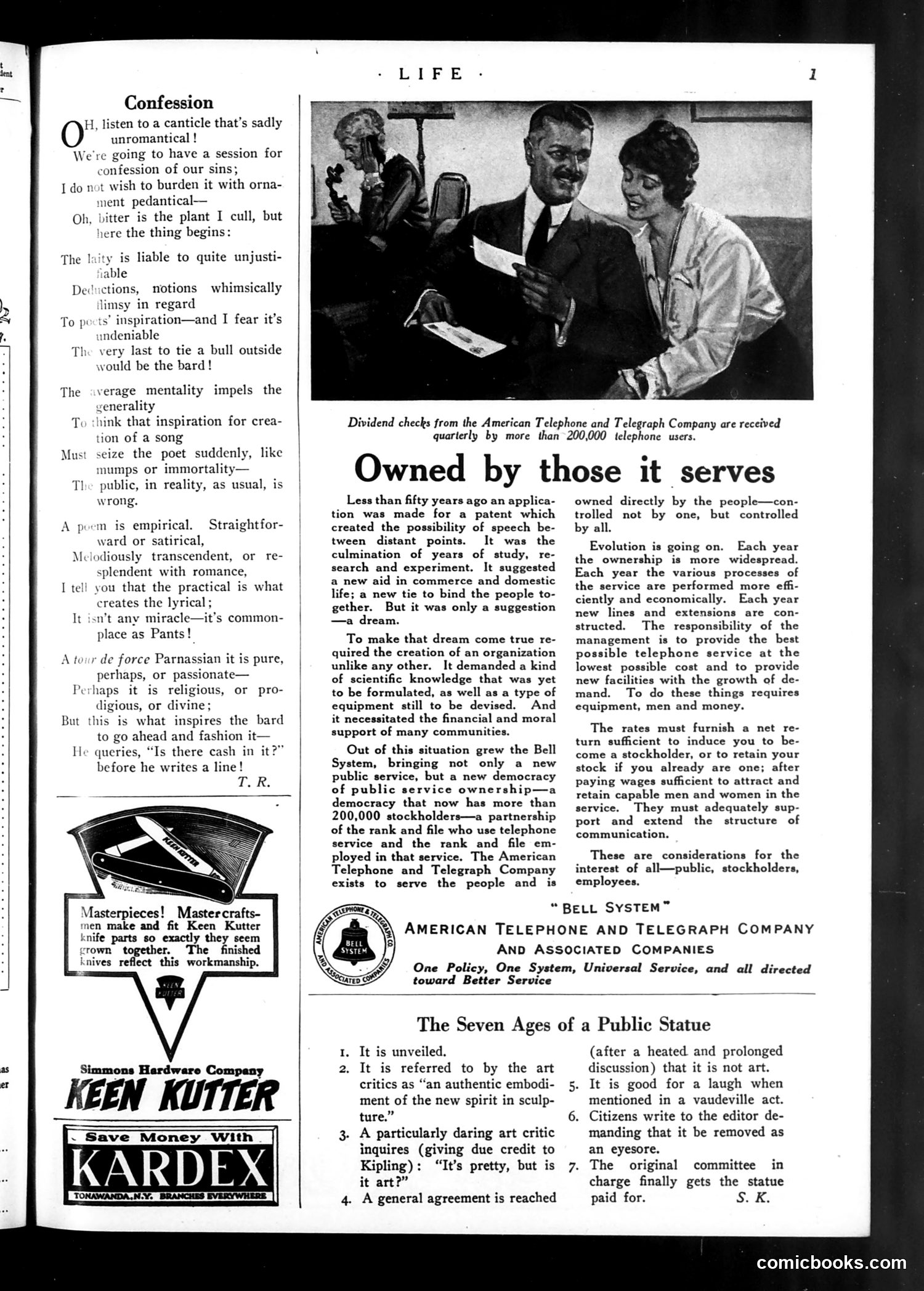
This page is primarily **advertising** rather than editorial content. The main image shows men in business attire examining dividend checks, accompanying an advertisement for the **American Telephone and Telegraph Company (AT&T)**, promoting their stock ownership model—"Owned by those it serves." The ad celebrates AT&T's expansion to "more than 200,000 stockholders," framing public ownership as democratic progress in telecommunications service. Below are unrelated **product advertisements**: Keen Kutter tools (Simmons Hardware Company) and Kardex filing systems. On the left is a poem titled "Confession" discussing artistic inspiration and poetic creation—likely satirizing romantic notions of the creative process. The page reflects early 20th-century corporate marketing emphasizing worker-shareholder participation and distributed ownership.
This is **not a cartoon or satire**—it's a straightforward advertisement for Phoenix brand hosiery from an early 20th-century issue of *Life* magazine. The ad uses ornamental Art Nouveau borders and makes practical claims about the product: that fine silk hosiery reduces friction between foot and shoe while remaining durable for long-distance wear. The language emphasizes durability ("withstands severest usage") and affordability ("low cost"). The phrase "Step on it!" is a period colloquialism meaning to hurry or go faster—a pun playing on the product being something one literally steps in. The ad targets "men, women and children of America," suggesting hosiery was marketed broadly across genders and ages.
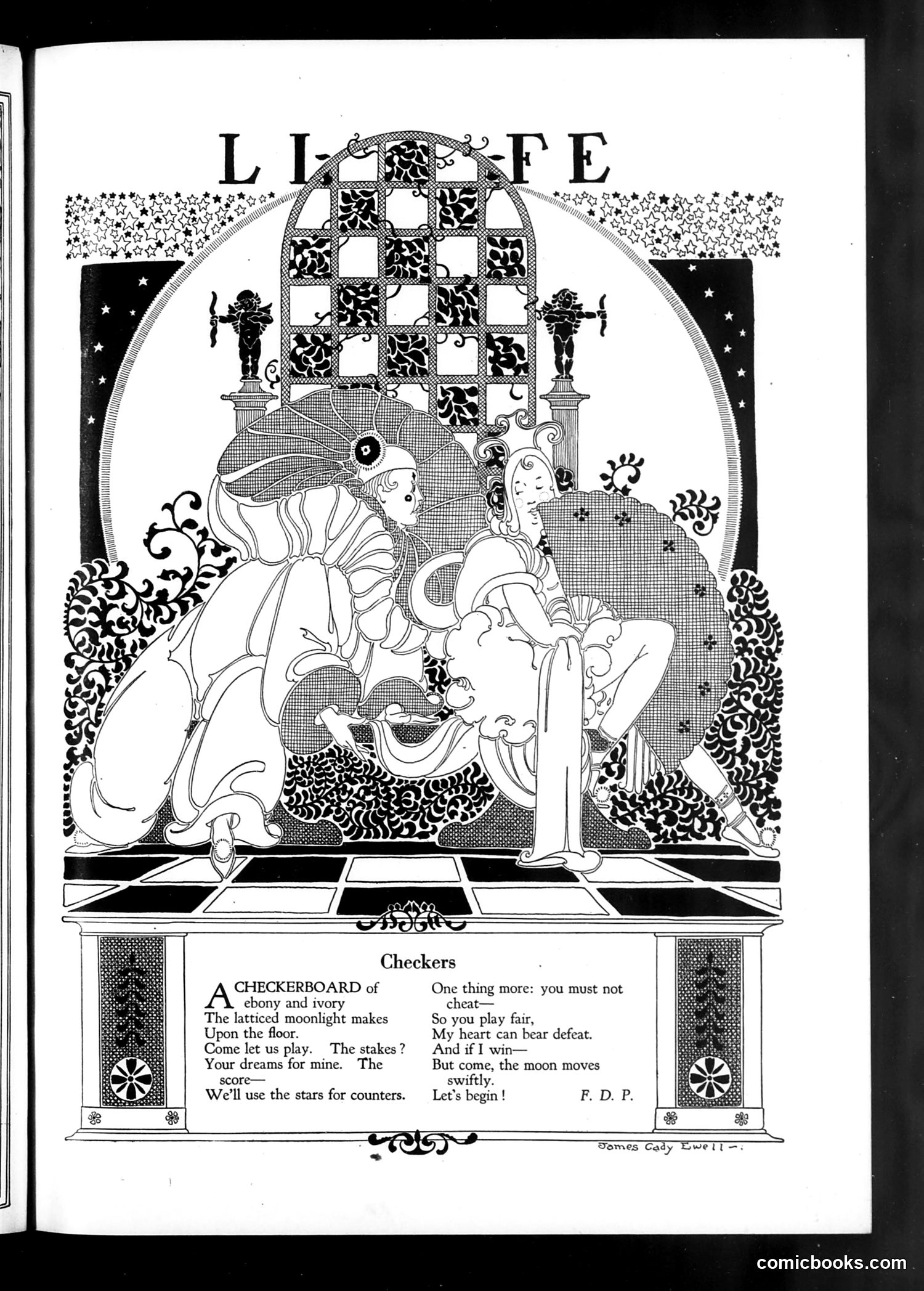
This is an illustration for a game of checkers styled as romantic theater. Two elegantly dressed figures—a woman and man in period costume—sit before an oversized checkerboard positioned like a stage set, with decorative architectural elements and cherubs above. The accompanying poem by F.D.P. frames checkers as a romantic contest: "A checkerboard of ebony and ivory / The latticed moonlight makes / Upon the floor. Come let us play." The humor lies in elevating a simple board game to high dramatic romance, playing on early 20th-century notions of courtship as theatrical performance. The "one thing more: you must not cheat" serves as gentle moral instruction wrapped in flirtation. This appears designed as whimsical entertainment content for *Life*'s readers.
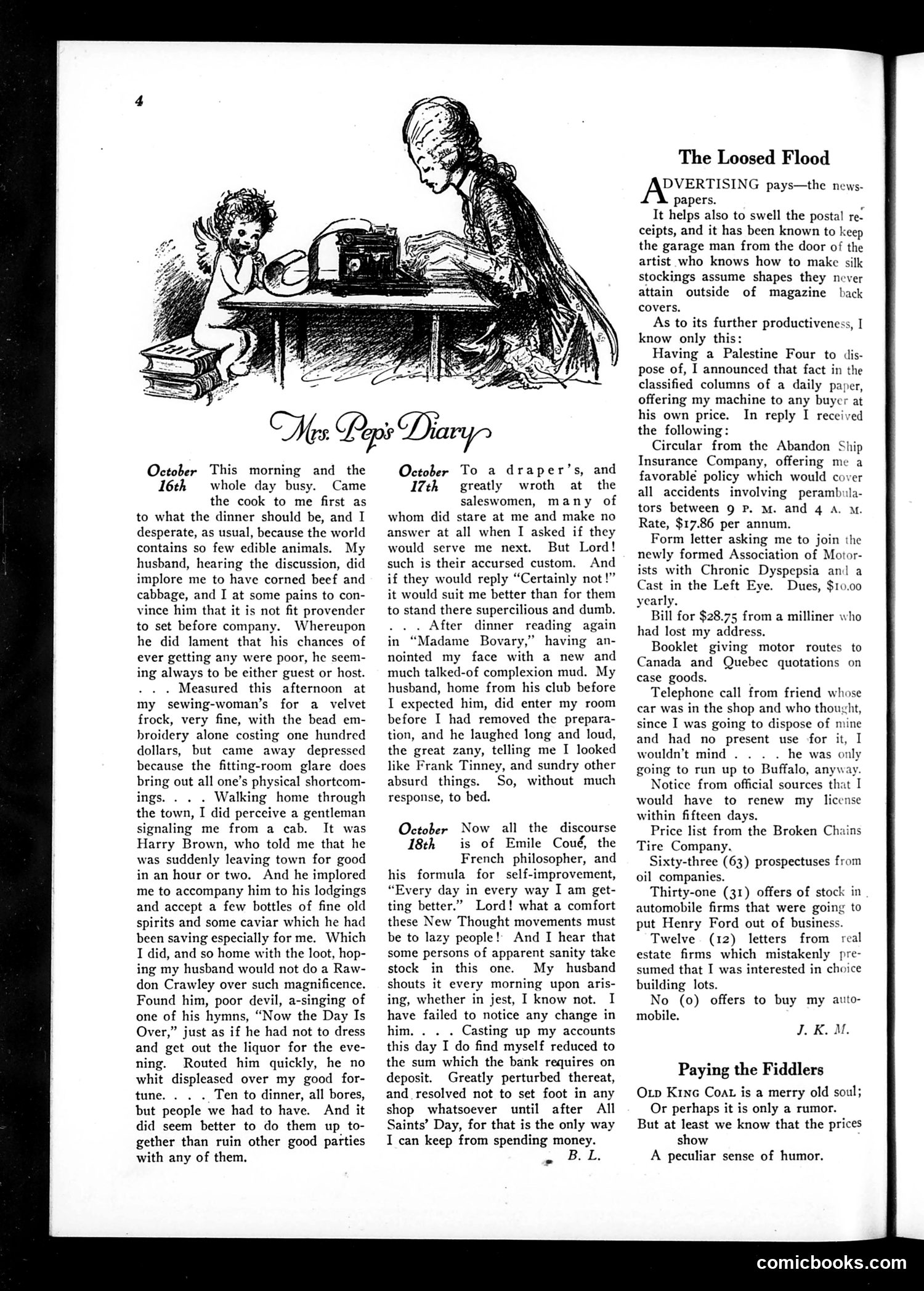
This page features "Mrs. Pepsi's Diary," a satirical column documenting mundane domestic life. The illustration shows a woman at a typewriter with a child, likely representing the diary's author documenting her experiences. The entries (October 16th-18th) humorously detail ordinary frustrations: servants' incompetence, a husband's poor business prospects, social embarrassments, and financial anxieties. References to "New Thought movements" and self-improvement fads suggest satire of contemporary wellness trends. The column mocks middle-class pretensions and domestic concerns through deadpan narration of petty grievances—servants who won't work, disappointing social calls, dwindling funds. The humor relies on readers recognizing these as exaggerated versions of their own experiences. The accompanying advertisements and small items suggest *Life* magazine's typical mixed content of satirical fiction, advice, and notices.
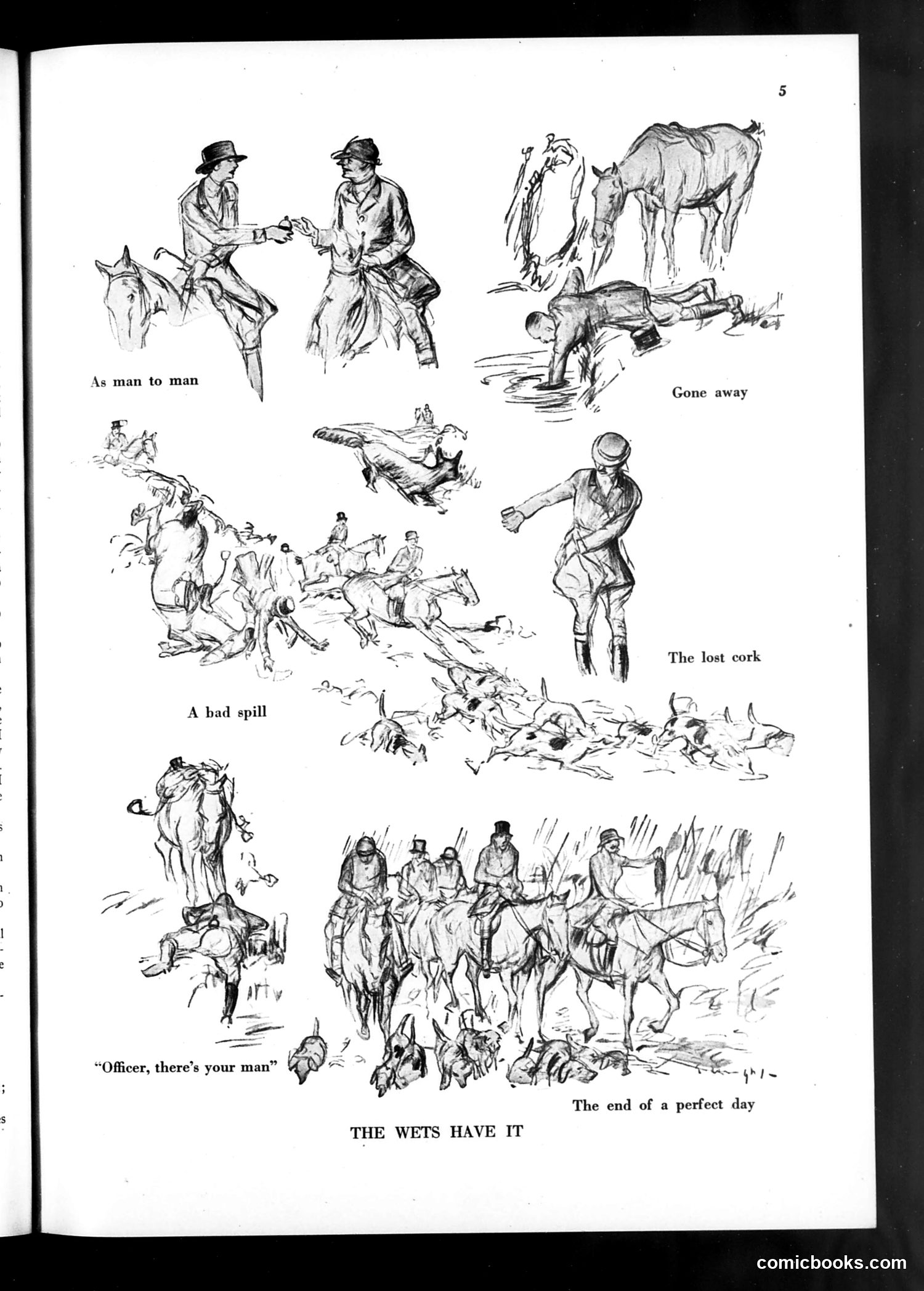
This page satirizes fox hunting mishaps among the British upper classes. Each sketch depicts hunting disasters with witty captions: - "As man to man": Two mounted hunters negotiate, likely over protocol or etiquette - "Gone away": A hunter lies prostrate beneath a horse, suggesting an ungraceful fall - "A bad spill": Multiple riders and horses in chaotic disarray - "The lost cork": A lone hunter, seemingly separated from the group - "Officer, there's your man": A disheveled figure amid scattered hunters - "The end of a perfect day": The full hunt party returns muddy and exhausted The title "The Wets Have It" suggests these incompetent, disaster-prone hunters are "wet"—British slang for weak or ineffectual. The humor mocks the pretensions of fox-hunting society through exaggerated depictions of their repeated failures and physical indignities.
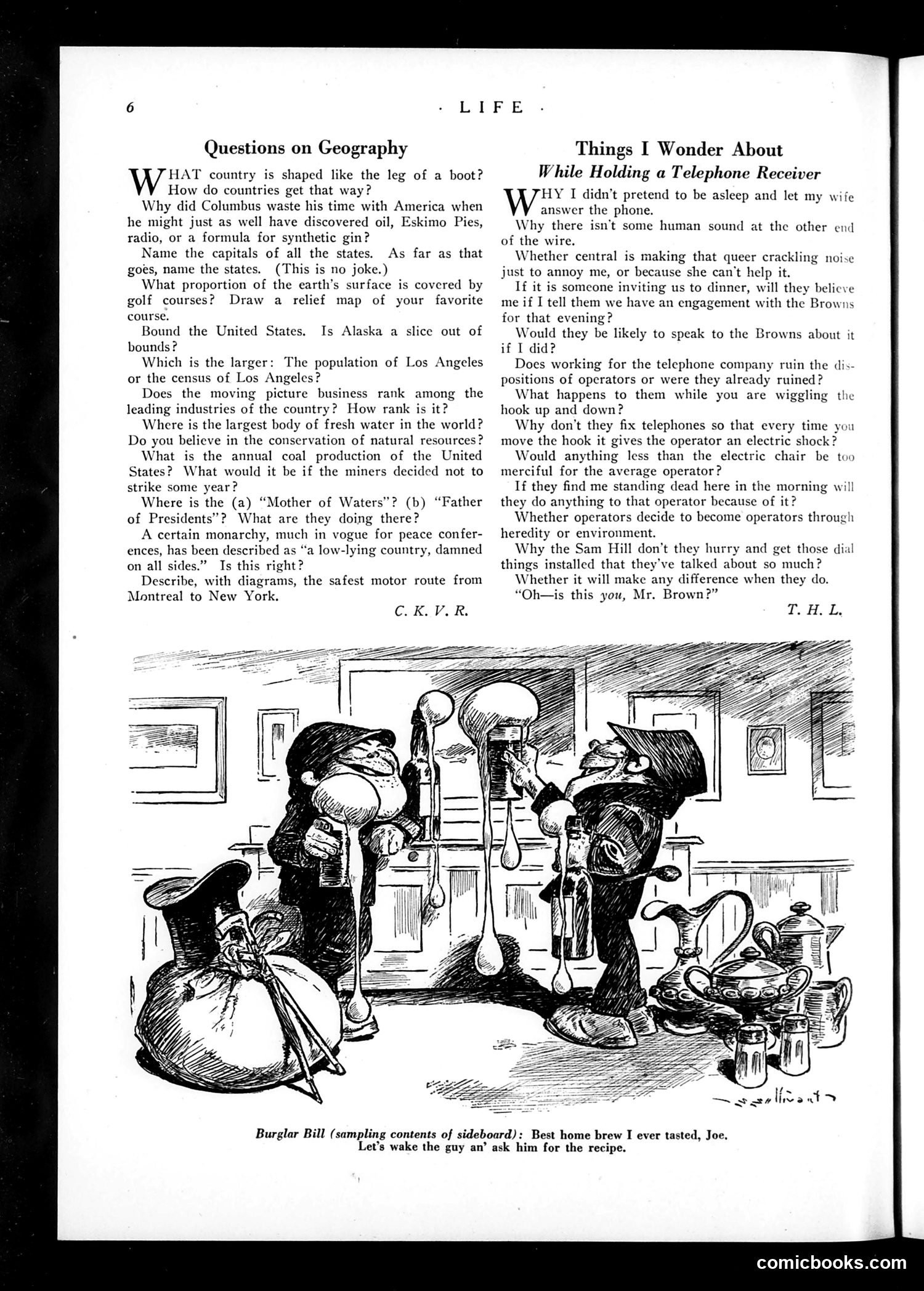
This page contains two distinct sections: **"Questions on Geography"** (left column): A quiz featuring educational geography questions about the United States and world geography, credited to C.K.V.R. **"Things I Wonder About While Holding a Telephone Receiver"** (right column): Humorous musings by T.H.L. about the frustrations and oddities of using a telephone—including poor connections, unwanted interruptions, and operator inefficiency. **The cartoon** depicts a domestic scene where a burglar interrupts a dinner party, sampling food from the sideboard. The humor derives from the burglar's enthusiasm for the home-brewed food ("Best home brew I ever tasted, Joe"), suggesting the hosts should ask him for the recipe. This likely satirizes Prohibition-era home brewing and the irony of a criminal appreciating the domestic effort more than the owners' guests.
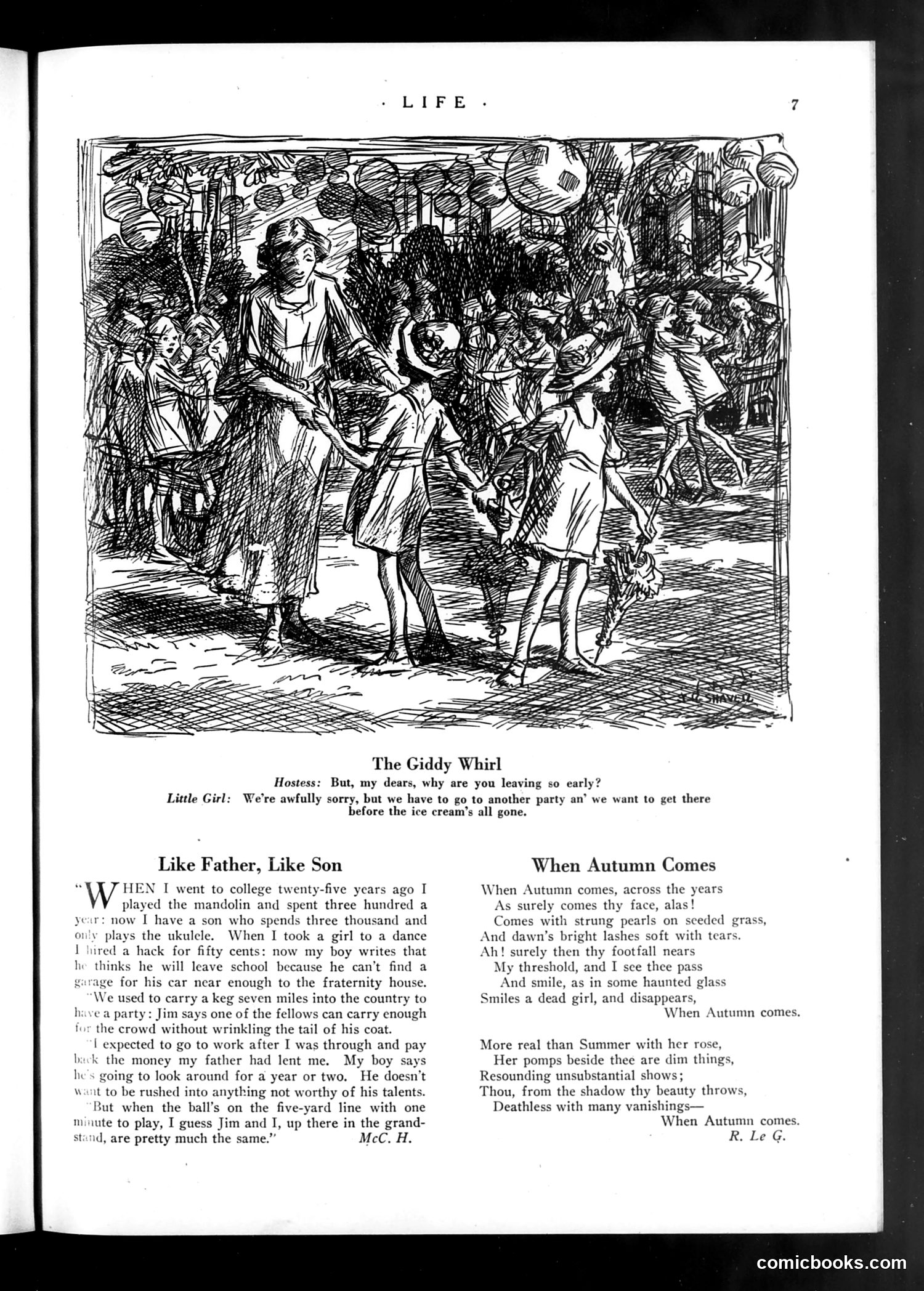
**"The Giddy Whirl"** is an illustration depicting a social scene where a well-dressed adult woman (labeled "Hostess") addresses departing young girls. One girl explains they must leave early because "we want to get there before the ice cream's all gone" at another party. The satire targets the frenetic social calendar of young women in the early 20th century—the expectation that unmarried girls would circulate constantly among multiple social events. The humor lies in the girls' honest admission that they're party-hopping merely to maximize refreshments rather than to genuinely enjoy any single gathering. Below are two pieces: **"Like Father, Like Son"** and **"When Autumn Comes"** (poetry)—unrelated to the main cartoon.
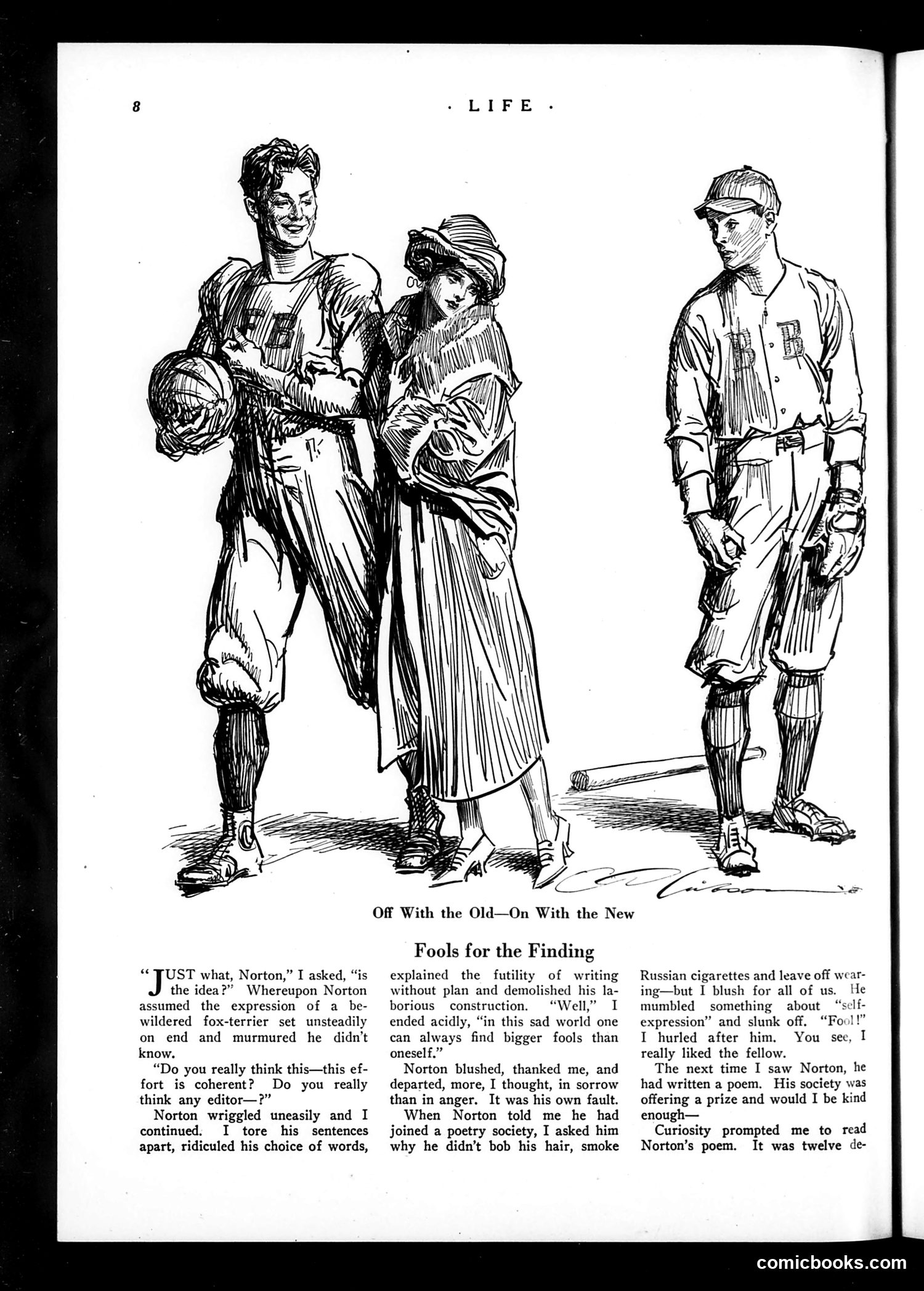
This illustration depicts three baseball players in different eras of uniforms, satirizing the magazine's article "Fools for the Finding" below it. The cartoon contrasts old and new baseball fashion/style. The left figure wears vintage uniform and holds a baseball; the center figure is a woman in contemporary dress (likely representing modern fashion influence); the right figure sports a newer-style uniform. The accompanying text discusses a character named Norton, apparently a would-be poet who joined a poetry society. The narrator critiques Norton's pretentious writing and lack of self-awareness, ultimately ridiculing his amateur poetry submission to a society competition. The "old vs. new" theme connects fashion/style changes to Norton's shift from unaware fool to would-be artist—satirizing both changing trends and amateur artistic pretension in early 20th-century American life.
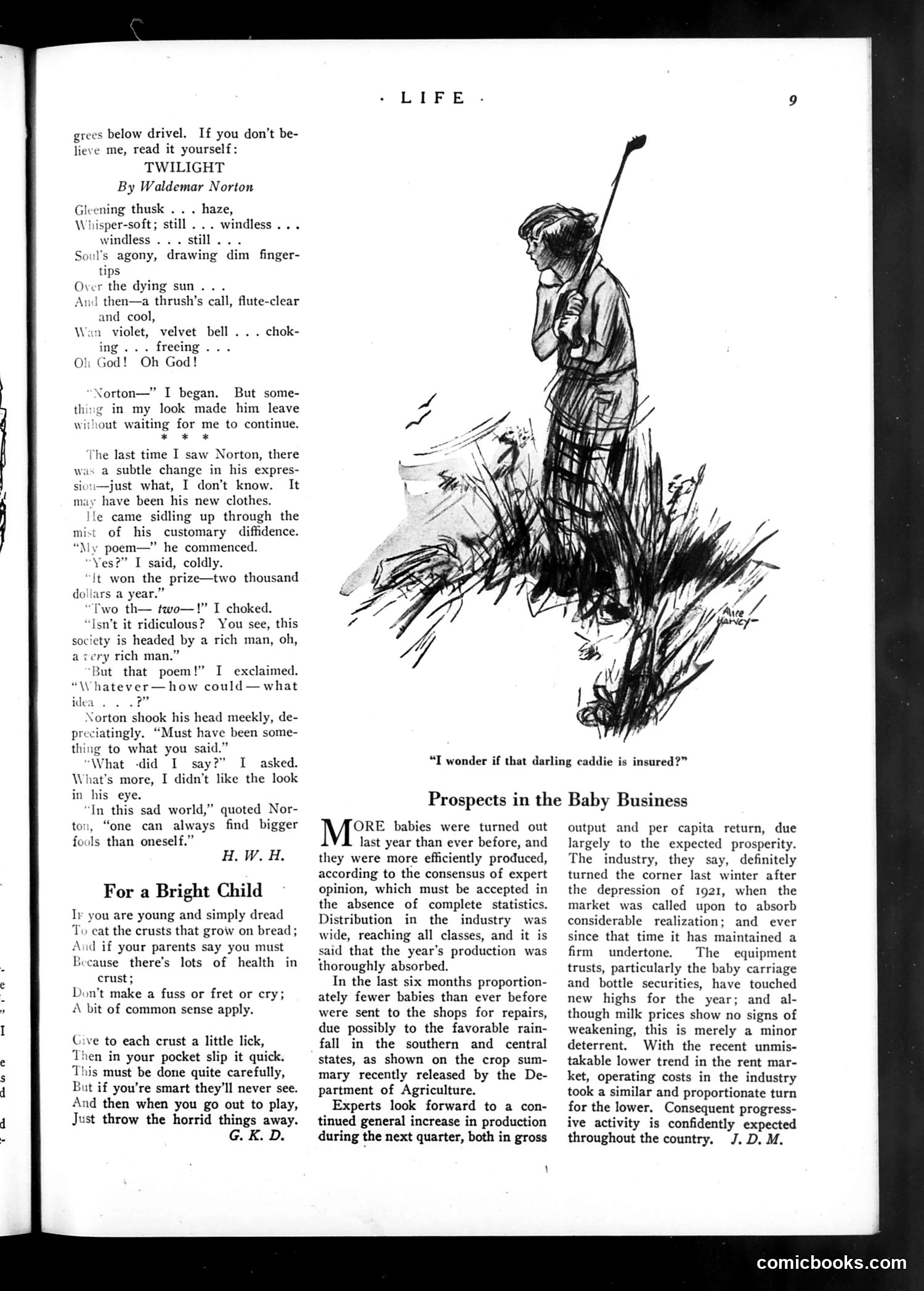
**The Illustration**: A sketch shows a golfer in mid-swing on what appears to be rough terrain. The caption reads "I wonder if that darling caddie is insured?" This is satirical commentary on insurance practices, likely from the early 20th century when liability insurance was becoming a commercial concern. The joke appears to be about a wealthy golfer's worry that his employee (the caddie) is properly insured—either implying the golfer's self-interested concern about potential lawsuits, or the absurdity of obsessing over insurance for a working person. **The Text Articles**: Include a poem "Twilight" by Waldemar Norton and advice pieces "For a Bright Child" and "Prospects in the Baby Business," the latter discussing increased infant production and equipment markets. These represent typical *Life* magazine content mixing poetry, humor, and social commentary.
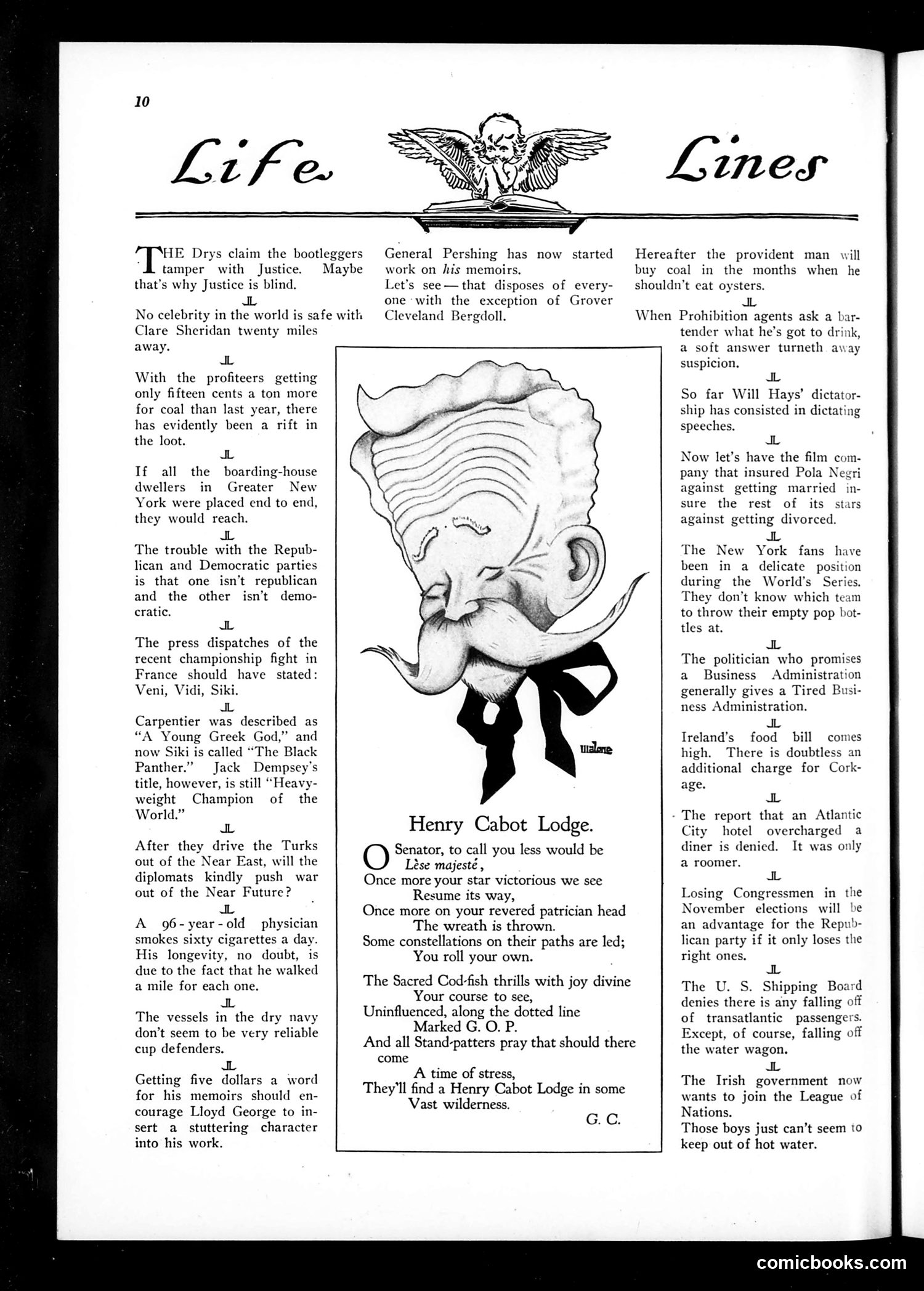
This page contains satirical short commentary and a political caricature titled "Henry Cabot Lodge." The central cartoon depicts a man with an exaggerated profile wearing a ribbon or bow, identified by caption as Henry Cabot Lodge, a prominent U.S. Senator. The accompanying poem by G.C. addresses Lodge as "Senator" and references his political standing, suggesting he's a patrician figure ("your reverend patrician head"). The satire appears to mock his political ambitions and influence, with references to "wreath" and leadership. The surrounding "Life Lines" commentary addresses contemporary 1920s issues: Prohibition enforcement, coal prices, political parties, boxing championships, diplomatic tensions with Turkey, and Irish independence movements. The overall tone is characteristic of Life magazine's irreverent political humor targeting public figures and current events.
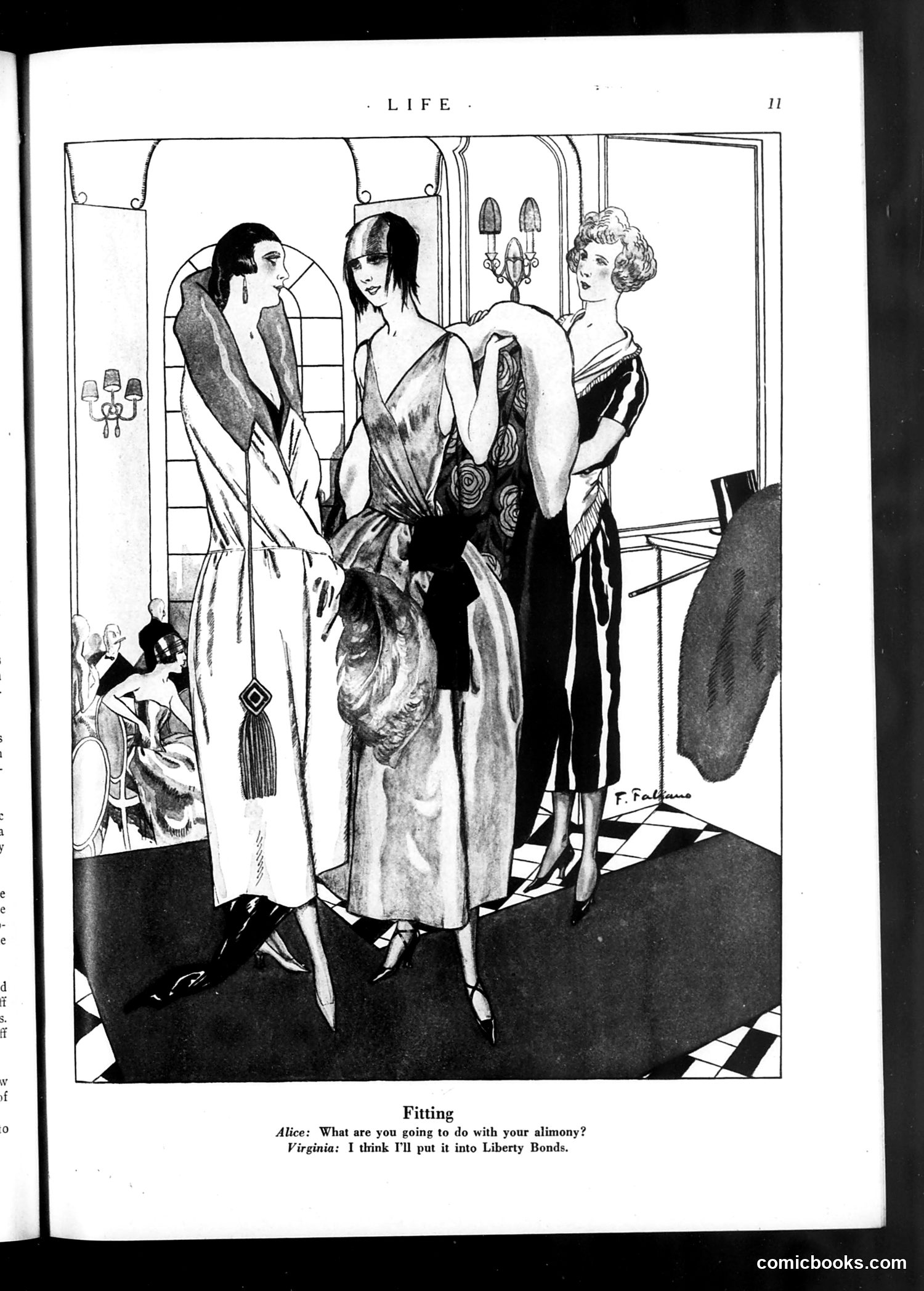
This cartoon depicts three fashionable women in what appears to be a dressing room or boutique, examining clothing. The dialogue reveals the satire's target: Alice asks Virginia about her "alimony," and Virginia responds she'll invest it in "Liberty Bonds." Liberty Bonds were U.S. government securities sold to finance World War I. The joke satirizes wealthy women receiving alimony payments (divorce settlements) and, rather than spending frivolously on themselves, patriotically investing in war bonds—presenting themselves as financially responsible citizens supporting the war effort. The cartoon likely mocks either the pretension of such women's claimed patriotism, or ironically praises their contribution to the war effort, depending on the magazine's editorial stance at the time.
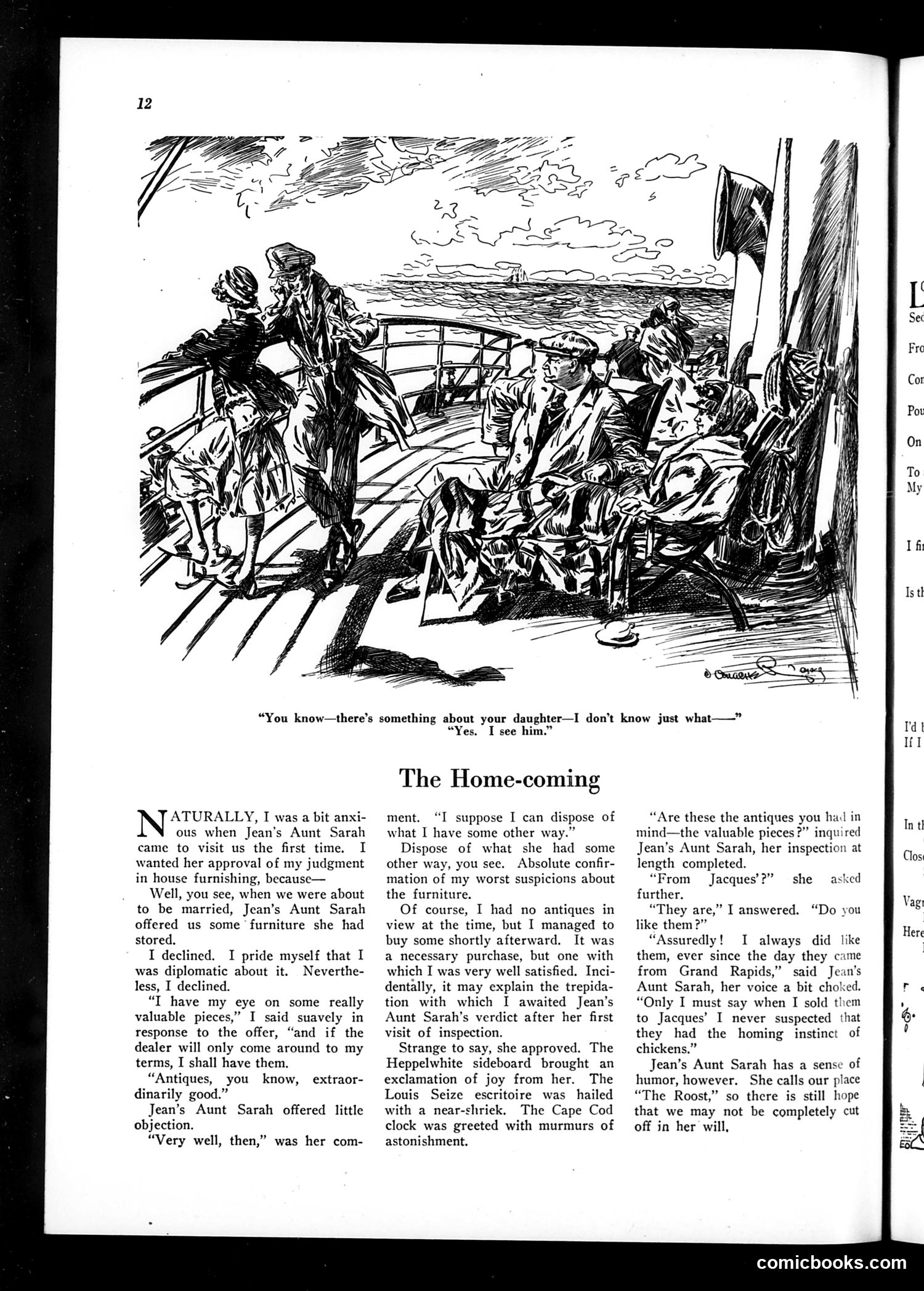
This page contains a short story titled "The Home-coming" rather than a political cartoon. The illustration shows a social scene aboard what appears to be a ship or boat, with multiple figures in early 20th-century dress gathered on deck. The story concerns Jean's anxieties about his Aunt Sarah's judgment of his home furnishings and antique acquisitions. The narrative reveals class-conscious domestic concerns typical of the era: anxiety over possessions as social markers, the importance of family approval, and interior design as a status indicator. The dialogue and story focus on personal relationships and domestic matters rather than political satire. This appears to be humorous fiction about family dynamics and social pretension among the middle or upper-middle classes.
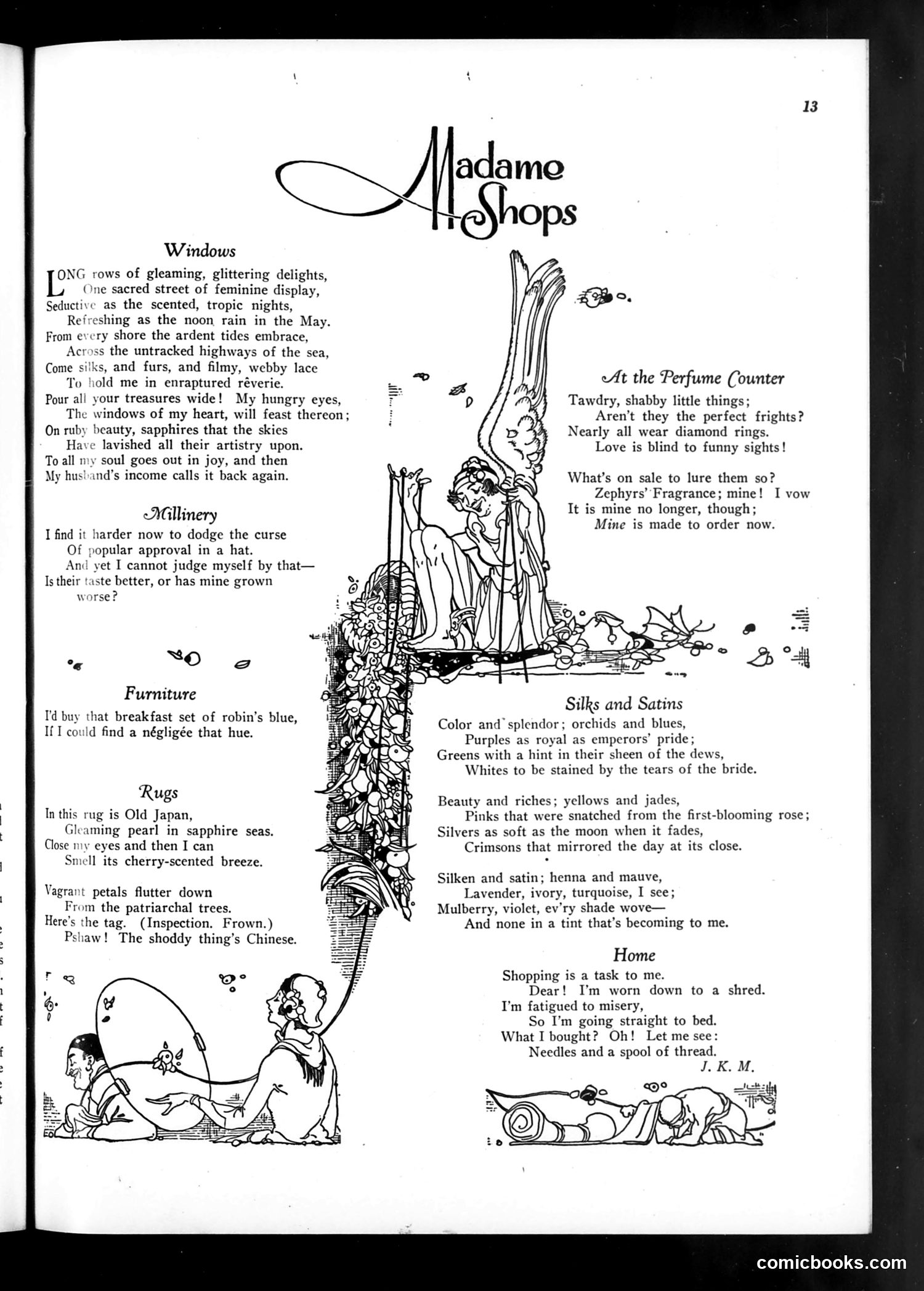
This page satirizes upper-class women's shopping habits through humorous poetry about department store departments. The central illustration depicts an elaborately dressed woman surrounded by luxury goods and servants, emphasizing conspicuous consumption. The sections mock specific shopping obsessions: "Windows" critiques the allure of display; "Millinery" jokes about hat fashion being harder to navigate than deeper aesthetic questions; "Furniture" and "Rugs" humorously describe impractical luxury purchases (robin's-blue breakfast sets, Old Japan rugs); "At the Perfume Counter" and "Silks and Satins" celebrate material excess. The "Home" section concludes with ironic exhaustion—the shopper is "worn down to a shred" despite buying only "needles and a spool of thread." The satire targets women's frivolous materialism and shopping addiction as viewed by early 20th-century satirists.
This page discusses whether the United States should join the League of Nations. The article critiques church organizations' calls for American intervention in European affairs, particularly regarding Turkish massacres in Asia Minor. The author argues that while churches wield significant political influence through their congregations and money, this doesn't necessarily produce good policy. The piece questions whether America should enter the League, suggesting that doing so would require abandoning isolationism—the prevailing post-WWI sentiment against foreign entanglements. Secretary of State Hughes is mentioned as opposing active military intervention in Near Eastern conflicts, despite diplomatic pressure from religious groups. The author suggests that American bankers and church leaders, though well-intentioned, shouldn't determine foreign policy through their financial or organizational power.
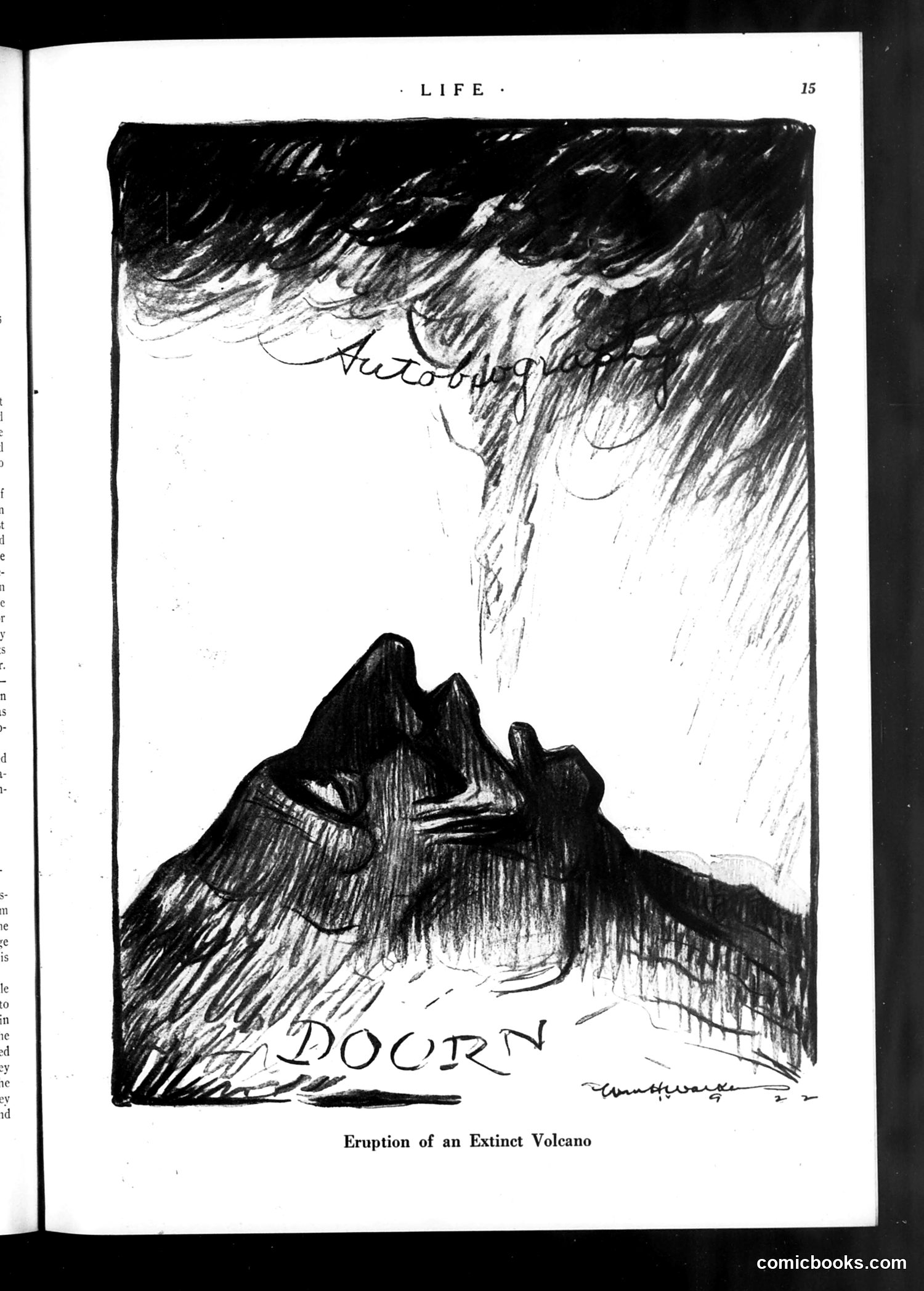
This cartoon depicts a mountain or volcano in violent eruption, with dark smoke and ash billowing upward. The word "DOORN" appears at the base—likely referring to **Doorn, Netherlands**, where German Kaiser Wilhelm II lived in exile after World War I. The satirical title suggests Wilhelm II, once a powerful political force (the "extinct volcano"), has suddenly become active again. This implies a resurgence of German militarism or the Kaiser's political influence during the interwar period. The sketch's dramatic style emphasizes the unexpected, violent nature of this "eruption"—suggesting alarm at renewed German aggression or Wilhelm's continued relevance as a political figure despite his formal exile.
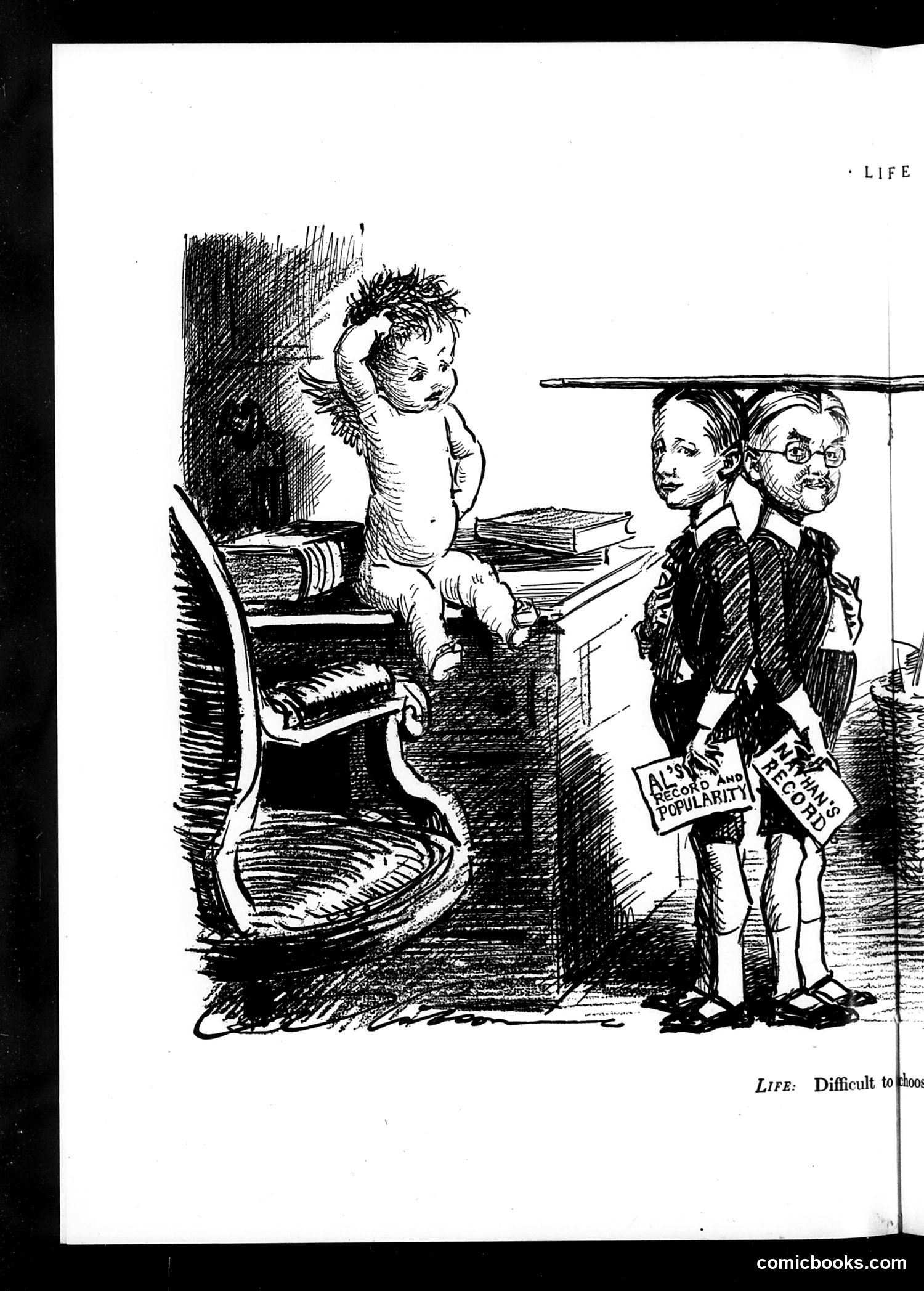
This Life magazine cartoon satirizes parental anxiety about children's education and social standing. A naked cherub sits at a desk surrounded by books, while two adults (appearing to be parents or educators) stand nearby holding signs reading "RECORD POPULARITY" and what appears to be "BRAINS" or similar markers of achievement. The caption begins "Difficult to choos..." (cut off), suggesting the joke concerns difficulty selecting between competing values—popularity versus intellectual development, or similar parental concerns about child-rearing priorities. The cartoon mocks the competitive pressures parents face regarding their children's success, using the absurd image of an infant surrounded by achievement metrics to highlight the ridiculousness of imposing adult ambitions on the very young.
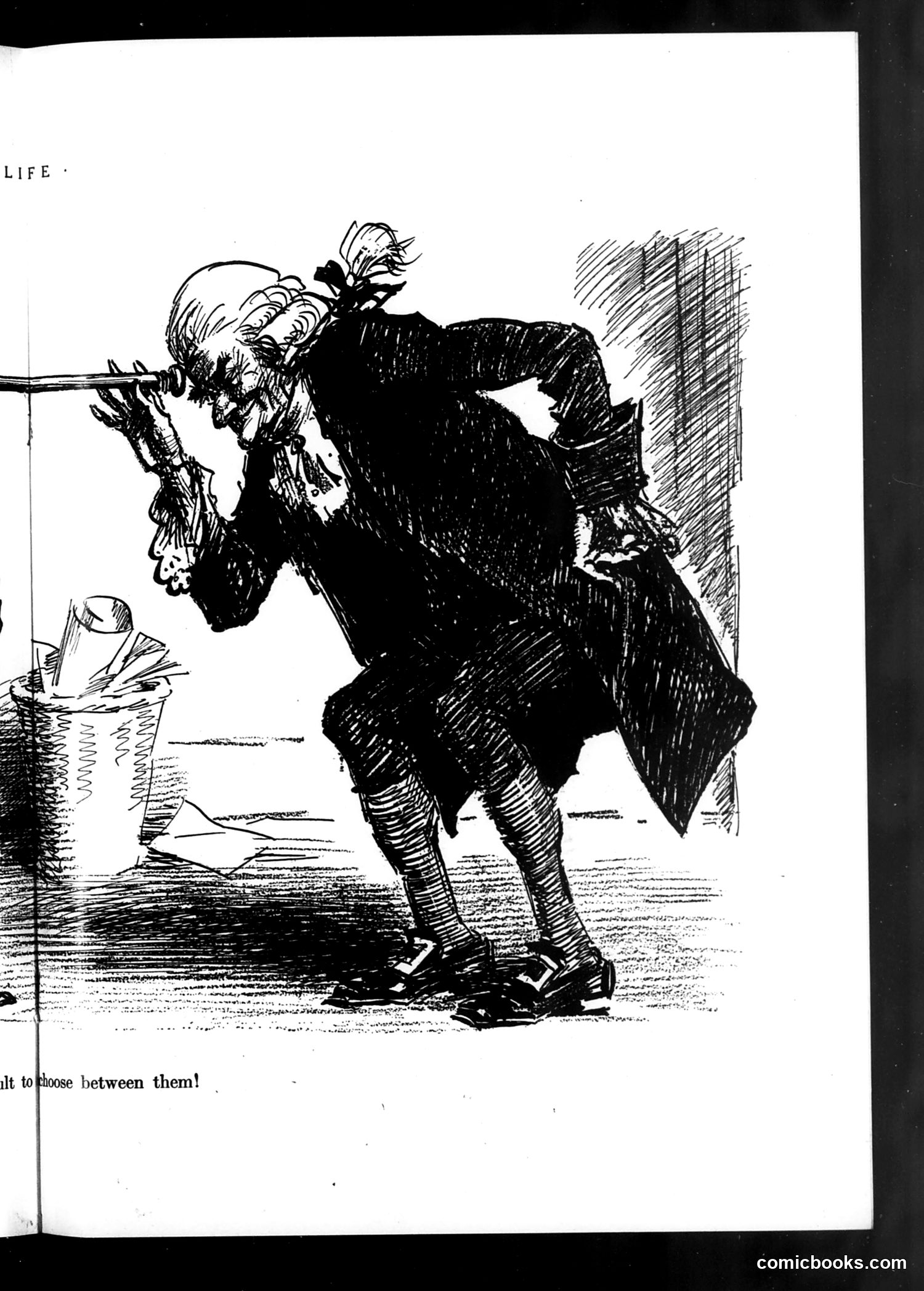
This cartoon depicts a figure in formal attire (coat and striped stockings) in a dramatic pose, appearing distressed or gesticulating wildly. The figure holds what appears to be a feather or quill, suggesting a writer or intellectual. There's a bucket or container visible on the left side. The partial visible text at bottom reads "...it to loose between them!" which suggests a commentary on conflict or discord between parties. The style and execution indicate this is satirical commentary, likely on a political or social figure of the era. However, **without the complete caption or clearer context, I cannot definitively identify the specific subject, date, or precise satirical target**. The artistic technique and magazine format suggest early-to-mid 20th century American political satire, but the specific reference remains unclear from this page alone.
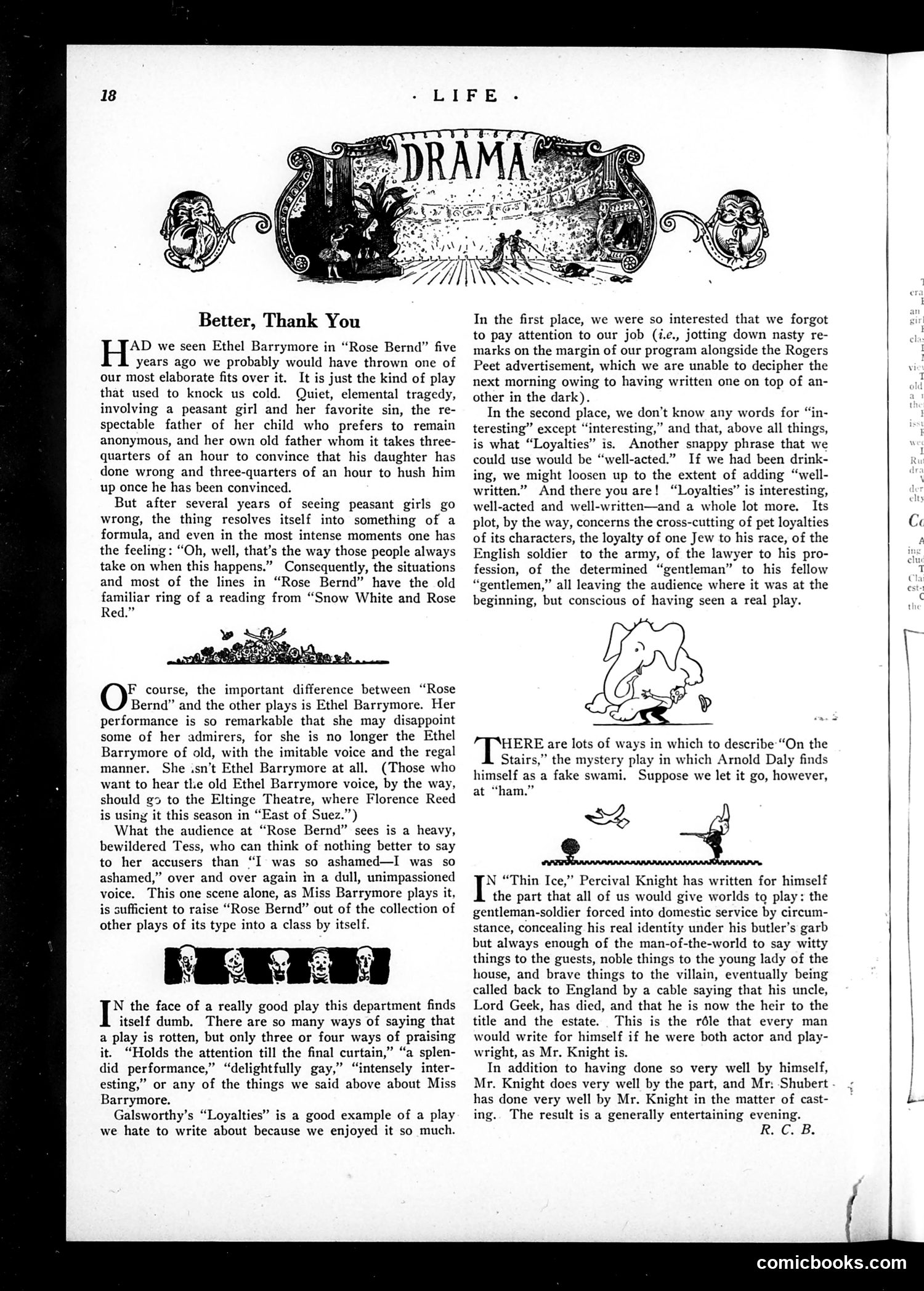
This page contains theater reviews from Life magazine's drama section. The main content critiques three Broadway plays: **"Rose Bernd"** — The reviewer praises actress Ethel Barrymore's performance in this peasant tragedy, noting her remarkable departure from her usual regal manner. She plays a "heavy, bewildered Tess" (referencing Hardy's tragic heroine), delivering a powerful scene of shame that elevates the otherwise formulaic play. **"Loyalties"** — Galsworthy's play about conflicting loyalties (a Jew's loyalty to his race, a soldier's to the army, etc.) is praised as genuinely interesting and well-acted, though the reviewer humorously admits struggling to find fresh superlatives. **"On the Stairs"** and **"Thin Ice"** receive brief mentions, the former dismissed as "ham" (overwrought acting). The satirical tone typical of Life appears in the reviewer's self-aware commentary about the difficulty of praising good plays versus panning bad ones—a running joke about critical vocabulary limitations.
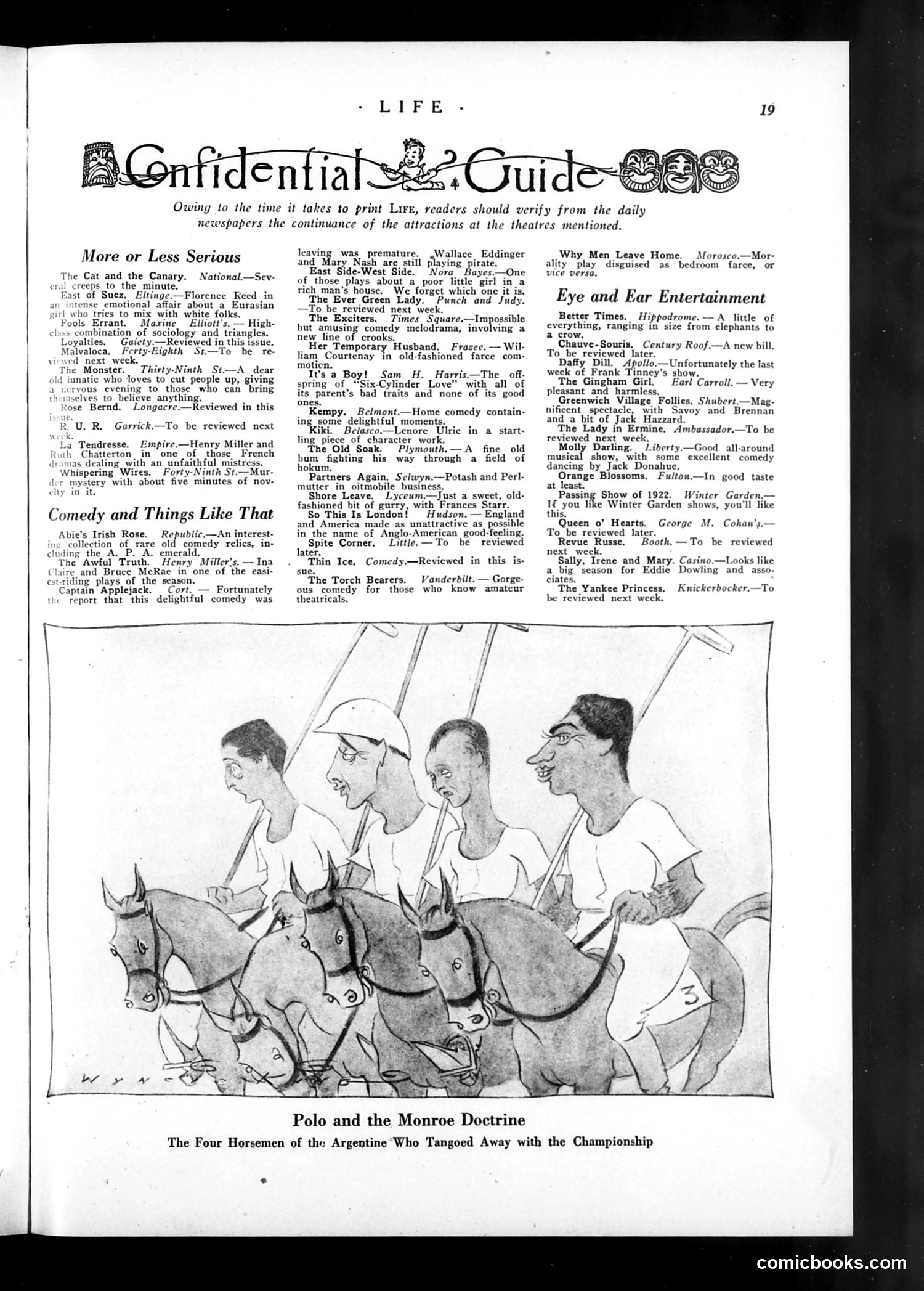
This cartoon satirizes Argentina's polo team's victory in an international championship. The caption's reference to the "Monroe Doctrine" (America's 19th-century policy asserting Western Hemisphere dominance) is the joke: Argentina has figuratively violated American sporting supremacy by winning the polo championship, traditionally dominated by Anglo-American competitors. The four caricatured Argentine polo players are depicted as exaggerated ethnic types riding horses, their grotesque faces emphasizing xenophobic humor common to 1920s American satire. The cartoon mocks American pride wounded by foreign athletic success, treating a sporting loss as a geopolitical embarrassment to American dominance in the region. This reflects both the popularity of polo among wealthy elites and anxieties about American cultural/athletic superiority being challenged by rivals.
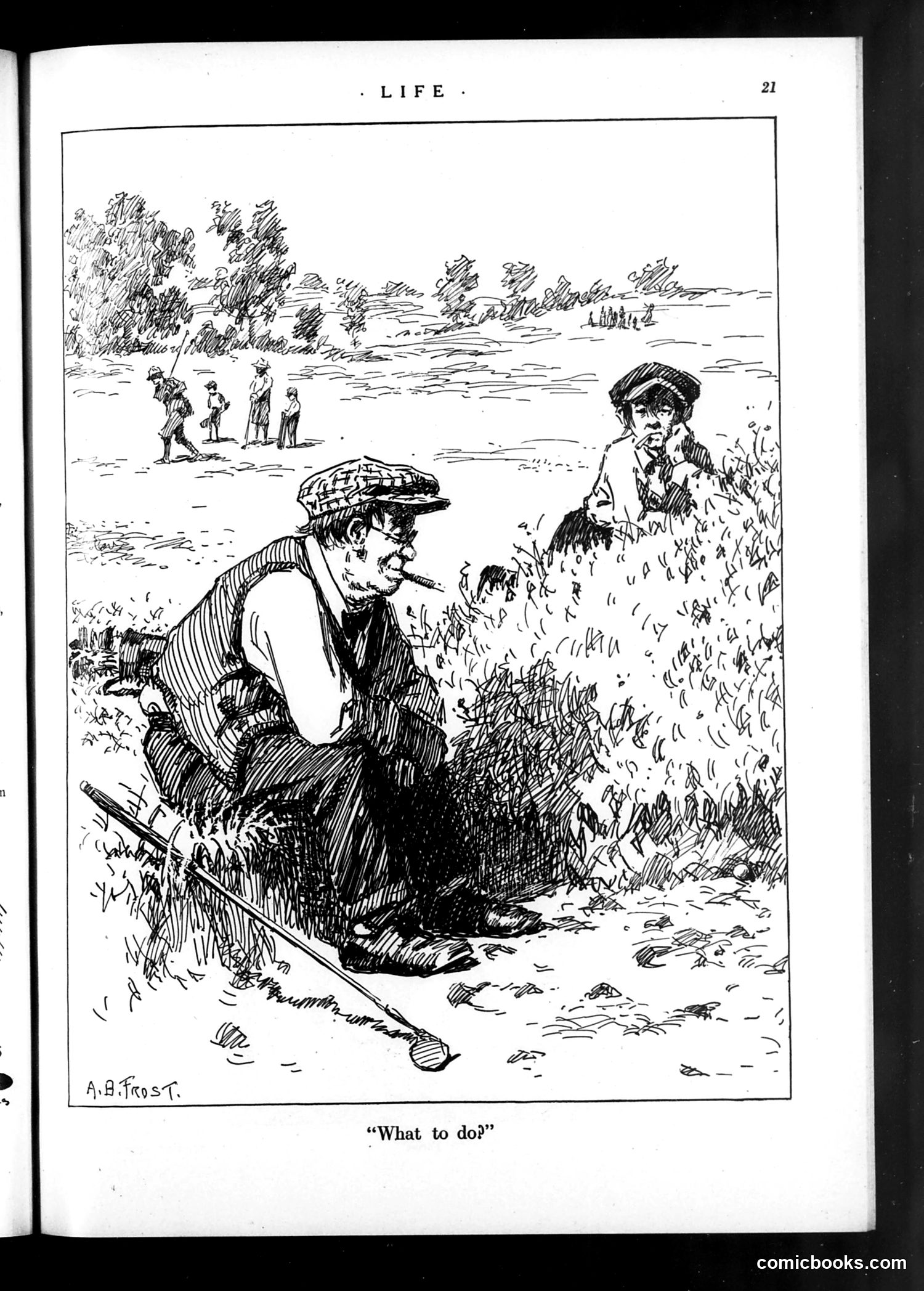
This cartoon depicts a working-class man in shabby clothing, crouched among weeds or brush, appearing dejected or bewildered. He holds what appears to be a tool or implement. In the background, other figures stand in a field or open area. The title "What to do?" suggests economic hardship or unemployment—a common theme in *Life* magazine's social commentary. The man's posture and setting indicate poverty or desperation. The cartoon likely satirizes the plight of laborers during economic downturns or social hardship, questioning what options remain for struggling working people. The contrast between the isolated, troubled figure in the foreground and the distant observers suggests social indifference or the isolation of the economically disadvantaged.
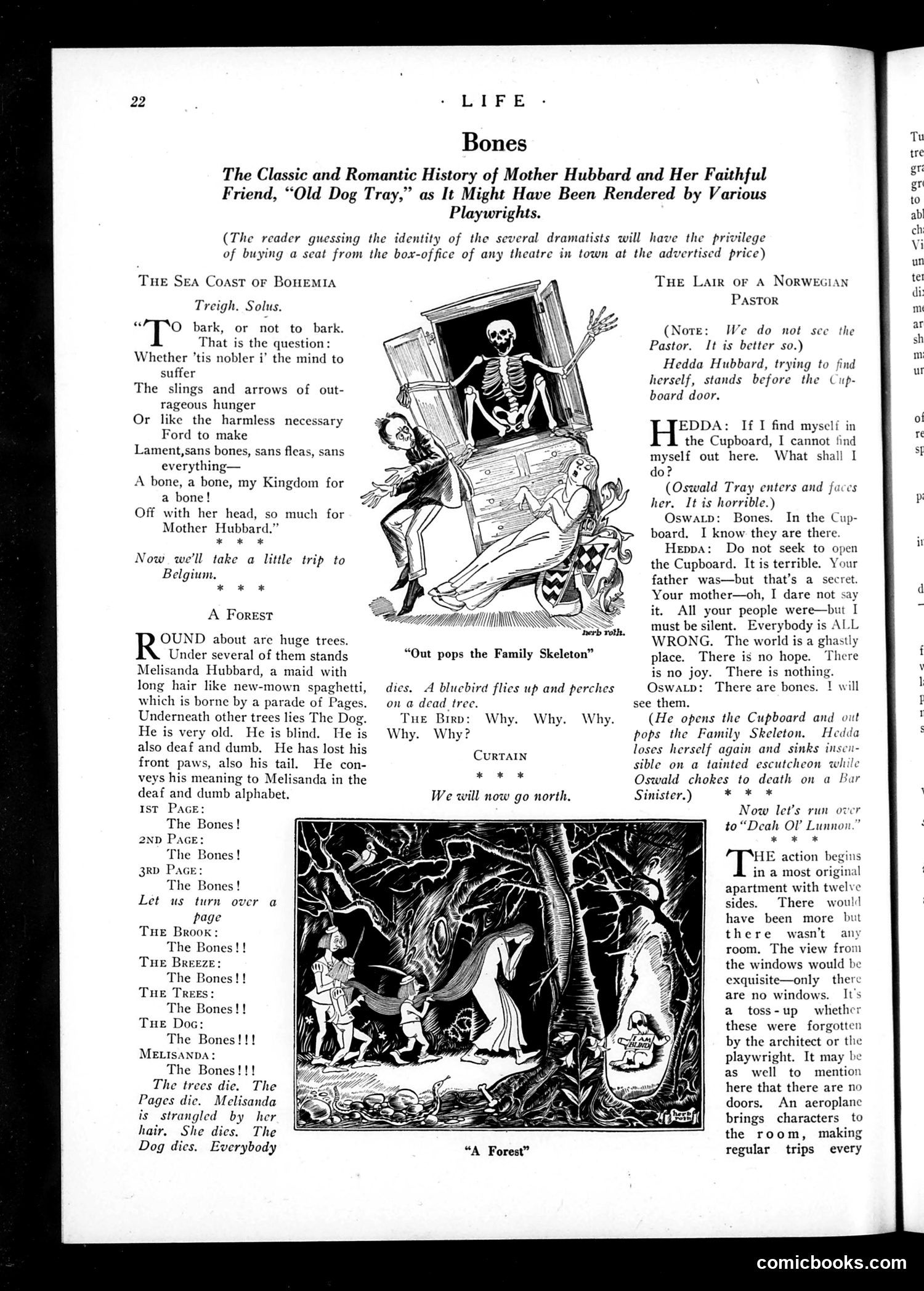
This page satirizes famous playwrights by reimagining the nursery rhyme "Old Mother Hubbard" in their styles. The captions identify specific dramatic traditions: **"The Sea Coast of Bohemia"** parodies Shakespeare—the "to bark or not to bark" echoes *Hamlet*'s soliloquy, with references to *Richard III* ("Off with her head"). **"A Forest"** mimics Romantic/Melodramatic theater, with stock characters (a maid, an old blind dog, Pages in a parade) and overwrought deaths where "everybody" dies. **"The Lair of a Norwegian Pastor"** references Ibsen's psychological drama—characters named Hedda and Oswald, existential despair ("There is no hope"), family secrets, and dark symbolism (the cupboard, the skeleton). The joke targets pretentious theatrical conventions: Life mocks how different playwrights would transform a simple children's story into their signature styles—from Shakespearean tragedy to Romantic melodrama to Modernist angst. Readers were invited to guess which real playwrights were being parodied.
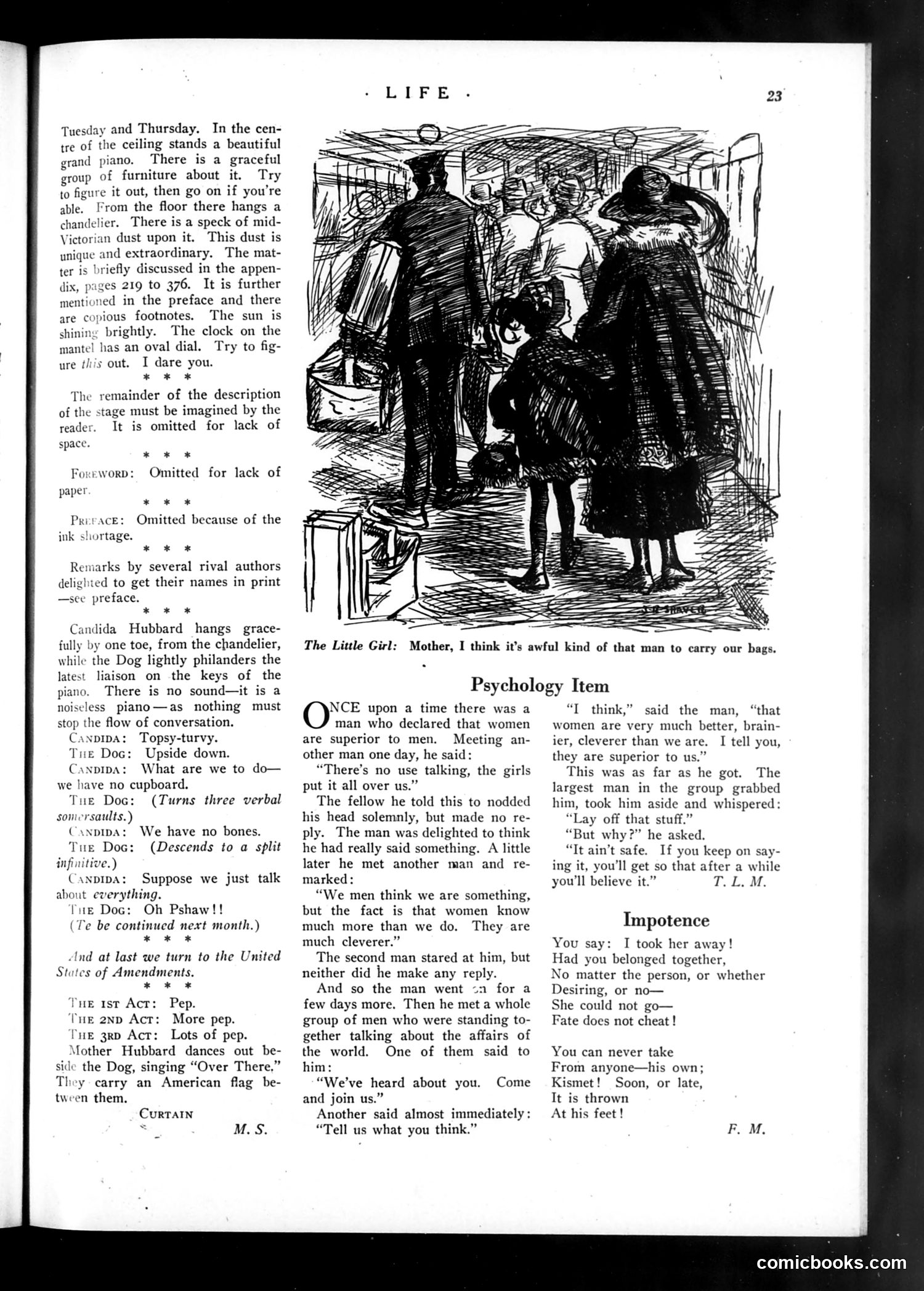
This page from Life magazine contains theatrical satire and humor pieces typical of early 20th-century American comedy. **Main Illustration**: Shows a mother and child watching a man carry their baggage, with the child praising his kindness—likely satirizing false politeness or performative chivalry. **Theater Piece** (top): A comedic play sketch mocking overly elaborate stage directions. It playfully notes omitted descriptions due to "lack of space," "lack of paper," and "ink shortage"—probably satirizing paper rationing during WWI or post-war scarcity. The absurdist humor includes a "noiseless piano" and characters speaking in puns. **"Psychology Item"**: Satire on male ego. A man repeatedly tells other men that women are superior, seeking validation. When he finally shares this with a group of men, the largest one warns him to stop—because he'll eventually believe his own flattery. The joke mocks how men unconsciously reinforce masculine superiority myths through peer pressure. **"Impotence"**: A brief poem about fate and lost love, unrelated to other content. The page demonstrates Life's satirical approach to social commentary, gender dynamics, and wartime conditions.
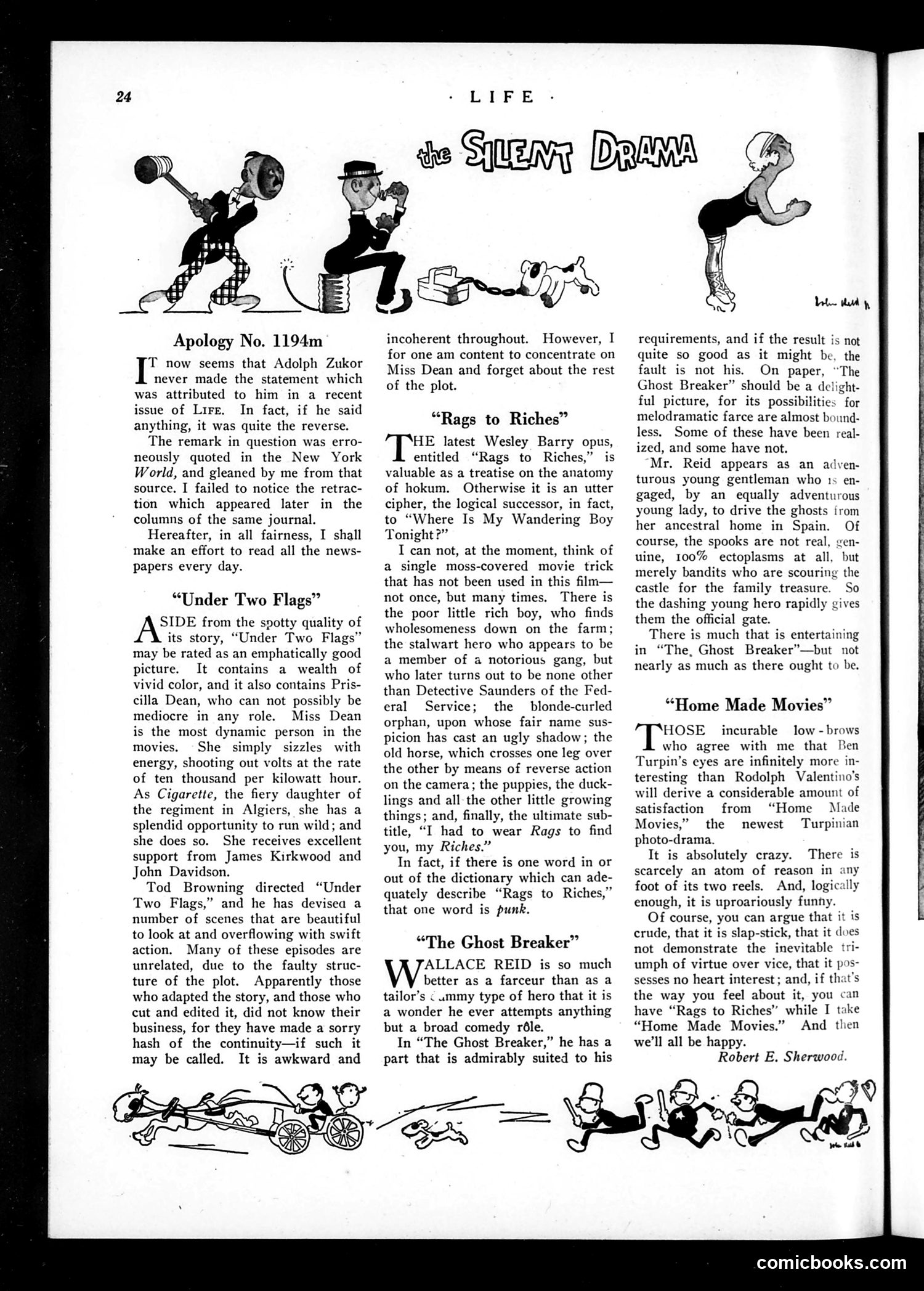
This page reviews four silent films from the early 1920s. The header cartoon titled "The Silent Drama" satirizes the physical comedy of silent cinema—showing exaggerated body contortions typical of the era's slapstick humor. The reviews critique specific films: - **"Under Two Flags"**: Praises actress Priscilla Dean's energy while condemning the plot's incoherent structure, suggesting editors bungled the adaptation. - **"Rags to Riches"**: Harshly dismisses Wesley Barry's film as exhaustingly reliant on every tired hokum device—the poor rich boy, the reformed gang member, the orphan, etc.—calling it simply "punk" (slang for bad). - **"The Ghost Breaker"**: Notes Wallace Reid excels in farce comedy but the script fails to realize its potential for melodramatic comedy. The opening section is an apology correcting a misquote attributed to film producer Adolph Zukor, illustrating early-cinema journalism's carelessness.
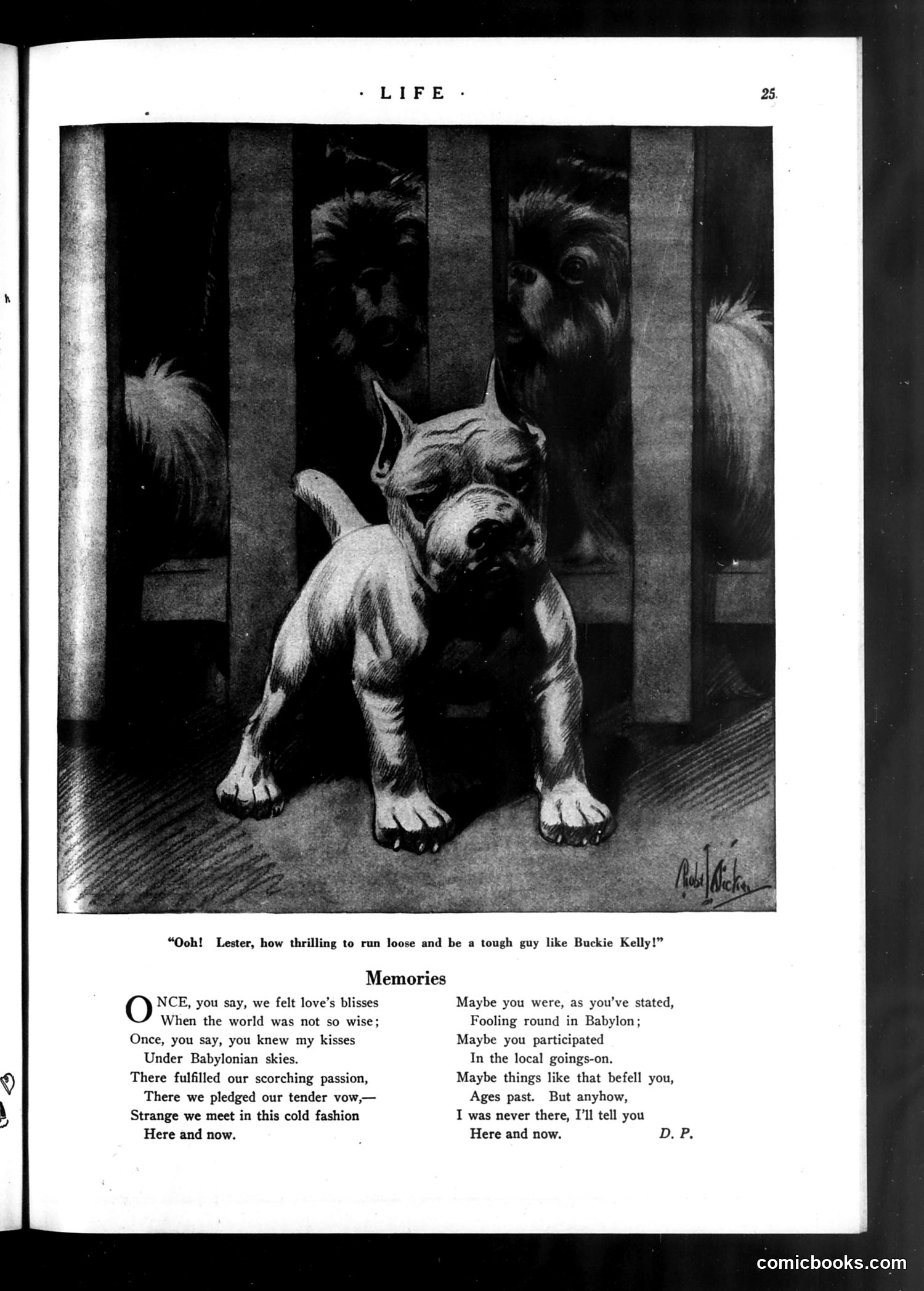
This page from *Life* magazine contains two separate pieces: **Top image**: A cartoon about dogs. A small puppy addresses older, tougher-looking dogs behind bars, expressing admiration for "Buckie Kelly"—apparently a dog known for being tough and running loose. The joke satirizes naive hero-worship of criminals or rowdy characters. **Bottom**: A poem titled "Memories" by D.P., presenting a romantic dispute. One speaker recalls passionate love "Under Babylonian skies," while the other responds skeptically, suggesting the first person may have merely been "fooling round" in Babylon. The poem's wit lies in the deflating response: the speaker claims they were never even present to witness these supposed romantic moments, reducing grand nostalgia to doubtful fiction. Both pieces use humor to mock pretense—whether a puppy's admiration for tough guys or exaggerated romantic reminiscence.
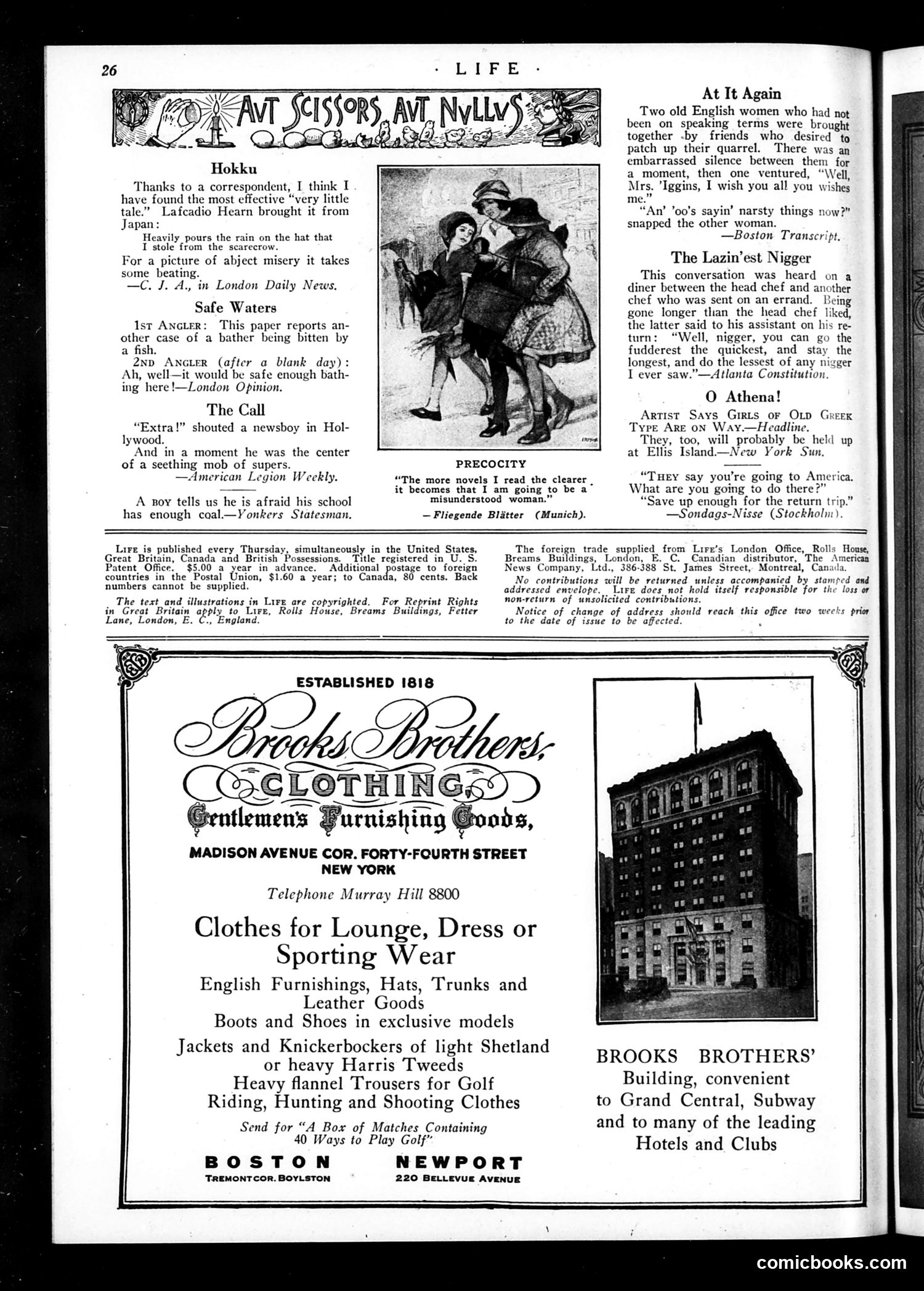
This page features short humorous anecdotes rather than political cartoons. The content reflects early 20th-century satirical humor: **"Hokku"** and similar pieces are brief, witty observations sourced from newspapers worldwide—a common Life feature showcasing human folly and irony. **Notable for modern readers:** One piece, "The Lazin'est Nigger," uses a racial slur in its title. The joke presents a derogatory stereotype about work ethic, reflecting deeply offensive period attitudes toward Black Americans. This language and sentiment would be entirely unacceptable today and represents the casual racism embedded in mainstream publications of this era. **Other items** include gentle humor about fishing, Hollywood extras, and misunderstandings between elderly English women—relatively innocuous social observation humor. The page is primarily advertising, featuring a Brooks Brothers clothing advertisement. The juxtaposition of racist content alongside genteel fashion marketing illustrates how normalized such attitudes were in ostensibly "sophisticated" publications of the time.
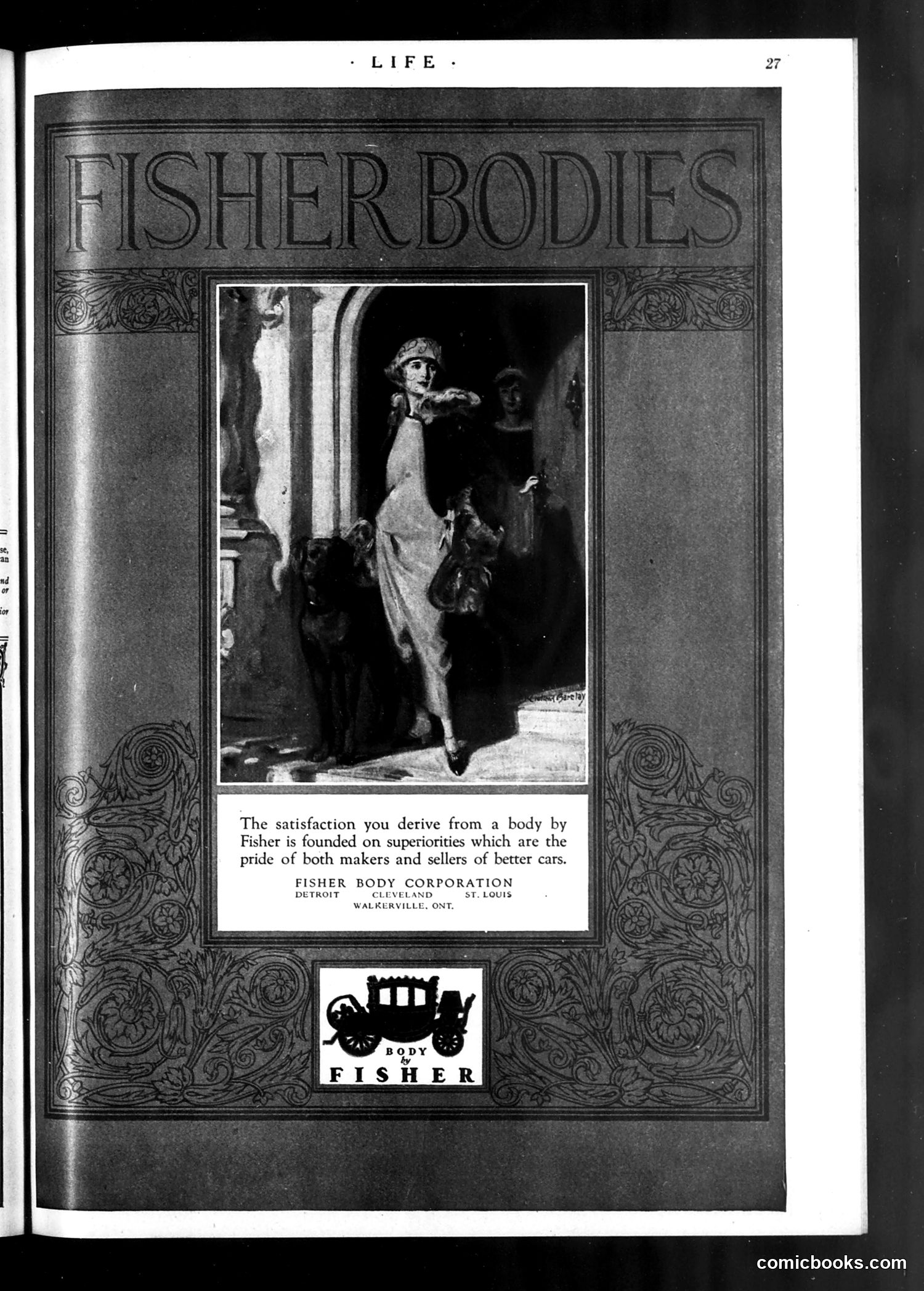
This is a Fisher Body Corporation advertisement rather than political satire. The page features an illustration of a woman in an elegant white gown posing inside what appears to be a luxury automobile interior, with attendants visible in the background. The ad emphasizes that Fisher Body's quality derives from manufacturing superiorities that appeal to makers and sellers of high-end cars. Fisher Body Corporation, headquartered in Detroit with facilities in Cleveland, St. Louis, and Walkerville, Ontario, was a major American automobile body manufacturer. The advertisement uses aspirational imagery—the elegantly dressed woman and ornate architectural framing—to associate Fisher bodies with luxury and prestige, targeting affluent consumers of better automobiles during what appears to be the 1920s era.
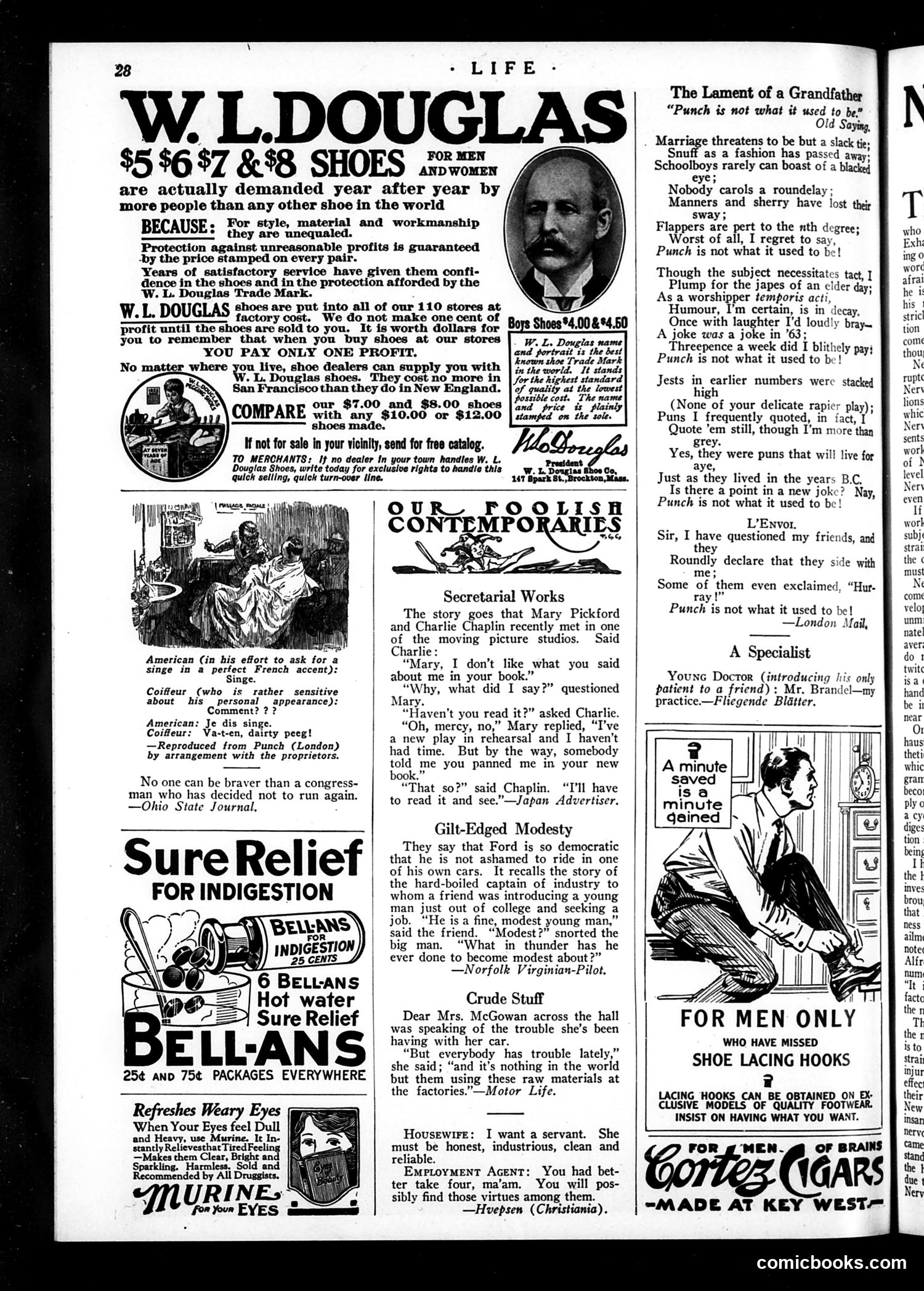
This page is primarily **advertisements** interspersed with brief humorous items typical of Life magazine's satirical format. The main content includes: **"The Lament of a Grandfather"** — A nostalgic poem lamenting modern social changes: marriage is less binding, snuff is outdated, schoolboys no longer get black eyes, traditional manners have declined, and flappers are disrespectfully bold. This reflects 1920s generational anxiety about youth culture and changing social norms. **"Secretarial Works"** — A joke about Mary Pickford and Charlie Chaplin (major silent film stars) who haven't read each other's books but worry the other criticized them. **Other brief humorous items** satirize Ford's democratic pretensions, modest job applicants, and servant-hiring difficulties. The page reflects Life's typical mix of consumer advertising (W.L. Douglas shoes, Bellans indigestion remedy) with light social commentary mocking contemporary trends, generational gaps, and celebrity culture of the early 1920s.
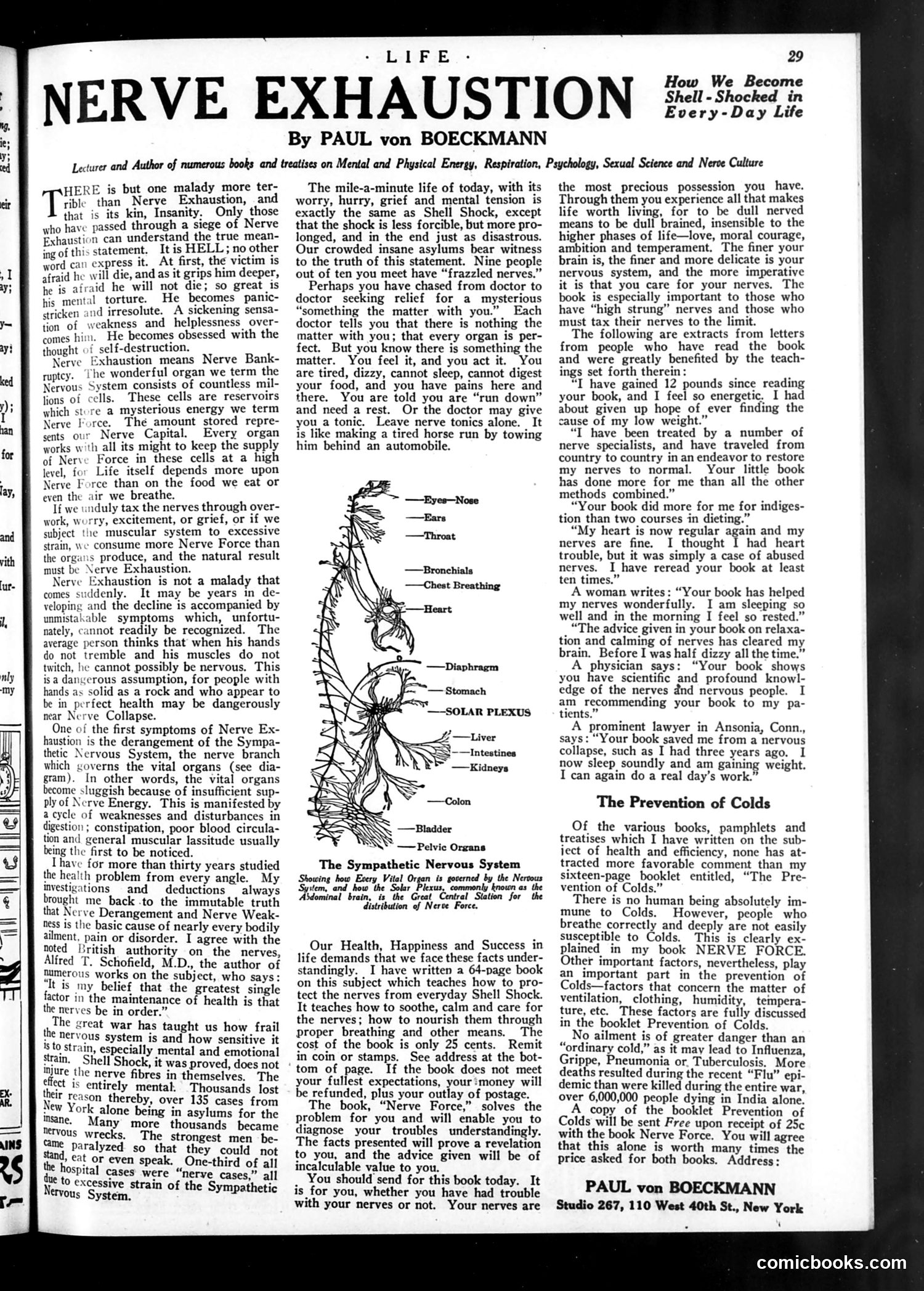
This page is primarily **advertising/promotional content**, not political satire. Paul von Boeckmann, a self-described lecturer on "Mental and Physical Energy," presents "Nerve Exhaustion" as a serious modern ailment caused by contemporary life's pace and stress. The piece references **World War I's "Shell Shock"** as evidence that nerves are fragile, drawing a parallel between combat trauma and everyday civilian stress. The diagram shows the sympathetic nervous system governing vital organs—Boeckmann's central claim is that modern worry, hurry, and mental tension deplete "Nerve Force" (a pseudo-scientific concept), causing physical and psychological collapse. The testimonials from readers claiming recovery suggest this was marketing material for Boeckmann's books on nerve restoration. While the language invokes scientific authority, the content represents early-20th-century pseudoscience about neurasthenia, a now-discredited diagnosis popular among the middle class. The piece reflects genuine anxiety about industrialization's psychological costs, but packages dubious remedies as scientific fact.
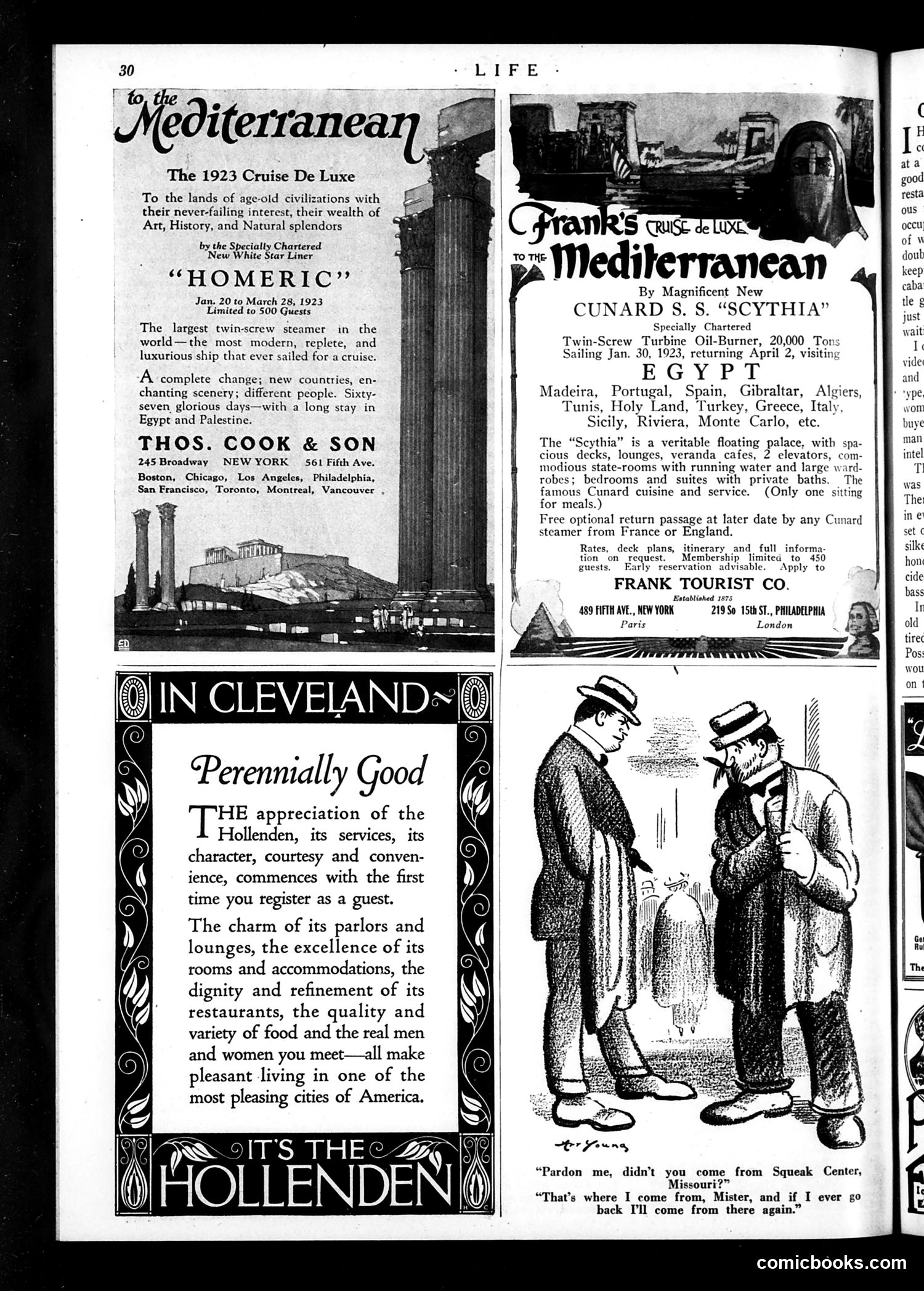
This page is primarily **travel and hotel advertising** with one small cartoon joke at bottom right. The ads promote luxury Mediterranean cruises (1923) aboard the White Star Line's "Homeric" and Cunard's "Scythia"—appealing to wealthy Americans seeking "age-old civilizations" in Egypt, Palestine, and Europe. These represent post-WWI leisure travel for the affluent. The **Hollenden Hotel** ad (Cleveland) emphasizes refined hospitality and social prestige. The cartoon depicts two men in conversation. One asks if the other came from "Squeak Center, Missouri"—an invented, dismissively-named small town. The reply's humor lies in its defiant pride: despite coming from an obscure, apparently undesirable place, the man would deliberately return there. **The satire**: It mocks both the snobbish assumption that small-town origins are shameful *and* the working-class loyalty to one's humble roots, even when cosmopolitan alternatives exist. The joke reflects 1920s tensions between urban sophistication and rural American identity.
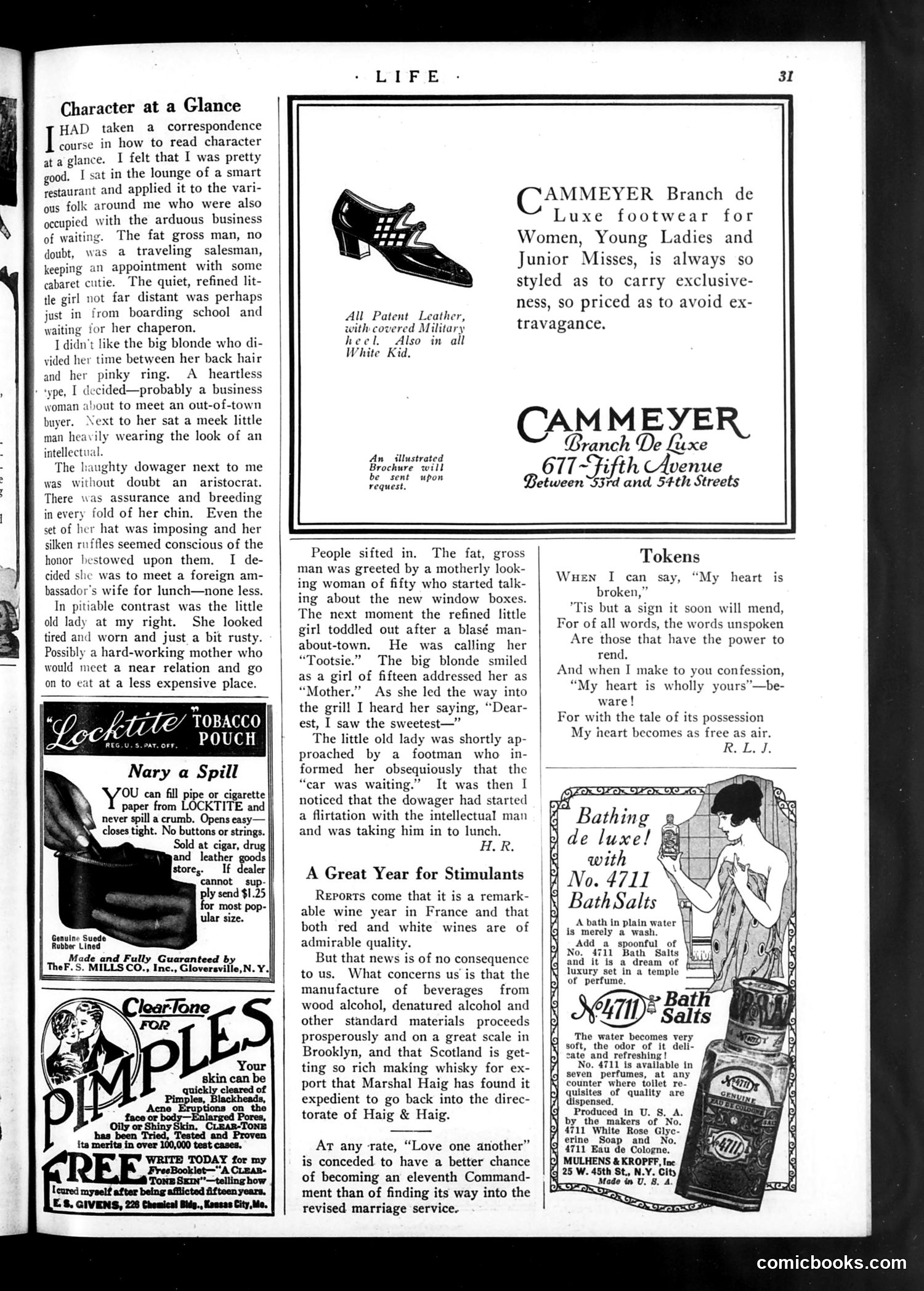
This page is primarily **advertising and social commentary**, not political satire. The main content is a short story titled "Character at a Glance" about making snap judgments of restaurant patrons based on appearance—a popular parlor game of the era. The humor lies in the **ironic reveal**: the narrator's character readings are completely wrong. The "fat gross man" isn't a salesman with a mistress but a respectable family man. The "heartless businesswoman" is actually a mother. The "aristocratic dowager" flirts shamelessly. The joke critiques superficial character-reading and class assumptions. The page includes period advertisements (Cammeyer shoes, Locktite tobacco pouch, Clearbone soap) and a poem called "Tokens." There's also an article about alcohol manufacture in Brooklyn and French wine—likely referencing Prohibition-era bootlegging, though the text remains oblique about this sensitive topic. No specific political figures or cartoons appear on this page.
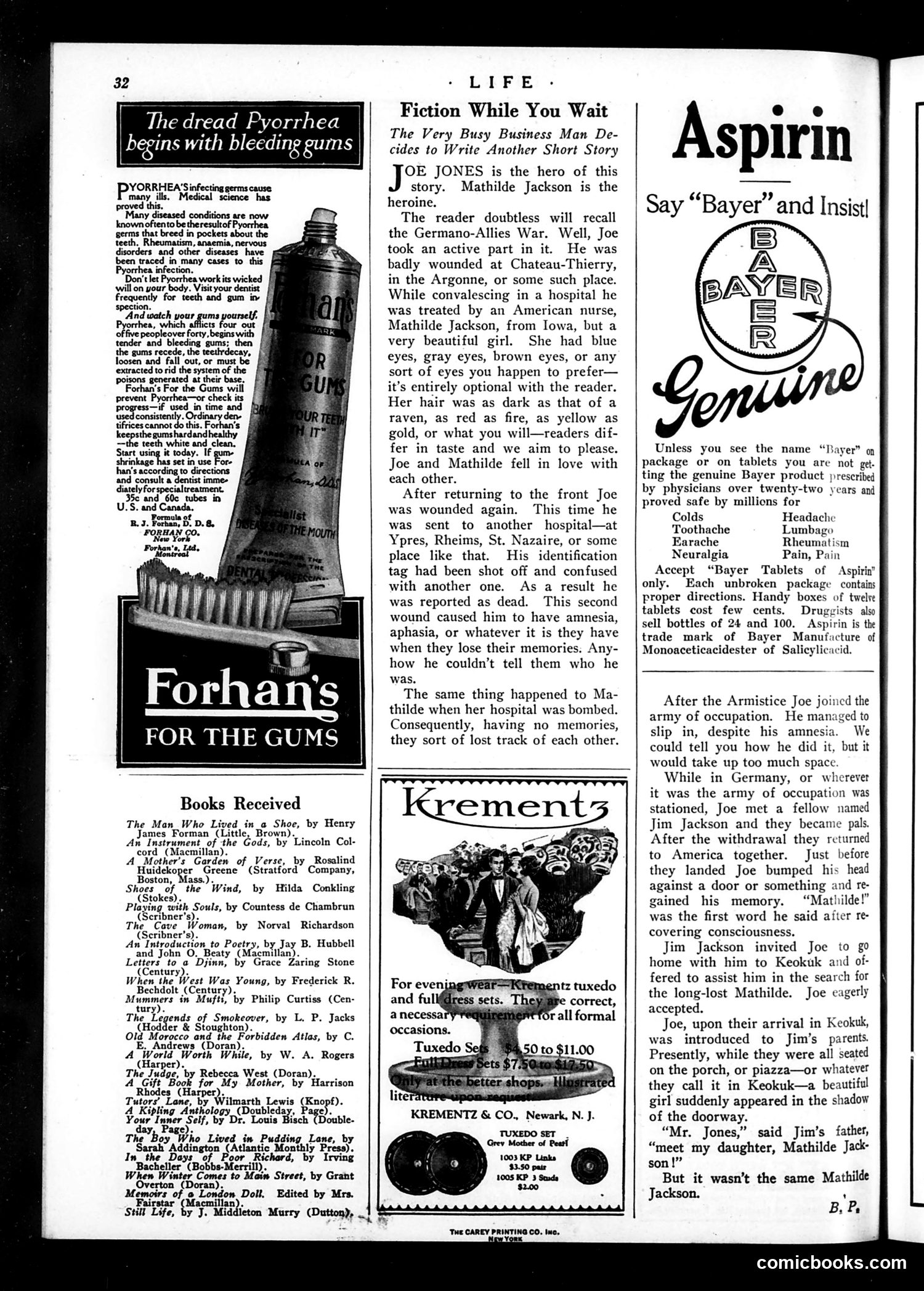
This page combines advertisements with satirical fiction. The main satire is a short story titled "Fiction While You Wait," which mocks the formulaic nature of popular romance fiction. The narrator deliberately presents a WWI love story with intentional vagueness—the heroine's eye color is "entirely optional," her hair can be "dark as a raven" or "yellow as gold," and the plot relies on convenient contrivances (amnesia, hospital bombings, lost identification tags) that allow the lovers to lose track of each other. The joke targets readers who consume predictable romance narratives without demanding specificity or originality. By offering interchangeable details, the author exposes how such stories are assembled from stock elements rather than genuine storytelling. The surrounding advertisements—for Forhan's toothpaste, Bayer Aspirin, and Krementz jewelry—represent the commercial apparatus supporting such mass-market entertainment in this era.
This is not a cartoon but rather a **full-page advertisement for Life magazine itself**, promoting the value of reading advertisements. Using Galileo's telescope as a metaphor, the piece argues that readers must use Life "properly"—meaning they should read the advertisements alongside editorial content, not just skip past them. The analogy warns that ignoring ads means looking through the "wrong end" of the telescope: you'll miss valuable information about products, services, and purchasing opportunities. The central claim is that advertising serves readers' interests by bringing "close to your hand the things you want" and providing practical consumer information. By omitting ads, readers "narrow your vision" on matters "that concern you most vitally." **For modern readers:** This reveals early 20th-century magazine economics where advertisements were presented not as intrusions but as legitimate, reader-beneficial content. The piece explicitly asks readers to treat ads as informational rather than promotional—a stark contrast to contemporary advertising skepticism.
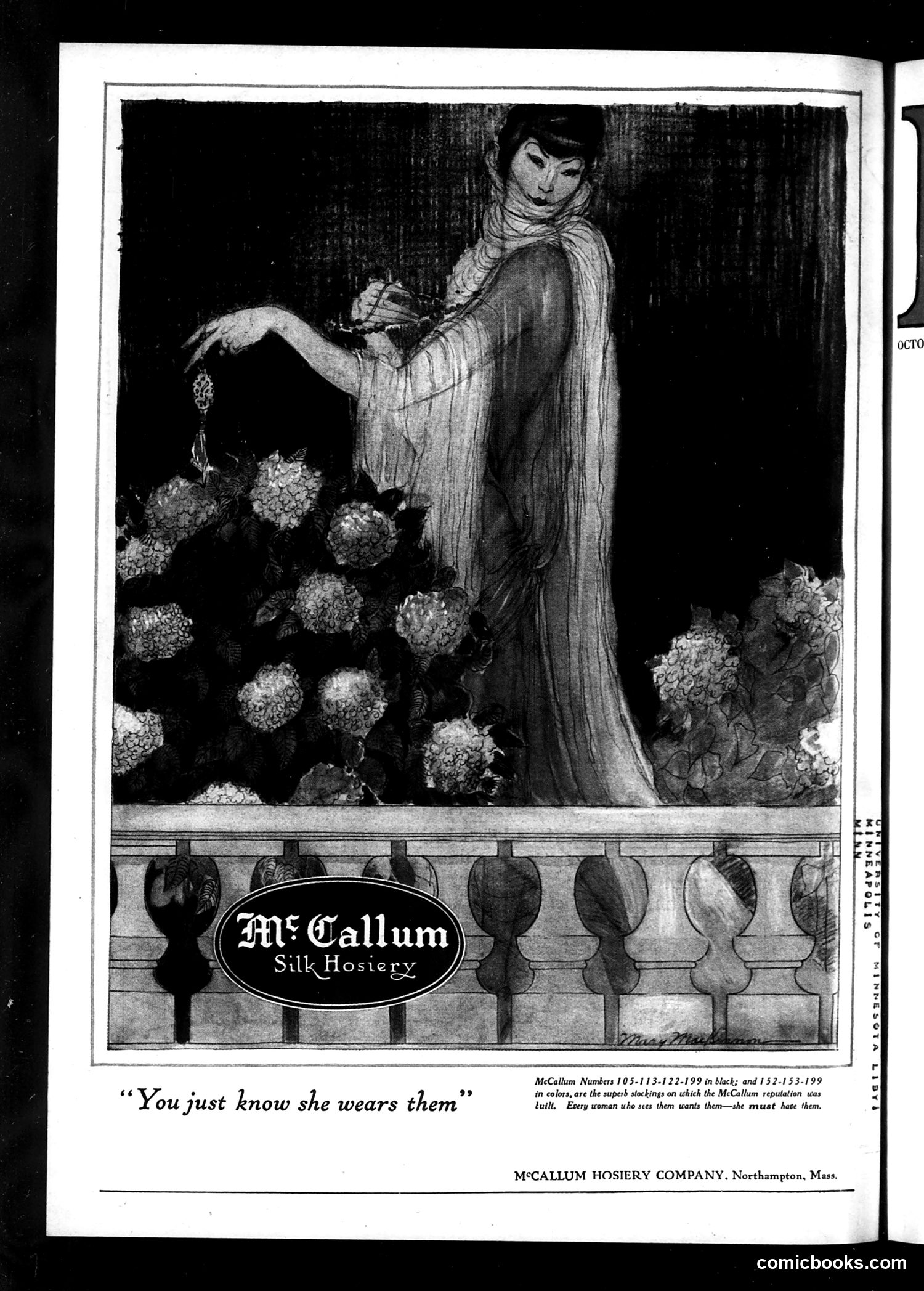
This is a **silk hosiery advertisement** for McCallum brand stockings, not political satire. The image shows a stylized woman in flowing robes tending flowering plants on a balcony, wearing an elegant wrap. The ad's tagline is "You just know she wears them"—meaning quality stockings are instantly recognizable markers of refinement. The appeal is purely **aspirational marketing**: the elegant, leisured woman embodies the sophistication and desirability associated with wearing McCallum hosiery. The manufacturer (based in Northampton, Massachusetts) is selling the idea that quality silk stockings signal status and taste. This reflects early 20th-century advertising that conflated consumer goods with social standing and feminine refinement. There is no political content or satire on this page.