
Life, 1922-10-19 · page 20 of 36
Life — October 19, 1922 — page 20: what you’re looking at
What you’re looking at
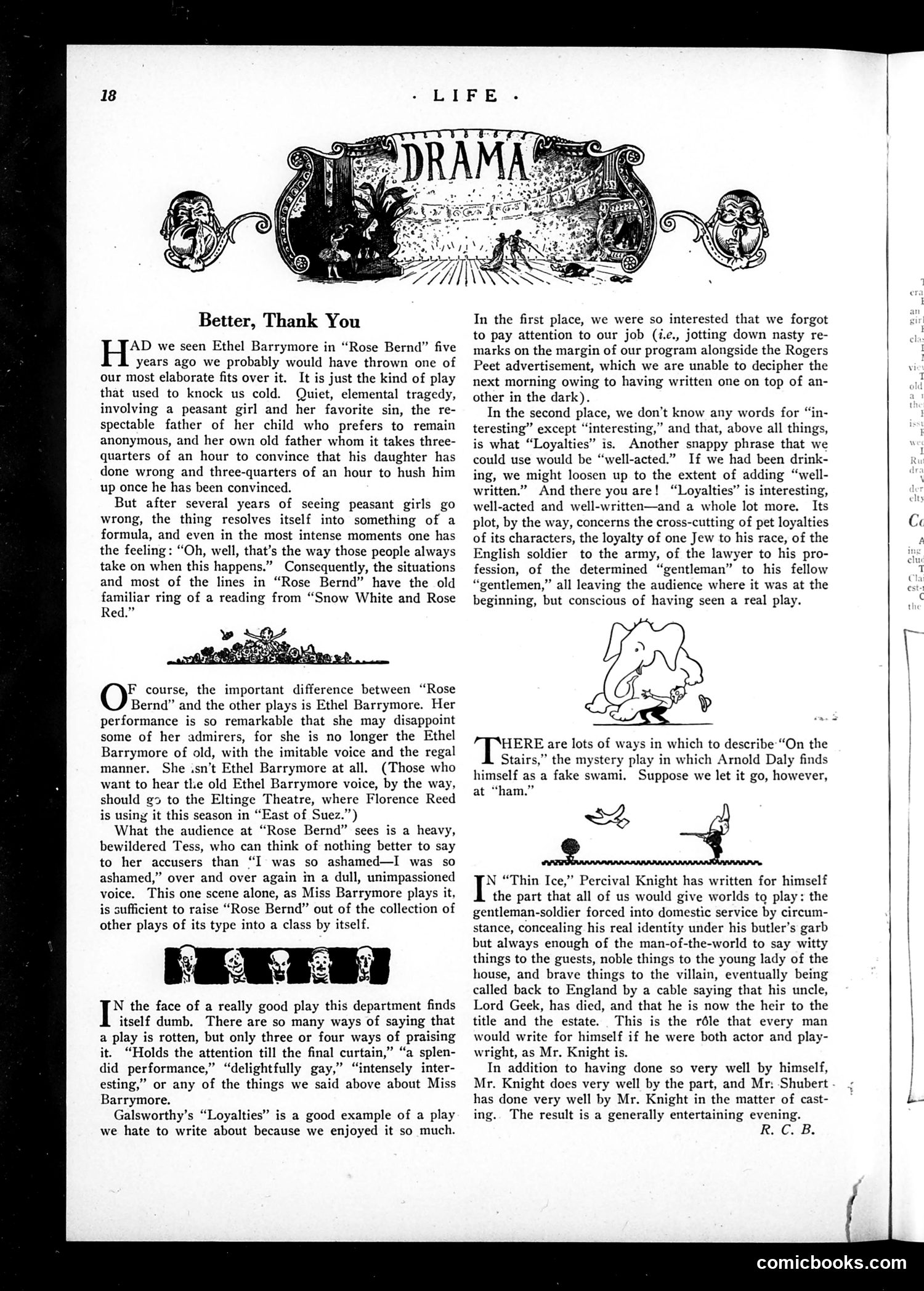
This page contains theater reviews from Life magazine's drama section. The main content critiques three Broadway plays: **"Rose Bernd"** — The reviewer praises actress Ethel Barrymore's performance in this peasant tragedy, noting her remarkable departure from her usual regal manner. She plays a "heavy, bewildered Tess" (referencing Hardy's tragic heroine), delivering a powerful scene of shame that elevates the otherwise formulaic play. **"Loyalties"** — Galsworthy's play about conflicting loyalties (a Jew's loyalty to his race, a soldier's to the army, etc.) is praised as genuinely interesting and well-acted, though the reviewer humorously admits struggling to find fresh superlatives. **"On the Stairs"** and **"Thin Ice"** receive brief mentions, the former dismissed as "ham" (overwrought acting). The satirical tone typical of Life appears in the reviewer's self-aware commentary about the difficulty of praising good plays versus panning bad ones—a running joke about critical vocabulary limitations.
📄 Transcribed text from this page (OCR, searchable)
Machine-transcribed from the original scan — historical spelling and the odd misread are preserved.
Better, Thank You AD we seen Ethel Barrymore in “Rose Bernd” five years ago we probably would have thrown one of our most elaborate fits over it. It is just the kind of play that used to knock us cold. Quiet, elemental tragedy, involving a peasant girl and her favorite sin, the re- spectable father of her child who prefers to remain anonymous, and her own old father whom it takes three- quarters of an hour to convince that his daughter has done wrong and three-quarters of an hour to hush him up once he has been convinced. But after several years of seeing peasant girls go wrong, the thing resolves itself into something of a formula, and even in the most intense moments one has the feeling: “Oh, well, that’s the way those people always take on when this happens.” Consequently, the situations and most of the lines in “Rose Bernd” have the old familiar ring of a reading from “Snow White and Rose Red.” F course, the important difference between “Rose Bernd” and the other plays is Ethel Barrymore. Her performance is so remarkable that she may disappoint some of her admirers, for she is no longer the Ethel Barrymore of old, with the imitable voice and the regal manner. She .sn’t Ethel Barrymore at all. (Those who want to hear the old Ethel Barrymore voice, by the way, should gs to the Eltinge Theatre, where Florence Reed is using it this season in “East of Suez.”) What the audience at “Rose Bernd” sees is a heavy, bewildered Tess, who can think of nothing better to say to her accusers than “I was so ashamed—I was so ashamed,” over and over again in a dull, unimpassioned voice. This one scene alone, as Miss Barrymore plays it, is sufficient to raise “Rose Bernd” out of the collection of other plays of its type into a class by itself. N the face of a really good play this department finds itself dumb. There are so many ways of saying that a play is rotten, but only three or four ways of praising it. “Holds the attention till the final curtain,” “a splen- did performance,” “delightfully gay,” “intensely inter- esting,” or any of the things we said above about Miss Barrymore. Galsworthy’s “Loyalties” is a good example of a play we hate to write about because we enjoyed it so much. In the first place, we were so interested that we forgot to pay attention to our job (i.e, jotting down nasty re- marks on the margin of our program alongside the Rogers Peet advertisement, which we are unable to decipher the next morning owing to having written one on top of an- other in the dark). In the second place, we don’t know any words for “in- teresting” except “interesting,” and that, above all things, is what “Loyalties” is. Another snappy phrase that we could use would be “well-acted.” If we had been drink- ing, we might loosen up to the extent of adding “well- written.” And there you are! “Loyalties” is interesting, well-acted and well-written—and a whole lot more. Its plot, by the way, concerns the cross-cutting of pet loyalties of its characters, the loyalty of one Jew to his race, of the English soldier to the army, of the lawyer to his pro- fession, of the determined “gentleman” to his fellow “gentlemen,” all leaving the audience where it was at the beginning, but conscious of having seen a real play. HERE are lots of ways in which to describe “On the Stairs,” the mystery play in which Arnold Daly finds himself as a fake swami. Suppose we let it go, however, at “ham.” s% N “Thin Ice,” Percival Knight has written for himself the part that all of us would give worlds tq play: the gentleman-soldier forced into domestic service by circum- stance, concealing his real identity under his butler’s garb but always enough of the man-of-the-world to say witty things to the guests, noble things to the young lady of the house, and brave things to the villain, eventually being called back to England by a cable saying that his uncle, Lord Geek, has died, and that he is now the heir to the title and the estate. This is the réle that every man would write for himself if he were both actor and play- wright, as Mr. Knight is. In addition to having done so very well by himself, Mr. Knight does very well by the part, and Mr: Shubert has done very well by Mr. Knight in the matter of cast- ing. The result is a generally entertaining evening. RC. B. comicbooks.com