
Life, 1922-10-19 · page 26 of 36
Life — October 19, 1922 — page 26: what you’re looking at
What you’re looking at
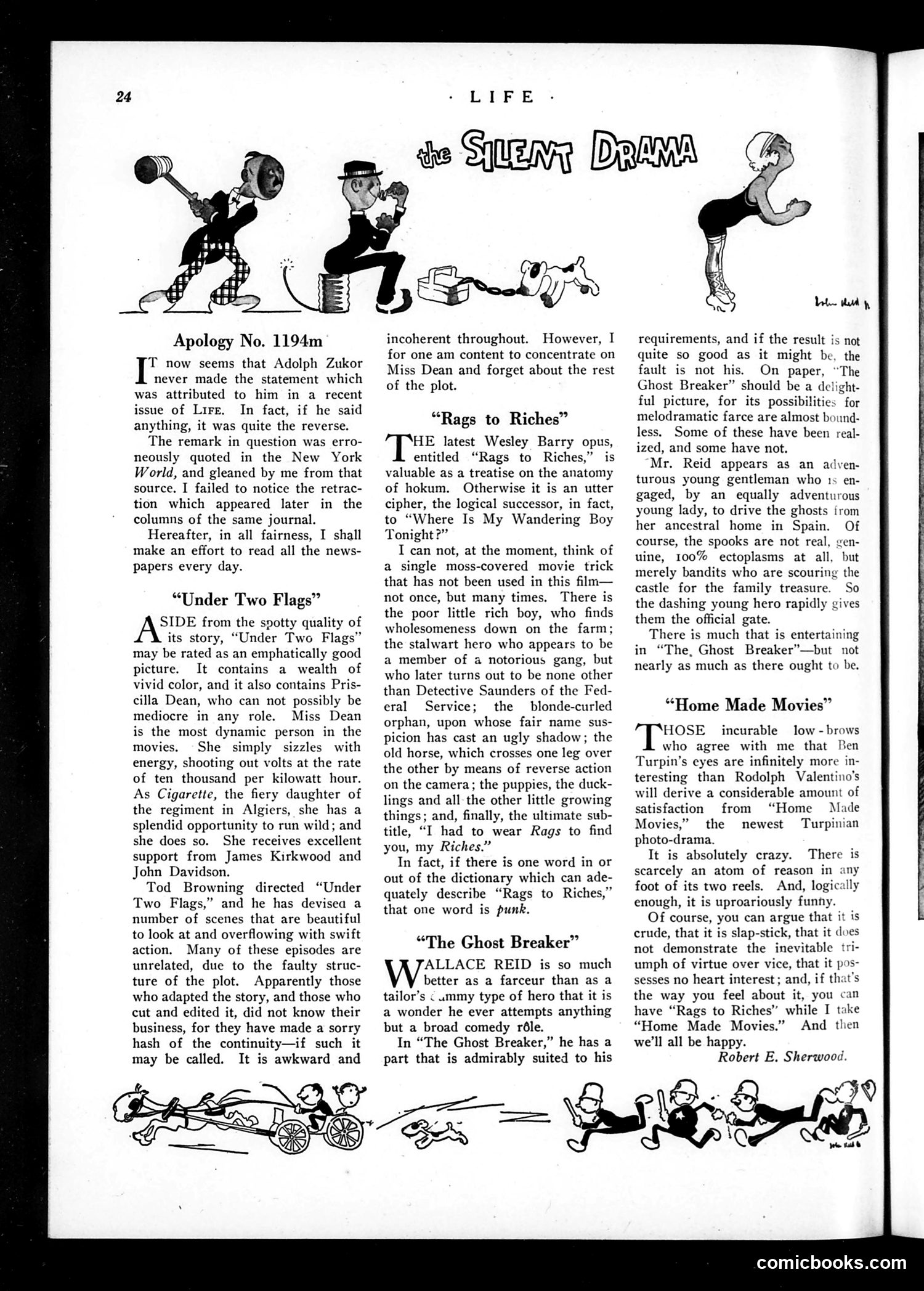
This page reviews four silent films from the early 1920s. The header cartoon titled "The Silent Drama" satirizes the physical comedy of silent cinema—showing exaggerated body contortions typical of the era's slapstick humor. The reviews critique specific films: - **"Under Two Flags"**: Praises actress Priscilla Dean's energy while condemning the plot's incoherent structure, suggesting editors bungled the adaptation. - **"Rags to Riches"**: Harshly dismisses Wesley Barry's film as exhaustingly reliant on every tired hokum device—the poor rich boy, the reformed gang member, the orphan, etc.—calling it simply "punk" (slang for bad). - **"The Ghost Breaker"**: Notes Wallace Reid excels in farce comedy but the script fails to realize its potential for melodramatic comedy. The opening section is an apology correcting a misquote attributed to film producer Adolph Zukor, illustrating early-cinema journalism's carelessness.
📄 Transcribed text from this page (OCR, searchable)
Machine-transcribed from the original scan — historical spelling and the odd misread are preserved.
Apology No. 1194m T now seems that Adolph Zukor never made the statement which was attributed to him in a recent issue of Lire. In fact, if he said anything, it was quite the reverse. The remark in question was erro- neously quoted in the New York World, and gleaned by me from that source. I failed to notice the retrac- tion which appeared later in the columns of the same journal. Hereafter, in all fairness, I shall make an effort to read all the news- papers every day. “Under Two Flags” SIDE from the spotty quality of its story, “Under Two Flags” may be rated as an emphatically good picture. It contains a wealth of vivid color, and it also contains Pris- cilla Dean, who can not possibly be mediocre in any role. Miss Dean is the most dynamic person in the movies. She simply sizzles with energy, shooting out volts at the rate of ten thousand per kilowatt hour. As Cigarette, the fiery daughter of the regiment in Algiers, she has a splendid opportunity to run wild; and she does so. She receives excellent support from James Kirkwood and John Davidson. Tod Browning directed “Under Two Flags,” and he has devisea a number of scenes that are beautiful to look at and overflowing with swift action. Many of these episodes are unrelated, due to the faulty struc- ture of the plot. Apparently those who adapted the story, and those who cut and edited it, did not know their business, for they have made a sorry hash of the continuity—if such it may be called. It is awkward and LIFE de Snea Dae 3] incoherent throughout. However, I for one am content to concentrate on Miss Dean and forget about the rest of the plot. “Rags to Riches” HE latest Wesley Barry opus, entitled “Rags to Riches,” is valuable as a treatise on the anatomy of hokum. Otherwise it is an utter cipher, the logical successor, in fact, to “Where Is My Wandering Boy Tonight?” I can not, at the moment, think of a single moss-covered movie trick that has not been used in this film— not once, but many times. There is the poor little rich boy, who finds wholesomeness down on the farm; the stalwart hero who appears to be a member of a notorious gang, but who later turns out to be none other than Detective Saunders of the Fed- eral Service; the blonde-curled orphan, upon whose fair name sus- picion has cast an ugly shadow; the old horse, which crosses one leg over the other by means of reverse action on the camera; the puppies, the duck- lings and all the other little growing things; and, finally, the ultimate sub- title, “I had to wear Rags to find you, my Riches.” In fact, if there is one word in or out of the dictionary which can ade- quately describe “Rags to Riches,” that one word is punk. “The Ghost Breaker” ‘ALLACE REID is so much better as a farceur than as a tailor’s < ummy type of hero that it is a wonder he ever attempts anything but a broad comedy réle. In “The Ghost Breaker,” he has a part that is admirably suited to his SS Vite dud requirements, and if the result is not quite so good as it might be, the fault is not his. On paper, “The Ghost Breaker” should be a delight- ful picture, for its possibilities for melodramatic farce are almost bound- less. Some of these have been real- ized, and some have not. Mr. Reid appears as an adyen- turous young gentleman who 1s en- gaged, by an equally adventurous young lady, to drive the ghosts irom her ancestral home in Spain. Of course, the spooks are not real, gen- uine, 100% ectoplasms at all, but merely bandits who are scouring the castle for the family treasure. So the dashing young hero rapidly gives them the official gate. There is much that is entertaining in “The, Ghost Breaker’—but not nearly as much as there ought to be. “Home Made Movies” HOSE incurable low - brows who agree with me that Ben Turpin’s eyes are infinitely more in- teresting than Rodolph Valentino's will derive a considerable amount of satisfaction from “Home Made Movies,” the newest Turpinian photo-drama. It is absolutely crazy. There is scarcely an atom of reason in any foot of its two reels. And, logically enough, it is uproariously funty. Of course, you can argue that i crude, that it is slap-stick, that it d not demonstrate the inevitable tri- umph of virtue over vice, that it pos- sesses no heart interest; and, if that’s the way you feel about it, you can have “Rags to Riches” while I take “Home Made Movies.” And then we'll all be happy. Robert E. Sherwood. Vv comicbooks.com