
Life, 1922-10-19 · page 16 of 36
Life — October 19, 1922 — page 16: what you’re looking at
What you’re looking at
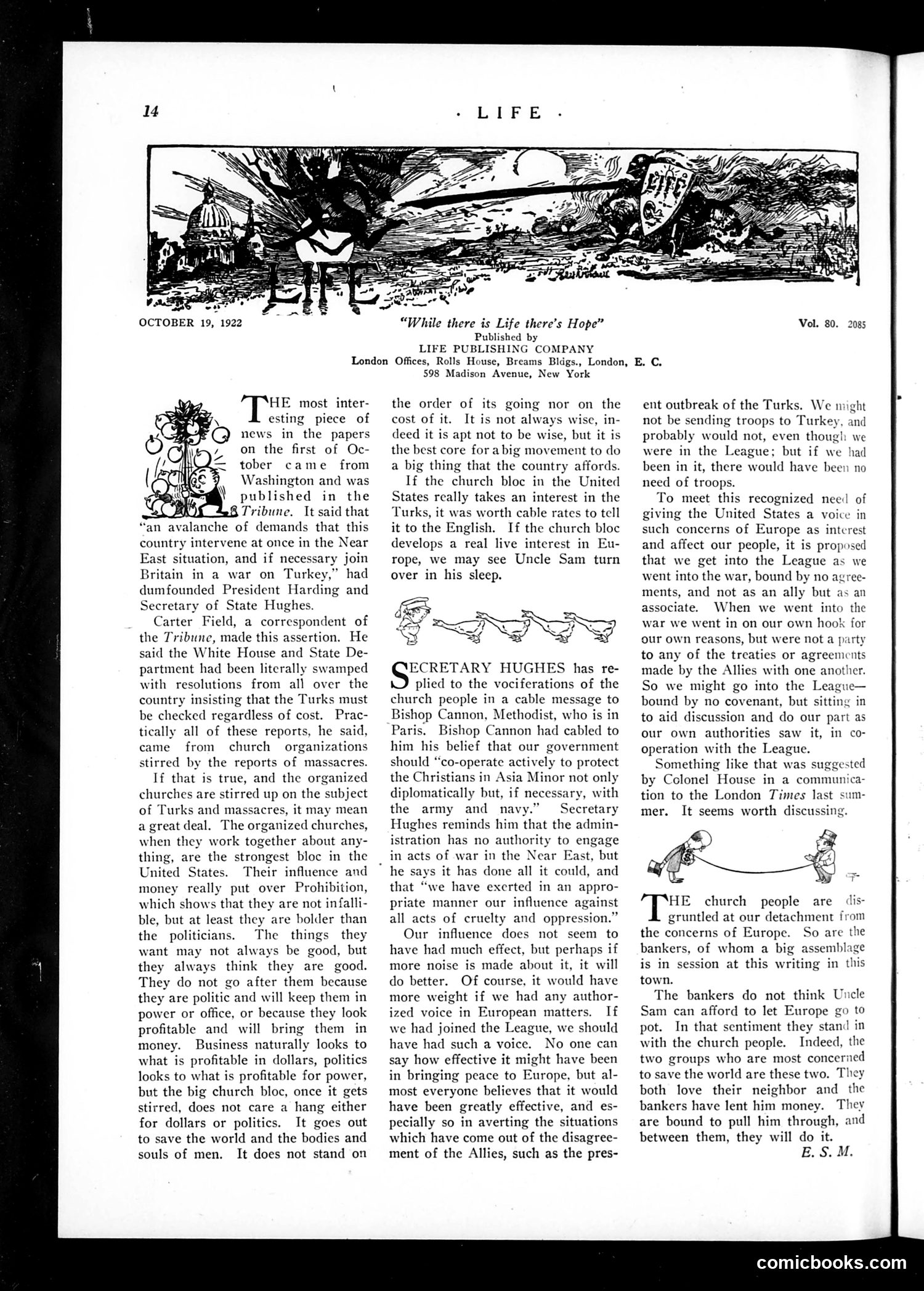
This page discusses whether the United States should join the League of Nations. The article critiques church organizations' calls for American intervention in European affairs, particularly regarding Turkish massacres in Asia Minor. The author argues that while churches wield significant political influence through their congregations and money, this doesn't necessarily produce good policy. The piece questions whether America should enter the League, suggesting that doing so would require abandoning isolationism—the prevailing post-WWI sentiment against foreign entanglements. Secretary of State Hughes is mentioned as opposing active military intervention in Near Eastern conflicts, despite diplomatic pressure from religious groups. The author suggests that American bankers and church leaders, though well-intentioned, shouldn't determine foreign policy through their financial or organizational power.
📄 Transcribed text from this page (OCR, searchable)
Machine-transcribed from the original scan — historical spelling and the odd misread are preserved.
“While there is Life there’s Hope” Published by LIFE PUBLISHING COMPANY 2085 London Offices, Rolls House, Breams Bldgs., London, E. C. HE most inter- esting piece of news in the papers on the first of Oc- tober came from Washington and was published in the It said that “an avalanche of demands that this country intervene at once in the Near East situation, and if necessary join Britain in a war on Turkey,” had dumfounded President Harding and Secretary of State Hughes. Carter Field, a correspondent of the Tribune, made this assertion. He said the White House and State De- partment had been literally swamped with resolutions from all over the country insisting that the Turks must be checked regardless of cost. Prac- tically all of these reports, he said, came from church organizations stirred by the reports of massacres. If that is true, and the organized churches are stirred up on the subject of Turks and massacres, it may mean a great deal. The organized churches, when they work together about any- thing, are the strongest bloc in the United States. Their influence and money really put over Prohibition, which shows that they are not infalli- ble, but at least they are bolder than the politicians. The things they want may not always be good, but they always think they are good. They do not go after them because they are politic and will keep them in power or office, or because they look profitable and will bring them in money. Business naturally looks to what is profitable in dollars, politics looks to what is profitable for power, but the big church bloc, once it gets stirred, does not care a hang either for dollars or politics. It goes out to save the world and the bodies and souls of men. It does not stand on 598 Madison Avenue, New York the order of its going nor on the cost of it. It is not always wise, in- deed it is apt not to be wise, but it is the best core for a big movement to do a big thing that the country affords. If the church bloc in the United States really takes an interest in the Turks, it was worth cable rates to tell it to the English. If the church bloc develops a real live interest in Eu- rope, we may see Uncle Sam turn over in his sleep. Se IS ECRETARY HUGHES has re- plied to the vociferations of the church people in a cable message to Bishop Cannon, Methodist, who is in Paris. Bishop Cannon had cabled to him his belief that our government should ‘co-operate actively to protect the Christians in Asia Minor not only diplomatically but, if necessary, with the army and navy.” Secretary Hughes reminds him that the admin- istration has no authority to engage _ in acts of war in the Near East, but he says it has done all it could, and that “we have exerted in an appro- priate manner our influence against all acts of cruelty and oppression.” Our influence does not seem to have had much effect, but perhaps if more noise is made about it, it will do better. Of course, it would have more weight if we had any author- ized voice in European matters. If we had joined the League, we should have had such a voice. No one can say how effective it might have been in bringing peace to Europe, but al- most everyone believes that it would have been greatly effective, and es- pecially so in averting the situations which have come out of the disagree- ment of the Allies, such as the pres- ent outbreak of the Turks. We might not be sending troops to Turkey, and probably would not, even though we were in the League; but if we had been in it, there would have been no need of troops. To meet this recognized need of giving the United States a voice in such concerns of Europe as interest and affect our people, it is proposed that we get into the League as we went into the war, bound by no agree- ments, and not as an ally but as an associate. When we went into the war we went in on our own hook for our own reasons, but were not a party to any of the treaties or agreements made by the Allies with one another. So we might go into the League— bound by no covenant, but sitting in to aid discussion and do our part as our own authorities saw it, in co- operation with the League. Something like that was suggested by Colonel House in a communica- tion to the London Times last sum- mer. It seems worth discussing. 5) HE church people are dis- gruntled at our detachment from the concerns of Europe. So are the bankers, of whom a big assemblage is in session at this writing in this town. The bankers do not think Uncle Sam can afford to let Europe go to pot. In that sentiment they stand in with the church people. Indeed, the two groups who are most concerned to save the world are these two. They both love their neighbor and the bankers have lent him money. They are bound to pull him through, and between them, they will do it. E.S.M. comicbooks.com