
Life, 1922-10-19 · page 9 of 36
Life — October 19, 1922 — page 9: what you’re looking at
What you’re looking at
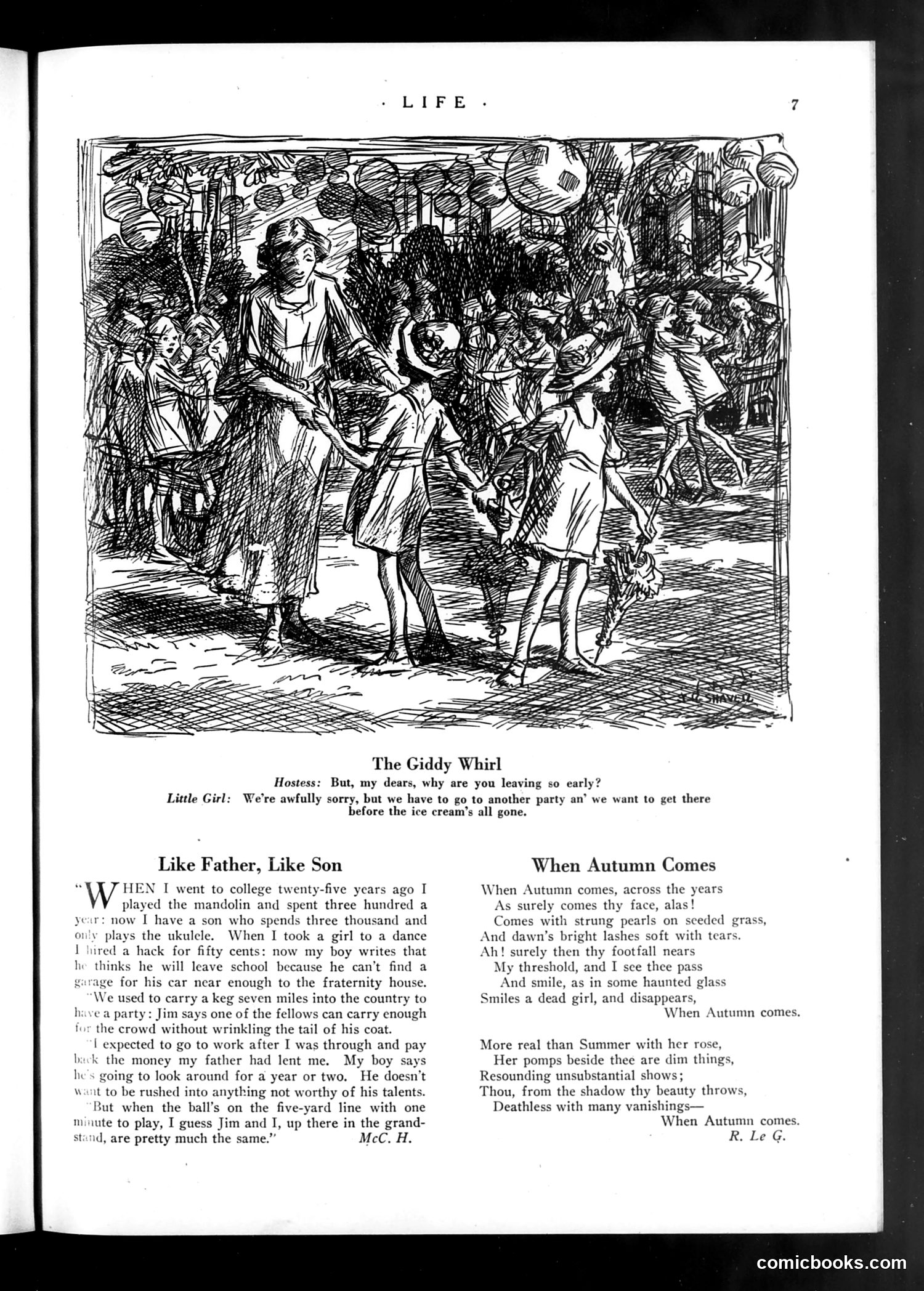
**"The Giddy Whirl"** is an illustration depicting a social scene where a well-dressed adult woman (labeled "Hostess") addresses departing young girls. One girl explains they must leave early because "we want to get there before the ice cream's all gone" at another party. The satire targets the frenetic social calendar of young women in the early 20th century—the expectation that unmarried girls would circulate constantly among multiple social events. The humor lies in the girls' honest admission that they're party-hopping merely to maximize refreshments rather than to genuinely enjoy any single gathering. Below are two pieces: **"Like Father, Like Son"** and **"When Autumn Comes"** (poetry)—unrelated to the main cartoon.
📄 Transcribed text from this page (OCR, searchable)
Machine-transcribed from the original scan — historical spelling and the odd misread are preserved.
The Giddy Whirl Hostess: But, my dears, why are you leaving so early? Little Girl: We're awfully sorry, but we have to go to another party an’ we want to get there before the ice cream’s all gone. Like Father, Like Son se HEN I went to college twenty-five years ago I played the mandolin and spent three hundred a year: now I have a son who spends three thousand and only plays the ukulele. When I took a girl to a dance | \ired a hack for fifty cents: now my boy writes that he thinks he will leave school because he can’t find a garage for his car near enough to the fraternity house. We used to carry a keg seven miles into the country to ea party: Jim says one of the fellows can carry enough or the crowd without wrinkling the tail of his coat. | expected to go to work after I was through and pay wk the money my father had lent me. My boy says s going to look around for a year or two. He doesn’t it to be rushed into anything not worthy of his talents. 3ut when the ball’s on the five-yard line with one aute to play, I guess Jim and I, up there in the grand- stsnd, are pretty much the same.” McC. H. When Autumn Comes When Autumn comes, across the years As surely comes thy face, alas! Comes with strung pearls on seeded grass, And dawn’s bright lashes soft with tears. Ah! surely then thy footfall nears My threshold, and I see thee pass And smile, as in some haunted glass Smiles a dead girl, and disappears, When Autumn comes. More real than Summer with her rose, Her pomps beside thee are dim things, Resounding unsubstantial shows ; Thou, from the shadow thy beauty throws, Deathless with many vanishings— When Autumn comes. R. Le G. comicbooks.com