
Life, 1922-10-19 · page 6 of 36
Life — October 19, 1922 — page 6: what you’re looking at
What you’re looking at
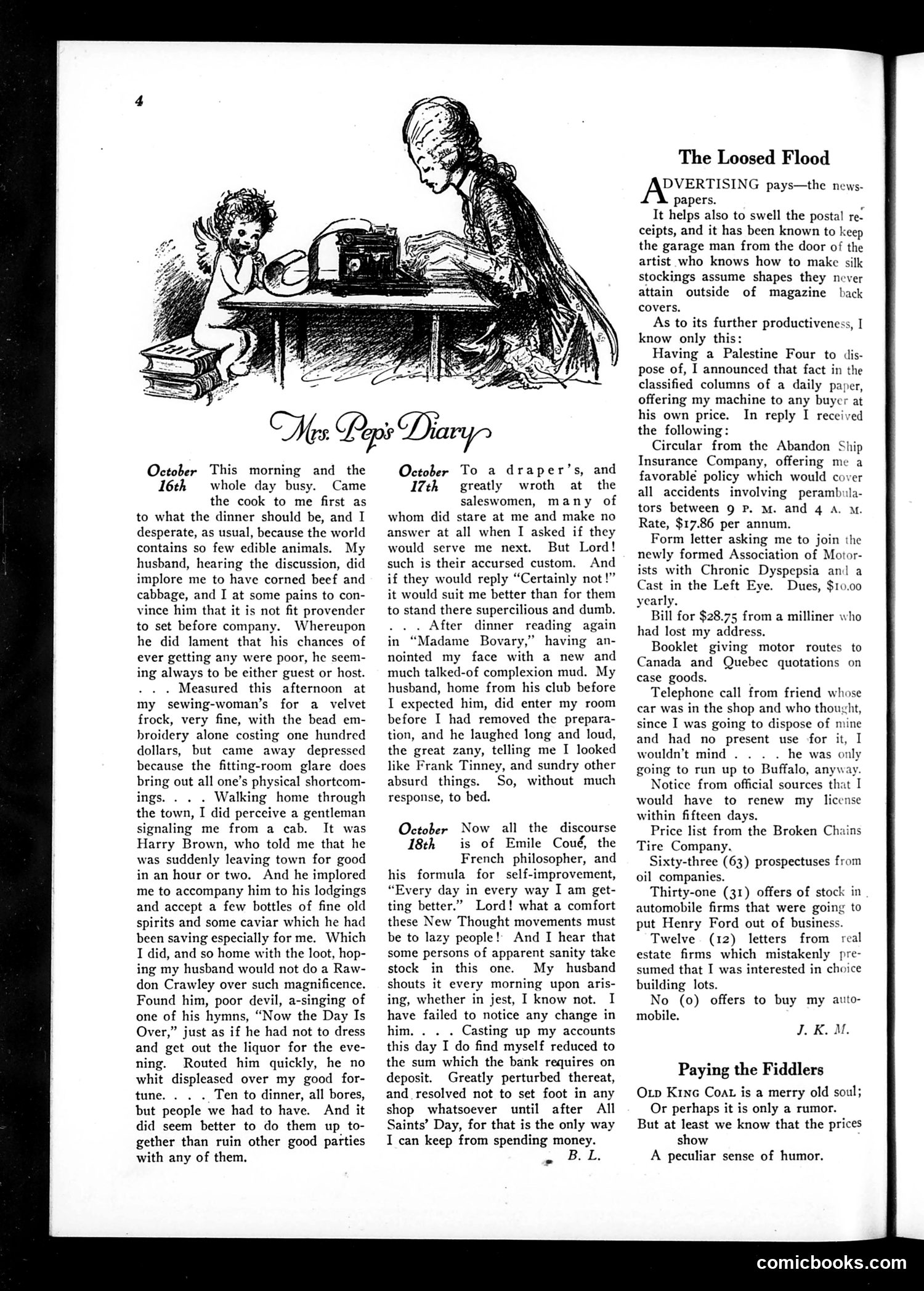
This page features "Mrs. Pepsi's Diary," a satirical column documenting mundane domestic life. The illustration shows a woman at a typewriter with a child, likely representing the diary's author documenting her experiences. The entries (October 16th-18th) humorously detail ordinary frustrations: servants' incompetence, a husband's poor business prospects, social embarrassments, and financial anxieties. References to "New Thought movements" and self-improvement fads suggest satire of contemporary wellness trends. The column mocks middle-class pretensions and domestic concerns through deadpan narration of petty grievances—servants who won't work, disappointing social calls, dwindling funds. The humor relies on readers recognizing these as exaggerated versions of their own experiences. The accompanying advertisements and small items suggest *Life* magazine's typical mixed content of satirical fiction, advice, and notices.
📄 Transcribed text from this page (OCR, searchable)
Machine-transcribed from the original scan — historical spelling and the odd misread are preserved.
October This morning and the 16th whole day busy. Came the cook to me first as to what the dinner should be, and I desperate, as usual, because the world contains so few edible animals. My husband, hearing the discussion, did implore me to have corned beef and cabbage, and I at some pains to con- vince him that it is not fit provender to set before company. Whereupon he did lament that his chances of ever getting any were poor, he seem- ing always to be either guest or host. . Measured this afternoon at my sewing-woman’s for a_ velvet frock, very fine, with the bead em- broidery alone costing one hundred dollars, but came away depressed because the fitting-room glare does bring out all one’s physical shortcom- ings. . . . Walking home through the town, I did perceive a gentleman signaling me from a cab. It was Harry Brown, who told me that he was suddenly leaving town for good in an hour or two. And he implored me to accompany him to his lodgings and accept a few bottles of fine old spirits and some caviar which he had been saving especially for me. Which I did, and so home with the loot, hop- ing my husband would not do a Raw- don Crawley over such magnificence. Found him, poor devil, a-singing of one of his hymns, “Now the Day Is Over,” just as if he had not to dress and get out the liquor for the eve- ning. Routed him quickly, he no whit displeased over my good for- tune. . . . Ten to dinner, all bores, but people we had to have. And it did seem better to do them up to- gether than ruin other good parties with any of them. October To a draper’s, and 7th greatly wroth at the saleswomen, many of whom did stare at me and make no answer at all when I asked if they would serve me next. But Lord! such is their accursed custom. And if they would reply “Certainly not!” it would suit me better than for them to stand there supercilious and dumb. . . . After dinner reading again in “Madame Bovary,” having an- nointed my face with a new and much talked-of complexion mud. My husband, home from his club before I expected him, did enter my room before I had removed the prepara- tion, and he laughed long and loud, the great zany, telling me I looked like Frank Tinney, and sundry other absurd things. So, without much response, to bed. October Now all the discourse 18th is of Emile Coué, the French philosopher, and his formula for self-improvement, “Every day in every way I am get- ting better.” Lord! what a comfort these New Thought movements must be to lazy people!’ And I hear that some persons of apparent sanity take stock in this one. My husband shouts it every morning upon aris- ing, whether in jest, I know not. I have failed to notice any change in him. . . . Casting up my accounts this day I do find myself reduced to the sum which the bank requires on deposit. Greatly perturbed thereat, and _ resolved not to set foot in any shop whatsoever until after All Saints’ Day, for that is the only way I can keep from spending money. BL; The Loosed Flood DVERTISING pays—the news- papers. It helps also to swell the postal re- ceipts, and it has been known to keep the garage man from the door of the artist who knows how to make silk stockings assume shapes they never attain outside of magazine back covers. As to its further productiveness, I know only this: Having a Palestine Four to dis- pose of, I announced that fact in the classified columns of a daily paper, offering my machine to any buyer at his own price. In reply I received the following: Circular from the Abandon Ship Insurance Company, offering me a favorable policy which would cover all accidents involving perambula- tors between 9 P. M. and 4 A. M. Rate, $17.86 per annum. Form letter asking me to join the newly formed Association of Motor- ists with Chronic Dyspepsia and a Cast in the Left Eye. Dues, $10.00 yearly, Bill for $28.75 from a milliner who had lost my address. Booklet giving motor routes to Canada and Quebec quotations on case goods. Telephone call from friend whose car was in the shop and who thought, since I was going to dispose of mine and had no present use for it, I wouldn’t mind . . he was ¢ going to run up to Buffalo, any Notice from official sources t would have to renew my license within fifteen days. Price list from the Broken Chains Tire Company. Sixty-three (63) prospectuses from oil companies. Thirty-one (31) offers of stock in automobile firms that were going to put Henry Ford out of business. Twelve (12) letters from real estate firms which mistakenly pre- sumed that I was interested in choice building lots. No (0) offers to buy my auto- mobile. J. K.M. Paying the Fiddlers Oxp Kine Coat is a merry old soul; Or perhaps it is only a rumor. But at least we know that the prices show A peculiar sense of humor. comicbooks.com