
A complete issue · 36 pages · 1922
Life — September 21, 1922
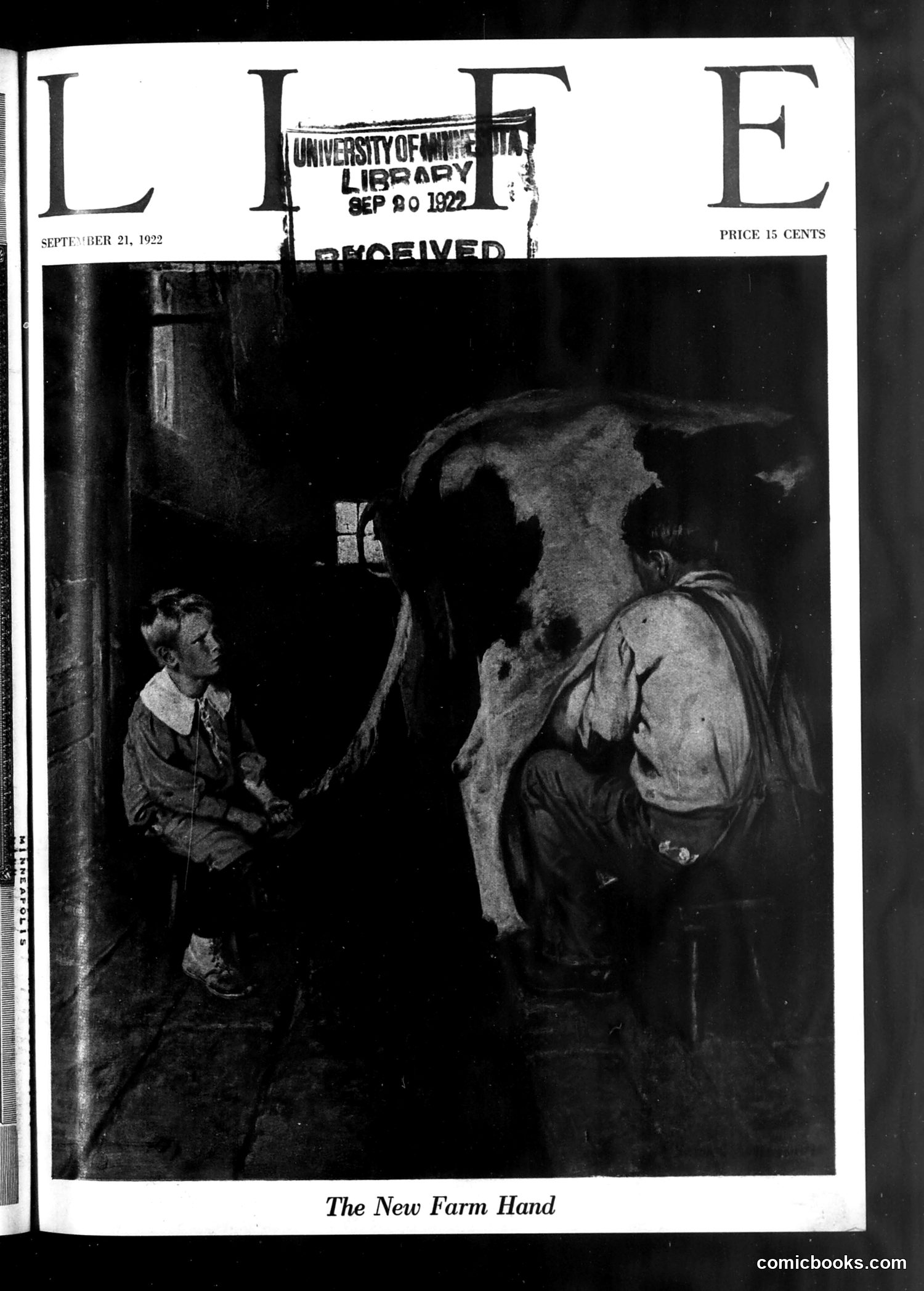
This illustration depicts a humorous scene of a young, inexperienced farm worker encountering a large cow for the first time. The caption "The New Farm Hand" suggests the joke centers on the newcomer's obvious nervousness and unfamiliarity with farm animals and rural work. The image shows the boy appearing startled or apprehensive while facing the cow, likely capturing a moment of comedic culture-clash between urban inexperience and agricultural reality. This reflects post-WWI America's broader social tensions between rural and urban populations during the 1920s. The satire gently mocks city folk's lack of practical farming knowledge, a common theme in period humor as industrialization drew more Americans away from agricultural lifestyles.
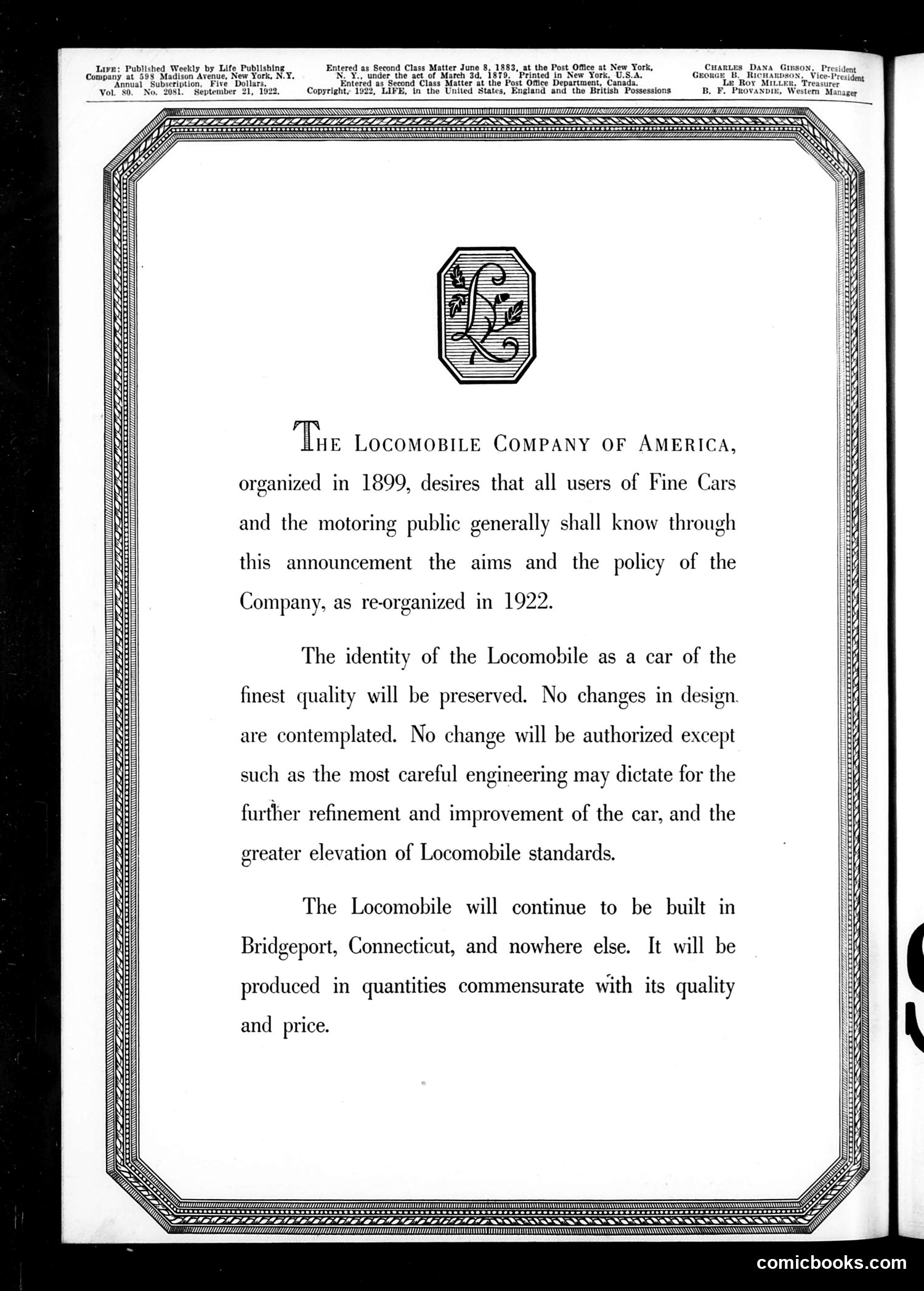
This page contains **advertising content**, not political satire or cartoon commentary. The Locomobile Company of America uses this Life magazine space to announce their 1922 reorganization and company policy. The advertisement emphasizes: - Preservation of the Locomobile brand as a "fine car" of highest quality - Commitment to design consistency (no changes except engineering refinements) - Exclusive production in Bridgeport, Connecticut - Output limited to quantities matching quality standards rather than mass production This represents a luxury automaker positioning itself against mass-production competitors (notably Ford's Model T). The announcement reassures existing owners and affluent buyers that their expensive vehicle won't be compromised by cost-cutting or redesigns—a significant concern during the 1920s automotive industry's rapid consolidation and competition.
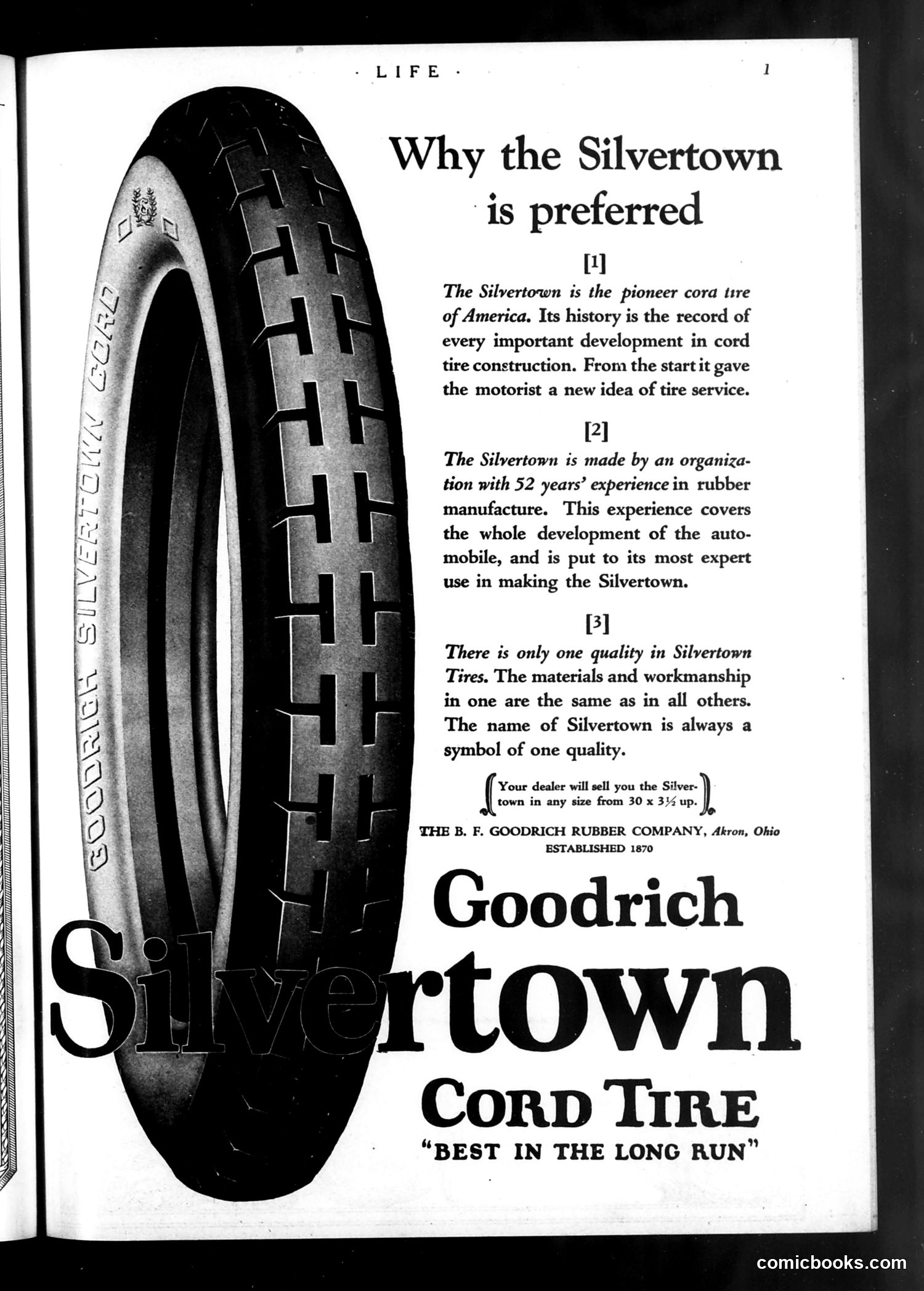
This is **not a cartoon or satirical content** — it's a straightforward advertisement for Goodrich Silvertown Cord Tires, occupying the full page in *Life* magazine. The ad makes three numbered claims about why Silvertown tires are "preferred": 1. They're described as "the pioneer cord tire of America" with a history of innovation 2. Made by a company with 52 years' rubber manufacturing experience 3. Consistent quality — "The name of Silvertown is always a symbol of quality" The tagline promises the tire is "BEST IN THE LONG RUN." A large photograph of the tire itself dominates the left side, showing its tread pattern clearly. This represents early automotive advertising, emphasizing brand heritage and reliability to emerging car-owning consumers.
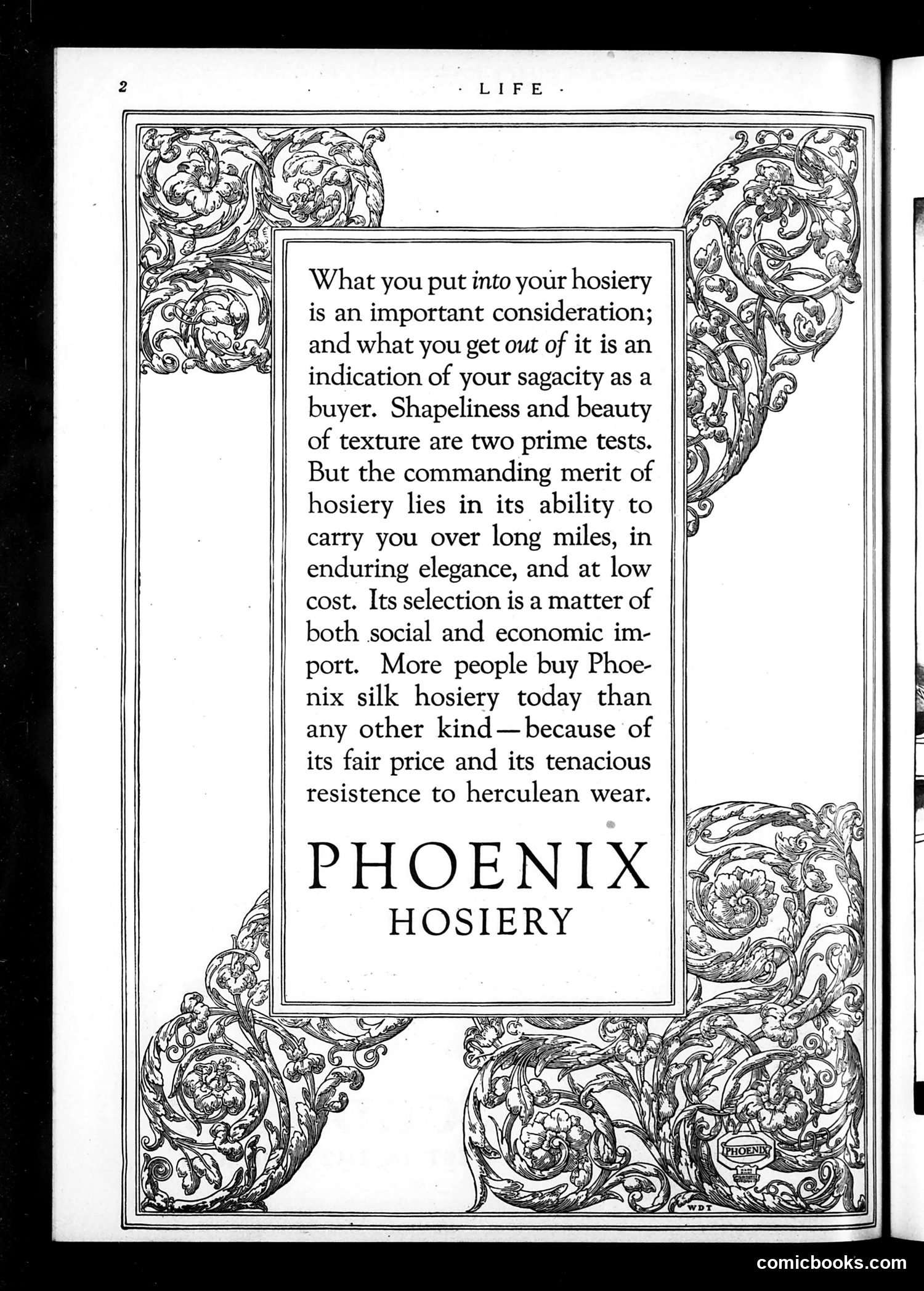
This is **not a cartoon or satirical piece**—it's a straightforward advertisement for Phoenix Silk Hosiery, likely from the early 20th century. The page features ornamental Art Nouveau decorative borders framing an advertisement that emphasizes the practical and economic merits of silk stockings. The text argues that Phoenix hosiery represents smart purchasing: it combines aesthetic qualities (shape, texture) with durability and affordability, allowing wearers to travel long distances in "enduring elegance" without expense. The advertisement positions Phoenix as the market leader, claiming "more people buy Phoenix silk hosiery today than any other kind" due to fair pricing and resistance to wear. This reflects the period's commercial focus on marketing hosiery as both a fashion and practical economic choice for consumers.
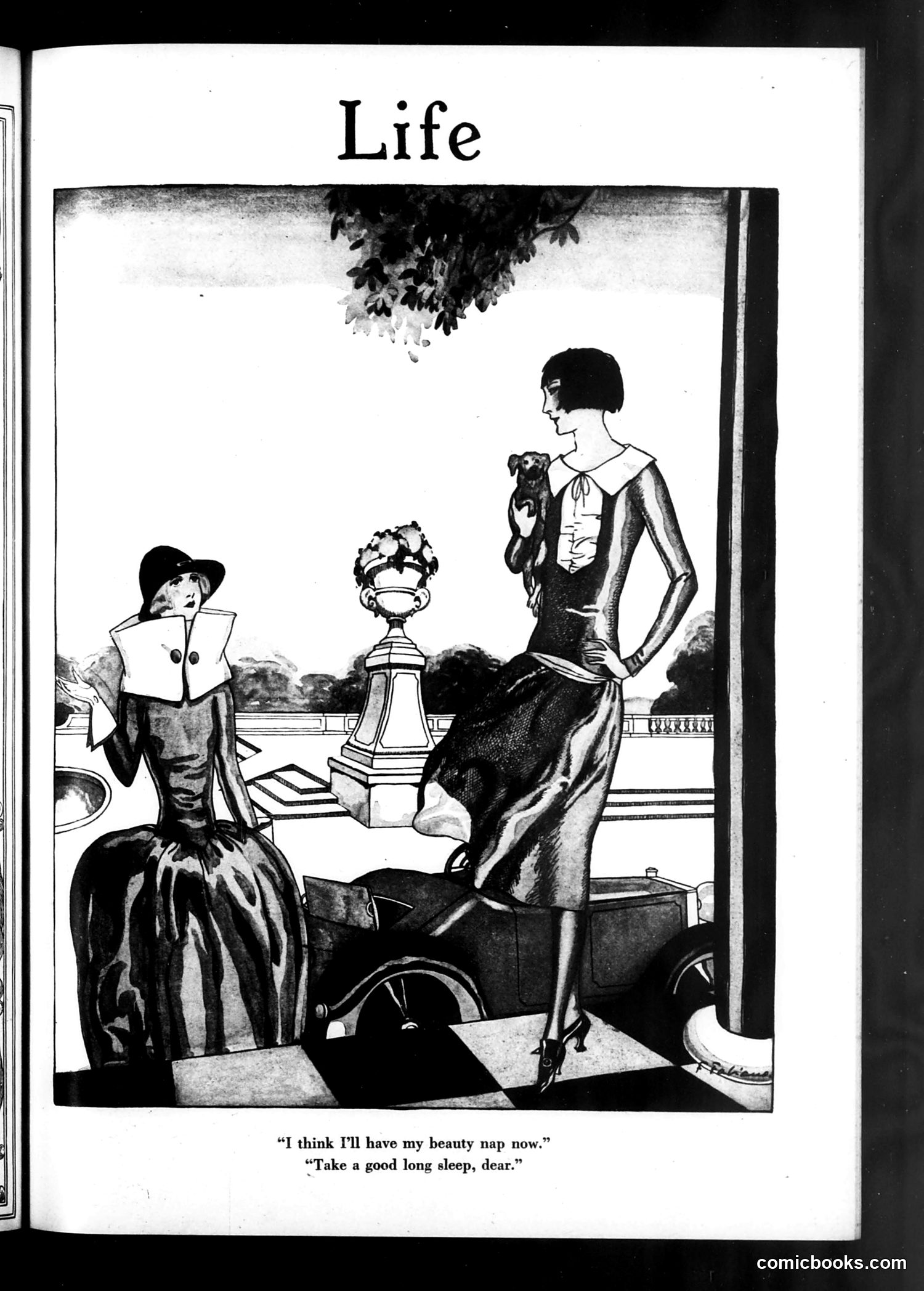
This appears to be a satirical comic from Life magazine's "Life" section, likely from the 1920s based on the art style and fashion. The illustration depicts three fashionably dressed women in an elegant outdoor setting with a car and decorative urn. The dialogue—"I think I'll have my beauty nap now" / "Take a good long sleep, dear"—suggests satirical commentary on wealthy women's leisure activities and beauty routines. The second speaker's pointed response implies criticism of the first woman's idleness or vanity, with "good long sleep" functioning as a cutting remark. The scene captures Life magazine's typical satirical targets: the idle wealthy, consumer culture, and changing gender roles in the modern era. However, without additional context, the specific social figures or events referenced remain unclear.
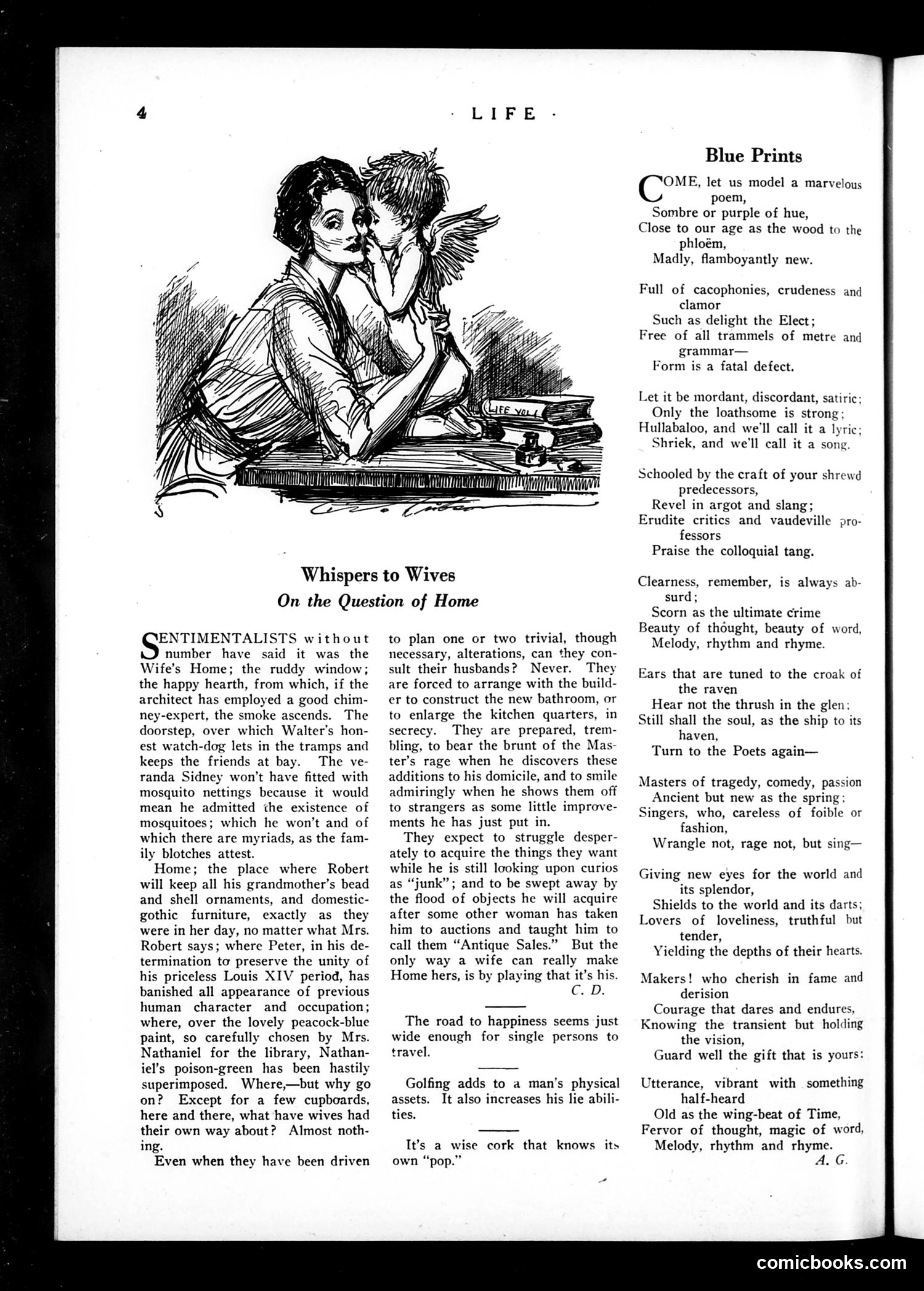
The illustration depicts a woman and a cherub or cupid figure at a writing desk, likely representing the creative process of writing poetry. The accompanying article "Whispers to Wives: On the Question of Home" discusses domestic arrangements between husbands and wives—specifically how wives might influence home decoration and management. The "Blue Prints" poem on the right appears to be satirical commentary on contemporary poetry trends, mocking overly complex, rule-breaking modern verse that eschews traditional "metre and grammar." The poem advocates for clarity, melody, and rhythm while ridiculing the avant-garde "Elect" poets who prize cacophony and structural experimentation. The satire targets intellectual pretension in modern literary circles circa early 20th century, when modernist poetry was challenging Victorian conventions.
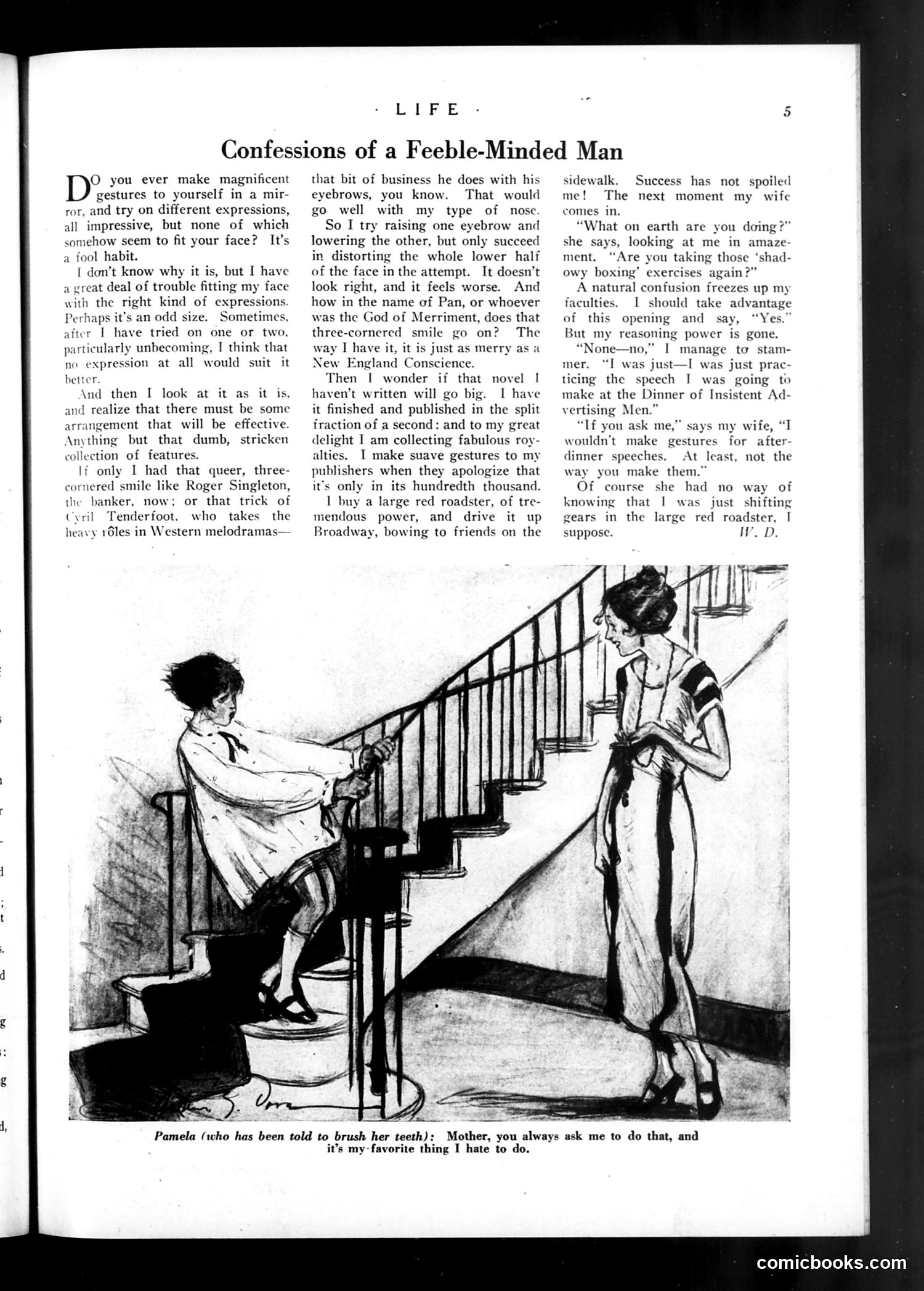
This is a humorous essay about a man's struggles with facial expressions and self-presentation. The narrator admits he cannot master appropriate expressions—he tries different eyebrow arrangements to look businesslike but fails. He compensates by buying a red roadster car and driving it around Broadway to appear successful, though his wife suspects he's just "shifting gears." The accompanying cartoon shows a mother instructing her daughter Pamela to brush her teeth—a task Pamela claims to hate, though her mother says she always asks her to do it. The joke appears to be about children's contradictory behavior or reluctant obedience. This was apparently a popular magazine feature satirizing everyday human foibles and domestic situations in early 20th-century American life.
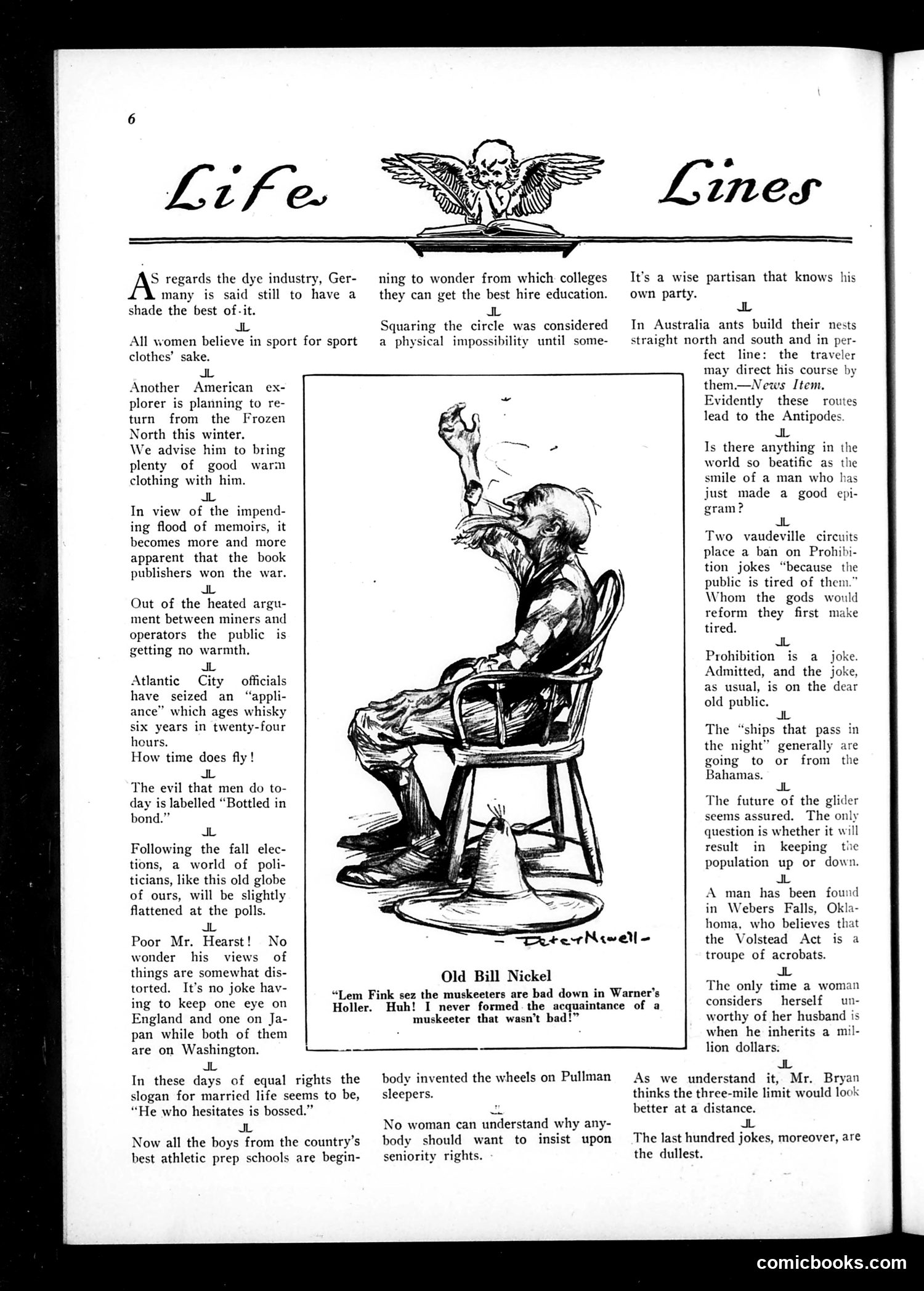
The central cartoon depicts a man slouched in a chair, apparently intoxicated, with the caption: "Lem Fink set the musketeers are bad down in Warner's Holler. Huh! I never formed the acquaintance of a musketeer that wasn't bad!" This appears to be rural Americana satire, likely referencing Prohibition-era concerns about illicit alcohol ("musketeers" possibly slang for bootleggers or criminals). The disheveled figure represents someone corrupted by illegal liquor culture in rural Appalachia ("Warner's Holler"). The surrounding "Life Lines" column contains various brief satirical observations on contemporary topics—Prohibition, women's rights, aviation, and Atlantic City whiskey aging—typical of the magazine's short-form humor format criticizing social and political trends of the era.
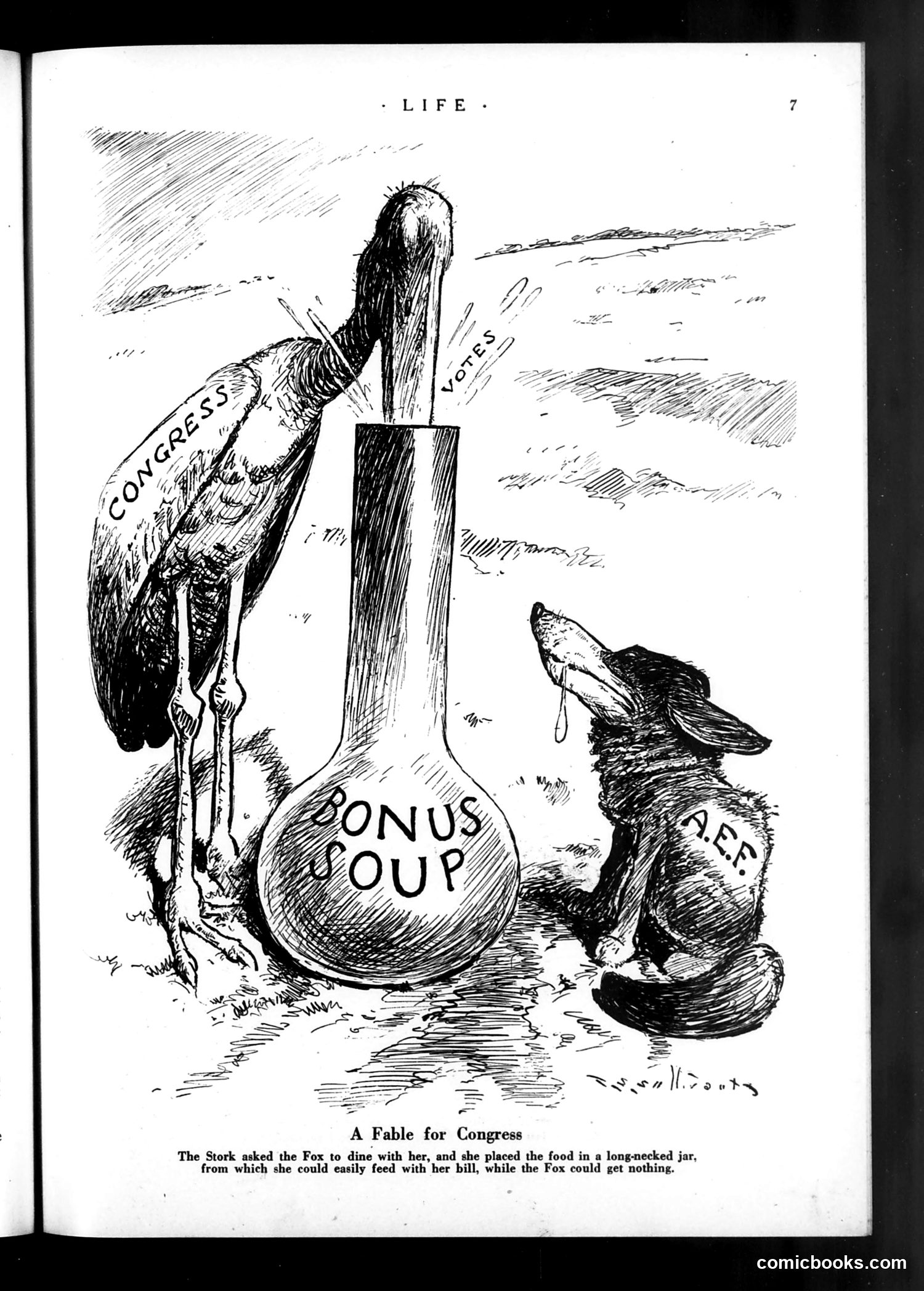
This political cartoon uses Aesop's fable imagery to satirize Congress. A **stork** (labeled "Congress") offers food in a long-necked jar labeled "Bonus Soup" to a **fox** (labeled "A.E.F."—likely the American Expeditionary Forces or veterans). The satire is sharp: the stork can easily feed from the jar with its long bill, but the fox cannot access the food despite its hunger. The fable's moral warns against false generosity—the "bonus soup" appears available but is structurally inaccessible to those it supposedly benefits. This likely critiques Congressional reluctance to provide promised bonuses or benefits to WWI veterans, offering symbolic gestures while withholding actual aid.
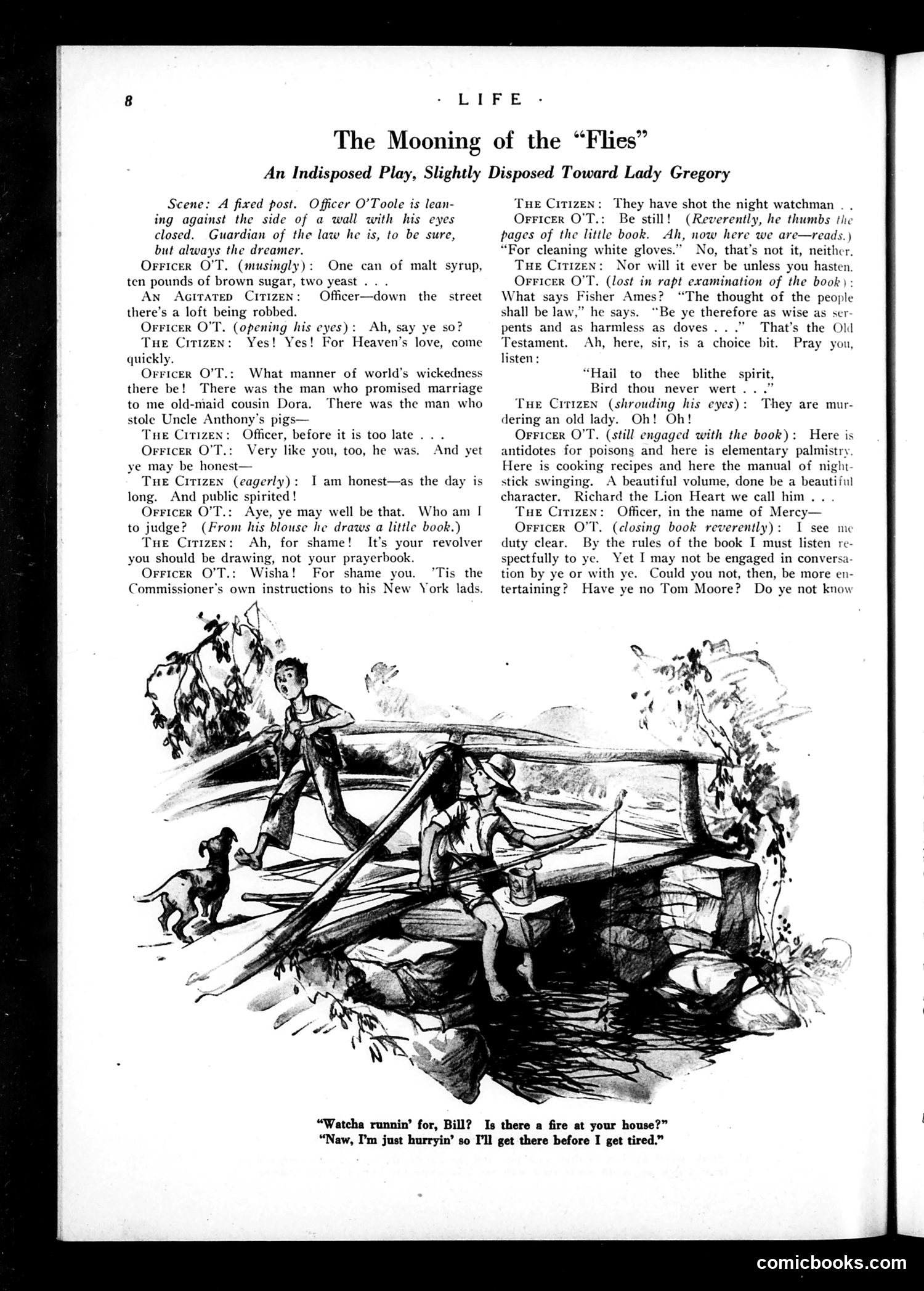
This is a satirical play script mocking bureaucratic inefficiency and police incompetence. Officer O'Toole and The Citizen debate trivial matters while a crime occurs nearby—a loft robbery and murder of an old lady. The humor satirizes how officers get distracted by irrelevant details (recipes, poetry, religious quotations) instead of preventing actual crimes. Officer O'Toole obsesses over a rulebook while his duty goes unfulfilled. The illustration shows children playing on a broken fence, seemingly oblivious to danger—perhaps reflecting the play's theme that negligent authorities leave citizens vulnerable. The title suggests incompetence ("mooning"—wasting time foolishly) regarding criminal "flies" (petty criminals or the criminals themselves). This critiques early 20th-century police bureaucracy prioritizing procedure over actual crime prevention.
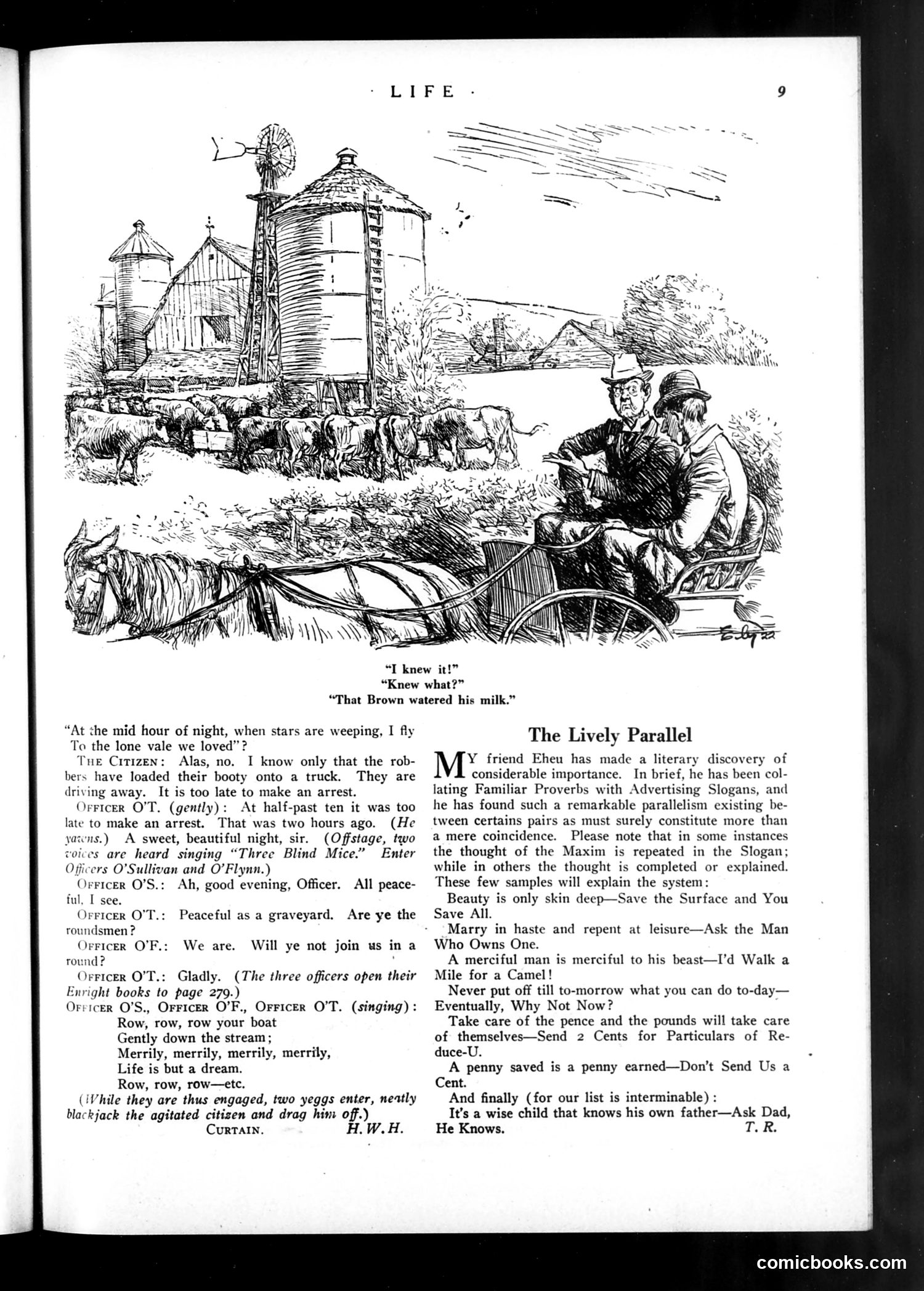
The main illustration depicts a rural farm scene with a farmer, his companion, and a horse-drawn cart passing a barn with cattle and windmill. The caption reads: "I knew it!" / "Knew what?" / "That Brown watered his milk." This is a straightforward visual joke about agricultural deception—a common rural concern of the era. "Watering milk" (diluting it with water to increase volume and profit) was a widespread adulteration practice that defrauded consumers. The cartoon satirizes this dishonest practice by showing the farmer's knowing recognition of the scheme, suggesting it was common enough that experienced people could identify the perpetrator. "The Lively Parallel" section compares advertising slogans with familiar proverbs, suggesting commercial language merely repackages old wisdom.
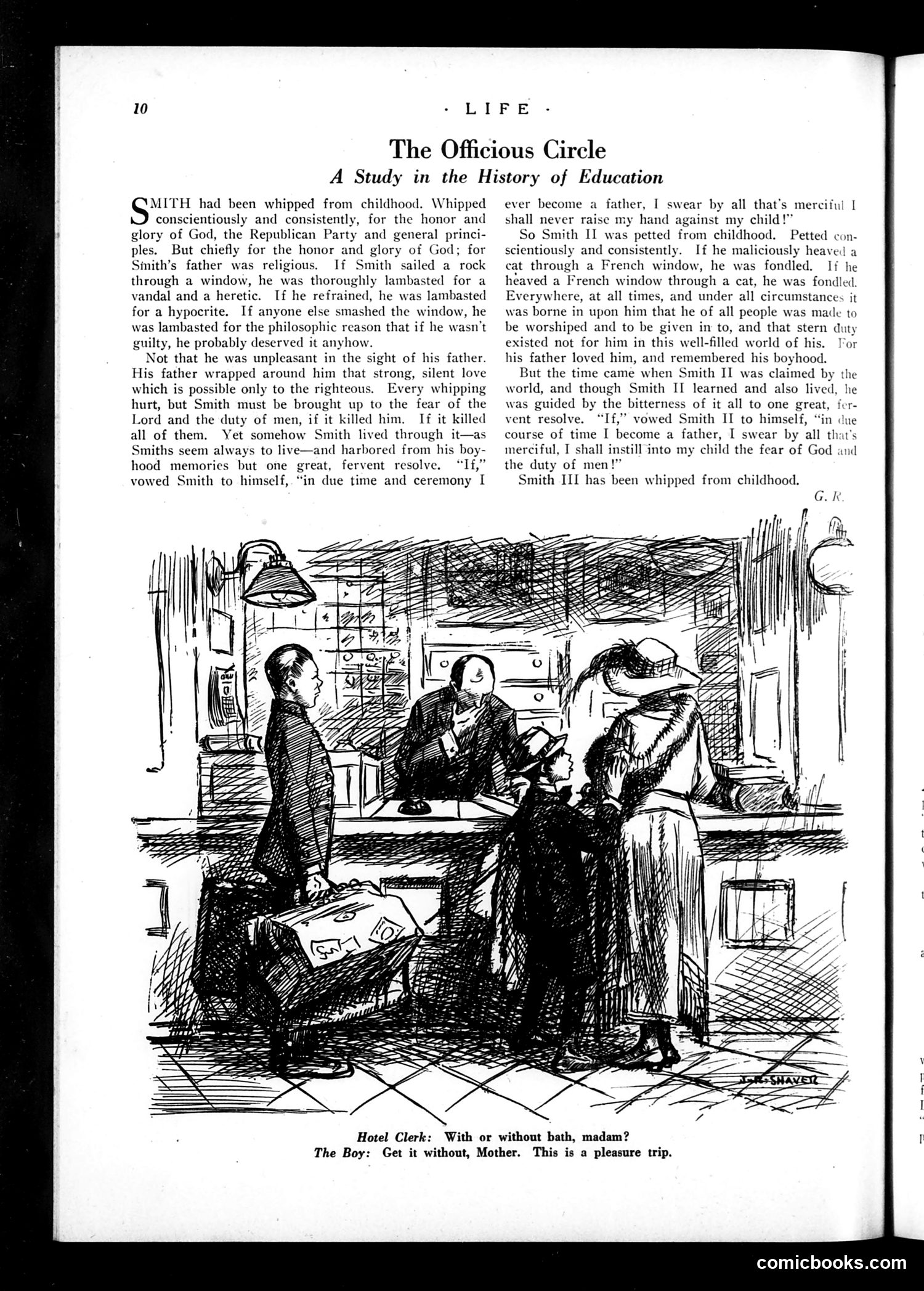
This page satirizes corporal punishment in child-rearing. The text describes how "Smith" was "whipped from childhood" for religious and patriotic reasons, then perpetuated this cycle by whipping his own son (Smith II), who in turn whips his son (Smith III). The cartoon depicts a hotel scene where a boy tells his mother he wants a room "without" a bath on their "pleasure trip"—likely a joke about avoiding bathing facilities, reflecting period anxieties about hygiene or modesty. The satire critiques how violent parenting practices become hereditary, passed down through generations as normalized "duty," while the cartoon's domestic humor contrasts the article's serious examination of educational brutality.
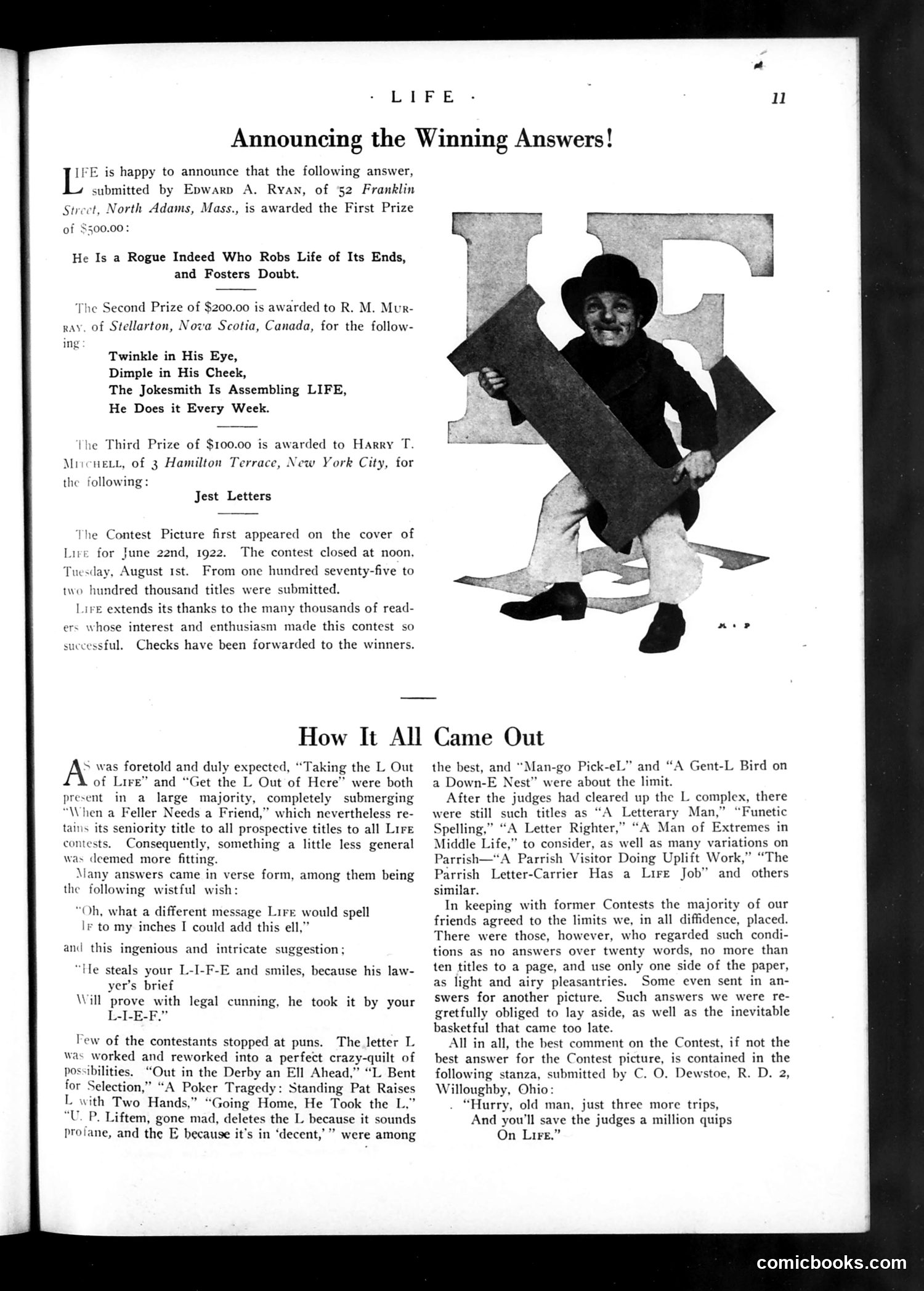
This page announces winners of a Life magazine contest from June-August 1922, where readers submitted clever titles for a contest picture featuring a large letter "L." The winning answers play on the letter's shape and sound: **First Prize:** "He Is a Rogue Indeed Who Robs Life of Its Ends, and Fosters Doubt" — a moralistic title about character. **Second Prize:** A playful answer using the letter L in wordplay ("Twinkle in His Eye, Dimple in His Cheek, The Jokesmith Is Assembling LIFE"). **Third Prize:** "Jest Letters" — a pun on the letter L sounding like "jest" (jokes). The cartoon shows a figure in old-fashioned dress holding the giant letter, likely representing the visual puzzle readers were solving. The contest attracted 175-200,000 submissions, demonstrating the magazine's popularity and reader engagement with wordplay-based humor typical of 1920s satirical publications.
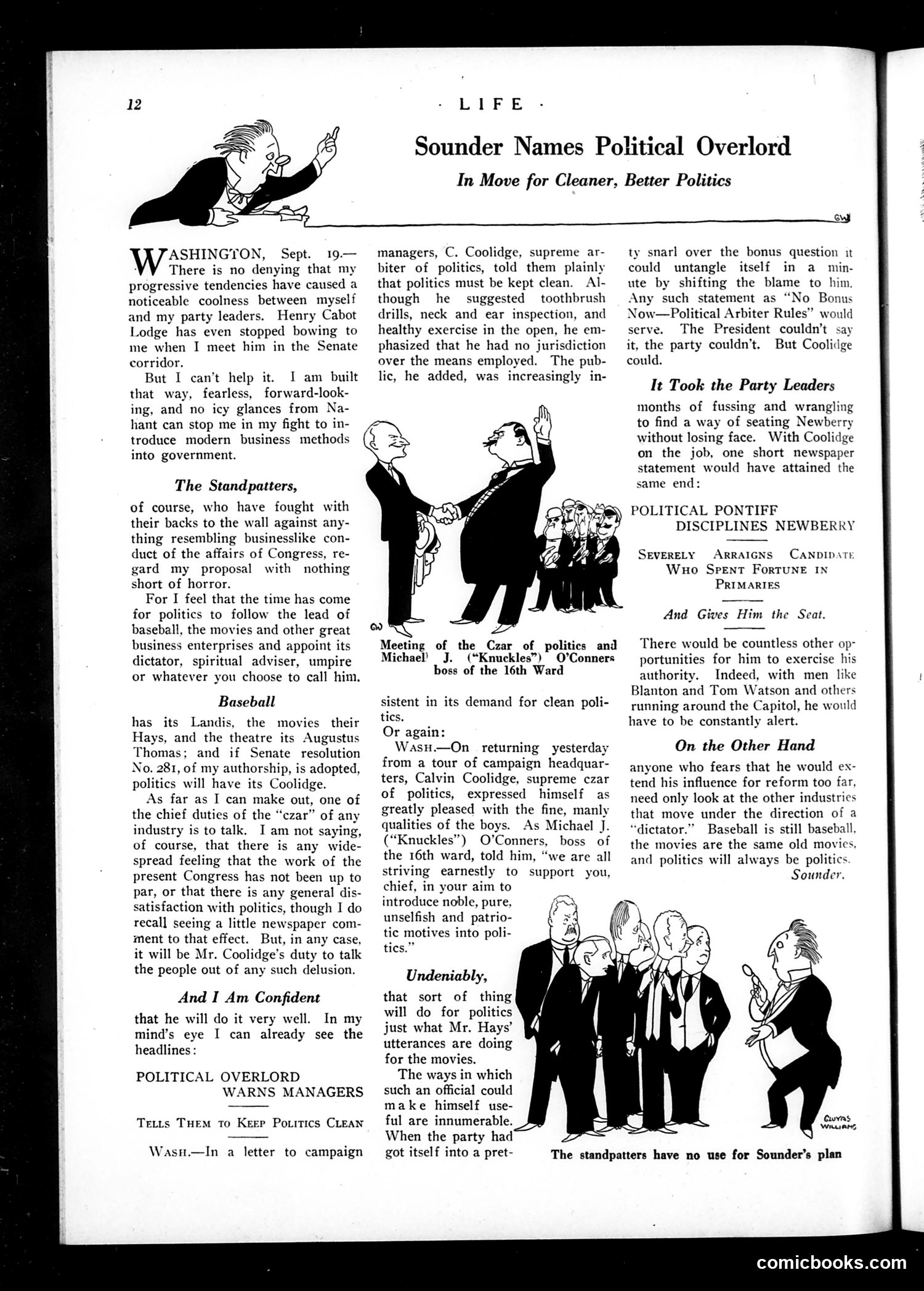
This Life magazine article by "Sounder" satirizes efforts to clean up politics. Senator Henry Cabot Lodge is criticized for promoting "modern business methods" in government—a trendy progressive reform idea. The main cartoon shows political bosses ("the Czar of politics" and "Knuckles" O'Conners, a ward boss) shaking hands while party workers cluster nearby. The satire: Sounder proposes appointing a "political adviser" or "dictator" to enforce clean politics, comparing it to baseball's management structure. The joke is the absurdity of fighting corruption by installing a political overlord—it would just create another corrupt power center. The "standpatters" (conservative Republicans opposing reform) correctly see the plan's futility. Sounder ironically suggests politicians should adopt integrity like movie studio executives do—implying even Hollywood is cleaner than politics.
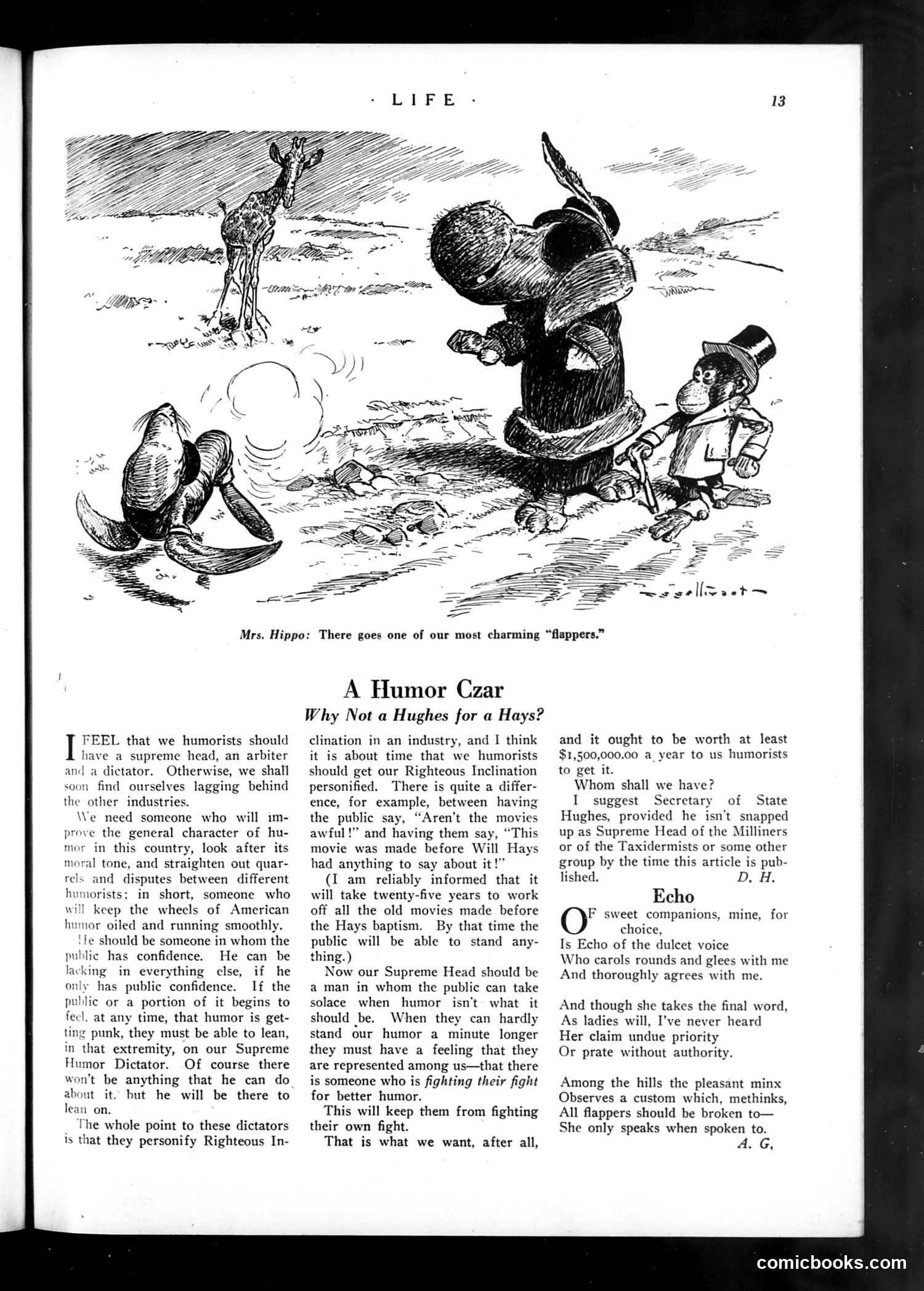
The cartoon depicts anthropomorphic animals—a hippo, giraffe, and monkey in formal dress—in an African savanna setting. Mrs. Hippo remarks that one character is "one of our most charming 'flappers.'" The accompanying article, "A Humor Czar: Why Not a Hughes for a Hays?" proposes creating a supreme authority figure to regulate American humor and resolve disputes between humorists. The author suggests this "Humor Dictator" should possess public confidence and keep humorists "fighting their fight" for better comedy. The cartoon appears to satirize this concept by showing animals as refined society members—likely mocking the idea that artificial authority could govern something as natural and organic as humor. The reference to "flappers" (1920s slang for modern women) dates this piece to that era.
This page discusses the "Curry Bill," a military reform measure then before Congress that would reduce officer numbers and restructure army ranks. The article criticizes the bill as poorly conceived, arguing it creates "hard cases" and lacks American justice. The page also addresses labor strikes, particularly railroad strikes, suggesting government ownership might resolve such disputes better than private management. A small illustration shows figures in conversation, likely representing workers or strikers. The piece concludes by defending the current administration's handling of labor matters, asserting that government management of railroads (recently returned to private control) has proven competent—contrary to critics who claimed only private managers could run them effectively.
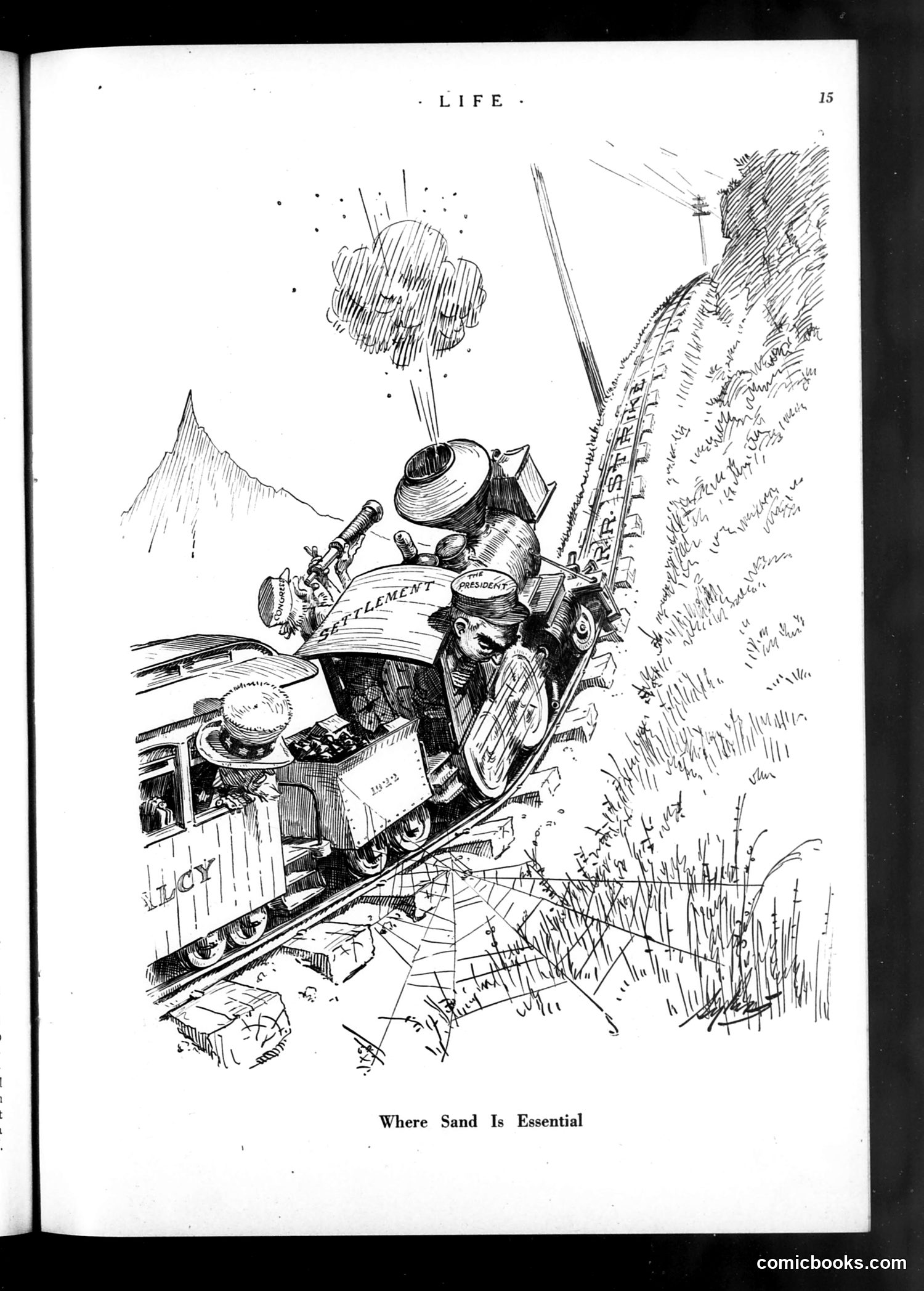
This political cartoon depicts a small train labeled "Settlement" climbing a steep, sandy mountain slope. The train is heavily loaded with supplies and equipment, struggling upward while spewing smoke. The caption suggests this represents efforts to establish settlements in desert or sandy terrain where such conditions are unavoidable. Without additional context, the specific settlement being referenced is unclear—it could relate to Western expansion, colonial ventures, or early 20th-century development projects. The visual metaphor emphasizes the difficulty and resource-intensive nature of establishing communities in inhospitable landscapes where sand literally becomes an essential component of survival and infrastructure. The satirical tone suggests critique of ambitious settlement schemes underestimating environmental challenges.
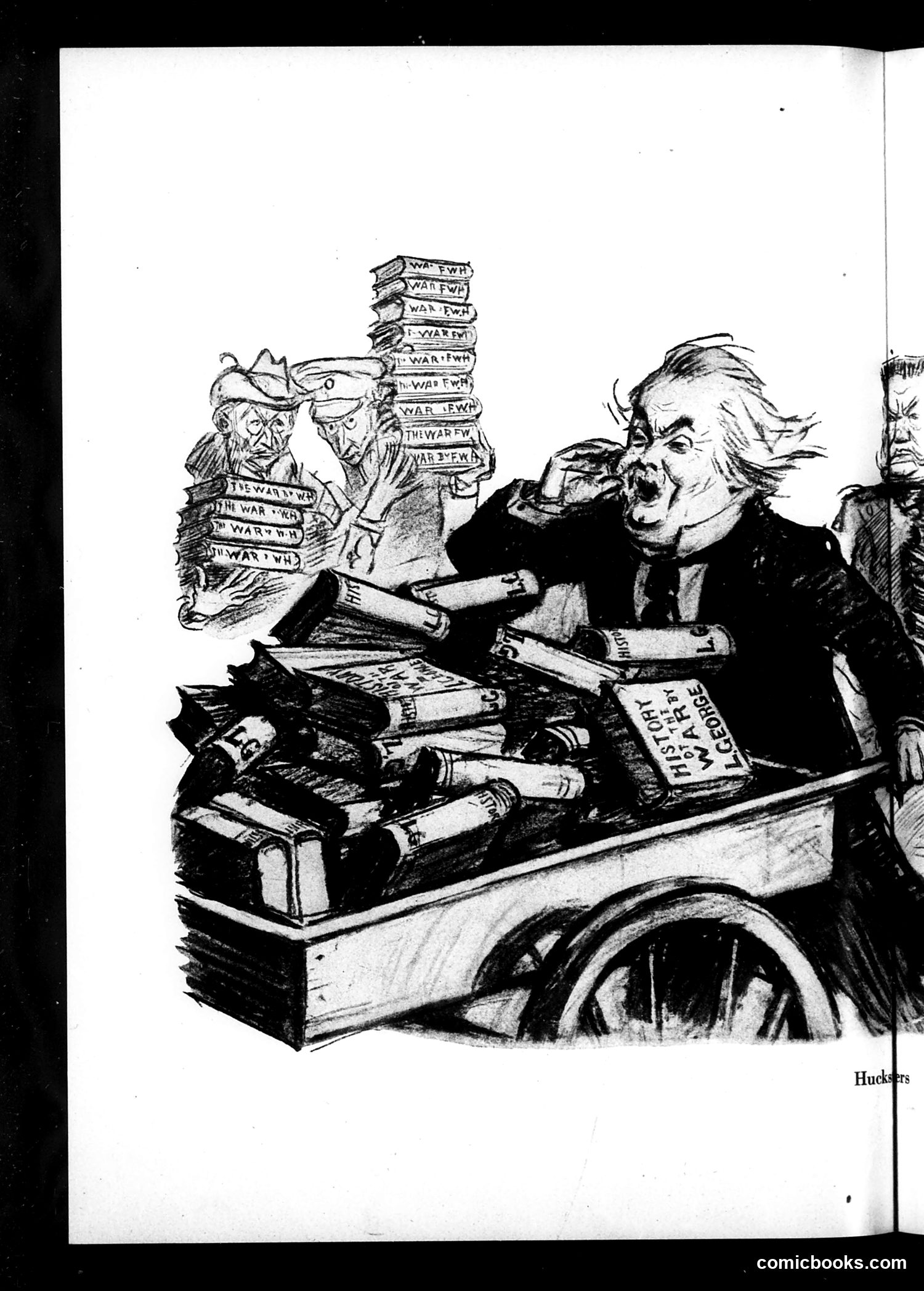
This is a satirical cartoon signed "Huckers" depicting profiteering from war. The central figure—an aggressive caricature with exaggerated features—sits at a cart laden with ammunition and military supplies labeled "WAR" repeatedly. He appears to be a war profiteer or munitions dealer, gleefully selling implements of destruction. The two gaunt figures on the left, stacked with "WAR" labels, likely represent soldiers or nations being consumed by endless conflict. The cartoon criticizes those who profit financially from warfare while ordinary people suffer its consequences. The style and subject matter suggest this cartoon addresses concerns about armaments manufacturers and their role in perpetuating or encouraging war—a recurring theme in early 20th-century American satirical publications.
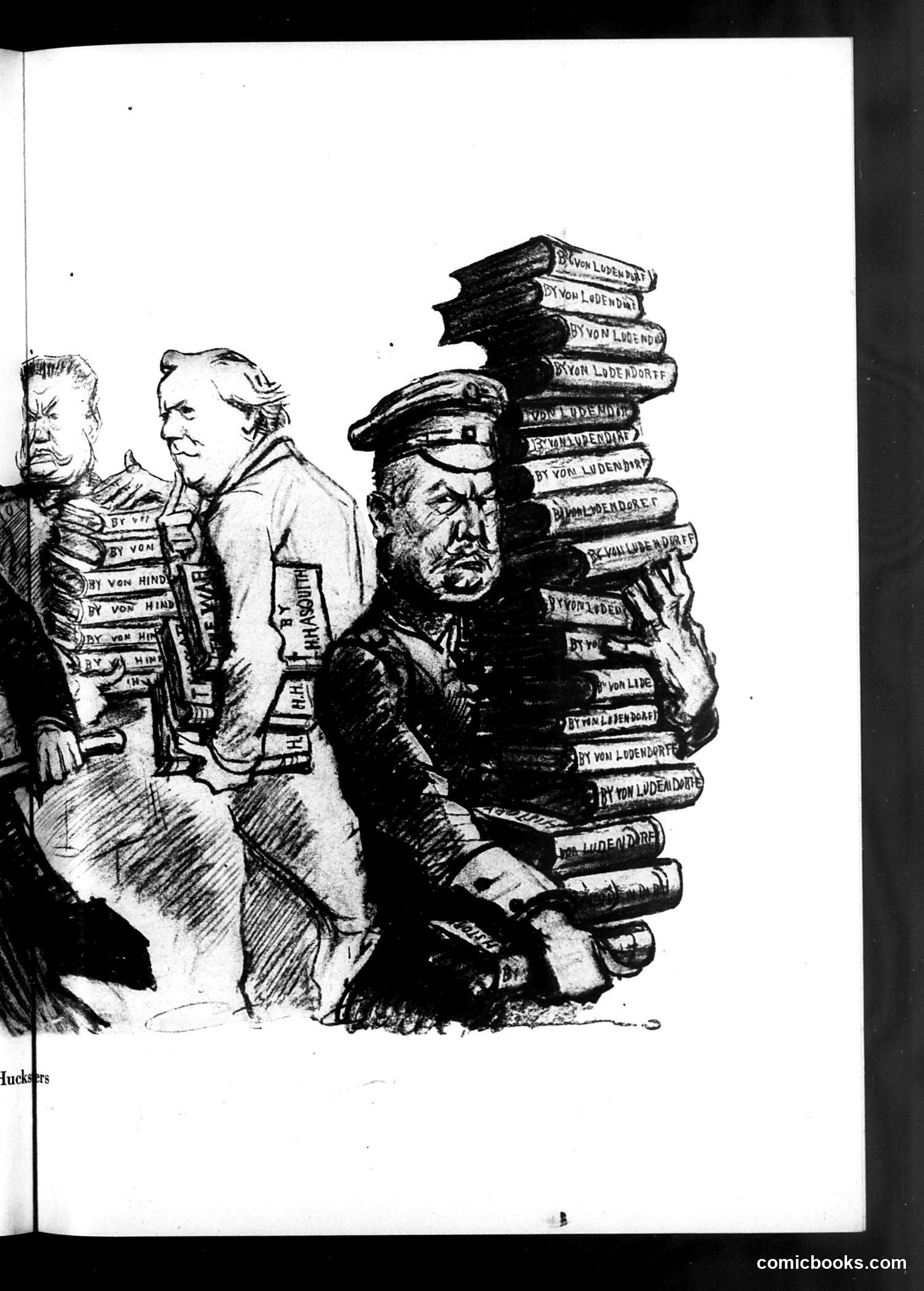
This appears to be a German satirical cartoon, likely from the early 20th century, showing three figures carrying stacks of books labeled "BY VON LUDENDROFF" (appearing to reference General Ludendorff). The satire mocks the proliferation of writings—possibly memoirs, propaganda, or self-justifications—by this military figure. The exaggerated stacks suggest an absurd overproduction of works, likely commenting on Ludendorff's attempts to control his public image or narrative after World War I. The three figures carrying these books may represent different segments (military, civilian leadership, or media) all burdened by propagating his message. The cartoon's point appears to be: criticism of excessive self-promotion or narrative-spinning by a controversial military leader through mass publication.
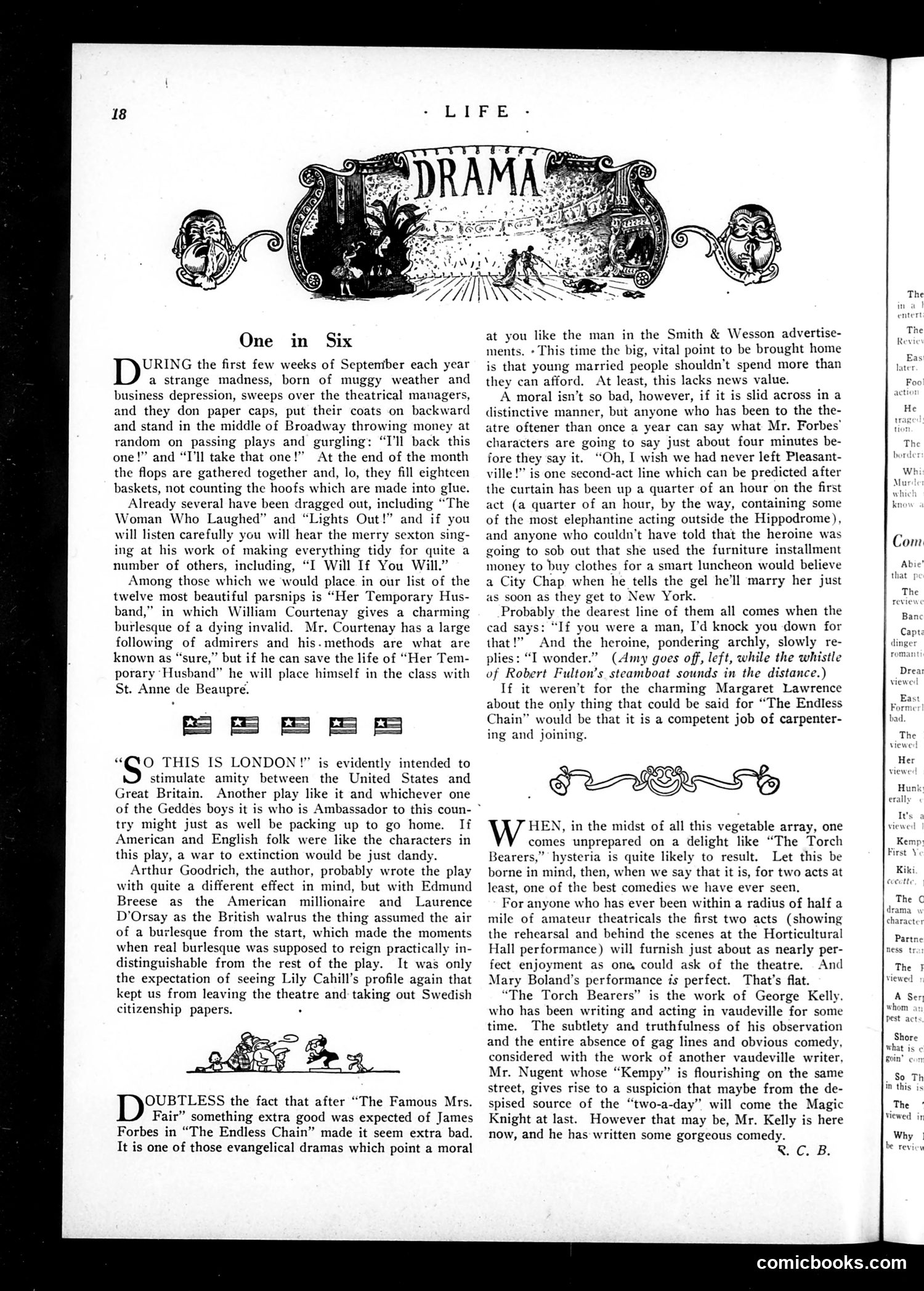
This page reviews several Broadway plays from early September (likely 1920s-era, based on style). The title "One in Six" sarcastically refers to theatrical managers' September tradition of recklessly funding plays—only about one in six apparently succeeds. The reviews mock: 1. **"Her Temporary Husband"** – criticized for William Courtenay's overwrought dying-invalid performance 2. **"So This Is London!"** – intended to promote US-British friendship but backfires, with actor Laurence D'Orsay's portrayal making it unintentionally comedic burlesque 3. **"The Endless Chain"** – an evangelical melodrama preaching that newlyweds shouldn't overspend. The critic ridicules its predictable moralizing and clumsy dialogue The satire targets both bad playwriting and overacting. The reviewer's point: these plays fail because they're heavy-handed, obvious, and tedious—not because their moral messages are wrong, but because they deliver them so clumsily that the "serious" moments become accidentally funny.
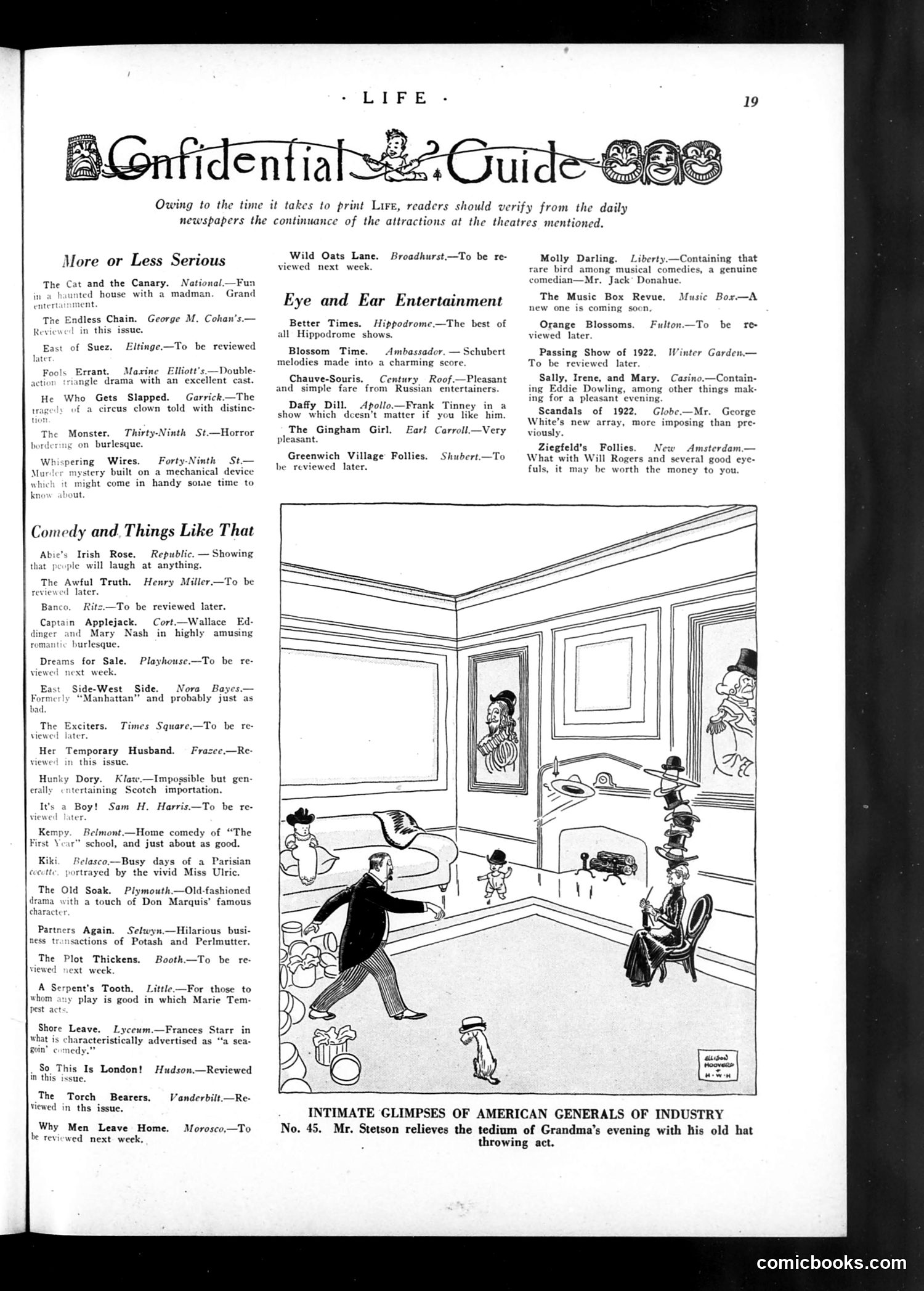
This page from *Life* magazine presents theatre reviews and a humorous cartoon titled "Intimate Glimpses of American Generals of Industry." The cartoon depicts Mr. Stetson entertaining his grandmother by throwing his hat around a crowded room full of children and figures in various poses. The caption suggests this simple hat-throwing act relieves the "tedium" of an elderly woman's evening. The satire here mocks wealthy industrialists ("Generals of Industry") by suggesting their entertainment value is trivial and childish—that a rich businessman's idea of amusement is reduced to performing basic physical comedy with a hat. This is likely satirizing the gap between the supposed importance and sophistication of industrial magnates and their actual capacity to entertain or contribute culturally. The page's left side is devoted to Broadway theatre listings and reviews from 1922, typical content for *Life*'s leisure-focused readership.
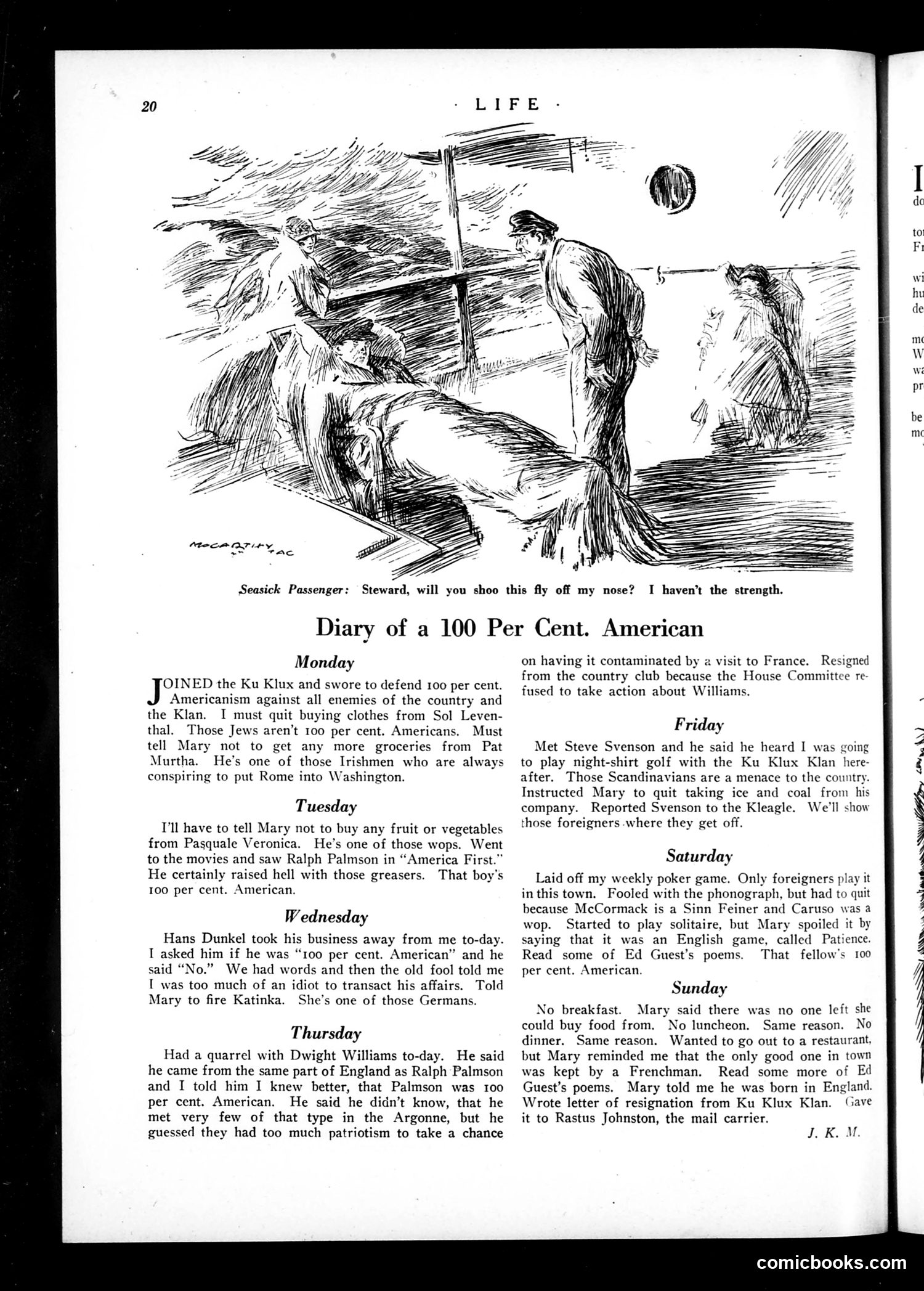
This satirical piece mocks the Ku Klux Klan and nativist "100% Americanism" movement of the 1920s. The narrator joins the KKK and obsessively purges his life of anyone deemed insufficiently American—firing Jewish, Irish, Italian, and German employees and service providers based solely on ethnicity. The satire's punch comes in the ending: by Sunday, having eliminated all "foreign" contacts, the narrator finds himself unable to eat, be entertained, or function. Even reading poet Ed Guest backfires when he's revealed as English-born. The narrator's final resignation from the Klan suggests the absurdity and self-defeating nature of such exclusionary ideology. The cartoon above depicts a seasick passenger too weak to swat a fly—visual commentary on the weakness or desperation underlying such prejudice. The piece critiques how ethnic and religious discrimination ultimately harms the discriminator, not the targets.
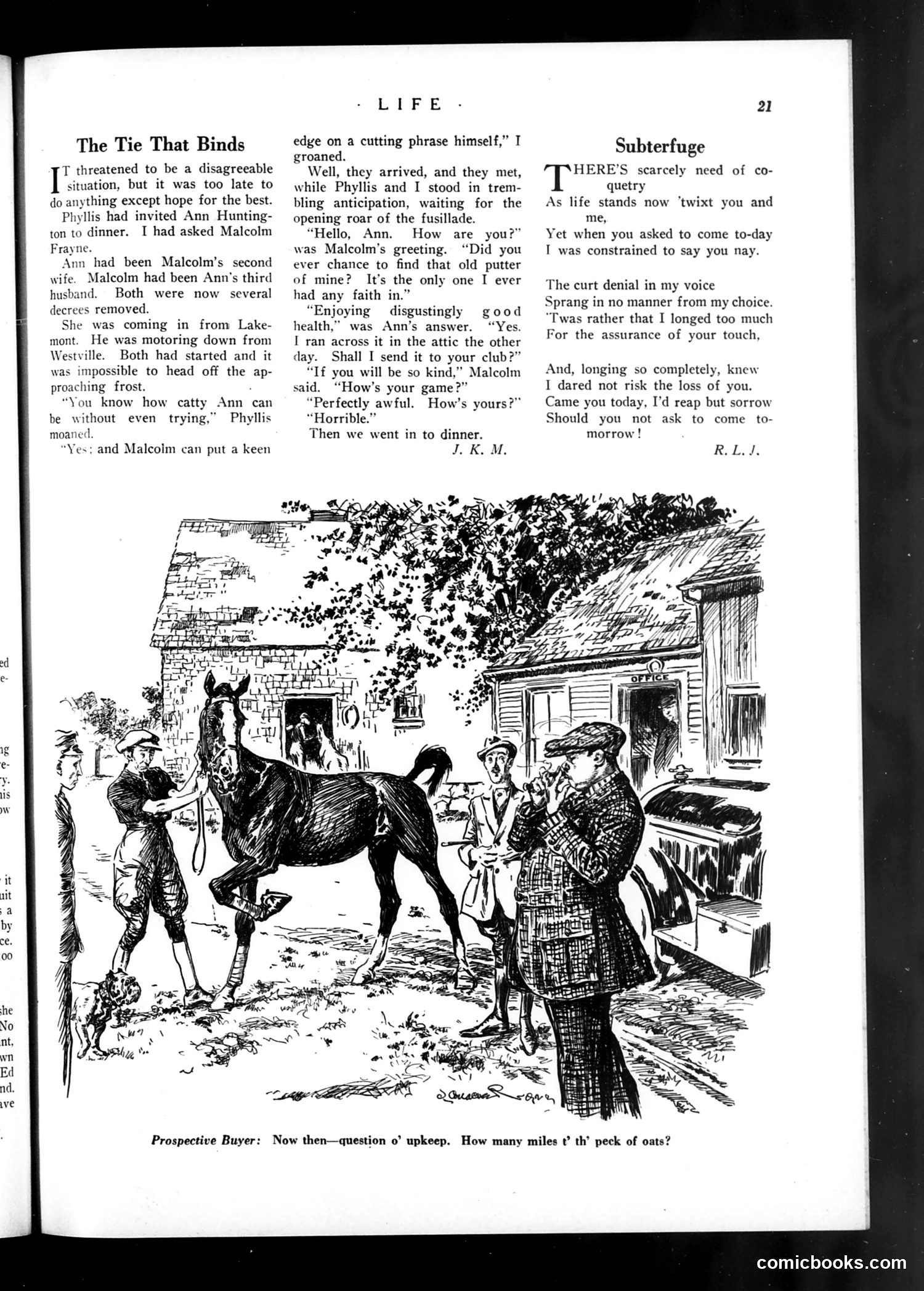
This page contains two distinct pieces of satirical content: **"The Tie That Binds"** (prose story): A humorous account of social anxiety. The narrator fears an uncomfortable dinner when two ex-spouses—Ann (Malcolm's second wife, his third husband) —unexpectedly meet at a dinner party. The satire mocks the anticipated drama and "catty" behavior, only to subvert expectations: the ex-couple greet each other politely, discussing a golf putter with forced civility. The joke is that their awkwardness manifests as tedious small talk rather than the "fusillade" of insults anticipated. **"Subterfuge"** (poem): A romantic piece about emotional vulnerability and feigned indifference. **Bottom cartoon**: Shows a prospective buyer negotiating a horse purchase, asking how many miles of oats the horse consumes per peck—a nonsensical question that satirizes ignorant or confused buyers haggling over livestock care. The humor lies in the absurd conflation of distance and feed measurements.
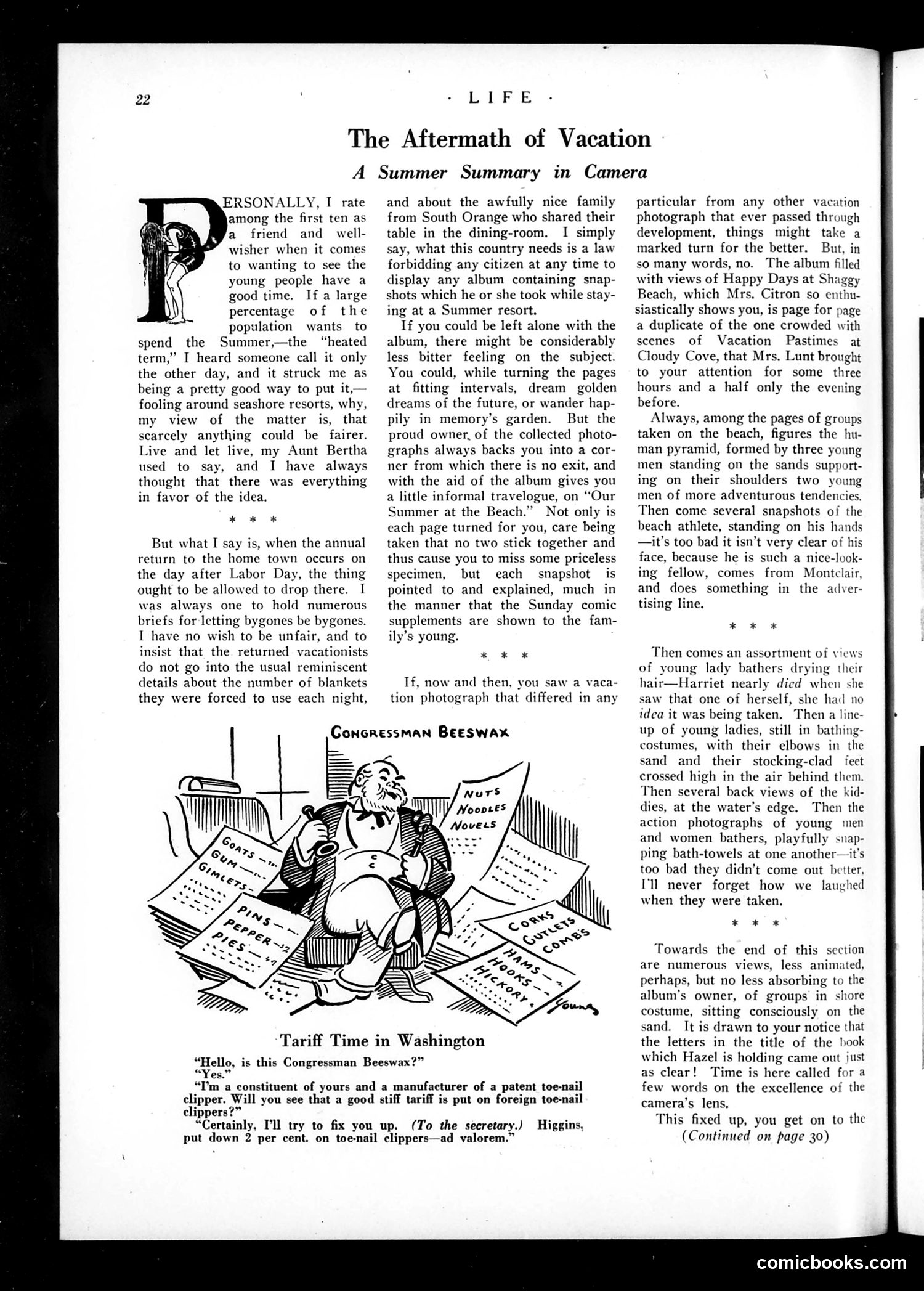
## Main Article: "The Aftermath of Vacation" The author satirizes the social ritual of returning vacationers boring non-travelers with their photo albums. The piece humorously condemns citizens who force guests to endure endless vacation photographs while providing tedious explanations—compared to showing Sunday comic supplements to children. The author proposes a law banning vacation photo display, acknowledging that viewing them alone might be pleasant, but communal viewing is torture. The satire targets the predictability of vacation photos: identical beach scenes across different resorts, mandatory human pyramids, beach athletes doing handstands, and vain ladies photographed drying their hair. ## Political Cartoon: "Congressman Beeswax" This cartoon satirizes tariff lobbying and political corruption. A constituent (a toe-nail clipper manufacturer) calls his congressman requesting a protective tariff on foreign clippers. The congressman casually agrees, instructing his secretary to "put down 2 per cent." This mocks how easily congressmen grant special-interest requests without serious consideration—depicted as a trivial, bureaucratic transaction—illustrating corruption in the tariff system.
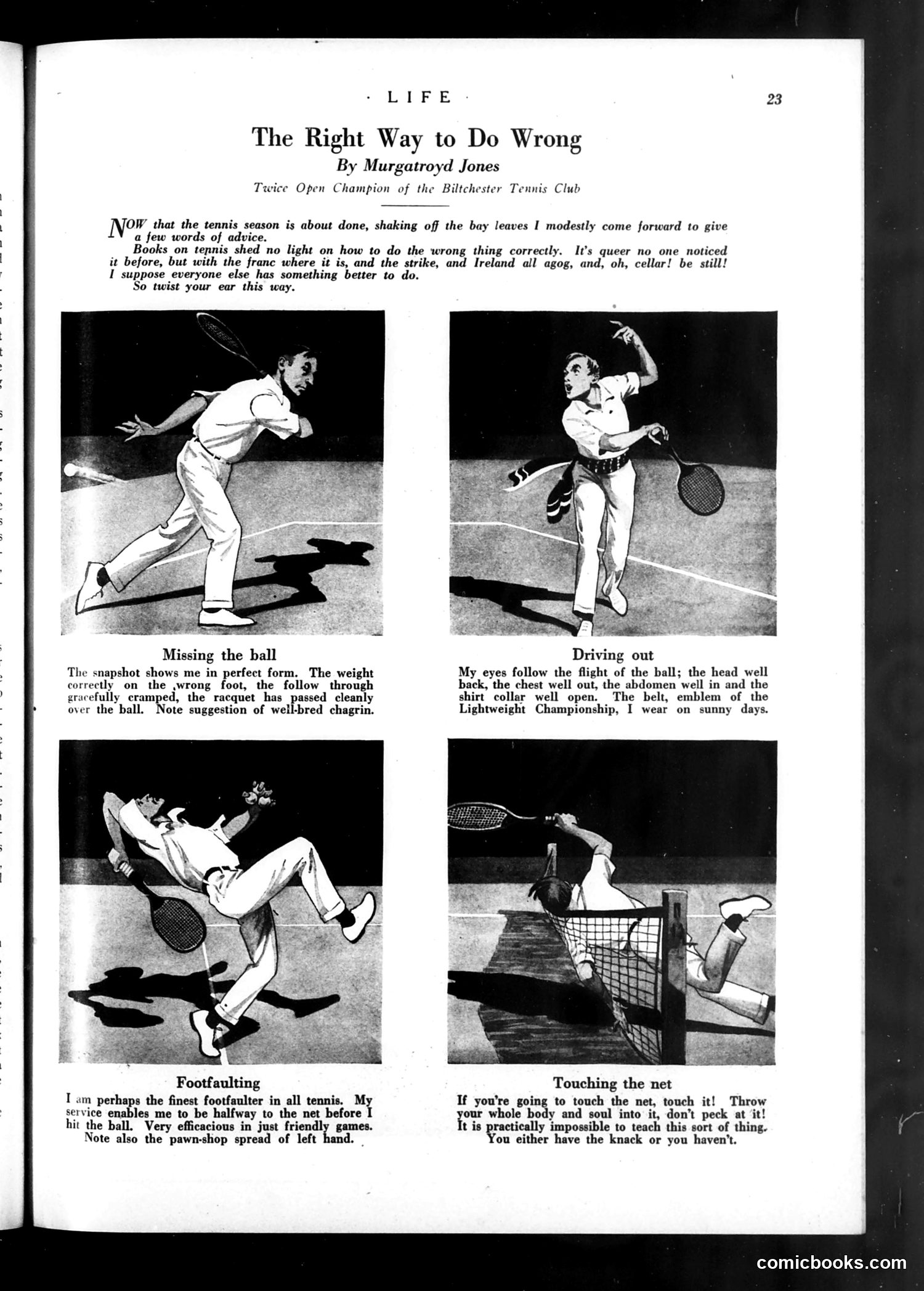
This is a humorous instructional article with photographs demonstrating deliberately *incorrect* tennis techniques. The author, presenting himself as a champion player, ironically offers advice on how to perform wrong moves with style and conviction. The four demonstrated faults are: - **Missing the ball**: maintaining poor form while failing to connect - **Driving out**: hitting beyond the court boundaries with apparent confidence - **Footfaulting**: serving illegally by stepping into the baseline - **Touching the net**: physically contacting the net during play (illegal) The satire works on multiple levels: the author's self-importance ("finest footfaulter"), the detailed instruction on rule violations, and the deadpan observation that "if you're going to do something wrong, do it completely." The opening reference to "the franc where it is, and the strike, and Ireland all agog" suggests this appeared during post-WWI economic turmoil and Irish independence tensions, making the article's focus on tennis triviality itself part of the humor—offering advice about doing things "wrong correctly" amid serious real-world problems.
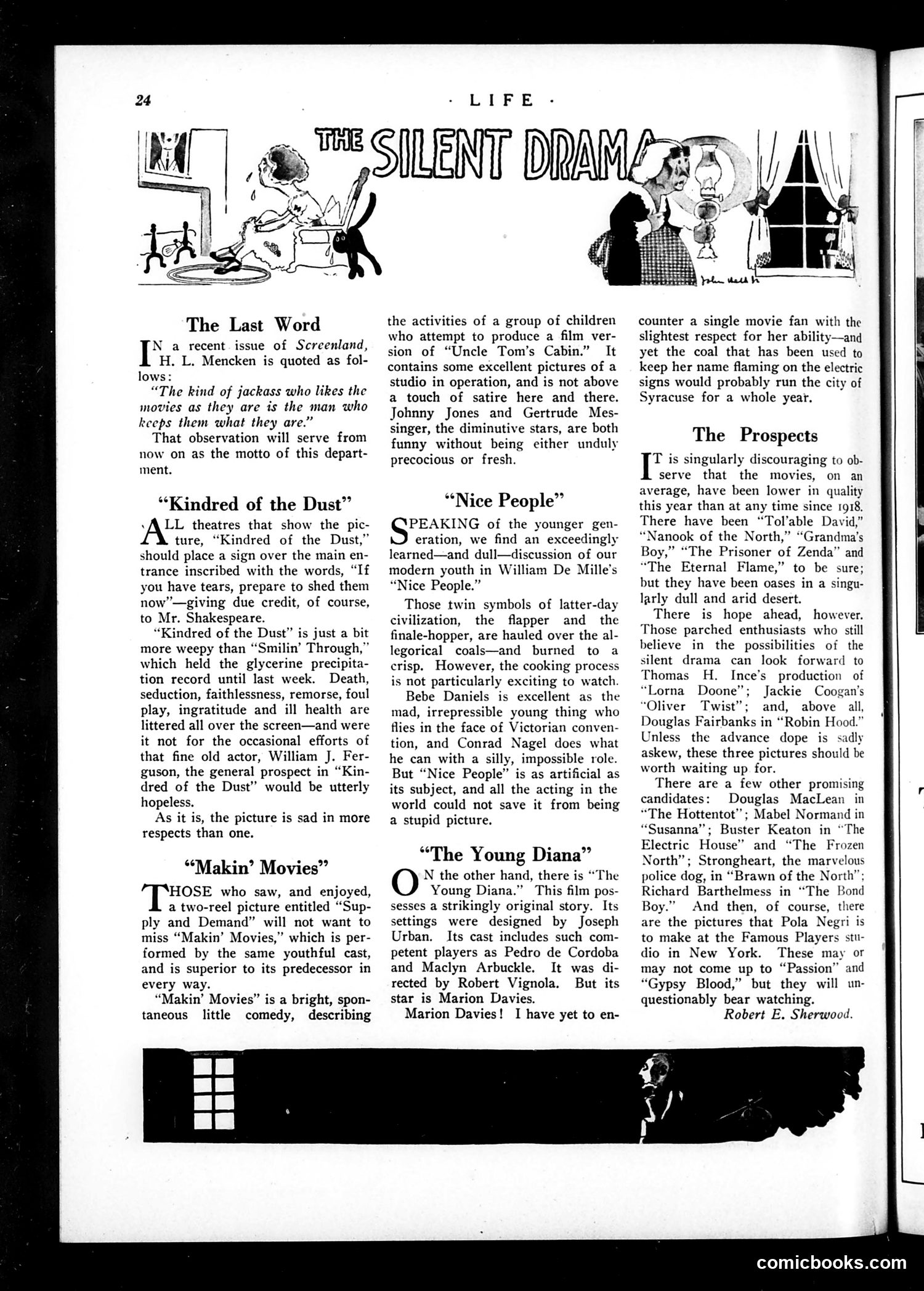
This page critiques early 1920s silent films through reviews of specific movies. The satirical editor opens with H.L. Mencken's observation that audiences enable poor filmmaking by accepting mediocre movies. The reviews mock contemporary cinema's melodramatic excesses: "Kindred of the Dust" is criticized as excessively tearful (compared to "Smilin' Through"), while "Nice People" is called an artificial, dull examination of flappers and modern youth. "The Young Diana," despite quality production design and direction, is derided primarily for starring Marion Davies—whom the critic sarcastically notes receives no respect despite massive promotion costs. The "Prospects" section expresses cautious optimism, acknowledging rare quality films like "Tol'able David" and "Nanook of the North," while anticipating promising upcoming releases with established stars (Douglas Fairbanks, Jackie Coogan). Overall, the page reflects 1920s film-industry criticism: frustration with industry pandering, excessive sentimentality, and star-power trumping talent.
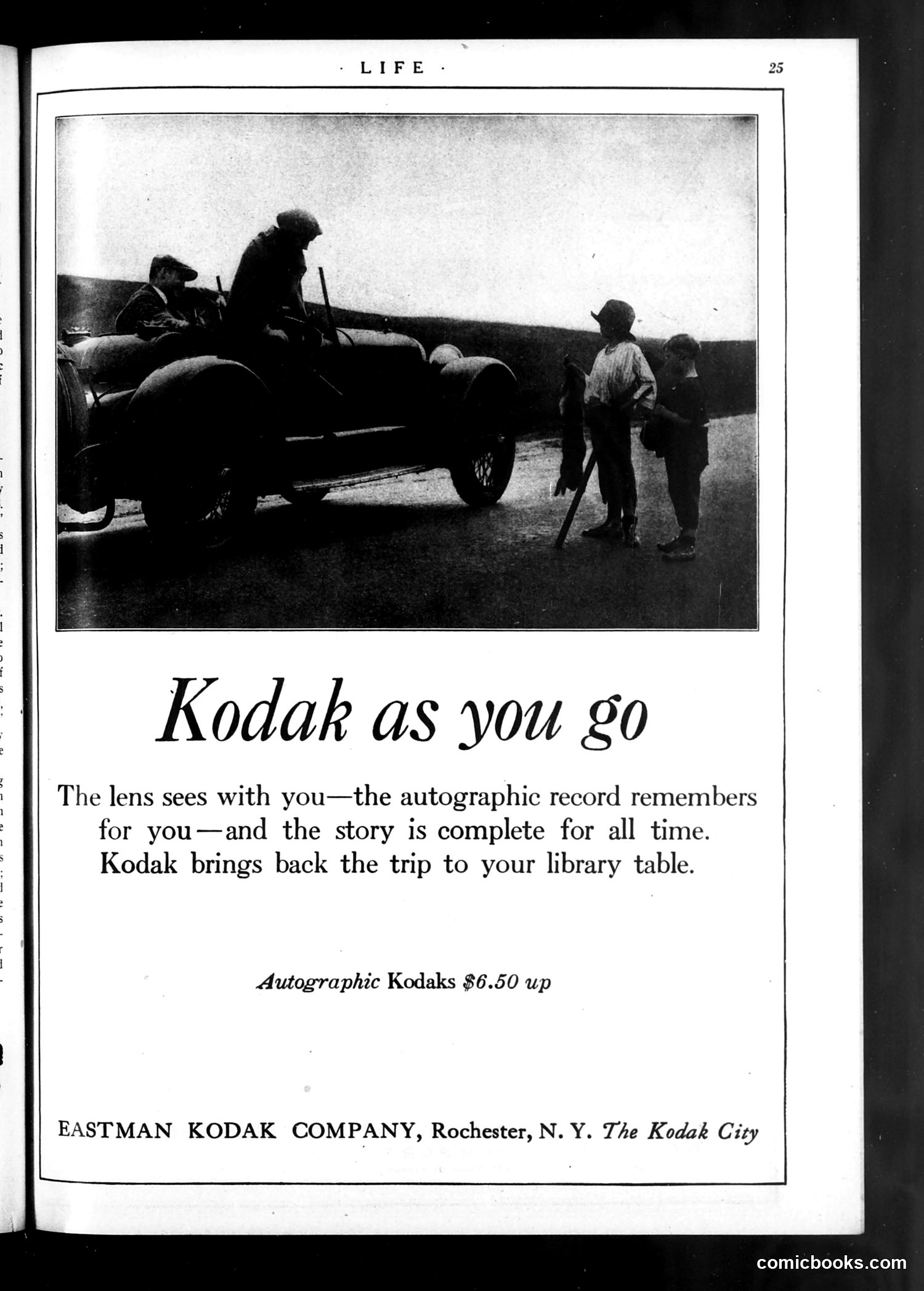
This is a **full-page advertisement**, not political satire or a cartoon. It promotes Eastman Kodak's "Autographic" camera line to *Life* magazine readers. The photograph shows a touring car with passengers stopped roadside, with children nearby—depicting leisure travel and family activities. The ad's appeal is straightforward: Kodak cameras allow ordinary people to document their experiences automatically and preserve memories permanently for home viewing. The phrase "autographic record" refers to Kodak's patented technology allowing users to write dates and notes directly onto film. The messaging targets middle-class Americans' growing leisure culture and travel habits in the early 20th century, positioning photography as essential for preserving family moments. The $6.50 price point ($230+ in modern currency) indicates this was marketed to relatively affluent consumers.
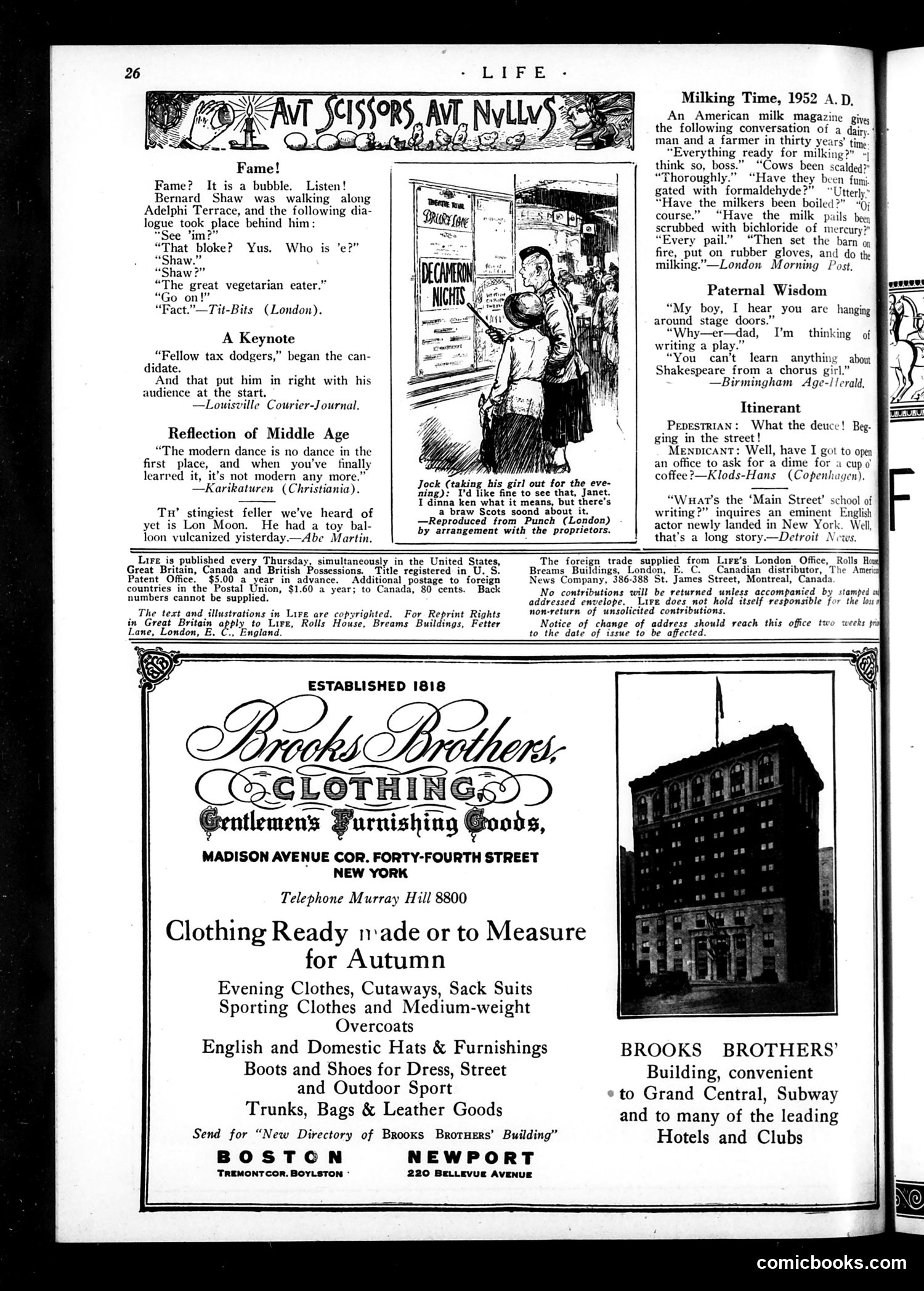
This cartoon satirizes the anticipated over-mechanization and bureaucratic obsession with sanitization in future dairy farming. A farmer quizzes a dairyman with increasingly absurd hygiene questions: have cows been "scalded"? milk pails "scrubbed with bichloride of mercury"? milkers "boiled"? The joke targets 1952-era anxieties about industrial progress run amok—the assumption that future dairy production will become so chemically obsessed and procedure-heavy that basic common sense disappears. The dairyman's exhausted responses suggest the absurdity of treating cows and equipment like laboratory specimens rather than practical farm work. It's social satire about how modernization rhetoric, taken to extremes, produces ridiculous overcomplications of simple tasks. The "thirty years hence" framing allows the cartoonist to exaggerate contemporary trends for comic effect.
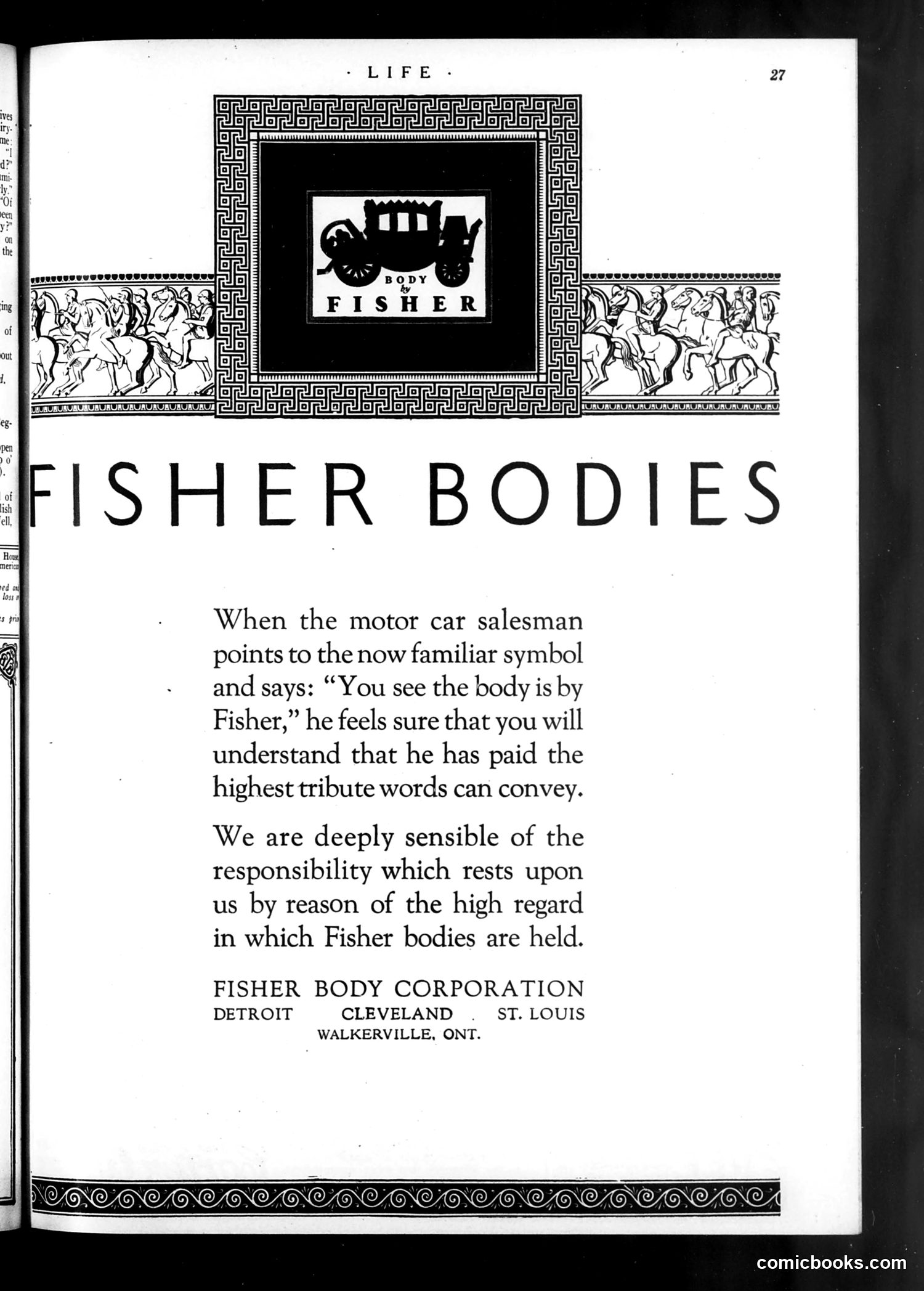
This is a corporate advertisement for Fisher Body Corporation, not political satire. It promotes automobile bodies manufactured by Fisher, emphasizing their prestige and quality. The text presents a scenario where car salesmen invoke "Fisher" as a mark of excellence—suggesting the brand name itself guarantees buyer confidence. The decorative border features classical Greek patterns and classical figures, while the Fisher logo depicts an ornate carriage. This classical framing positions Fisher bodies as inherently refined and valuable. The company lists manufacturing locations in Detroit, Cleveland, St. Louis, and Walkerville, Ontario. The ad conveys Fisher's message that their reputation for quality craftsmanship carries such weight that merely naming the manufacturer provides sufficient endorsement to customers.
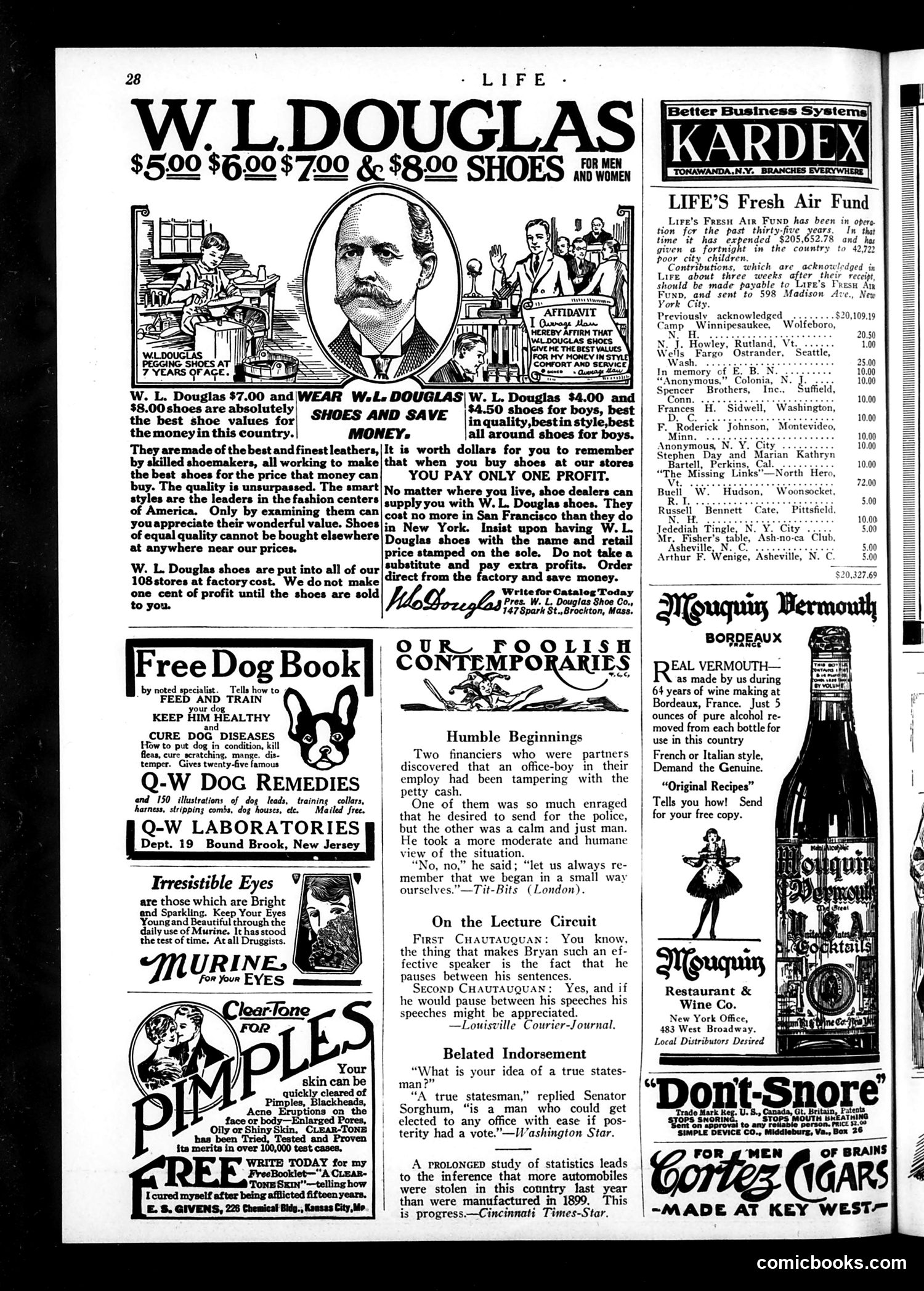
This page is primarily **advertising**, dominated by a large W.L. Douglas shoe company ad featuring the company founder's portrait. The ad emphasizes factory-direct sales and single-profit margins—a competitive claim against middlemen retailers. The small satirical pieces at bottom are typical *Life* humor: **"Humble Beginnings"** jokes that wealthy financiers rationalize an office boy stealing petty cash by romanticizing their own modest origins—deflating self-made-man mythology. **"On the Lecture Circuit"** mocks William Jennings Bryan (identifiable from context as "Bryan"), the famous Populist/Democratic speaker, suggesting his effectiveness comes from pauses between sentences rather than actual content. The joke implies his speeches lack substance. **"Belated Indorsement"** satirizes Senator "Sorghum" (a fictional politician type) defining a true statesman as someone who could win elections if only the dead could vote—commenting cynically on political corruption and nostalgia. The final item jokes that more automobiles were stolen than manufactured, treating crime as "progress"—ironic social commentary.
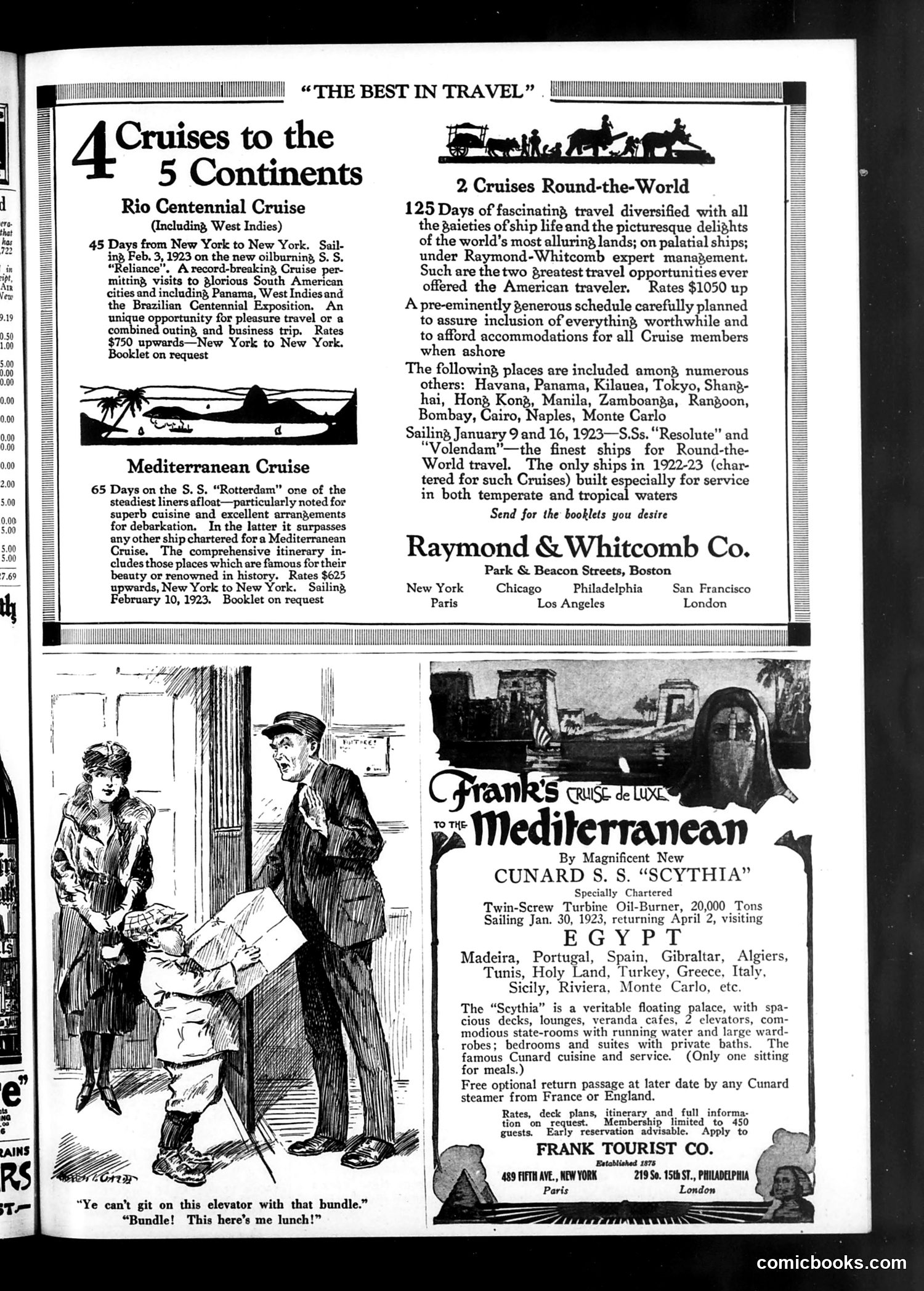
This page is primarily **travel advertising** for luxury cruises (1923), with one small cartoon for comic relief. ## The Cartoon The sketch shows a doorman and passenger at an elevator. The doorman refuses entry, saying the passenger can't board with "that bundle." The passenger protests it's his lunch, not luggage. **The joke**: It's a class-based gag about a working-class man carrying his lunch in a bundle—clearly out of place among wealthy cruise passengers. The humor mocks his appearance and assumption that the fancy hotel/ship elevator would permit such common, unglamorous behavior. It reflects 1920s attitudes about social hierarchy and the divide between wealthy travelers and working-class people. ## The Advertisements The bulk of the page advertises Raymond & Whitcomb cruises and Cunard's S.S. Scythia, emphasizing luxury accommodations, exotic destinations (Egypt, Mediterranean, round-the-world), and high prices ($625-$1050+). These ads target affluent Americans seeking prestigious leisure travel.
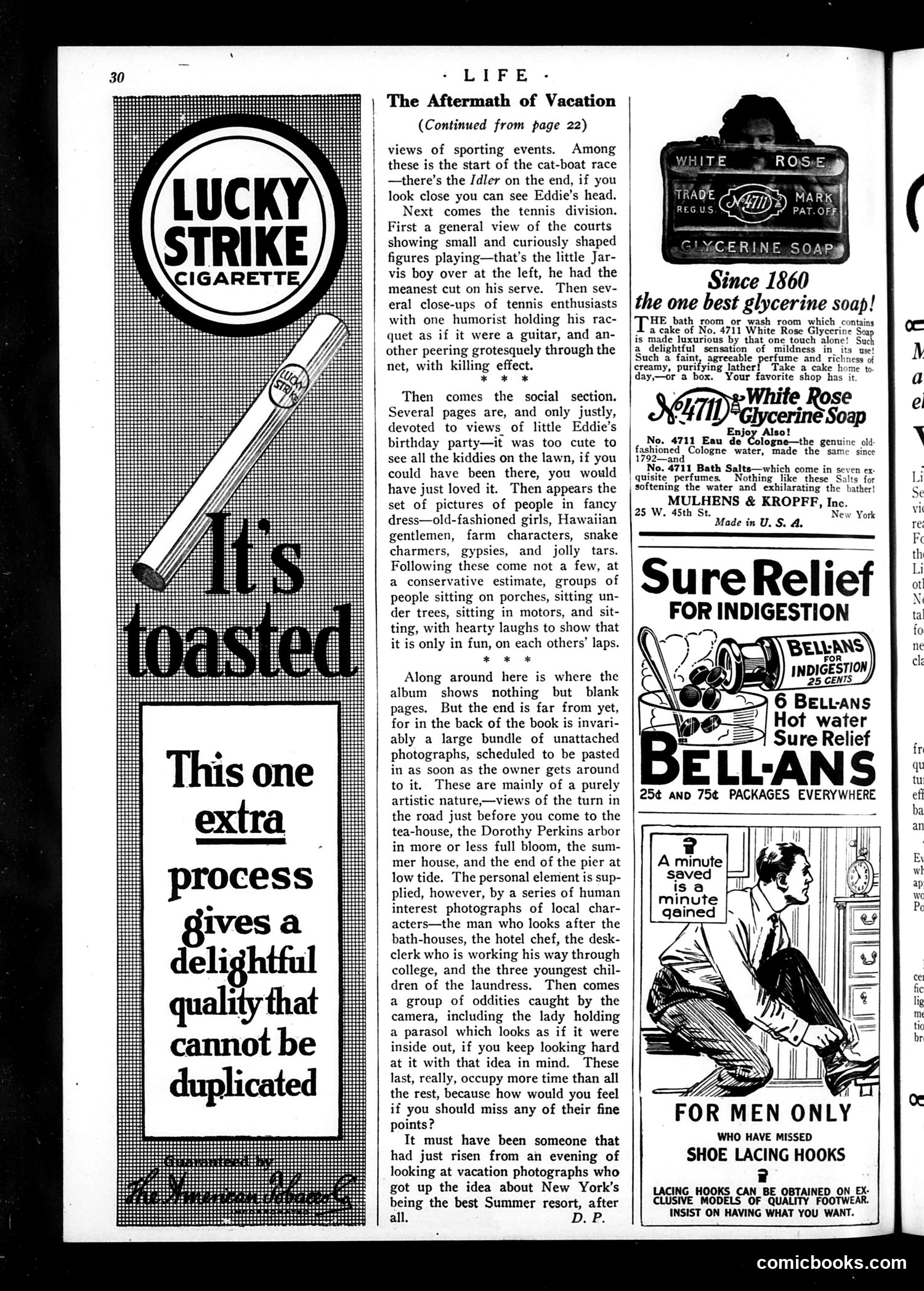
This satirical article mocks the tedium of vacation photo albums—a common early-20th-century social custom. The author humorously catalogs typical album contents: sporting events (sailboat races, tennis), children's birthday parties, costumed guests in "fancy dress," and countless porch/garden scenes. The joke builds to the article's point: vacation albums are padded with hundreds of nearly-identical photographs—parasol mishaps, landscape shots of tea-houses and piers—that the owner hasn't bothered organizing or pasting in yet. The author suggests these mundane images consume disproportionate viewer attention simply because viewers fear missing "fine points." The satire culminates with the revelation that someone looking at such tedious vacation photos concluded New York City was actually the best summer resort—implying that enduring photo albums makes anywhere else seem preferable. The article lampoons both the compulsive documentation of leisure activities and the social obligation to display and admire vacation photographs.
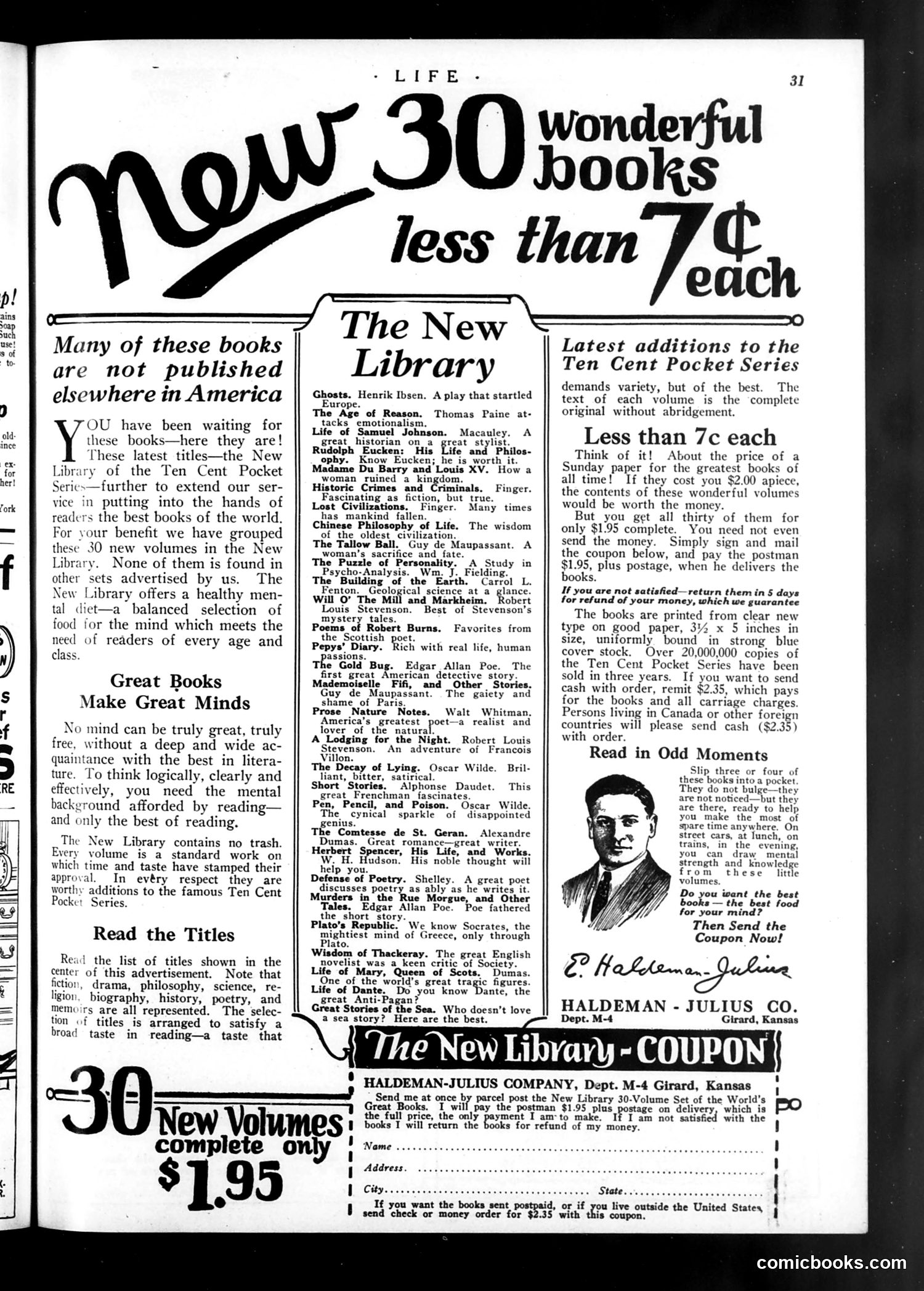
This is **not a cartoon or satirical content**—it's a straightforward advertisement from *Life* magazine for the Haldeman-Julius Company's budget book series. The ad promotes 30 classic literary works sold for less than 7¢ each through mail order. It appeals to middle-class readers by emphasizing that quality literature improves the mind: "Great Books Make Great Minds." The selection ranges across fiction, philosophy, history, and poetry—works by Poe, Wilde, Thackeray, Dumas, and others. The marketing pitch stresses affordability and accessibility: for $1.95, one could own all 30 volumes. A money-back guarantee and return policy are offered to reduce purchase risk. The portrait shown is likely the company founder or endorser. This reflects early 20th-century democratization of reading through cheap mass-market editions—making "high culture" available to working people, not just the wealthy.
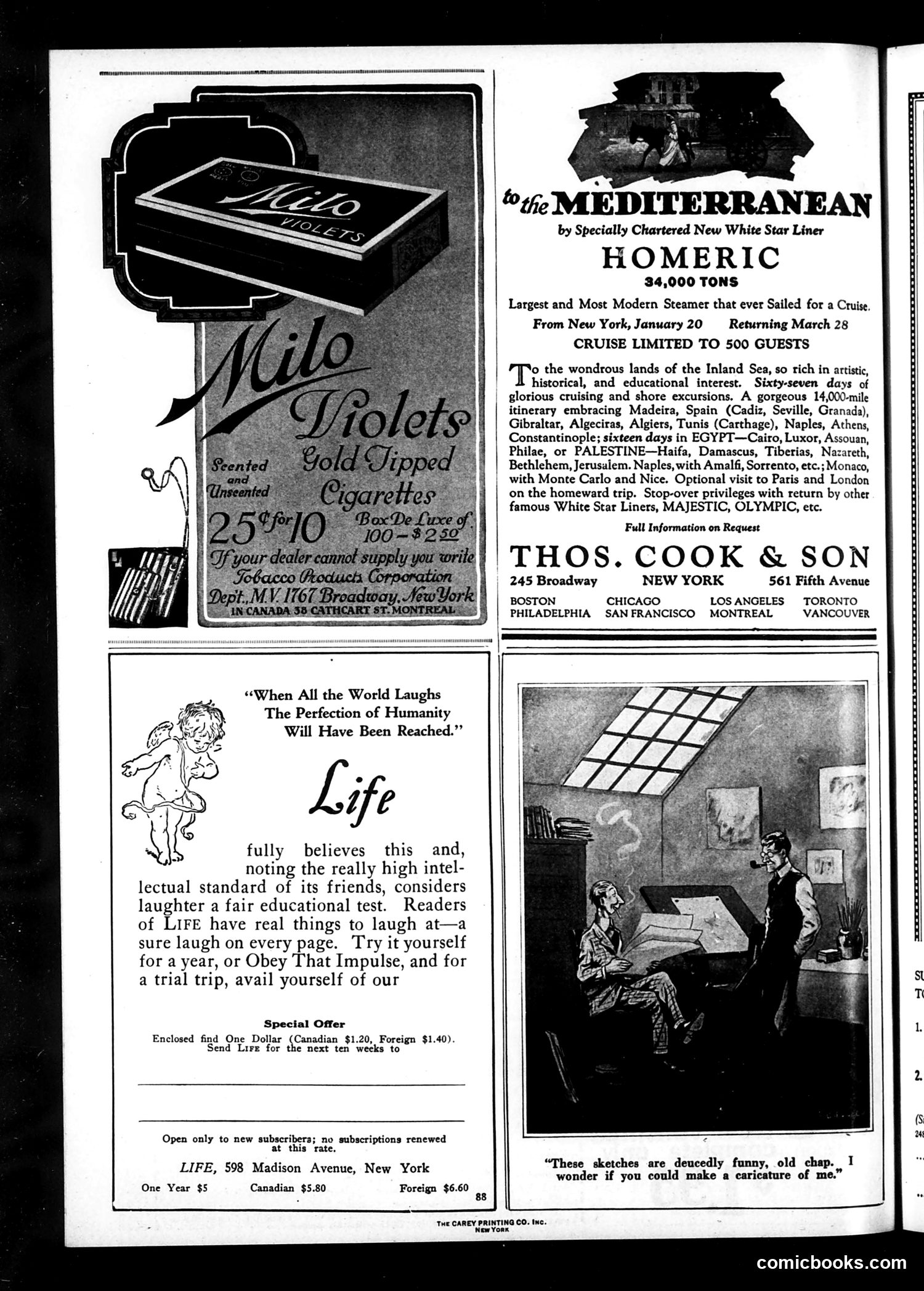
This page is primarily **advertising**, not political satire. It contains three main ads: 1. **Milo Violets** (top left): A cigarette advertisement for "Gold Tipped Cigarettes" at 25¢/10 or $2.32/box. 2. **Mediterranean Cruise** (top right): Thomas Cook & Son promotes a 67-day Mediterranean voyage aboard the White Star Liner *Homeric*, departing January 20, visiting Egypt, Palestine, Greece, and other historic sites. The cruise cost and exclusivity (500 guests maximum) suggest this targets wealthy readers. 3. **Life Magazine Subscription** (bottom left): Life promotes itself as an intellectual humor publication, offering a trial subscription for $1. 4. **Cartoon Panel** (bottom right): A single-panel cartoon shows two men examining artwork, with one saying "These sketches are deucedly funny, old chap. I wonder if you could make a caricature of me?" This is generic humor about artists and vanity, not political commentary. The page reflects early-20th-century consumer culture and leisure travel for the affluent.
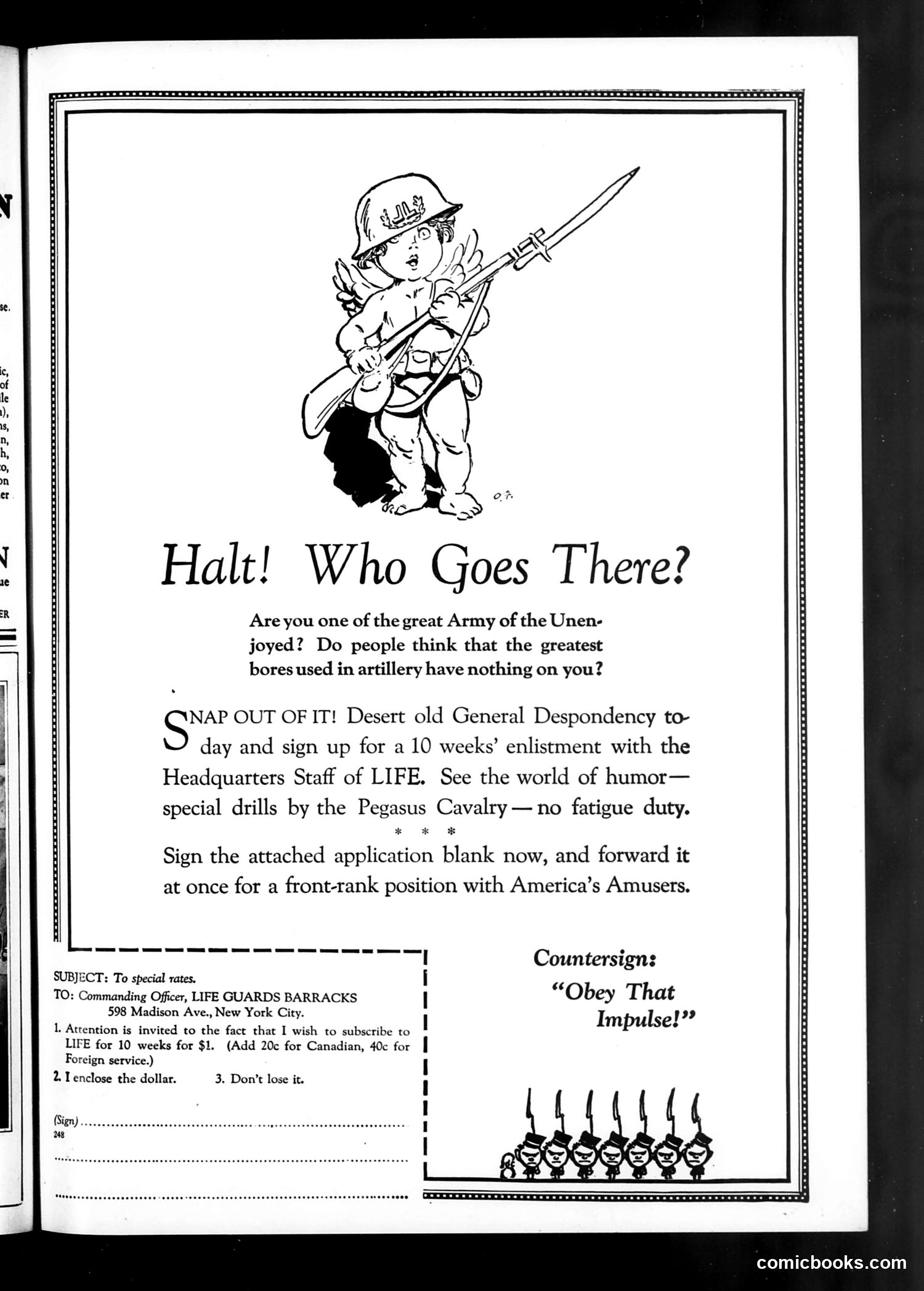
This is a subscription recruitment ad for *Life* magazine, disguised as military satire. The cartoon shows a child soldier with bayonet, playfully evoking WWI imagery. The ad targets bored, unhappy readers ("the Army of the Unenjoyed") by framing a magazine subscription as an amusing military enlistment. It promises escape from "General Despondency" through humor and satire—*Life's* core product. References to "Pegasus Cavalry" and "America's Amusers" emphasize the magazine's comedic mission. The bottom section is a mock official form treating subscription as a military application, complete with serious instructions ("Don't lose it"). This blends playful military tropes with the actual business of selling subscriptions ($1 for 10 weeks). For modern readers: this reflects *Life's* self-brand as a humor magazine offering intellectual escape during what appears to be the WWI era, using popular military imagery as an organizing metaphor for readership recruitment.
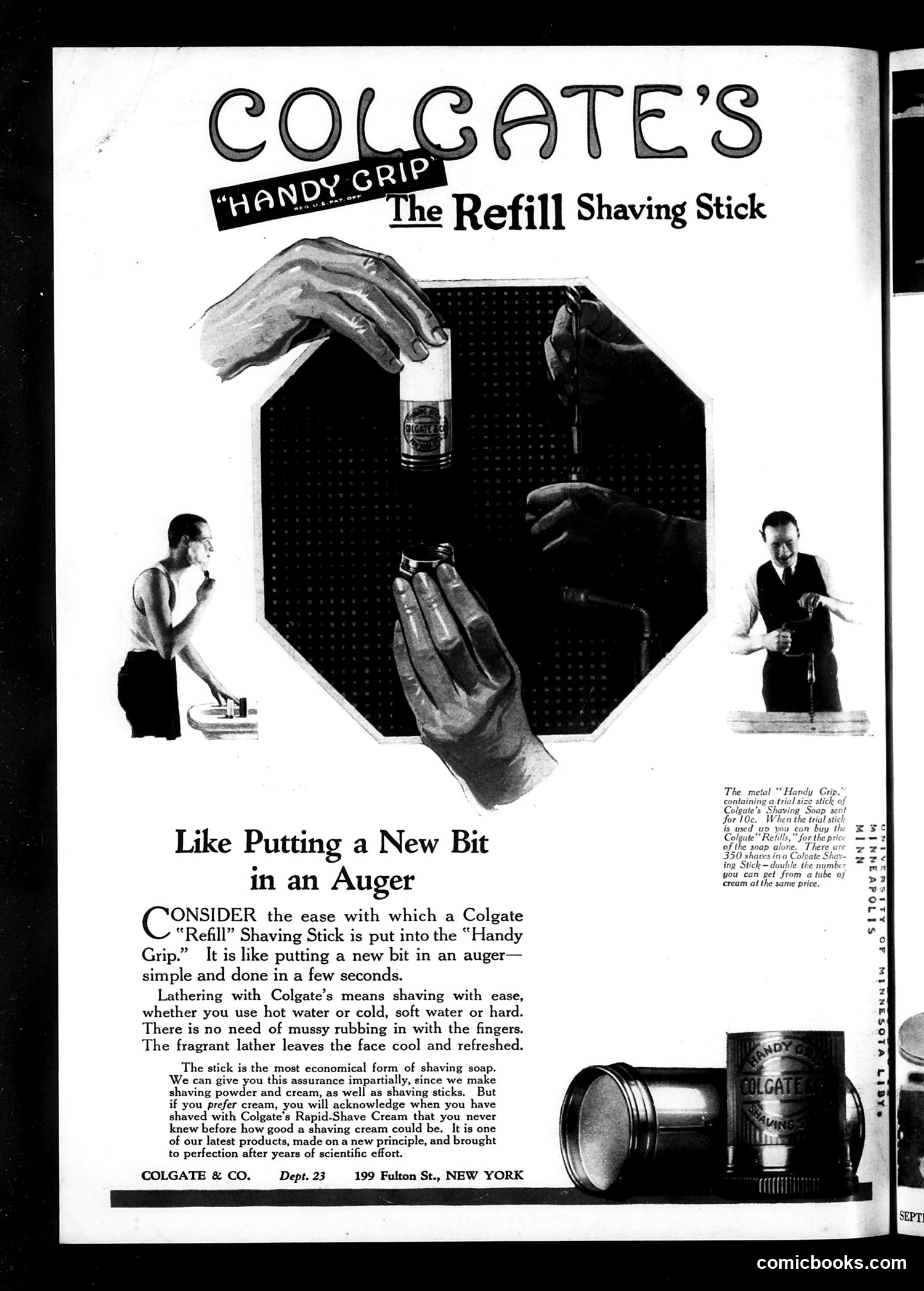
This is a **Colgate advertisement**, not a political cartoon. It promotes Colgate's "Refill" Shaving Stick with its "Handy Grip" metal holder. The page uses an analogy to explain the product's convenience: inserting a refill stick is "like putting a new bit in an auger"—a quick, simple mechanical action. The imagery shows hands demonstrating the refill mechanism, with men at left and right presumably using the product. The advertising copy emphasizes practical benefits: the soap works with any water temperature, requires no vigorous rubbing, and is economical. It also notes that Colgate makes competing products (powder, cream) but still promotes the stick form, positioning themselves as impartial authorities. This reflects early-20th-century marketing that used mechanical analogies and scientific language to sell grooming products to men—emphasizing efficiency and modern convenience.