
Life, 1922-09-21 · page 20 of 36
Life — September 21, 1922 — page 20: what you’re looking at
What you’re looking at
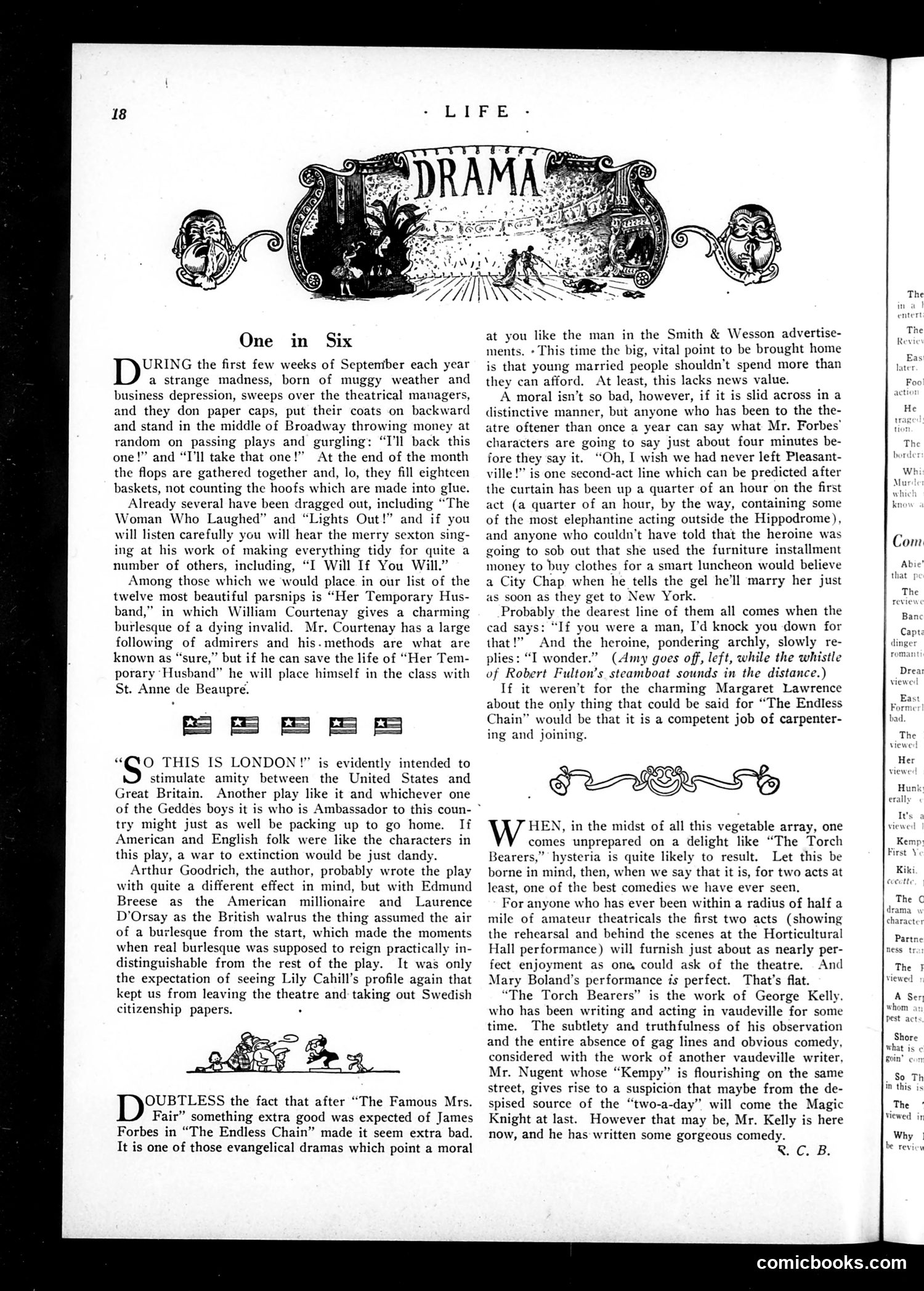
This page reviews several Broadway plays from early September (likely 1920s-era, based on style). The title "One in Six" sarcastically refers to theatrical managers' September tradition of recklessly funding plays—only about one in six apparently succeeds. The reviews mock: 1. **"Her Temporary Husband"** – criticized for William Courtenay's overwrought dying-invalid performance 2. **"So This Is London!"** – intended to promote US-British friendship but backfires, with actor Laurence D'Orsay's portrayal making it unintentionally comedic burlesque 3. **"The Endless Chain"** – an evangelical melodrama preaching that newlyweds shouldn't overspend. The critic ridicules its predictable moralizing and clumsy dialogue The satire targets both bad playwriting and overacting. The reviewer's point: these plays fail because they're heavy-handed, obvious, and tedious—not because their moral messages are wrong, but because they deliver them so clumsily that the "serious" moments become accidentally funny.
📄 Transcribed text from this page (OCR, searchable)
Machine-transcribed from the original scan — historical spelling and the odd misread are preserved.
One in Six URING the first few weeks of September each year a strange madness, born of muggy weather and business depression, sweeps over the theatrical managers, and they don paper caps, put their coats on backward and stand in the middle of Broadway throwing money at random on passing plays and gurgling: “I'll back this one!” and “I'll take that one!” At the end of the month the flops are gathered together and, lo, they fill eighteen baskets, not counting the hoofs which are made into glue. Already several have been dragged out, including “The Woman Who Laughed” and “Lights Out!” and if you will listen carefully you will hear the merry sexton sing- ing at his work of making everything tidy for quite a number of others, including, “I Will If You Will.” Among those which we would place in our list of the twelve most beautiful parsnips is “Her Temporary Hus- band,” in which William Courtenay gives a charming burlesque of a dying invalid. Mr. Courtenay has a large following of admirers and his.methods are what are known as “sure,” but if he can save the life of “Her Tem- porary “Husband” he will place himself in the class with St. Anne de Beaupre. = — i — | ‘S° THIS IS LONDON!” is evidently intended to stimulate amity between the United States and Great Britain. Another play like it and whichever one of the Geddes boys it is who is Ambassador to this coun- ~ try might just as well be packing up to go home. If American and English folk were like the characters in this play, a war to extinction would be just dandy. Arthur Goodrich, the author, probably wrote the play with quite a different effect in mind, but with Edmund Breese as the American millionaire and Laurence D’Orsay as the British walrus the thing assumed the air of a burlesque from the start, which made the moments when real burlesque was supposed to reign practically in- distinguishable from the rest of the play. It was only the expectation of seeing Lily Cahill’s profile again that kept us from leaving the theatre and taking out Swedish citizenship papers. OUBTLESS the fact that after “The Famous Mrs. Fair” something extra good was expected of James Forbes in “The Endless Chain” made it seem extra bad. It is one of those evangelical dramas which point a moral at you like the man in the Smith & Wesson advertise- ments. » This time the big, vital point to be brought home is that young married people shouldn't spend more than they can afford. At least, this lacks news value. A moral isn’t so bad, however, if it is slid across in a distinctive manner, but anyone who has been to the the- atre oftener than once a year can say what Mr. Forbes’ characters are going to say just about four minutes be- fore they say it. “Oh, I wish we had never left Pleasant- ville!” is one second-act line which can be predicted after the curtain has been up a quarter of an hour on the first act (a quarter of an hour, by the way, containing some of the most elephantine acting outside the Hippodrome), and anyone who couldn't have told that the heroine was going to sob out that she used the furniture installment money to buy clothes for a smart luncheon would believe a City Chap when he tells the gel he'll marry her just as soon as they get to New York. Probably the dearest line of them all comes when the cad says: “If you were a man, I’d knock you down for that!” And the heroine, pondering archly, slowly re- plies: “I wonder.” (Amy goes off, left, while the whistle of Robert Fulton’s steamboat sounds in the distance.) If it weren’t for the charming Margaret Lawrence about the only thing that could be said for “The Endless Chain” would be that it is a competent job of carpenter- ing and joining. HEN, in the midst of all this vegetable array, one ‘comes unprepared on a delight like “The Torch Bearers,” hysteria is quite likely to result. Let this be borne in mind, then, when we say that it is, for two acts at least, one of the best comedies we have ever seen, For anyone who has ever been within a radius of half a mile of amateur theatricals the first two acts (showing the rehearsal and behind the scenes at the Horticultural Hall performance) will furnish just about as nearly per- fect enjoyment as one could ask of the theatre. And Mary Boland’s performance is perfect. That's flat. “The Torch Bearers” is the work of George Kelly. who has been writing and acting in vaudeville for some time. The subtlety and truthfulness of his observation and the entire absence of gag lines and obvious comedy, considered with the work of another vaudeville writer, Mr. Nugent whose “Kempy” is flourishing on the same street, gives rise to a suspicion that maybe from the de- spised source of the “two-a-day” will come the Magic Knight at last. However that may be, Mr. Kelly is here now, and he has written some gorgeous comedy. RC. B. Bein” cor So Th in this is The viewed in Why | be review comicbooks.com