
Life, 1922-09-21 · page 26 of 36
Life — September 21, 1922 — page 26: what you’re looking at
What you’re looking at
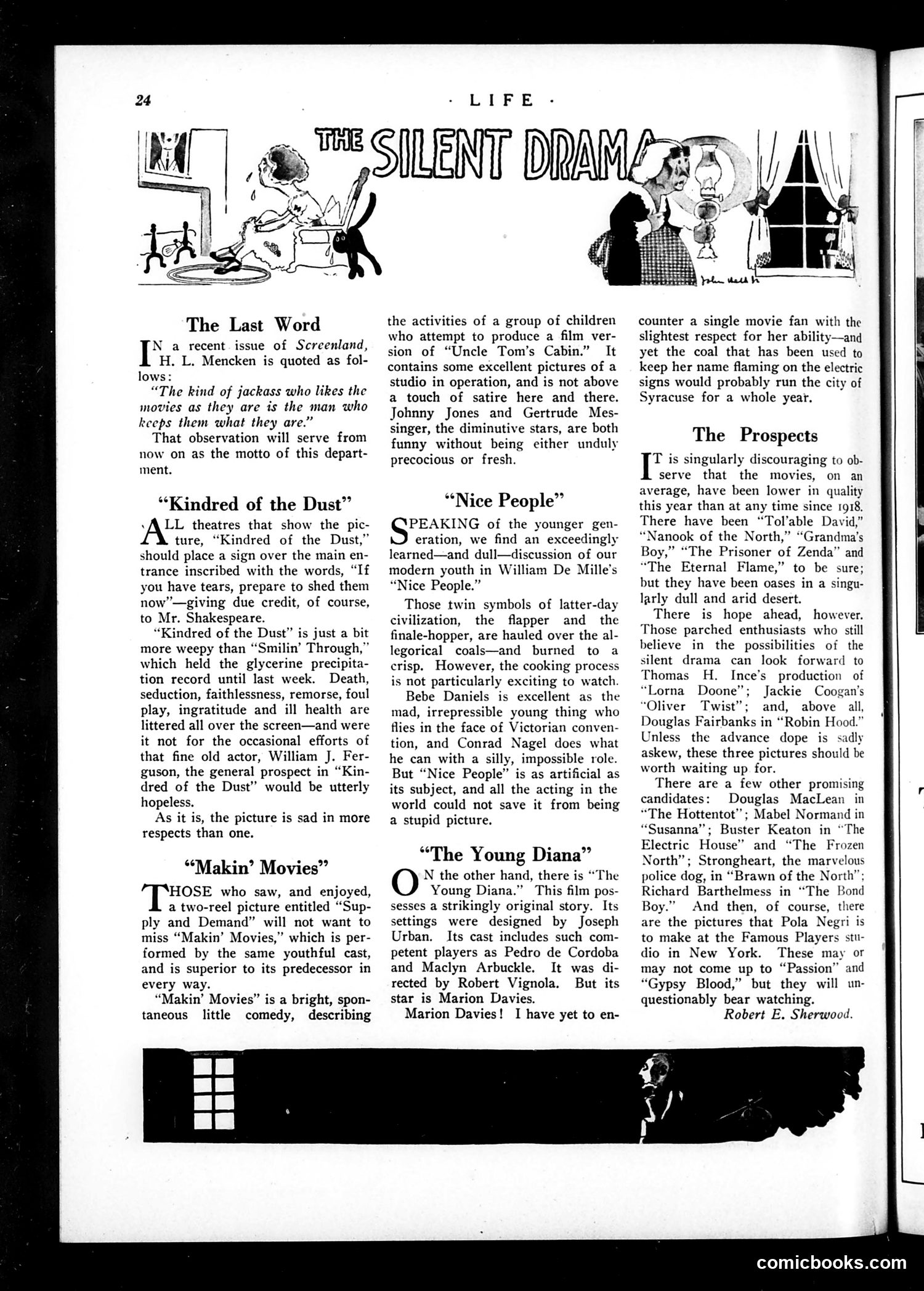
This page critiques early 1920s silent films through reviews of specific movies. The satirical editor opens with H.L. Mencken's observation that audiences enable poor filmmaking by accepting mediocre movies. The reviews mock contemporary cinema's melodramatic excesses: "Kindred of the Dust" is criticized as excessively tearful (compared to "Smilin' Through"), while "Nice People" is called an artificial, dull examination of flappers and modern youth. "The Young Diana," despite quality production design and direction, is derided primarily for starring Marion Davies—whom the critic sarcastically notes receives no respect despite massive promotion costs. The "Prospects" section expresses cautious optimism, acknowledging rare quality films like "Tol'able David" and "Nanook of the North," while anticipating promising upcoming releases with established stars (Douglas Fairbanks, Jackie Coogan). Overall, the page reflects 1920s film-industry criticism: frustration with industry pandering, excessive sentimentality, and star-power trumping talent.
📄 Transcribed text from this page (OCR, searchable)
Machine-transcribed from the original scan — historical spelling and the odd misread are preserved.
The Last Word N a recent issue of Screenland, H. L. Mencken is quoted as fol- lows: “The kind of jackass who likes the movies as they are is the man who keeps them what they are.” That observation will serve from now on as the motto of this depart- ment. “Kindred of the Dust” ‘ALL theatres that show the pic- ture, “Kindred of the Dust,” should place a sign over the main en- trance inscribed with the words, “If you have tears, prepare to shed them now”’—giving due credit, of course, to Mr. Shakespeare. “Kindred of the Dust” is just a bit more weepy than “Smilin’ Through,” which held the glycerine precipita- tion record until last week. Death, seduction, faithlessness, remorse, foul play, ingratitude and ill health are littered all over the screen—and were it not for the occasional efforts of that fine old actor, William J. Fer- guson, the general prospect in “Kin- dred of the Dust” would be utterly hopeless. As it is, the picture is sad in more respects than one. ‘Makin’ Movies” ‘HOSE who saw, and enjoyed, a two-reel picture entitled “Sup- ply and Demand” will not want to miss “Makin’ Movies,” which is per- formed by the same youthful cast, and is superior to its predecessor in every way. “Makin’ Movies” is a bright, spon- taneous little comedy, describing the activities of a group of children who attempt to produce a film ver- sion of “Uncle Tom’s Cabin.” It contains some excellent pictures of a studio in operation, and is not above a touch of satire here and there. Johnny Jones and Gertrude Mes- singer, the diminutive stars, are both funny without being either unduly precocious or fresh. “Nice People” PEAKING of the younger gen- eration, we find an exceedingly learned—and dull—discussion of our modern youth in William De Mille’s “Nice People.” Those twin symbols of latter-day civilization, the flapper and the finale-hopper, are hauled over the al- legorical coals—and burned to a crisp. However, the cooking process is not particularly exciting to watch. Bebe Daniels is excellent as the mad, irrepressible young thing who flies in the face of Victorian conven- tion, and Conrad Nagel does what he can with a silly, impossible role. But “Nice People” is as artificial as its subject, and all the acting in the world could not save it from being a stupid picture. “The Young Diana” O N the other hand, there is “The Young Diana.” This film pos- sesses a strikingly original story. Its settings were designed by Joseph Urban. Its cast includes such com- petent players as Pedro de Cordoba and Maclyn Arbuckle. It was di- rected by Robert Vignola. But its star is Marion Davies. Marion Davies! I have yet to en- counter a single movie fan with the slightest respect for her ability—and yet the coal that has been used to keep her name flaming on the electric signs would probably run the city of Syracuse for a whole year. The Prospects T is singularly discouraging to ob- serve that the movies, on an average, have been lower in quality this year than at any time since 1918. There have been “Tol’able David,” “Nanook of the North,” “Grandma’s Boy,” “The Prisoner of Zenda” and “The Eternal Flame,” to be sure; but they have been oases in a singu- larly dull and arid desert. There is hope ahead, however. Those parched enthusiasts who still believe in the possibilities of the silent drama can look forward to Thomas H. Ince’s production of “Lorna Doone Jackie Coogan’s “Oliver Twist”; and, above all, Douglas Fairbanks in “Robin Hood.” Unless the advance dope is sadly askew, these three pictures should be worth waiting up for. There are a few other promising candidates: Douglas MacLean in “The Hottentot”; Mabel Normand in “Susanna”; Buster Keaton in “The Electric House” and “The Frozen North”; Strongheart, the marvelous police dog, in “Brawn of the North”; Richard Barthelmess in “The Bond Boy.” And then, of course, there are the pictures that Pola Negri is to make at the Famous Players stu- dio in New York. These may or may not come up to “Passion” and “Gypsy Blood,” but they will un- questionably bear watching. Robert E. Sherwood. = comicbooks.com