
A complete issue · 44 pages · 1922
Life — September 7, 1922
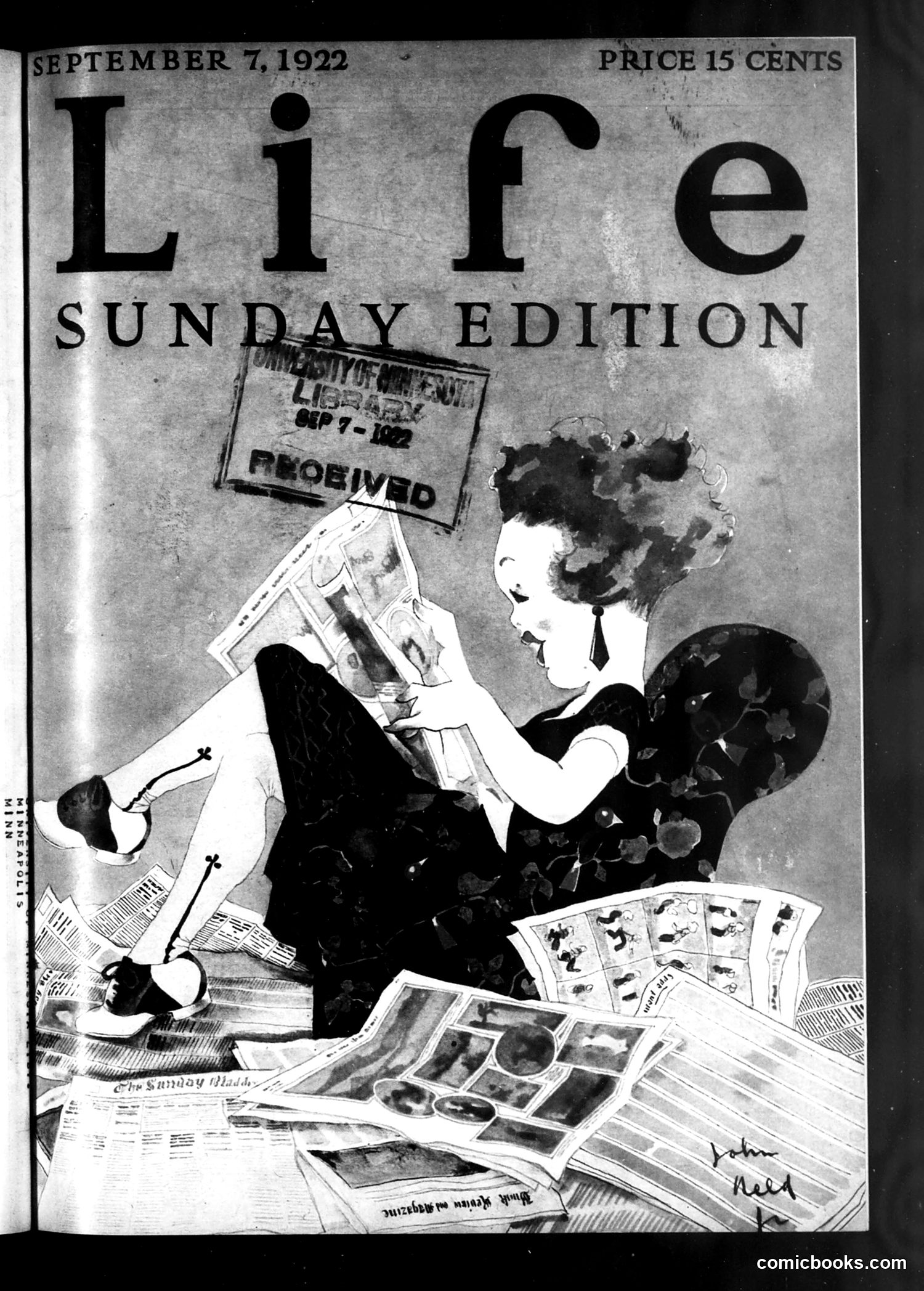
This cover depicts a fashionable woman in 1920s attire reading Life magazine while surrounded by newspapers and entertainment materials. The illustration satirizes the modern consumer culture of the Jazz Age—specifically, women's increasing leisure time and engagement with popular media. The "Prohibited" stamp visible on the cover likely references Prohibition (enacted 1920), suggesting Life magazine itself faced censorship or mock-restriction during this period of moral guardianship. The woman's elegant pose and abundant reading materials mock the proliferation of mass media consumption. The illustration, signed by what appears to be "John Held Jr." (a prominent cartoonist of the era), captures the era's cultural anxiety about modern women's independence, consumerism, and changing social roles during the 1920s.
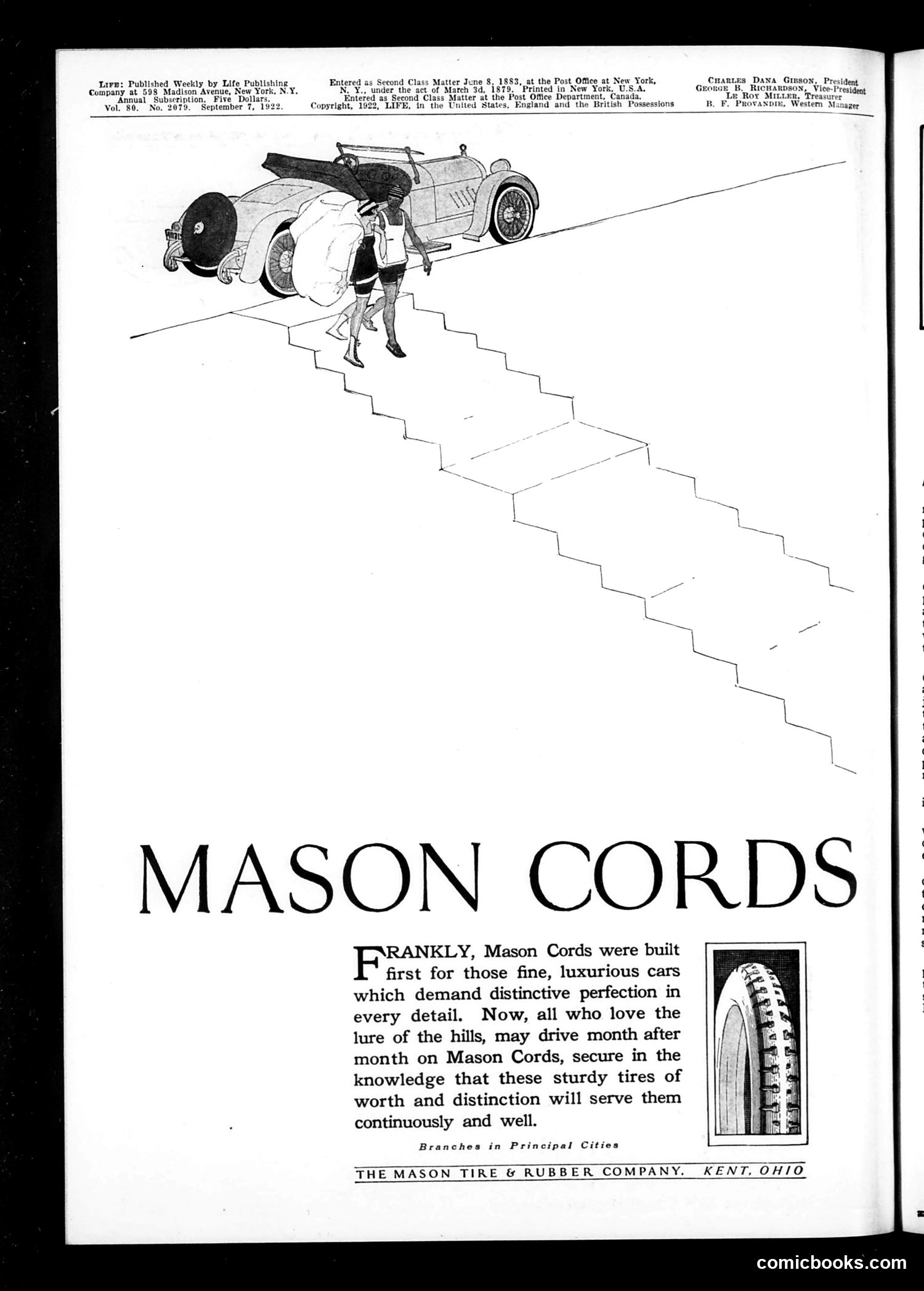
This page is primarily an **advertisement for Mason Cords tires**, not political satire. The illustration shows a stylized figure (appears to be a woman in classical dress) pulling a luxury automobile up an impossible staircase, emphasizing the tire's climbing power and reliability on steep terrain. The ad's copy plays on the appeal to luxury car owners: Mason Cords were originally built for "fine, luxurious cars" but now anyone can enjoy their durability for "month after month" of driving in hills. The exaggerated image of hauling a car up endless steps is hyperbolic advertising—meant to convey superior traction and strength rather than make a political or social commentary.
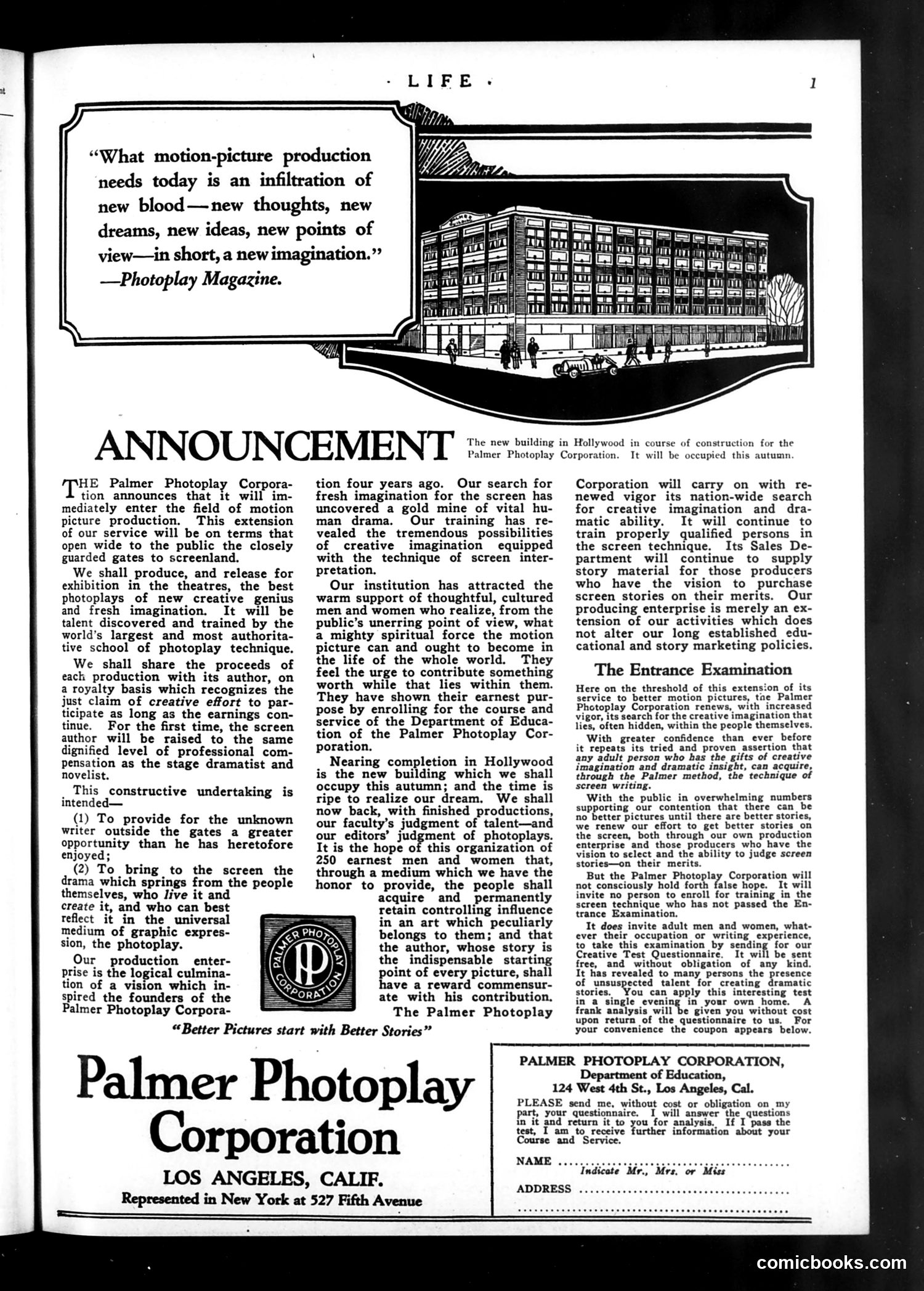
This page is primarily an **advertisement**, not a satirical cartoon. It announces the Palmer Photoplay Corporation's entry into motion picture production in Hollywood, with a new building under construction. The ad emphasizes the company's mission to bring "new blood" and fresh creative perspectives to filmmaking—new thoughts, ideas, and imagination. It appeals for talented writers and creative personnel, promising fair compensation and creative control to contributors. The text includes an "Entrance Examination" section inviting the public to submit story ideas and take a creative test, positioning this as an opportunity to discover untapped talent for the film industry. There is no political satire here—this is straightforward early-20th-century Hollywood business promotion.
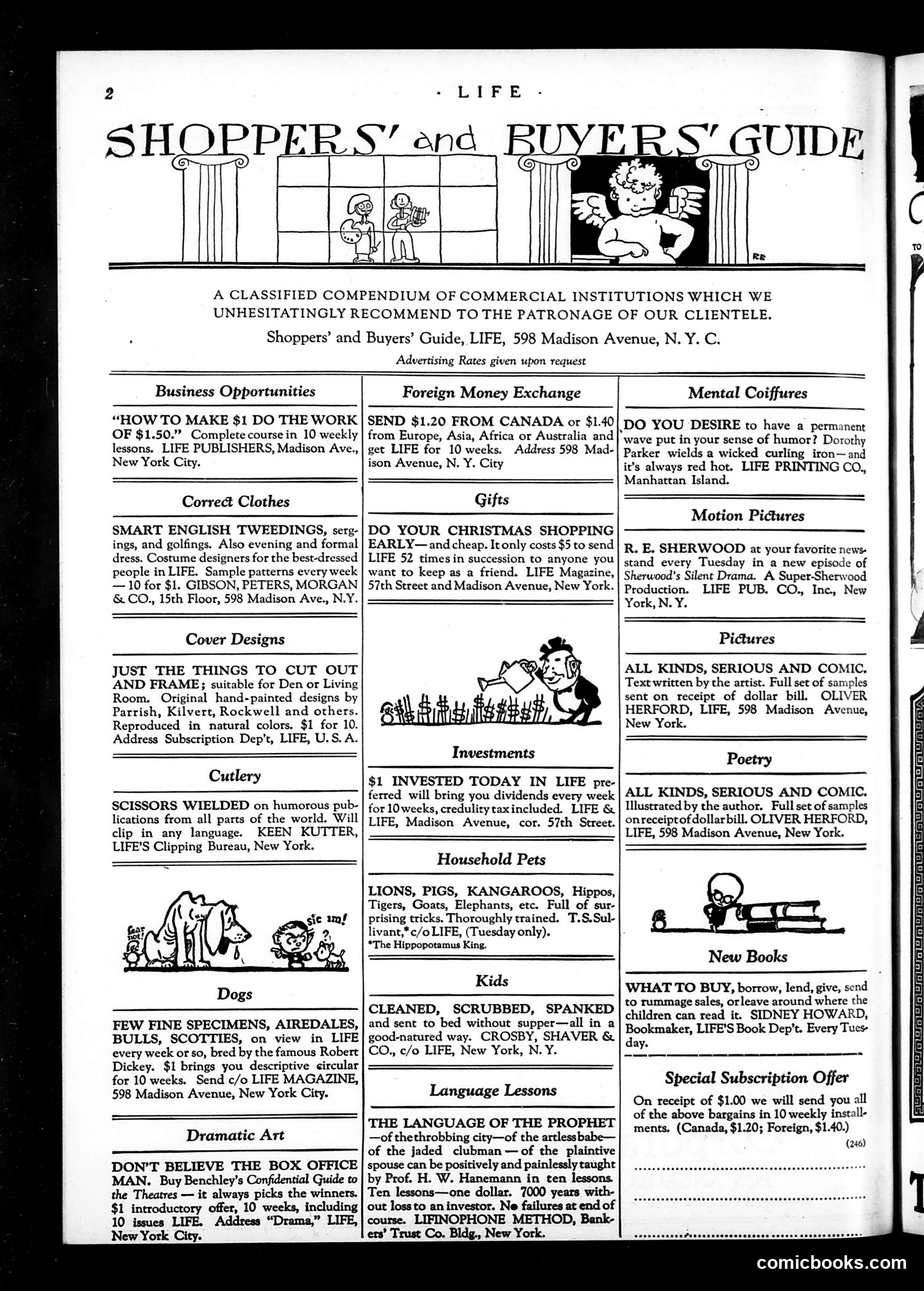
This page is primarily a **classified advertising section** titled "Shoppers' and Buyers' Guide" from Life magazine. The content consists almost entirely of commercial advertisements for various services and products—from language lessons and investment schemes to dog breeders and household pets. The only cartoon element visible is a small **illustration of anthropomorphic animals** (appearing to be dogs or similar creatures) accompanying the "Dogs" section, which advertises fine dog breeds available for viewing. There is **no political satire or social commentary** on this page. Rather, it's a straightforward commercial directory demonstrating the breadth of services advertisers wished to reach Life's readership, reflecting early 20th-century consumer culture and marketplace diversity.
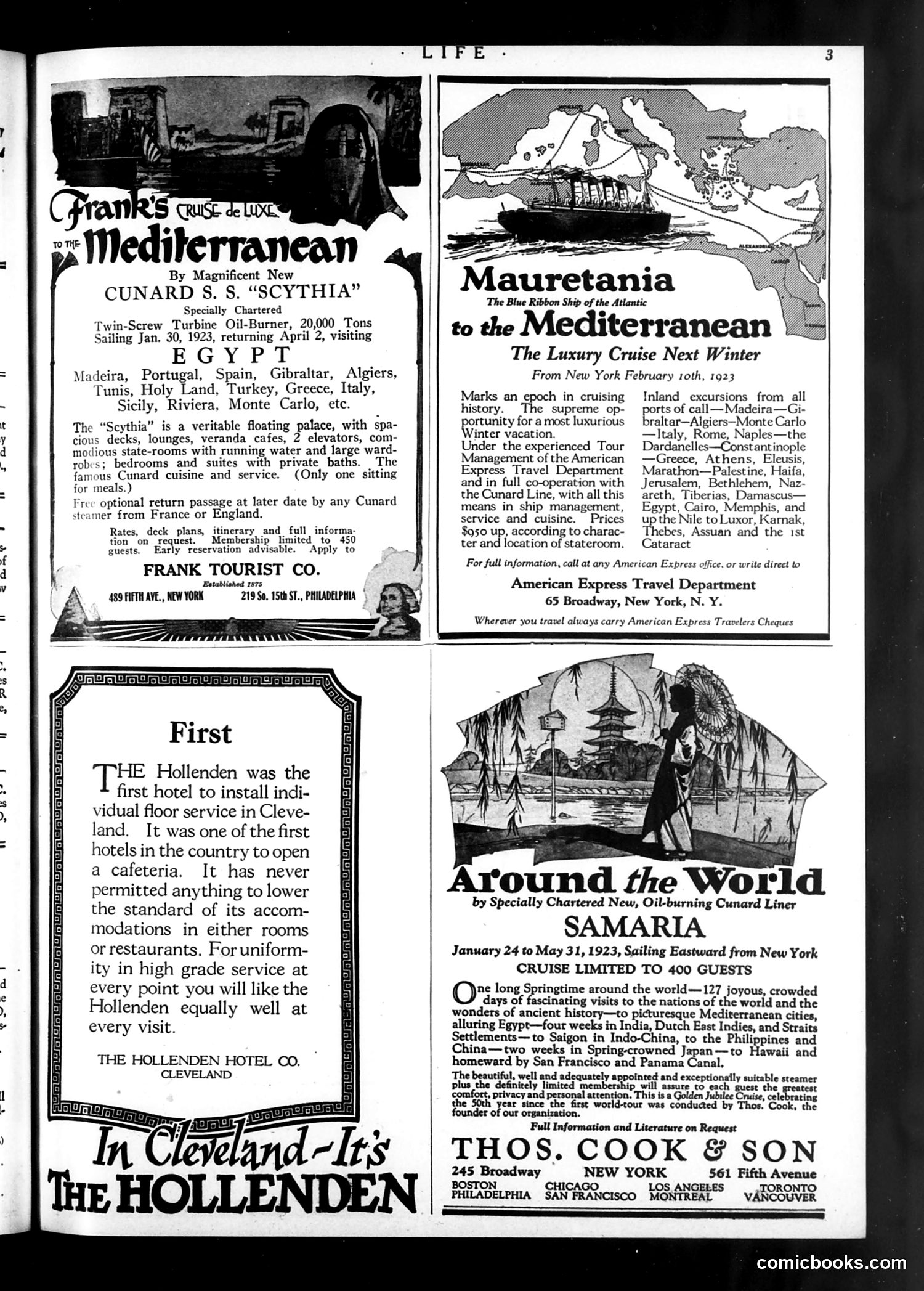
This page is primarily **advertising**, not satire or political commentary. It contains four travel and hospitality advertisements from 1923: 1. **Cunard cruise** to the Mediterranean aboard the S.S. "Scythia" 2. **Mauritania cruise** (another Cunard liner) departing New York in February 1923 3. **The Hollenden Hotel** in Cleveland, promoting its pioneering individual floor service and cafeteria 4. **Thos. Cook & Son** advertising a world cruise aboard the "Samaria" The only non-advertising content is a brief testimonial praising the Hollenden Hotel's service standards. All advertisements target wealthy travelers seeking luxury voyages and accommodations—typical Life magazine content from the prosperous 1920s. There is no political satire or social commentary present.
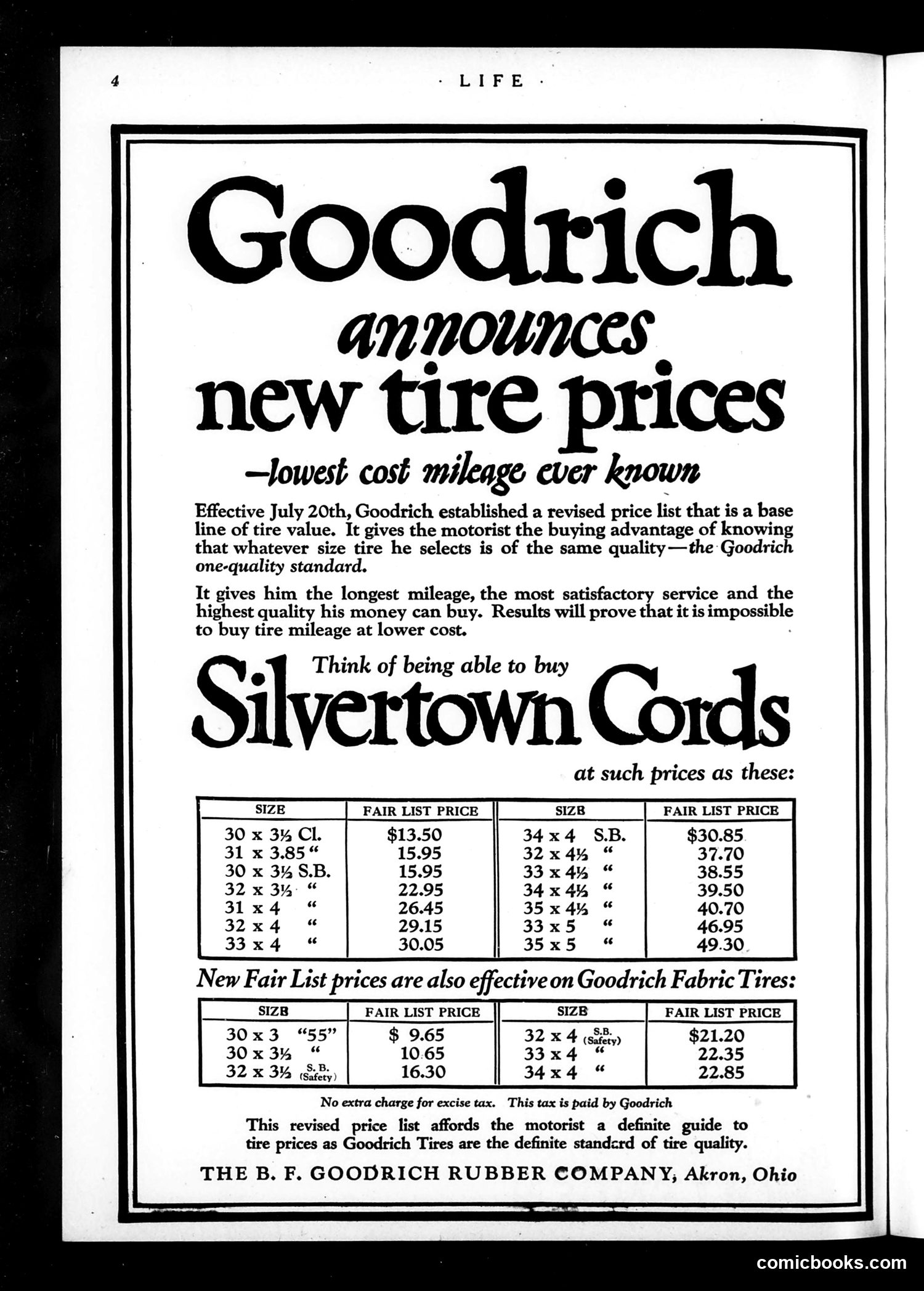
This is **not a cartoon or satire page**, but rather a straightforward **advertisement** for Goodrich tires. The ad announces new, reduced tire prices effective July 20th, emphasizing value: "lowest cost mileage ever known." It promotes Silvertown Cords and Goodrich Fabric Tires with detailed pricing tables for various tire sizes. The language appeals to motorists by promising "the longest mileage, the most satisfactory service and the highest quality his money can buy." There is no political commentary, caricature, or satirical content—just commercial messaging typical of early 20th-century magazine advertising. The page represents how Life magazine, despite its satirical reputation, carried conventional paid advertisements to support publication.
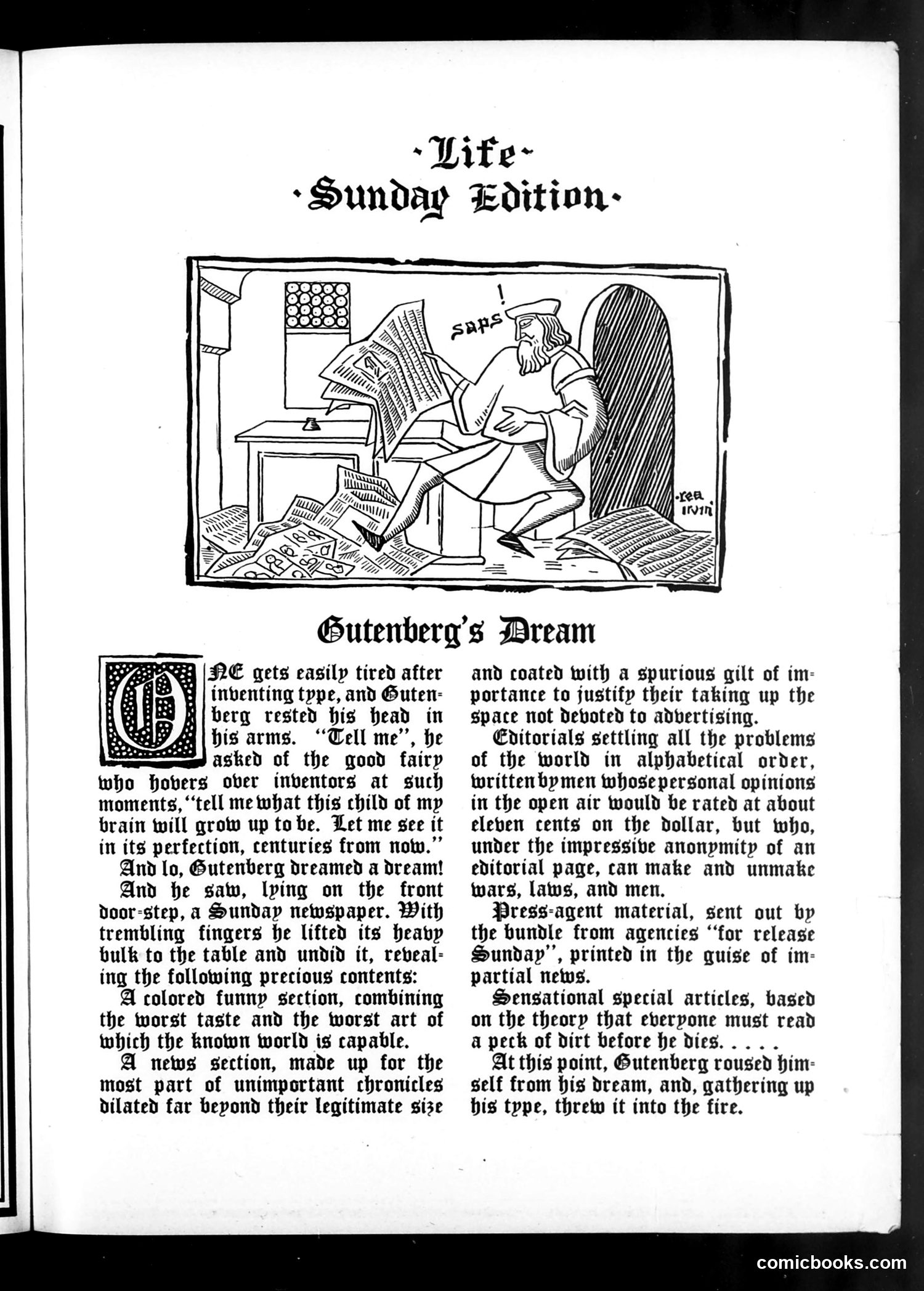
This page satirizes the printing press's impact on modern journalism. The illustration shows Johannes Gutenberg (inventor of the movable-type printing press) dreaming of a "Sunday newspaper" - depicted as an angel figure presenting newspapers to him. The accompanying text mocks contemporary Sunday editions, attacking their sensationalism: "colored funny section," oversized news coverage of trivial matters, and editorials that presume to solve world problems while accepting paid advertising disguised as news ("press-agent material"). The satire targets how newspapers—originally Gutenberg's revolutionary invention—have become vehicles for frivolous content and hidden advertising presented as legitimate journalism. The "dream" has become corrupted by commercialism and yellow journalism practices.
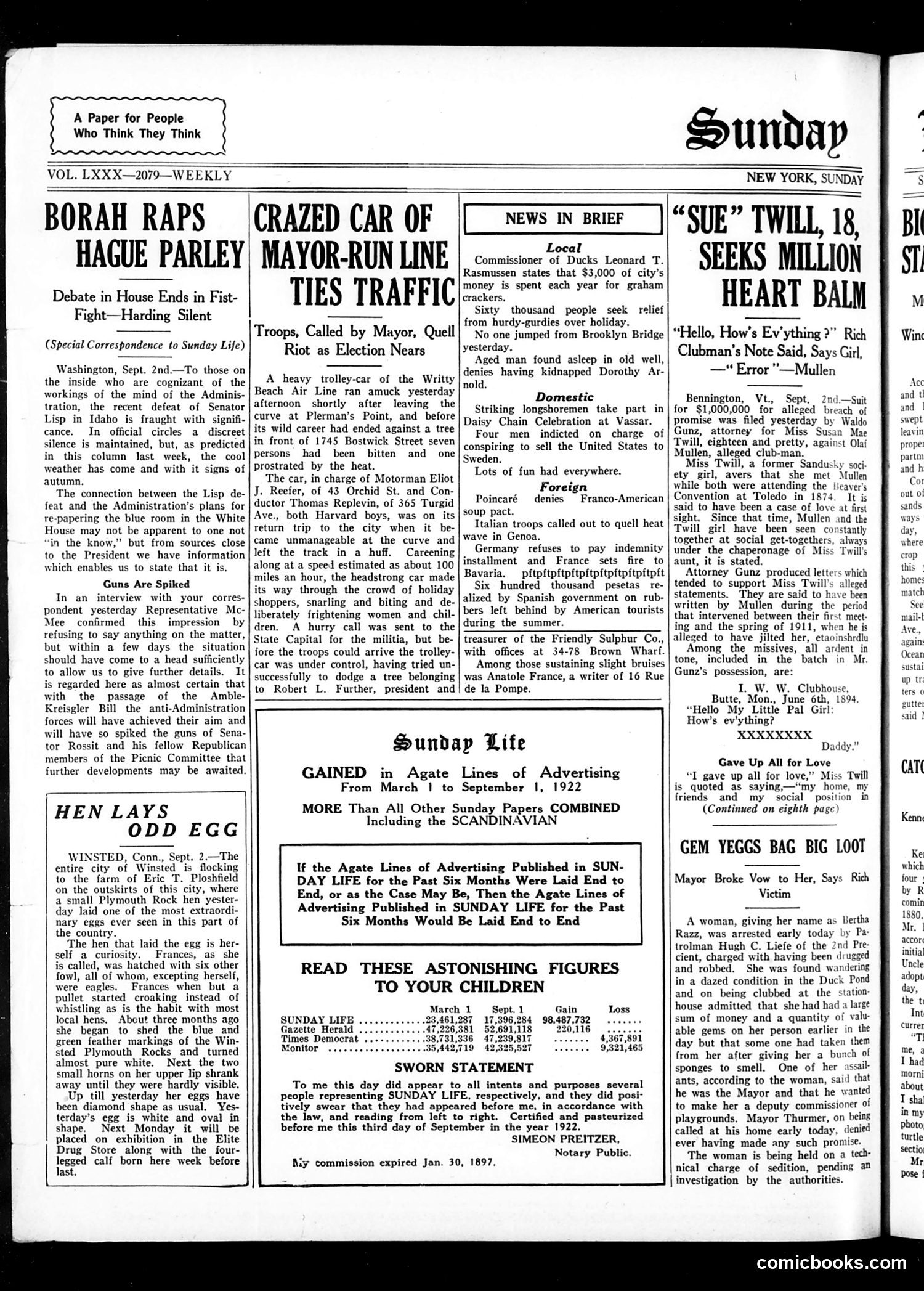
This is a news and satire page from *Sunday Life* magazine (September 2, 1922). The main content consists of political news briefs and society gossip rather than editorial cartoons. The prominent stories include: - **"Borah Raps Hague Parley"**: Senator William Borah's criticism of diplomatic negotiations, with a House debate ending in a fistfight - **"Crazed Car of Mayor-Run Line Ties Traffic"**: A trolley car accident in Washington, D.C., involving troops called by the Mayor during election unrest - **"Sue" Twill, 18, Seeks Million Heart Balm**: A lawsuit for alleged breach of promise The page satirizes contemporary political chaos (Senate violence, municipal mismanagement) and social scandals. "Sunday Life" was *Life* magazine's society/humor section, mixing serious news with satirical commentary on American institutions and behavior.
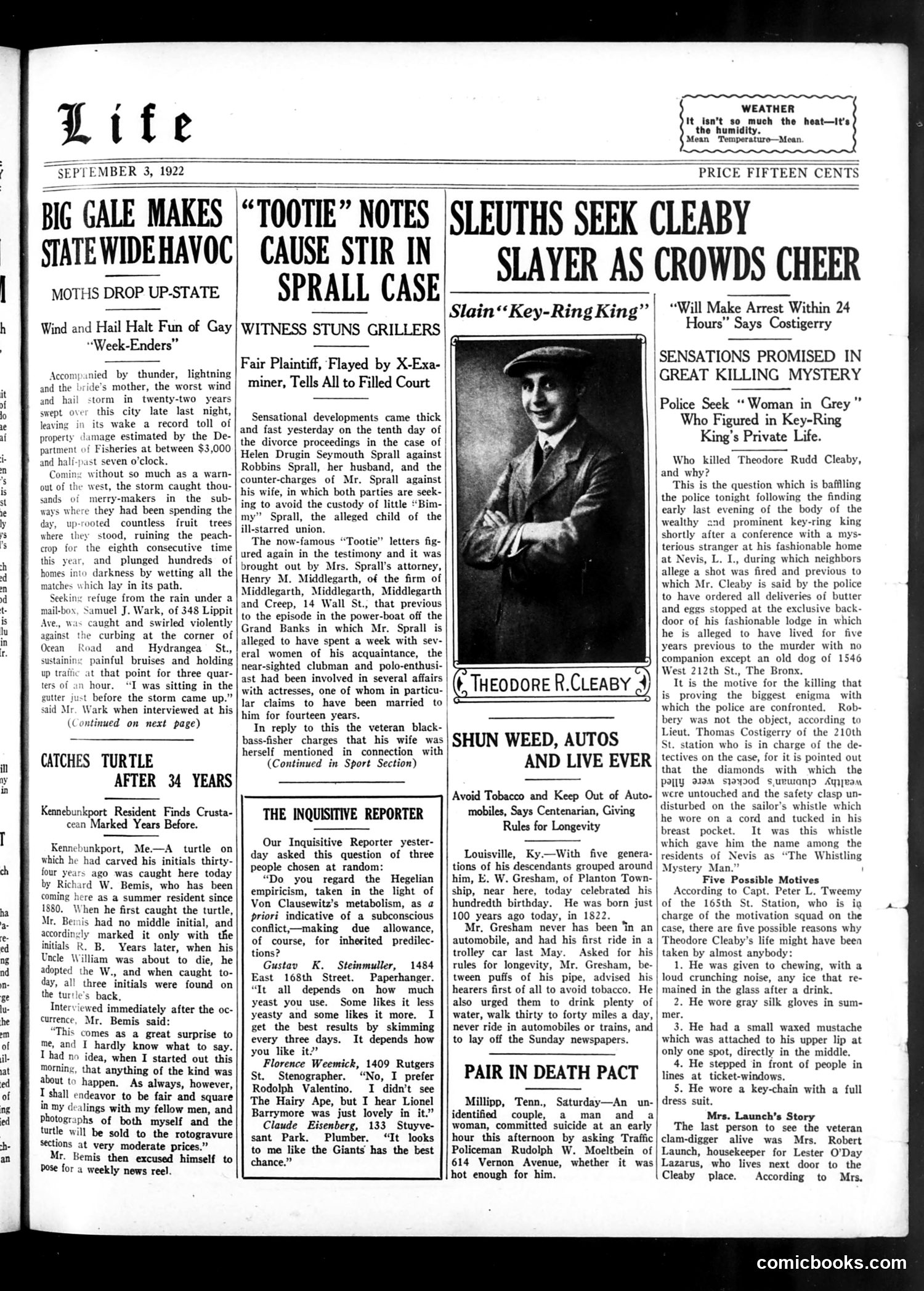
This page contains news articles and crime reporting rather than political satire or comics. The main content focuses on: **"Sleuths Seek Cleaby Slayer"** — coverage of the Theodore Rudd Cleaby murder case, asking "who killed Theodore Rudd Cleaby, and why?" The article discusses police investigations into this "great killing mystery." **Other sections** include "Big Gale Makes Statewide Havoc" (weather reporting), "Tootie Notes" (a sprall/court case), and "Shun Weed, Autos and Live Ever" (health/lifestyle advice). **"Catches Turtle After 34 Years"** — a human-interest story about a man who caught a turtle he'd released decades earlier. This appears to be a standard news/feature page from Life magazine during the early 1920s, emphasizing crime reporting and local interest stories rather than satirical commentary.
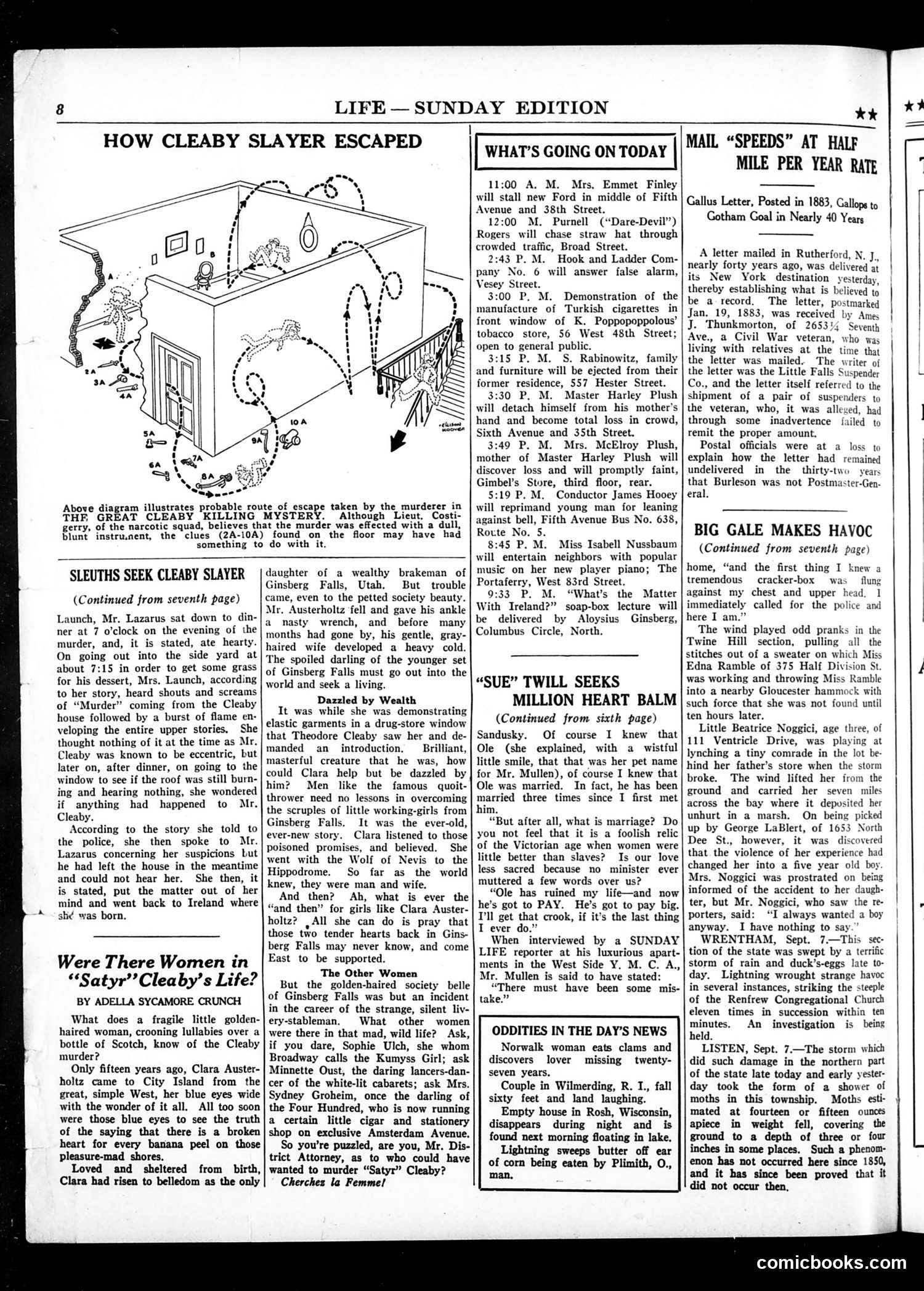
This page documents the "Satyr Cleaby" murder case through a detailed architectural diagram showing the probable escape route of a murderer through a building. The illustration traces the killer's path using dotted lines and numbered points, depicting how they navigated from the crime scene through various rooms and exits. The accompanying articles discuss the case details, including witness accounts and investigation developments. A sidebar explores whether women appeared in "Satyr" Cleaby's life, suggesting this was a sensational true-crime story of contemporary interest to Life's readers. The page mixes investigative journalism with visual diagram—an early example of using architectural illustration to explain criminal methodology to the public.
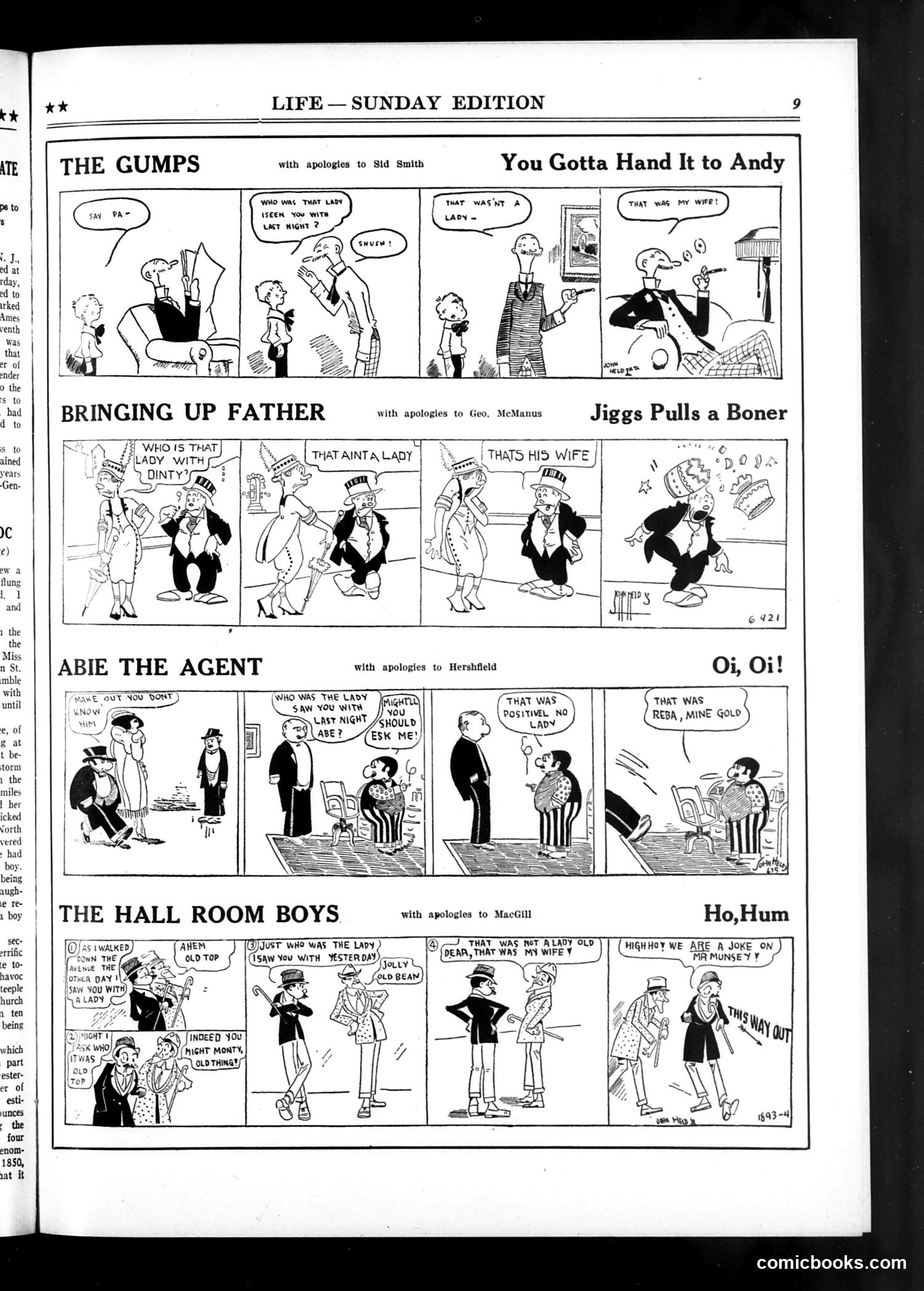
This is a Sunday comics page from *Life* magazine featuring five humor strips. The strips use domestic situations to satirize social conventions: **"The Gumps"** and **"Bringing Up Father"** focus on marital misunderstandings—wives being mistaken for other women, husbands confused about their spouses' identities or whereabouts. **"Abie the Agent"** depicts a man observing a couple, misinterpreting their relationship ("That ain't a lady"), then suffering consequences when corrected by an angry woman ("Reba, mine gold"). **"The Hall Room Boys"** plays on gossip and mistaken identity regarding "the lady" and "yesterday." These strips reflect early 20th-century humor obsessed with marriage confusion, class anxiety, and the comedy of miscommunication. The jokes rely on visual slapstick and rapid dialogue misunderstandings typical of the era's comic conventions.
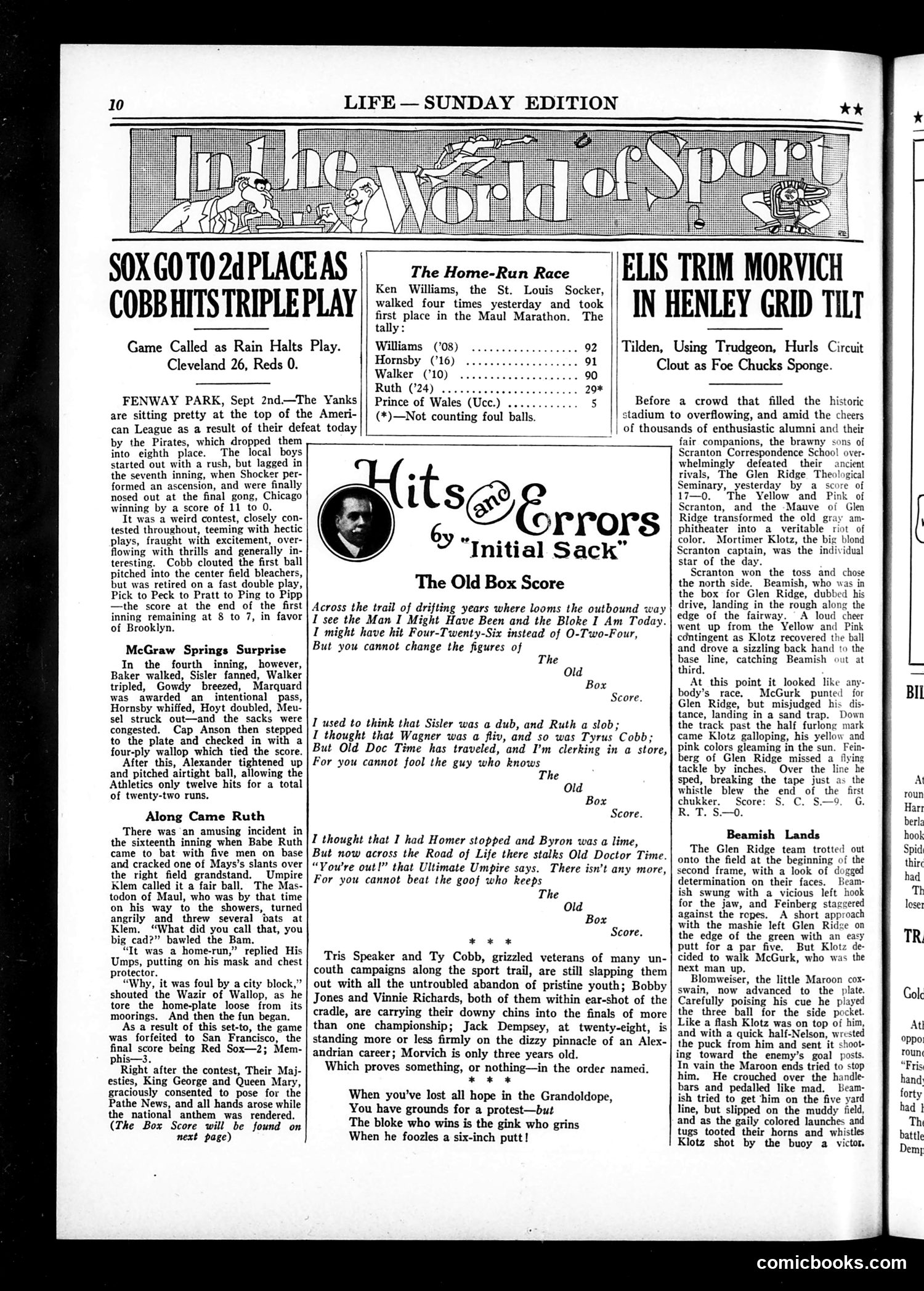
This is a **sports page** from Life magazine's Sunday edition, focused on baseball and auto racing coverage rather than political satire. The main content includes: 1. **"Sox Go To 2d Place as Cobb Hits Triple Play"** — reporting on Cleveland Indians defeating the Yankees 2. **"Hits and Errors by 'Initial Sack'"** — a baseball humor column using the conceit of "The Old Box Score" to comment on players' performance in whimsical, exaggerated language. The writer compares baseball statistics to romantic relationships and classical references (Homer, Wagner, Byron). 3. **"Elis Trim Movich in Henley Grid Tilt"** — covering Yale's football victory using the Henley rowing race as a metaphor. 4. **"Beamish Lands"** — describing a horse racing or auto racing event. The page is primarily **sports journalism and humor**, not political commentary.
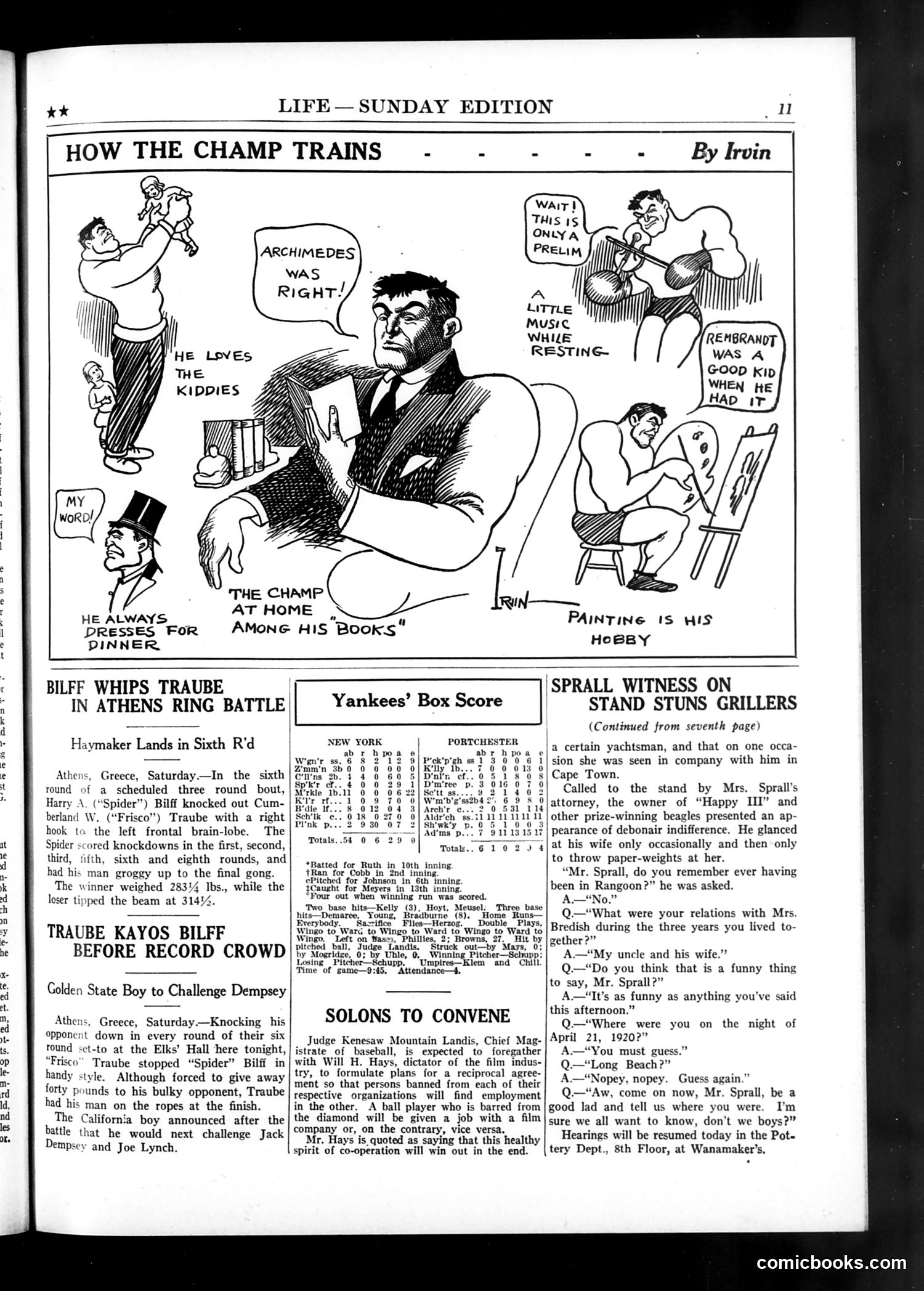
This cartoon satirizes a champion boxer's domestic life and training habits. The central figure is shown "at home among his books," depicting the ironic contrast between a fighter's tough public image and refined private interests. The vignettes show: - He loves playing with children (lifting a kid) - He always dresses formally for dinner (top hat reference) - Training includes reading ("Archimedes was right!") - He takes music breaks while resting - Painting is his hobby The satire mocks the pretension of presenting oneself as cultured and intellectual while being a professional fighter. The title's reference to "the champ" suggests this depicts a specific contemporary boxing champion, though the cartoon doesn't identify which one. The joke criticizes the gap between a boxer's brutal profession and claimed genteel pursuits.
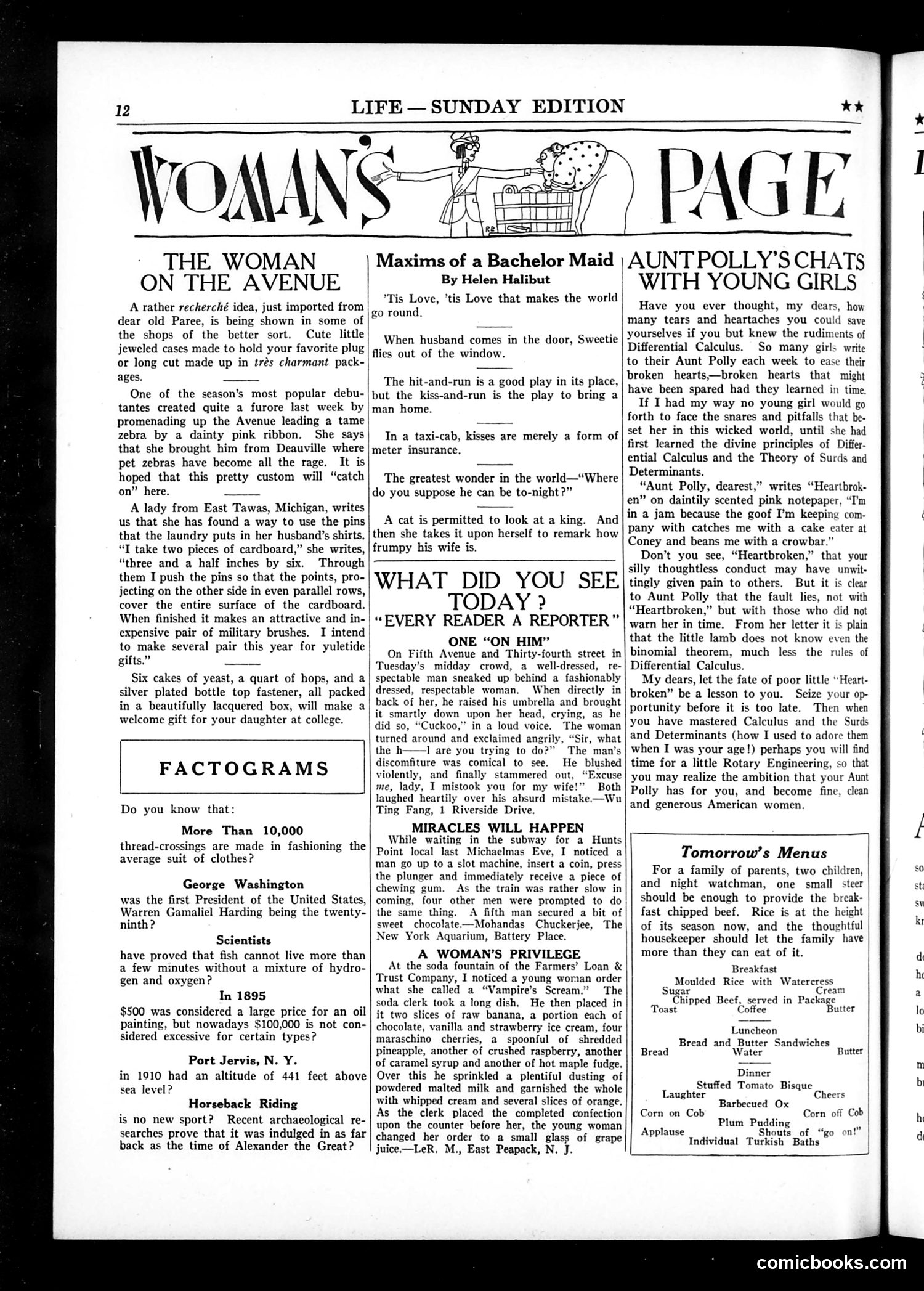
This is a **Woman's Page** from Life magazine's Sunday edition, featuring domestic and social content rather than political satire. The page includes: **Main Content:** - "The Woman on the Avenue" - a fashion/social observation piece about women wearing decorative ribbons on Fifth Avenue - "Maxims of a Bachelor Maid" by Helen Halibut - humorous advice about romance and relationships - "Aunt Polly's Chats with Young Girls" - advice column addressing heartbreak and life lessons - "What Did You See? Every Reader a Reporter" - a human interest story about a Fifth Avenue incident involving an umbrella dispute **Supporting Features:** - Factograms (trivia questions) - Tomorrow's Menus (meal planning guide) The page targets female readers with light humor, practical advice, and social commentary rather than political satire or caricature.
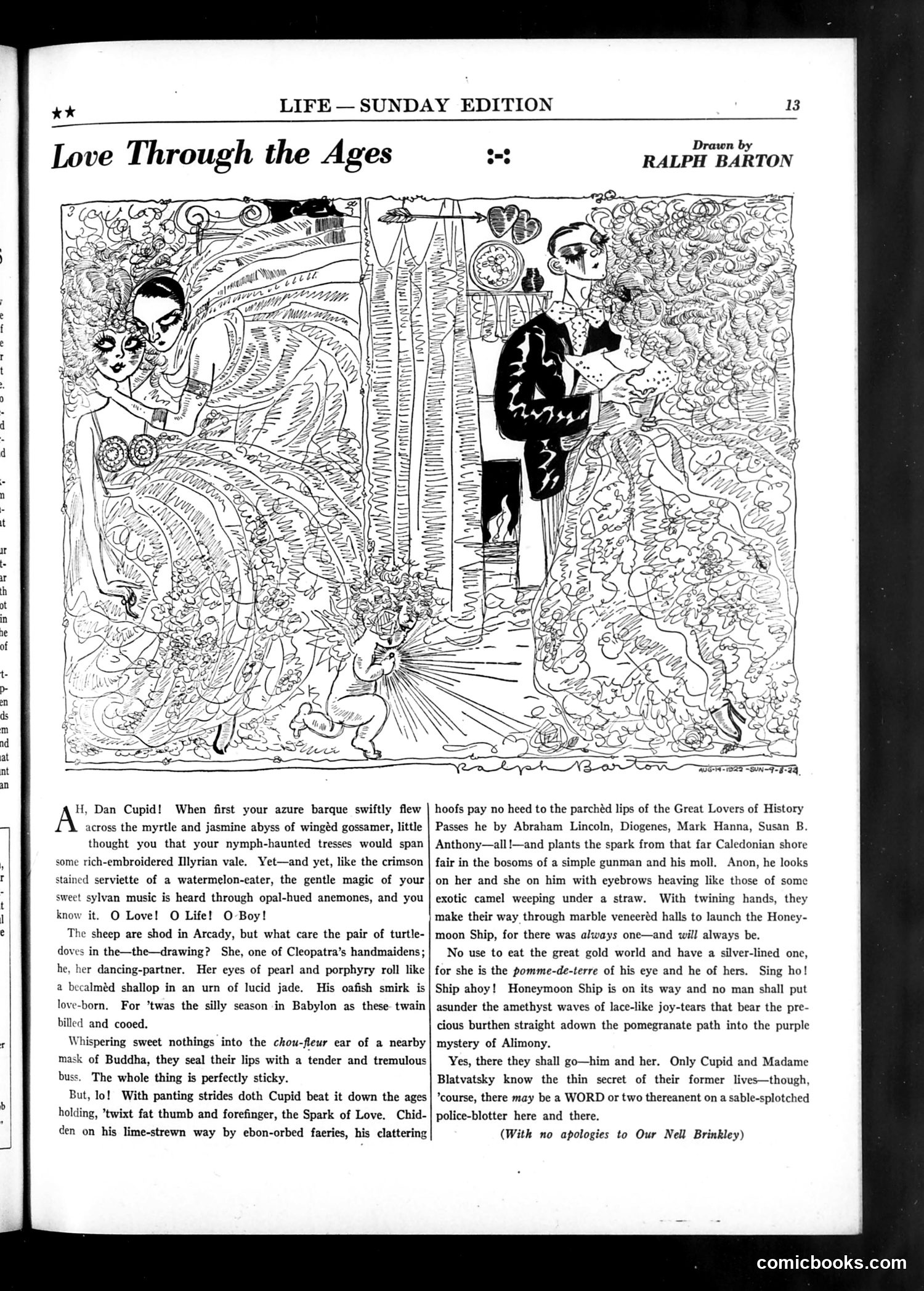
This satirical piece mocks romantic idealization across history. The illustration depicts a woman in classical dress surrounded by elaborate, ornate detail work—representing "mythic Jasmine" and "azure barque" references from the text. The satire targets how lovers romanticize their relationships through historical and literary references. The text humorously catalogs overwrought romantic language: references to Cleopatra, Babylon, the "Honeymoon Ship," and classical mythology like Cupid and Madame Blavatsky. Barton's point appears to be deflating pretentious romantic notions—suggesting that beneath all this flowery historical-mythological language, modern lovers are simply engaging in ordinary domestic situations, occasionally punctuated by marital discord ("police-blotter"). It's a critique of artificial sentimentality in love.
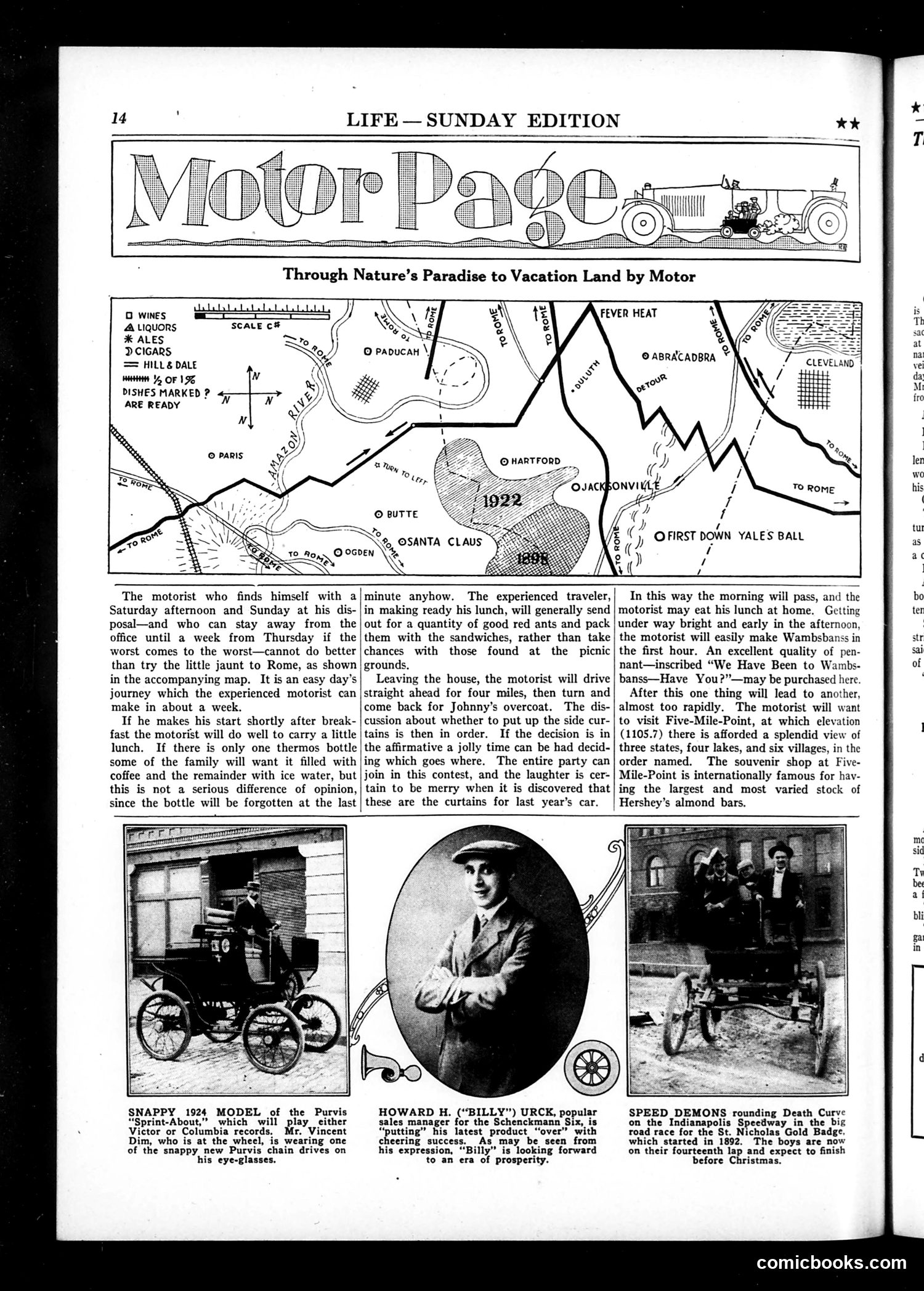
This page from Life magazine's "Motor Page" section discusses weekend automobile travel for leisure—a relatively new concept in the 1920s. The accompanying map shows a route "Through Nature's Paradise to Vacation Land" with marked stops for accommodations and refreshments. The text provides practical advice for motorists taking day trips or longer vacations, addressing concerns about planning meals, packing supplies, and deciding whether to bring family members. The tone treats motoring as an adventure requiring preparation and decision-making. Below are three photographs: a 1924 Purvis "Sprint-About" vehicle, a portrait of Howard H. ("Billy") Urck (a sales manager), and "Speed Demons" racing on the Indianapolis Speedway. These illustrate contemporary automotive culture and the growing popularity of motor travel among Americans during the early automotive era.
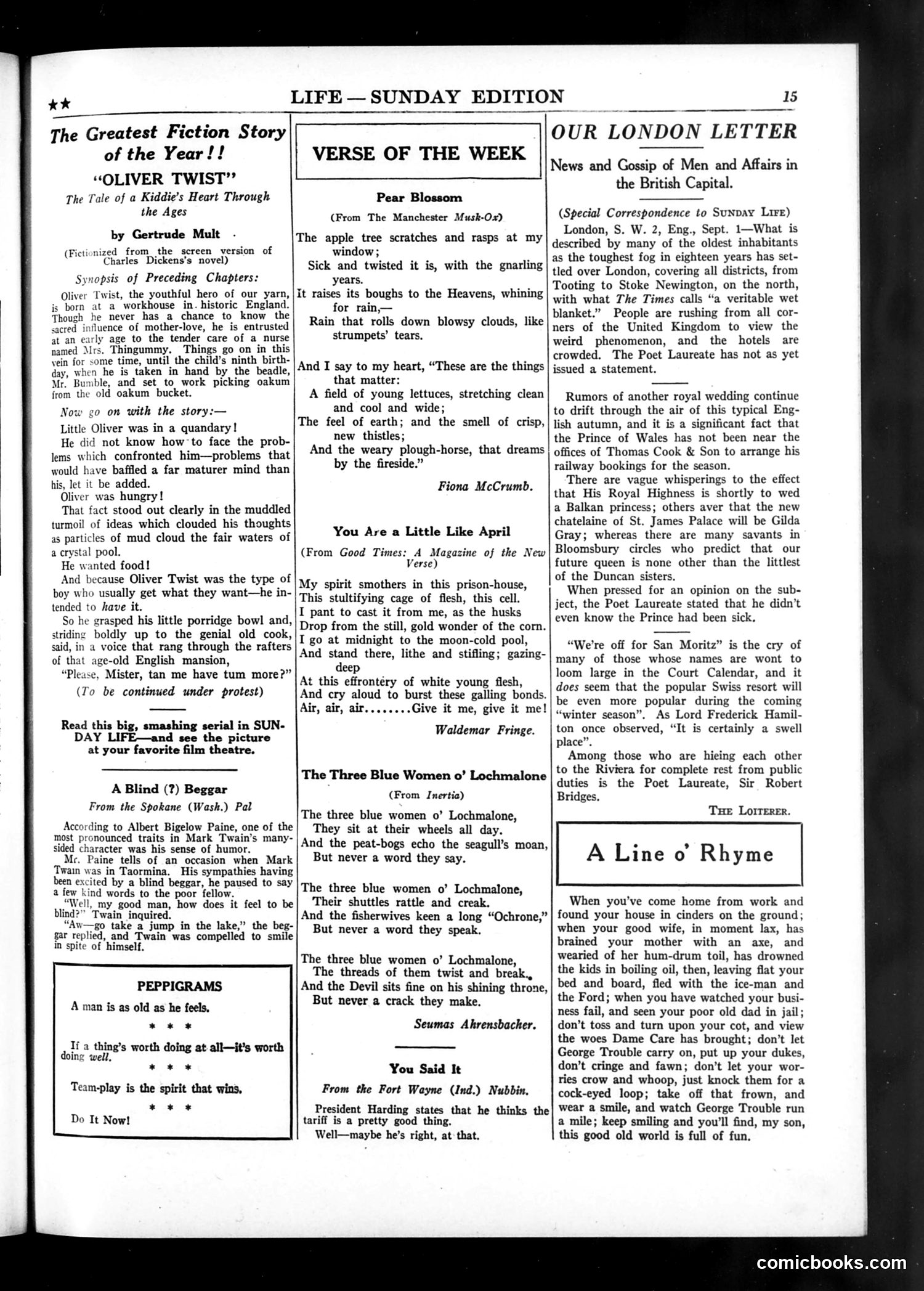
This page contains **serialized fiction and poetry**, not political cartoons. The main content is: **"Oliver Twist" serialization**: A fictionized retelling of Dickens's novel for Life magazine, presenting Oliver's famous workhouse scene where he requests more gruel—a moment satirizing Victorian poverty and institutional indifference. The joke is presenting this tragedy as serialized melodrama for entertainment. **Supporting content** includes: - An anecdote about Mark Twain's wit with a blind beggar (illustrating Twain's irreverent humor) - Poetry selections ("Pear Blossom," "You Are a Little Like April," "The Three Blue Women o' Lochmalone")—largely melancholic romantic verse typical of early 20th-century literary magazines - **"Peppigrams"**: brief aphorisms/wisdom quotes The page functions as a **literary supplement** rather than political satire. Its appeal lay in serialized fiction entertainment and contemporary poetry, reflecting Life magazine's role as a general-interest publication mixing humor with serious literature.
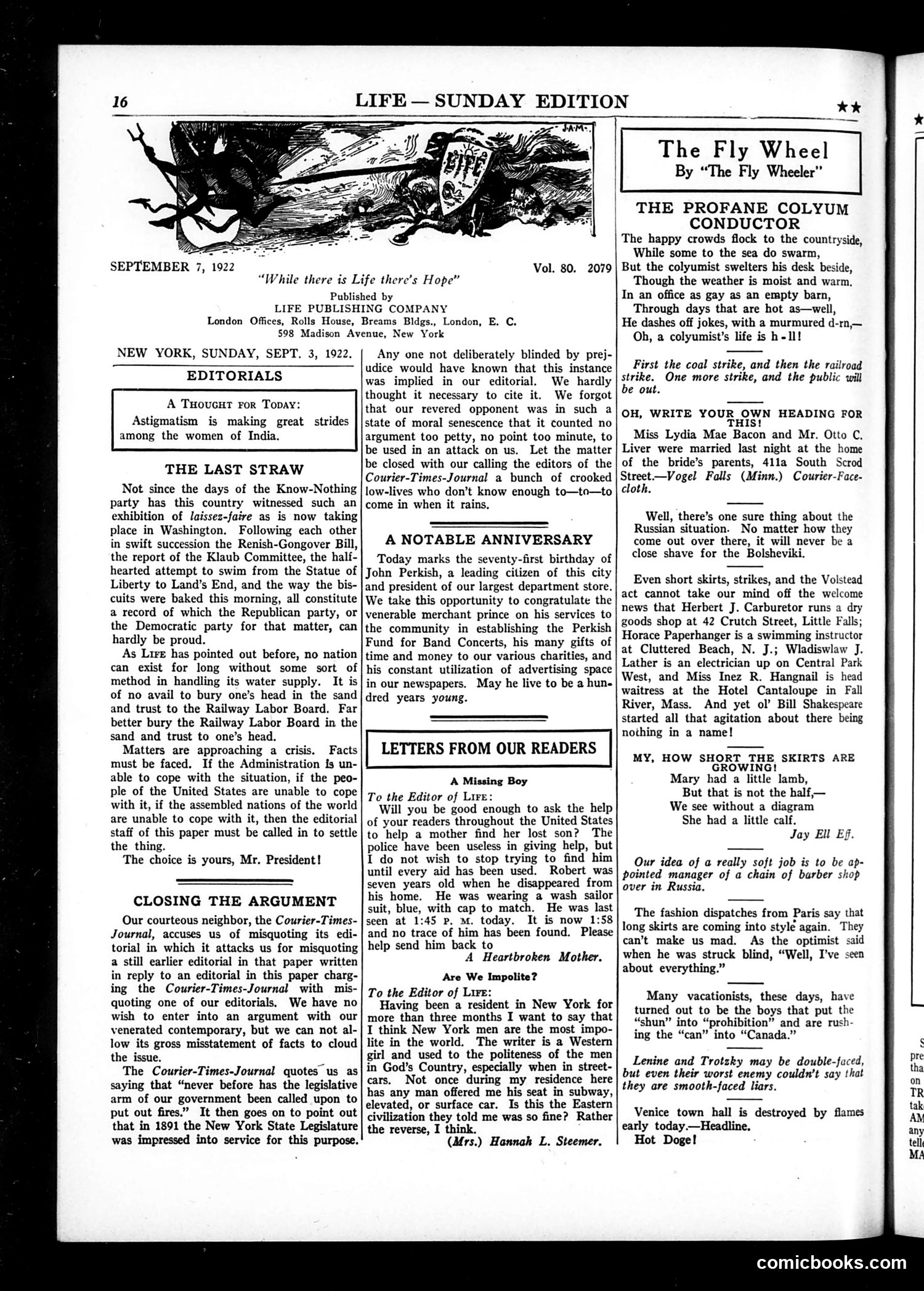
This page consists primarily of **editorial commentary and reader letters** rather than political cartoons. The masthead image at top appears to be decorative illustration rather than satirical cartooning. The editorials employ **absurdist satire** typical of Life magazine's style. "The Last Straw" mocks government incompetence by listing increasingly ridiculous issues (the "Renish-Gongover Bill," biscuit-baking) as equivalent crises, climaxing with the editor's mock-serious threat that the editorial staff must personally solve the nation's problems. This is self-aware parody of pompous journalism. "Closing the Argument" satirizes an **endless editorial dispute** with a rival newspaper (Courier-Times-Journal) about misquoting, where each side accuses the other of misquoting previous accusations—a commentary on pointless journalistic feuds. The piece ends by calling the rival editors "crooked low-lives." The page also includes a genuine **missing person appeal** for a seven-year-old boy named Robert, indicating Life published readers' letters alongside satirical content.
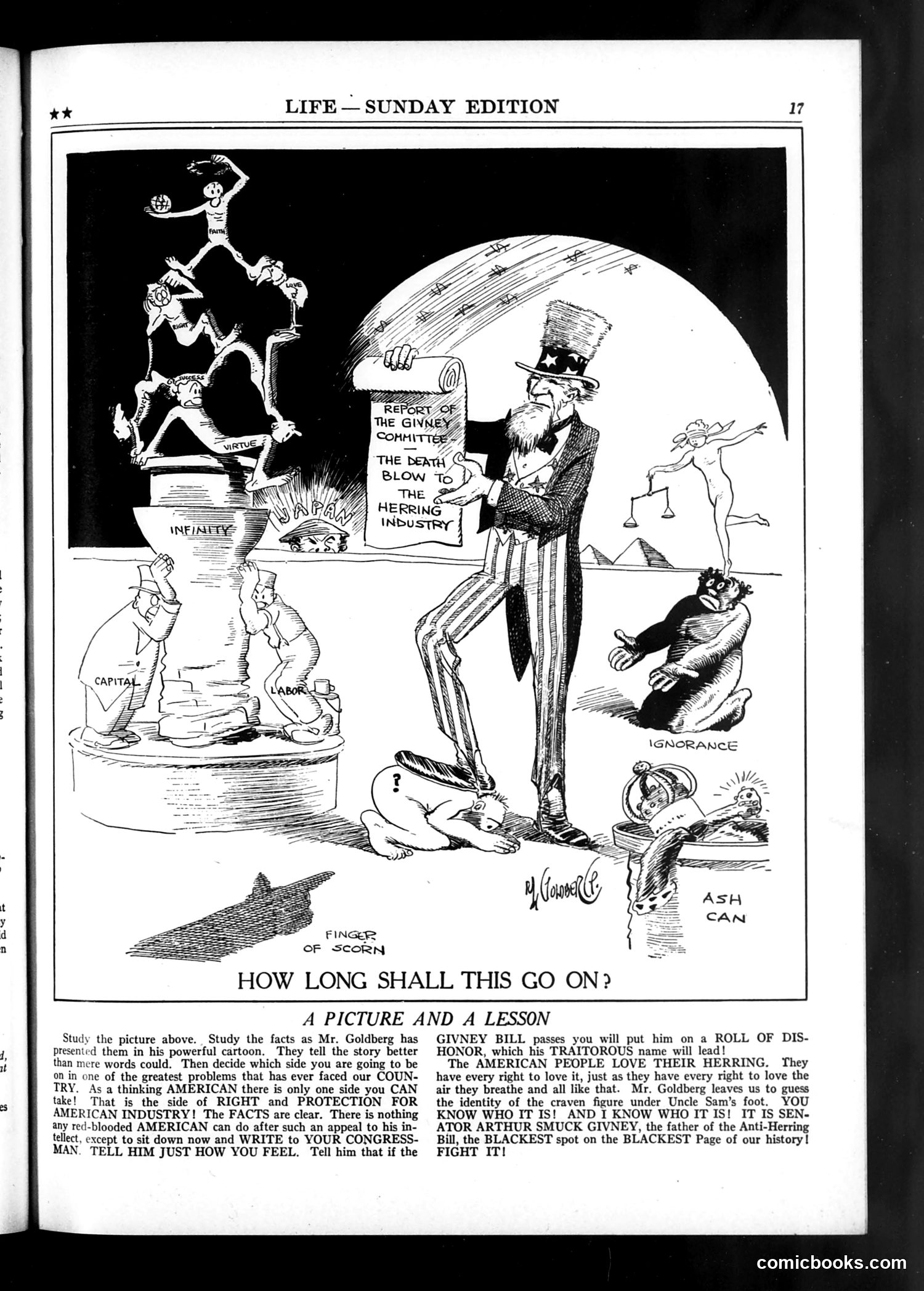
This is a propagandistic political cartoon by Goldberg attacking Senator Arthur Smuck Givney over the proposed "Givney Bill"—legislation apparently threatening the American herring industry. The cartoon depicts Uncle Sam as a tall figure holding a report about the bill's damage to the herring industry, standing over a craven figure (identified as Givney) whom he crushes underfoot. Surrounding elements include "Capital" and "Labor" supporting an "Infinity" tower, representing American industrial strength, while various symbolic figures (Ignorance, Ash Can, Finger of Scorn) represent opposing forces. The accompanying text urges readers to write Congress opposing the bill, framing support for the herring industry as patriotic duty. The rhetoric is intensely nationalist, suggesting Givney's bill represents betrayal of American workers and interests. Without knowing the bill's actual contents or date, the cartoon's exact historical context remains unclear, but it exemplifies early-to-mid 20th-century protectionist sentiment dressed in patriotic language.
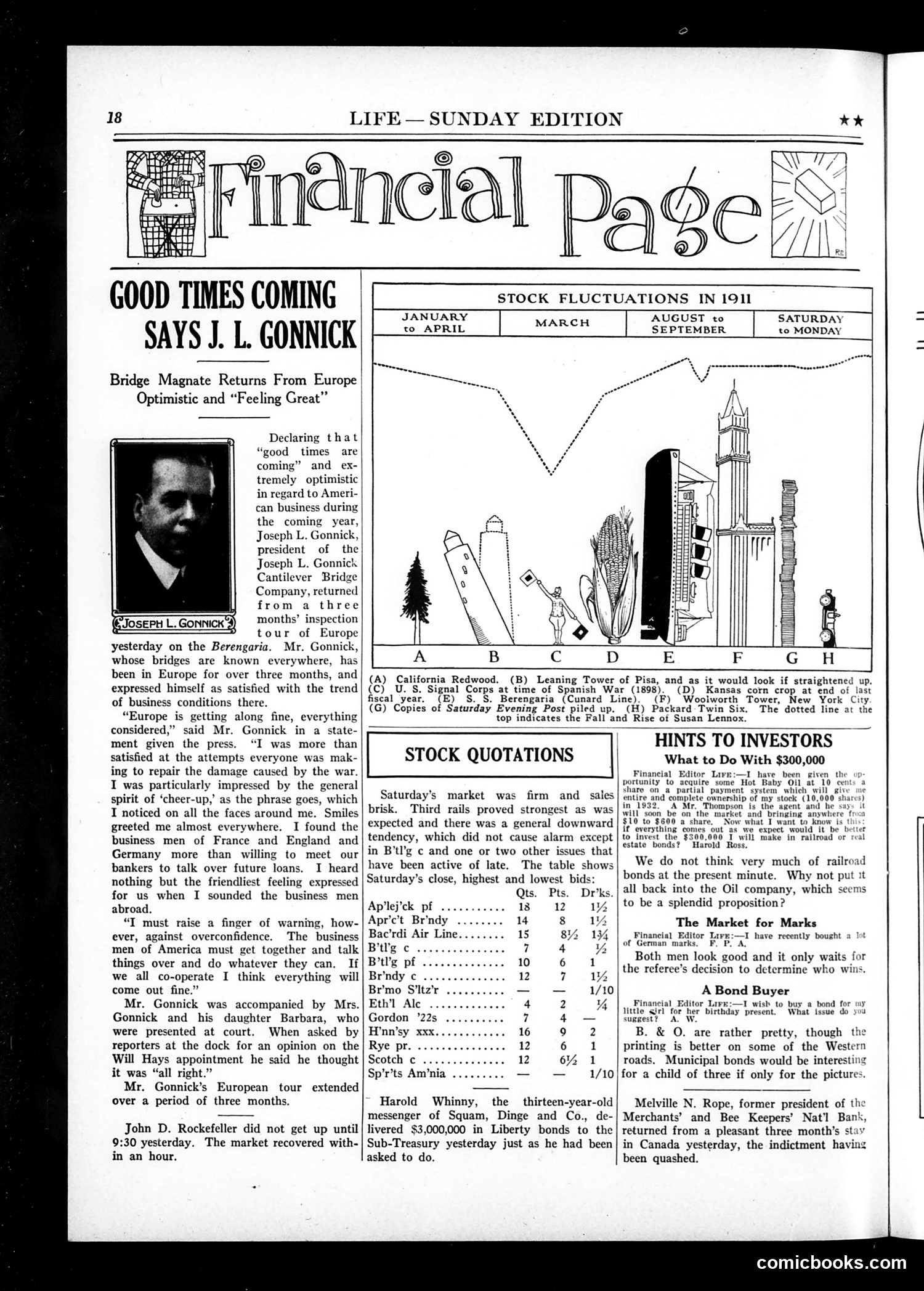
This is a financial page mixing genuine business news with pointed satire. **J.L. Gonnick**, a bridge magnate, returns from Europe declaring "good times coming"—a declaration the magazine treats skeptically through juxtaposition. The **stock chart** labeled "Stock Fluctuations in 1911" is entirely fake. Items labeled A-H include "California Redwood," "Leaning Tower of Pisa (straightened)," and "Packard Twin Six" rather than actual stocks—mocking the arbitrary nature of market movements and investors' willingness to chase any commodity. The **"Stock Quotations"** section continues the joke with absurd ticker symbols like "Ap'lej'ck pf" (applejack), "Bac'rdi Air Line," and "Scotch c"—all alcoholic beverages disguised as securities, likely satirizing Prohibition-era speculation and frivolous investing. The **"Hints to Investors"** column features get-rich-quick schemes (Hot Baby Oil stock), mocking naive investors' desperation. The sardonic kicker: "John D. Rockefeller did not get up until 9:30 yesterday. The market recovered within an hour"—suggesting even industrial titans' trivial actions move markets.
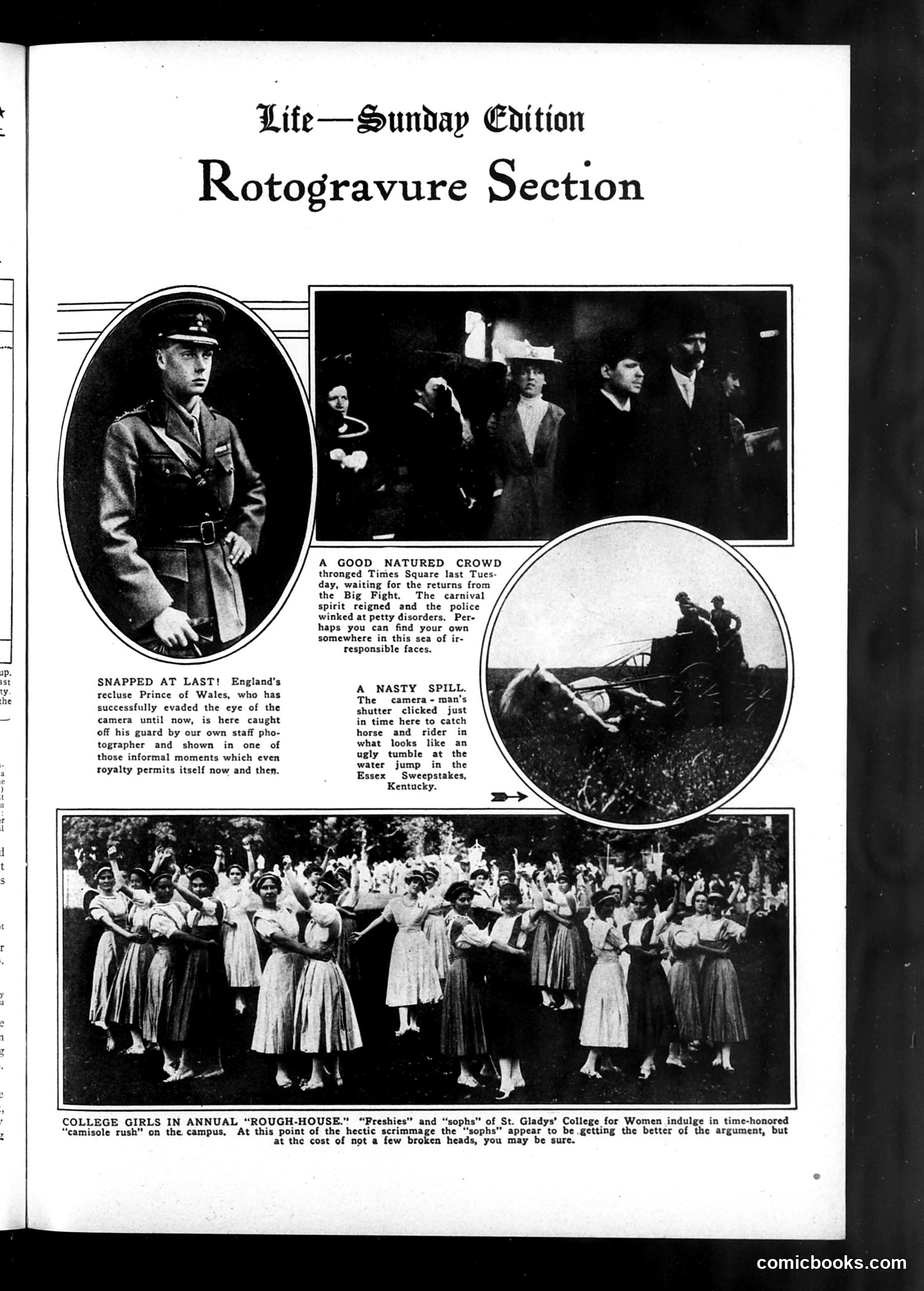
This is a photo-journalism page from Life's Sunday edition featuring candid photographs with light captions. The main content includes: 1. **Prince of Wales portrait**: A formal photograph of England's Prince of Wales, presented as a rare "candid" capture—notable because he reportedly avoided cameras. 2. **Times Square boxing crowd**: A street scene of spectators gathered for fight results, depicted as good-natured but rowdy, with police tolerating minor disorder. 3. **Equestrian accident**: A horse and rider captured mid-fall at a steeplechase event in Kentucky. 4. **College "rough-house"**: Female students from St. Gladys' College engaged in a traditional "camisole rush"—a raucous hazing ritual where sophomores and freshmen compete physically, apparently resulting in "broken heads." The page celebrates candid photography and captures of contemporary life, mixing royalty, sports crowds, accidents, and youthful antics as entertainment for readers.
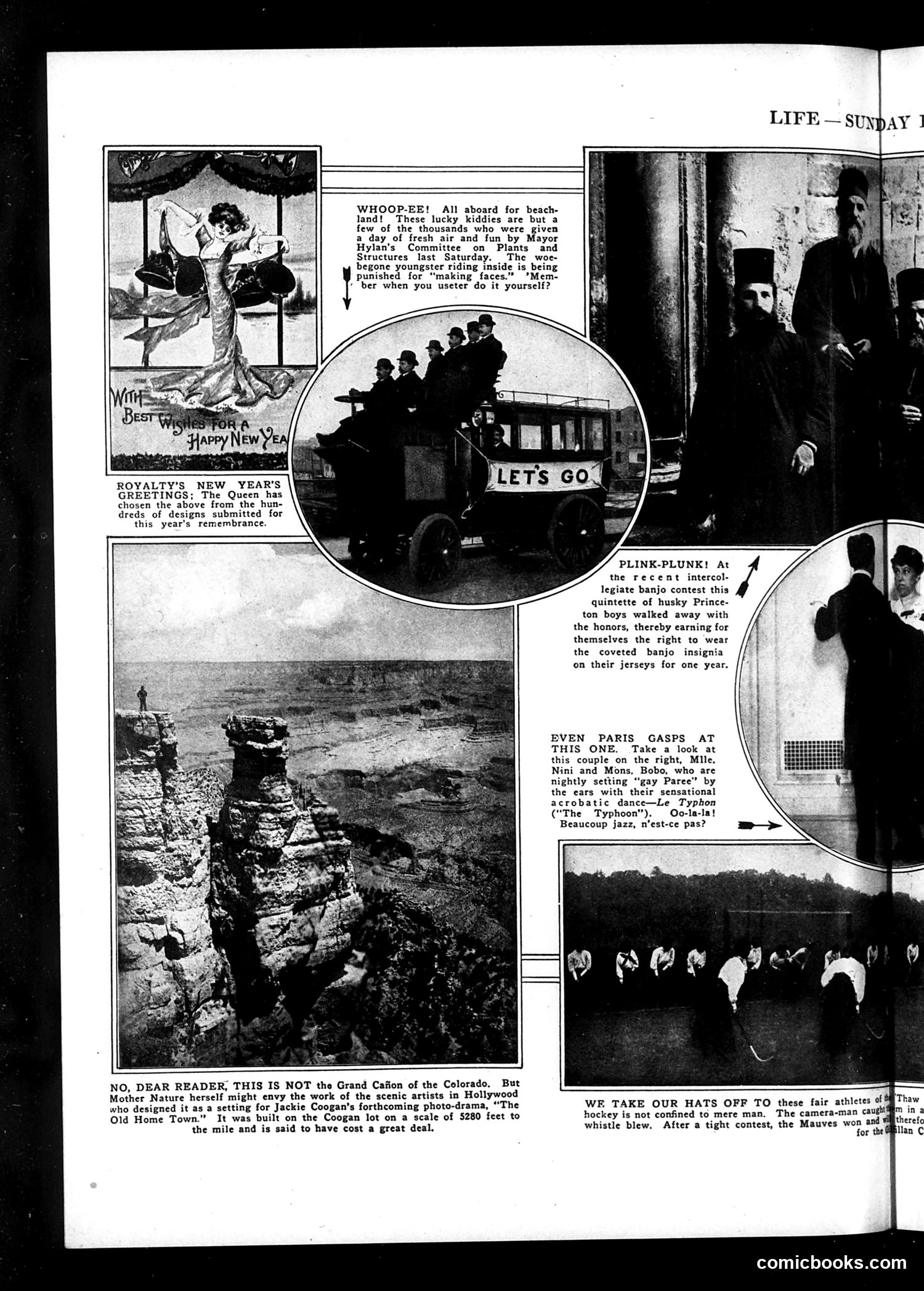
This is a miscellaneous content page from Life magazine featuring several unrelated brief items and photos, typical of the publication's format. The main items include: 1. **Mayor Hylan's beach program**: A satirical note about NYC Mayor Hylan providing beach outings for poor children, with humor about a child being punished for making faces. 2. **Royal New Year's greeting**: The British Queen's chosen design for her annual greeting card. 3. **Princeton banjo contest**: Collegiate athletes competing for the honor of wearing a banjo insignia on their jerseys—likely mocking the pretentiousness of college athletic honors. 4. **Paris dance act**: A French acrobatic dancing couple performing "Le Typhon," with satirical French phrases ("Oo-la-la! Beaucoup jazz") mocking Parisian nightlife trends. 5. **Hollywood set**: Jackie Coogan's movie set designed to resemble the Grand Canyon—satirizing Hollywood's elaborate artificiality. 6. **Women's hockey**: A brief note about female hockey athletes. The page is light, gossipy satire typical of Life's social commentary.
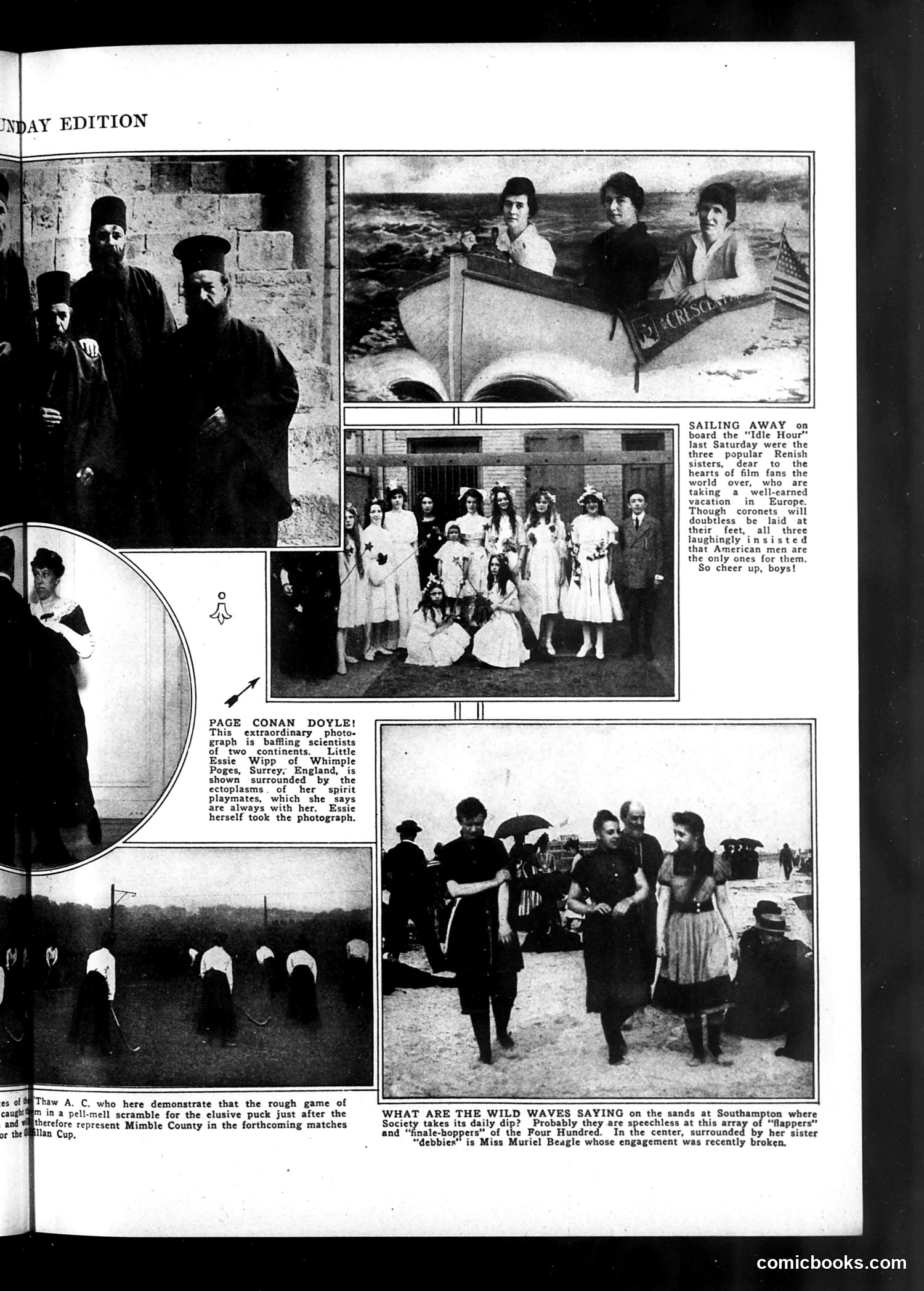
This page presents early 1920s society gossip and pseudo-scientific curiosity pieces typical of satirical magazines of the era. The main feature ridicules spiritualism's popularity: a photograph claims to show "ectoplasms" (spirit entities) around young Essie Wipp, supposedly captured by the child herself. The caption's reference to "Page Conan Doyle" likely mocks Sir Arthur Conan Doyle, the famous Sherlock Holmes author who was a prominent spiritualism believer. The satire suggests credulous acceptance of dubious supernatural photography. The other items mock wealthy society figures: young "flappers" (modern, fashionable young women of the 1920s) departing on leisure voyages, and society women claiming preference for American men over European nobility. The bottom photo shows fashionably-dressed young women ("flappers" and "finale-hoppers"—dancehall enthusiasts) at Southampton beach, likely satirizing their conspicuous leisure and modern behavior, which scandalized conservative readers. Overall, the page satirizes both spiritualism credulity and the Jazz Age social upheaval represented by young women's newfound independence and frivolity.
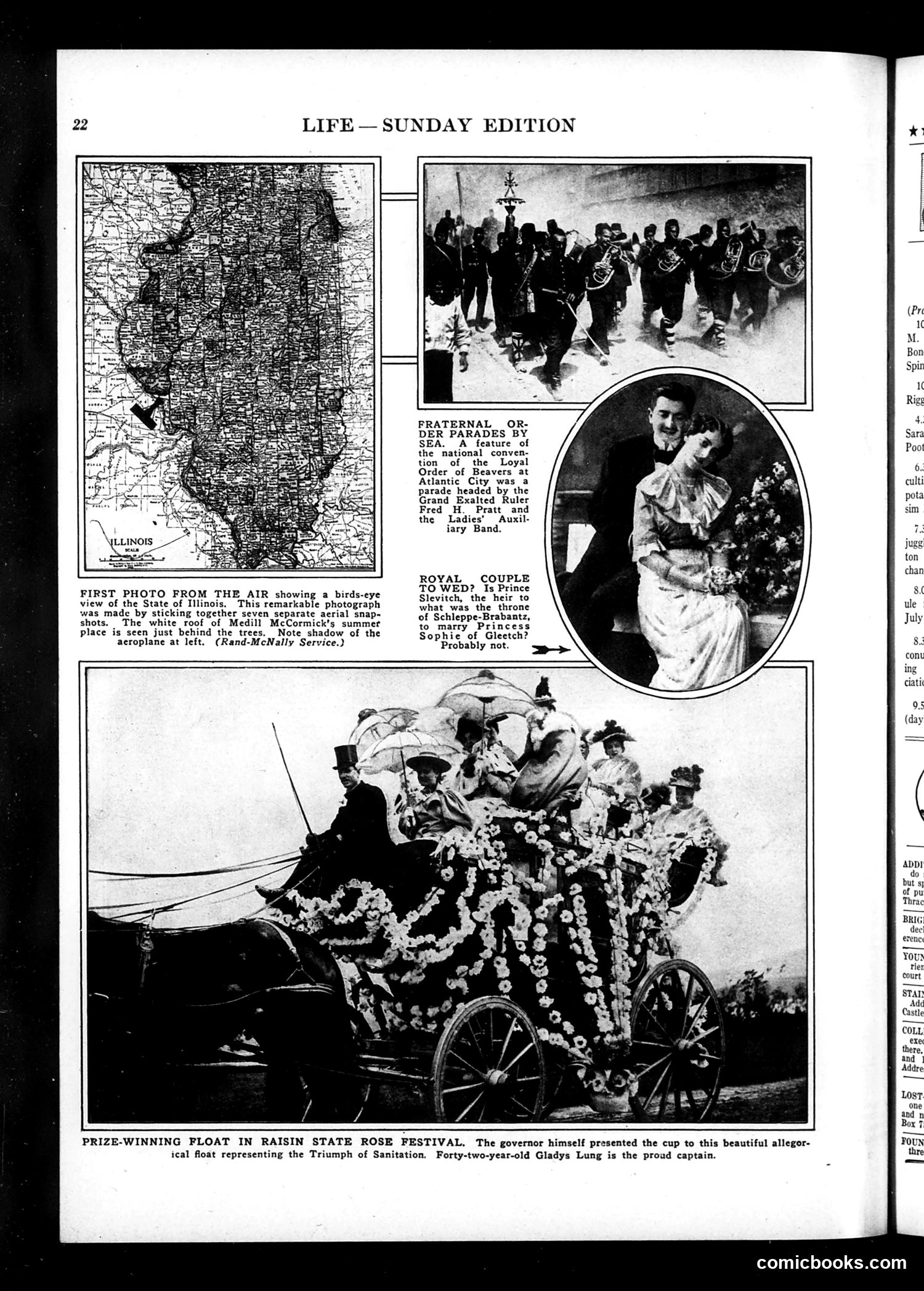
This page from Life's Sunday Edition showcases four distinct photo-journalistic items rather than traditional political cartoons: 1. **Illinois Aerial Map**: A composite photograph of Illinois made from seven aerial snapshots—notable as an early example of aerial photography technology. 2. **Fraternal Order Parade**: Documents a "Loyal Order of Beavers" convention parade in Atlantic City, led by Grand Exalted Ruler Fred H. Pratt. This appears to be straightforward coverage of a fraternal organization's gathering. 3. **Royal Couple Portrait**: A posed photograph of what appears to be European royalty (the caption's sarcastic questioning—"Probably not"—suggests the identities are uncertain or the claim is dubious). 4. **Rose Festival Float**: A California raisin festival's allegorical float celebrating sanitation, captained by 42-year-old Gladys Lung, with the governor presenting the award. The page emphasizes visual novelty and human-interest stories typical of Life's illustrated journalism format, blending genuine news coverage with lighthearted, quirky Americana.
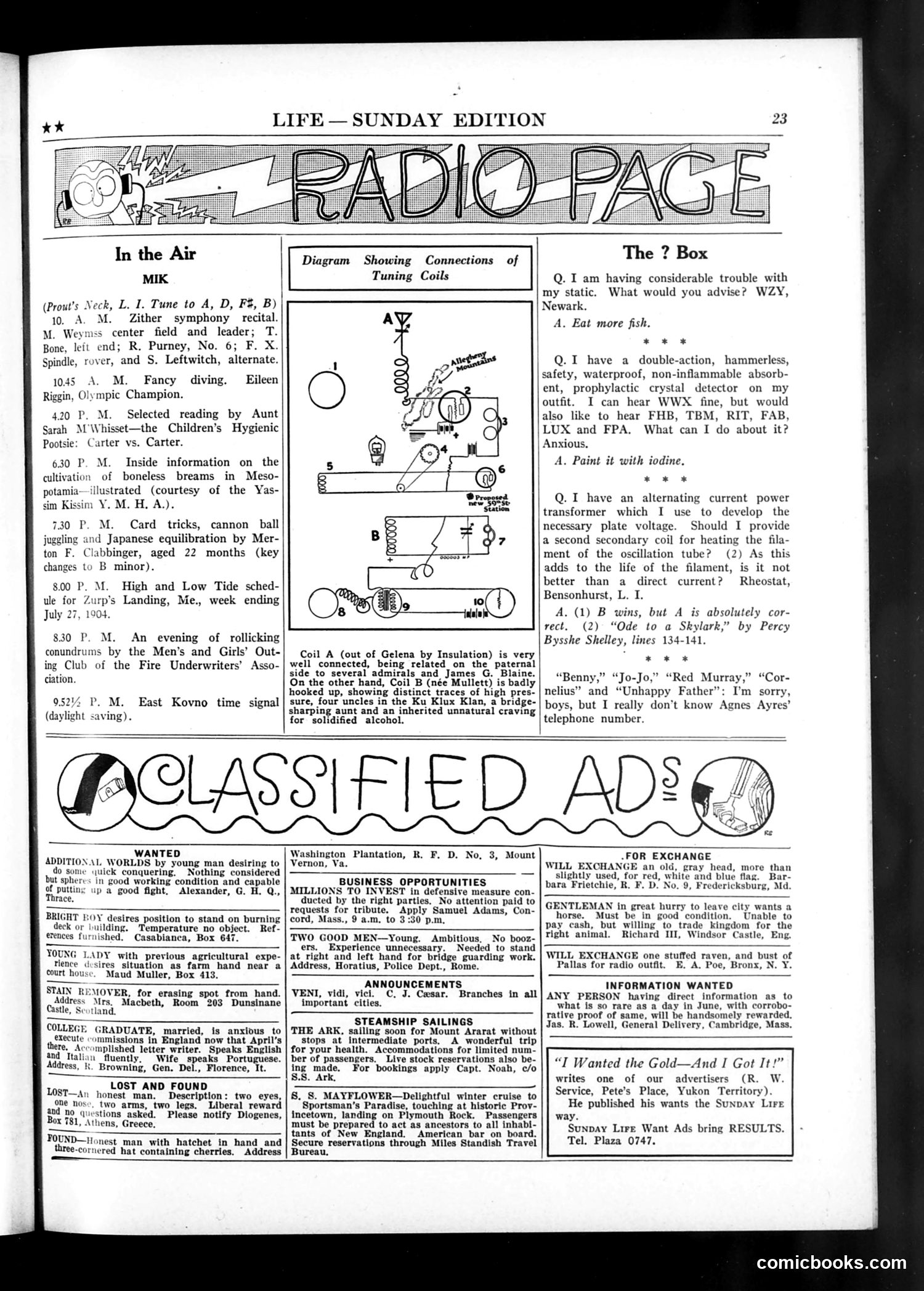
This page is primarily a **parody of radio broadcasting schedules and advice columns**, which were novel forms of media in the early 1900s. The **"In the Air"** section mocks radio programming with absurdly specific, mundane—even nonsensical—listings ("Zither symphony recital," a 22-month-old juggling, East Kovno time signals). This satirizes how radio stations filled airtime with experimental, often pointless content. The **"? Box"** section parodies technical radio advice columns by answering serious engineering questions with ridiculous non-sequiturs ("Paint it with iodine," quotes Percy Bysshe Shelley). The **"Classified Ads"** section below uses literary and historical references (Macbeth, Diogenes, Maud Muller) to create absurdist humor—advertising for impossible things like "additional worlds" or an honest man. Overall, the humor targets the confusion and hype surrounding early radio technology and media's growing role in American life.
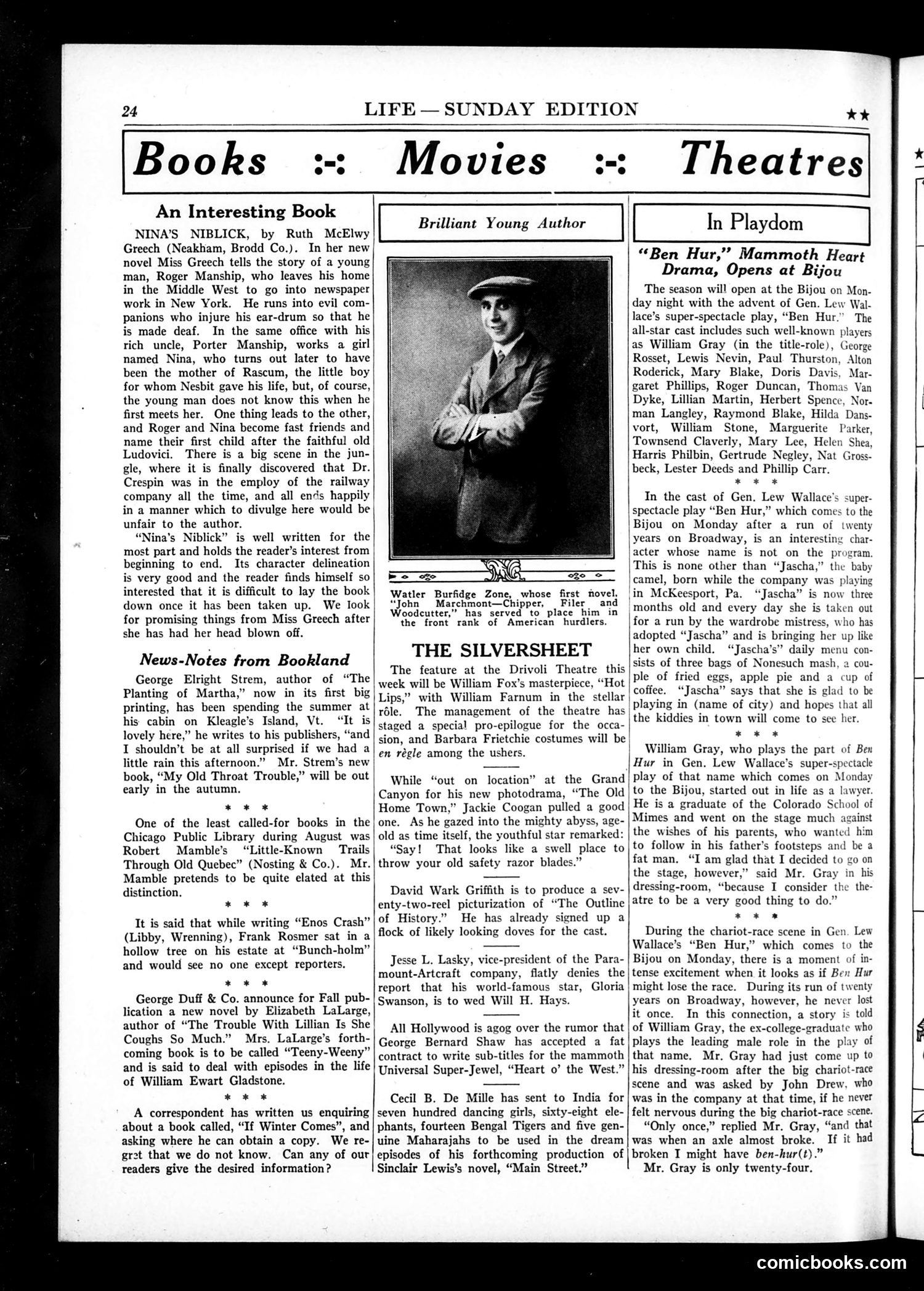
This is a **satirical books/movies/theater review page** from Life magazine's Sunday edition. The satire operates through absurdist humor targeting literary and entertainment pretension. The **book reviews mock mediocre novels** through ridiculous plot summaries—"Nina's Niblick" features a convoluted story with inexplicable plot twists (a character's "head blown off" at the end). The "News-Notes" section parodies literary culture: an author celebrates his obscurity, another writes in a hollow tree to avoid reporters, and there's a query about an unknown book no reader can locate. The **movie section** satirizes Hollywood excess—D.W. Griffith's announced 72-reel film adaptation and studio production absurdities. Jackie Coogan's joke about throwing razor blades into the Grand Canyon mocks celebrity vacuity. **The central image** appears to be a portrait of a young author, likely representing the "brilliant young author" referenced in the caption. Overall, this page ridicules the pretensions of 1920s literary and film industries through deadpan, nonsensical content that exposes their often-hollow substance.
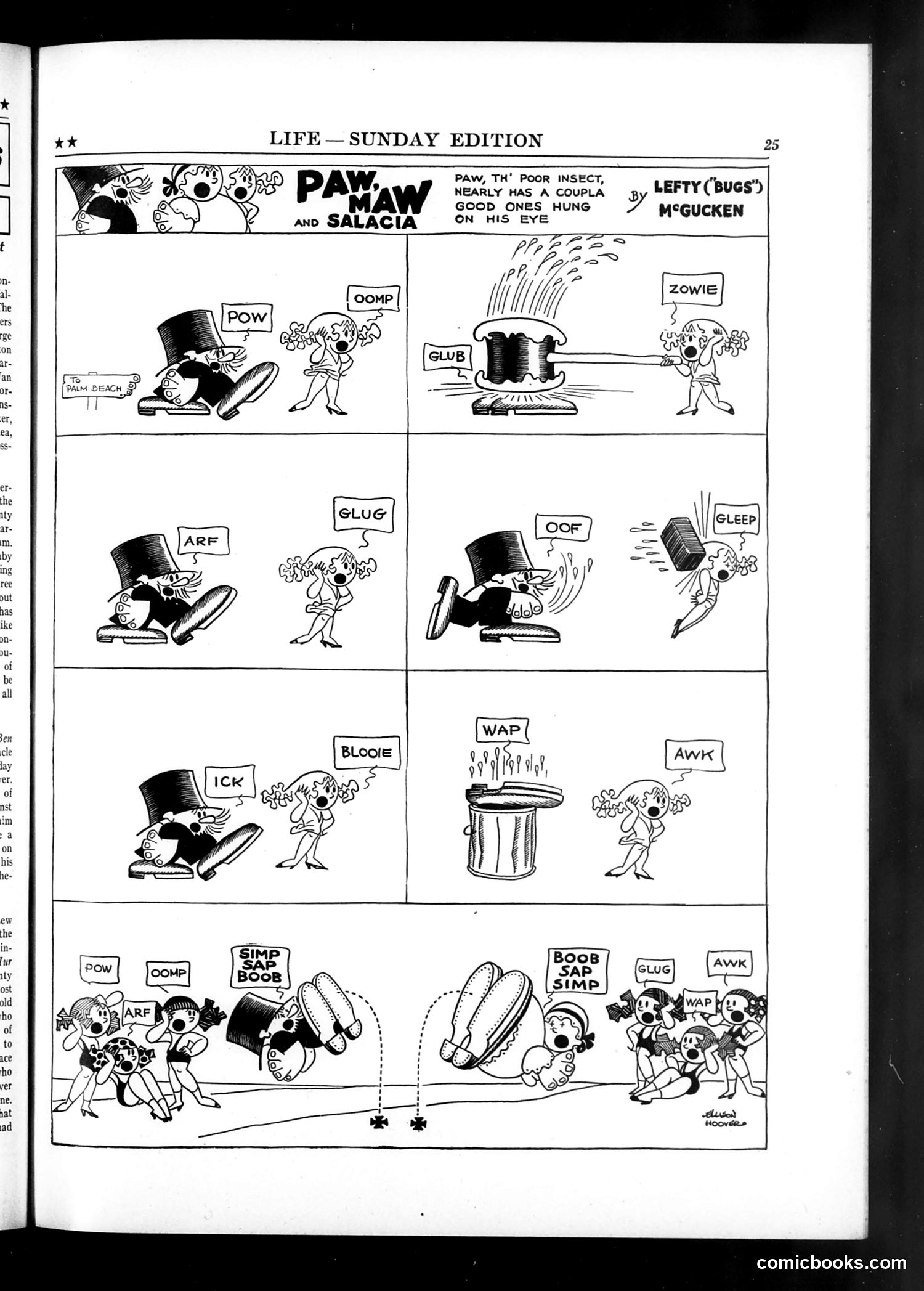
This is a slapstick comedy strip by Lefty McGucken depicting physical altercations between characters. The humor relies on onomatopoeia (POW, OOMP, GLUB, ARF, OOF, ICK, BLOGIE, WAP, AWK) representing various sounds of impact and violence. The setup appears to involve a character in a top hat repeatedly striking or being struck by another character, with a third figure reacting. The final panel shows both characters covered in injuries, surrounded by sound-effect words, suggesting an escalating cycle of comic violence. The satire or deeper meaning is unclear without additional context about these specific characters or the strip's running storylines. It's primarily visual slapstick rather than political or social commentary.
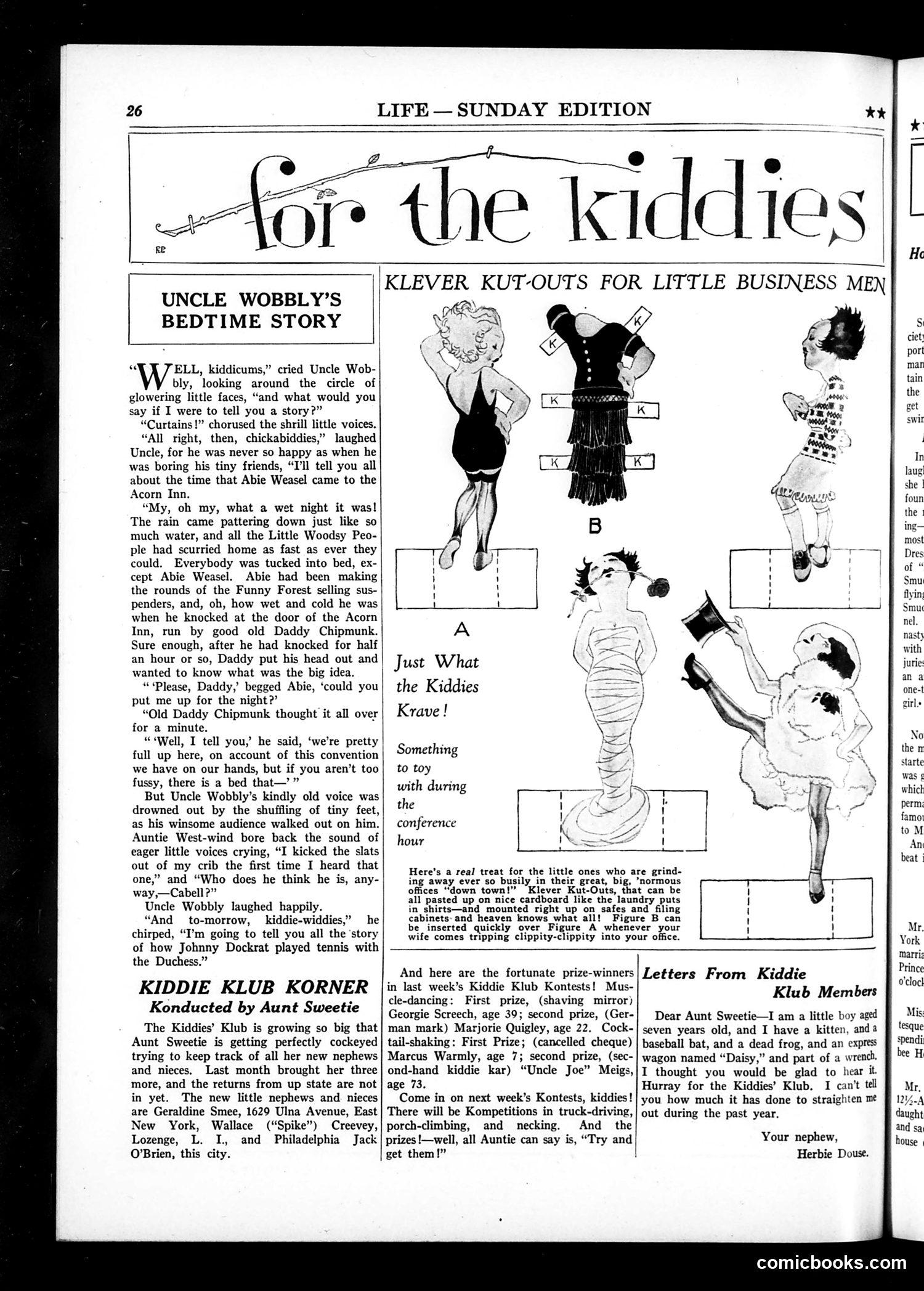
This is a children's entertainment section from Life magazine featuring three satirical pieces aimed at adults, not children—the jokes work on multiple levels. **Uncle Wobbly's Bedtime Story** mocks tedious, old-fashioned children's literature. The tale of "Abie Weasel" and "Daddy Chipmunk" is deliberately boring; the children walk out mid-story, validating the satire of overly wholesome, saccharine fiction. **Klever Kut-Outs** satirizes busy businessmen. The page offers paper dolls labeled "Little Business Men" designed to be swapped over office furniture—a sarcastic commentary on men so obsessed with work they need childish diversions during business conferences. The joke: these grown men are the real "kiddies." **Kiddie Klub Korner** extends the mockery by listing "prize winners" with absurd ages (39, 73 years old) competing in children's contests, further blurring the line between childish and adult behavior. The satire targets turn-of-the-century American business culture and its infantilization of adult males.
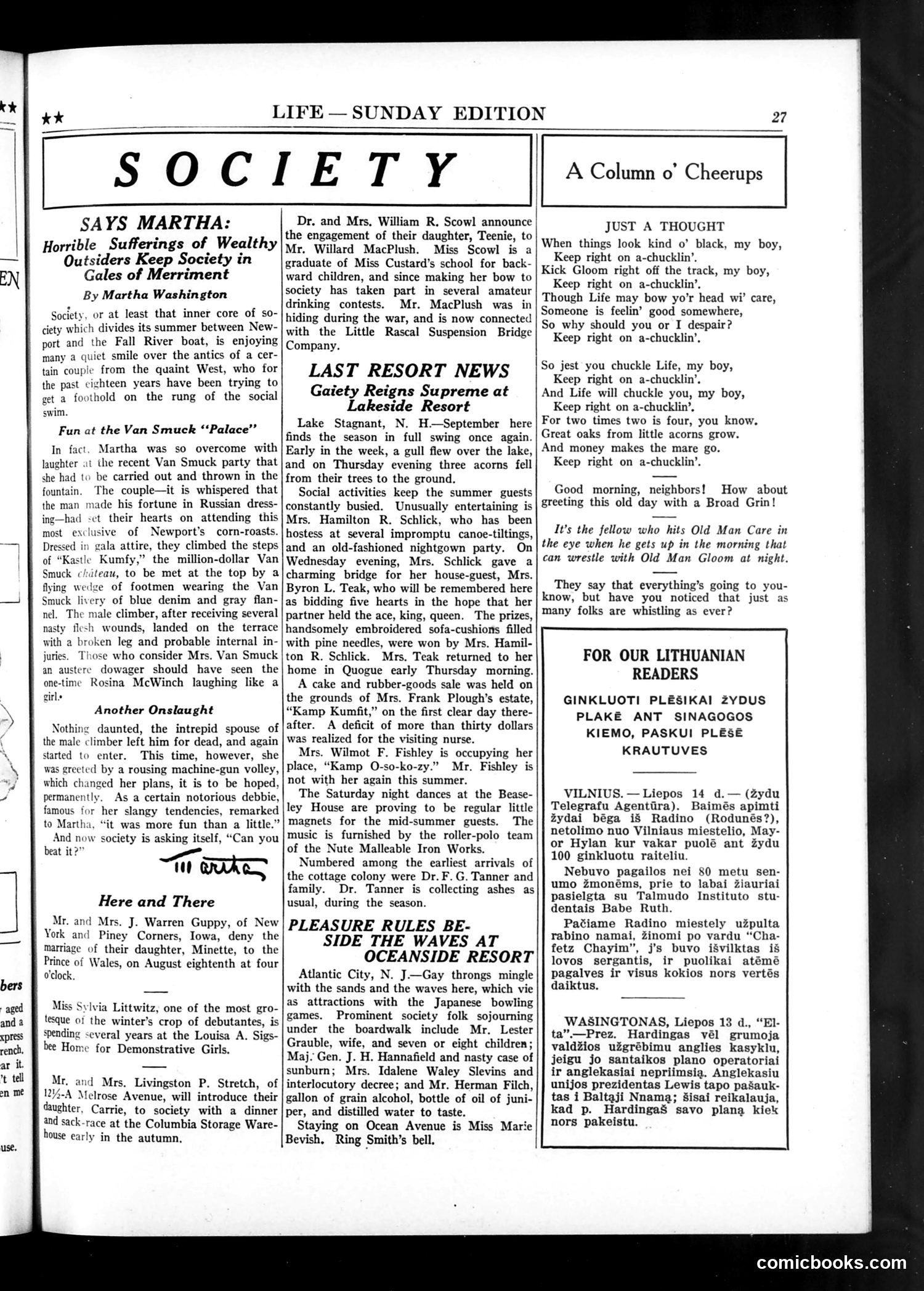
This is a satirical society column mocking wealthy American high society's pretensions and absurdity. "Martha Washington" (a pseudonymous gossip columnist) ridicules the social elite's exclusivity and snobbery. The main humor targets **newly wealthy outsiders** attempting to enter established Newport society. The Van Smuck family—their name itself a joke suggesting crude origins ("Russian dressing" fortune)—are depicted literally violently excluded from a society event, with footmen shooting at them with machine guns. This exaggerates but mocks how harshly old-money aristocrats rejected social climbers. The column also satirizes the triviality of wealthy leisure activities: a lakeside resort's "excitement" consists of a gull flying overhead and acorns falling. Society women's accomplishments are mocked (one debutante is "grotesque," another's only noted achievement is amateur drinking contests). The humor relies on readers' familiarity with Newport social gossip and the era's class tensions between old money and nouveau riche.
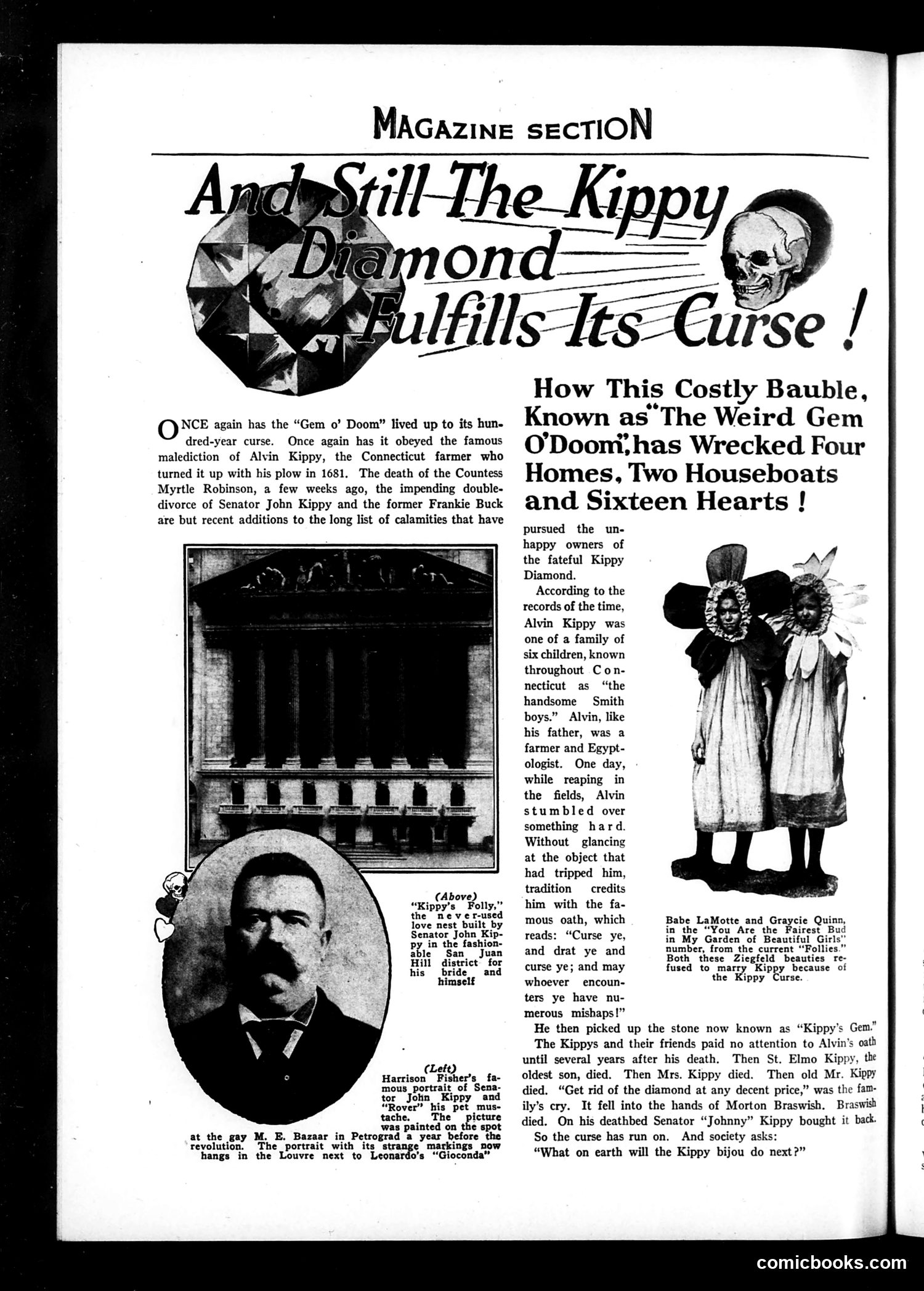
This is a humorous Life magazine article mocking the superstition surrounding cursed diamonds—a popular tabloid obsession of the early 20th century. The piece invents a fictional "Gem of Doom" supposedly discovered by Connecticut farmer Alvin Kippy in 1681, with an elaborate curse narrative spanning generations. The satire targets credulous society's fascination with cursed objects and their supposed supernatural consequences. Each transfer of the diamond coincides with convenient misfortunes (deaths, divorces, financial ruin). The article includes period portraits and photographs of actual people (notably Senator John Kippy and actresses Babe LaMotte and Graycie Quinn) to add false authenticity to the fabrication. The joke is the absurdity: readers are meant to recognize this as invented hokum while society reportedly remains enchanted by such nonsense. It satirizes both superstition and celebrity scandal-mongering.
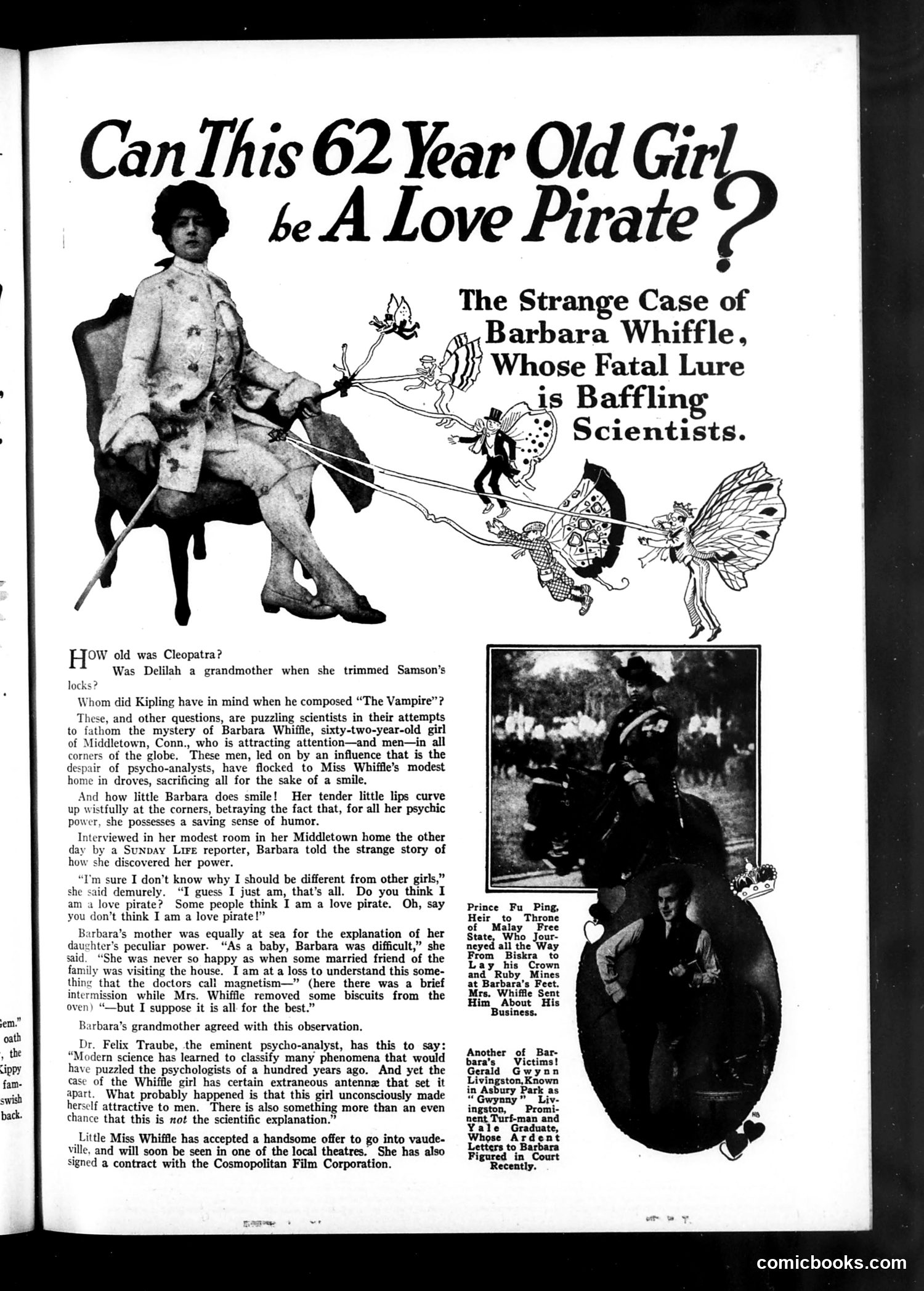
This Life magazine article satirizes the supposed mysterious "powers" of Barbara Whiffle, a 62-year-old Connecticut woman allegedly attracting admirers from around the world. The piece mockingly compares her to historical seductresses (Cleopatra, Delilah) and literary figures (Kipling's "The Vampire"). The satire targets both credulous public fascination and pseudo-scientific explanations. A psychoanalyst quoted invokes vague concepts like "extraneous antennae" to explain her appeal—lampooning how experts deployed obscure jargon to seem authoritative. The accompanying photographs show various supposedly smitten men, including "Prince Fu Ping" and others, visiting her modest home. The humor lies in the absurd contrast: a 62-year-old woman from Middletown, Connecticut somehow possessing irresistible appeal, while she herself humbly claims ignorance of her power. The article's breathless tone and elaborate buildup undercut by mundane reality creates the satirical effect.
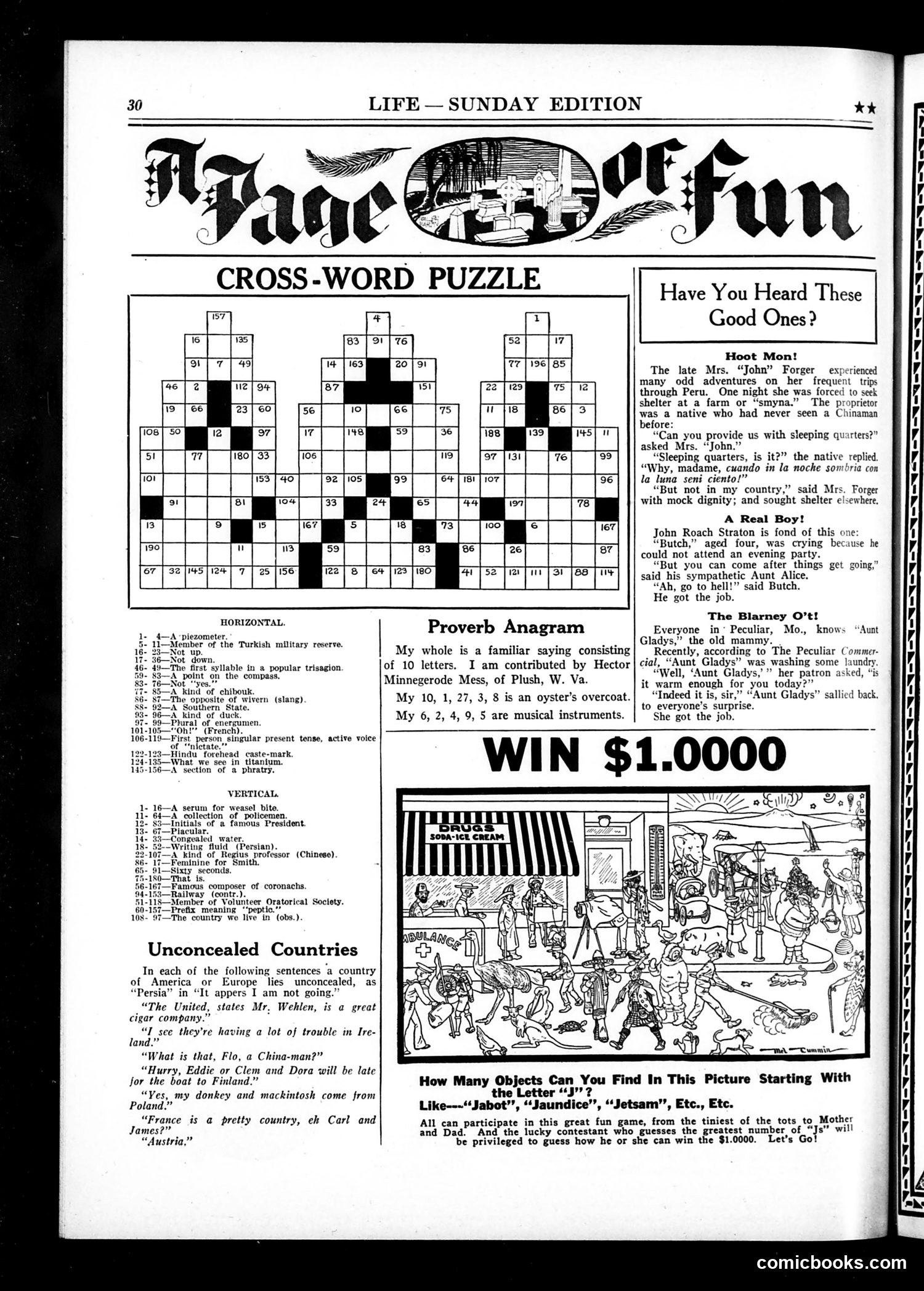
This page is primarily **puzzle and humor content** rather than political satire. It features: **Main Elements:** - A crossword puzzle with clues referencing geography, language, and obscure terms - A "Proverb Anagram" word game - Three humorous anecdotes in the "Good Ones?" section - An "Unconcealed Countries" word puzzle where country names are hidden in sentences - A "$1,000" contest asking readers to find objects in an illustration starting with the letter "J" **The Humor:** The anecdotes use period comedic tropes: Mrs. Forger's Peru travels (playing on exotic tourism), a child's profanity for comedic effect ("Butch"), and gentle racial humor featuring "Aunt Gladys," an African American domestic worker. These represent typical early 20th-century magazine humor that relied on stereotypes and cultural assumptions now considered offensive. **Overall:** This is a **recreational/entertainment page** typical of Life's "Sunday Edition"—offering word games, jokes, and contests rather than political commentary.
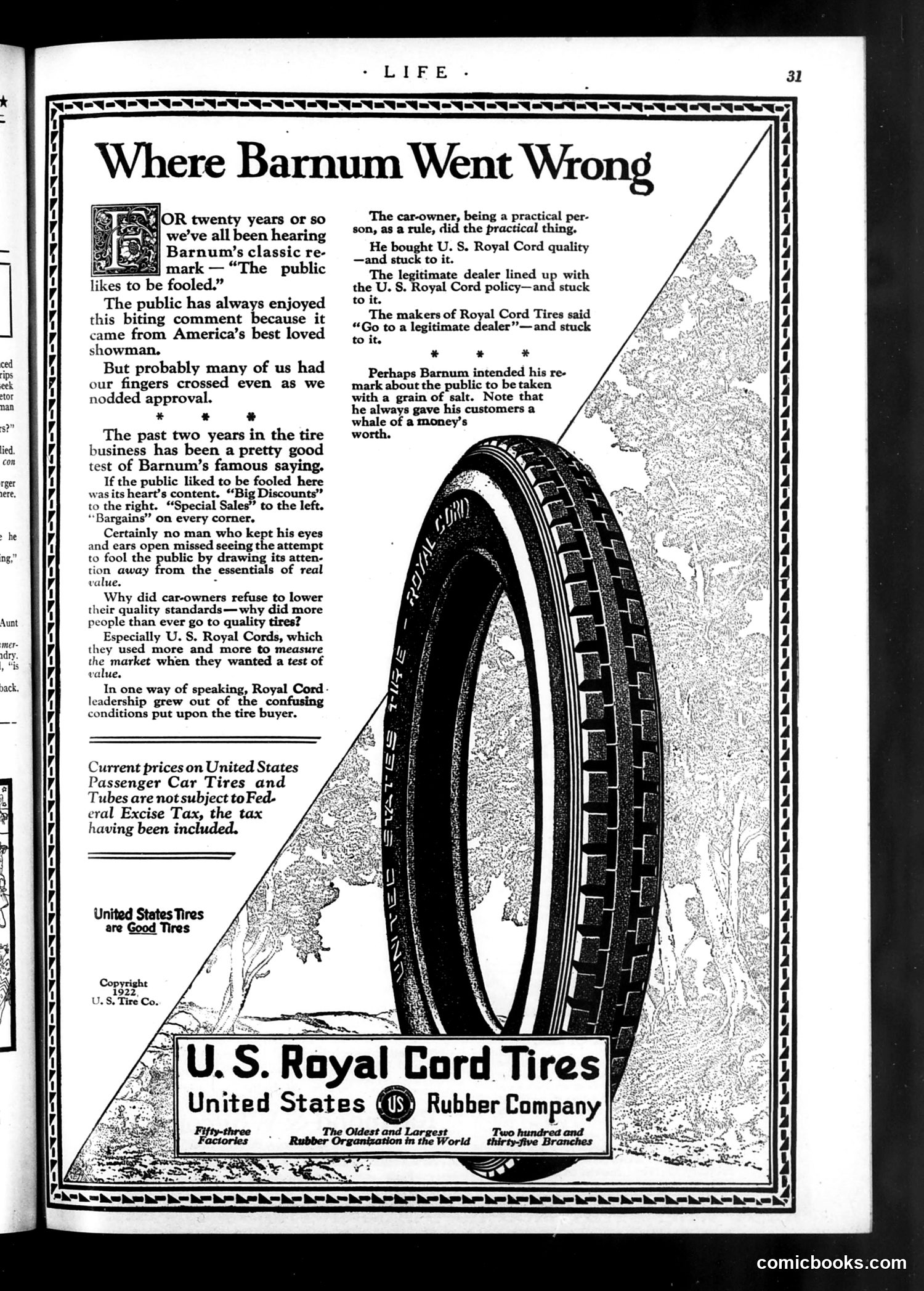
This is primarily an **advertisement** for U.S. Royal Cord Tires, not a political cartoon. The "satire" is self-directed advertising strategy. The piece references P.T. **Barnum's famous quote** that "the public likes to be fooled"—a real showman's observation known to early 20th-century readers. The ad argues that Barnum was *wrong* about tire buyers specifically. During a period of confusing tire marketing (with competing "discounts" and "bargains"), consumers actually chose **quality over deception**—specifically U.S. Royal Cord tires. The ad claims that car-owners, dealers, and manufacturers all rejected gimmicks and "stuck to" honest quality. The joke: Barnum's cynical philosophy failed here because practical Americans recognize genuine value. The tire itself (shown prominently) becomes proof that consumers rejected marketing manipulation. It's aspirational advertising disguised as social commentary—flattering readers as too sensible to fool.
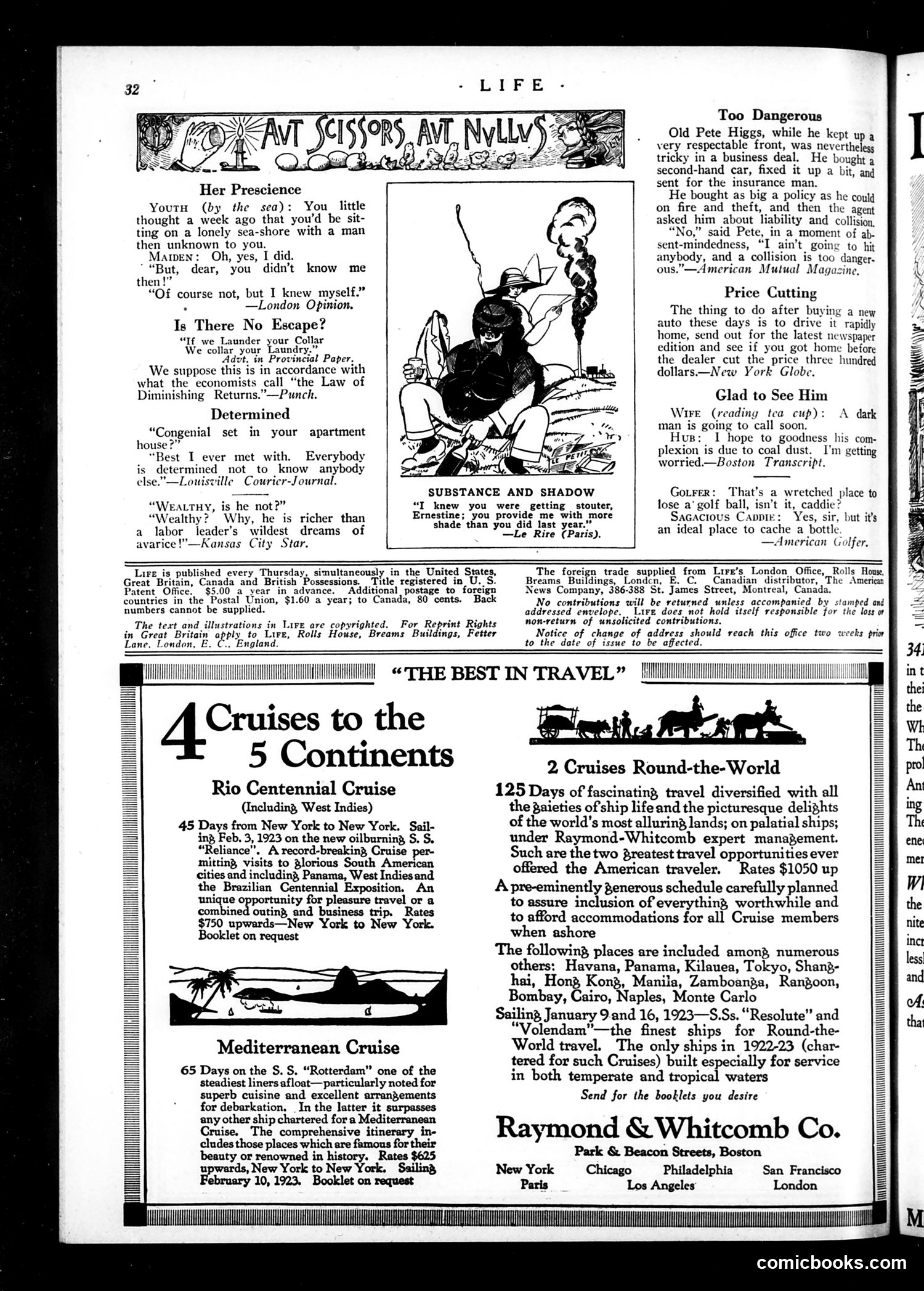
This page from Life magazine presents several short humorous anecdotes mocking human nature and social conventions circa 1923. **Key satirical pieces:** - **"Her Prescience"**: A woman claims she "knew herself" well enough to predict she'd meet her future romantic partner—satirizing women's supposed intuitive powers. - **"Too Dangerous"**: Old Pete Higgs, a dishonest used-car dealer, ironically declines collision insurance because he claims he won't hit anybody—the joke being his obvious untrustworthiness makes accidents likely. - **"Is There No Escape?"**: A laundry's advertisement accidentally suggests they simultaneously launder collars while stealing laundry—satirizing confusing corporate messaging. - Various other brief jokes mock labor leaders' wealth, shipping regulations, and golf etiquette. The page combines social commentary with wordplay typical of early-20th-century satirical humor, targeting consumer culture, business dishonesty, and social pretense. The bottom features cruise advertisements.
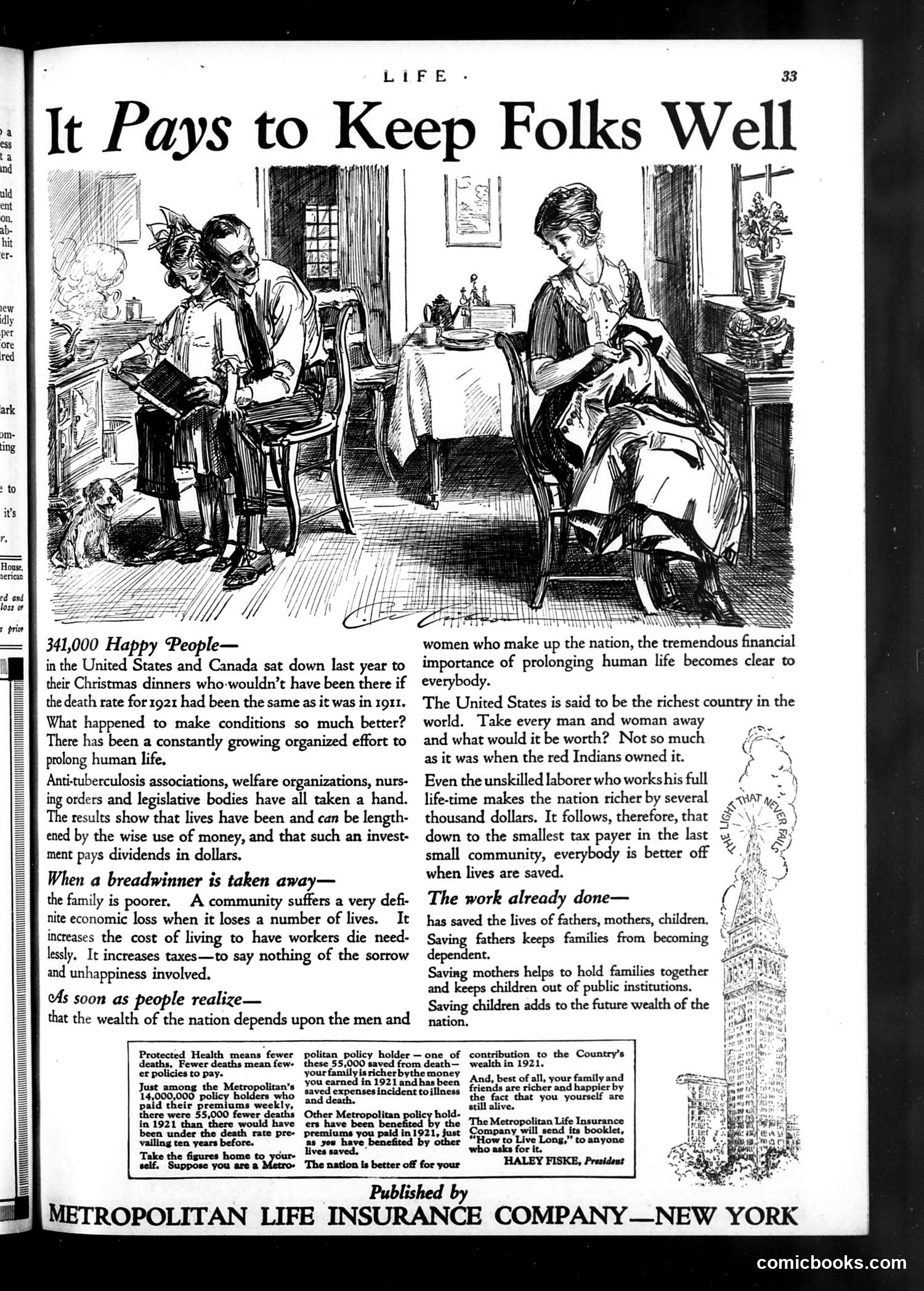
This is a **Metropolitan Life Insurance Company advertisement**, not satire. The page argues that public health improvements—anti-tuberculosis campaigns, welfare organizations, nursing care—have economic value, citing 341,000 people who survived to 1921 who would have died under 1911 mortality rates. The illustration shows a domestic scene: a woman reading to a man and child in a comfortable home, while an insurance agent consults with them—visualizing the financial security life insurance provides families. The argument is explicitly economic: dead workers harm communities through lost productivity and increased taxes; healthy workers create national wealth. Even unskilled laborers contribute "several thousand dollars" over lifetimes. Therefore, prolonging life—through both public health and life insurance—benefits everyone financially. This reflects early-20th-century progressivism linking public health to economic prosperity, and serves Metropolitan Life's business interests by framing insurance as patriotic investment in national welfare.
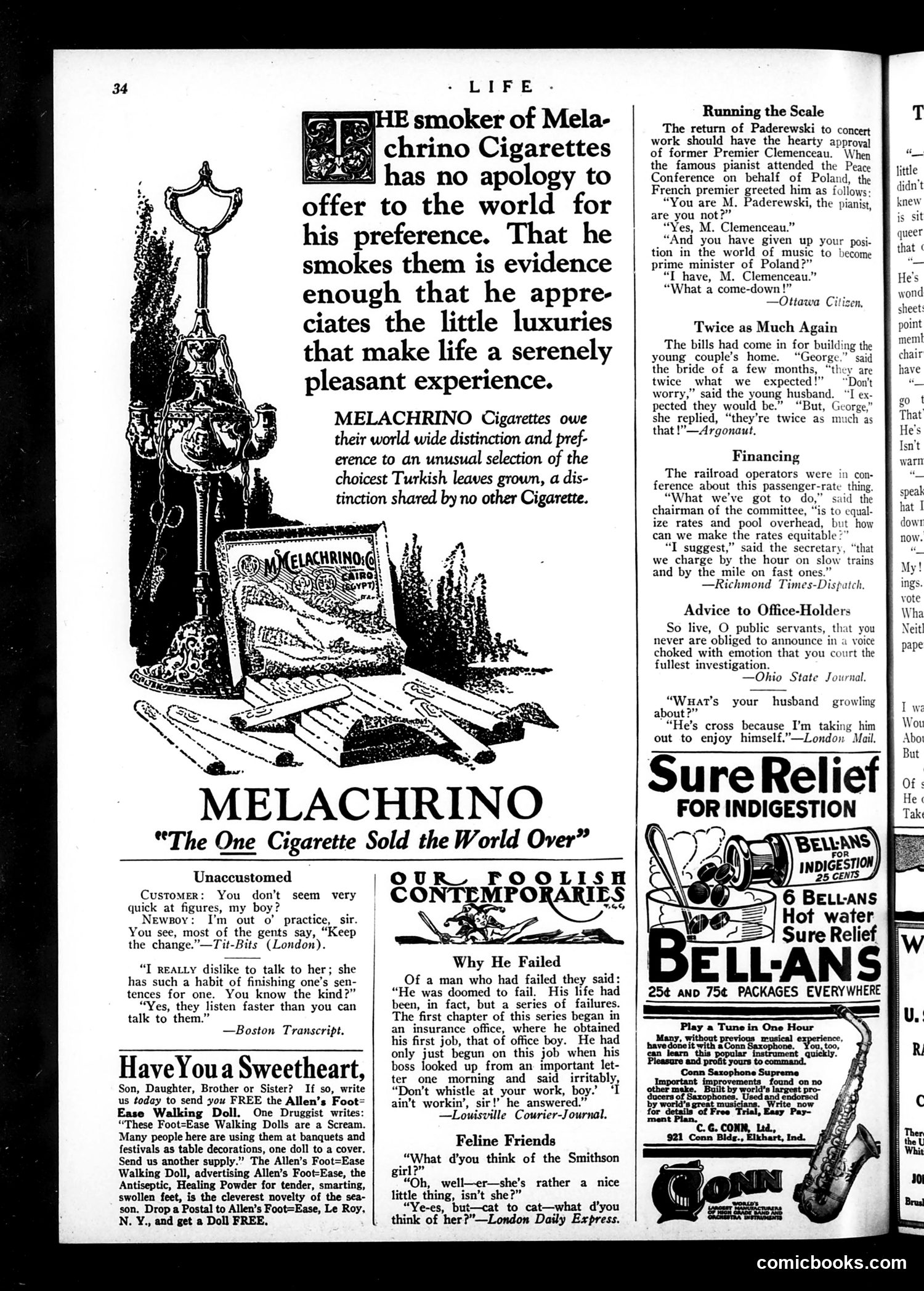
This page consists primarily of advertisements and miscellaneous humor pieces rather than political cartoons. The main advertisement (left side) promotes Melachrino Cigarettes, featuring an ornate illustration of Turkish tobacco leaves and decorative urns. The copy claims the cigarettes use "choicest Turkish leaves"—reflecting early 20th-century marketing that positioned imported tobacco as a luxury good. The right column contains brief satirical pieces typical of Life's humor format: "Running the Scale" jokes about pianist Ignacy Jan Paderewski attending the Paris Peace Conference as Poland's representative (appearing to reference post-WWI negotiations); "Twice as Much Again" mocks newlyweds' construction costs; "Financing" satirizes railroad rate-setting discussions. Lower sections include advertisements for Bellans indigestion remedy and Conn saxophones. The humor is gentle, observational satire about everyday life—marriage, employment, bureaucracy—rather than sharp political commentary. The cigarette advertisement and product endorsements reflect period attitudes toward smoking as sophisticated and desirable.
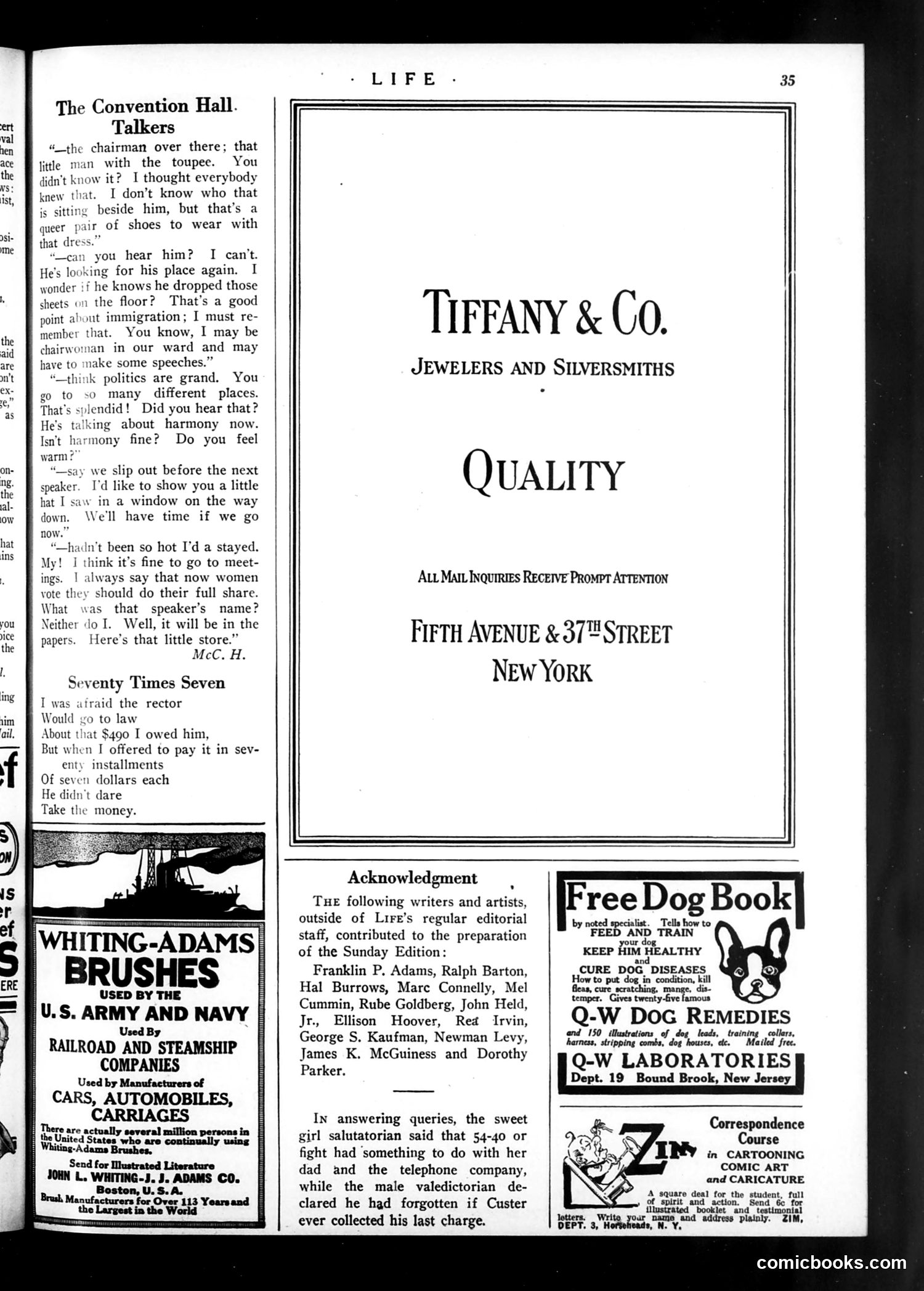
This cartoon mocks newly enfranchised women attending a political convention. The dialogue captures women gossiping about speakers, fashion, and shopping rather than engaging substantively with political content. One woman admits not knowing speakers' names, another suggests leaving early to window-shop, and they discuss shoes and hats while claiming to care about "harmony" and politics. The satire targets two anxieties of the 1920s: first, that women's new voting rights wouldn't produce informed citizenry, and second, that women were frivolous and distracted by consumerism. The chairwoman character boasts of making ward speeches despite clearly not paying attention—suggesting performative rather than genuine political participation. The piece reflects contemporary skepticism about women's political capabilities, though presented as lighthearted social commentary rather than serious critique.
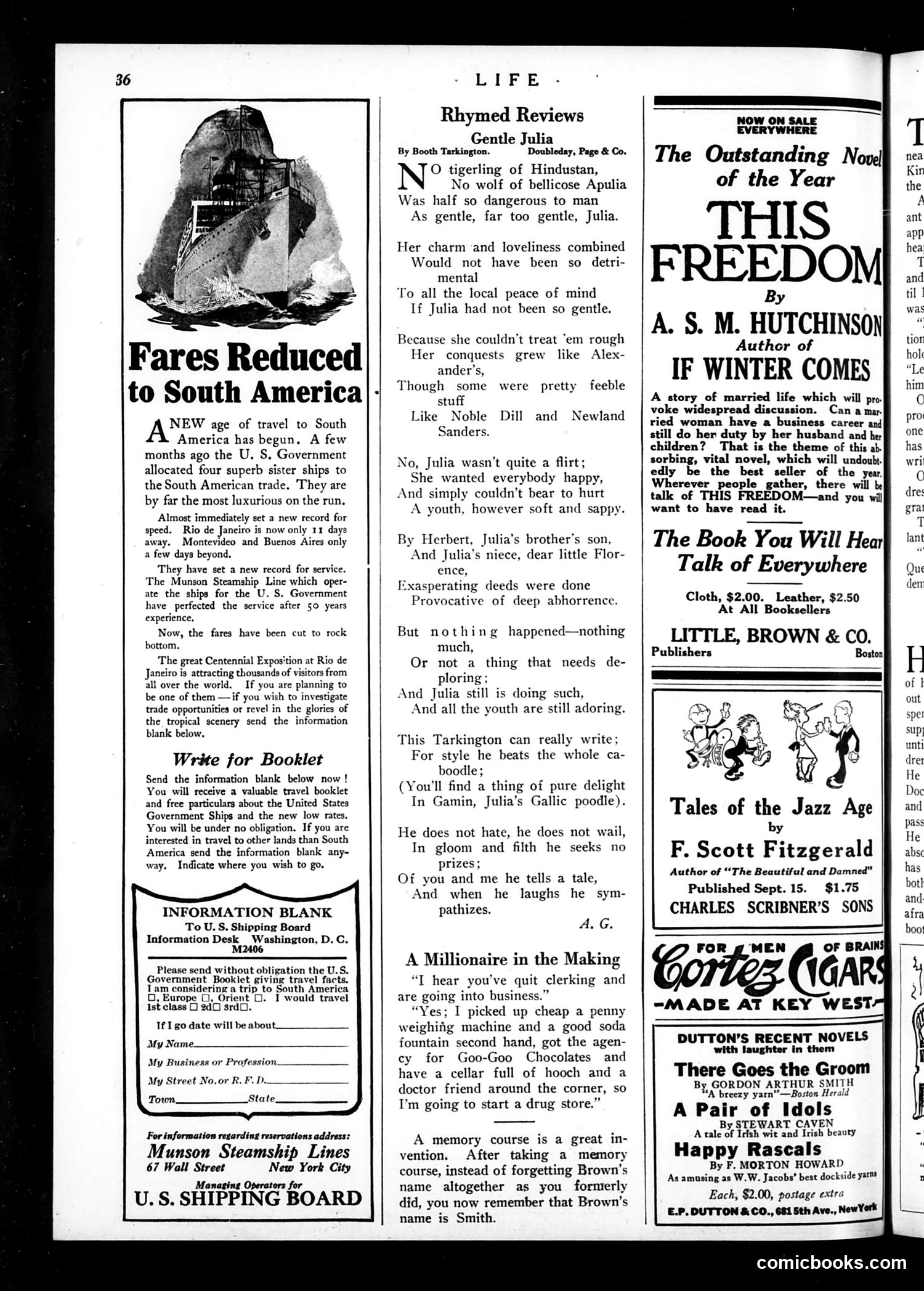
This page is primarily **advertising and book reviews** from an early 20th-century Life magazine. The main advertisement (left) promotes **U.S. Government shipping lines to South America**, capitalizing on: - New luxury steamships operated by Munson Lines - Reduced fares and faster travel times (11 days to Rio) - The Rio de Janeiro Centennial Exposition as a tourism draw - Commercial trade opportunities The **rhymed book review** (center) satirizes Booth Tarkington's novel "Gentle Julia," a romance about a woman whose excessive kindness and desire to please everyone—rather than flirtatiousness—makes her dangerously attractive to men. The reviewer mocks the premise's absurdity while praising Tarkington's writing style. A brief **joke** satirizes capitalist enterprise: a man starting a "drug store" by combining a penny-scale machine, soda fountain, chocolate sales, and bootleg alcohol—barely concealing it as a speakeasy during Prohibition. The page otherwise contains book advertisements typical of the era.
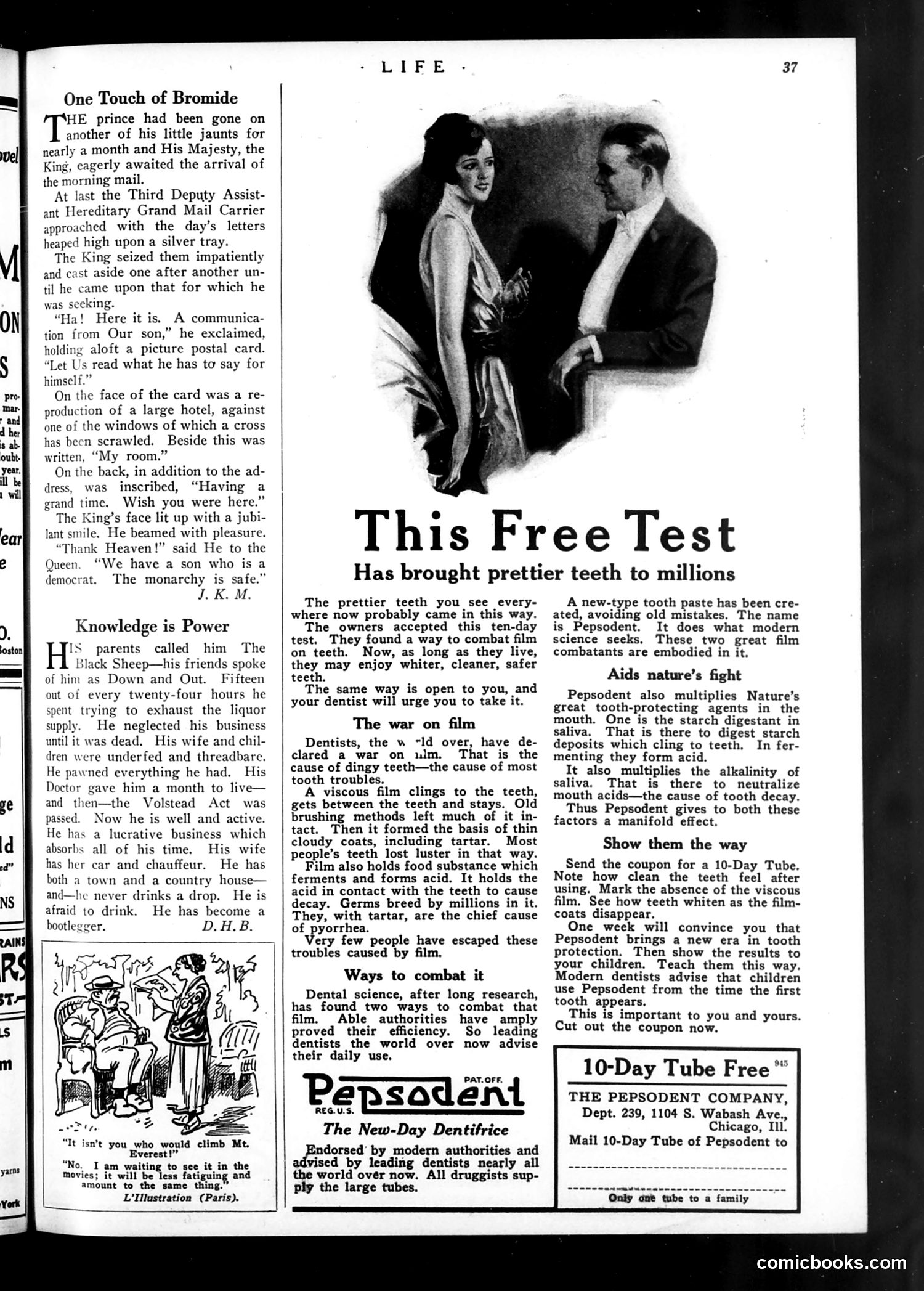
**"One Touch of Bromide"** satirizes royal pretense. A king receives a postcard from his traveling son showing a hotel room marked with a cross and the cliché message "Having a grand time. Wish you were here." The king celebrates that his son is "a democrat" because the generic, mass-produced postcard suggests ordinariness. The satire mocks both the hollowness of such tourist clichés and the king's naive conflation of triteness with democratic values. **"Knowledge is Power"** is a dark joke about Prohibition. A man called "The Black Sheep"—a drunk who squandered his family's welfare—suddenly becomes prosperous and respectable after the Volstead Act (Prohibition) passes. He's now a successful bootlegger who "never drinks a drop" from fear. The satire exposes Prohibition's perverse effect: it created wealth and stability for criminals while supposedly improving society. The page also contains a **Pepsodent toothpaste advertisement**, a standard commercial element of the era.
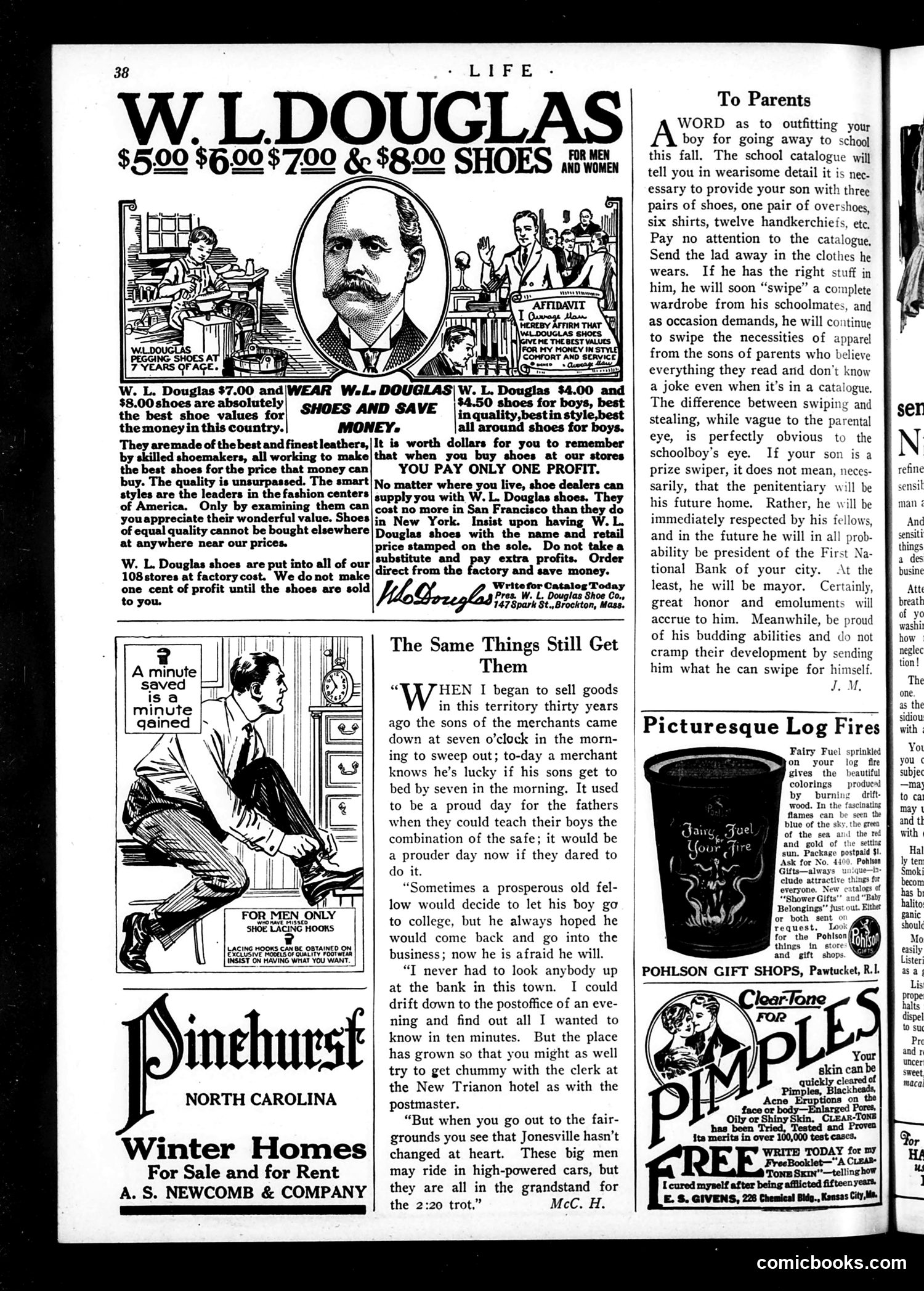
This page is primarily **advertising**, dominated by a large W.L. Douglas shoe company ad featuring the company founder's portrait. The ad emphasizes direct factory sales and single-profit margins. The satirical content appears in two pieces: 1. **"To Parents"** (right column): A tongue-in-cheek advisory that humorously endorses "swiping" (stealing) clothes from schoolmates as character-building. It suggests that a boy who successfully steals from peers shows resourcefulness and will become a bank president—obviously mocking both parental naivety and school catalog recommendations. 2. **"The Same Things Still Get Them"** (lower section): An anecdotal commentary on social change. An older businessman reflects that thirty years ago, sons respectfully learned business (safe combinations) from fathers; now sons avoid the family business entirely. Yet at county fairs, he notes, fundamental values persist—all these modernized men still gather for horse races. It's nostalgic satire about progress and lost traditions. Both pieces use irony to comment on American society, youth behavior, and changing values in the early 20th century.
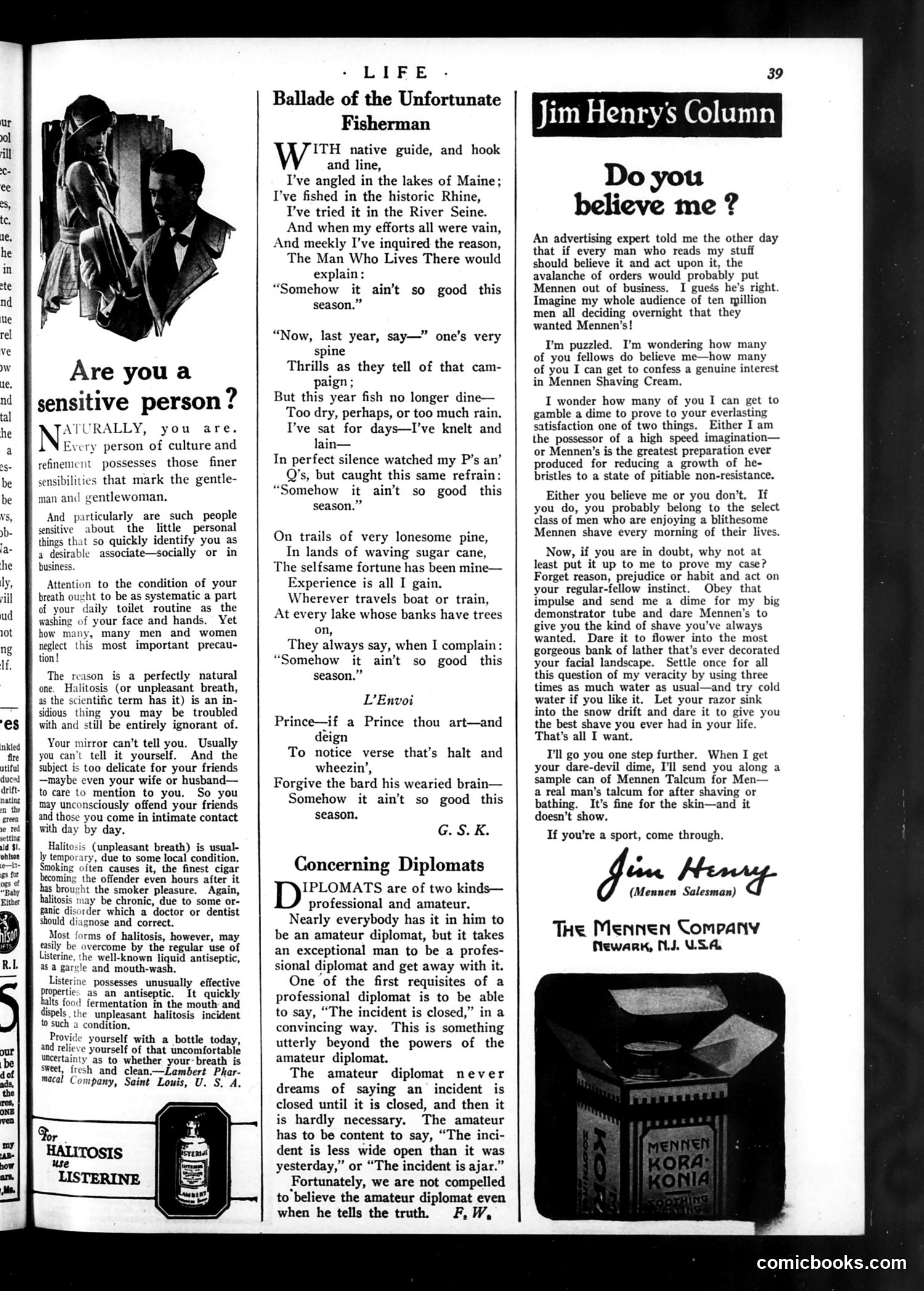
This page contains three distinct pieces: **Left side: Listerine Advertisement** — A pseudo-psychological pitch targeting "sensitive persons" about halitosis (bad breath). It exploits social anxiety about personal hygiene as a marketing tactic, claiming Listerine mouthwash solves the problem. This reflects 1920s-30s advertising's invention of consumer insecurities. **Center: "Ballade of the Unfortunate Fisherman"** — A humorous poem about a fisherman who travels worldwide (Maine, Rhine, Seine) seeking good fishing, only to be repeatedly told by locals, "Somehow it ain't so good this season." The joke satirizes how people blame external conditions rather than admitting failure—a universal human tendency. **Right: Jim Henry's Column** — An essay questioning whether advertising claims are believable, specifically doubting whether Mennen shaving cream really works as advertised. It's meta-commentary on advertising credibility—asking readers to think critically about marketing promises. Together, these pieces critique consumer culture and advertising's manipulation tactics.
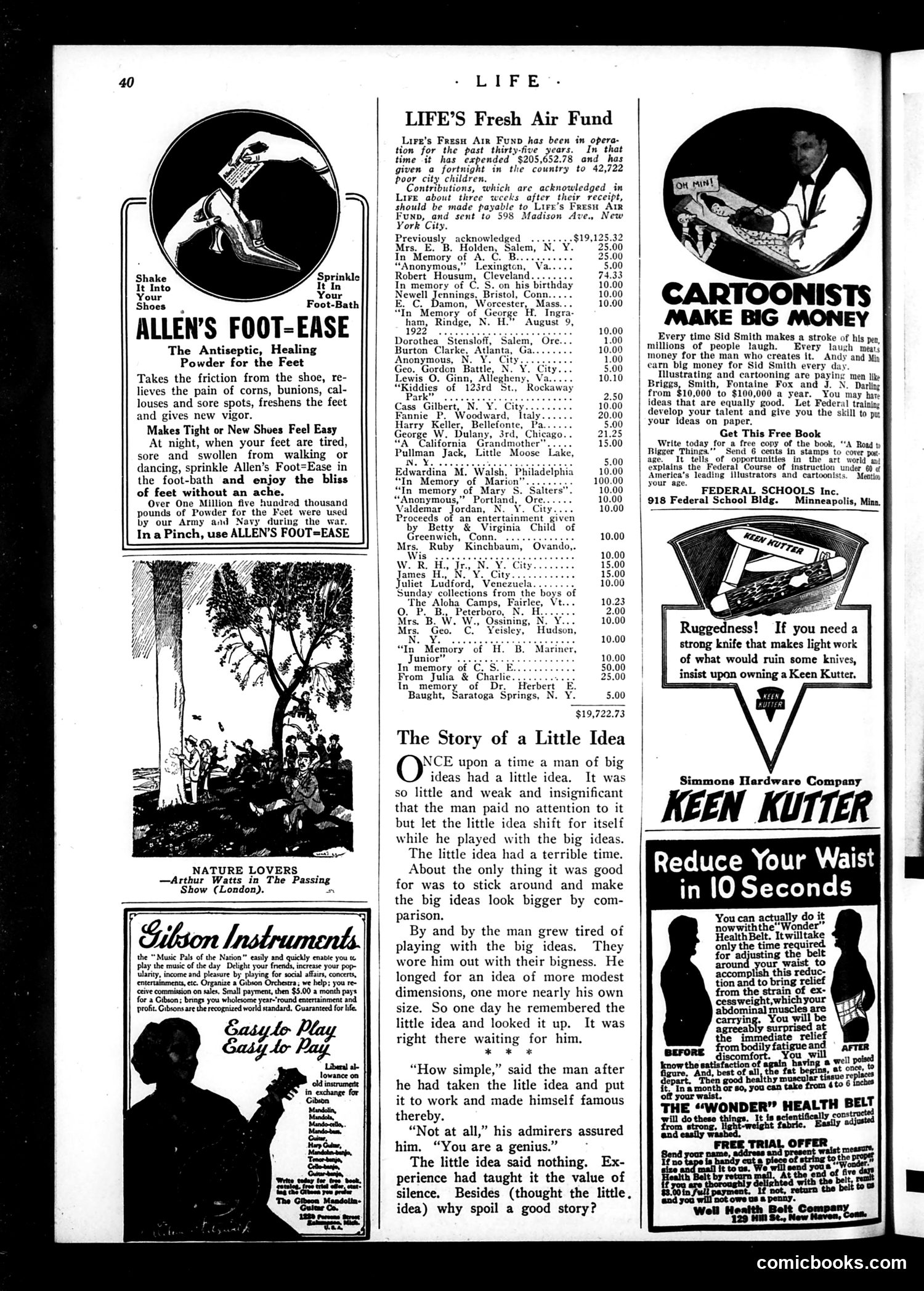
This page is primarily **advertising and fundraising**, not political satire. The main content includes: **Left side**: Advertisements for Allen's Foot-Ease powder and Gibson Instruments, plus a cartoon titled "Nature Lovers" by Arthur Watts showing figures in a pastoral setting—a gentle, non-political humor piece. **Center**: LIFE's Fresh Air Fund announcement, listing donations to support sending poor city children to the countryside. This was a genuine charitable cause LIFE magazine maintained, reflecting Progressive-era concern for urban poverty. **Right side**: More advertisements (cartoonists' earnings, Keen Kutter knives, Wonder Health Belt) and "The Story of a Little Idea"—a moral fable about persistence and humility, not contemporary satire. The page reflects **early 20th-century concerns**: urban poverty, health products, and the emerging lucrative market for commercial illustration. There is no identifiable political commentary or caricature requiring historical context beyond understanding this was a magazine mixing journalism, humor, and advertising.
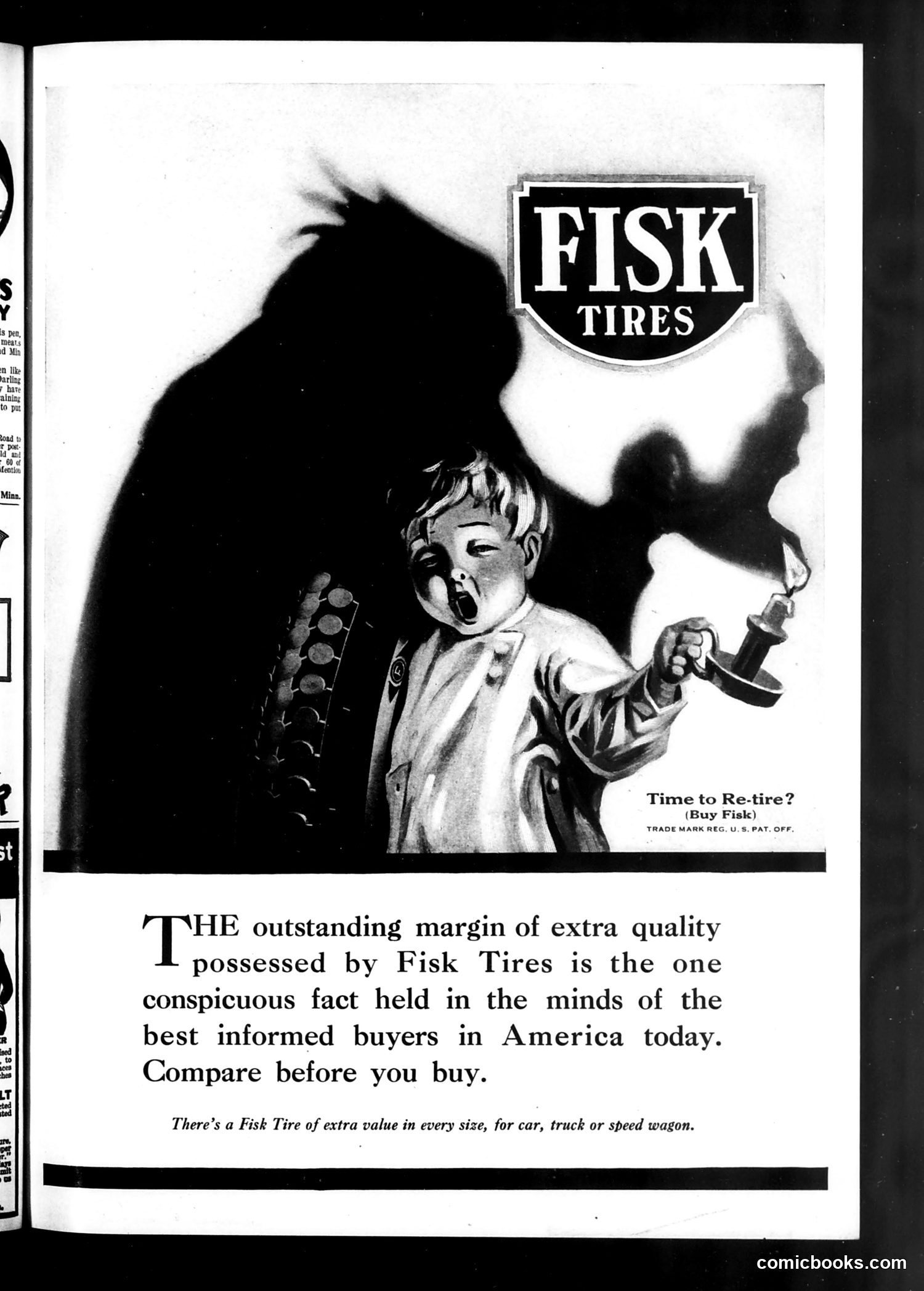
This is primarily a **Fisk Tires advertisement**, not political satire. The image shows a menacing figure (appearing to be Death or a grim reaper character) looming over a small child who holds a tire, with the tagline "Time to Re-tire? (Buy Fisk)." The ad uses **fear-based marketing**: suggesting that worn tires are dangerously life-threatening, implying that failing to buy Fisk brand tires puts children at mortal risk. This exploitative approach—using a child in danger to sell a product—was common in early 20th-century advertising, though it would be considered shocking and unethical today. The accompanying text claims Fisk Tires possess superior quality that "best informed buyers" recognize, using comparative language to encourage purchasing.
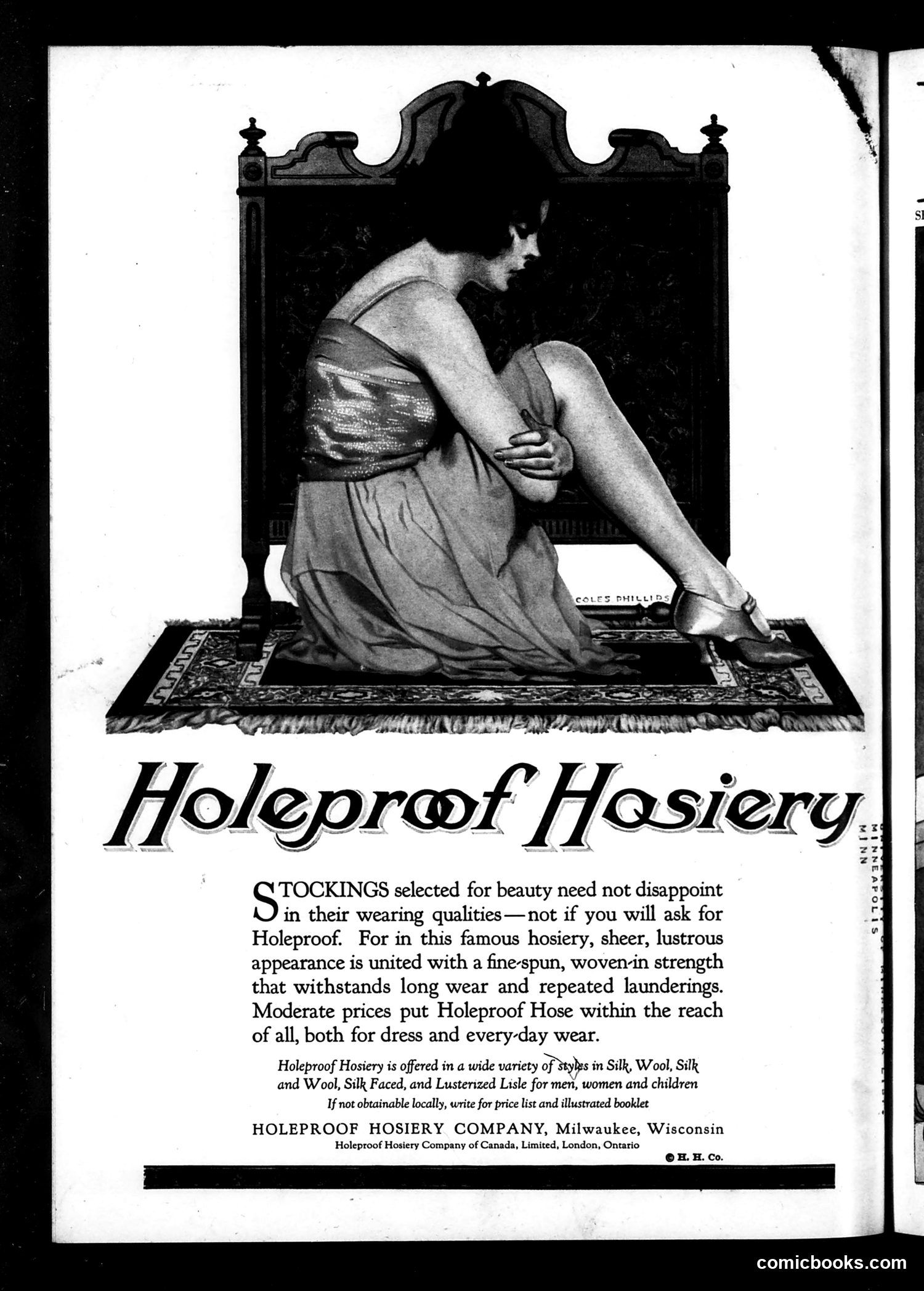
This is a **Holeproof Hosiery advertisement**, not satire or political content. The image shows a woman in classical pose, kneeling on a decorative rug before an ornate mirror, adjusting her stockings. The visual strategy emphasizes elegance and femininity to market hosiery as both beautiful and durable. The text's selling point combines aesthetics ("sheer, lustrous appearance") with practicality ("withstands long wear and repeated launderings"). The phrase "selected for beauty need not disappoint" suggests competing brands offered looks without durability. For modern readers: this represents early 20th-century advertising's focus on women's appearance and domestic concerns. The classical artistic framing—treating stocking-wearing as an elegant, almost ritualistic act—elevated a mundane product to aspirational status. The emphasis on "moderate prices" suggests Holeproof positioned itself as quality hosiery for middle-class women, not just wealthy consumers.