
Life, 1922-09-07 · page 17 of 44
Life — September 7, 1922 — page 17: what you’re looking at
What you’re looking at
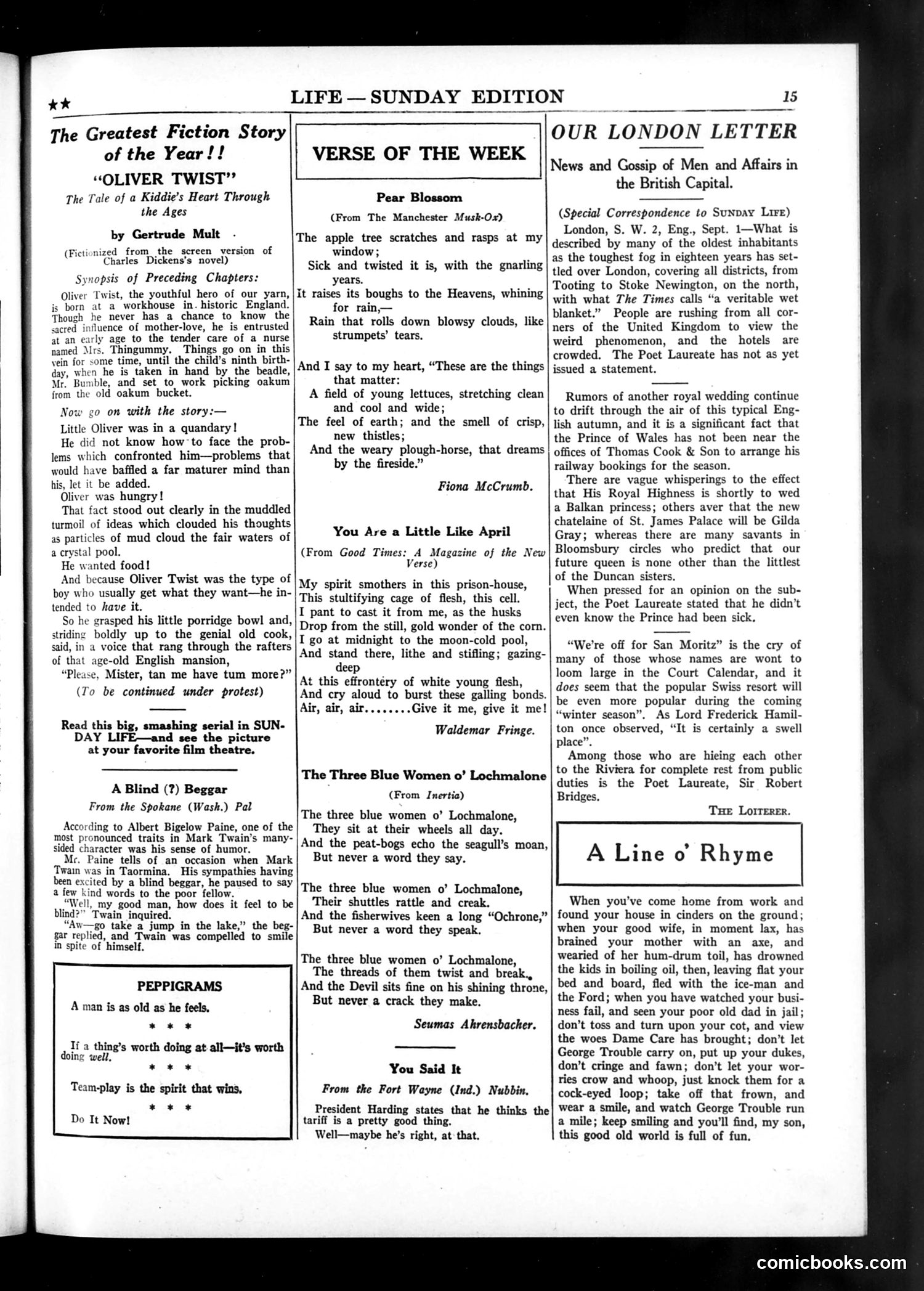
This page contains **serialized fiction and poetry**, not political cartoons. The main content is: **"Oliver Twist" serialization**: A fictionized retelling of Dickens's novel for Life magazine, presenting Oliver's famous workhouse scene where he requests more gruel—a moment satirizing Victorian poverty and institutional indifference. The joke is presenting this tragedy as serialized melodrama for entertainment. **Supporting content** includes: - An anecdote about Mark Twain's wit with a blind beggar (illustrating Twain's irreverent humor) - Poetry selections ("Pear Blossom," "You Are a Little Like April," "The Three Blue Women o' Lochmalone")—largely melancholic romantic verse typical of early 20th-century literary magazines - **"Peppigrams"**: brief aphorisms/wisdom quotes The page functions as a **literary supplement** rather than political satire. Its appeal lay in serialized fiction entertainment and contemporary poetry, reflecting Life magazine's role as a general-interest publication mixing humor with serious literature.
📄 Transcribed text from this page (OCR, searchable)
Machine-transcribed from the original scan — historical spelling and the odd misread are preserved.
xr LIFE — SUNDAY EDITION 15 The Greatest Fiction Story of the Year!! “OLIVER TWIST” The Tale of a Kiddie’s Heart Through the Ages by Gertrude Mult (Fictionized from the screen version of Charles Dickens's novel) Synopsis of Preceding Chapters: Oliver Twist, the youthful hero of our yarn, is born at a workhouse in. historic England. Though he never has a chance to know the sacred influence of mother-love, he is entrusted at an e age to the tender care of a nurse named Mrs, Thingummy. Things go on in this vein for some time, until the child’s ninth birth- day, when he is taken in hand by the beadle, Mr. Bumble, and set to work picking oakum from the old oakum bucket. Now go on with the story:— Little Oliver was in a quandary! He did not know howto face the prob- lems which confronted him—problems that would have baffled a far maturer mind than his, let it be added. Oliver was hungry! That fact stood out clearly in the muddled turmoil of ideas which clouded his thoughts as particles of mud cloud the fair waters of a crystal pool. He wanted food! And because Oliver Twist was the type of boy who usually get what they want—he in- tended to have it. So he grasped his little porridge bowl and, striding boldly up to the genial old cook, said, in a voice that rang through the rafters of that age-old English mansion, “Please, Mister, tan me have tum more?” (To be continued under protest) Read this big, smashing serial in SUN- DAY LIFE—and see the picture at your favorite film theatre. A Blind (?) Beggar From the Spokane (Wash.) Pal According to Albert Bigelow Paine, one of the most pronounced traits in Mark Twain’s many- sided character was his sense of humor. Mr. Paine tells of an occasion when Mark Twain was in Taormina. His sympathies having been excited by a blind beggar, he paused to say a few kind words to the poor fellow. “Well, my good man, how does it feel to be blind?” Twain inquired. “Aw—go take a jump in the lake,” the beg- gar replied, and Twain was compelled to smile in spite of himself. PEPPIGRAMS A man is as old as he feels. sk * Tia thing’s worth doing at all—it’s worth doing well, ** * Team-play is the spirit that wins, *- * * Do It Now! Pear Blossom (From The Manchester Musk-O+) The apple tree scratches and rasps at my window; Sick and twisted it is, with the gnarling years. it raises its boughs to the Heavens, whining for rain,— Rain that rolls down blowsy clouds, like strumpets’ tears. And I say to my heart, “These are the things that matter: A field of young lettuces, stretching clean and cool and wide; The feel of earth; and the smell of crisp, new thistles; And the weary plough-horse, that dreams by the fireside.” Fiona McCrumb. You Are a Little Like April (From Good Times: A Magazine oj the New Verse) My spirit smothers in this prison-house, This stultifying cage of flesh, this cell. I pant to cast it from me, as the husks Drop from the still, gold wonder of the corn. I go at midnight to the moon-cold pool, And stand there, lithe and stifling; gazing- deep At this effrontéry of white young flesh, And cry aloud to burst these galling bonds. Air, air, air........Give it me, give it me! Waldemar Fringe. The Three Blue Women o’ Lochmalone (From Inertia) The three blue women o’ Lochmalone, They sit at their wheels all day. And the peat-bogs echo the seagull’s moan, But never a word they say. The three blue women o’ Lochmalone, Their shuttles rattle and creak. And the fisherwives keen a long “Ochrone,” But never a word they speak. The three blue women o’ Lochmalone, The threads of them twist and break. And the Devil sits fine on his shining throne, But never a crack they make, Seumas Ahrensbacher. You Said It From the Fort Wayne (Ind.) Nubbin, President Harding states that he thinks the tariff is a pretty good thing. Well—maybe he’s right, at that. OUR LONDON LETTER News and Gossip of Men and Affairs in the British Capital. (Special Correspondence to Sunvay Lire) London, S. W. 2, Eng., Sept. 1—What is described by many of the oldest inhabitants as the toughest fog in eighteen years has set- tled over London, covering all districts, from Tooting to Stoke Newington, on the north, with what The Times calls “a veritable wet blanket.” People are rushing from all cor- ners of the United Kingdom to view the weird phenomenon, and the hotels are crowded. The Poet Laureate has not as yet issued a statement. Rumors of another royal wedding continue to drift through the air of this typical Eng- lish autumn, and it is a significant fact that the Prince of Wales has not been near the offices of Thomas Cook & Son to arrange his railway bookings for the season. There are vague whisperings to the effect that His Royal Highness is shortly to wed a Balkan princess; others aver that the new chatelaine of St. James Palace will be Gilda Gray; whereas there are many savants in Bloomsbury circles who predict that our future queen is none other than the littlest of the Duncan sisters. When pressed for an opinion on the sub- ject, the Poet Laureate stated that he didn’t even know the Prince had been sick. “We're off for San Moritz” is the cry of many of those whose names are wont to loom large in the Court Calendar, and it does seem that the popular Swiss resort will be even more popular during the coming “winter season”, As Lord Frederick Hamil- ton once observed, “It is certainly a swell place”. Among those who are hieing each other to the Riviera for complete rest from public duties is the Poet Laureate, Sir Robert Bridges. Tue Lorrerer. A Line o' Rhyme When you’ve come home from work and found your house in cinders on the ground; when your good wife, in moment lax, has brained your mother with an axe, and wearied of her hum-drum toil, has drowned the kids in boiling oil, then, leaving flat your bed and board, fled with the ice-man and the Ford; when you have watched your busi- ness fail, and seen your poor old dad in jail; don’t toss and turn upon your cot, and view the woes Dame Care has brought; don’t let George Trouble carry on, put up your dukes, don’t cringe and fawn; don’t let your wor- ries crow and whoop, just knock them for a cock-eyed loop; take off that frown, and wear a smile, and watch George Trouble run a mile; keep smiling and you'll find, my son, this good old world is full of fun. comicbooks.com