
Life, 1922-09-07 · page 35 of 44
Life — September 7, 1922 — page 35: what you’re looking at
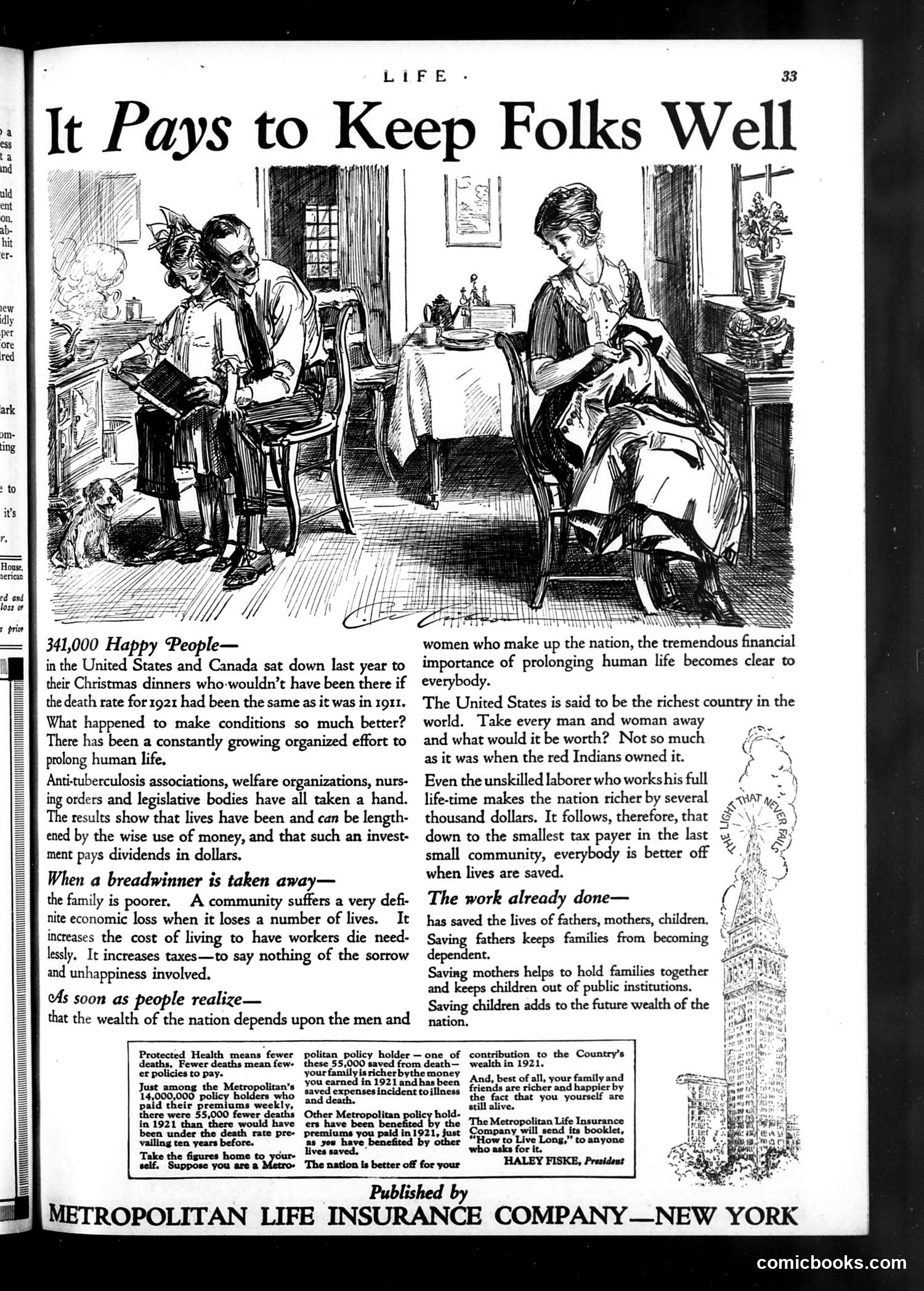
What you’re looking at
This is a **Metropolitan Life Insurance Company advertisement**, not satire. The page argues that public health improvements—anti-tuberculosis campaigns, welfare organizations, nursing care—have economic value, citing 341,000 people who survived to 1921 who would have died under 1911 mortality rates. The illustration shows a domestic scene: a woman reading to a man and child in a comfortable home, while an insurance agent consults with them—visualizing the financial security life insurance provides families. The argument is explicitly economic: dead workers harm communities through lost productivity and increased taxes; healthy workers create national wealth. Even unskilled laborers contribute "several thousand dollars" over lifetimes. Therefore, prolonging life—through both public health and life insurance—benefits everyone financially. This reflects early-20th-century progressivism linking public health to economic prosperity, and serves Metropolitan Life's business interests by framing insurance as patriotic investment in national welfare.
📄 Transcribed text from this page (OCR, searchable)
Machine-transcribed from the original scan — historical spelling and the odd misread are preserved.
LIFE Keep 341,000 Happy People— in the United States and Canada sat down last year to their Christmas dinners who-wouldn’t have been there if the death rate for 1921 had been the same as it was in 1911. What happened to make conditions so much better? There has been a constantly growing organized effort to prolong human life, Anti-tuberculosis associations, welfare organizations, nurs- ing orders and legislative bodies have all taken a hand. The results show that lives have been and can be length- ened by the wise use of money, and that such an invest- ment pays dividends in dollars. When a breadwinner is taken away— the family is poorer. A community suffers a very defi- nite economic loss when it loses a number of lives. It increases the cost of living to have workers die need- lessly, It increases taxes—to say nothing of the sorrow and unhappiness involved. Us soon as people realize— that the wealth of the nation depends upon the men and 33 cq & asia . women who make up the nation, the tremendous financial importance of prolonging human life becomes clear to everybody. The United States is said to be the richest country in the world, Take every man and woman away and what would it be worth? Not so much as it was when the red Indians owned it. Even the unskilled laborer who works his full life-time makes the nation richer by several thousand dollars. It follows, therefore, that down to the smallest tax payer in the last small community, everybody is better off when lives are saved. The work already done— has saved the lives of fathers, mothers, children. Saving fathers keeps families from becoming dependent. Saving mothers helps to hold families together wees children ot of public institutions. Saving children adds to the future wealth of the nation, Protected Health means fewer policy holder — deaths, Fewer deaths mean few- er policies to pay. politan these 5: you earned in 1921 saved expenses incident toillness and death. Other Me hold- crs have bees benebied by the premi in 19: jums you paid in ‘The nation is better off for your by METROPOLITAN LIFE INSURANCE COMPANY—NEW 5,000 saved from di your family is richerbythe money and has been by other contribution wealth in 192: And, best of all, your family and friends are richer and happier by the fact that you yor are still alive. ‘The Metropolitan Life Insurance Company will send its booklet, “How to Live Long,” to anyone who asks for it. HALEY FISKE, President one of S the Country’s jleath— 21, just ~ wise YORK comicbooks.com