
A complete issue · 36 pages · 1922
Life — August 24, 1922
I can see this is a black and white photograph or illustration from Life magazine (price 15 cents, dated around 1927 based on the visible date), but the image quality is quite poor and heavily darkened, making it difficult to discern clear details. The image appears to show a silhouetted figure in what looks like period clothing against a contrasting background with some foliage or decorative elements. However, I cannot reliably identify specific individuals, read any captions clearly, or determine what political or social satire this may represent. Without legible text or clearer visual details, I cannot accurately explain the cartoon's meaning to a modern reader. I'd need a higher-quality scan to provide the historical context you're seeking.
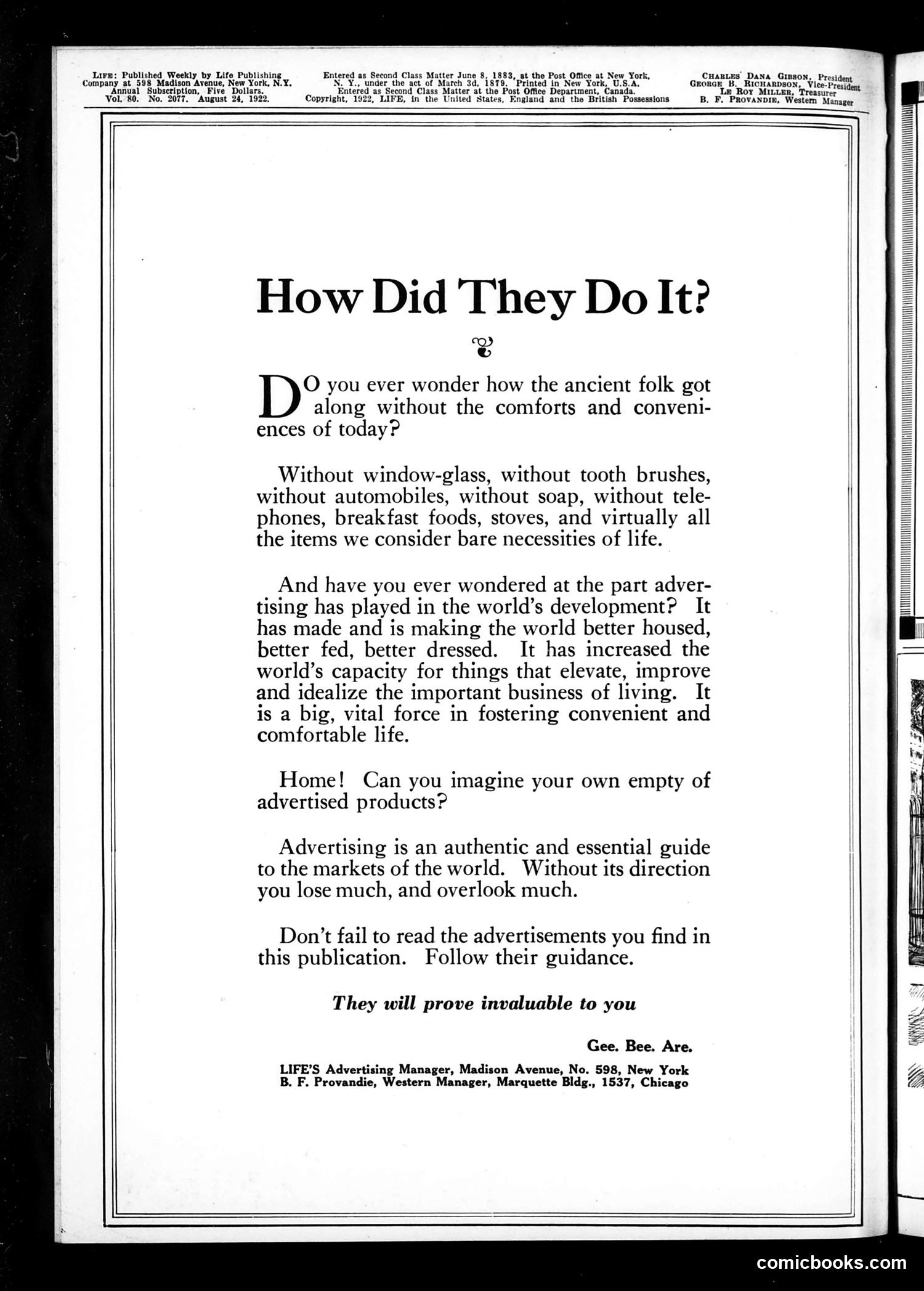
This page contains no cartoon or satirical illustration. Instead, it's a full-page **advertisement for advertising itself**, signed "Gee. Bee. Are." (the initials of Life's Advertising Manager). The text is a meta-advertisement arguing that advertising is essential to modern life. It uses rhetorical questions to make readers appreciate conveniences (window-glass, automobiles, soap) while crediting advertising with improving human welfare. The final pitch urges readers to study the magazine's advertisements, claiming they "will prove invaluable to you." This appears to be self-promotional content justifying advertising's role in society while encouraging readers to trust commercial messages—a straightforward pitch rather than satire or political commentary.
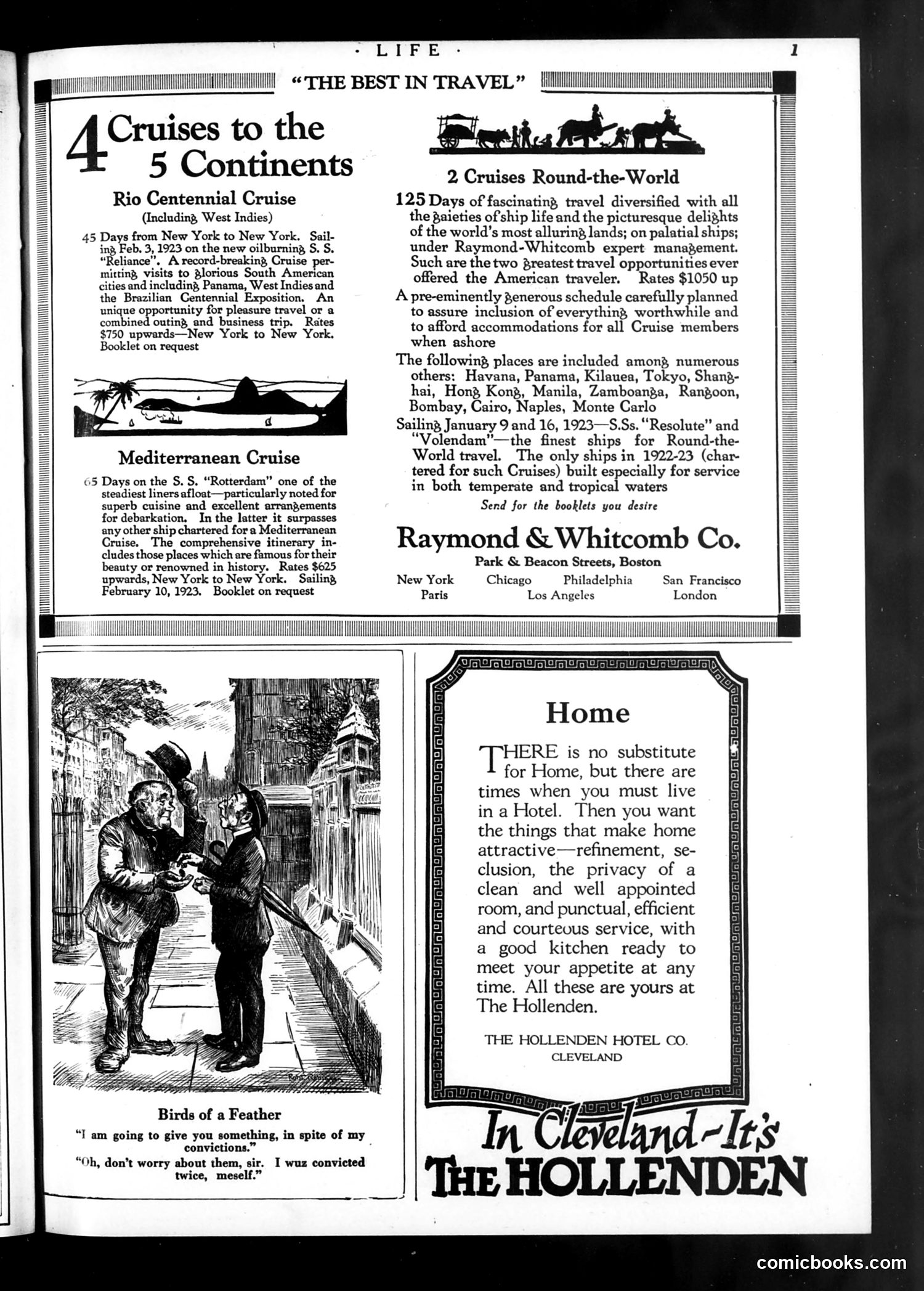
This cartoon illustrates a social satire about hypocrisy and moral compromise. Two men in period dress converse on a street; the older man gives something to the younger while saying "I am going to give you something, in spite of my convictions." The younger man replies: "Oh, don't worry about them, sir. I was convicted twice, myself." The joke plays on the double meaning of "convicted"—the older man means moral/ethical convictions, while the younger man interprets it as criminal convictions. This reveals the cartoon's point: that both men lack genuine principles. The younger man's casual reference to actual legal convictions (implying a criminal record) suggests they're equally unprincipled, making the older man's sanctimonious statement absurd.
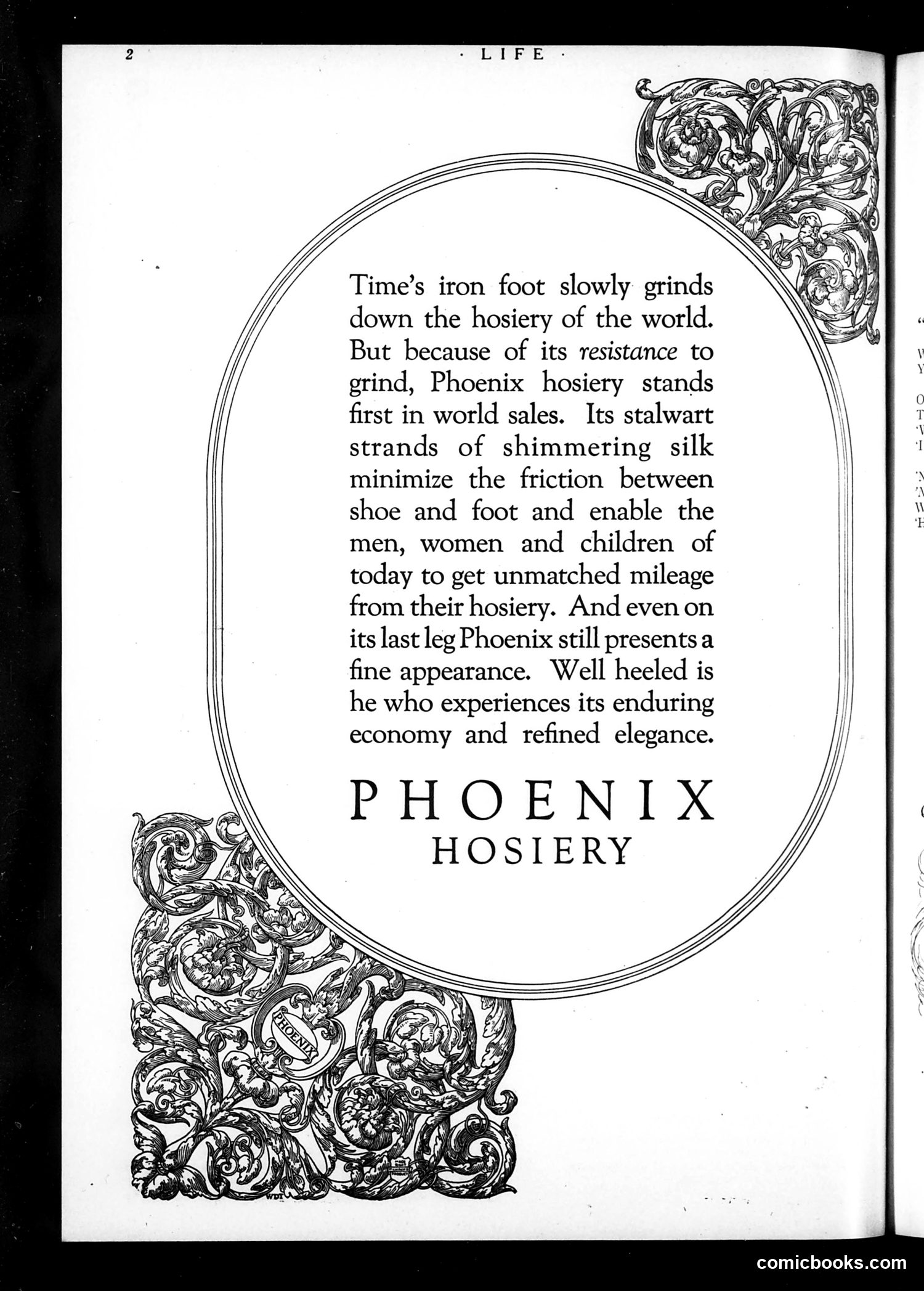
This page is **advertising copy, not satire or editorial content**. It's a full-page advertisement for Phoenix Hosiery that appeared in *Life* magazine. The ad uses poetic, elevated language to market socks and stockings as durable products that resist wear ("Time's iron foot slowly grinds down the hosery of the world"). The copy emphasizes practical benefits—silk strands reduce friction, enabling longer wear—while appealing to vanity through claims of "enduring economy and refined elegance." The ornate decorative borders and classical framing device (the oval shape with flourishes) were typical design conventions of early 20th-century print advertising, lending the product an air of sophistication and timelessness. There is no political or social satire here—simply a commercial pitch dressed in genteel language.
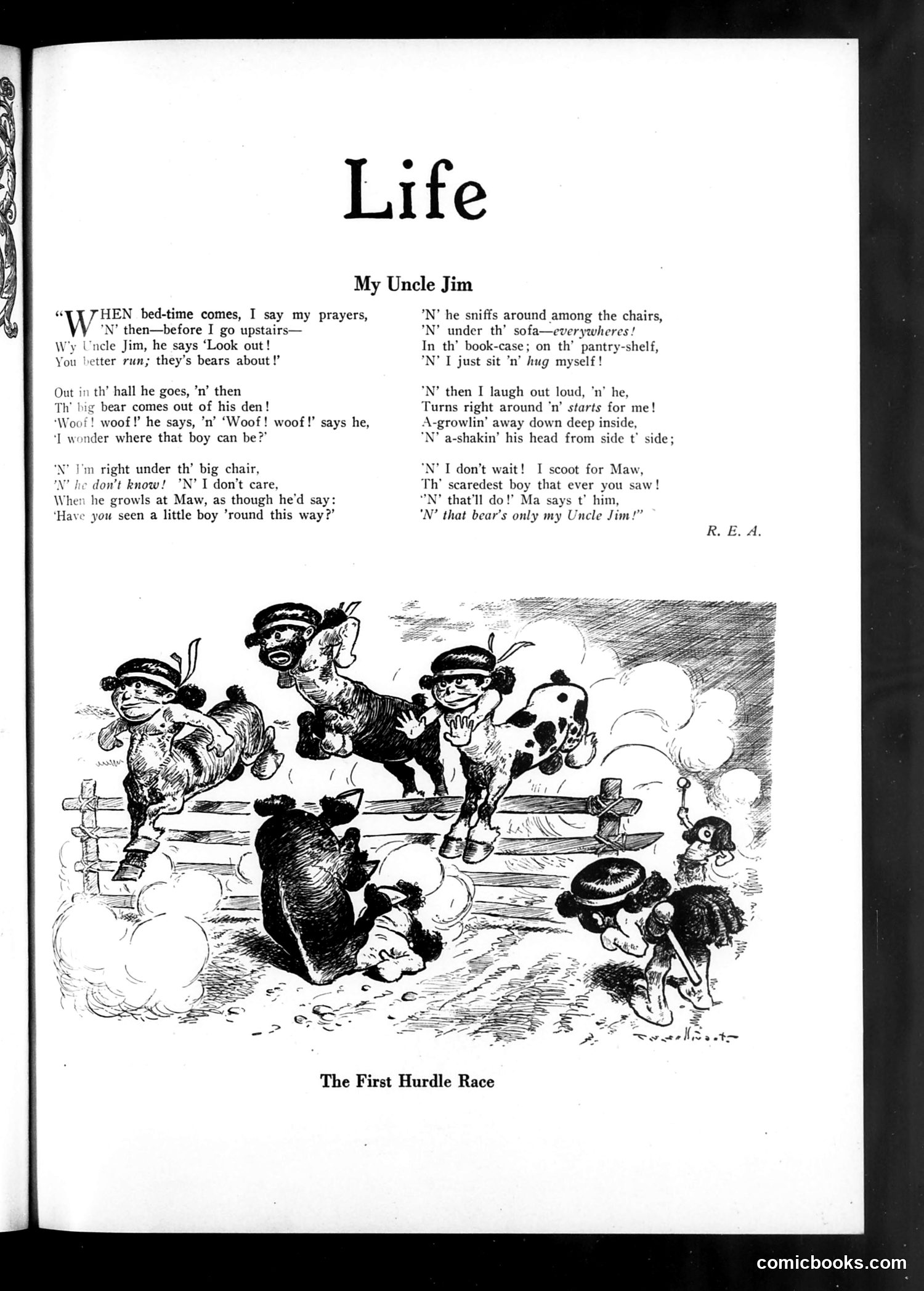
This is a children's poem by R.E.A. about a mischievous uncle who playfully frightens his nephew at bedtime. The poem uses phonetic dialect ("'N'" for "and") to capture colloquial speech. Uncle Jim hides under furniture, makes animal noises ("Woof! woof!"), and generally causes harmless chaos—sneaking around chairs, hiding in bookshelves, and startling the child. The accompanying illustration, titled "The First Hurdle Race," depicts anthropomorphized animals (bears, dogs, and other creatures) in a racing scene with hurdles and clouds of dust. This appears to be a whimsical visualization of childhood play and adventure rather than political satire. The overall page celebrates playful, mischievous behavior as wholesome family entertainment—typical of early 20th-century children's literature in *Life* magazine.
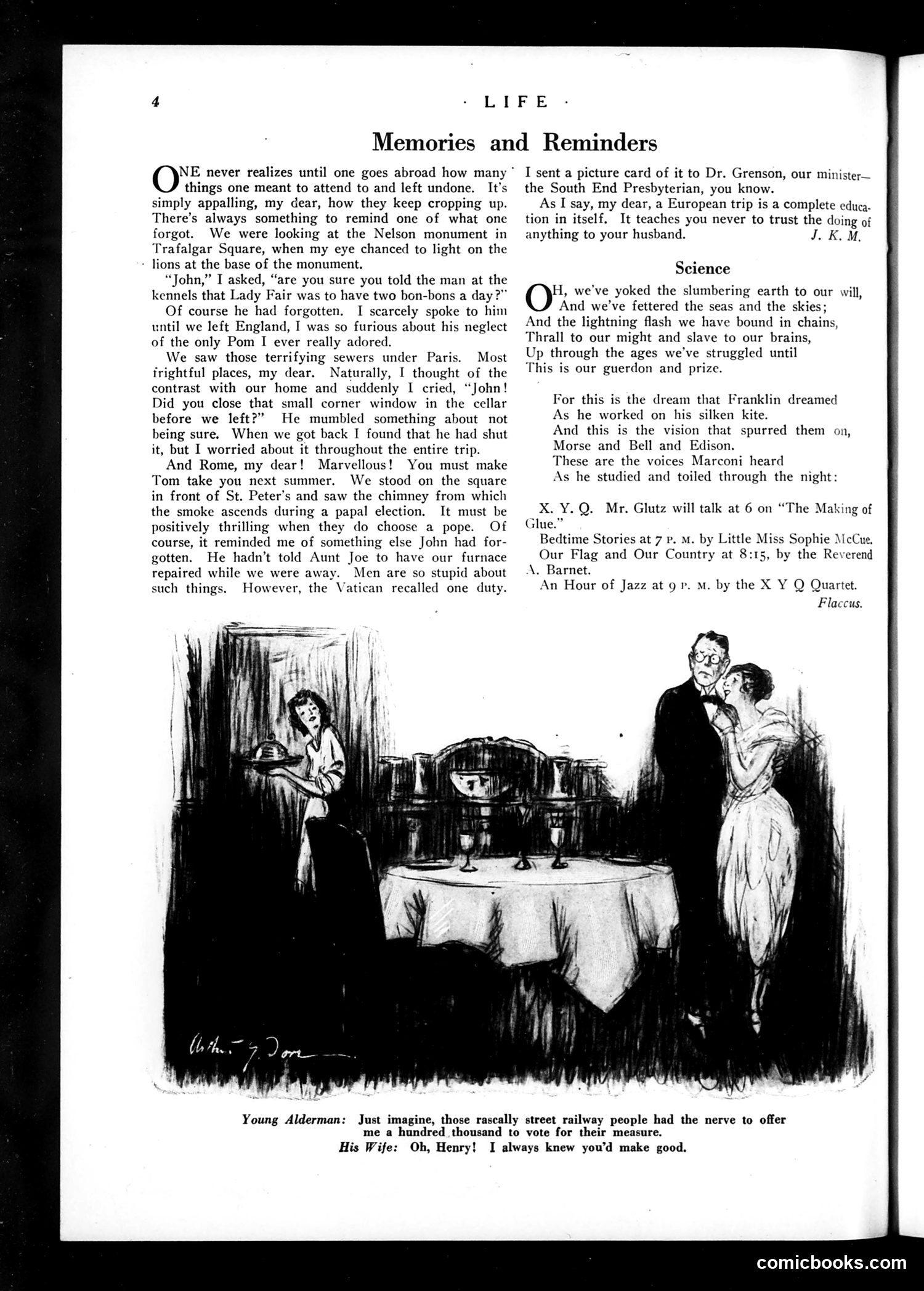
This page contains two distinct sections: **"Memories and Reminders"** (top): A personal essay about European travel, mentioning the Nelson monument in Trafalgar Square and Paris sewers. The writer humorously notes forgetting to close a cellar window during a trip to Rome. **"Science" (middle)**: A poem celebrating technological progress—Franklin, Morse, Bell, and Edison—framed as humanity's triumph over nature. **The Cartoon (bottom)**: A domestic scene where a young alderman boasts to his wife about being offered a bribe—"a hundred thousand to vote for their measure." His wife responds, "Oh, Henry! I always knew you'd make good," implying she expected his corruption. The satire mocks both urban political corruption and naive spousal pride, reflecting early 20th-century concerns about machine politics.
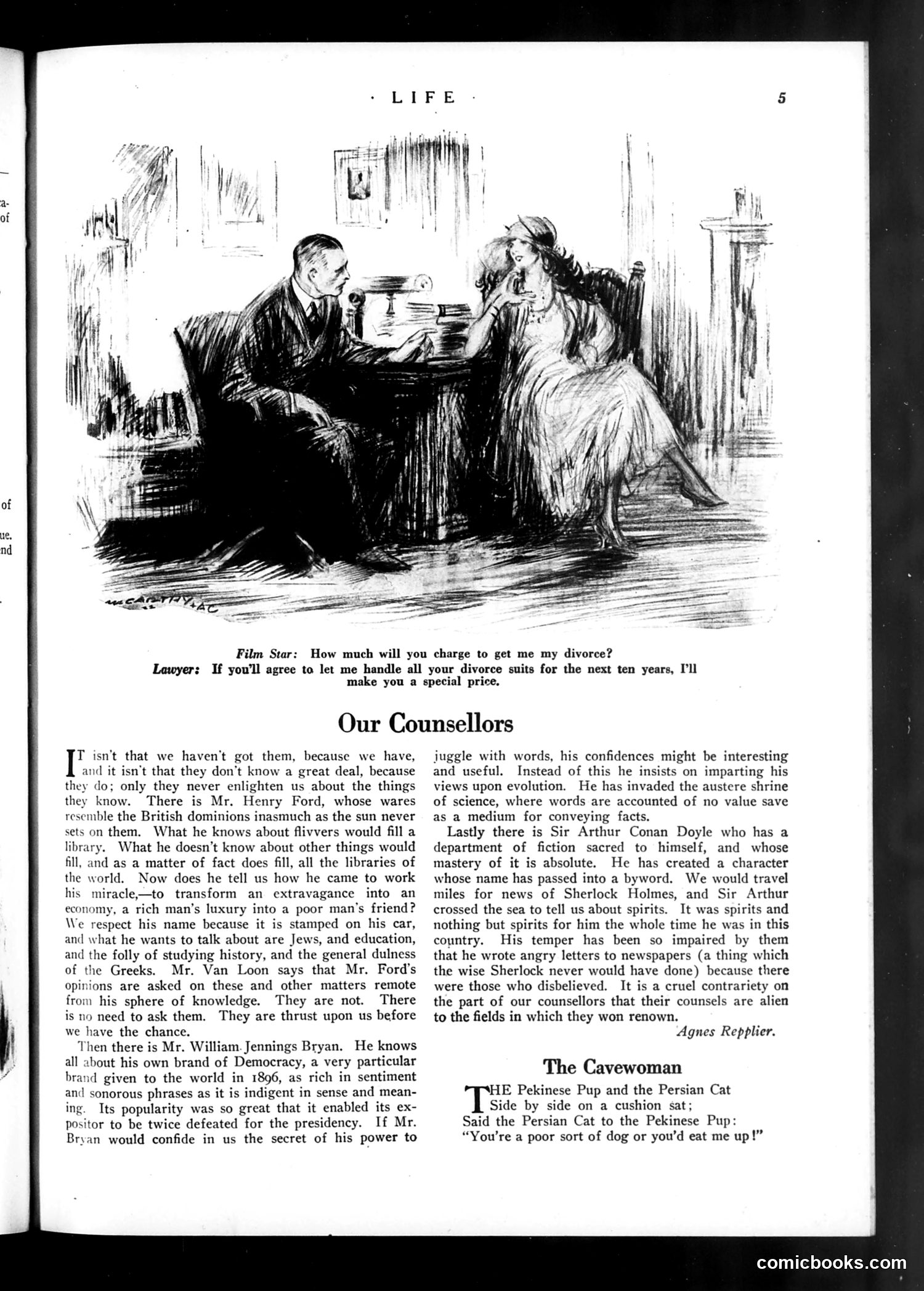
The top cartoon depicts a film star consulting a lawyer about divorce costs. The lawyer offers a cynical deal: handle her divorce cases for ten years in exchange for a "special price." This satirizes how divorce—then scandalous and legally complex—was becoming common enough among Hollywood celebrities that lawyers could profit from it as a specialty practice. The accompanying article mocks various public figures who serve as cultural "counsellors": Henry Ford (business), William Jennings Bryan (politics), and Sir Arthur Conan Doyle (fiction). The satire criticizes how these men, despite expertise in narrow fields, presume to advise the public on matters far beyond their knowledge. The page ridicules both celebrity culture's influence and experts overstepping their authority.
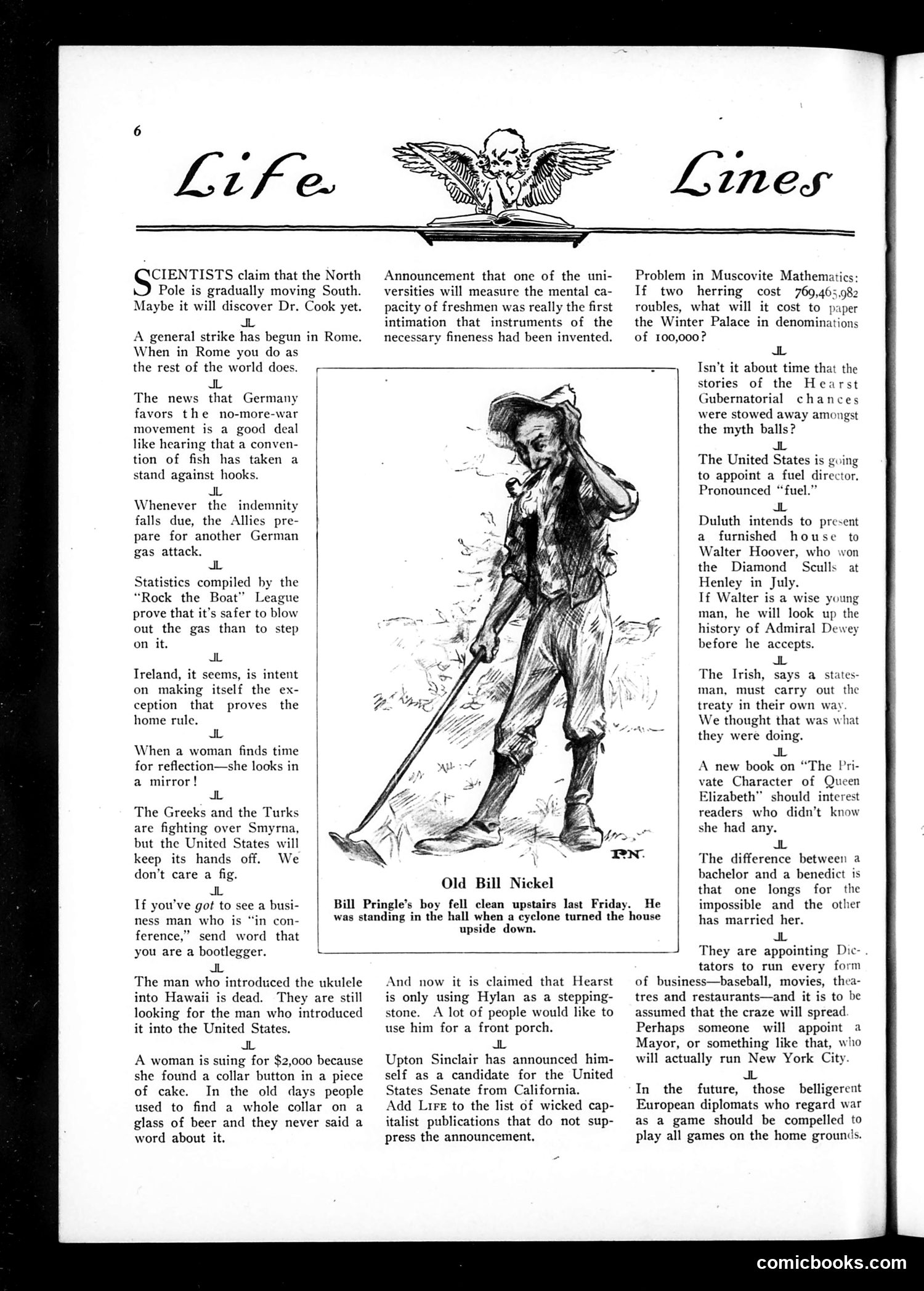
This cartoon depicts an elderly, shabby man labeled "Old Bill Nickel" skating or sliding on ice. The caption explains: "Bill Pringle's boy fell clean upstairs last Friday. He was standing in the hall when a cyclone turned the house upside down." The joke appears to be wordplay: the boy fell "upstairs" during a cyclone that turned the house "upside down"—meaning he fell in a direction that would normally be impossible. "Old Bill Nickel" likely represents a tall-tale character or folk figure used to humorously convey absurd scenarios. The cartoon's humor relies on the impossibility of the situation described, common to early-20th-century American comic traditions featuring exaggerated frontier or rural characters telling implausible stories.
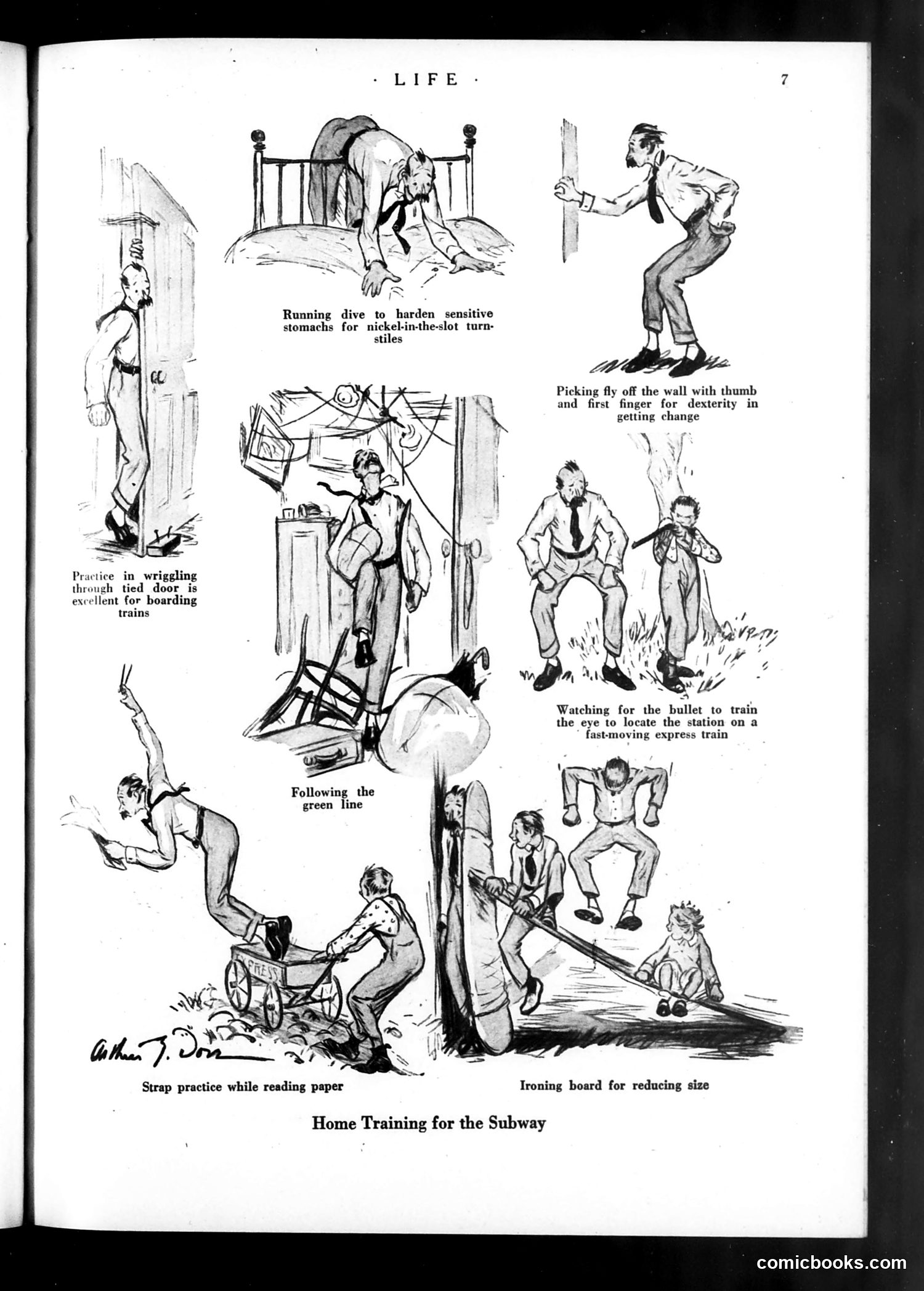
This satirical cartoon mocks the physical challenges of riding New York's crowded subway system by presenting absurd "training exercises" New Yorkers supposedly need to practice at home. The exercises include: contorting through tied doors, hardening stomachs for "nickel-in-the-slot turnstiles," practicing wall-climbing and finger dexterity, watching fast-moving trains, pushing children through crowds, and using an ironing board to reduce body size. The humor targets the subway's notorious overcrowding, uncomfortable conditions, and aggressive passenger behavior. The cartoonist suggests riders need to develop almost superhuman flexibility, strength, and reduced dimensions just to survive daily commutes. This is social satire about 1920s-era urban transit hardships, presented through exaggerated physical scenarios that highlight genuine commuter frustrations.
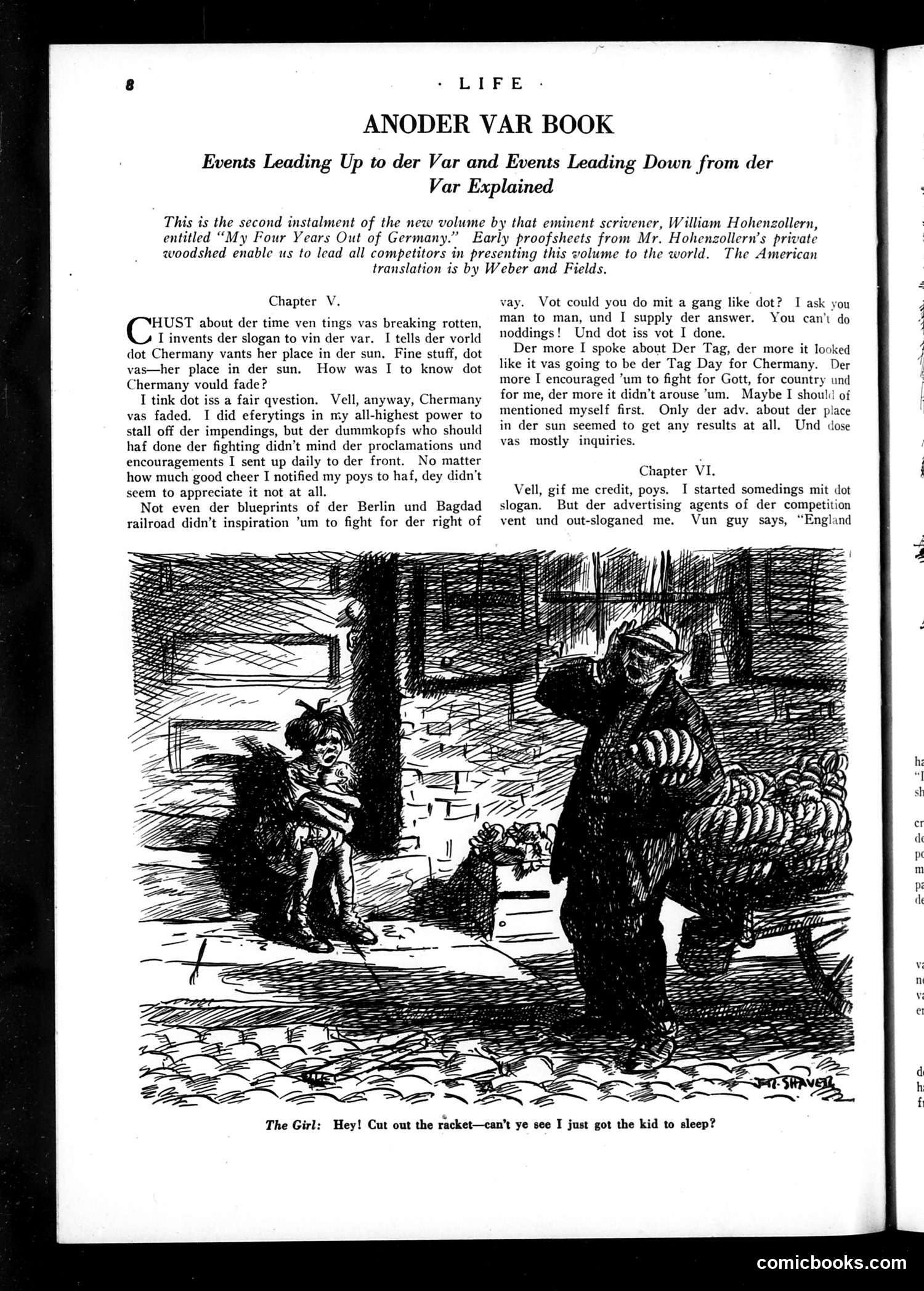
This page from *Life* magazine presents "Anoder Var Book," a satirical piece about German militarism using deliberate phonetic German-English dialect. The text mocks German justifications for World War I, with a narrator claiming Germany "had" to fight for "Fatherland" and dismissing pacifist objections. The illustration depicts a German soldier (identifiable by uniform and spiked helmet) approaching a woman holding a child in war-torn surroundings. The caption reads: "The Girl: Hey! Cut out the racket—can't ye see I just got the kid asleep?" The satire targets German aggression by contrasting militaristic rhetoric with its human cost—disruption to civilians. The crude dialect emphasizes the "foreign" nature of German militarism to American readers, reflecting wartime anti-German sentiment and skepticism of German war justifications.
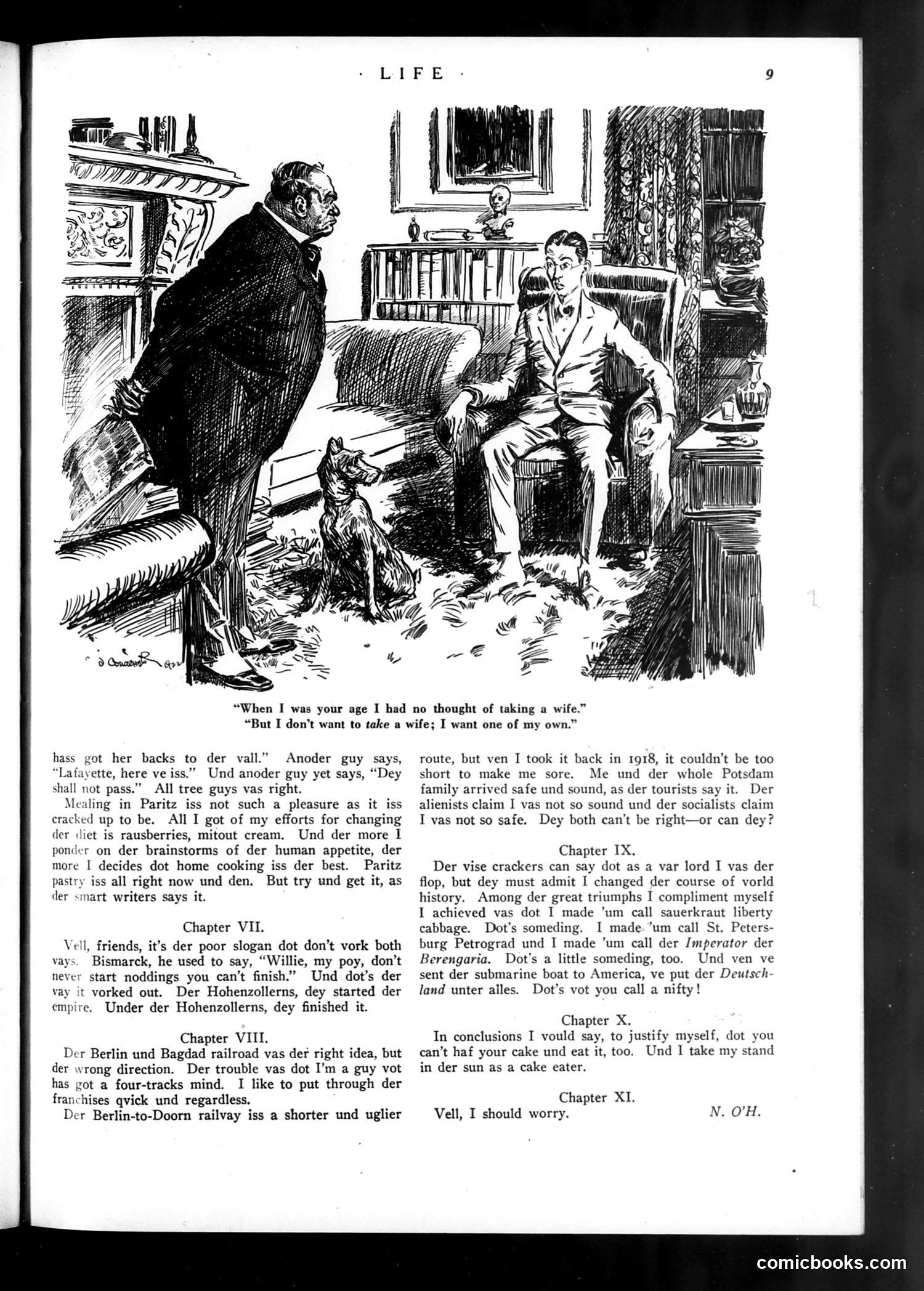
This page features a single cartoon depicting two men in an elegant study. One older man stands with his back to the viewer near a fireplace; a younger man sits in a chair. A small dog is present. The caption reads: "When I was your age I had no thought of taking a wife." / "But I don't want to take a wife; I want one of my own." **The Joke:** This is a play on the phrase "take a wife"—the older generation understood marriage as acquiring a wife (passive possession), while the younger man jokes he wants an *independent* woman he'd choose for herself, not one given to him. It satirizes changing attitudes toward marriage and women's agency, suggesting generational conflict over outdated marital concepts. The cartoon mocks old-fashioned patriarchal assumptions about marriage as a transaction.
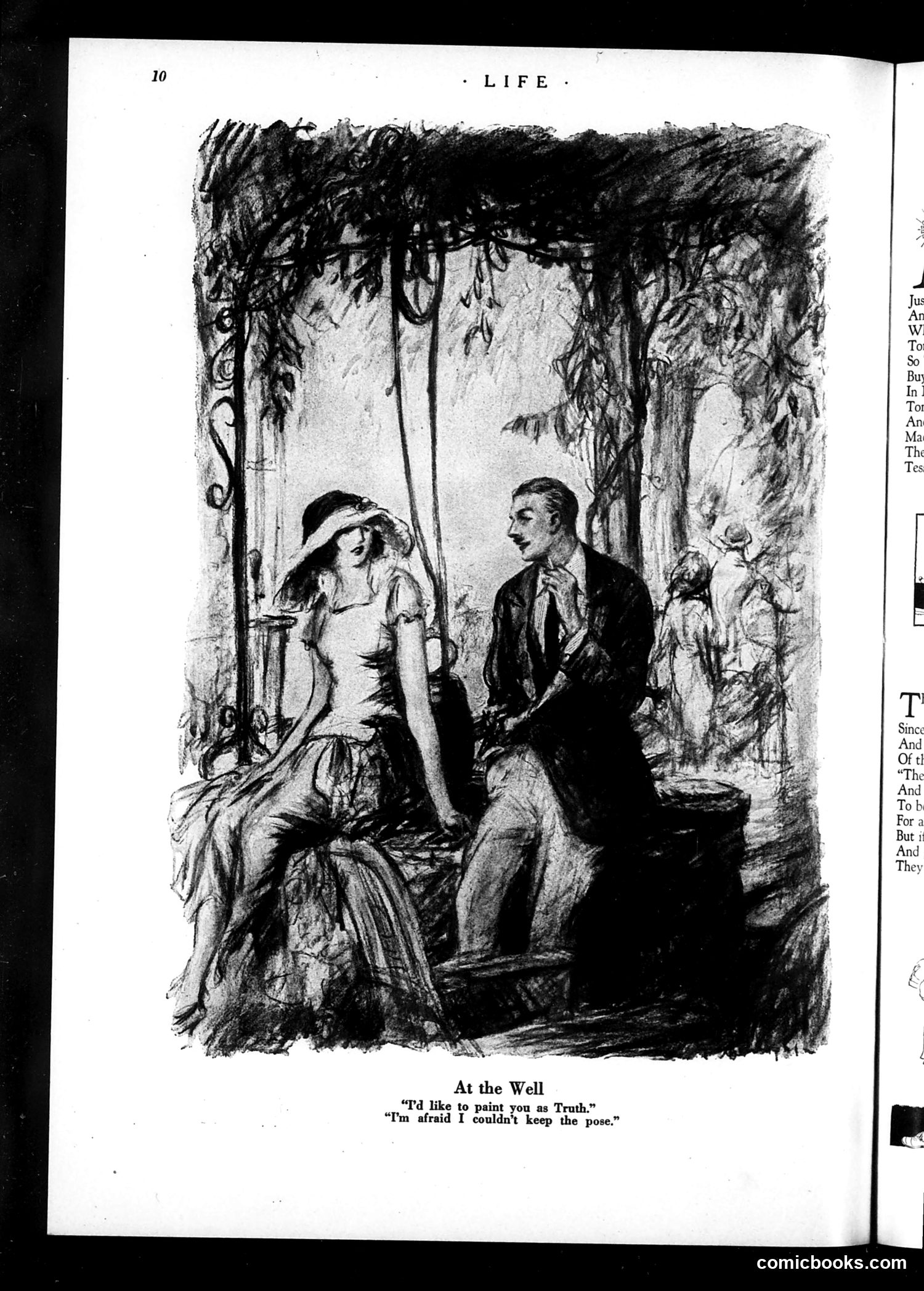
This sketch depicts a romantic or flirtatious encounter between a well-dressed man and woman at a garden well, surrounded by hanging vines and foliage. The woman wears a hat and fashionable dress; the man is in dark formal attire. The caption quotes the man: "I'd like to paint you as Truth" and the woman's response: "I'm afraid I couldn't keep the pose." This is a playful social satire about artistic pretension and feminine virtue. The joke suggests that depicting a woman as "Truth" (typically shown nude or partially clothed in classical art) would be impossible because respectable women cannot maintain such poses—a witty commentary on both artistic convention and contemporary standards of propriety.
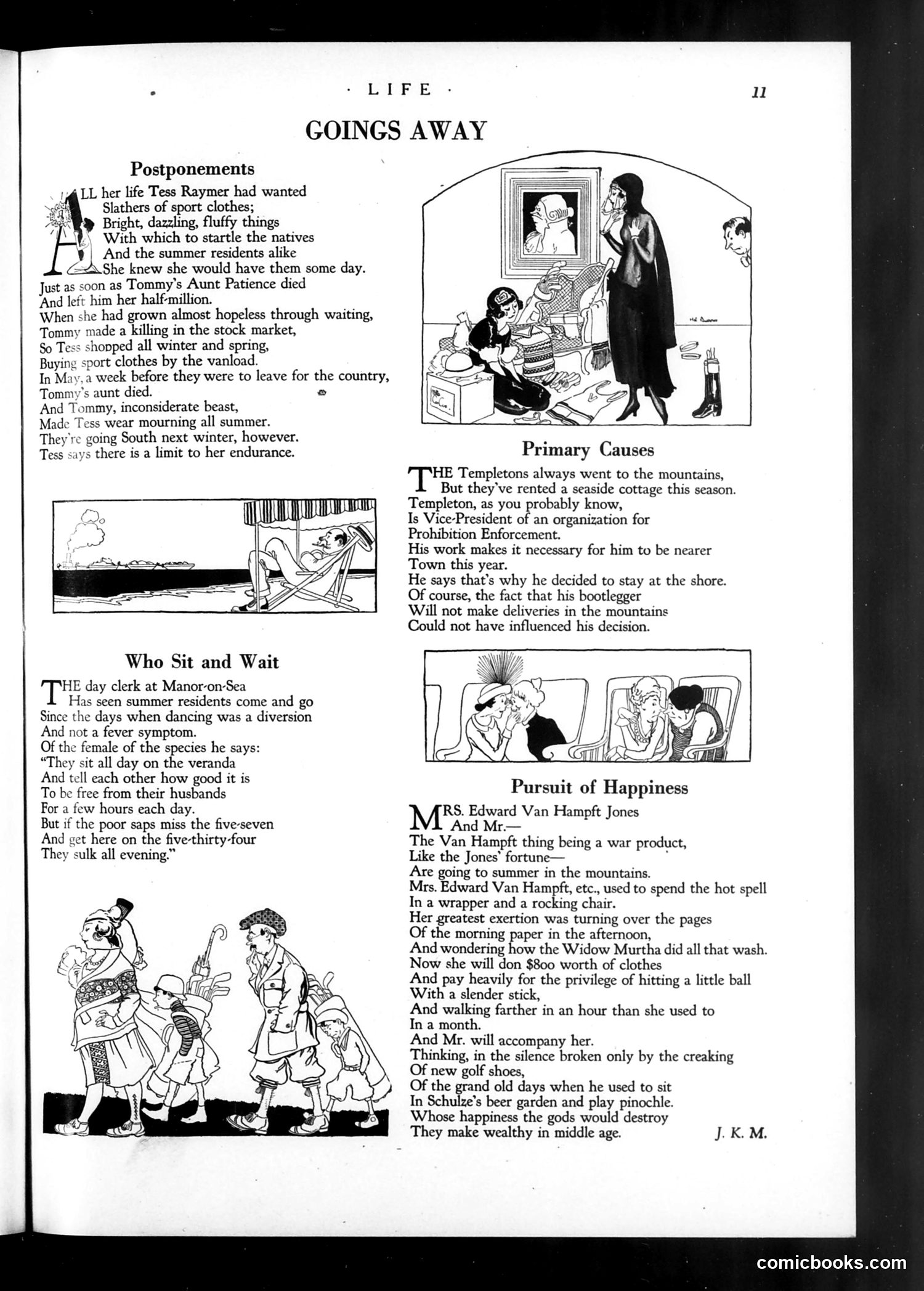
This page satirizes wealthy Americans' summer vacation habits during Prohibition era (reference to "Prohibition Enforcement"). **"Postponements"** mocks a woman (Tess) who repeatedly delayed her country escape while shopping for fashionable clothes, only to leave after her aunt's death provided inheritance funds. **"Primary Causes"** jokes that Mr. Templeton, a Prohibition enforcement official, stays at the shore—likely implying he's avoiding work or has ulterior motives (his "bootlegger" is mentioned, suggesting corruption). **"Pursuit of Happiness"** satirizes Mrs. Van Hampt Jones's lavish mountain vacation plans—she'll spend her time in leisurely activities (rocking chairs, golf) while contemplating expensive purchases, embodying wealthy excess during economically restrictive times. The cartoons criticize class privilege and hypocrisy among the wealthy during Prohibition.
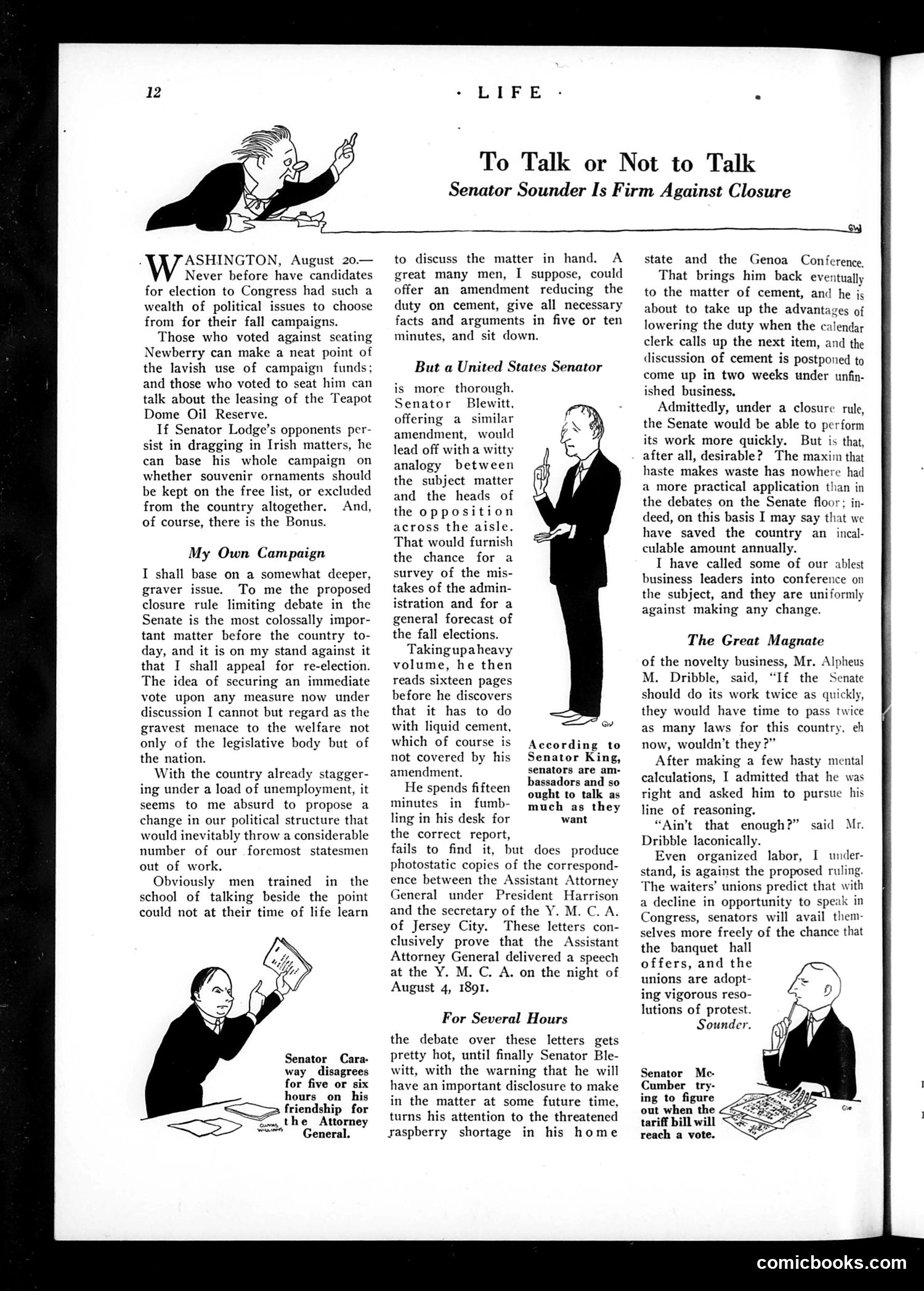
This article satirizes a Senate debate over implementing "closure"—a rule to limit endless debate and force votes on legislation. Senator Sounder opposes closure, fearing it would restrict senators' ability to discuss issues thoroughly. The cartoons mock senators who exploit unlimited debate time: one illustration shows a senator endlessly talking at his desk; another depicts Senator Caraway disagreeing with colleagues over debating the Attorney General's friendship. The satire's point: senators abuse unlimited debate privileges to delay votes on unpopular measures (the article mentions Irish matters, Teapot Dome leasing, and cement duties). The author argues closure would improve Senate efficiency and prevent obstruction, while critics claim it restricts necessary discussion. The cartoons ridicule senators' self-interested use of procedural delays.
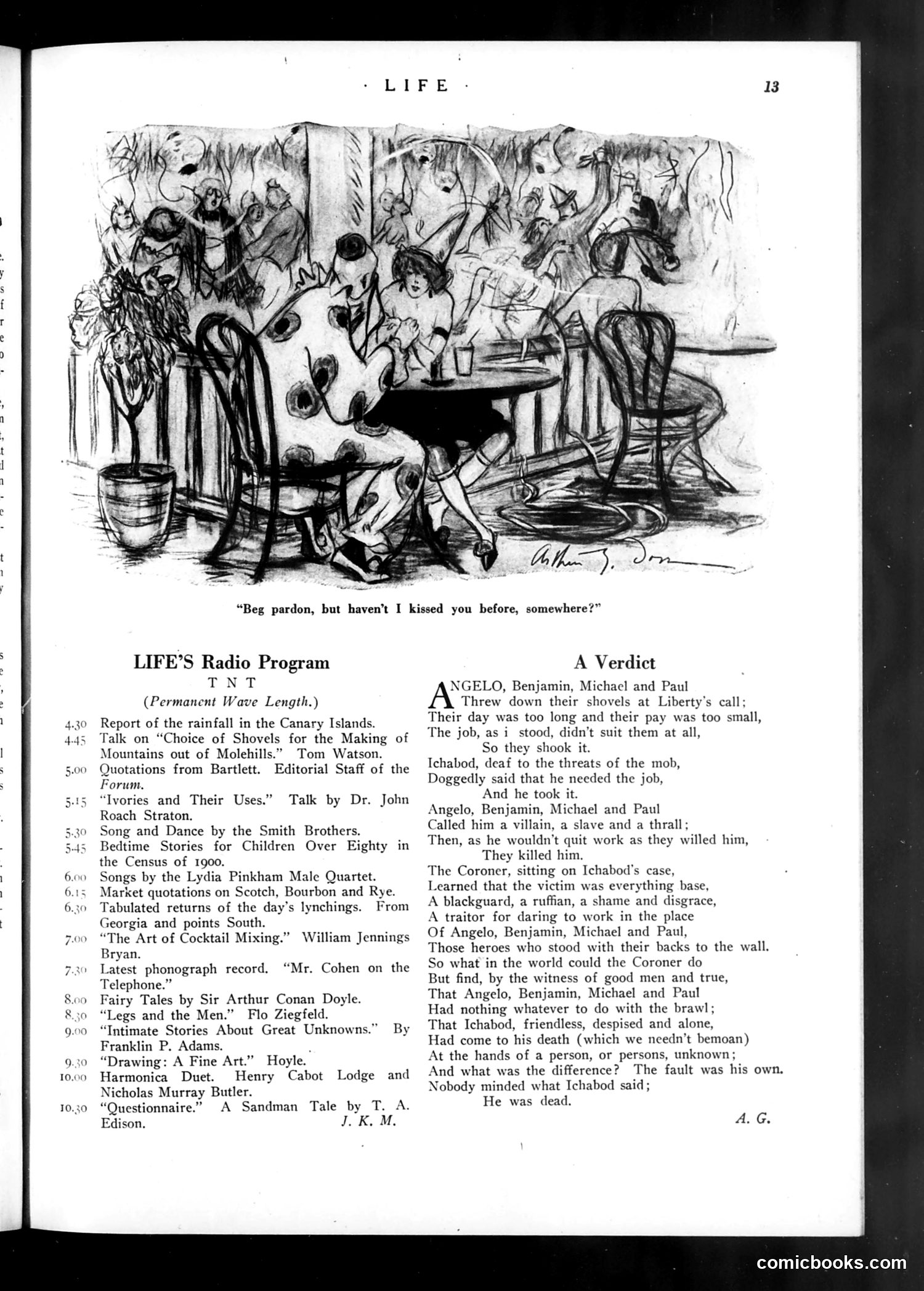
The cartoon depicts a crowded indoor scene with a man at a piano addressing a woman, with the caption: "Beg pardon, but haven't I kissed you before, somewhere?" This is a social satire on casual encounters and mistaken identity in crowded public spaces—likely a party or nightclub setting given the era. The joke plays on the awkwardness of recognizing (or misremembering) someone in a crowded room, particularly in romantic/flirtatious contexts. The crowded background and the pianist's casual demeanor suggest this is commenting on modern social life where strangers frequently cross paths. The humor relies on the universal experience of social embarrassment: the assumption of prior intimacy that may or may not be real, reflecting Jazz Age anxieties about anonymity in urban environments.
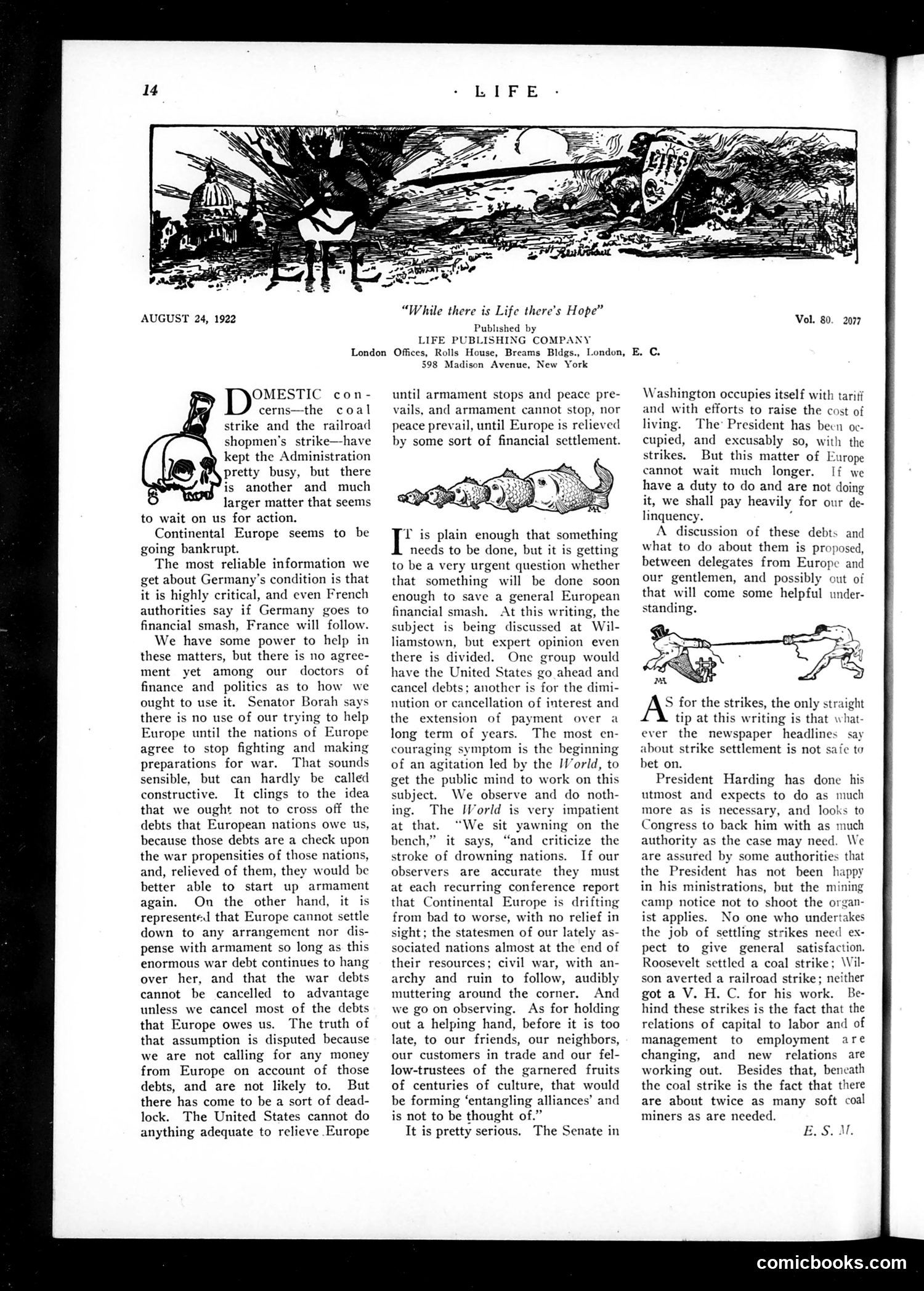
This Life magazine editorial addresses three major crises facing the U.S. and Europe: **The coal strike and railroad unrest** are domestic concerns, but the article emphasizes that **Continental Europe's financial collapse** is the urgent priority. The piece warns that Germany's financial devastation threatens all of Europe, and France will follow without intervention. **The cartoon illustrations** (appearing as decorative elements) likely satirize the economic chaos—the image of what appears to be a dead or dying figure suggests the severity of European economic collapse. **The main target**: The article criticizes the *World* newspaper for calling strikes "entangling alliances" and urges President Harding to act decisively on both domestic labor disputes and European debt relief before the situation becomes irreversible.
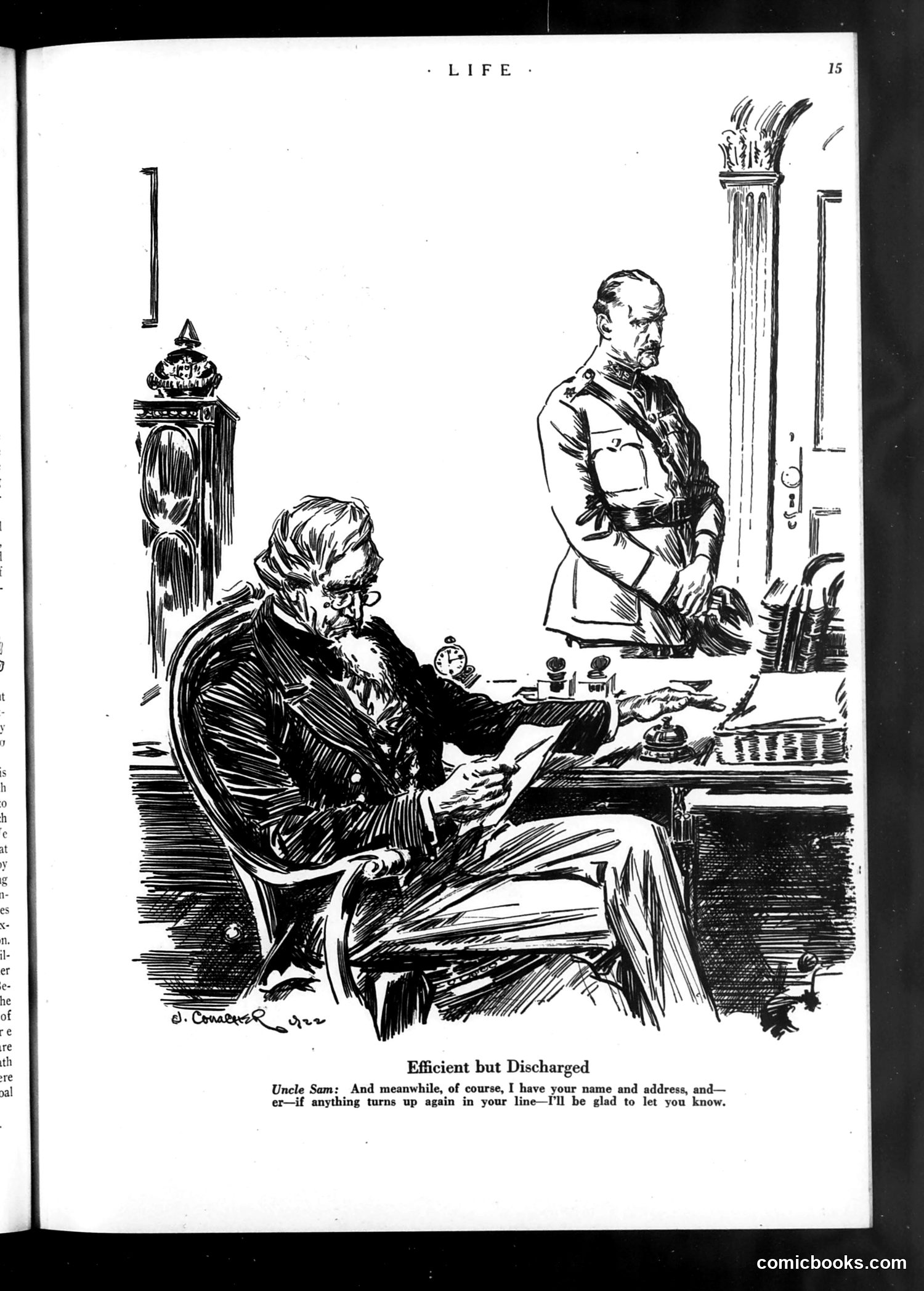
This cartoon depicts Uncle Sam (personifying the U.S. government) discharging a military officer. The officer, seated at a desk with administrative materials, appears to be an efficient but now-dismissed serviceman. Uncle Sam's comment about keeping his "name and address" and contacting him "if anything turns up again in your line" suggests a conditional or temporary dismissal—likely referencing post-WWI demobilization or a similar period of military downsizing. The satire appears to target the government's bureaucratic handling of soldier discharge: portraying competent officers being let go while remaining on file for potential future recall. The title "Efficient but Discharged" emphasizes the irony of removing capable personnel, critiquing either military management or broader government employment practices during this era.
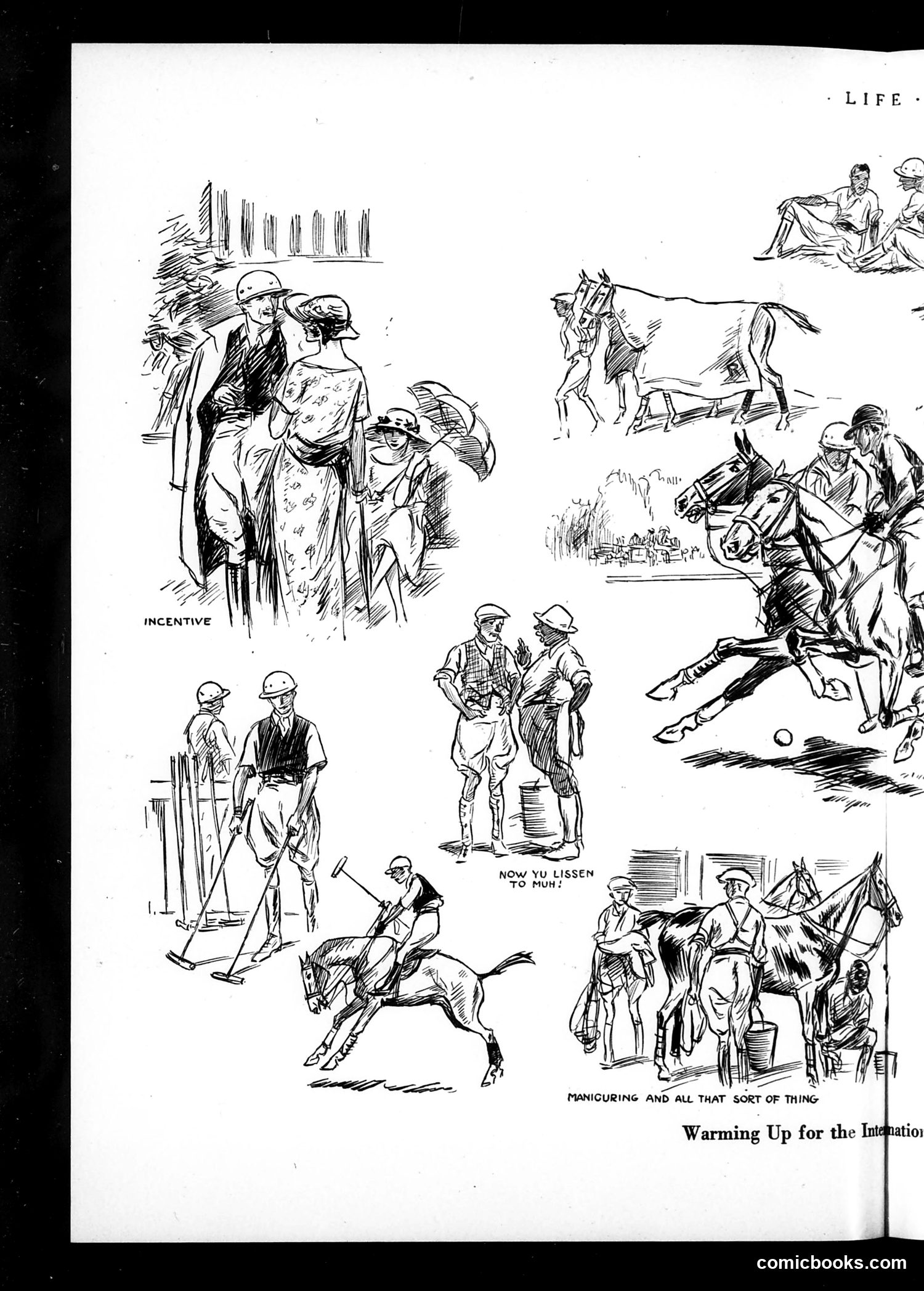
This satirical page depicts preparation for an international polo competition. The top section labeled "INCENTIVE" shows wealthy spectators and participants in formal dress observing the sport. The subsequent sketches illustrate various aspects of polo culture: grooming horses, instruction between players ("NOW YU LISSEN TO HUH"), and mounted riders practicing maneuvers. The caption "MANICURING AND ALL THAT SORT OF THING" suggests the satirist is mocking the fussy, elaborate preparation and social rituals surrounding polo—a sport associated with aristocratic leisure and wealth. The overall satire appears to critique the pretentiousness and excessive attention to detail in upper-class sporting culture, implying that wealthy competitors primp their horses and themselves as much as they actually practice horsemanship.
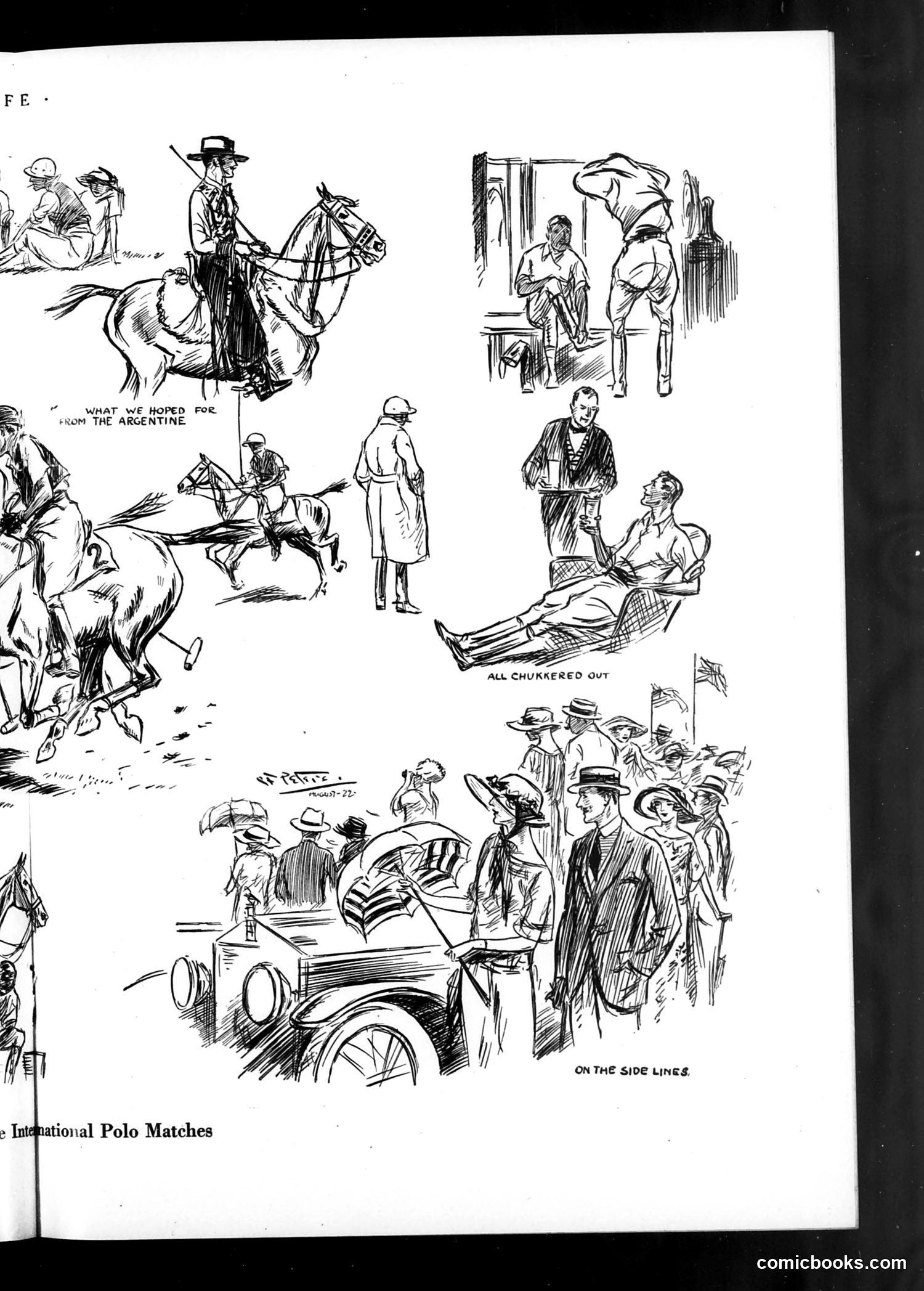
This page depicts scenes from polo matches, likely international competition. The sketches show various aspects of the sport: skilled horsemen playing polo ("What We Hoped For from the Argentine"), spectators watching matches, players being injured or "chukkereed out" (removed from play after a chukker, or period), and crowds gathering "on the sidelines." The satire appears to target the sport itself as an elite, somewhat absurd pursuit—showing both the glamorous expectations around international polo and the physical toll on players. The casual treatment of injuries and the emphasis on spectacle suggest Life magazine was mocking polo as frivolous entertainment for the wealthy classes, particularly highlighting American interest in Argentine polo players and competition.
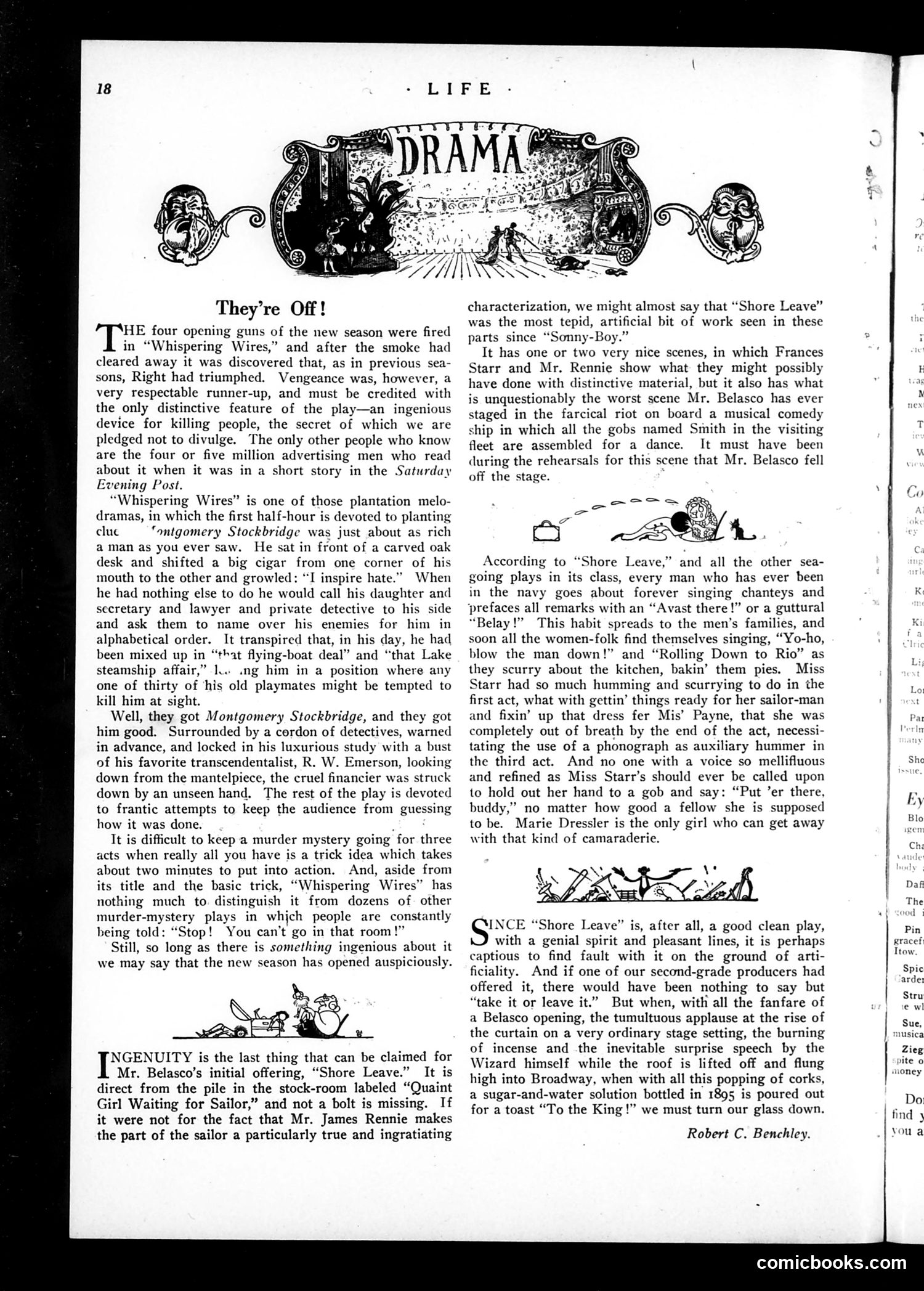
This page reviews two Broadway plays: "Whispering Wires" and "Shore Leave." The critic uses satirical commentary to mock tired theatrical conventions. "Whispering Wires" is a melodrama about a wealthy man (Montgomery Stockbridge) murdered despite elaborate precautions. The reviewer mocks the plot's predictability—good triumphs, vengeance follows—and notes the play's only merit is a gimmicky murder method. He sarcastically observes millions read about it first in the *Saturday Evening Post*, suggesting theater recycles existing material. "Shore Leave," produced by impresario David Belasco, is criticized as formulaic—merely labeled "Quaint Girl Waiting for Sailor" from stock material. While actor James Rennie and actress Frances Starr show promise, the play relies on stereotype: all sailors perpetually sing sea shanties using nautical slang ("Belay!"). The reviewer particularly ridicules a farcical shipboard dance scene where "all the gobs named Smith" assemble, suggesting absurd contrivance. The satire targets Broadway's reliance on predictable plots, recycled premises, and exaggerated character types.
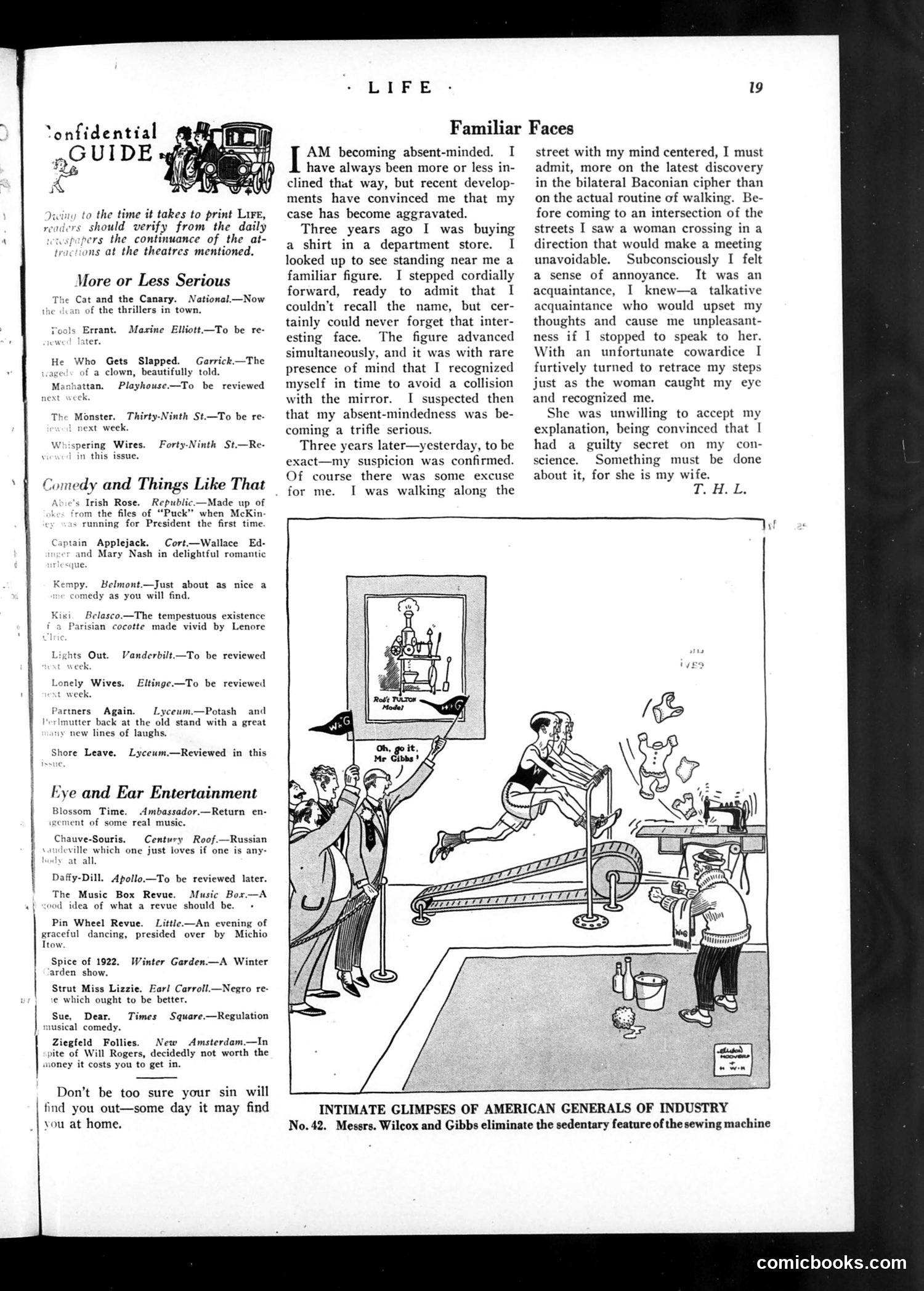
This page contains a humorous essay titled "Familiar Faces" by T.H.L. about absent-mindedness. The author recounts two embarrassing incidents: mistaking his own mirror reflection for a familiar person in a department store three years prior, and more recently, deliberately avoiding eye contact with an acquaintance (his wife) on the street to escape conversation. His wife, spotting his evasion, now suspects he's hiding an affair. The irony is that his attempt to avoid her has created the exact marital problem he hoped to prevent. The cartoon at page bottom, captioned "Intimate Glimpses of American Generals of Industry No. 42," satirizes inventors Wilcox and Gibbs by depicting them operating their own sewing machine in an exaggerated, chaotic manner—suggesting their innovation (eliminating the sedentary feature) results in comically awkward, active positioning rather than practical improvement. The rest of the page lists Broadway theatrical productions and entertainment reviews typical of Life's leisure coverage.
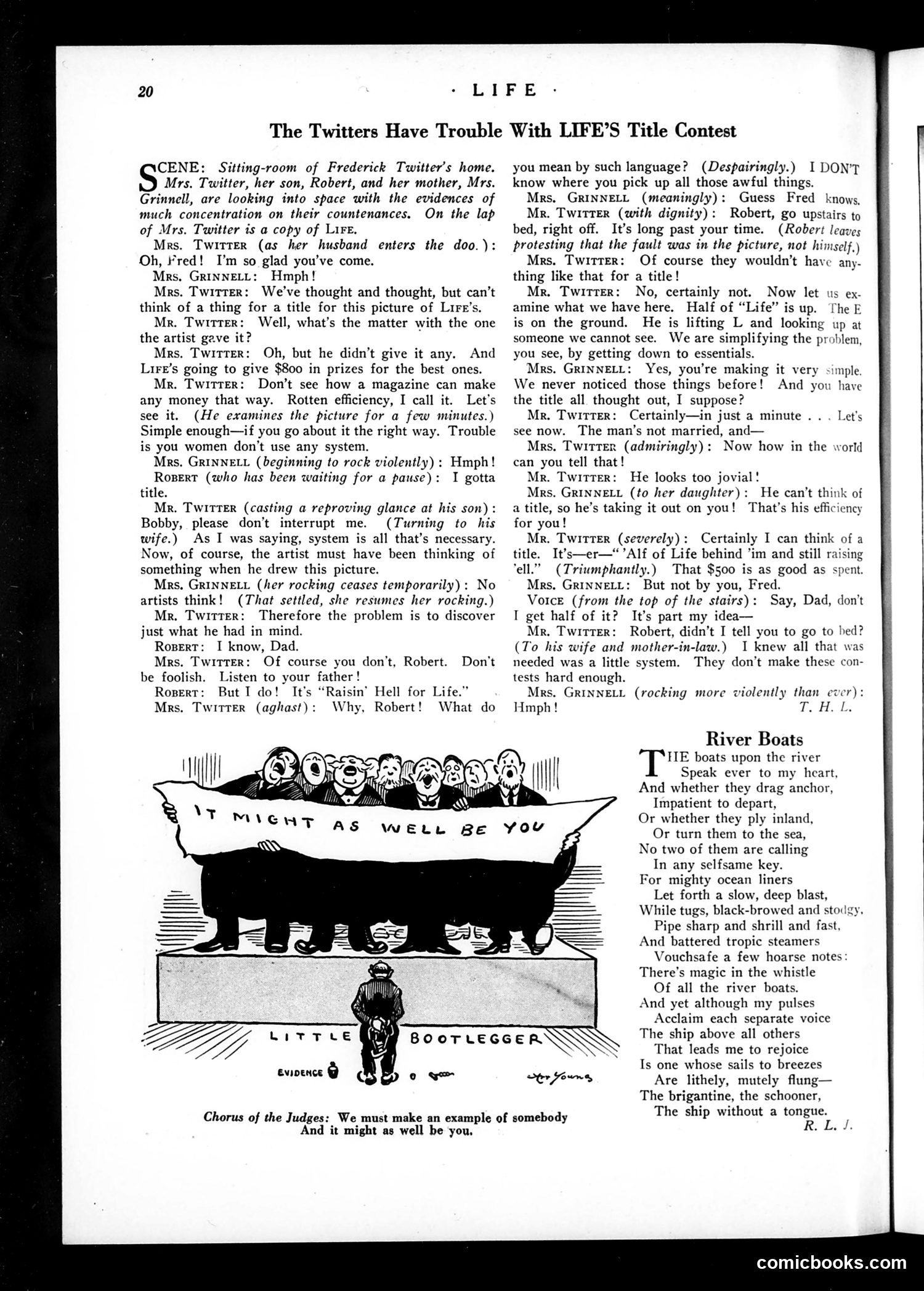
This is a domestic comedy sketch satirizing both the *Life* magazine itself and middle-class American family dynamics. *Life* magazine ran a contest asking readers to title a picture (showing the letter "L" lifting the letter "E"), offering $800 in prizes. The satire mocks: 1. **The magazine's inefficiency**: Mr. Twitter sarcastically notes that giving away prize money is poor business practice. 2. **Gender stereotypes**: The women (Mrs. Twitter and her mother Mrs. Grinnell) supposedly "don't use any system," while Mr. Twitter confidently applies "logic"—yet arrives at a clumsy, vulgar title ("'Alf of Life behind 'im and still raising 'ell"). 3. **Family hierarchy**: Young Robert actually solves the puzzle correctly but is silenced and sent to bed for his crude language, only to demand credit for the prize money. The joke: systematic thinking and male authority produce worse results than the child's intuition, exposing the pretension of "proper" problem-solving.
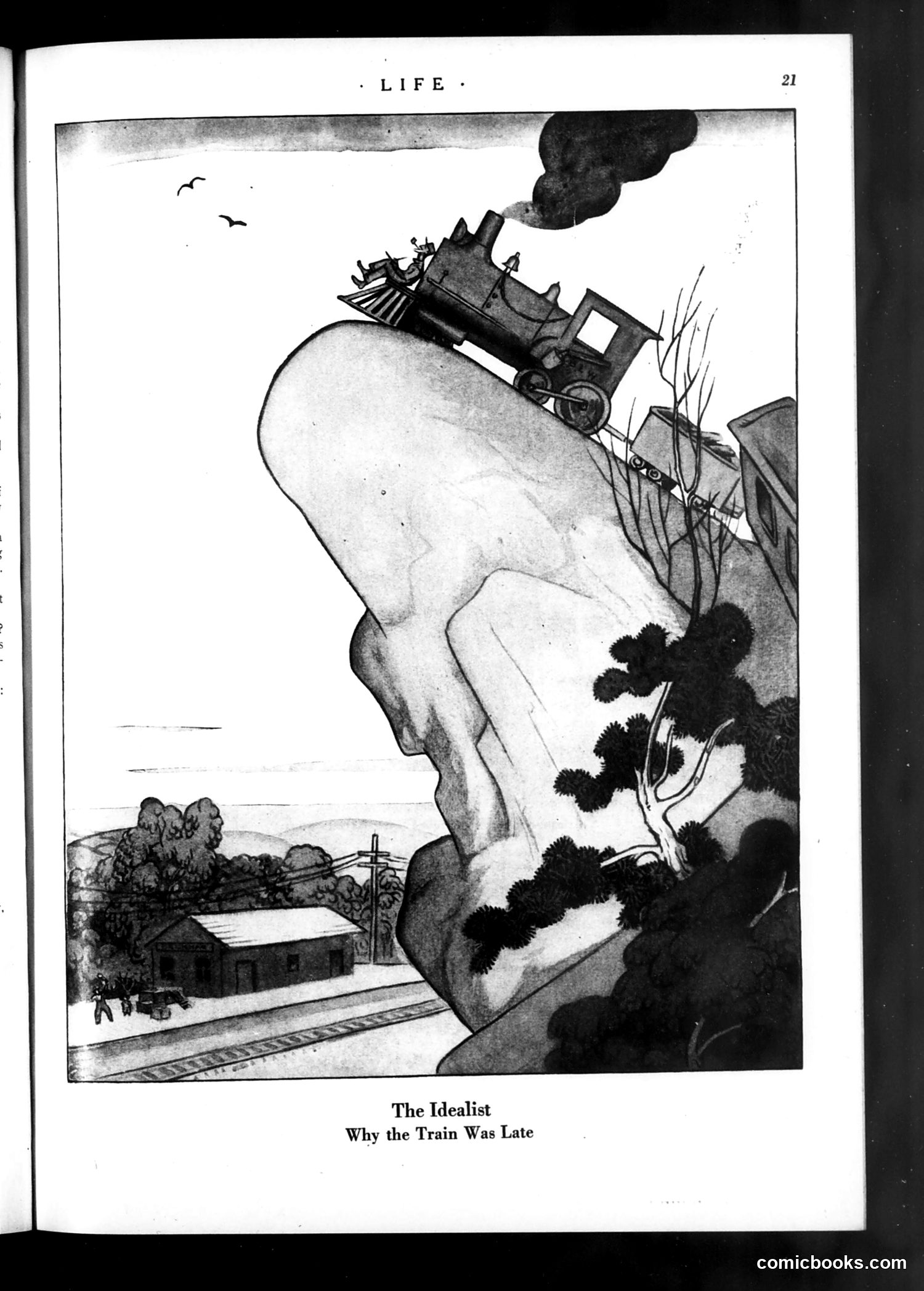
This satirical cartoon depicts an enormous human head in profile positioned directly on railroad tracks, blocking a steam locomotive. The train sits atop the figure's head, smoke billowing from its stack. In the background, a small railway station and crossing are visible. The satire appears to critique idealistic thinking or daydreaming as a practical obstacle. The title suggests that an "idealist"—someone lost in thought or abstract ideas—literally blocks progress. The massive head represents abstract idealism taking up physical space and preventing the practical machinery of modern life (the train) from functioning normally. It's a commentary on how excessive idealism or impractical philosophy can impede real-world efficiency and progress.
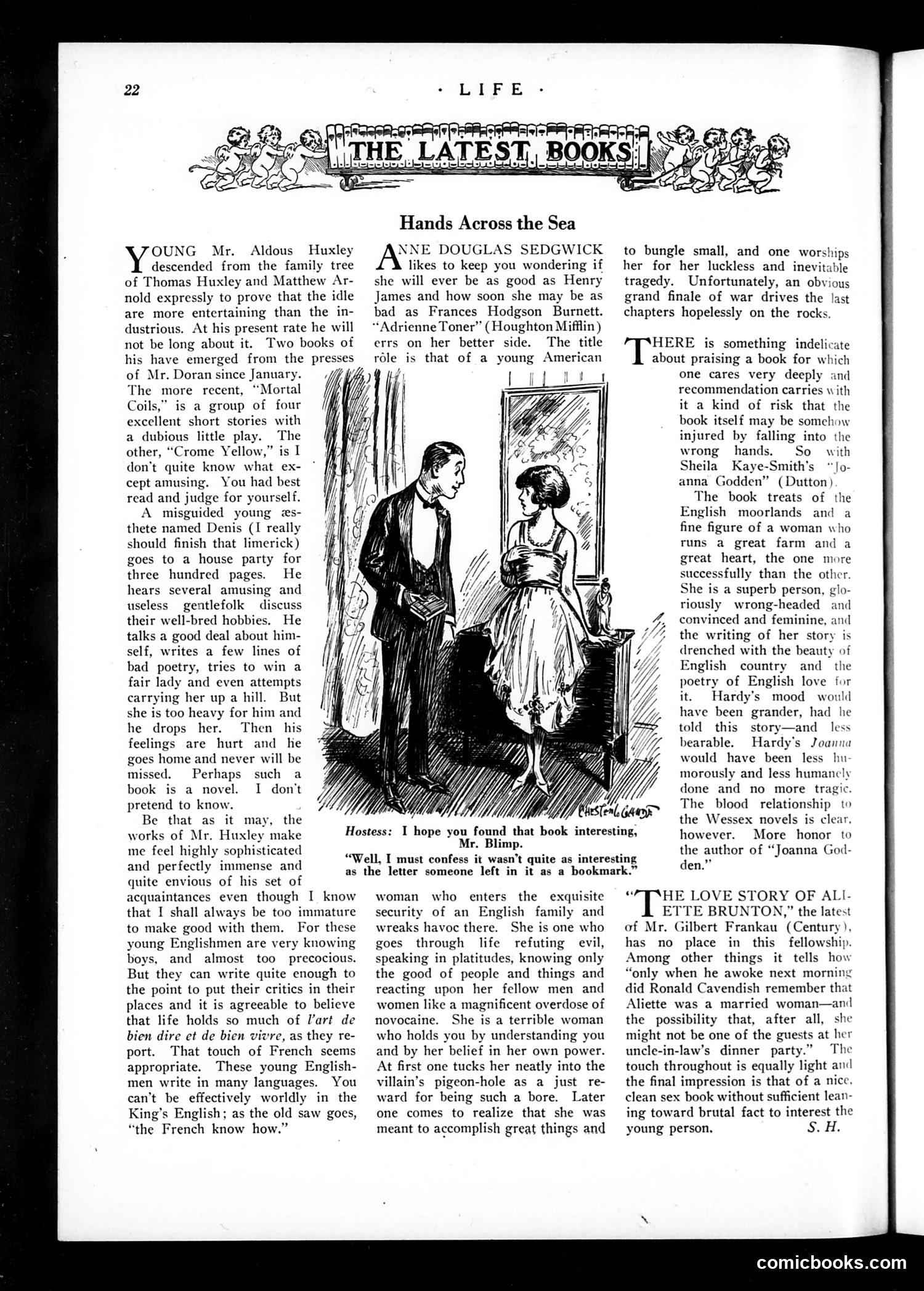
This is a book review section from *Life* magazine featuring three literary critiques. The main cartoon shows a couple at what appears to be a social gathering, with the caption about someone using a letter as a bookmark—a mild joke about the book being unremarkable enough for casual use. The reviews discuss: 1. **Aldous Huxley's works**, praised as witty and sophisticated, appealing to intellectually ambitious readers wanting to seem worldly 2. **Anne Douglas Sedgwick's "Adrienne Toner,"** comparing her favorably to Henry James but unfavorably to Frances Hodgson Burnett 3. **Sheila Kaye-Smith's "Joanna Godden,"** praised as beautifully written about English rural life The tone is typical of early 1920s literary criticism—somewhat precious, preoccupied with whether authors measure up to established greats, and focused on whether readers will appear sufficiently cultured by engaging with these works. The writing itself demonstrates the "sophisticated" English style the reviewer attributes to Huxley.
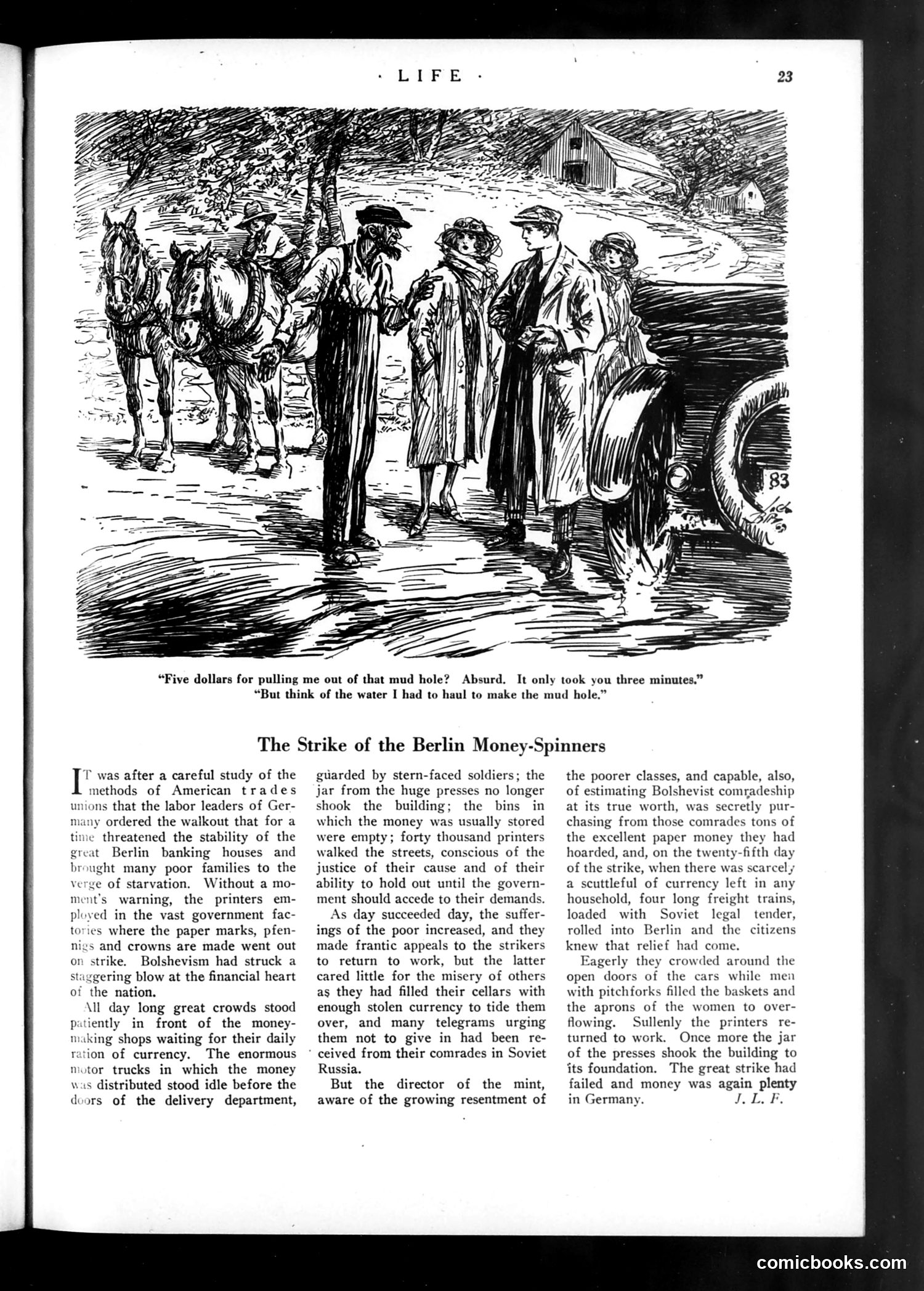
This satirical article attacks both labor strikers and Bolshevism through a fictional account of a Berlin printing workers' strike that cripples the nation's currency production. **The satire works on multiple levels:** The opening cartoon joke establishes the theme of workers extracting disproportionate payment for minimal effort—a dig at labor demands generally. The story then presents striking printers as hypocrites: they claim moral justice for their cause while secretly hoarding stolen currency and receiving support from Soviet Russia. The implied message is that labor movements are Bolshevik-corrupted and fundamentally selfish—willing to starve ordinary citizens to enrich themselves. The resolution mocks the strikers' powerlessness: when the mint director simply imports Soviet currency, the workers capitulate, suggesting their leverage was illusory and their communist allies unreliable. **Context:** This reflects 1920s American anti-labor, anti-communist sentiment during postwar economic anxiety and the Red Scare.
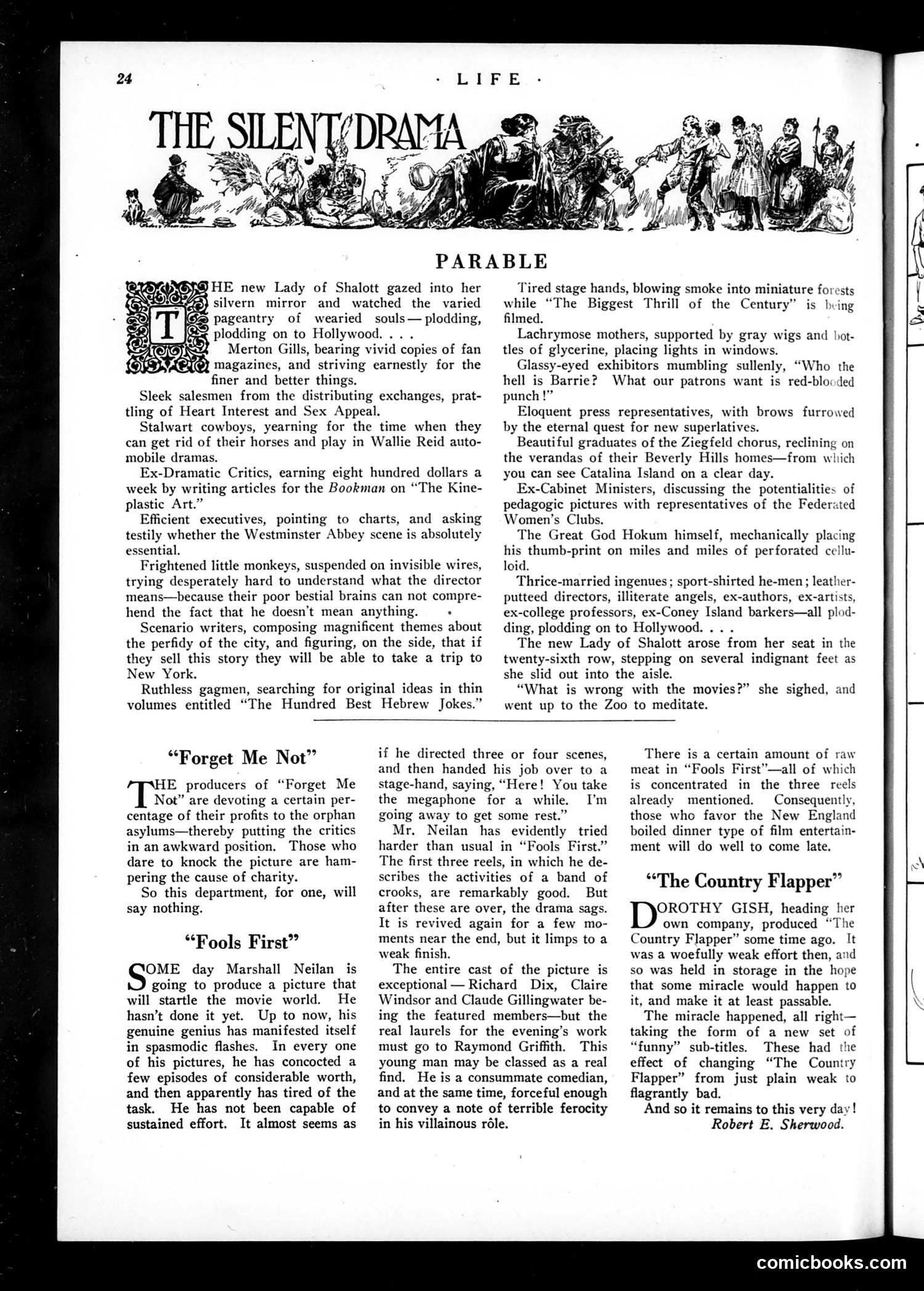
This page satirizes the 1920s Hollywood film industry through two forms: a scathing poetic "Parable" listing the absurd characters and types populating movie-making—from desperate actors yearning for stardom to incompetent directors who don't understand their own work—and three brief film reviews. The "Parable" mocks the desperation, pretension, and incompetence endemic to Hollywood: scenario writers copying ideas from joke books, executives obsessed with irrelevant details, and the mechanical pursuit of profit ("The Great God Hokum"). The framing device—a woman in a cinema asking "What is wrong with the movies?"—underscores the satire's central message: the entire enterprise is fundamentally broken. The reviews critiquing specific films (particularly Marshall Neilan's inconsistent direction in "Fools First") reinforce the theme that Hollywood produces sporadic quality amid general mediocrity. The tone throughout is one of intellectual disdain for both the industry and its products.
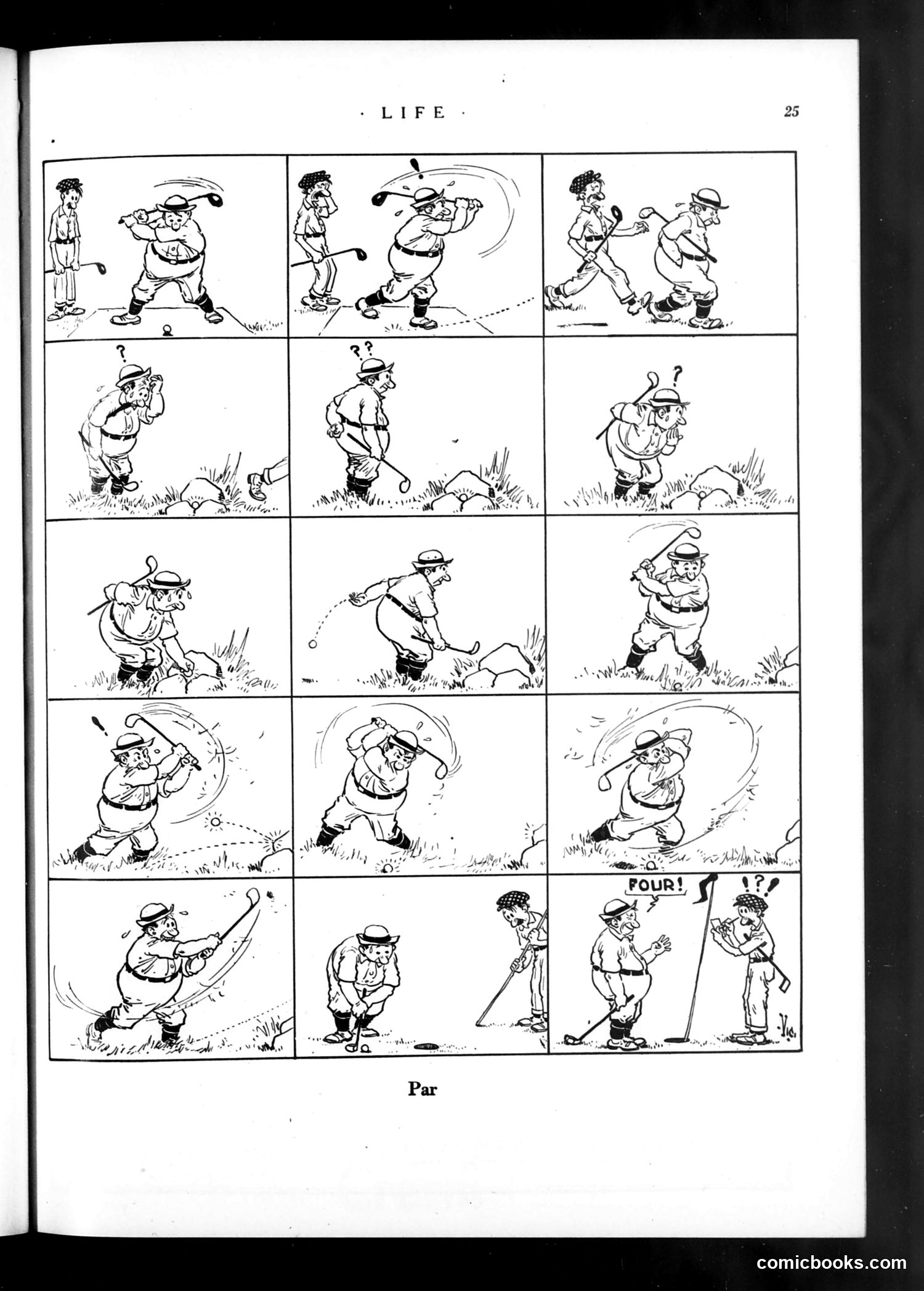
This is a humorous sequential comic strip about golf, titled "Par." It depicts a rotund golfer (likely an Everyman character representing an amateur golfer) attempting to play a hole of golf. The strip follows his increasingly exaggerated and comedic attempts: he swings wildly, loses his balance, appears confused about where his ball went, and eventually exclaims "FOUR!" while his playing companion responds with skepticism or surprise marks. The humor derives from the golfer's poor performance, wild swings, and apparent delusion about his actual score—a classic satire of amateur golfers who either miscalculate or exaggerate their abilities. The physical comedy and slapstick style were typical of Life magazine's humor pages during this era.
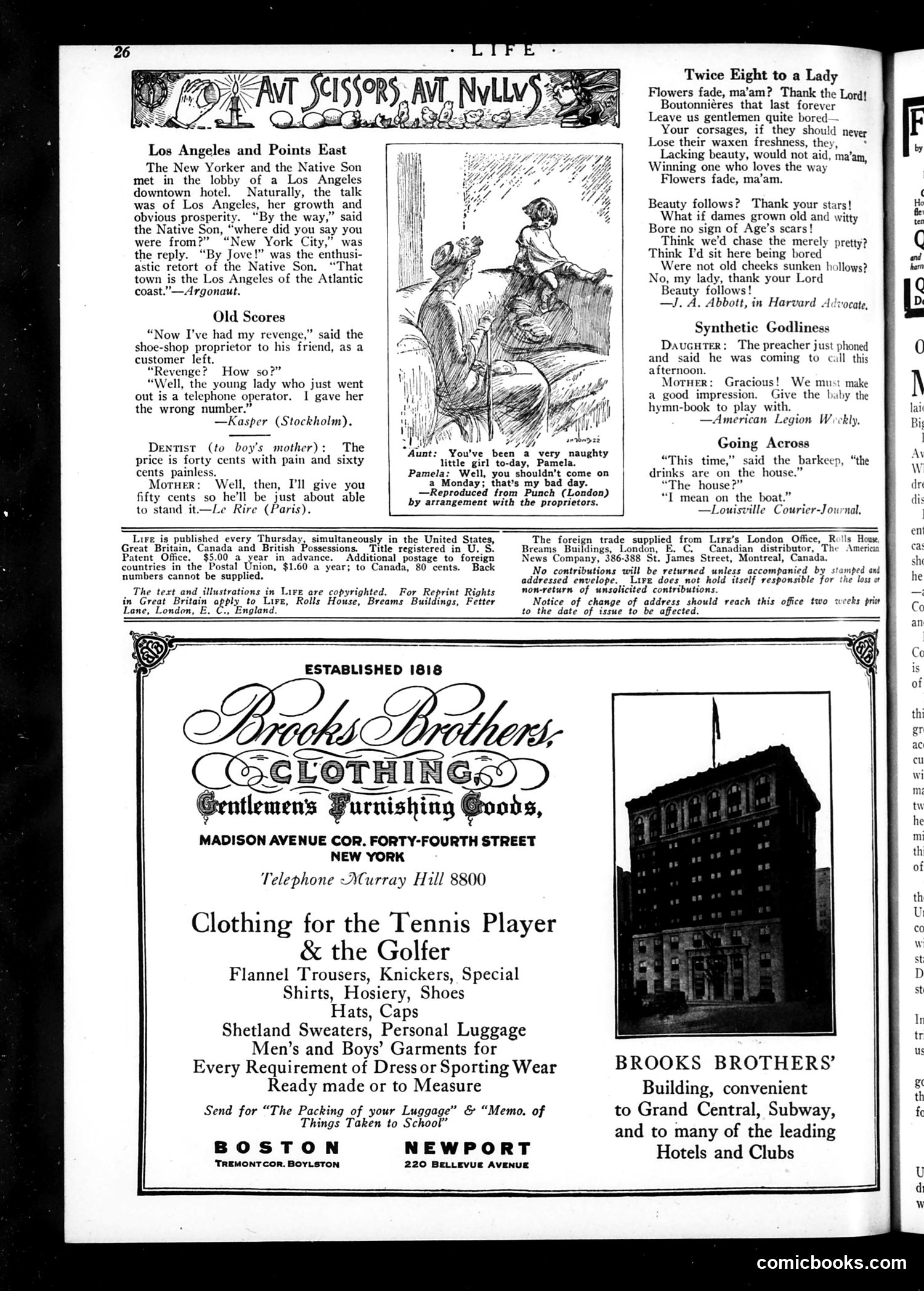
This page contains several brief humor pieces typical of Life's satirical format: **"Twice Eight to a Lady"** is a poem defending faded flowers and aging women—arguing that men prefer the character of older women to youthful prettiness, satirizing romantic sentimentality. **"Los Angeles and Points East"** jokes that a New Yorker told a Los Angeles native that New York City is "the Los Angeles of the Atlantic coast"—a reversal implying LA's growth rivals the East Coast's established importance. **"Old Scores"** depicts petty revenge: a shoe-shop owner gave a telephone operator a wrong number, exploiting her profession against her. **"Synthetic Godliness"** mocks performative piety—a mother gives a baby a hymn-book as a prop to impress a visiting preacher. **"Going Across"** plays on maritime terminology: a bartender offers free drinks "on the house," then clarifies he means "on the boat." The page is primarily **advertising** for Brooks Brothers clothing, occupying substantial space at the bottom.
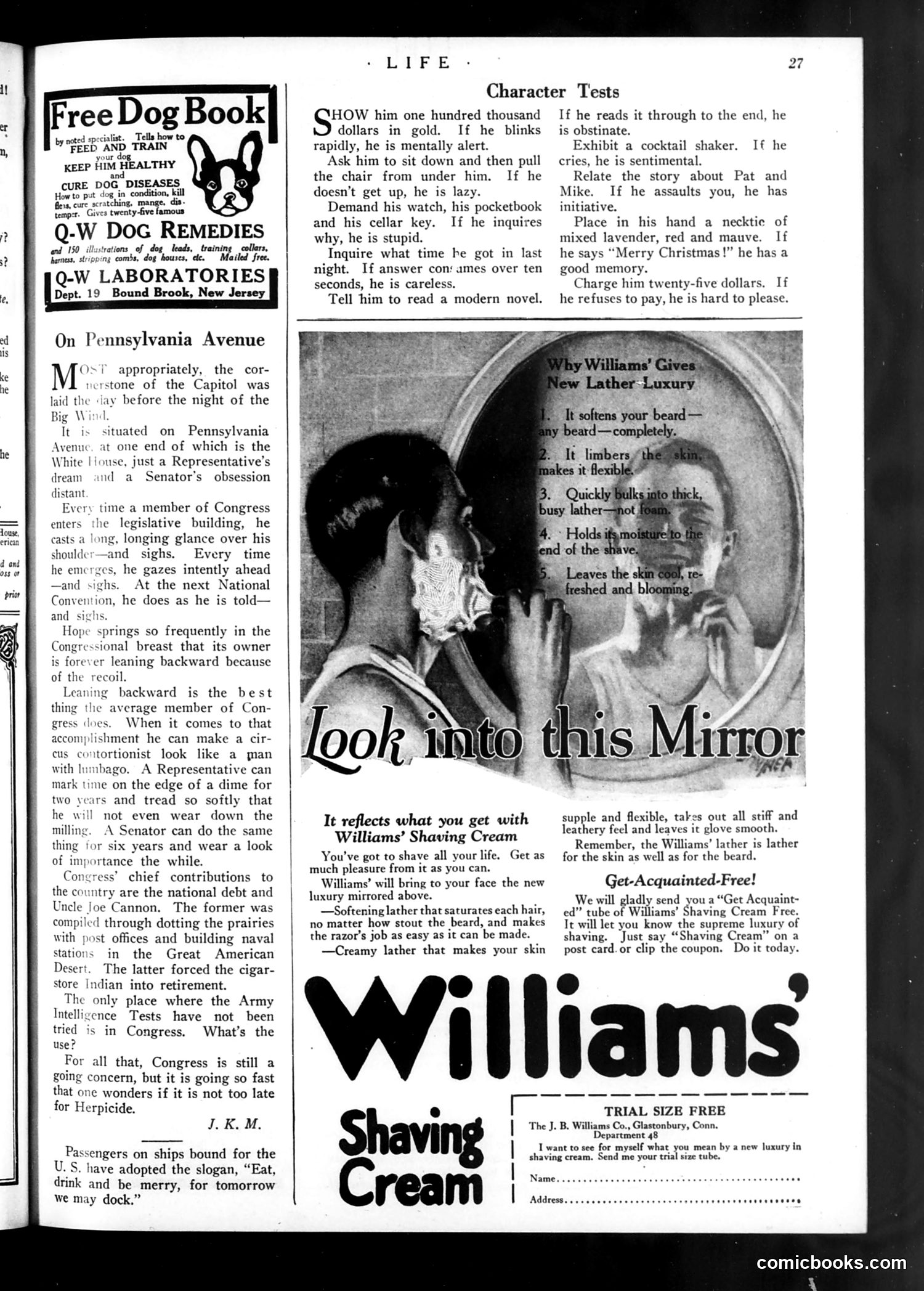
This page combines political satire with advertising. The main editorial content, "On Pennsylvania Avenue," mocks members of Congress through exaggerated character sketches. The author ridicules their perpetual hope for advancement, their theatrical sighing, and their ability to accomplish little while appearing important. References to "Uncle Joe Cannon" (a powerful Speaker of the House) and criticisms of building unnecessary post offices and naval stations suggest this targets congressional waste and political theater generally. The satirical "Character Tests" section offers absurdist personality assessments—if someone doesn't blink at money, they're alert; if they read a modern novel through, they're stubborn. This mocks pseudoscientific personality evaluation trends popular in the era. The Williams' Shaving Cream advertisement dominates the lower half, featuring a mirror image advertisement typical of early 20th-century luxury product marketing, emphasizing quality and self-care.
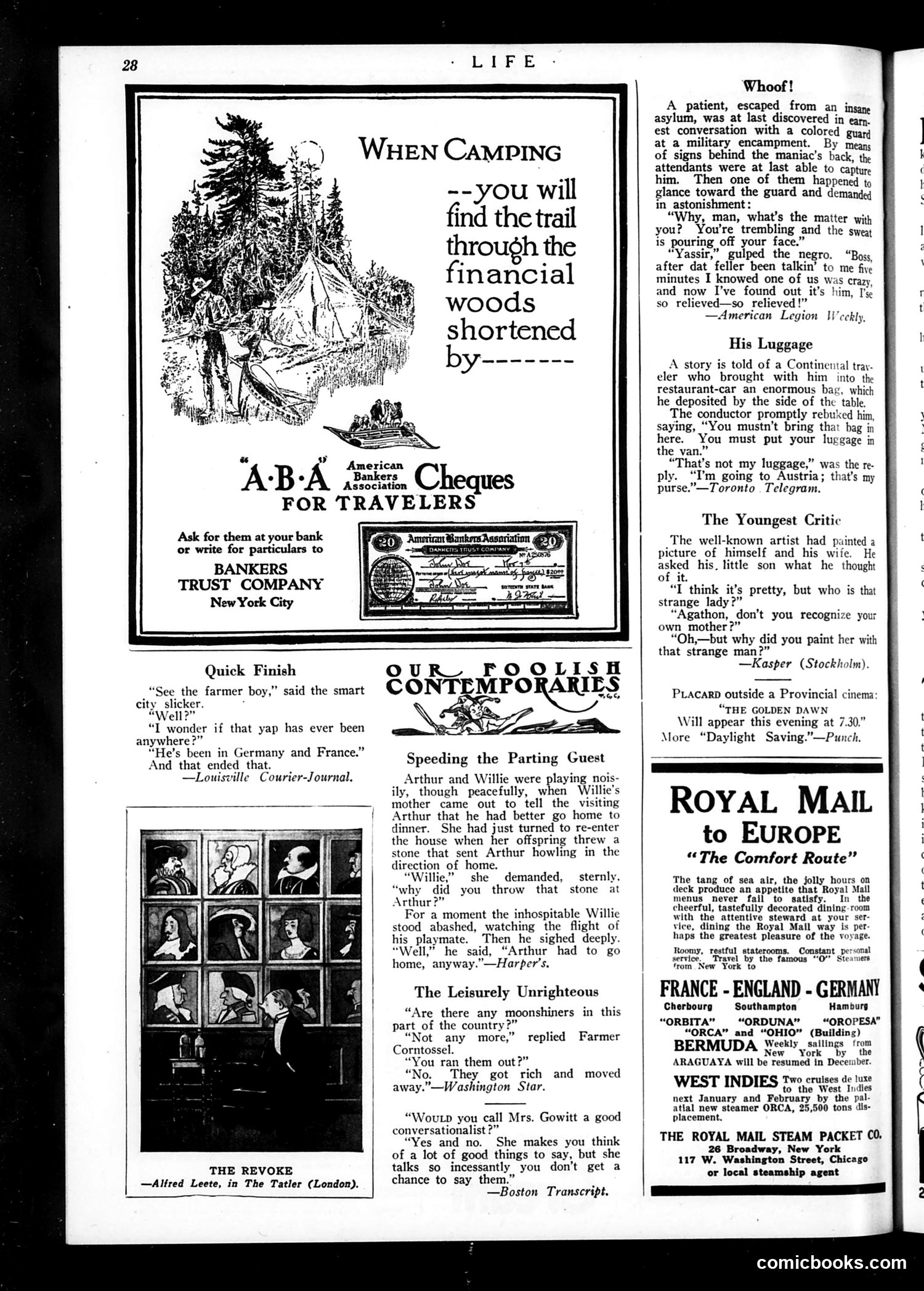
This page is primarily **advertising and humor**, with three main elements: **The Main Advertisement** features ABA (American Bankers Association) traveler's cheques, playing on financial anxiety: camping metaphorically represents travel's costs, and the cheques supposedly "shorten" the financial burden—a joke about money running out quickly on trips. **The Cartoons and Jokes** are brief, typical early-20th-century humor: - A city slicker and farmer boy exchange about European travel - Children's anecdotes about awkward farewells and parental frustration - Small social observations (moonshiners becoming wealthy and moving away; talkative wives) **The Visual Element** "The Revoke" by Alfred Leete appears to be a serious illustration, possibly British, but its subject is unclear from context alone. The remaining content consists of **travel advertisements** (Royal Mail ships to Europe, Bermuda, West Indies), standard for magazines of this era. The humor reflects period attitudes: rural simplicity versus urban sophistication, domestic family chaos, and Prohibition-era references (moonshiners). Nothing here addresses specific political events—it's general social satire and commerce.
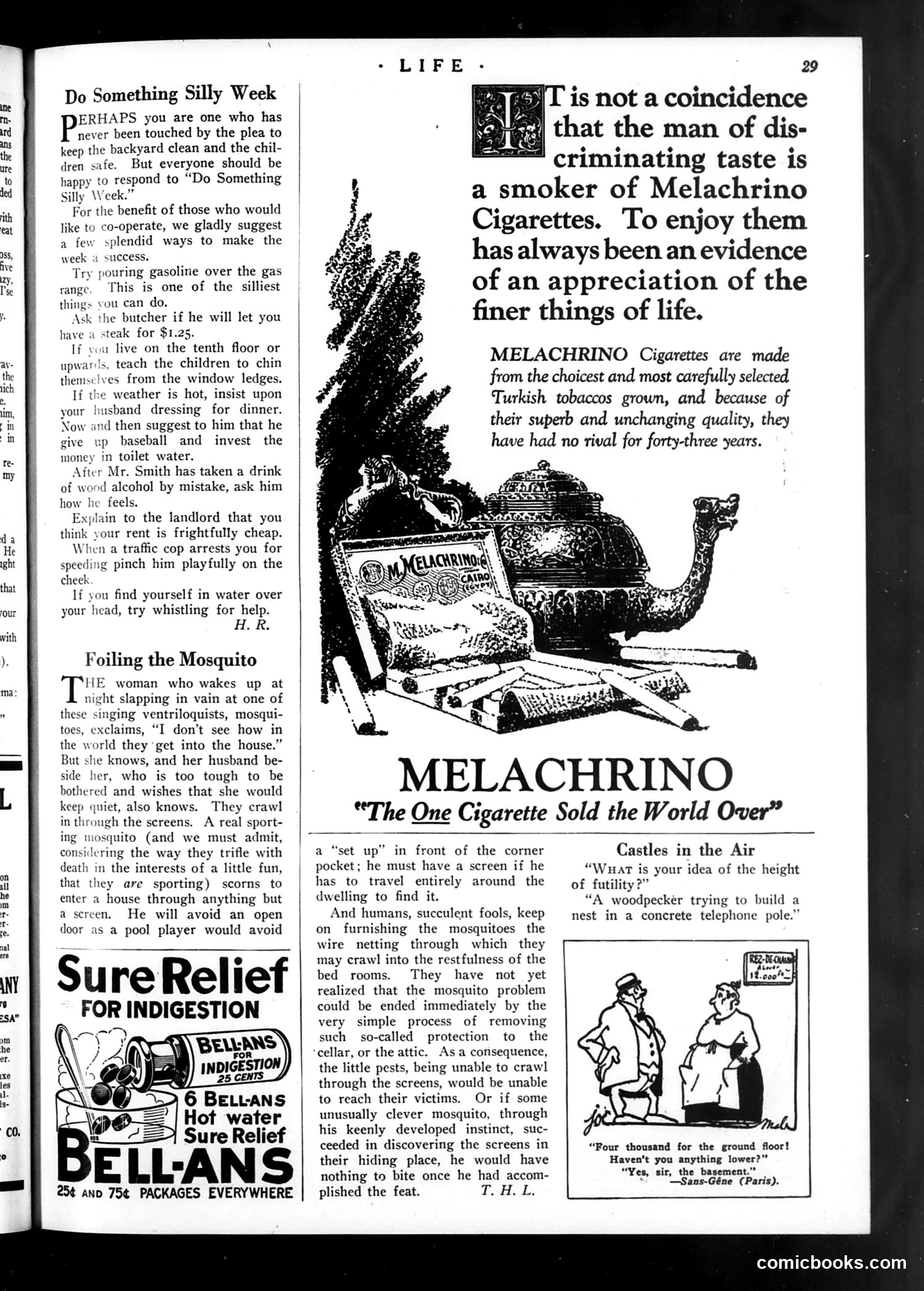
This page contains three distinct elements: **"Do Something Silly Week"** is satirical advice presenting deliberately dangerous and absurd activities—pouring gasoline on a stove, teaching children to hang from window ledges, drinking wood alcohol by mistake—as humorous "silly" suggestions. The satire mocks public safety campaigns by exaggerating their earnestness into obviously harmful nonsense. **"Foiling the Mosquito"** humorously suggests that mosquitoes deliberately choose to enter homes through screens rather than open doors, attributing them "sporting" instincts like a pool player. It satirizes human irrationality by noting people maintain screens that let mosquitoes in while complaining about them. **"Castles in the Air"** is a single-panel joke about a woodpecker attempting to build a nest in a concrete telephone pole—absurd futility presented as the height of futility itself. The page also contains cigarette and indigestion remedy advertisements typical of 1920s-era magazines, which modern readers should note represent now-banned or heavily regulated advertising practices.
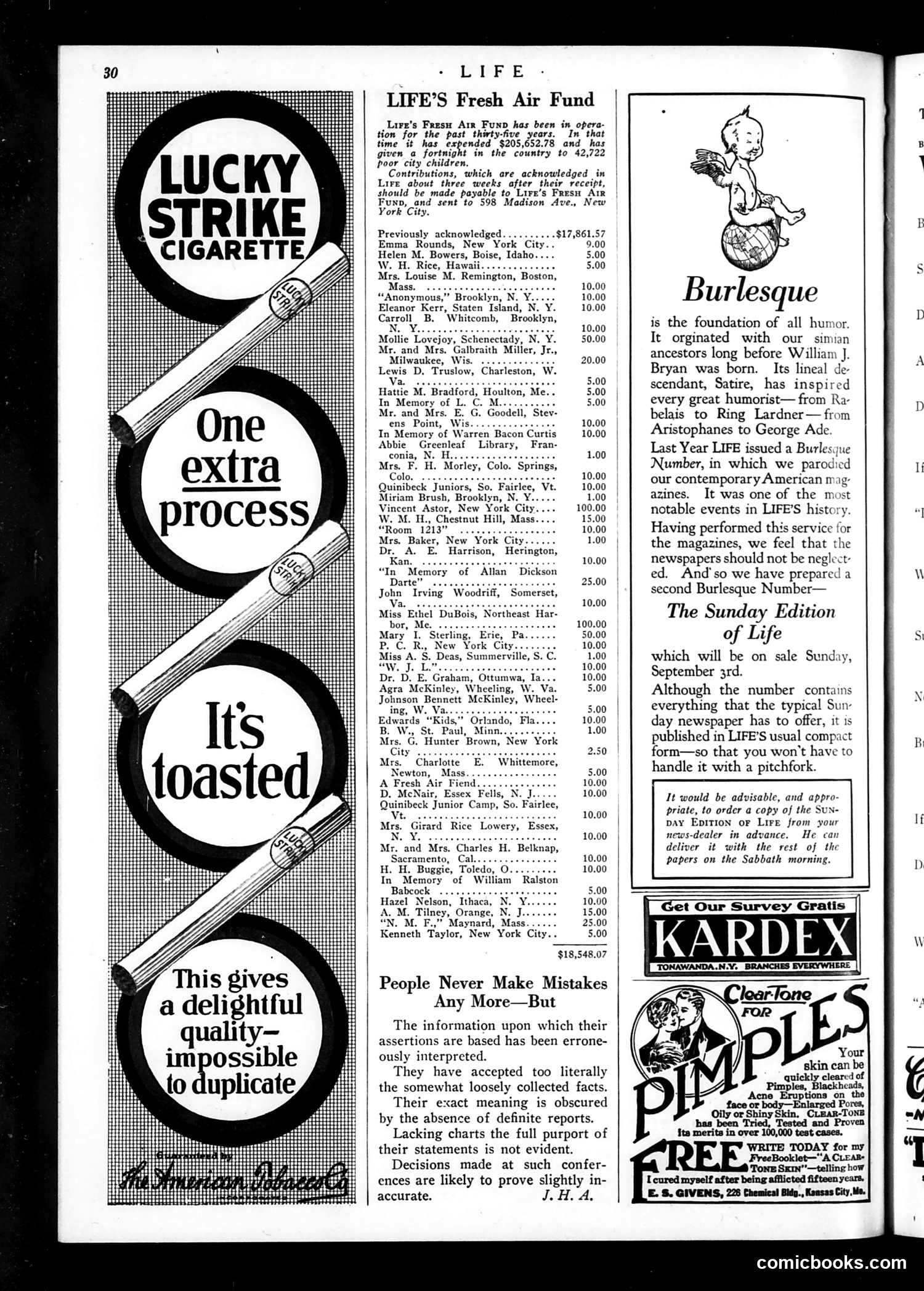
The left side is a **Lucky Strike cigarette advertisement** employing circular "testimonial" design, each ring promising benefits: "One extra process," "It's toasted," and "This gives a delightful quality impossible to duplicate." This reflects early 20th-century cigarette marketing that emphasized manufacturing claims as health/quality virtues—a common tactic before tobacco's dangers were acknowledged. The right side contains **Life magazine's charitable announcements** (Fresh Air Fund donations) and promotional material for an upcoming **"Burlesque Number"**—a parody issue mocking contemporary American newspapers, following a previous successful magazine parody. The piece titled "People Never Make Mistakes Any More—But" sarcastically catalogs how people rationalize errors through misinterpretation, loose facts, and absent data—satirizing human self-deception, a common *Life* editorial theme. The **burlesque concept** references satirical humor traditions from classical sources (Aristophanes) through American humorists like Ring Lardner, positioning *Life* as cultural commentator.
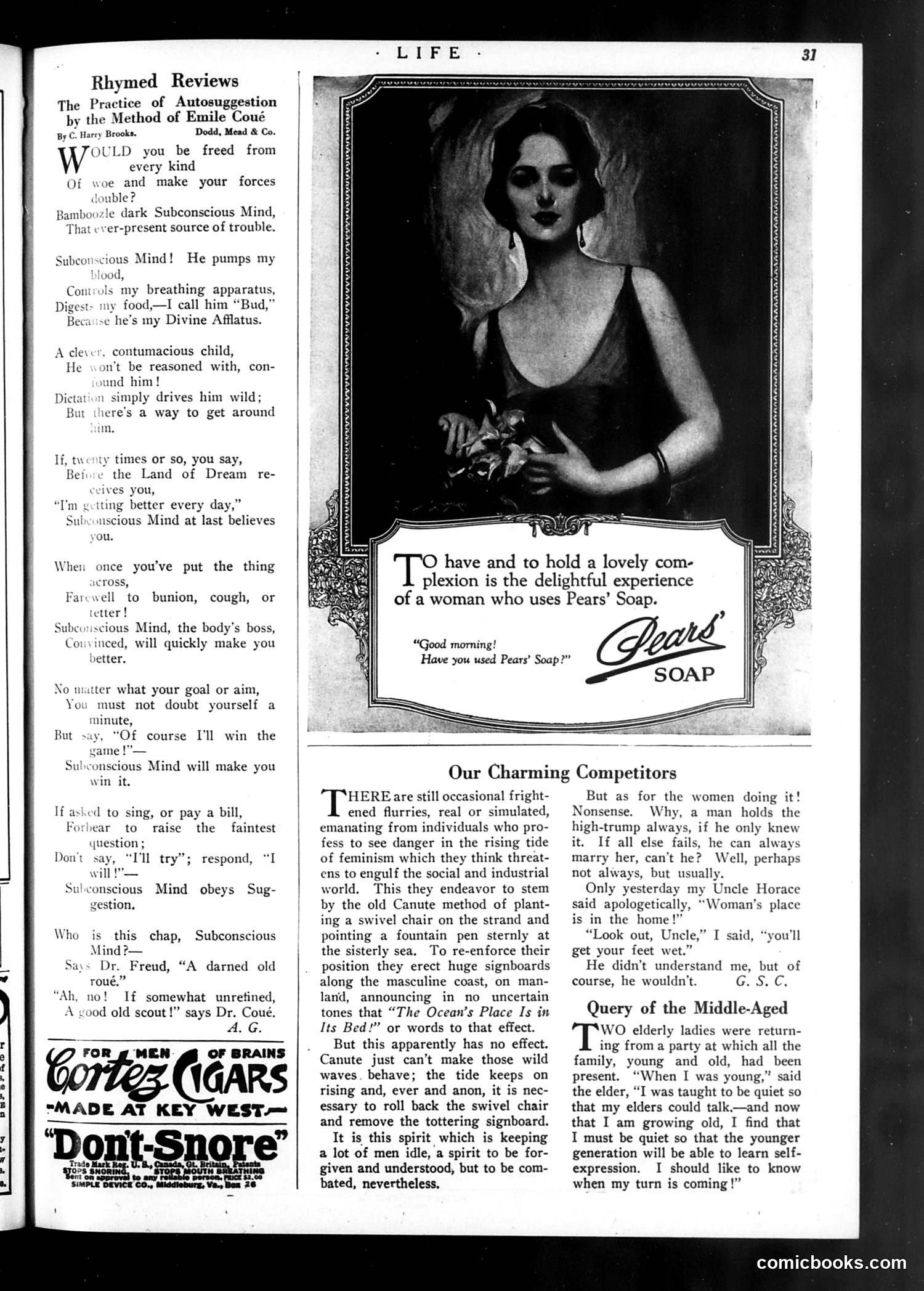
This Life magazine page from the early 1920s contains three distinct items: **Rhymed Review**: A humorous poem mocking Émile Coué's "autosuggestion" self-help method, which was genuinely popular at the time. The satire ridicules the idea that repeating "I'm getting better every day" can cure physical ailments and achieve goals by manipulating one's subconscious mind. It playfully compares Coué (presented as optimistic) to Freud (presented as cynical about human nature). **Pears' Soap Advertisement**: A conventional beauty product advertisement featuring a woman's portrait. **"Our Charming Competitors"**: A satirical piece about resistance to feminism. It mocks men using King Canute imagery—attempting to hold back women's advancement like Canute supposedly tried stopping the tide. The author ridicules this resistance as futile and somewhat pathetic, though notes men still hold advantages (like marriage prospects). **"Query of the Middle-Aged"**: A brief anecdote about generational double-bind—elderly women taught silence for elders now must stay silent for younger people's "self-expression."
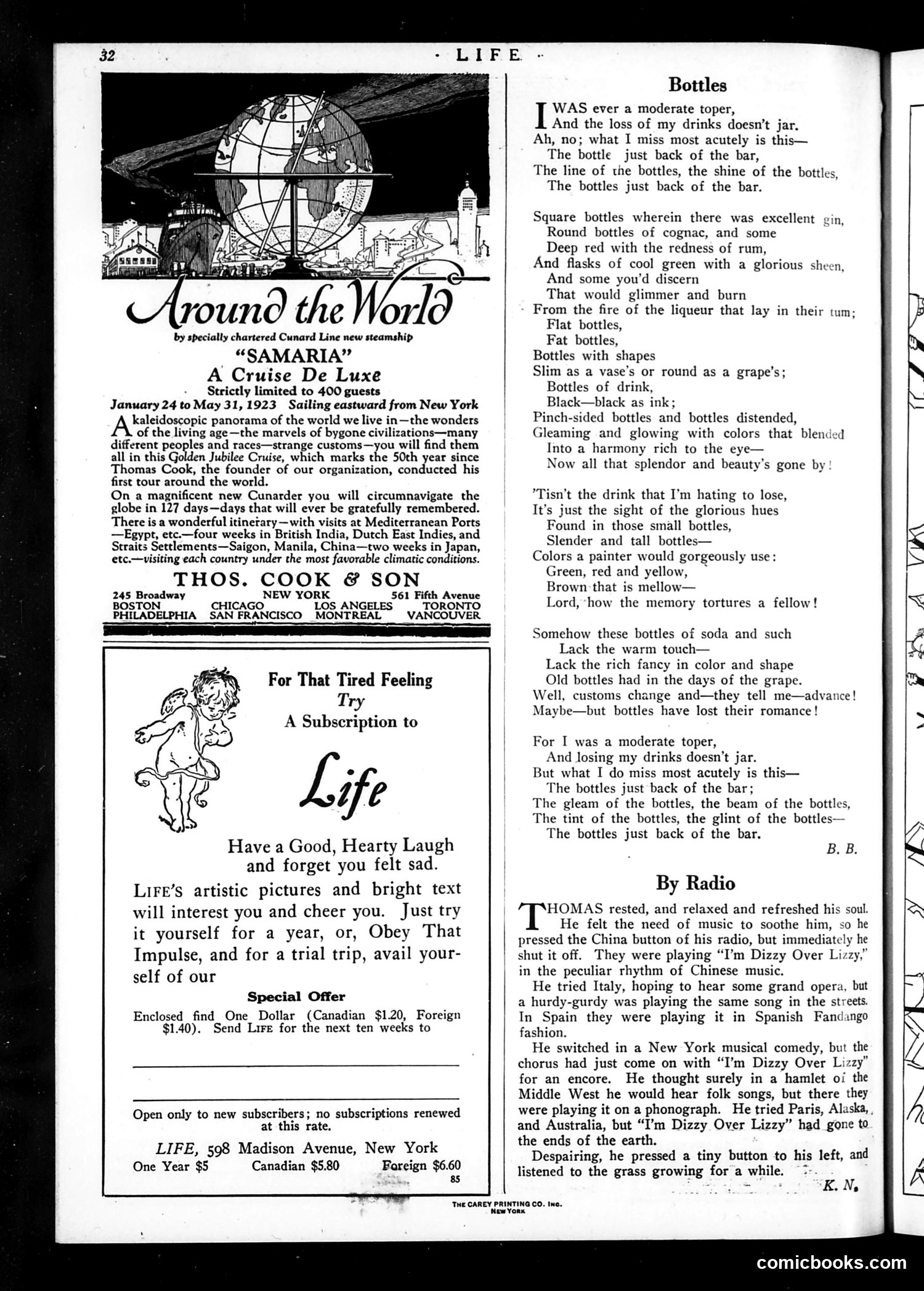
This page primarily contains **advertisements and light verse** rather than political satire. The main content is a nostalgic poem titled "Bottles" by B.B., lamenting the loss of alcohol following Prohibition (which began in 1920). The speaker—a "moderate toper" (drinker)—doesn't miss drinking itself, but specifically mourns the *visual beauty* of bottles displayed behind bars: their colors, shapes, and gleaming appearance. The poem humorously contrasts colorful liquor bottles with modern substitute "bottles of soda," which lack aesthetic appeal and "romance." The page also features a Thomas Cook cruise advertisement and Life magazine's own subscription promotion promising "a good, hearty laugh" as a cure for tired feelings. The "By Radio" story fragment at bottom depicts someone named Thomas seeking music via radio but encountering "I'm Dizzy Over Lizzy"—a popular novelty song—everywhere globally, suggesting the homogenizing effect of modern mass media. The humor reflects 1920s anxieties about Prohibition's cultural impact and standardized entertainment.
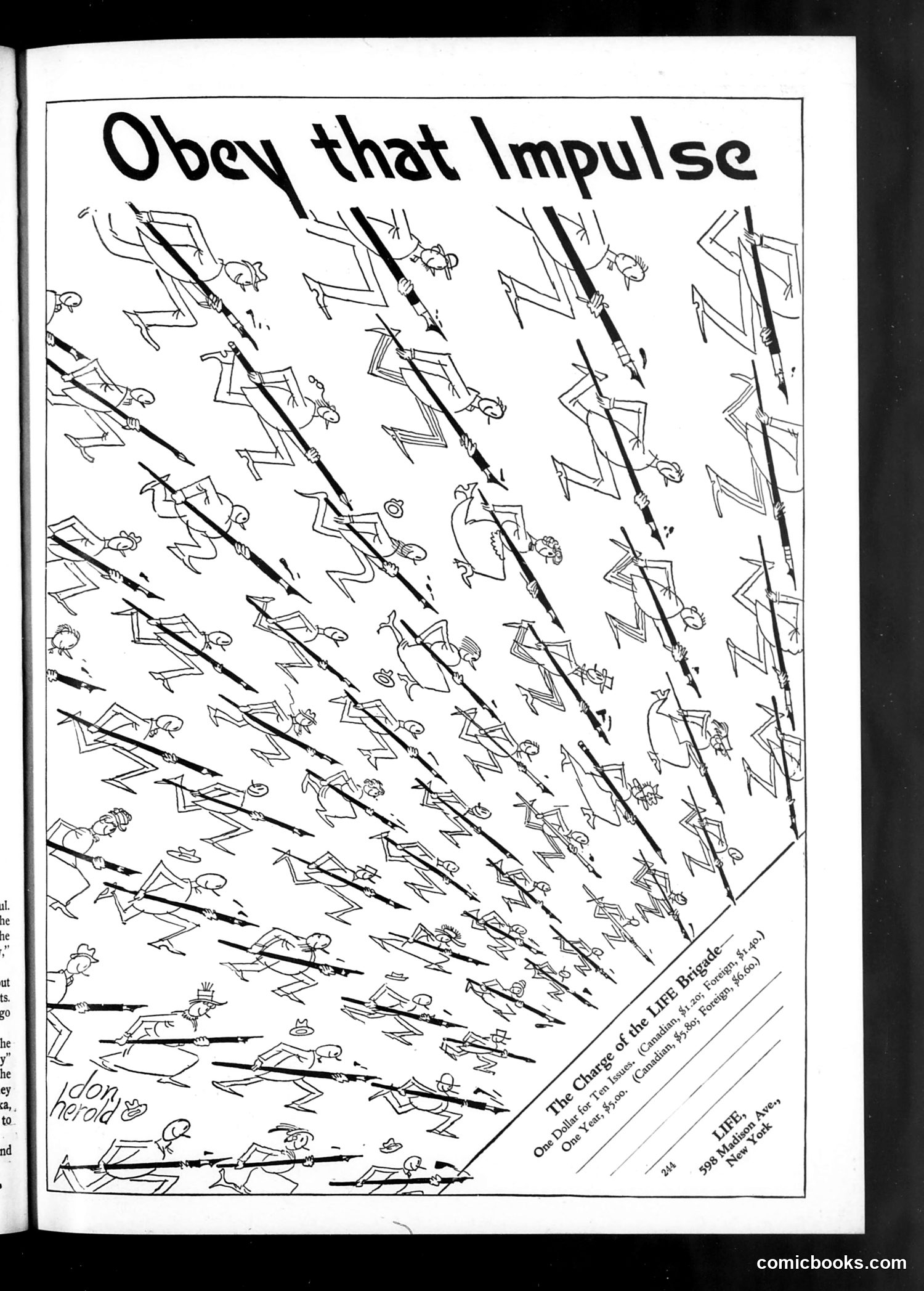
This satirical cartoon depicts a massive crowd of simplified figures all moving in the same diagonal direction, following bold black arrows. The title commands readers to "obey that impulse," suggesting mindless conformity and herd behavior. The work appears to critique collective obedience or mass movements—likely referencing either wartime mobilization, propaganda compliance, or social pressure to conform during a specific historical period. The repeated, identical figures emphasize deindividuation and loss of personal agency. The credit line references "Life" magazine and appears to include "The Charge of the LIFE Brigade," suggesting this is satirizing some form of organized mass action or public pressure that Life's editors viewed critically. The cartoon warns against unthinking compliance with prevailing impulses or directives.
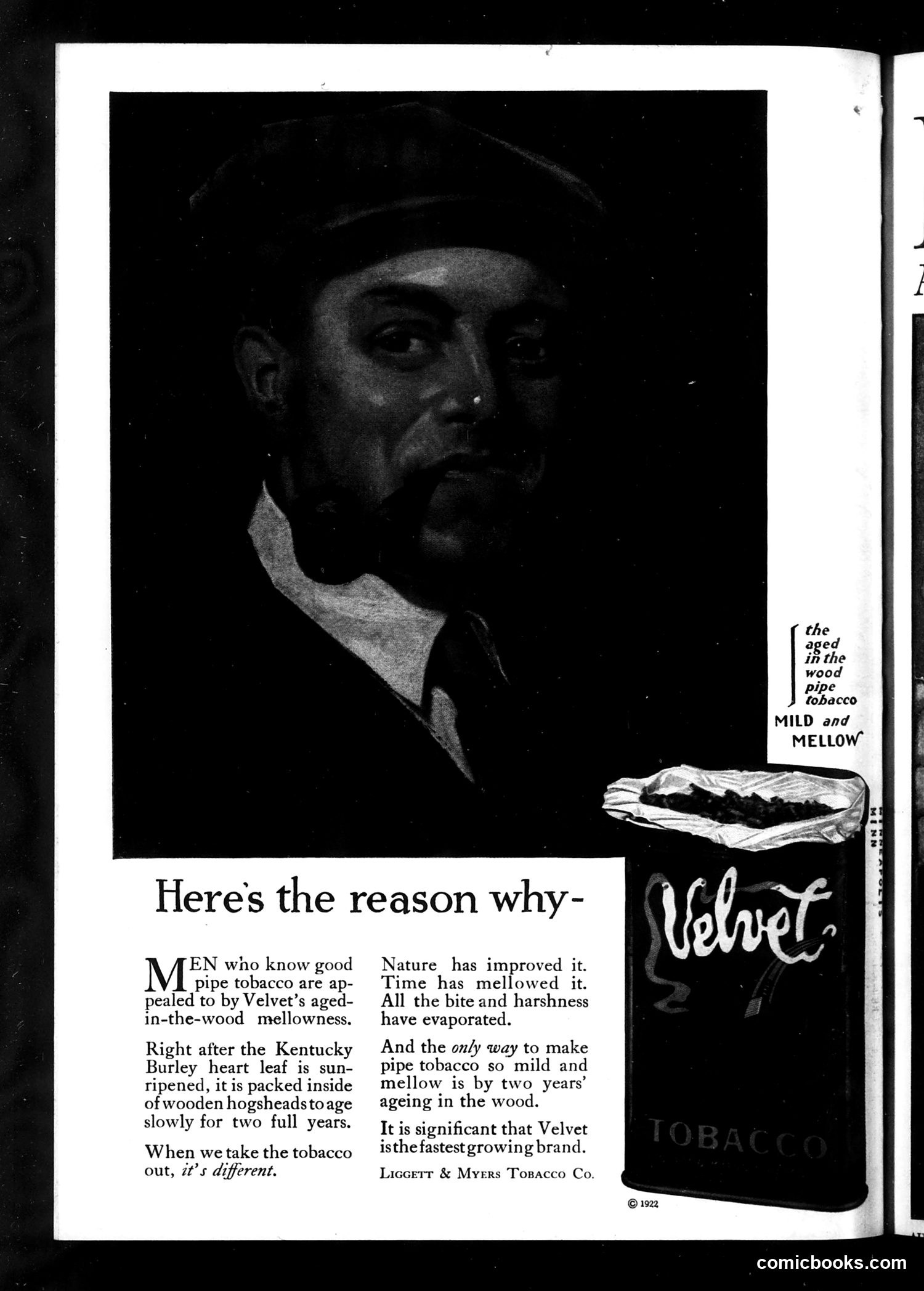
This is **not a cartoon or satire** — it's a straightforward **tobacco advertisement** from 1922 by Liggett & Myers Tobacco Co. for Velvet pipe tobacco. The page features a portrait photograph of a man (identity unclear from the image alone) positioned to suggest authority or expertise. The ad's argument centers on Velvet's competitive advantage: two-year aging in wooden hogsheads, which allegedly mellows the tobacco by removing "bite and harshness." The advertising claim that Velvet is "the fastest growing brand" suggests competitive positioning in the pipe tobacco market. The emphasis on aging and natural improvement reflects early 20th-century marketing appeals to quality and tradition. This represents pre-regulation tobacco advertising, when health claims and product benefits could be stated without modern restrictions.