
Life, 1922-08-24 · page 7 of 36
Life — August 24, 1922 — page 7: what you’re looking at
What you’re looking at
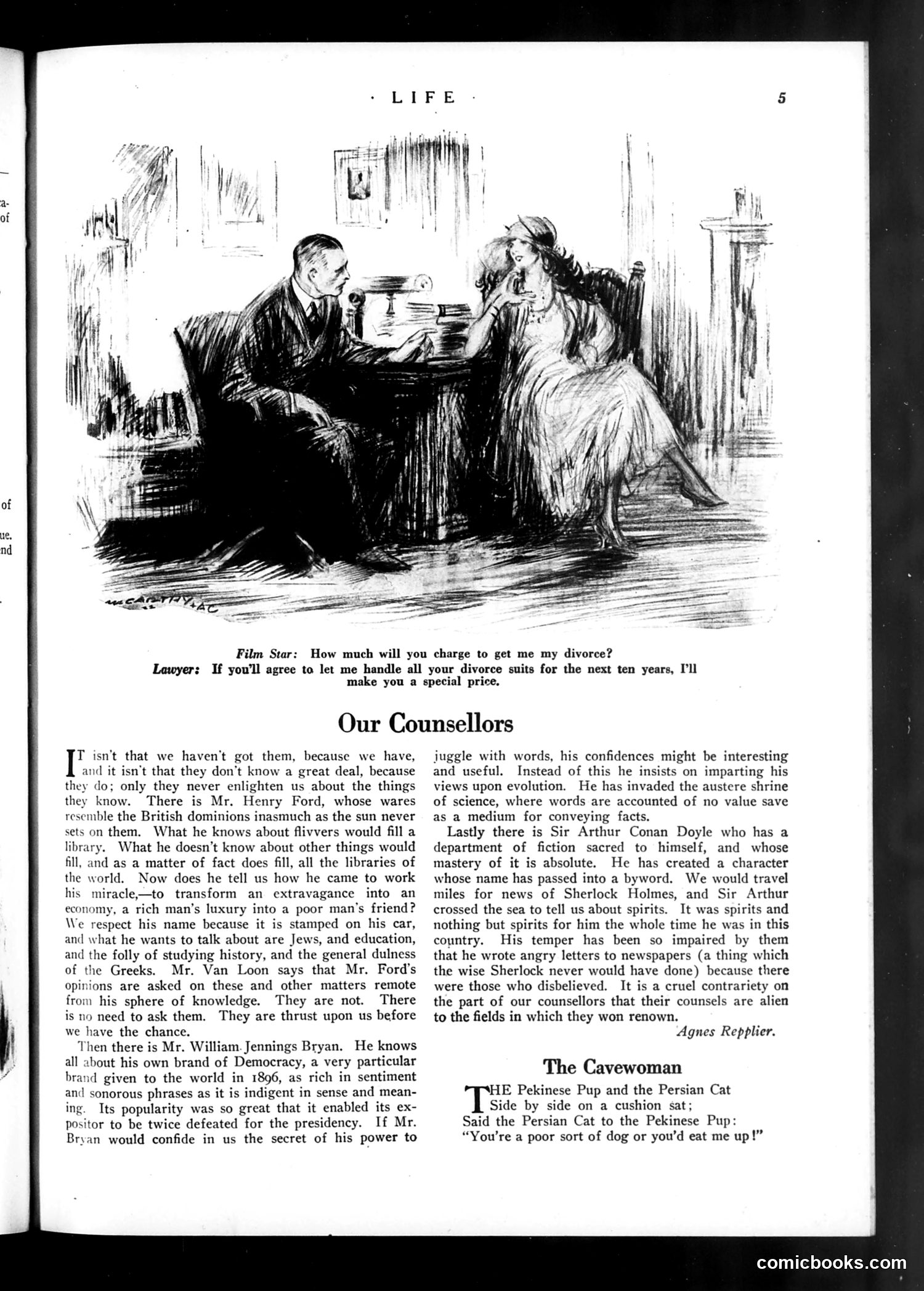
The top cartoon depicts a film star consulting a lawyer about divorce costs. The lawyer offers a cynical deal: handle her divorce cases for ten years in exchange for a "special price." This satirizes how divorce—then scandalous and legally complex—was becoming common enough among Hollywood celebrities that lawyers could profit from it as a specialty practice. The accompanying article mocks various public figures who serve as cultural "counsellors": Henry Ford (business), William Jennings Bryan (politics), and Sir Arthur Conan Doyle (fiction). The satire criticizes how these men, despite expertise in narrow fields, presume to advise the public on matters far beyond their knowledge. The page ridicules both celebrity culture's influence and experts overstepping their authority.
📄 Transcribed text from this page (OCR, searchable)
Machine-transcribed from the original scan — historical spelling and the odd misread are preserved.
Film Star: How much will you charge to get me my divorce? Lawyer: If you'll agree to let me handle all your divorce suits for the next ten years, I’ll make you a special price. Our Counsellors T isn’t that we haven't got them, because we have, and it isn’t that they don’t know a great deal, because they do; only they never enlighten us about the things they know. There is Mr. Henry Ford, whose wares resemble the British dominions inasmuch as the sun never sets on them. What he knows about flivvers would fill a library. What he doesn’t know about other things would fill, and as a matter of fact does fill, all the libraries of the world. Now does he tell us how he came to work his miracle—to transform an extravagance into an economy, a rich man’s luxury into a poor man’s friend? We respect his name because it is stamped on his car, and what he wants to talk about are Jews, and education, and the folly of studying history, and the general dulness of the Greeks. Mr. Van Loon says that Mr. Ford's opinions are asked on these and other matters remote from his sphere of knowledge. They are not. There is no need to ask them. They are thrust upon us before we have the chance. Then there is Mr. William. Jennings Bryan. He knows all about his own brand of Democracy, a very particular brand given to the world in 1896, as rich in sentiment and sonorous phrases as it is indigent in sense and mean- ing. Its popularity was so great that it enabled its ex- positor to be twice defeated for the presidency. If Mr. Bryan would confide in us the secret of his power to juggle with words, his confidences might be interesting and useful. Instead of this he insists on imparting his views upon evolution. He has invaded the austere shrine of science, where words are accounted of no value save as a medium for conveying facts. Lastly there is Sir Arthur Conan Doyle who has a department of fiction sacred to himself, and whose mastery of it is absolute. He has created a character whose name has passed into a byword. We would travel miles for news of Sherlock Holmes, and Sir Arthur crossed the sea to tell us about spirits. It was spi and nothing but spirits for him the whole time he was in this country. His temper has been so impaired by them that he wrote angry letters to newspapers (a thing which the wise Sherlock never would have done) because there were those who disbelieved. It is a cruel contrariety on the part of our counsellors that their counsels are alien to the fields in which they won renown. Agnes Repplier. The Cavewoman HE Pekinese Pup and the Persian Cat Side by side on a cushion sat; Said the Persian Cat to the Pekinese Pup: “You're a poor sort of dog or you’d eat me up!” comicbooks.com