
Life, 1922-08-24 · page 26 of 36
Life — August 24, 1922 — page 26: what you’re looking at
What you’re looking at
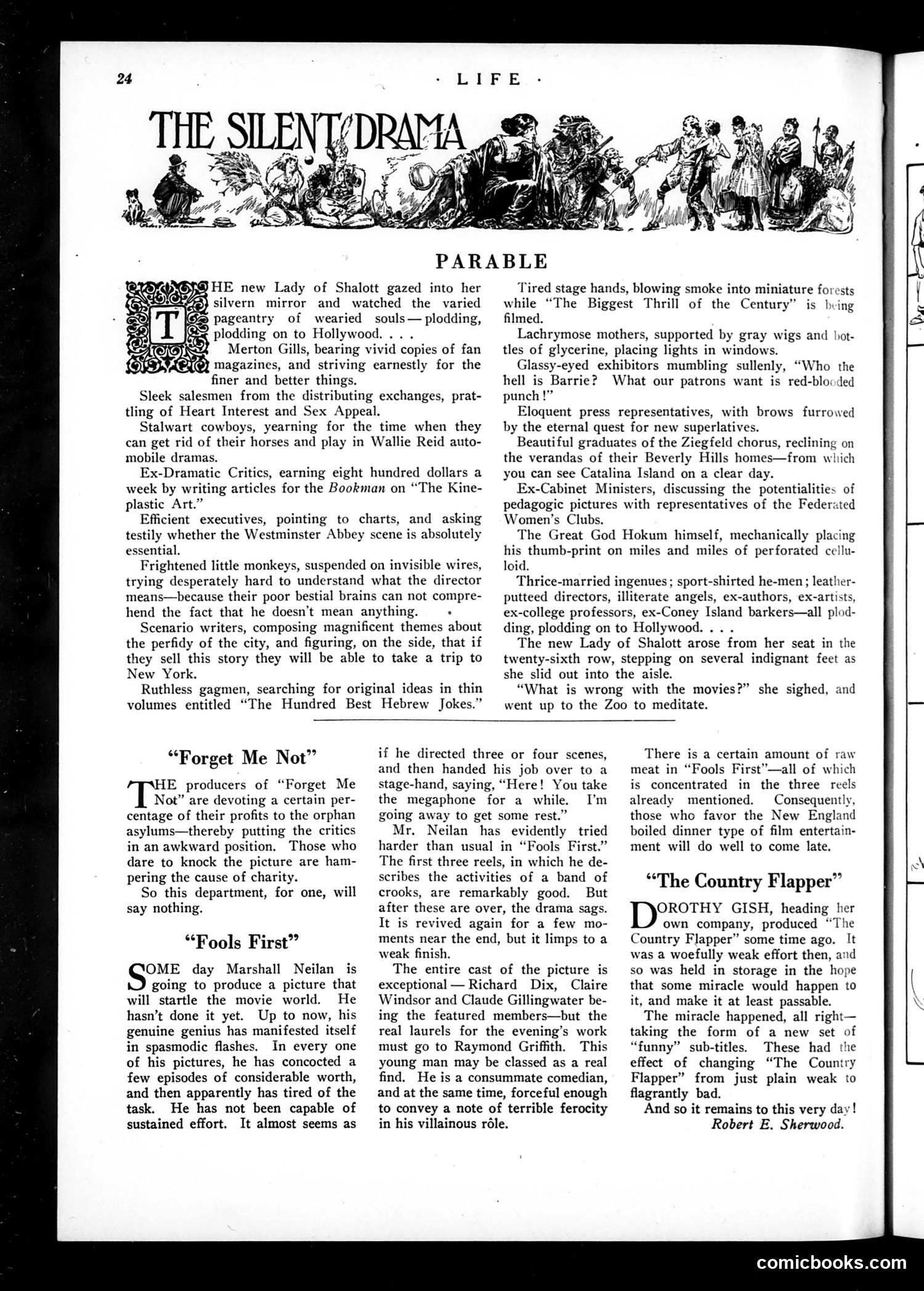
This page satirizes the 1920s Hollywood film industry through two forms: a scathing poetic "Parable" listing the absurd characters and types populating movie-making—from desperate actors yearning for stardom to incompetent directors who don't understand their own work—and three brief film reviews. The "Parable" mocks the desperation, pretension, and incompetence endemic to Hollywood: scenario writers copying ideas from joke books, executives obsessed with irrelevant details, and the mechanical pursuit of profit ("The Great God Hokum"). The framing device—a woman in a cinema asking "What is wrong with the movies?"—underscores the satire's central message: the entire enterprise is fundamentally broken. The reviews critiquing specific films (particularly Marshall Neilan's inconsistent direction in "Fools First") reinforce the theme that Hollywood produces sporadic quality amid general mediocrity. The tone throughout is one of intellectual disdain for both the industry and its products.
📄 Transcribed text from this page (OCR, searchable)
Machine-transcribed from the original scan — historical spelling and the odd misread are preserved.
LIFE oT pag ? “DRAMA, mirror and watched the varied > pageantry of wearied souls— plodding, plodding on to Hollywood. .. . Merton Gills, bearing vivid copies of fan g} magazines, and striving earnestly for the finer and better things. Sleek salesmen from the distributing exchanges, prat- tling of Heart Interest and Sex Appeal. Stalwart cowboys, yearning for the time when they can get rid of their horses and play in Wallie Reid auto- mobile dramas. Ex-Dramatic Critics, earning eight hundred dollars a week by writing articles for the Bookman on “The Kine- plastic Art.” Efficient executives, pointing to charts, and asking testily whether the Westminster Abbey scene is absolutely essential. Frightened little monkeys, suspended on invisible wires, trying desperately hard to understand what the director means—because their poor bestial brains can not compre- hend the fact that he doesn’t mean anything. . Scenario writers, composing magnificent themes about the perfidy of the city, and figuring, on the side, that if they sell this story they will be able to take a trip to New York. Ruthless gagmen, searching for original ideas in thin volumes entitled “The Hundred Best Hebrew Jokes.” Tired stage hands, blowing smoke into miniature forests while “The Biggest Thrill of the Century” is being filmed. Lachrymose mothers, supported by gray wigs and hot- tles of glycerine, placing lights in windows. Glassy-eyed exhibitors mumbling sullenly, “Who the hell is Barrie? What our patrons want is red-blooded punch !” Eloquent press representatives, with brows furrowed by the eternal quest for new superlatives. Beautiful graduates of the Ziegfeld chorus, reclining on the verandas of their Beverly Hills homes—from which you can see Catalina Island on a clear day. Ex-Cabinet Ministers, discussing the potentialities of pedagogic pictures with representatives of the Federated Women’s Clubs. The Great God Hokum himself, mechanically placing his thumb-print on miles and miles of perforated cellu- loid. Thrice-married ingenues ; sport-shirted he-men ; leather- putteed directors, illiterate angels, ex-authors, ex-artists, ex-college professors, ex-Coney Island barkers—all plod- ding, plodding on to Hollywood. . . . The new Lady of Shalott arose from her seat in the twenty-sixth row, stepping on several indignant feet as she slid out into the aisle. “What is wrong with the movies?” she sighed, and went up to the Zoo to meditate. “Forget Me Not” HE producers of “Forget Me Not” are devoting a certain per- centage of their profits to the orphan asylums—thereby putting the critics in an awkward position. Those who dare to knock the picture are ham- pering the cause of charity. So this department, for one, will say nothing. “Fools First” OME day Marshall Neilan is going to produce a picture that will startle the movie world. He hasn’t done it yet. Up to now, his genuine genius has manifested itself in spasmodic flashes. In every one of his pictures, he has concocted a few episodes of considerable worth, and then apparently has tired of the task. He has not been capable of sustained effort. It almost seems as if he directed three or four scenes, and then handed his job over to a stage-hand, saying, “Here! You take the megaphone for a while. I’m going away to get some rest.” Mr. Neilan has evidently tried harder than usual in “Fools First.” The first three reels, in which he de- scribes the activities of a band of crooks, are remarkably good. But after these are over, the drama sags. It is revived again for a few mo- ments near the end, but it limps to a weak finish. The entire cast of the picture is exceptional — Richard Dix, Claire Windsor and Claude Gillingwater be- ing the featured members—but the real laurels for the evening’s work must go to Raymond Griffith. This young man may be classed as a real find. He is a consummate comedian, and at the same time, forceful enough to convey a note of terrible ferocity in his villainous réle. There is a certain amount of raw meat in “Fools First”—all of which is concentrated in the three reels already mentioned. Consequently, those who favor the New England boiled dinner type of film entertain- ment will do well to come late. “The Country Flapper” OROTHY GISH, heading her own company, produced “The Country Flapper” some time ago. It was a woefully weak effort then, and so was held in storage in the hope that some miracle would happen to it, and make it at least passable. The miracle happened, all right— taking the form of a new set of “funny” sub-titles. These had the effect of changing “The Country Flapper” from just plain weak to flagrantly bad. And so it remains to this very day! Robert E. Sherwood. ws comicbooks.com