
Life, 1922-08-24 · page 16 of 36
Life — August 24, 1922 — page 16: what you’re looking at
What you’re looking at
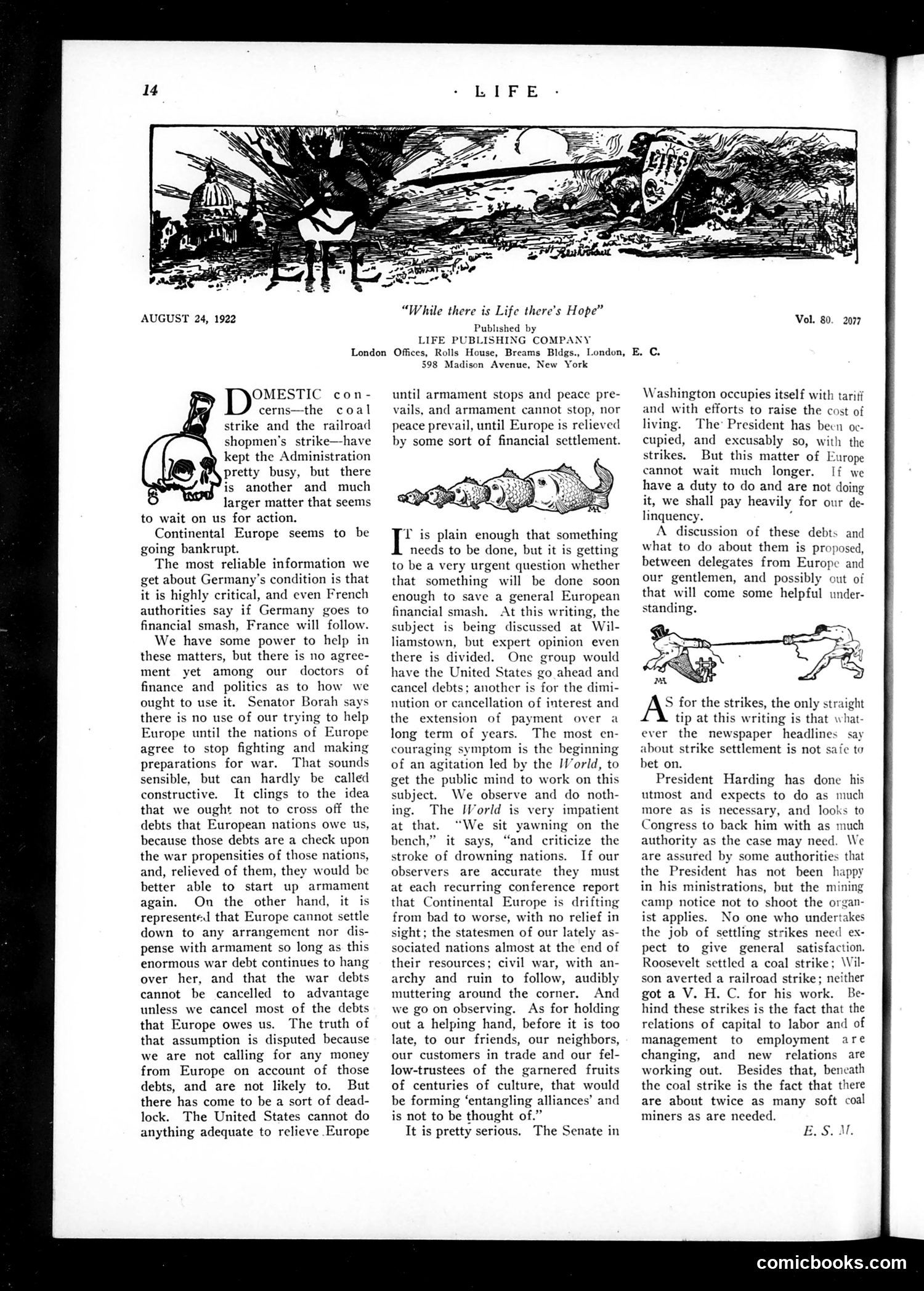
This Life magazine editorial addresses three major crises facing the U.S. and Europe: **The coal strike and railroad unrest** are domestic concerns, but the article emphasizes that **Continental Europe's financial collapse** is the urgent priority. The piece warns that Germany's financial devastation threatens all of Europe, and France will follow without intervention. **The cartoon illustrations** (appearing as decorative elements) likely satirize the economic chaos—the image of what appears to be a dead or dying figure suggests the severity of European economic collapse. **The main target**: The article criticizes the *World* newspaper for calling strikes "entangling alliances" and urges President Harding to act decisively on both domestic labor disputes and European debt relief before the situation becomes irreversible.
📄 Transcribed text from this page (OCR, searchable)
Machine-transcribed from the original scan — historical spelling and the odd misread are preserved.
AUGUST 24, 1922 7 eer, =f, See “While there is Life there’s Hope” Published by LIFE PUBLISHING COMPANY Vol. 80. 2077 London Offices, Rolls House, Breams Bldgs., London, E. C. OMESTIC con- cerns—the coal strike and the railroad shopmen’s strike—have kept the Administration pretty busy, but there is another and much larger matter that seems to wait on us for action. Continental Europe seems to be going bankrupt. The most reliable information we get about Germany's condition is that it is highly critical, and even French authorities say if Germany goes to financial smash, France will follow. We have some power to help in these matters, but there is no agree- ment yet among our doctors of finance and politics as to how we ought to use it. Senator Borah says there is no use of our trying to help Europe until the nations of Europe agree to stop fighting and making preparations for war. That sounds sensible, but can hardly be called constructive. It clings to the idea that we ought not to cross off the debts that European nations owe us, because those debts are a check upon the war propensities of those nations, and, relieved of them, they would be better able to start up armament again. On the other hand, it is represented that Europe cannot settle down to any arrangement nor dis- pense with armament so long as this enormous war debt continues to hang over her, and that the war debts cannot be cancelled to advantage unless we cancel most of the debts that Europe owes us. The truth of that assumption is disputed because we are not calling for any money from Europe on account of those debts, and are not likely to. But there has come to be a sort of dead- lock. The United States cannot do anything adequate to relieve Europe 598 Madison Avenue, New York until armament stops and peace pre- vails, and armament cannot stop, nor peace prevail, until Europe is relieved by some sort of financial settlement. ‘T is plain enough that something needs to be done, but it is getting to be a very urgent question whether that something will be done soon enough to save a general European financial smash. At this writing, the subject is being discussed at Wil- liamstown, but expert opinion even there is divided. One group would have the United States go ahead and cancel debts; another is for the dimi- nution or cancellation of interest and the extension of payment over a long term of years. The most en- couraging symptom is the beginning of an agitation led by the IVorld, to get the public mind to work on this subject. We observe and do noth- ing. The [World is very impatient at that. “We sit yawning on the bench,” it says, “and criticize the stroke of drowning nations. If our observers are accurate they must at each recurring conference report that Continental Europe is drifting from bad to worse, with no relief in sight; the statesmen of our lately as- sociated nations almost at the end of their resources; civil war, with an- archy and ruin to follow, audibly muttering around the corner. And we go on observing. As for holding out a helping hand, before it is too late, to our friends, our neighbors, our customers in trade and our fel- low-trustees of the garnered fruits of centuries of culture, that would be forming ‘entangling alliances’ and is not to be thought of.” It is pretty serious, The Senate in Washington occupies itself with tariff and with efforts to raise the cost of living. The’ President has been oc- cupied, and excusably so, with the strikes. But this matter of Europe cannot wait much longer. If we have a duty to do and are not doing it, we shall pay heavily for our de- linquency. . A discussion of these debts and what to do about them is proposed, between delegates from Europe and our gentlemen, and possibly out of that will come some helpful under- standing. AS for the strikes, the only straight tip at this writing is that what- ever the newspaper headlines say about strike settlement is not safe to bet on. President Harding has done his utmost and expects to do as much more is necessary, and looks to Congress to back him with as much authority as the case may need. We are assured by some authorities that the President has not been happy in his ministrations, but the mining camp notice not to shoot the organ- ist applies. No one who undertakes the job of settling strikes need ex- pect to give general satisfaction. Roosevelt settled a coal strike; \Vil- son averted a railroad strike; neither got a V. H.C. for his work. Be- hind these strikes is the fact that the relations of capital to labor and of management to employment are changing, and new relations are working out. Besides that, beneath the coal strike is the fact that there are about twice as many soft coal miners as are needed. E.S. M. comicbooks.com