
Life, 1922-08-24 · page 14 of 36
Life — August 24, 1922 — page 14: what you’re looking at
What you’re looking at
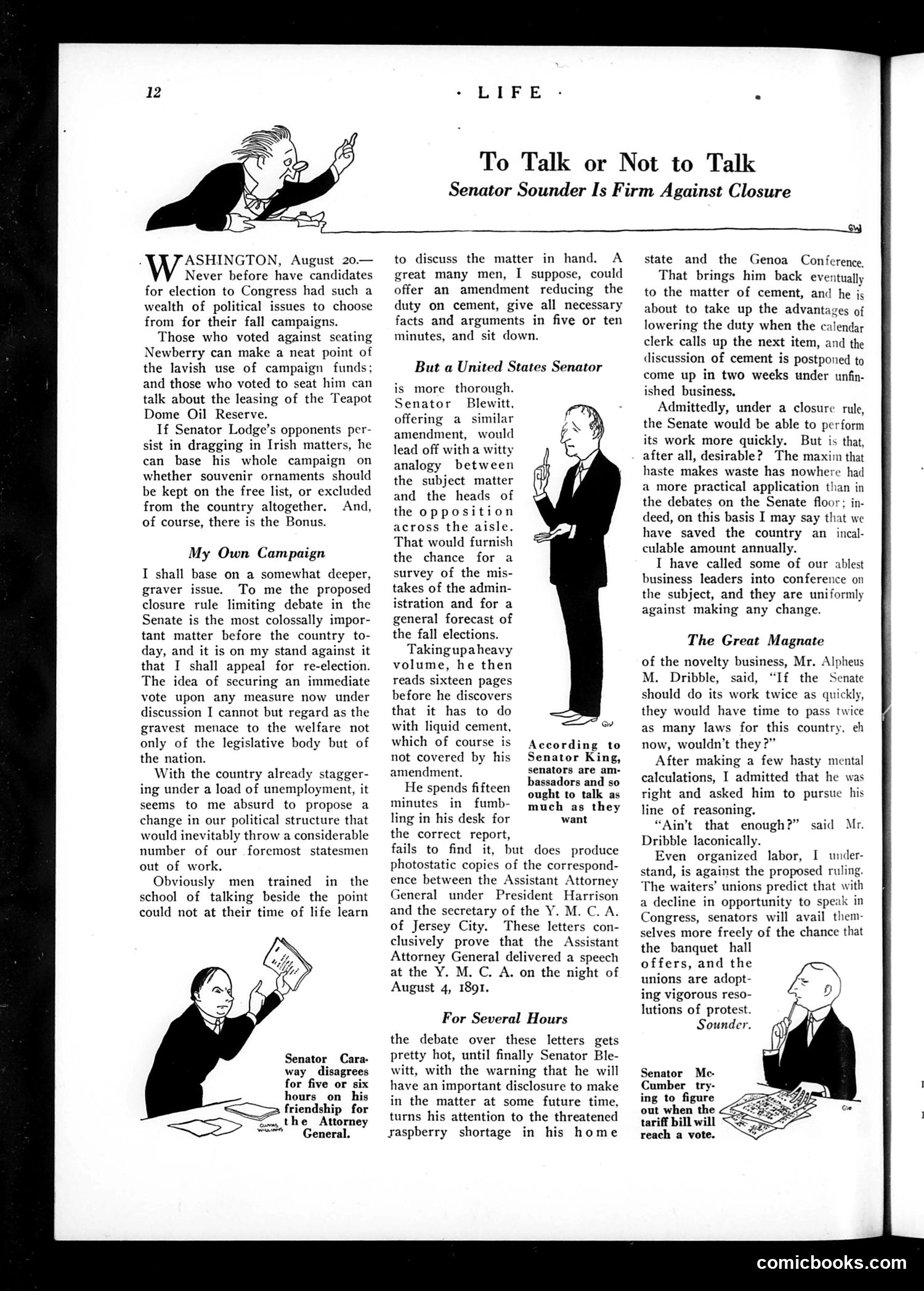
This article satirizes a Senate debate over implementing "closure"—a rule to limit endless debate and force votes on legislation. Senator Sounder opposes closure, fearing it would restrict senators' ability to discuss issues thoroughly. The cartoons mock senators who exploit unlimited debate time: one illustration shows a senator endlessly talking at his desk; another depicts Senator Caraway disagreeing with colleagues over debating the Attorney General's friendship. The satire's point: senators abuse unlimited debate privileges to delay votes on unpopular measures (the article mentions Irish matters, Teapot Dome leasing, and cement duties). The author argues closure would improve Senate efficiency and prevent obstruction, while critics claim it restricts necessary discussion. The cartoons ridicule senators' self-interested use of procedural delays.
📄 Transcribed text from this page (OCR, searchable)
Machine-transcribed from the original scan — historical spelling and the odd misread are preserved.
To Talk or Not to Talk Senator Sounder Is Firm Against Closure : ASHINGTON, August 20.— Never before have candidates for election to Congress had such a wealth of political issues to choose from for their fall campaigns. Those who voted against seating Newberry can make a neat point of the lavish use of campaign funds; and those who voted to seat him can talk about the leasing of the Teapot Dome Oil Reserve. If Senator Lodge’s opponents per- sist in dragging in Irish matters, he can base his whole campaign on whether souvenir ornaments should be kept on the free list, or excluded from the country altogether. And, of course, there is the Bonus. My Own Campaign I shall base on a somewhat deeper, graver issue. To me the proposed closure rule limiting debate in the Senate is the most colossally impor- tant matter before the country to- day, and it is on my stand against it that I shall appeal for re-election. The idea of securing an immediate vote upon any measure now under discussion I cannot but regard as the gravest menace to the welfare not only of the legislative body but of the nation. With the country already stagger- ing under a load of unemployment, it seems to me absurd to propose a change in our political structure that would inevitably throw a considerable number of our foremost statesmen out of work. Obviously men trained in the school of talking beside the point could not at their time of life learn Senator Cara. way disagrees for five or six hours on his SS friendship for = om, the Attorney were General. to discuss the matter in hand. A great many men, I suppose, could offer an amendment reducing the duty on cement, give all necessary facts and arguments in five or ten minutes, and sit down. But a United States Senator is more thorough. Senator Blewitt. offering a similar amendment, would lead off with a witty analogy between the subject matter and the heads of the opposition across the aisle. That would furnish the chance for a survey of the mis- takes of the admin- istration and for a general forecast of the fall elections. Taking upaheavy volume, he then reads sixteen pages before he discovers that it has to do with liquid cement, se which of course is not covered by his amendment. He spends fifteen minutes in fumb- ling in his desk for the correct report, fails to find it, but does produce photostatic copies of the correspond- ence between the Assistant Attorney General under President Harrison and the secretary of the Y. M. C. A. of Jersey City. These letters con- clusively prove that the Assistant Attorney General delivered a speech at the Y. M. C. A. on the night of August 4, 1891. According to Senator King, senators are am- bassadors and so ought to talk as much as they want For Several Hours the debate over these letters gets pretty hot, until finally Senator Ble- witt, with the warning that he will have an important disclosure to make in the matter at some future time, turns his attention to the threatened raspberry shortage in his home oy state and the Genoa Conference, That brings him back eventually to the matter of cement, and he is about to take up the advantages of lowering the duty when the calendar clerk calls up the next item, and the discussion of cement is postponed to come up in two weeks under unfin- ished business, Admittedly, under a closure rule, the Senate would be able to perform its work more quickly. But is that, after all, desirable? The maxim that haste makes waste has nowhere had a more practical application than in the debates on the Senate floor; in- deed, on this basis I may say that we have saved the country an_ incal- culable amount annually. I have called some of our ablest business leaders into conference on the subject, and they are uniformly against making any change. The Great Magnate of the novelty business, Mr. Alpheus M. Dribble, said, “If the Senate should do its work twice as quickly, they would have time to pass twice as many laws for this country, eh now, wouldn't they?” After making a few hasty mental calculations, I admitted that he was right and asked him to pursue his line of reasoning. “Ain't that enough?” said Mr. Dribble laconically. Even organized labor, I under- stand, is against the proposed ruling. The waiters’ unions predict that with a decline in opportunity to speak in Congress, senators will avail them- selves more freely of the chance that the banquet hall offers, and the unions are adopt- ing vigorous reso- lutions of protest. Sounder. Senator Me- Cumber try- ing to figure out when the tariff bill will reach a vote. comicbooks.com