
Life, 1922-08-24 · page 24 of 36
Life — August 24, 1922 — page 24: what you’re looking at
What you’re looking at
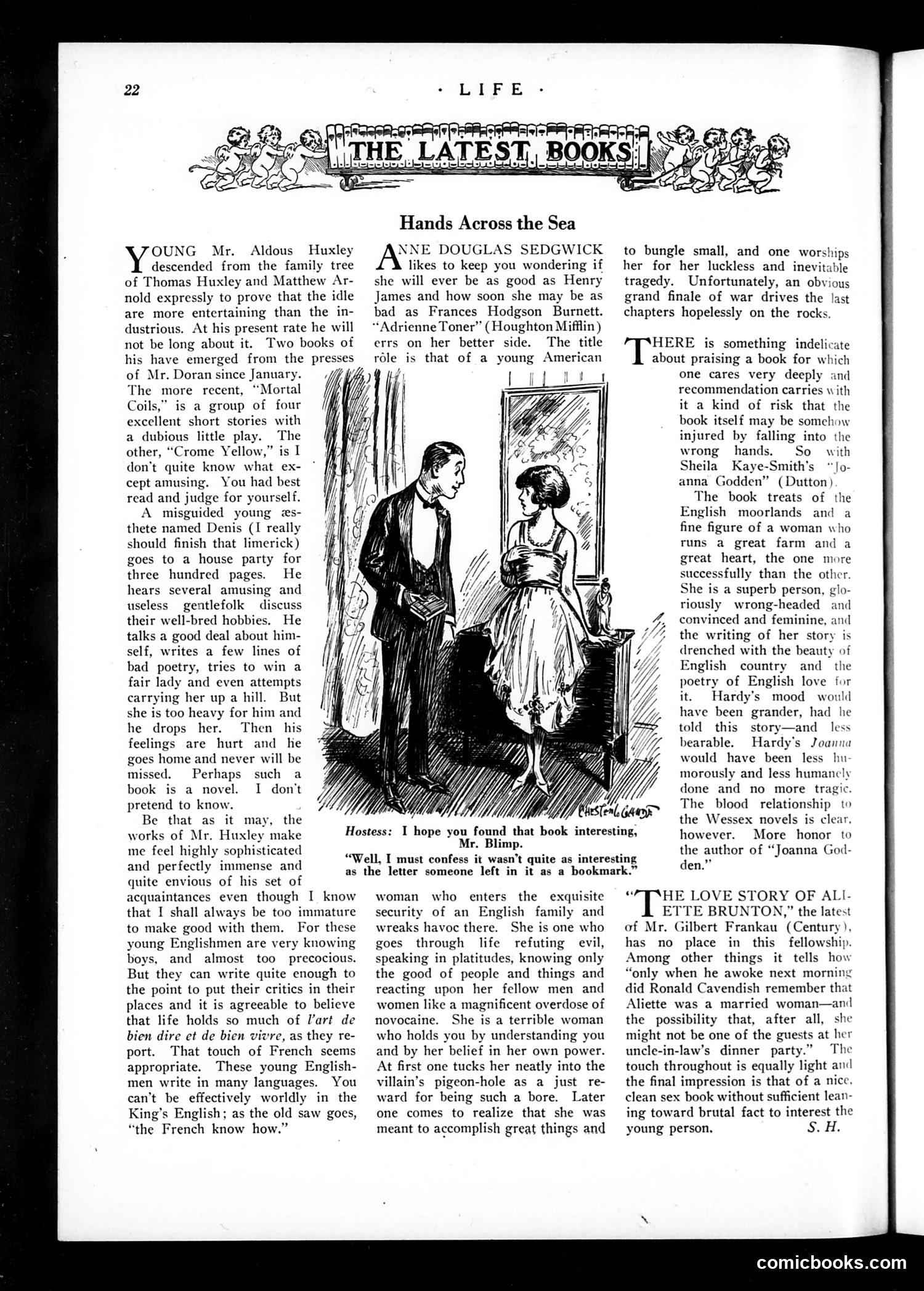
This is a book review section from *Life* magazine featuring three literary critiques. The main cartoon shows a couple at what appears to be a social gathering, with the caption about someone using a letter as a bookmark—a mild joke about the book being unremarkable enough for casual use. The reviews discuss: 1. **Aldous Huxley's works**, praised as witty and sophisticated, appealing to intellectually ambitious readers wanting to seem worldly 2. **Anne Douglas Sedgwick's "Adrienne Toner,"** comparing her favorably to Henry James but unfavorably to Frances Hodgson Burnett 3. **Sheila Kaye-Smith's "Joanna Godden,"** praised as beautifully written about English rural life The tone is typical of early 1920s literary criticism—somewhat precious, preoccupied with whether authors measure up to established greats, and focused on whether readers will appear sufficiently cultured by engaging with these works. The writing itself demonstrates the "sophisticated" English style the reviewer attributes to Huxley.
📄 Transcribed text from this page (OCR, searchable)
Machine-transcribed from the original scan — historical spelling and the odd misread are preserved.
OUNG Mr. Aldous Huxley descended from the family tree of Thomas Huxley and Matthew Ar- nold expressly to prove that the idle are more entertaining than the in- dustrious. At his present rate he will not be long about it. Two books of his have emerged from the presses of Mr. Doran since January. The more recent, “Mortal Coils,” is a group of four excellent short stories with a dubious little play. The other, “Crome Yellow,” is I don’t quite know what ex- cept amusing. You had best read and judge for yourself. A misguided young es- thete named Denis (I really should finish that limerick) goes to a house party for three hundred pages. He hears several amusing and useless gentlefolk discuss their well-bred hobbies. He talks a good deal about him- self, writes a few lines of bad poetry, tries to win a fair lady and even attempts carrying her up a hill. But she is too heavy for him and he drops her. Then his feelings are hurt and lie goes home and never will be missed. Perhaps such a book is a novel. I don't pretend to know. Be that as it may, the works of Mr. Huxley make me feel highly sophisticated and perfectly immense and quite envious of his set of acquaintances even though I know that I shall always be too immature to make good with them. For these young Englishmen are very knowing boys, and almost too precocious. But they can write quite enough to the point to put their critics in their places and it is agreeable to believe that life holds so much of V’art de bien dire et de bien vivre, as they re- port. That touch of French seems appropriate. These young English- men write in many languages. You can't be effectively worldly in the King’s English; as the old saw goes, “the French know how.” Hands Across the Sea NNE DOUGLAS SEDGWICK likes to keep you wondering if she will ever be as good as Henry James and how soon she may be as bad as Frances Hodgson Burnett. ‘Adrienne Toner” (Houghton Mifflin) errs on her better side. The title role is that of a young American Mr. Blimp. “Well, I must confess it wasn’t quite as interesting as the letter someone left in it as a bookmark.” woman who enters the exquisite security of an English family and wreaks havoc there. She is one who goes through life refuting evil, speaking in platitudes, knowing only the good of people and things and reacting upon her fellow men and women like a magnificent overdose of novocaine. She is a terrible woman who holds you by understanding you and by her belief in her own power. At first one tucks her neatly into the villain’s pigeon-hole as a just re- ward for being such a bore. Later one comes to realize that she was meant to accomplish great things and to bungle small, and one worships her for her luckless and inevitable tragedy. Unfortunately, an obvious grand finale of war drives the last chapters hopelessly on the rocks. HERE is something indelicate about praising a book for which one cares very deeply and recommendation carries with it a kind of risk that the book itself may be somehow injured by falling into the wrong hands. So with Sheila Kaye-Smith’s “Jo- anna Godden” (Dutton) The book treats of the English moorlands and a fine figure of a woman who runs a great farm and a great heart, the one more successfully than the other. 5 a superb person, glo- wrong-headed and convinced and feminine, and the writing of her story is drenched with the beauty of English country and the poetry of English love for it. Hardy's mood would have been grander, had he told this story—and_ less bearable. Hardy's Joanna would have been less hu morously and less humancly done and no more tragic. The blood relationship to the Wessex novels is clear, however. More honor to the author of “Joanna God- den.” “ HE LOVE STORY OF ALI- ETTE BRUNTON,” the latest of Mr. Gilbert Frankau (Century), has no place in this fellowship. Among other things it tells how “only when he awoke next morning did Ronald Cavendish remember that Aliette was a married woman—ani the possibility that, after all, she might not be one of the guests at her uncle-in-law’s dinner party.” The touch throughout is equally light and the final impression is that of a nice, clean sex book without sufficient lean- ing toward brutal fact to interest the young person, S.H. comicbooks.com