
Life, 1922-08-24 · page 20 of 36
Life — August 24, 1922 — page 20: what you’re looking at
What you’re looking at
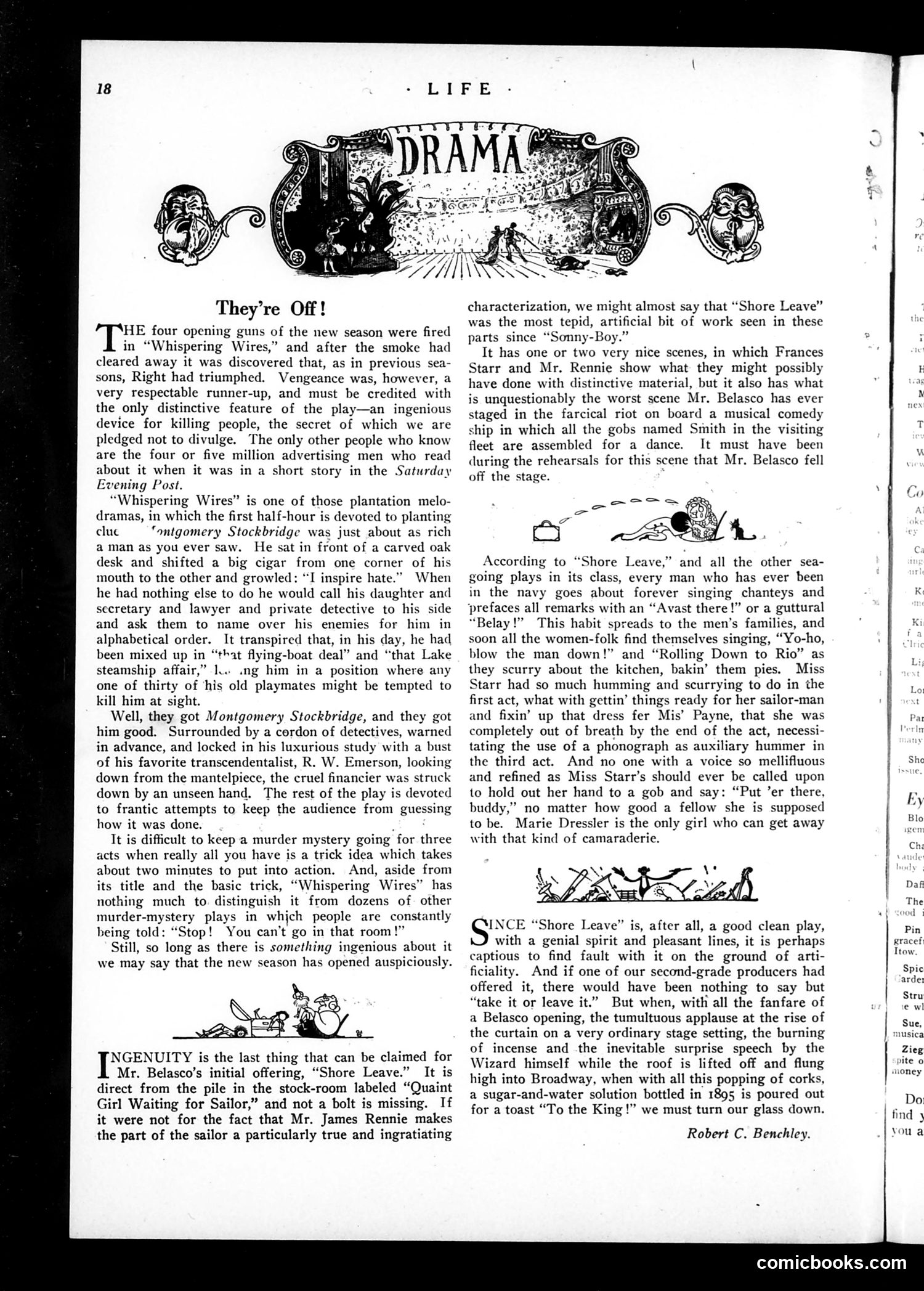
This page reviews two Broadway plays: "Whispering Wires" and "Shore Leave." The critic uses satirical commentary to mock tired theatrical conventions. "Whispering Wires" is a melodrama about a wealthy man (Montgomery Stockbridge) murdered despite elaborate precautions. The reviewer mocks the plot's predictability—good triumphs, vengeance follows—and notes the play's only merit is a gimmicky murder method. He sarcastically observes millions read about it first in the *Saturday Evening Post*, suggesting theater recycles existing material. "Shore Leave," produced by impresario David Belasco, is criticized as formulaic—merely labeled "Quaint Girl Waiting for Sailor" from stock material. While actor James Rennie and actress Frances Starr show promise, the play relies on stereotype: all sailors perpetually sing sea shanties using nautical slang ("Belay!"). The reviewer particularly ridicules a farcical shipboard dance scene where "all the gobs named Smith" assemble, suggesting absurd contrivance. The satire targets Broadway's reliance on predictable plots, recycled premises, and exaggerated character types.
📄 Transcribed text from this page (OCR, searchable)
Machine-transcribed from the original scan — historical spelling and the odd misread are preserved.
They’re Off! ‘HE four opening guns of the new season were fired in “Whispering Wires,” and after the smoke had cleared away it was discovered that, as in previous sea- sons, Right had triumphed. Vengeance was, however, a very respectable runner-up, and must be credited with the only distinctive feature of the play—an ingenious device for killing people, the secret of which we are pledged not to divulge. The only other people who know are the four or five million advertising men who read about it when it was in a short story in the Saturday Evening Post. “Whispering Wires” is one of those plantation melo- dramas, in which the first half-hour is devoted to planting cluc ‘ontgomery Stockbridge was just about as rich aman as you ever saw. He sat in front of a carved oak desk and shifted a big cigar from one corner of his mouth to the other and growled: “I inspire hate.” When he had nothing else to do he would call his daughter and secretary and lawyer and private detective to his side and ask them to name over his enemies for him in alphabetical order. It transpired that, in his day, he had been mixed up in “that flying-boat deal” and “that Lake steamship affair,” 1... .ng him in a position where any one of thirty of his old playmates might be tempted to kill him at sight. Well, they got Montgomery Stockbridge, and they got him good. Surrounded by a cordon of detectives, warned in advance, and locked in his luxurious study with a bust of his favorite transcendentalist, R. W. Emerson, looking down from the mantelpiece, the cruel financier was struck down by an unseen hand. The rest of the play is devoted to frantic attempts to keep the audience from guessing how it was done. . It is difficult to keep a murder mystery going for three acts when really all you have is a trick idea which takes about two minutes to put into action. And, aside from its title and the basic trick, “Whispering Wires” has nothing much to. distinguish it from dozens of other murder-mystery plays in whjch people are constantly being told: “Stop! You can’t go in that room!” Still, so long as there is something ingenious about it we may say that the new season has opened auspiciously. NGENUITY is the last thing that can be claimed for Mr. Belasco’s initial offering, “Shore Leave.” It is direct from the pile in the stock-room labeled “Quaint Girl Waiting for Sailor,” and not a bolt is missing. If it were not for the fact that Mr. James Rennie makes the part of the sailor a particularly true and ingratiating characterization, we might almost say that “Shore Leave” was the most tepid, artificial bit of work seen in these parts since “Sonny-Boy.” It has one or two very nice scenes, in which Frances Starr and Mr. Rennie show what they might possibly have done with distinctive material, but it also has what is unquestionably the worst scene Mr. Belasco has ever staged in the farcical riot on board a musical comedy ship in which all the gobs named Smith in the visiting fleet are assembled for a dance. It must have been during the rehearsals for this scene that Mr. Belasco fell off the stage. According to “Shore Leave,” and all the other sea- going plays in its class, every man who has ever been in the navy goes about forever singing chanteys and prefaces all remarks with an “Avast there!” or a guttural “Belay!” This habit spreads to the men’s families, and soon all the women-folk find themselves singing, “Yo-ho, blow the man down!” and “Rolling Down to Rio” as they scurry about the kitchen, bakin’ them pies. Miss Starr had so much humming and scurrying to do in the first act, what with gettin’ things ready for her sailor-man and fixin’ up that dress fer Mis’ Payne, that she was completely out of breath by the end of the act, necessi- tating the use of a phonograph as auxiliary hummer in the third act. And no one with a voice so mellifluous and refined as Miss Starr’s should ever be called upon to hold out her hand to a gob and say: “Put ’er there, buddy,” no matter how good a fellow she is supposed to be. Marie Dressler is the only girl who can get away with that kind of camaraderie. INCE “Shore Leave” is, after all, a good clean play, with a genial spirit and pleasant lines, it is perhaps captious to find fault with it on the ground of arti- ficiality. And if one of our second-grade producers had offered it, there would have been nothing to say but “take it or leave it.” But when, with all the fanfare of a Belasco opening, the tumultuous applause at the rise of the curtain on a very ordinary stage setting, the burning of incense and the inevitable surprise speech by the Wizard himself while the roof is lifted off and flung high into Broadway, when with all this popping of corks, a sugar-and-water solution bottled in 1895 is poured out for a toast “To the King!” we must turn our glass down. Robert C. Benchley. The Pin gracefi Trow Spic arder Stru ¢ wi Sue, vusica Zieg vite 0 sioney Do | find you a comicbooks.com