
Life, 1922-08-24 · page 25 of 36
Life — August 24, 1922 — page 25: what you’re looking at
What you’re looking at
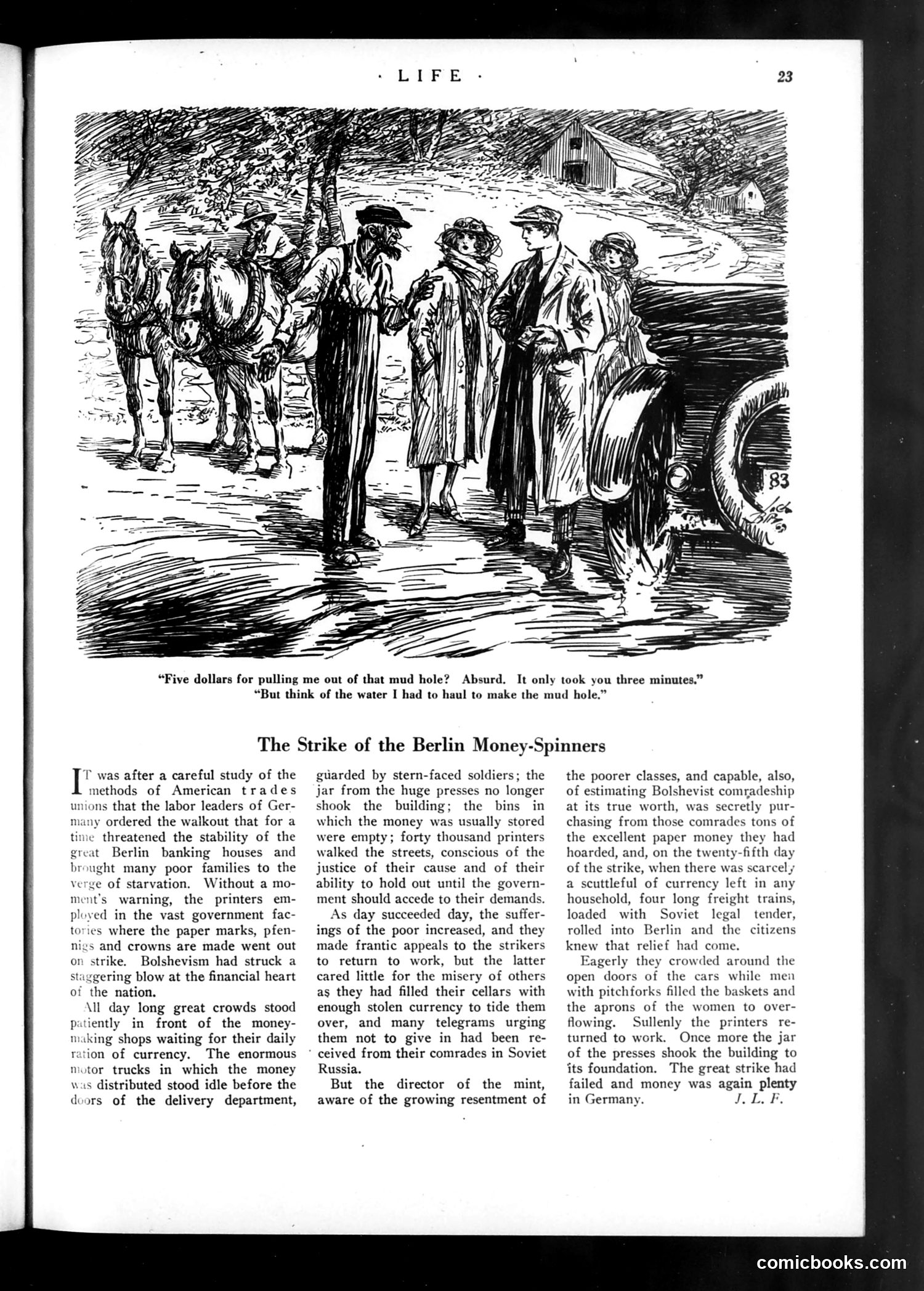
This satirical article attacks both labor strikers and Bolshevism through a fictional account of a Berlin printing workers' strike that cripples the nation's currency production. **The satire works on multiple levels:** The opening cartoon joke establishes the theme of workers extracting disproportionate payment for minimal effort—a dig at labor demands generally. The story then presents striking printers as hypocrites: they claim moral justice for their cause while secretly hoarding stolen currency and receiving support from Soviet Russia. The implied message is that labor movements are Bolshevik-corrupted and fundamentally selfish—willing to starve ordinary citizens to enrich themselves. The resolution mocks the strikers' powerlessness: when the mint director simply imports Soviet currency, the workers capitulate, suggesting their leverage was illusory and their communist allies unreliable. **Context:** This reflects 1920s American anti-labor, anti-communist sentiment during postwar economic anxiety and the Red Scare.
📄 Transcribed text from this page (OCR, searchable)
Machine-transcribed from the original scan — historical spelling and the odd misread are preserved.
“Five dollars for pulling me out of that mud hole? Absurd. It only took you three minutes.” “But think of the water I had to haul to make the mud hole.” The Strike of the Berlin Money-Spinners T was after a careful study of the nethods of American trades ms that the labor leaders of Ger- y ordered the walkout that for a threatened the stability of the at Berlin banking houses and vught many poor families to the of starvation. Without a mo- warning, the printers em- ed in the vast government fac- -s where the paper marks, pfen- igs and crowns are made went out 1 strike. Bolshevism had struck a aggering blow at the financial heart 1 the nation. \ll day long great crowds stood tly in front of the money- ing shops waiting for their daily ation of currency. The enormous vtor trucks in which the money sus distributed stood idle before the wors of the delivery department, gtiarded by stern-faced soldiers; the jar from the huge presses no longer shook the building; the bins in which the money was usually stored were empty; forty thousand printers walked the streets, conscious of the justice of their cause and of their ability to hold out until the govern- ment should accede to their demands. As day succeeded day, the suffer- ings of the poor increased, and they made frantic appeals to the strikers to return to work, but the latter cared little for the misery of others as they had filled their cellars with enough stolen currency to tide them over, and many telegrams urging them not to give in had been re- * ceived from their comrades in Soviet Russia. But the director of the mint, aware of the growing resentment of the poorer classes, and capable, also, of estimating Bolshevist comradeship at its true worth, was secretly pur- chasing from those comrades tons of the excellent paper money they had hoarded, and, on the twenty-fifth day of the strike, when there was scarcely a scuttleful of currency left in any household, four long freight trains, loaded with Soviet legal tender, rolled into Berlin and the citizens knew that relief had come. Eagerly they crowded around the open doors of the cars while men with pitchforks filled the baskets and the aprons of the women to over- flowing. Sullenly the printers re- turned to work. Once more the jar of the presses shook the building to its foundation. The great strike had failed and money was again plenty in Germany. oe i oF comicbooks.com