
A complete issue · 36 pages · 1922
Life — August 17, 1922
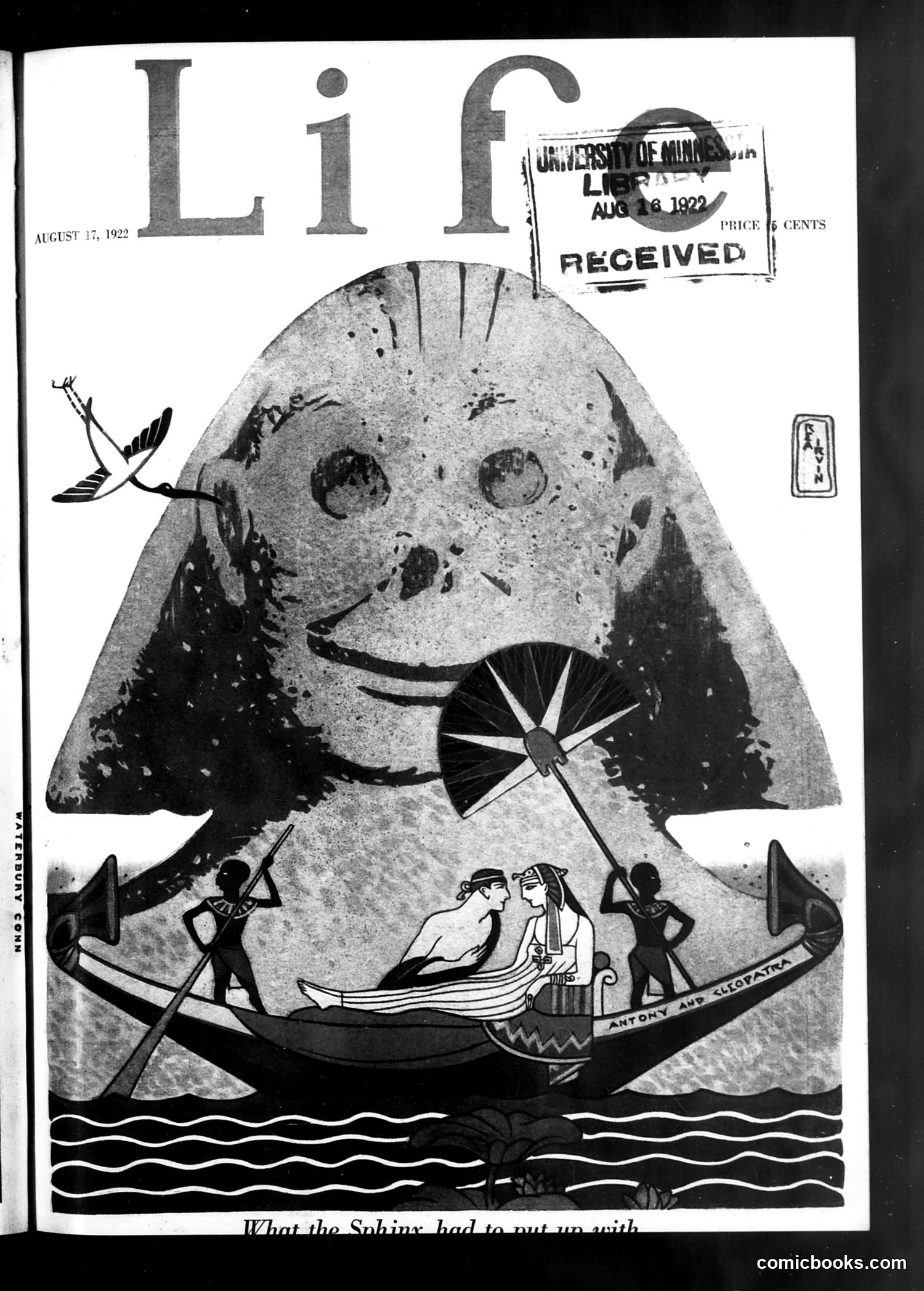
This cover depicts a giant moon-faced figure looming over a Venetian gondola. The moon's features are exaggerated and grotesque—spotted, with a broad grin and prominent eyes. Below, tiny gondoliers navigate their boat while two tourists appear to observe the spectacle. The partial caption reads: "What the Sphins had to put up with" (likely "Sphinxes"). This appears to be satirizing tourism and the romanticization of foreign landscapes. The oversized, almost monstrous moon suggests the absurdity of travelers' fantasies about exotic destinations like Venice. The juxtaposition of the mundane tourists against this fantastical backdrop mocks the gap between tourist expectations and reality—a common theme in 1920s satire about the growing tourist industry.
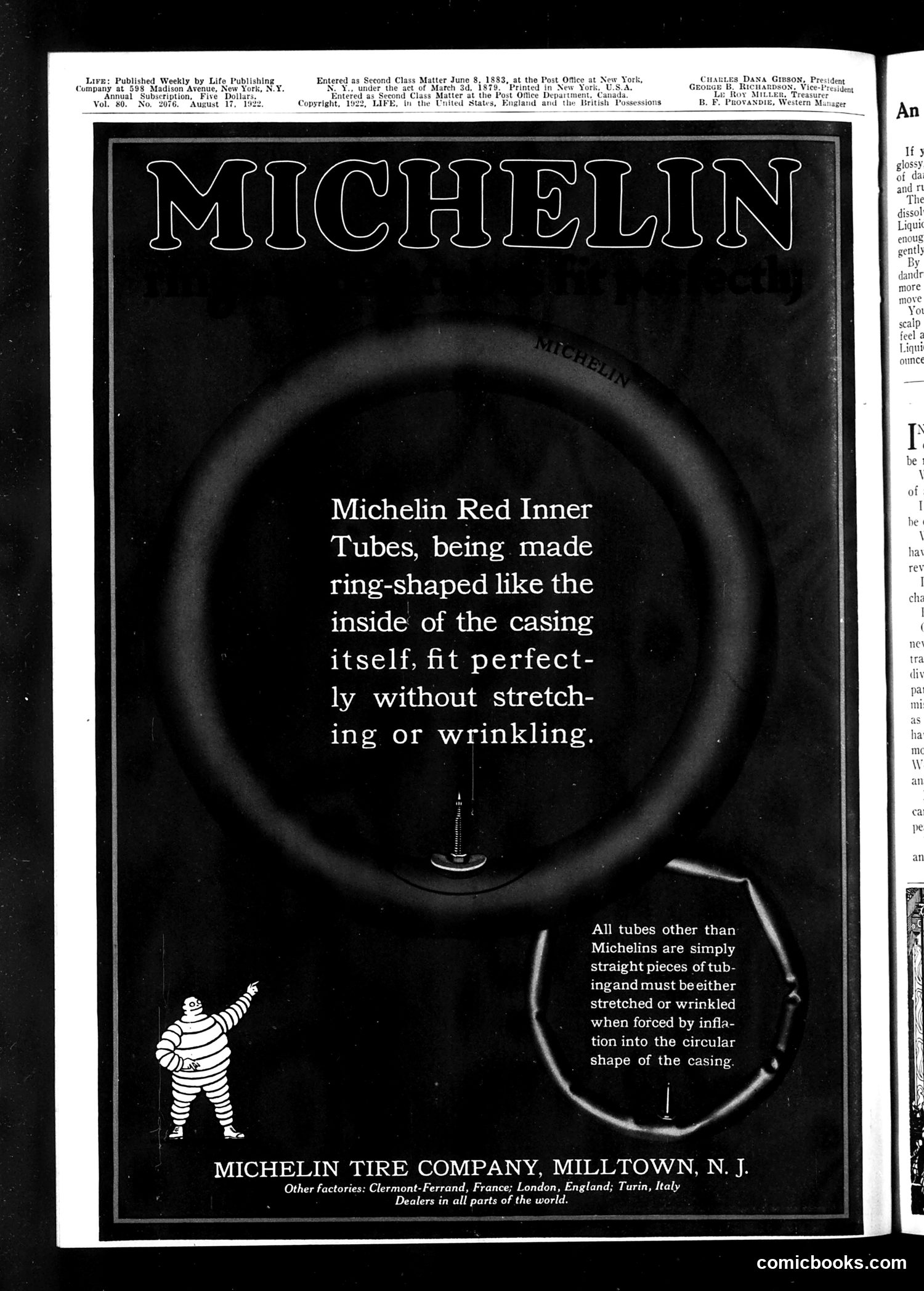
This page is **primarily a Michelin Tire advertisement**, not political satire or comics content. The ad showcases Michelin's innovative "Red Inner Tubes" — rubber tubes shaped like rings that fit inside tire casings without stretching or wrinkling, unlike competitors' straight-tube designs. The visual demonstration shows a circular tube fitting perfectly into the circular tire casing. The famous **Michelin Man** mascot (the rotund figure made of tire rings, left side) appears as the company's brand icon. The ad emphasizes Michelin's technical superiority and is directed at early automobile owners concerned with tire reliability. This represents early 20th-century industrial advertising in *Life* magazine, before it shifted toward satirical content. The "satire" here is purely commercial — promoting one brand's engineering advantage over others.
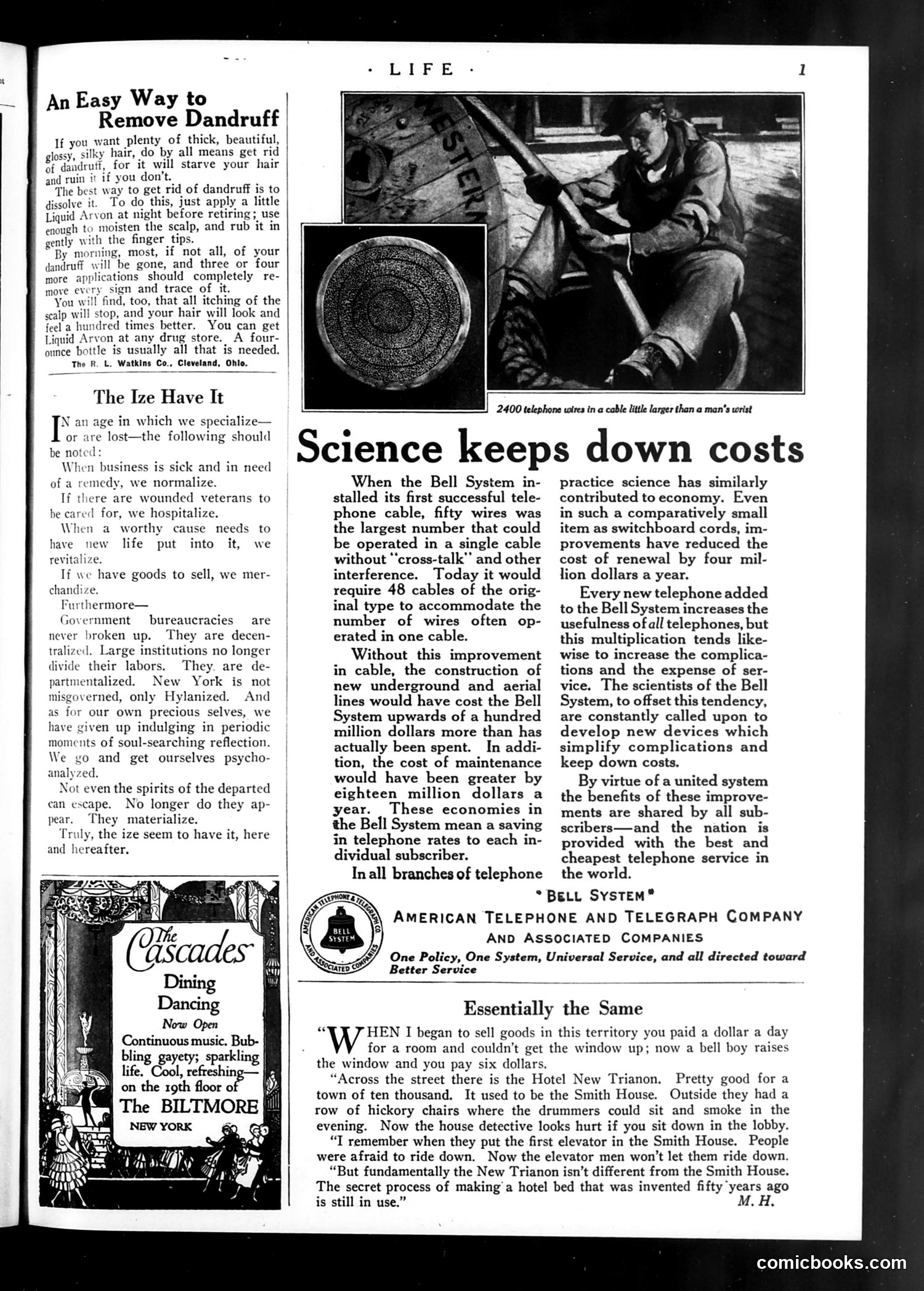
This page contains **primarily commercial content** rather than political satire. The main features are: 1. **"An Easy Way to Remove Dandruff"** — a product advertisement for Liquid Arvon, promoting hair care. 2. **"Science keeps down costs"** — a substantial Bell System advertisement explaining how telephone cable innovations reduced infrastructure expenses, ultimately lowering subscriber rates. This appears designed to justify Bell's business practices to consumers. 3. **"The Biltmore" advertisement** — promoting a New York dining and dancing venue. 4. **"Essentially the Same"** — an anecdotal piece about a bell boy and hotel modernization, likely humorous commentary on changing urban amenities. The page lacks traditional political cartoons or satirical commentary. It represents early 20th-century Life magazine's mixed model of editorial content and paid advertisements.
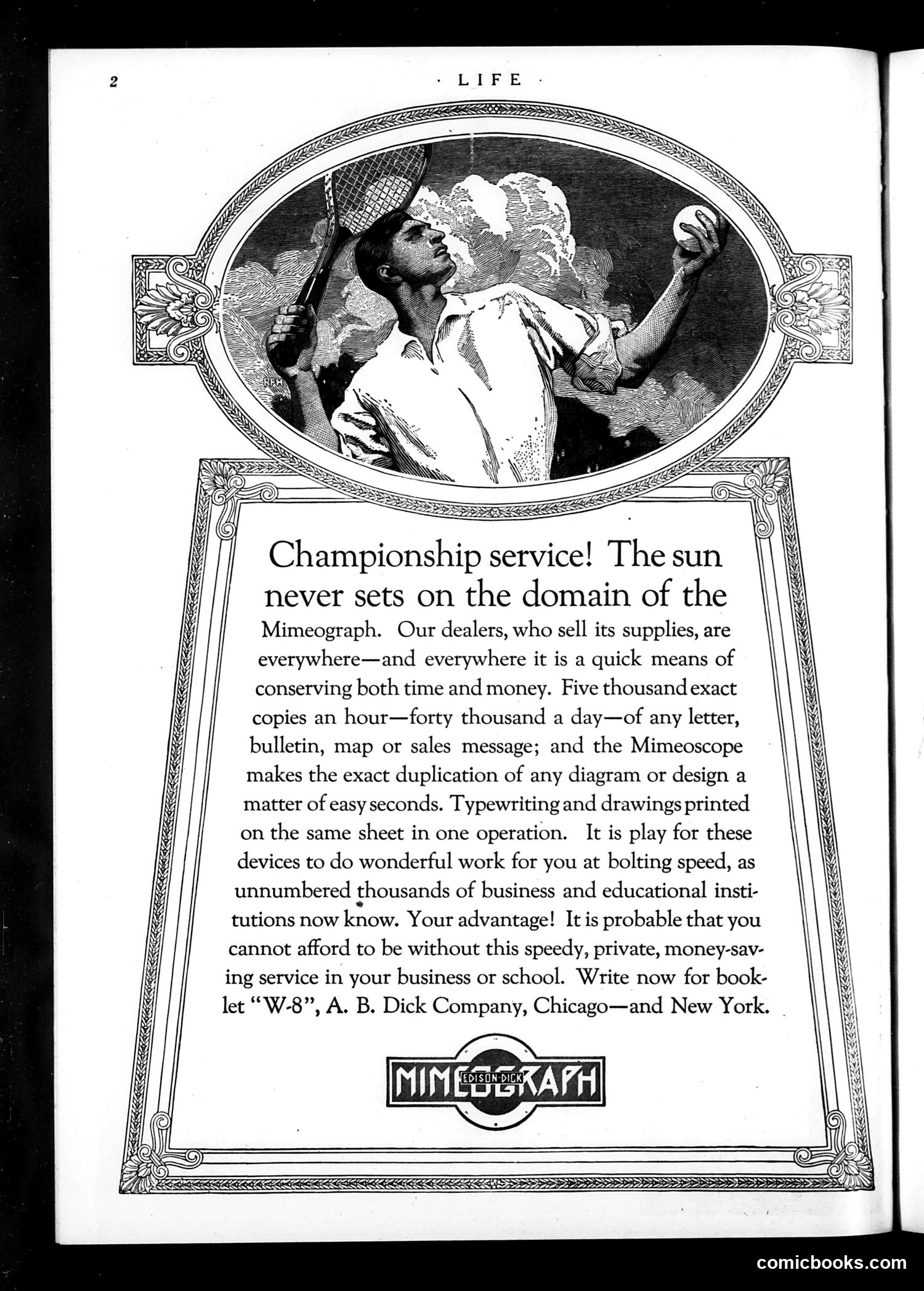
This page is primarily a **commercial advertisement**, not political satire. It promotes the Mimeograph and Mimeoscope, early 20th-century document reproduction devices made by A. B. Dick Company. The illustration shows an athlete in action—likely a tennis or sports player—serving a ball, visually metaphorizing the machines' speed and efficiency ("championship service"). The text employs sports imagery and competitive language to market these devices to businesses and schools, claiming they enable rapid copying (5,000 copies hourly) while saving time and money. The phrase "the sun never sets on the domain of the Mimeograph" humorously references the British Empire's global reach, suggesting these machines are similarly ubiquitous. This is pure product marketing dressed in energetic, persuasive language typical of early 20th-century advertising.
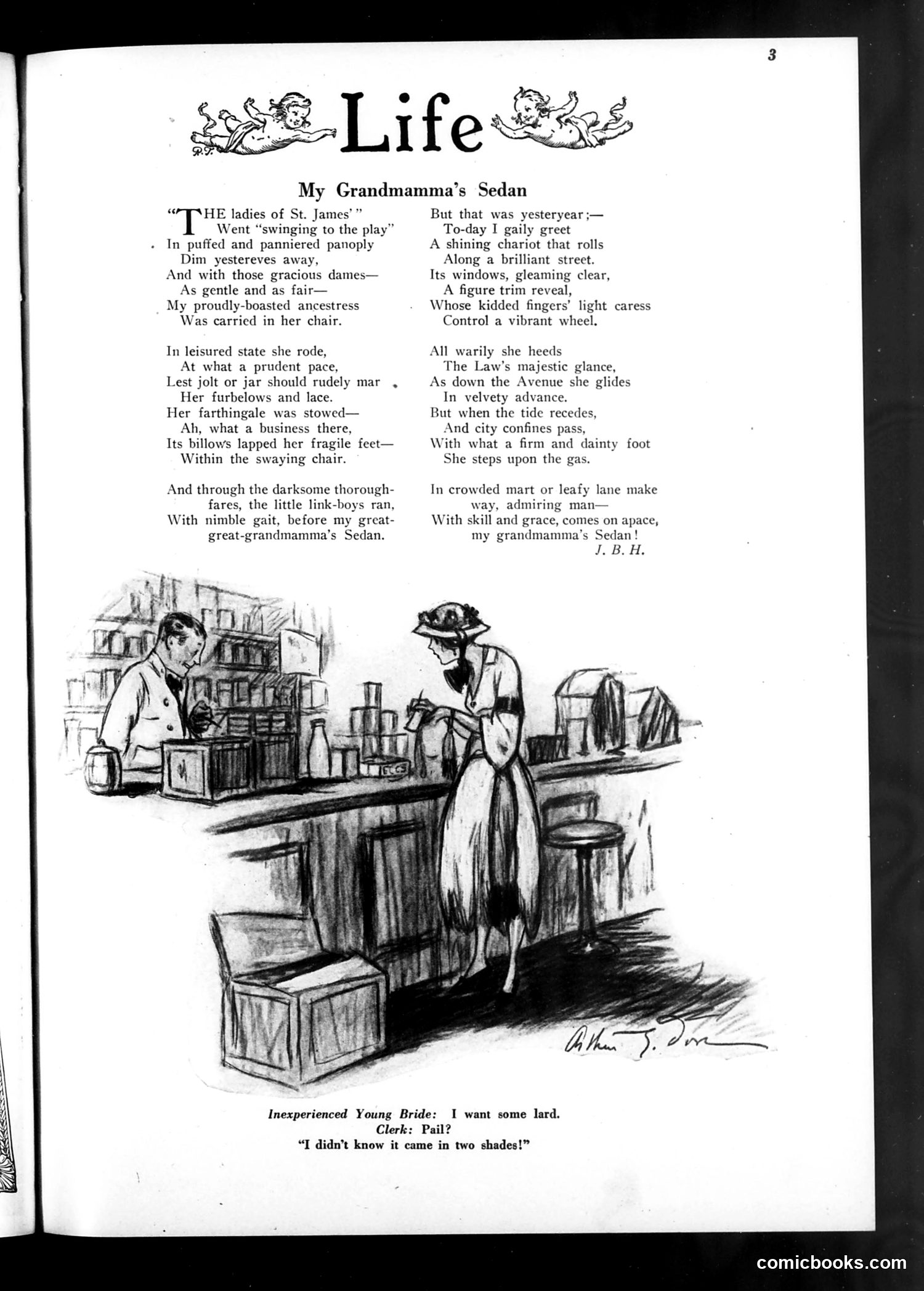
This page contains two distinct pieces: **The Poem** (left): A nostalgic verse contrasting a grandmother's elegant horse-drawn sedan from the past with her modern motorcar. The poem celebrates how she gracefully navigated both eras—from leisurely carriage rides through London streets to confidently driving her automobile through crowded city traffic. **The Cartoon** (bottom): Shows a humorous domestic scene at a butcher shop. An inexperienced young bride asks the clerk for "lard," apparently unaware it comes in different forms. The clerk's response—"I didn't know it came in two shades!"—suggests she's confused about basic household shopping, satirizing young women's lack of domestic knowledge or culinary experience.
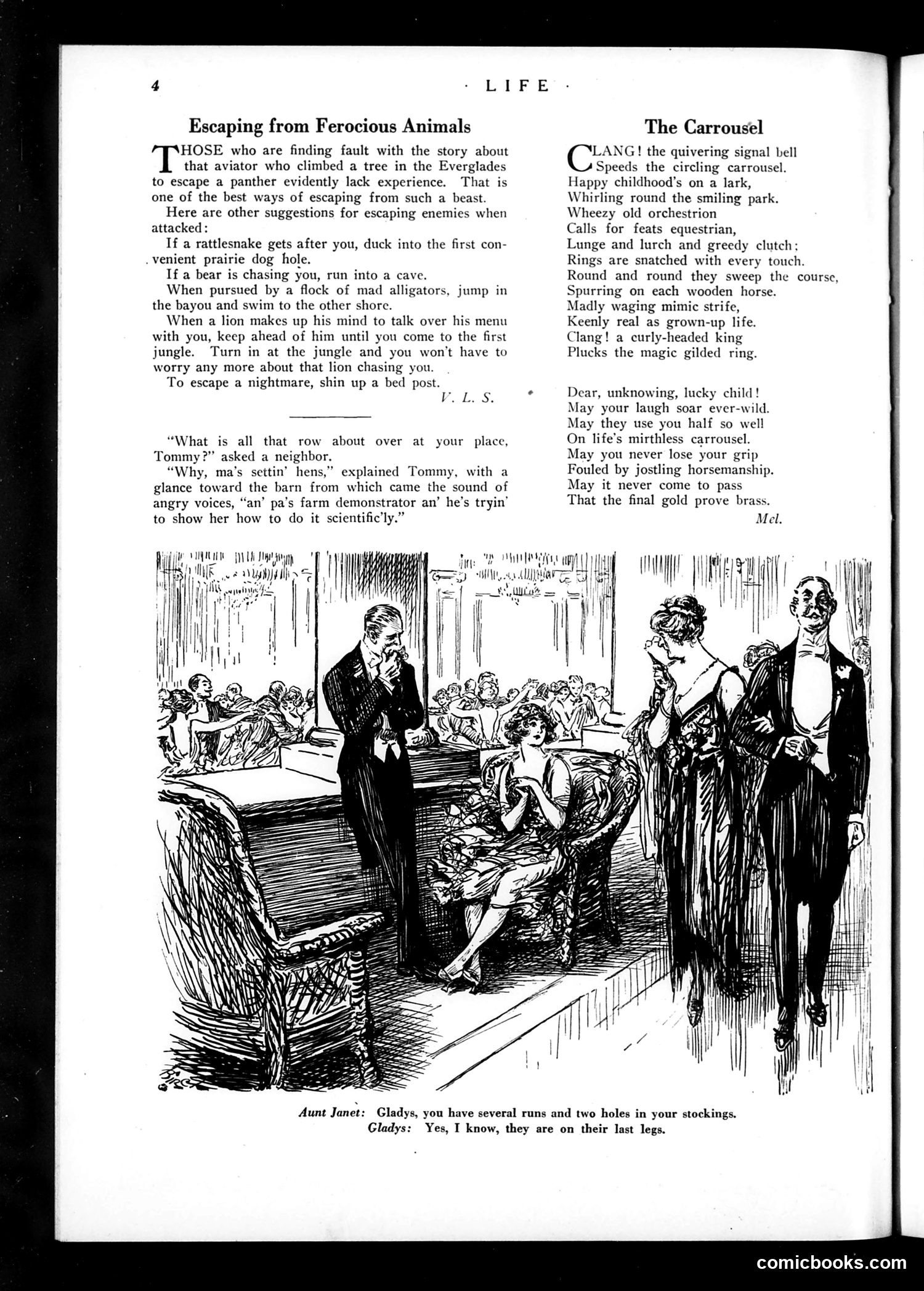
This page contains three distinct pieces: 1. **"Escaping from Ferocious Animals"** (left column): Humorous advice on evading wildlife threats—prairie dogs, bears, alligators, and nightmares. The practical tips suggest this is lighthearted survival humor rather than serious commentary. 2. **"The Carousel"** (right column): A sentimental poem about childhood innocence and the carousel as a metaphor for life's joys and uncertainties. 3. **The Main Cartoon**: A social satire showing well-dressed adults at what appears to be a formal event or party. The caption reveals the joke: Aunt Janet comments on Gladys's torn stockings; Gladys replies her stockings are "on their last legs"—a pun combining the worn garment with the idiom suggesting something is failing. The humor targets upper-class social pretension and worn gentility during economically uncertain times.
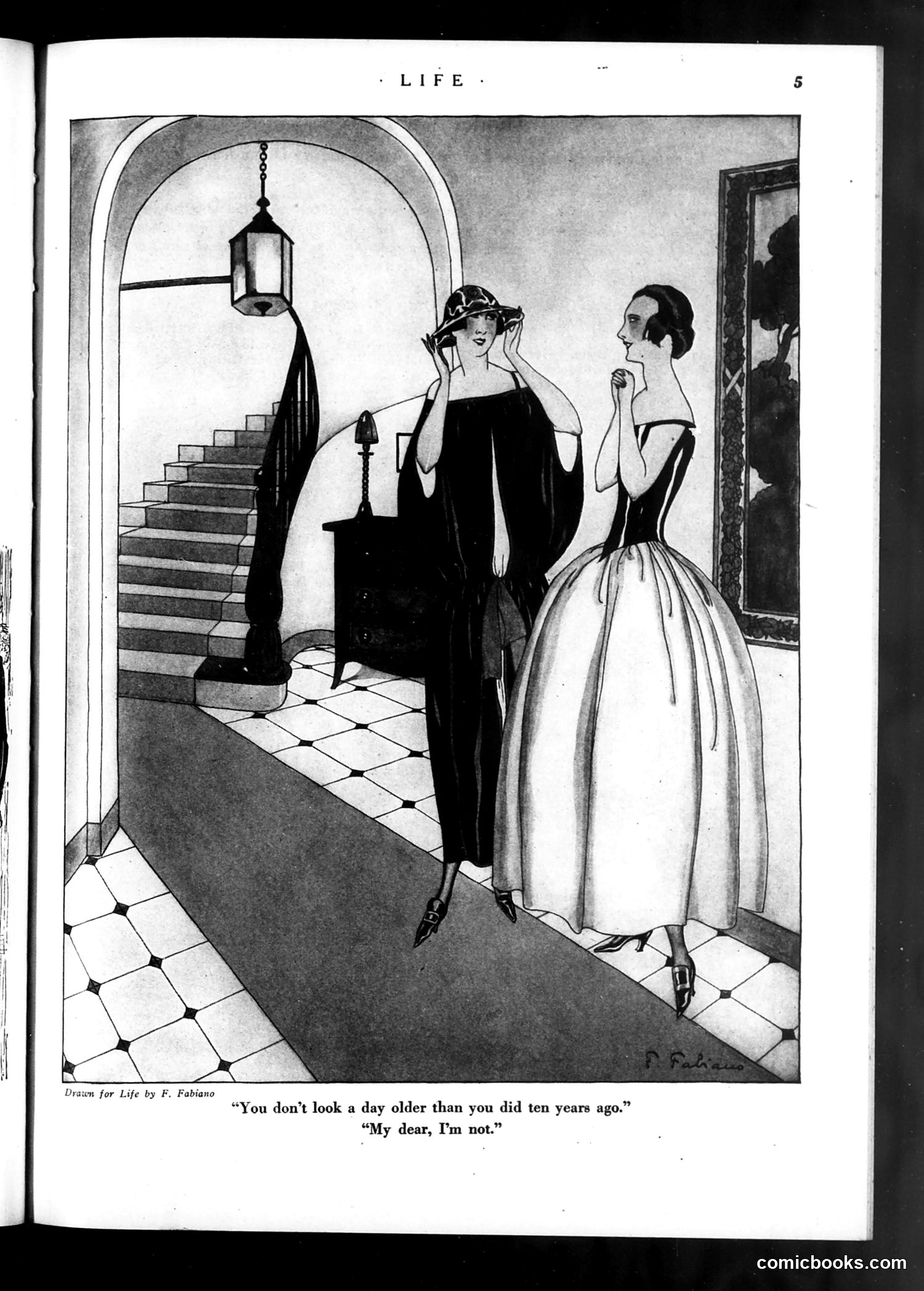
This is a single-panel cartoon by F. Fabiano depicting two women in an elegant hallway. The woman on the left, dressed in black, wears a fashionable hat and appears youthful. The woman on the right, in a white ball gown, makes a compliment: "You don't look a day older than you did ten years ago." The response: "My dear, I'm not." The joke satirizes vanity and the social performance of age among wealthy women. The woman's deadpan reply suggests she's claiming to have found some method—cosmetic treatments, procedures, or products—to literally prevent aging, treating it as an achievable goal rather than inevitable. The cartoon mocks both the obsession with youthful appearance and the implicit dishonesty of such claims in high society.
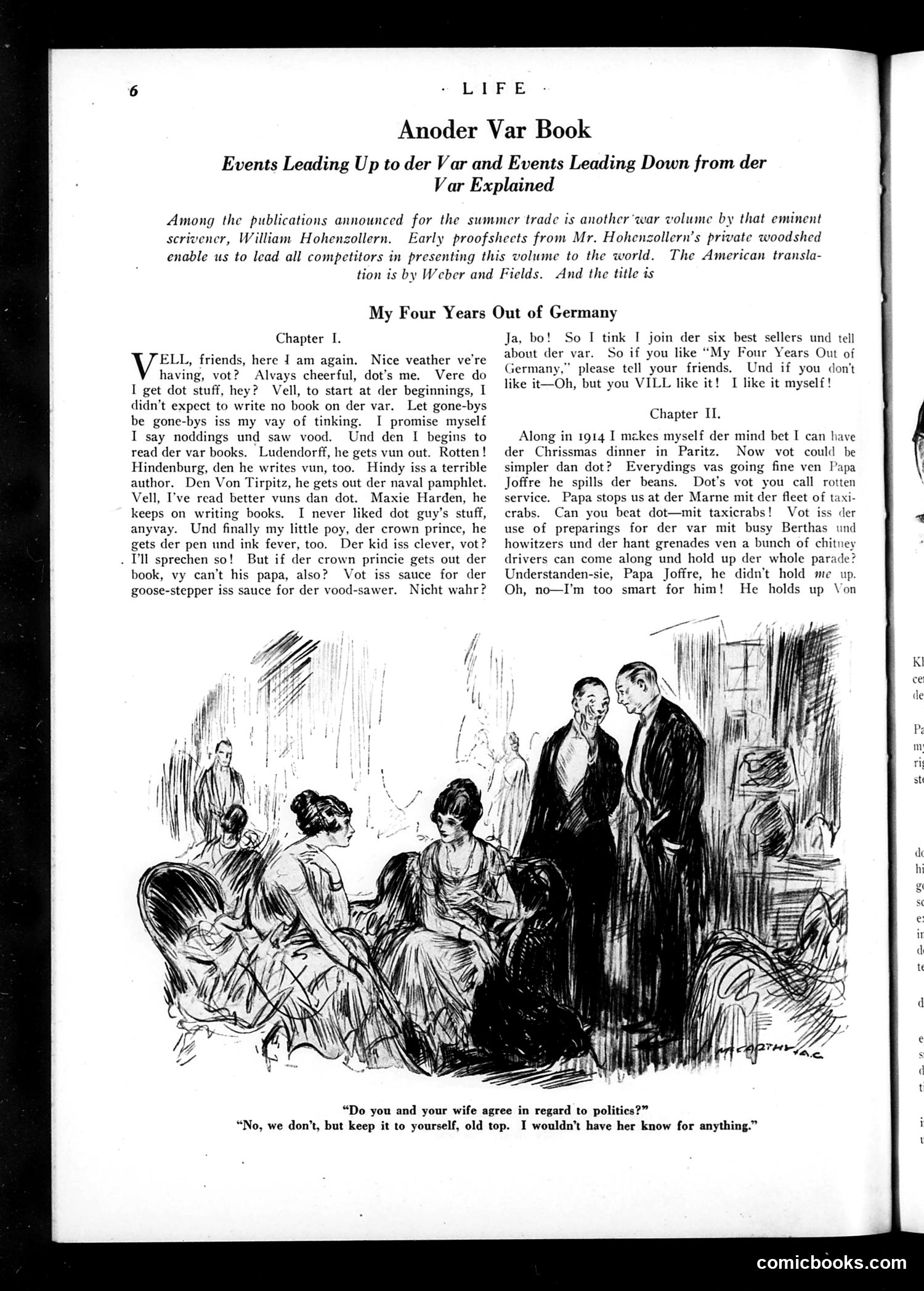
This page introduces a serialized work titled "My Four Years Out of Germany," apparently a memoir or novel about German life. The illustration depicts a domestic scene where two well-dressed men converse with seated women in what appears to be a parlor. The caption's humor concerns marital discretion: when asked if he and his wife agree on politics, the man replies they don't discuss it—he deliberately keeps her uninformed ("I wouldn't have her know for anything"). This satirizes early 20th-century gender attitudes, mocking the notion that wives shouldn't be troubled with political knowledge or opinions. The "joke" reflects period assumptions about women's intellectual exclusion from civic matters, attitudes Life's readership would have recognized as commonplace, if not universally approved.
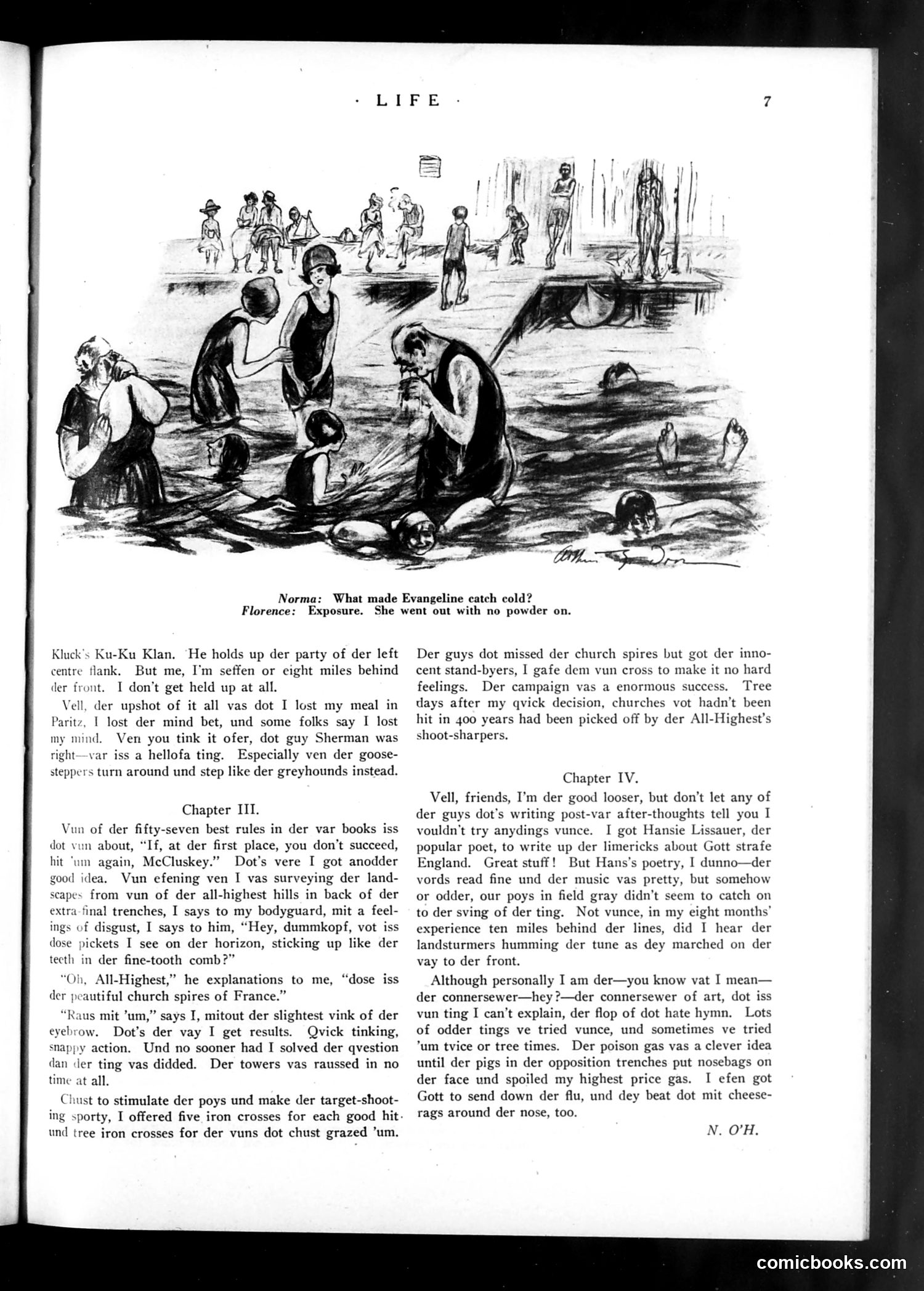
The page contains a sketch depicting a beach or seaside scene with adults and children bathing. The accompanying dialogue is a humorous exchange about a woman named Evangeline catching cold. The satire appears to target Victorian-era attitudes about women's propriety and fashion. When asked what caused Evangeline's illness, the response is "Exposure. She went out with no powder on." This is a joke about social conventions: the implication is that appearing in public without cosmetic makeup was considered so socially transgressive or embarrassing that it could literally make a woman ill—a mocking exaggeration of how seriously upper-class society took women's appearance standards. The text below (Chapters III-IV) contains dialect-heavy narrative, likely satirizing German-American immigrant speech patterns popular in early 20th-century American humor magazines.
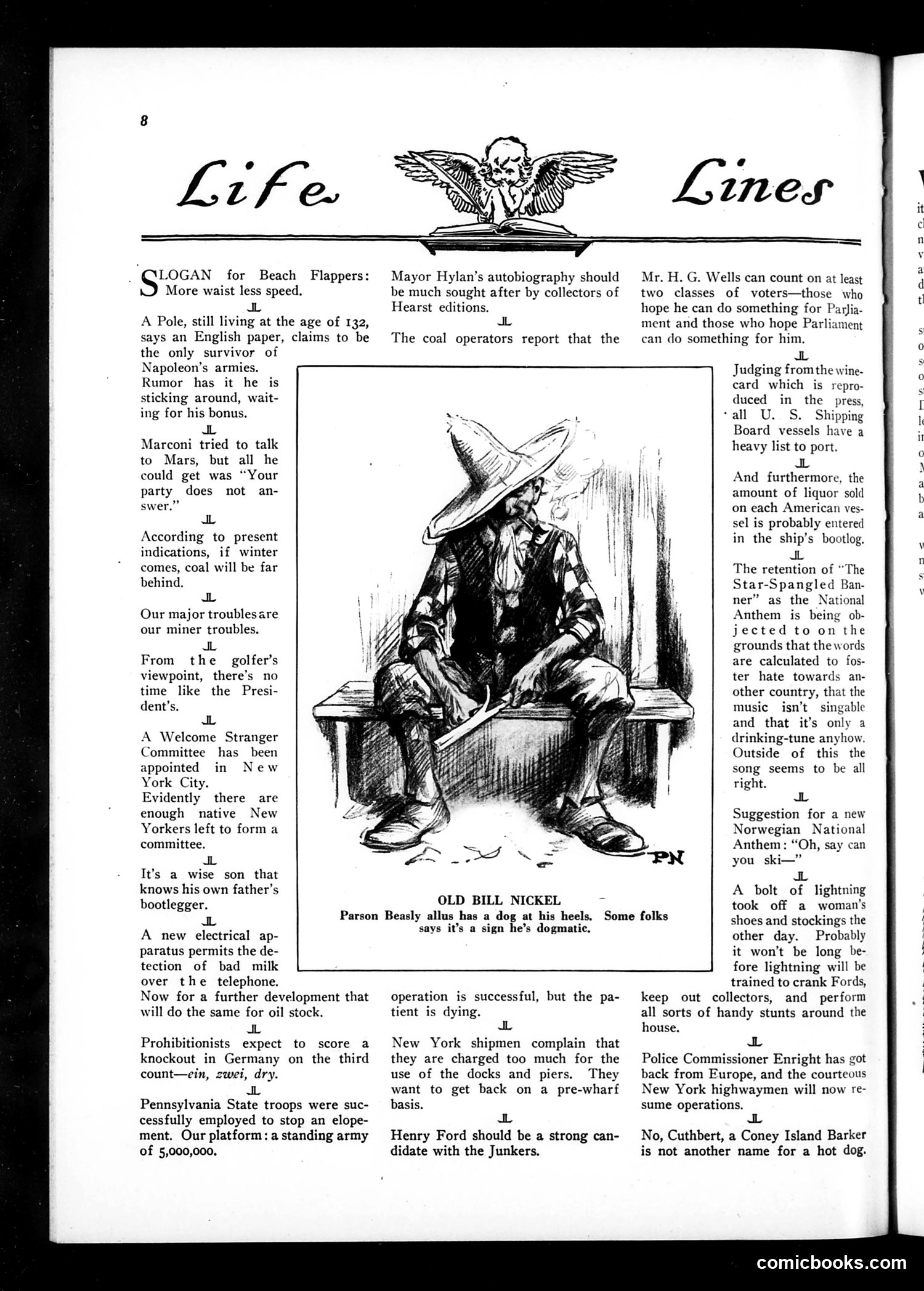
This cartoon depicts a weathered man in a wide-brimmed hat sitting on a bench, illustrating the caption: "OLD BILL NICKEL: He had a dog at his heels. Some folks say it's a sign he's dogmatic." The humor is a visual pun playing on the character's name "Bill Nickel" combined with the phrase "at his heels"—suggesting he's "dogmatic" (literally having a dog at his heels, while "dogmatic" means stubborn or opinionated). The figure appears to be a stock "character" type used for satirical commentary, though the specific identity of "Old Bill Nickel" and whether he represents a particular public figure remains unclear from the image alone.
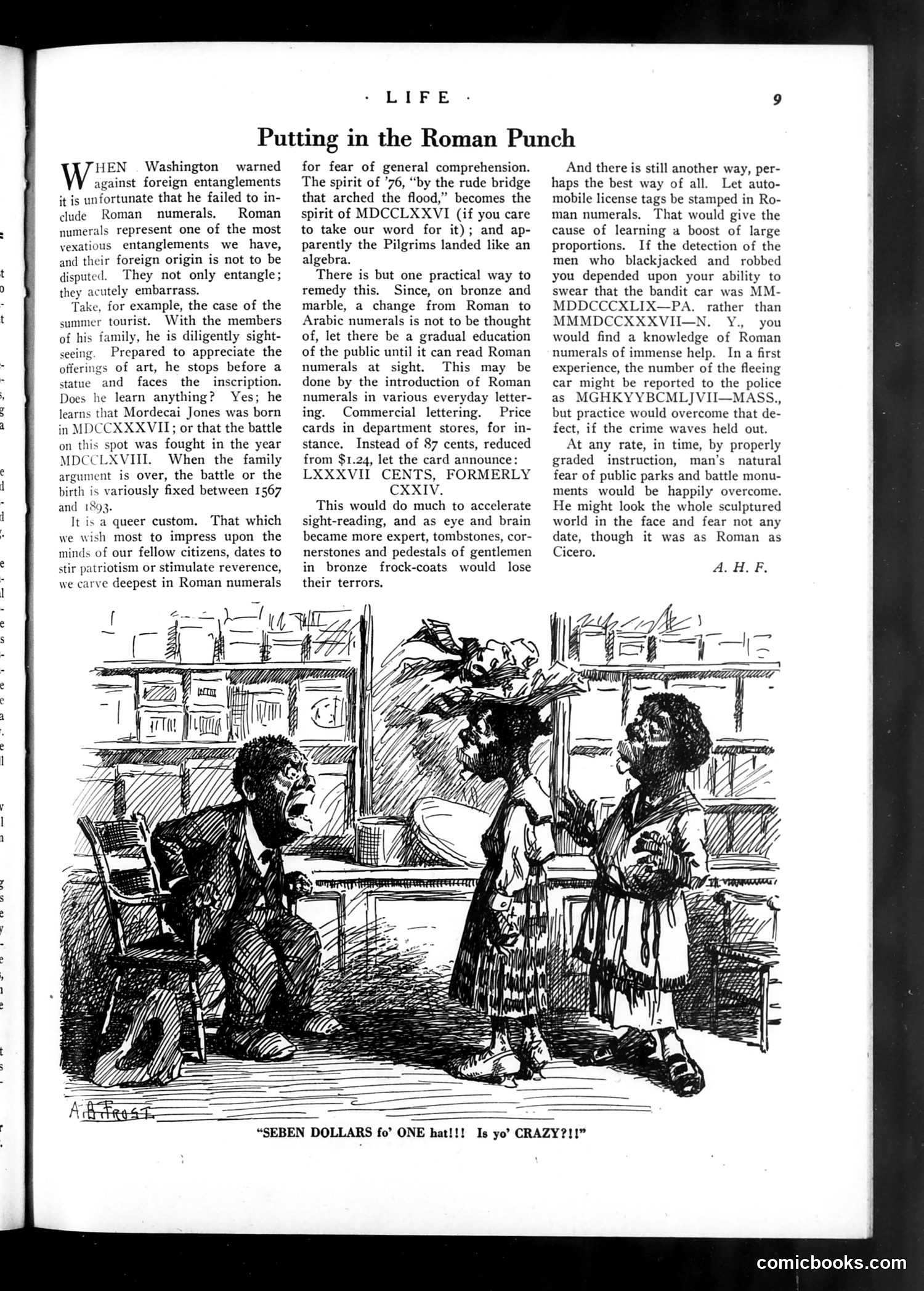
The article discusses Washington's warning against Roman numerals in official contexts, arguing they create confusion and embarrassment. It proposes gradual public education through everyday uses—price cards, commercial lettering—to improve numeracy. The cartoon illustrates the absurdity through a domestic scene: a shopkeeper or merchant appears to be quoting an inflated price ("SEVEN DOLLARS for ONE hat!!!") to two working-class customers (likely a woman and child). The caption "Is yo' CRAZY?!!" suggests the customers' incredulous reaction to what seems an unreasonable price. The satire connects Roman numerals to commercial fraud—if citizens cannot read "LXXVII CENTS" properly, merchants could exploit them with inflated, disguised pricing. The joke exposes both public mathematical illiteracy and the dishonest practices it enables.
This is a satirical poem mocking American summer resort culture. Parker's refrain—"I hate Summer Resorts; They ruin my vacation"—frames ironic complaints about resort experiences. The poem ridicules the pretensions and tedium of these destinations: overcrowded beaches, shallow socializing, stale gossip about infidelities, and manufactured "scenery" (postcards of places like Lovers' Leap). Parker mocks both the resorts themselves and the guests who gather there, describing inane conversations about children's ailments and the performative claims of seeing rare wildlife. The satire targets the false promise that these commercial establishments offer genuine relaxation or connection to nature. Instead, Parker presents resorts as sites of social posturing, gossip, and boredom—places that ironically spoil the very vacation they promise.
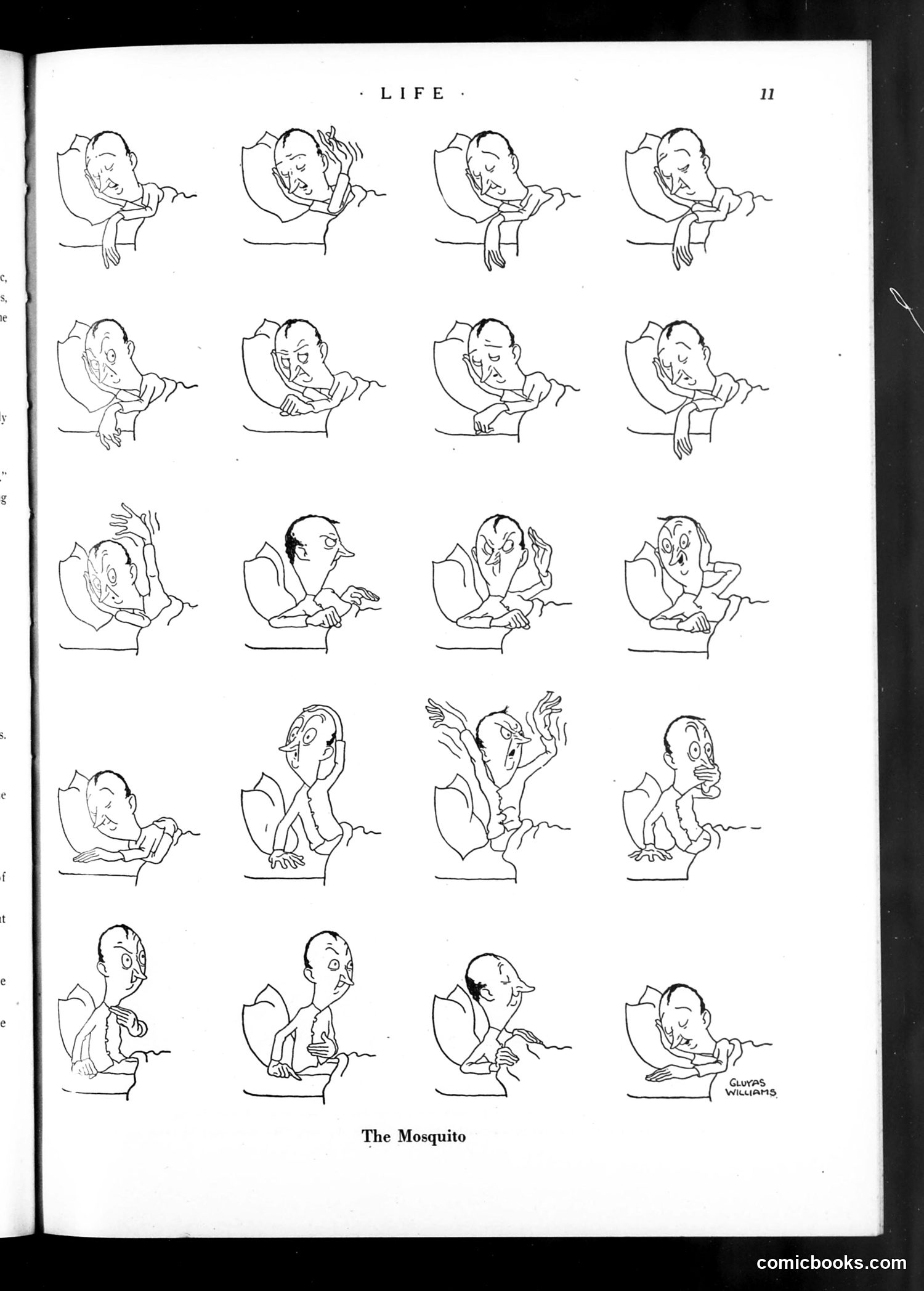
This page shows a sequential comic strip titled "The Mosquito," illustrated by Cluyas Williams. The strip depicts a man in a chair repeatedly being bothered by a mosquito, shown through 16 panel variations of his escalating reactions—from calm annoyance to increasingly frantic gestures and expressions of frustration. The humor is situational rather than political: it's a relatable domestic comedy about the universal experience of being pestered by an insect indoors. Each panel shows different comic poses and facial expressions as the protagonist attempts to deal with the mosquito's unwanted attention. The repetition and exaggeration of his reactions build comedic effect through physicality—a common approach in early-to-mid 20th century American comic strips and cartooning.
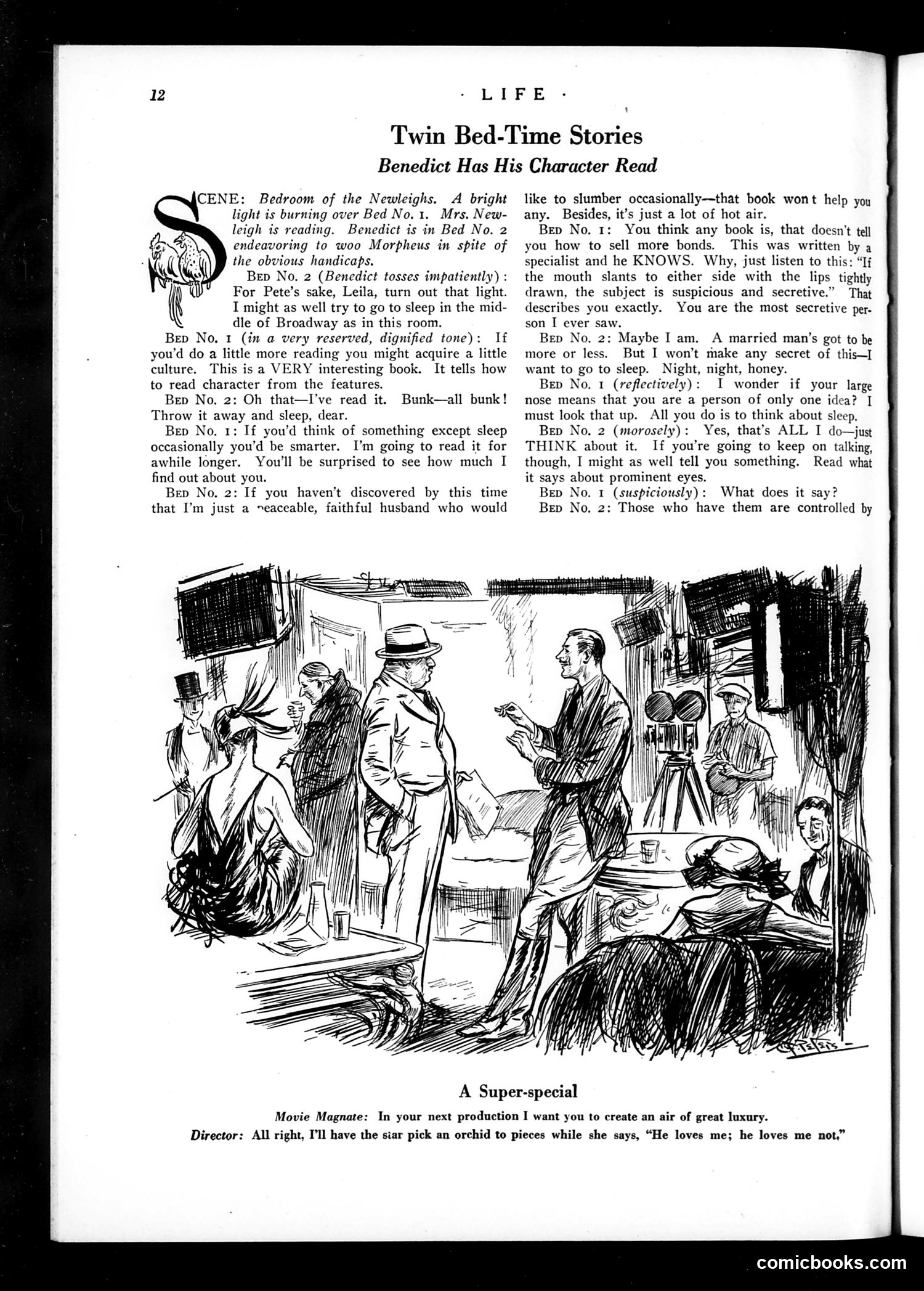
This page from *Life* magazine presents a humorous domestic sketch titled "Benedict Has His Character Read." The scene depicts a bedroom conversation between a married couple (Benedict and his wife) where she's reading character analysis from a book to him as they prepare for bed. The satire targets early-20th-century pseudoscientific character-reading trends—likely physiognomy or similar popular psychology. The wife uses the book's descriptions to describe her husband's personality traits, with comedic irony as she claims his "large nose" proves he's "a person of only one idea" and that "prominent eyes" indicate he's "controlled by" others. The bottom caption about a movie magnate and orchids appears to be a separate Hollywood-related gag typical of *Life's* celebrity satire of the era.
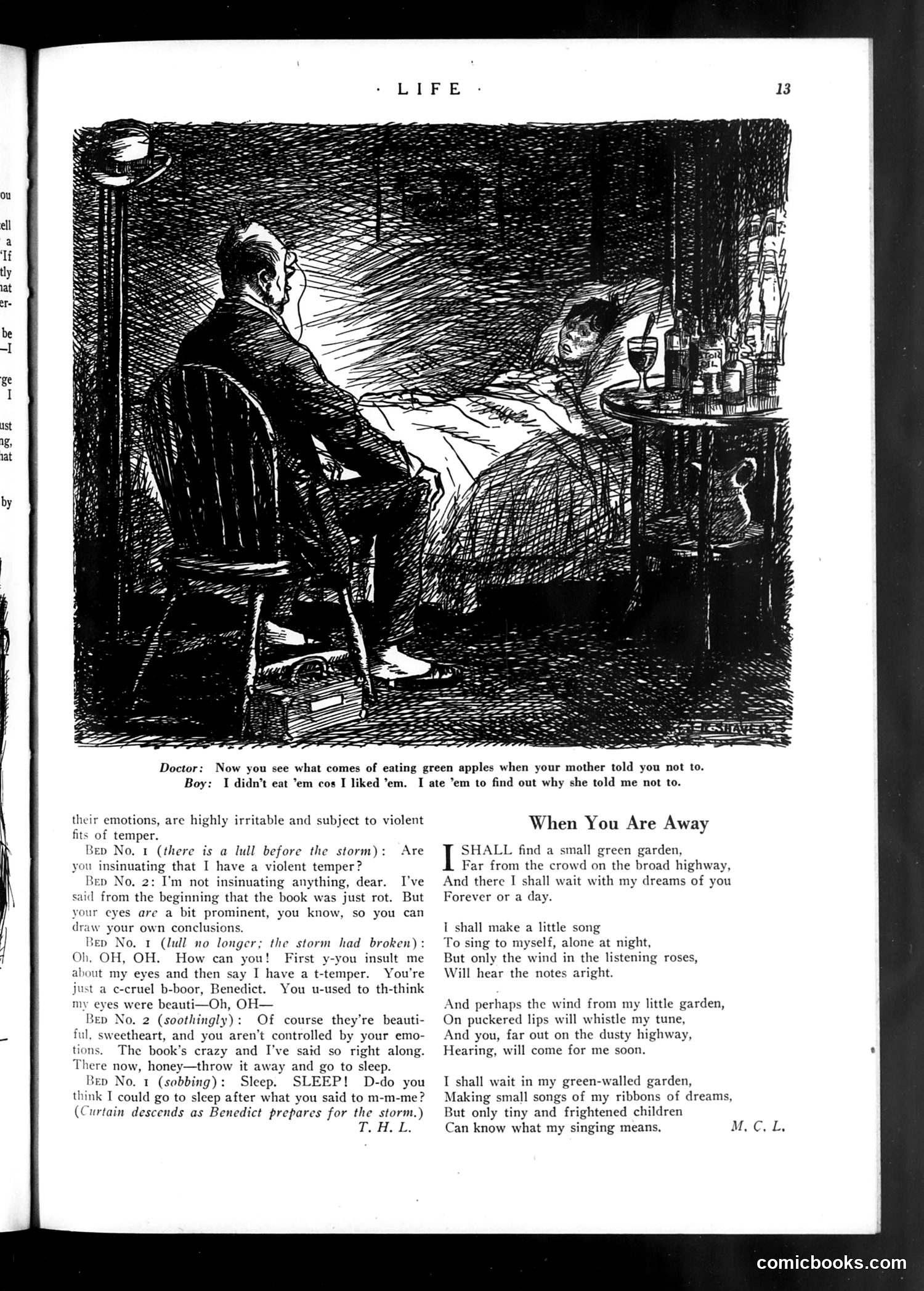
The page contains a single-panel cartoon depicting a doctor examining a sick boy in bed. The boy explains he ate green apples despite his mother's warnings—and ate them specifically to discover *why* she had forbidden them. The humor relies on a common parental scenario: children's natural curiosity about prohibited things. The joke is the boy's logical but exasperating reasoning: he needed empirical evidence of the danger rather than accepting parental authority. The accompanying dialogue between "Bed No. 1" and "Bed No. 2" (apparently patients debating temperament and book quality) appears unrelated satirical content, likely from a separate feature. The page also includes a poem titled "When You Are Away" by M.C.L., which is romantic verse unrelated to the cartoon.
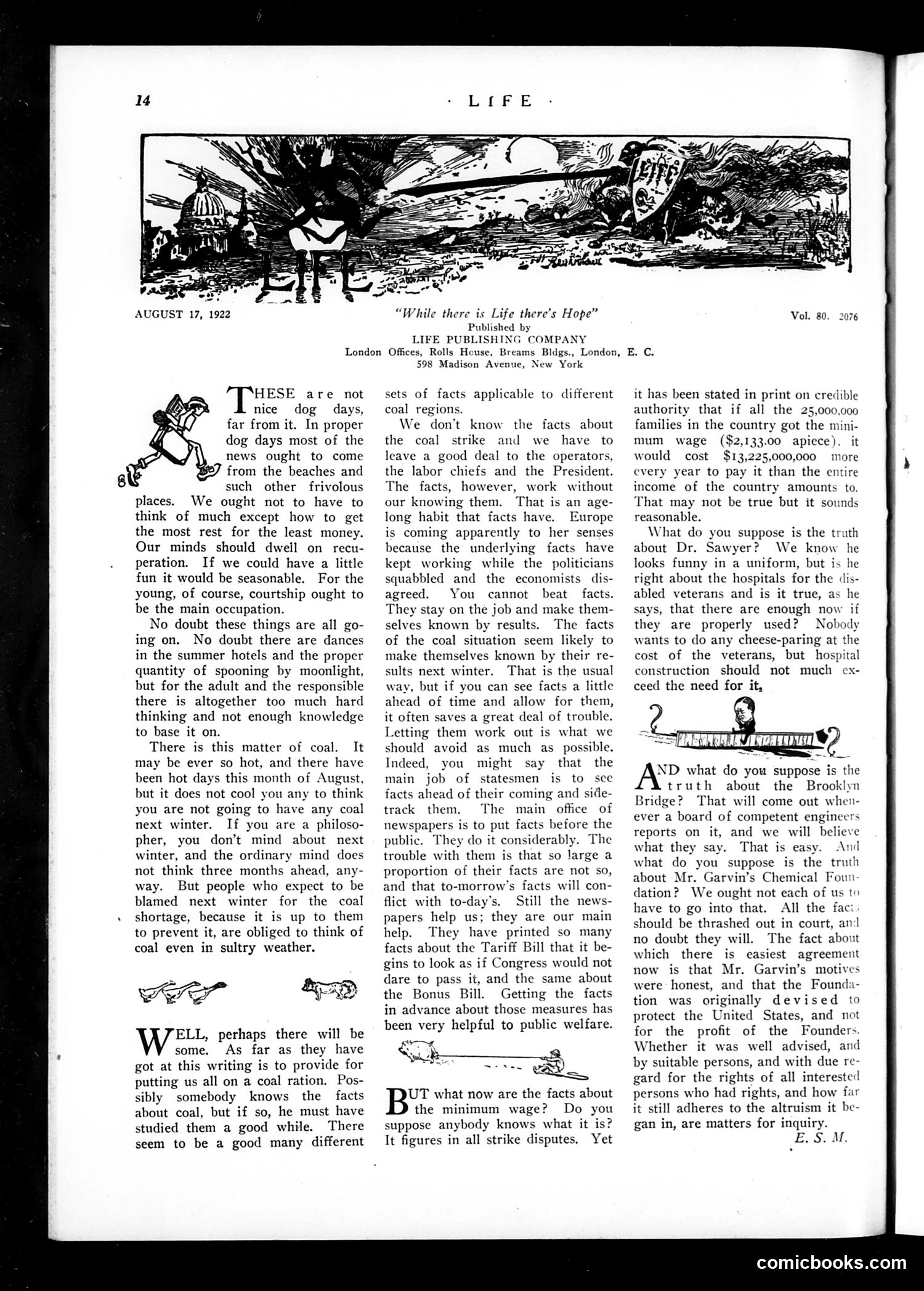
The editorial content discusses contemporary labor and political disputes—specifically the coal shortage, strikes, tariff bills, and the minimum wage. The accompanying cartoon(s) at the top appear to use allegorical or symbolic imagery related to these economic issues, though specific figure identification is unclear from the image quality. The text argues for facts-based public discourse on these contentious issues rather than political rhetoric. It references the "Tariff Bill" and "Home Bill" as measures Congress debated, and mentions "Mr. Garvin's Chemical Foundation" in context of institutional credibility during labor disputes. The overall point: satire of how politicians and newspapers obscure economic realities (coal shortages, wage disputes) behind ideology, when citizens need straightforward factual information to understand strikes and industrial policy.
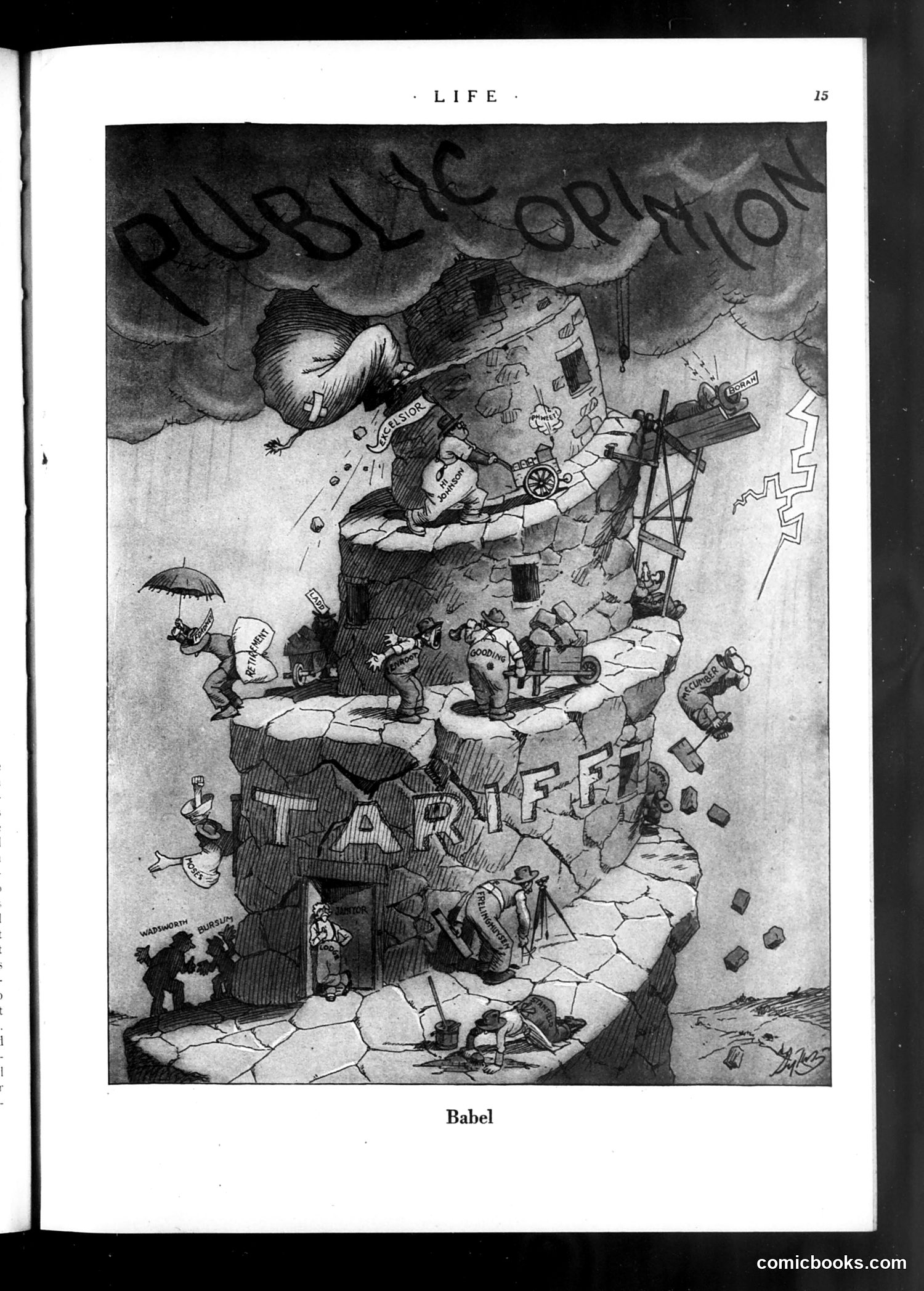
This political cartoon satirizes the confusion and lack of coordination among various groups or nations, referenced by the title "Babel" (evoking the biblical Tower of Babel where languages became confused). The illustration depicts a chaotic tower-like structure with multiple figures engaged in different activities simultaneously—some appear to be working, others arguing or gesturing. Various labels and text are scattered throughout, though specific identifications are unclear in this reproduction. Dark storm clouds loom above, suggesting impending disaster or conflict. The satire appears to critique disorder, miscommunication, or conflicting agendas among different factions or nations, suggesting that without unified purpose or clear communication, ambitious projects collapse into chaos. The biblical allusion implies divine punishment for human arrogance or disunity.
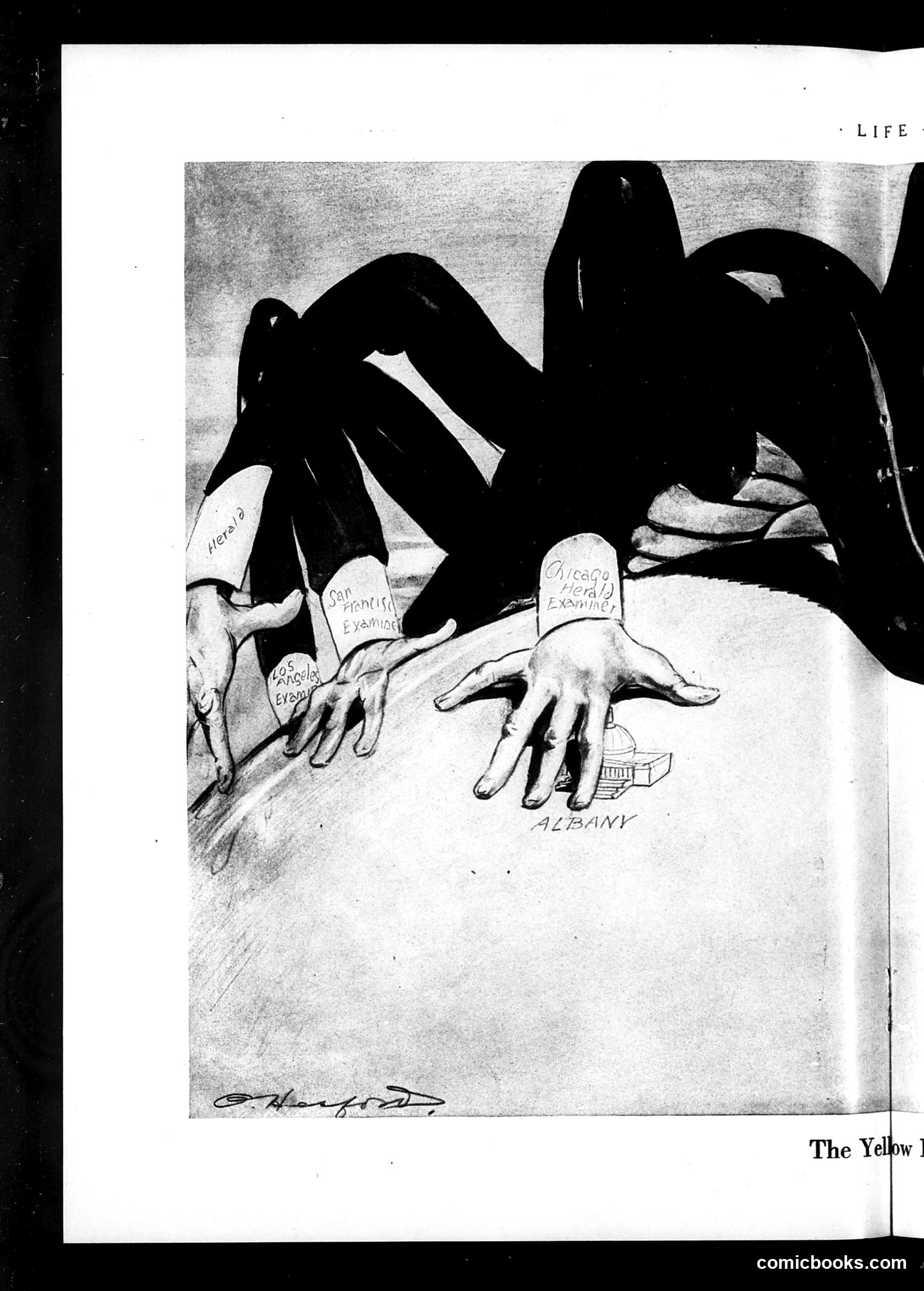
This is a political cartoon depicting what appears to be newspapers or publications as shadowy figures examining a map of New York State. The visible text on their hands/arms includes references to newspaper names: "Herald Examiner," "Pan-Francis Examiner," and "Chicago Herald Examiner," with "Albany" marked on the map below. The cartoon satirizes newspaper monopolies or consolidation—specifically, how major newspaper chains (particularly Hearst publications, suggested by the "Examiner" references) were expanding control across different cities and regions. The silhouetted, grasping hands suggest predatory acquisition of media outlets. The focus on Albany (New York's capital) indicates this concerns state-level political implications of concentrated newspaper power. This reflects early 20th-century concerns about media monopolies and their influence on democracy.
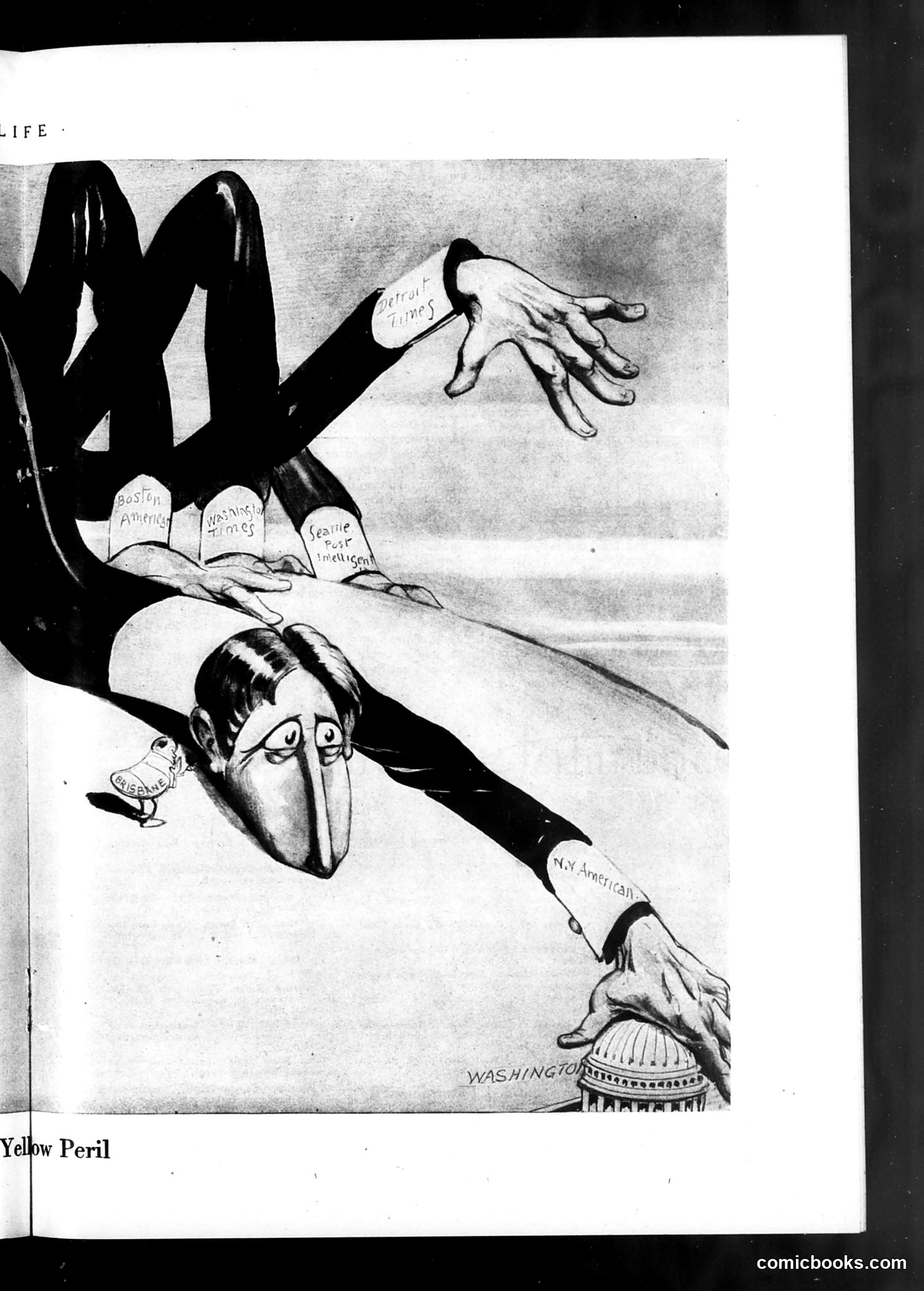
This political cartoon depicts a grotesquely caricatured figure with exaggerated Asian features labeled "WASHINGTON," wearing what appears to be formal attire. The figure is depicted in a threatening pose with an extended arm, while books labeled with American institutions and values (appearing to reference "Boston," "American," "Sea" and "Intelligence") lie scattered below. The cartoon satirizes anxieties about Asian—likely Chinese or Japanese—influence threatening American institutions and values during the early 20th century. The "Yellow Peril" title references the contemporary racist concept that Asian immigration and influence posed an existential threat to American society. The caricature and composition express xenophobic fears about foreign infiltration of American political and cultural centers, reflecting the prejudiced discourse common to that era.
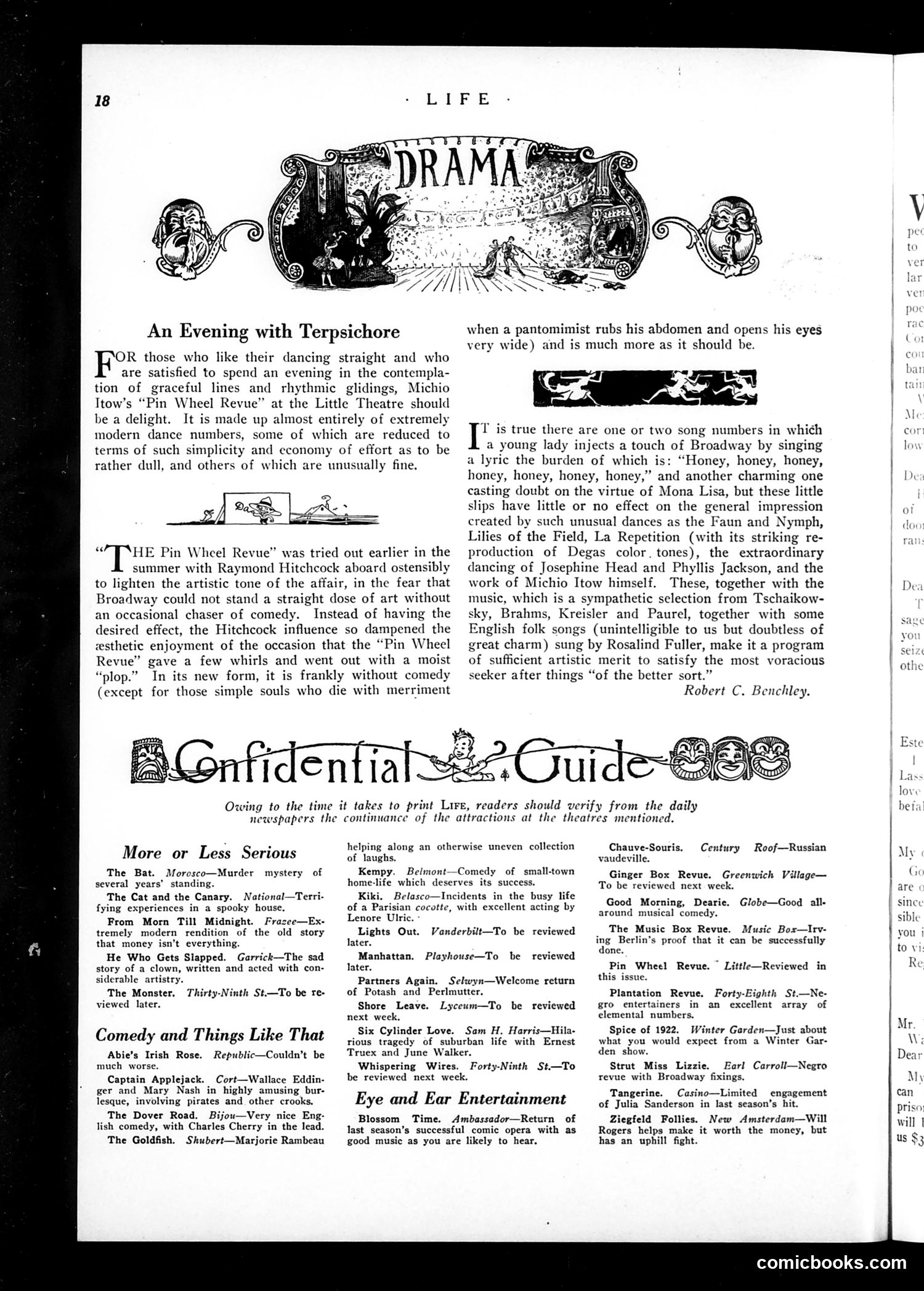
This page from *Life* magazine contains theater reviews, not political cartoons. The main content is Robert C. Benchley's critique of Michio Itow's "Pin Wheel Revue" at the Little Theatre—a modern dance production. The satire targets Broadway's commercial demands. Initially, comedian Raymond Hitchcock was added to make "straight" modern dance palatable to mass audiences, but his presence actually dampened artistic appreciation. Benchley praises the revised version for abandoning comedy entirely, mocking lowbrow tastes (those "simple souls who die with merriment" at crude physical humor). The review also pokes fun at the show's few Broadway-style song numbers, particularly one endlessly repeating "honey, honey, honey" and another casting aspersions on the Mona Lisa's virtue—presented as unnecessary compromises with popular taste. The remainder lists current theatrical attractions, categorized as "serious" or comedic productions.
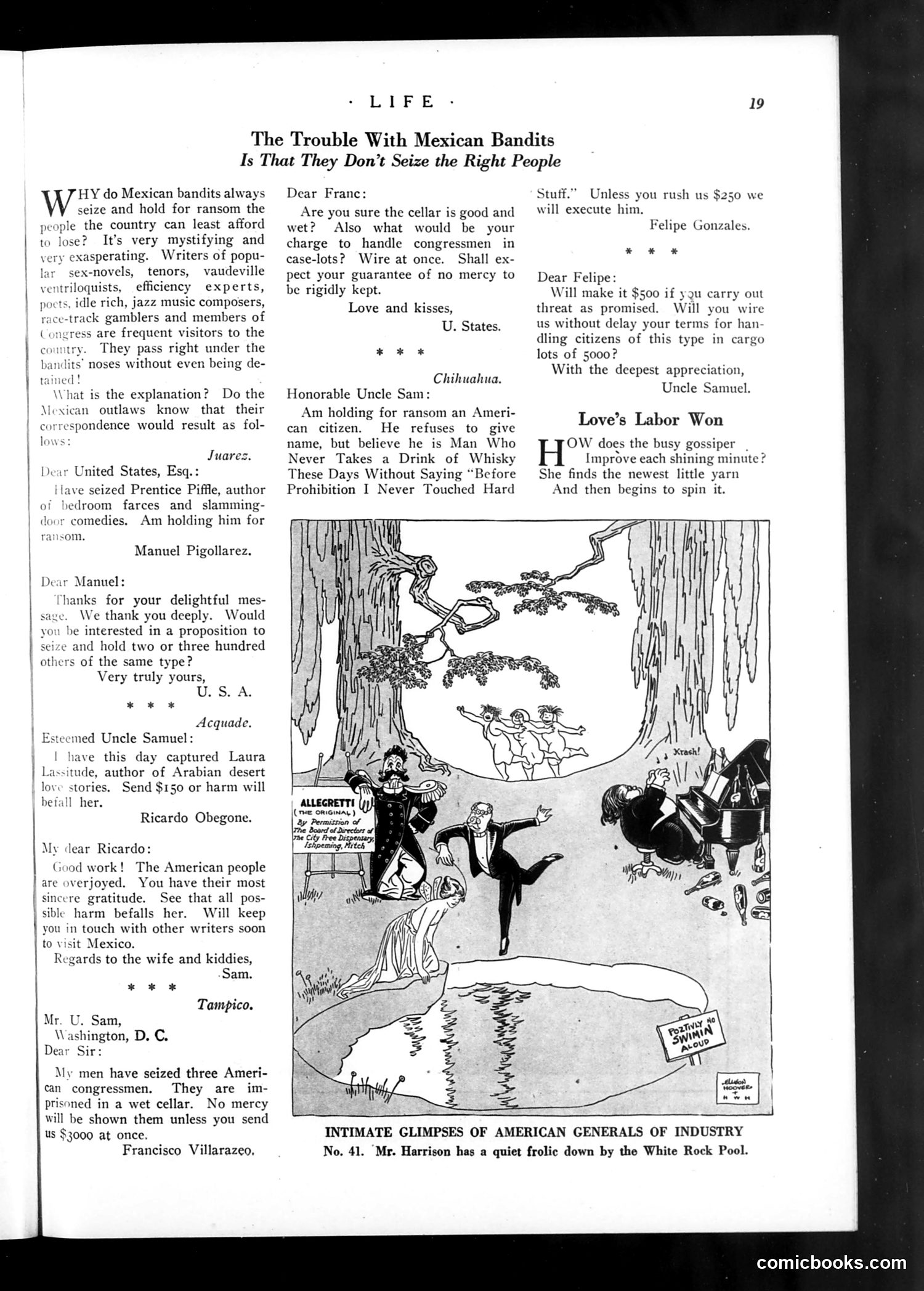
This 1920s satirical piece mocks American attitudes toward Mexico during a period of banditry and U.S. intervention. The humor derives from a darkly cynical premise: Mexican bandits kidnap the "wrong" people—artists, writers, congressmen—whom Americans secretly wish would disappear. The joke escalates through fake ransom correspondence where "Uncle Sam" (the U.S. government) expresses gratitude to kidnappers and offers bulk discounts for future captures of similarly undesirable citizens. The final letter involves a man defined solely by repetitively recounting his pre-Prohibition drinking habits—a jab at annoying Americans obsessed with Prohibition nostalgia. The satire targets American cultural figures and politicians the magazine's readers presumably disliked, while cynically suggesting the U.S. government wouldn't ransom them. It reflects both American exasperation with Mexican instability and contempt for domestic celebrities and politicians.
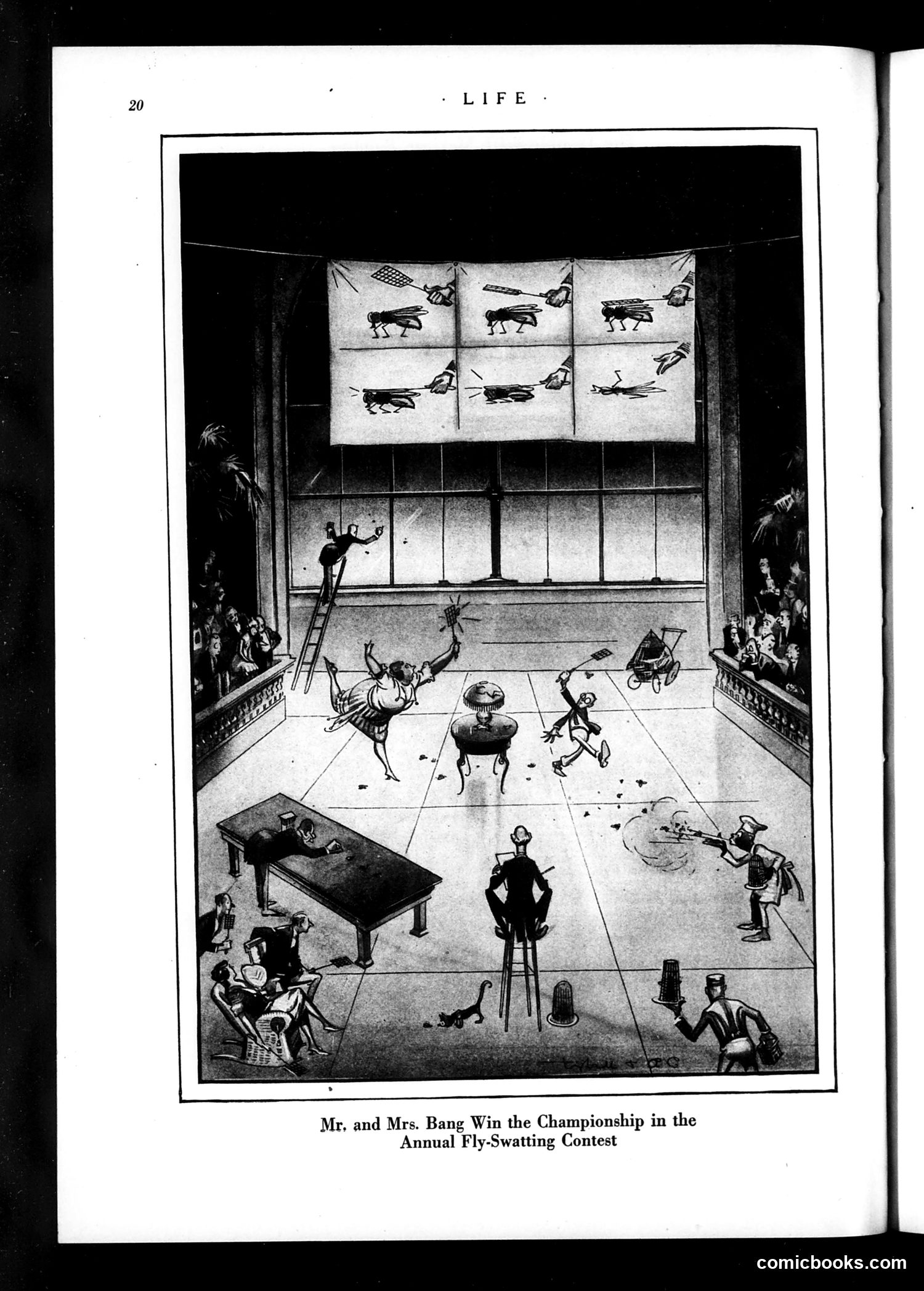
This is a humorous illustration depicting an indoor "Annual Fly-Swatting Contest" where anthropomorphic characters compete. The caption identifies the winners as "Mr. and Mrs. Bang." The cartoon satirizes competitive sporting events by applying tournament-style drama to the mundane household task of killing flies. The scene shows various absurd participants in a grand hall with spectators in balconies, a referee, and scorecards displayed above. The exaggerated scale and formal setting mock how Americans elevate ordinary activities into serious competitions. The characters appear to be insects or bug-like creatures rather than humans, which adds surreal humor. This reflects early 20th-century Life magazine's style of playful, whimsical satire that gently poked fun at American social customs and competitive culture without specific political targets.
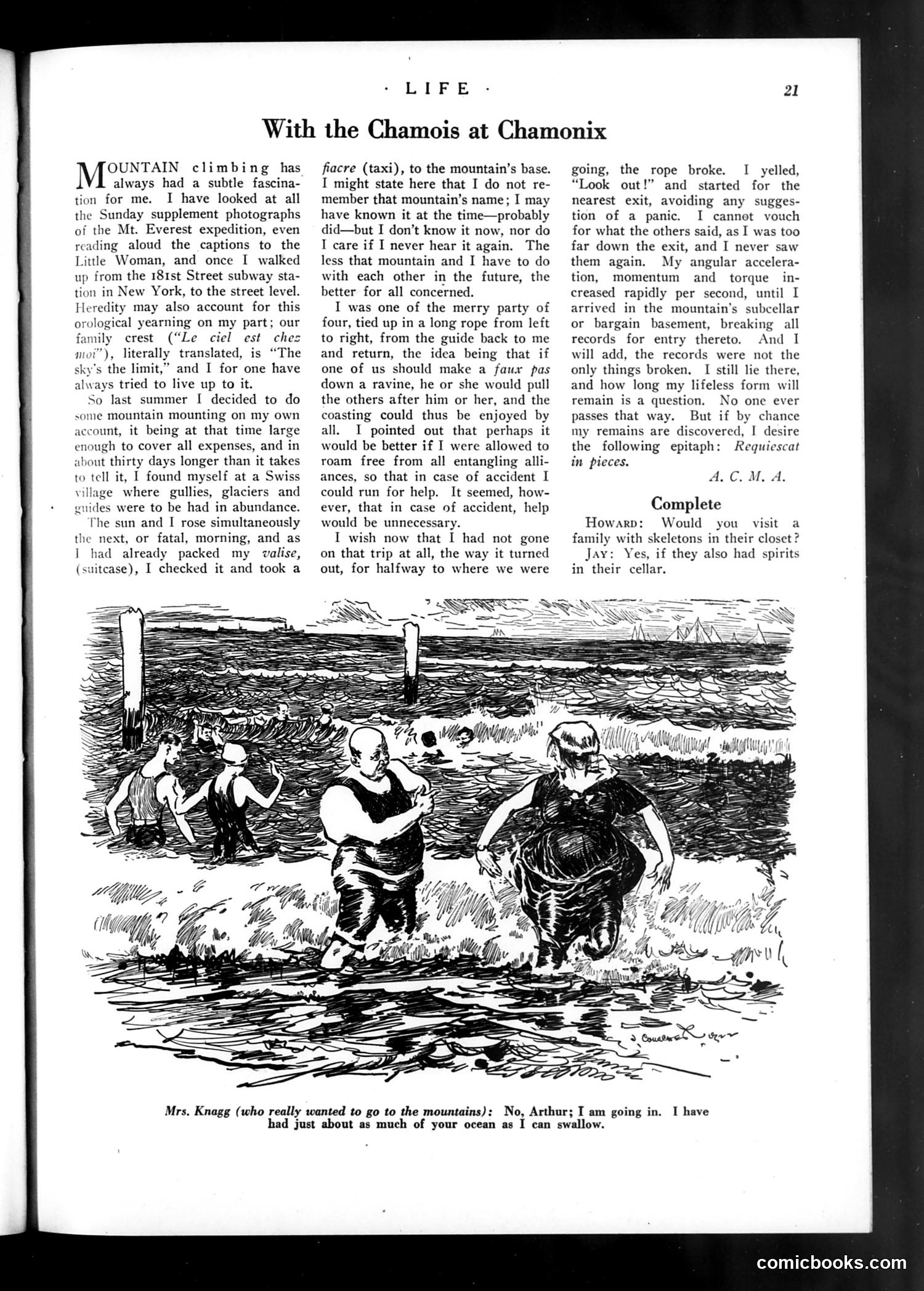
This is a humorous first-person account mocking the early 20th-century fad of mountain climbing and adventure tourism, particularly mountaineering expeditions to famous Alpine peaks like Mont Blanc near Chamonix, France. The narrator satirizes weekend adventurers who read about daring Mt. Everest expeditions in newspapers, then attempt their own "conquests" with minimal preparation or actual skill. The joke escalates when the climbing party's safety rope breaks mid-ascent, and the narrator tumbles down the mountain, ultimately dying in the "bargain basement" subcavern—ending with a pun on his own demise ("Requiescat in pieces"). The accompanying illustration and caption about "Mrs. Knagg" add domestic humor: while the husband boasts about mountain adventures, his wife sardonically notes she's endured enough of his ocean (seasickness) without encouraging further misadventures. The satire targets pretentious amateur adventurism and the gap between Sunday newspaper fantasies and actual capability.
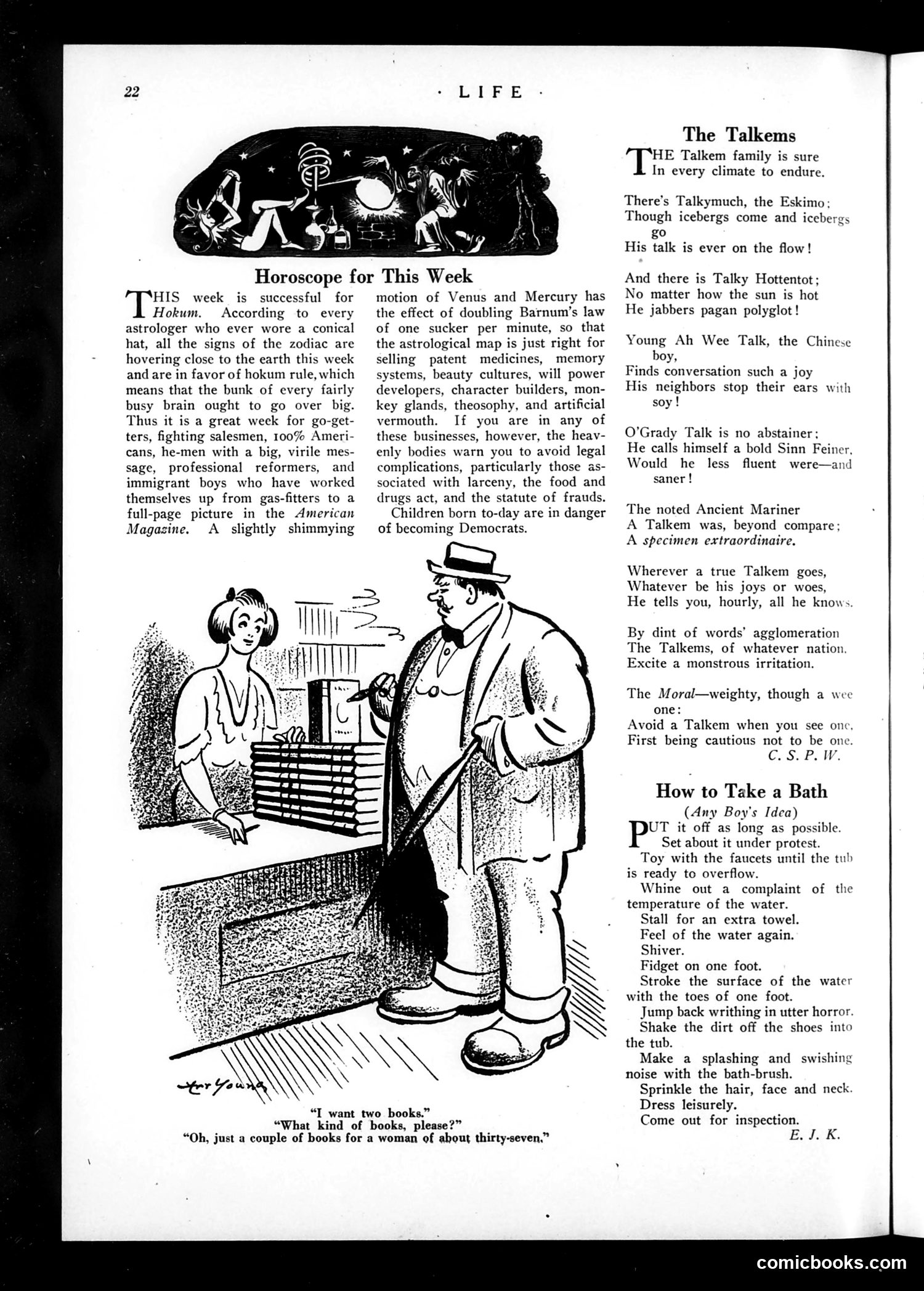
This page from *Life* magazine contains three satirical pieces targeting American social pretension and behavior: **"Horoscope for This Week"** mocks credulous believers in astrology and pseudoscience. The horoscope sarcastically claims the planetary alignment favors "hokum"—fraudulent schemes like patent medicines, "monkey glands" (quack rejuvenation treatments), and "artificial vermouth." It warns practitioners to avoid legal trouble for larceny and food fraud violations, and jokingly suggests children born that week risk becoming Democrats. **"The Talkems"** is a humorous poem satirizing garrulous people of various ethnicities and nationalities—Eskimos, Hottentots, Chinese, and Irish (referencing "Sinn Feiner," Irish nationalists). The joke is that compulsive talkers transcend all cultures and backgrounds, and are universally annoying. **"How to Take a Bath (Any Boy's Idea)"** humorously catalogs the procrastination and resistance tactics boys employ to avoid bathing—delay, complaint, fidgeting—depicting childhood reluctance to hygiene. All three pieces target human weakness, gullibility, and universal behavioral quirks with gentle satire typical of *Life*'s approach.
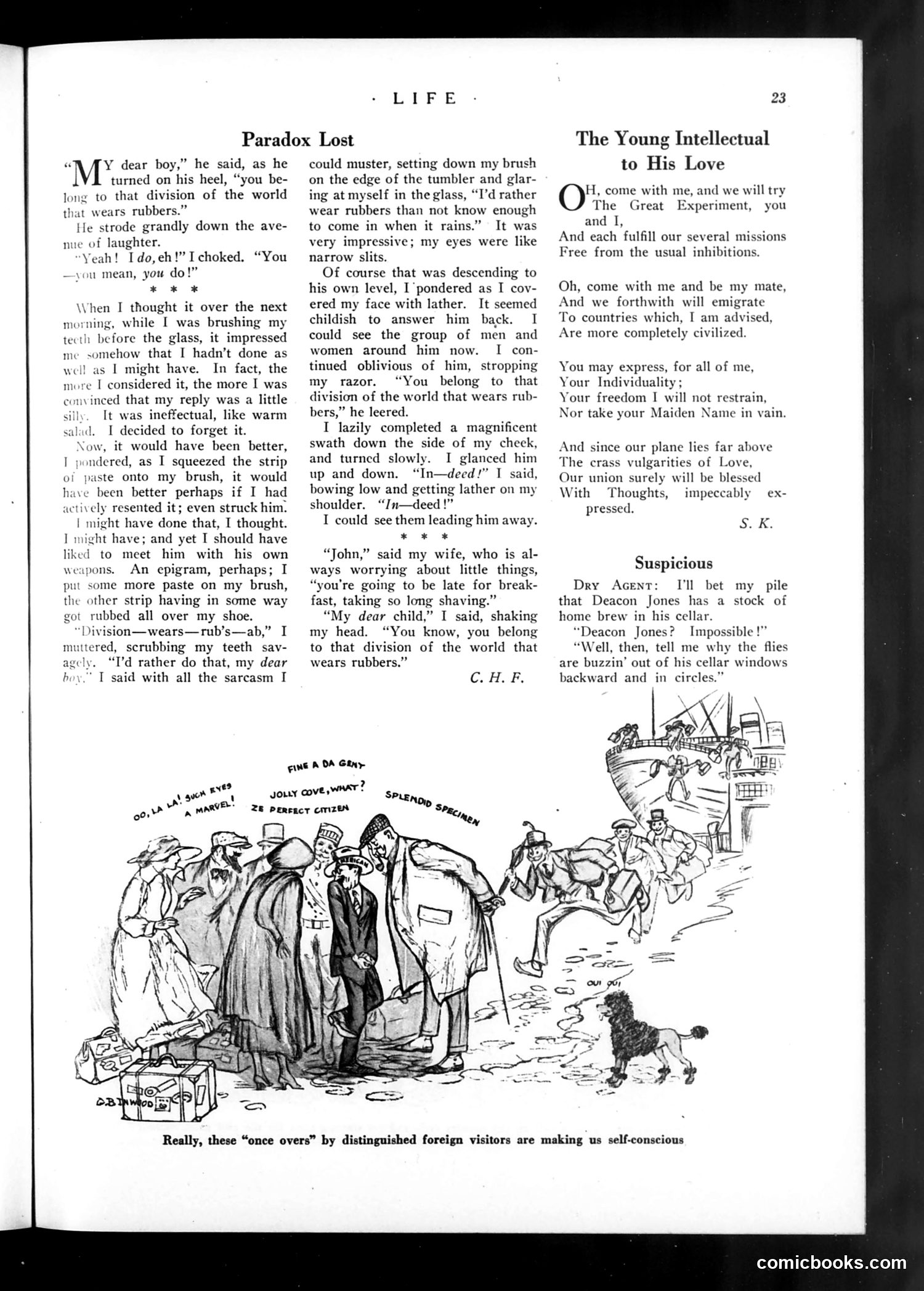
**"Paradox Lost"** (left column): A humorous story about a social snub. A man insults the narrator by saying he belongs to "that division of the world that wears rubbers" (implying lower class or practical rather than sophisticated). The narrator spends the next morning composing the perfect witty comeback while shaving, finally delivering an elaborate rejoinder—only to imagine the man being "led away," suggesting he's made himself look foolish. The joke satirizes the gap between imagined clever comebacks and actual social interactions. **"The Young Intellectual to His Love"** (right column): A parody of bohemian/modernist romance rhetoric. A young intellectual proposes an unconventional relationship emphasizing "freedom," "individuality," and rejection of "usual inhibitions." The satire mocks how intellectual posturing replaces genuine emotion—their union will be blessed with "Thoughts, impeccably expressed" rather than actual love. **Bottom cartoon**: Mocks foreign visitors' criticism of American society, suggesting their scrutiny makes Americans self-conscious about their own habits and customs. All three pieces satirize pretension and social affectation common in 1920s culture.
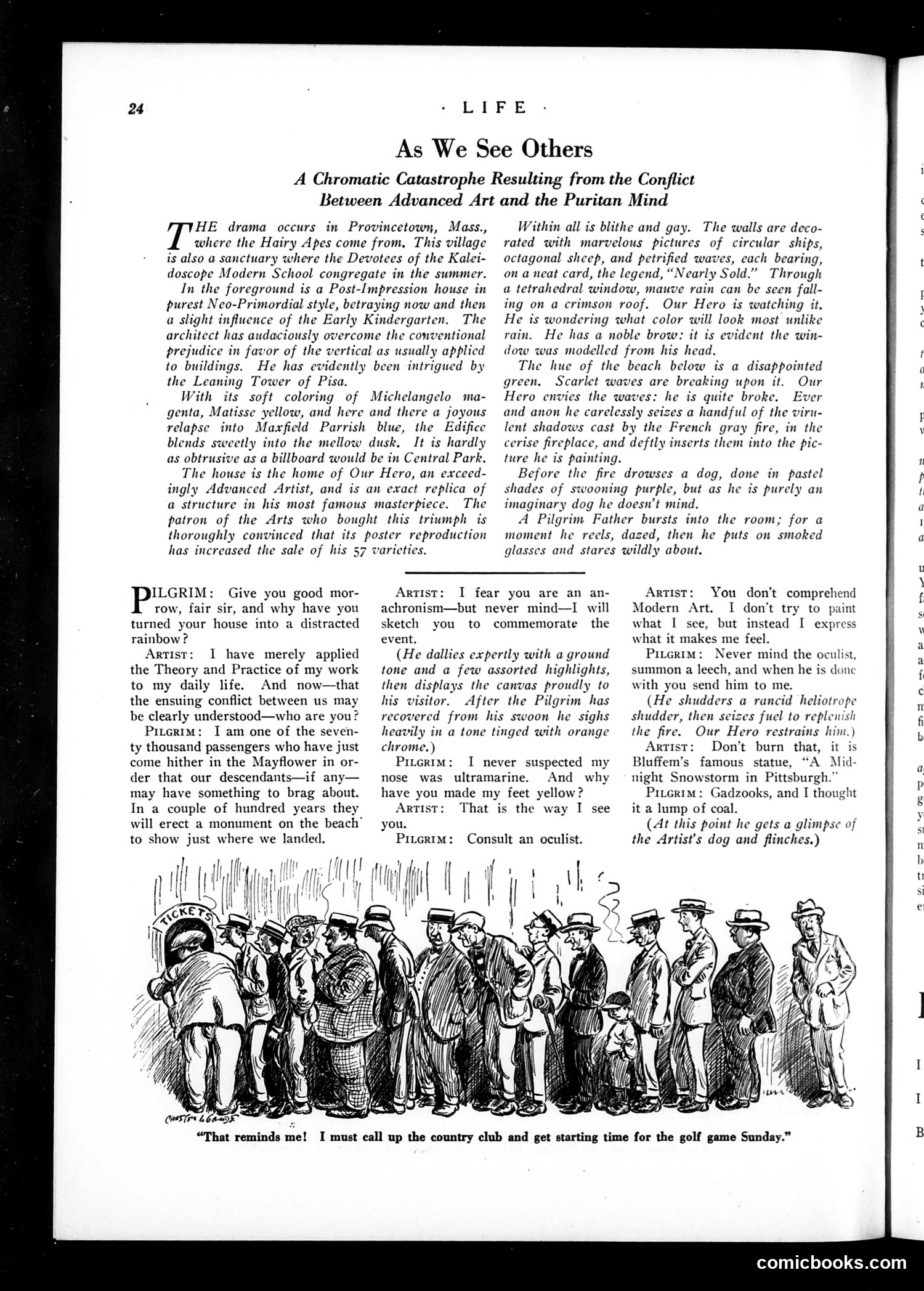
This satire mocks the clash between avant-garde modernism and traditional American values in 1920s Provincetown, Massachusetts—a real bohemian artists' colony. The conflict centers on a self-consciously "advanced" artist whose house and paintings reject realistic representation for experimental color and abstraction. The humor comes from the confrontation between the Artist (representing modernist pretension) and the Pilgrim (representing Puritan restraint and practicality). When the Pilgrim protests that the Artist has painted his nose ultramarine and feet yellow, the Artist responds that's simply "how I see you"—a jab at modernist artists' claim to express subjective feeling over objective reality. Life magazine ridicules both: the Artist's self-important theory-spouting and the Pilgrim's bewildered incomprehension. The cartoon suggests modernism was seen as absurdly divorced from reality, while simultaneously portraying traditional values as stubbornly outdated and unable to engage with contemporary art.
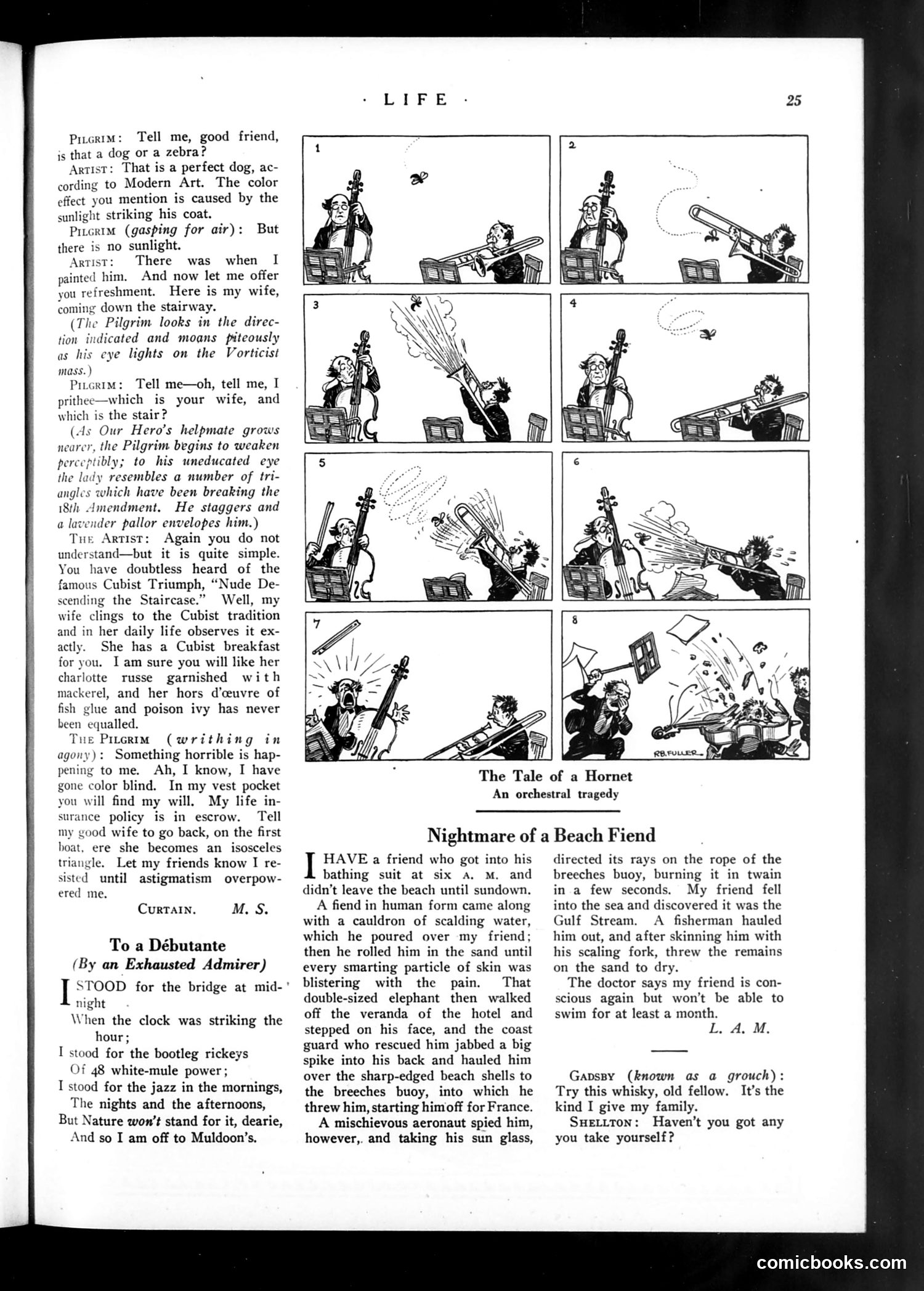
This 1920s satire mocks avant-garde modern art movements, particularly Cubism and Vorticism. A "Pilgrim" visitor encounters an artist whose work is incomprehensibly abstract—he claims a striped dog is actually a perfect modern artwork, its "color effect" explained away implausibly. The joke escalates when the artist's wife appears: she's described as a chaotic arrangement of triangles (referencing the famous Cubist painting "Nude Descending a Staircase"). The Pilgrim literally cannot distinguish her from the staircase, and the artist offers inedible "Cubist breakfast" featuring poisoned food. The satire targets the pretentiousness of modernist artists who justify nonsensical work through pseudo-intellectual explanation. The Pilgrim's breakdown—losing color vision and becoming "an isosceles triangle"—suggests exposure to such art causes mental deterioration. This reflects widespread early-20th-century public skepticism toward abstract art as incomprehensible fraud.
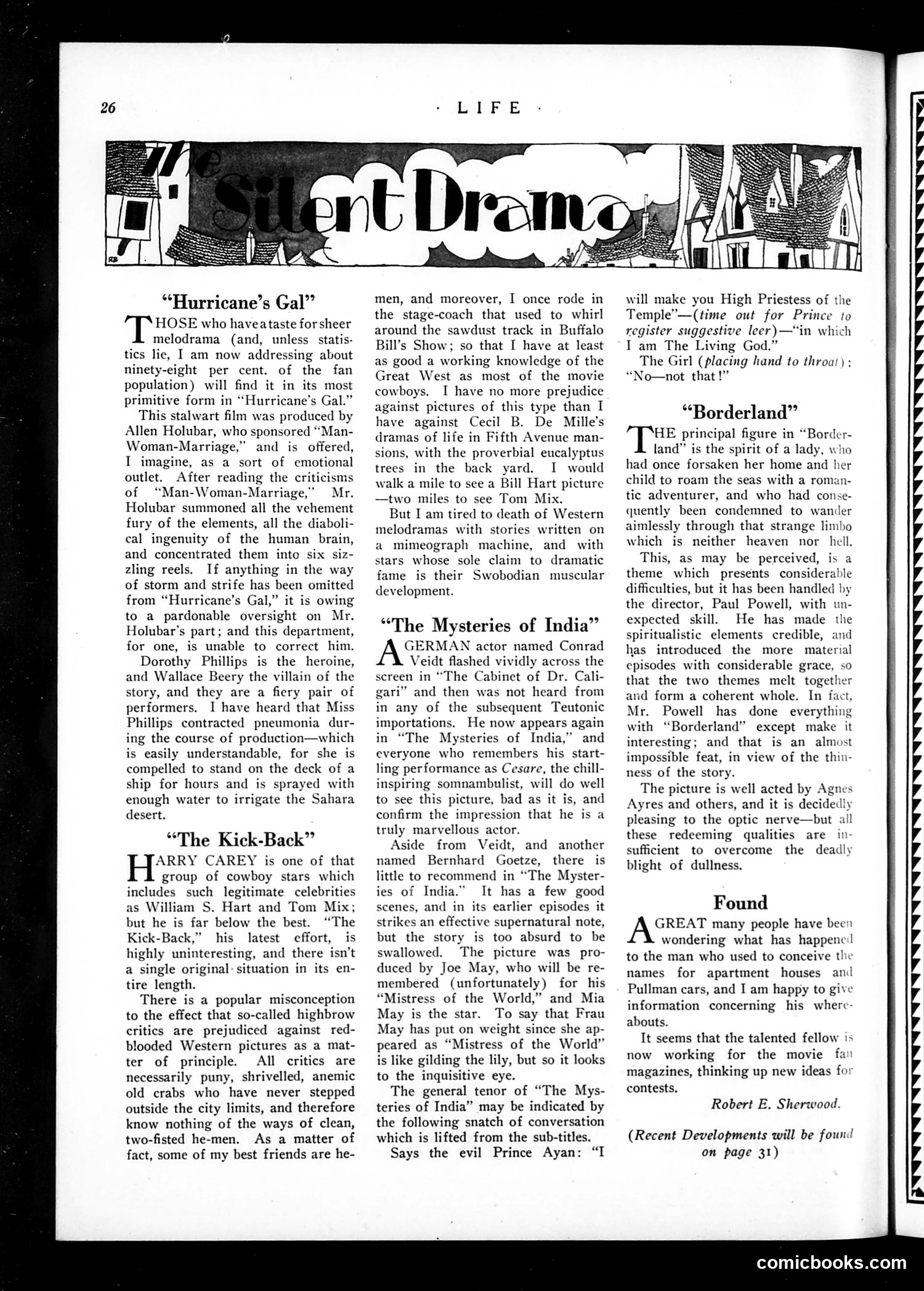
This page reviews three silent films for modern readers unfamiliar with early cinema: **"Hurricane's Gal"** stars Dorothy Phillips and Wallace Beery in melodrama so extreme the reviewer sarcastically notes Phillips endured actual pneumonia during production—suggesting the film prioritizes spectacle (storms, water scenes) over plot subtlety. **"The Kick-Back"** features cowboy star Harry Carey. The critic defends Western pictures against "highbrow" dismissal, claiming he's no urban snob (he rode in Buffalo Bill's stage show). However, he condemns formulaic Westerns with muscular stars but no real acting talent—a jab at the genre's reliance on physicality over dramatic skill. **"The Mysteries of India"** stars German actor Conrad Veidt (famous from *The Cabinet of Dr. Caligari*). The reviewer praises Veidt as genuinely talented but criticizes the film's absurd plot and jokes about co-star Mia May's weight gain since her previous starring role.

This is **not a cartoon or satire**—it's a straightforward **advertisement** for U.S. Royal Cord Tires from the United States Rubber Company. The ad defends Royal Cords against market criticism. Competitors apparently claimed consumers were demanding cheap tires during an economic downturn (likely the early 1920s recession). U.S. Rubber counters this by arguing Royal Cords' *increasing* sales prove Americans actually value quality over price. The ad emphasizes the tire's distinctive white sidewall stripe, scientific tread design (patented seven years prior), and widespread adoption across vehicle makes—positioning it as the market leader. The large tire illustration and cityscape background serve to showcase the product's prominence and prestige. This is corporate messaging defending market position against lower-priced competitors, not political satire or humorous commentary.
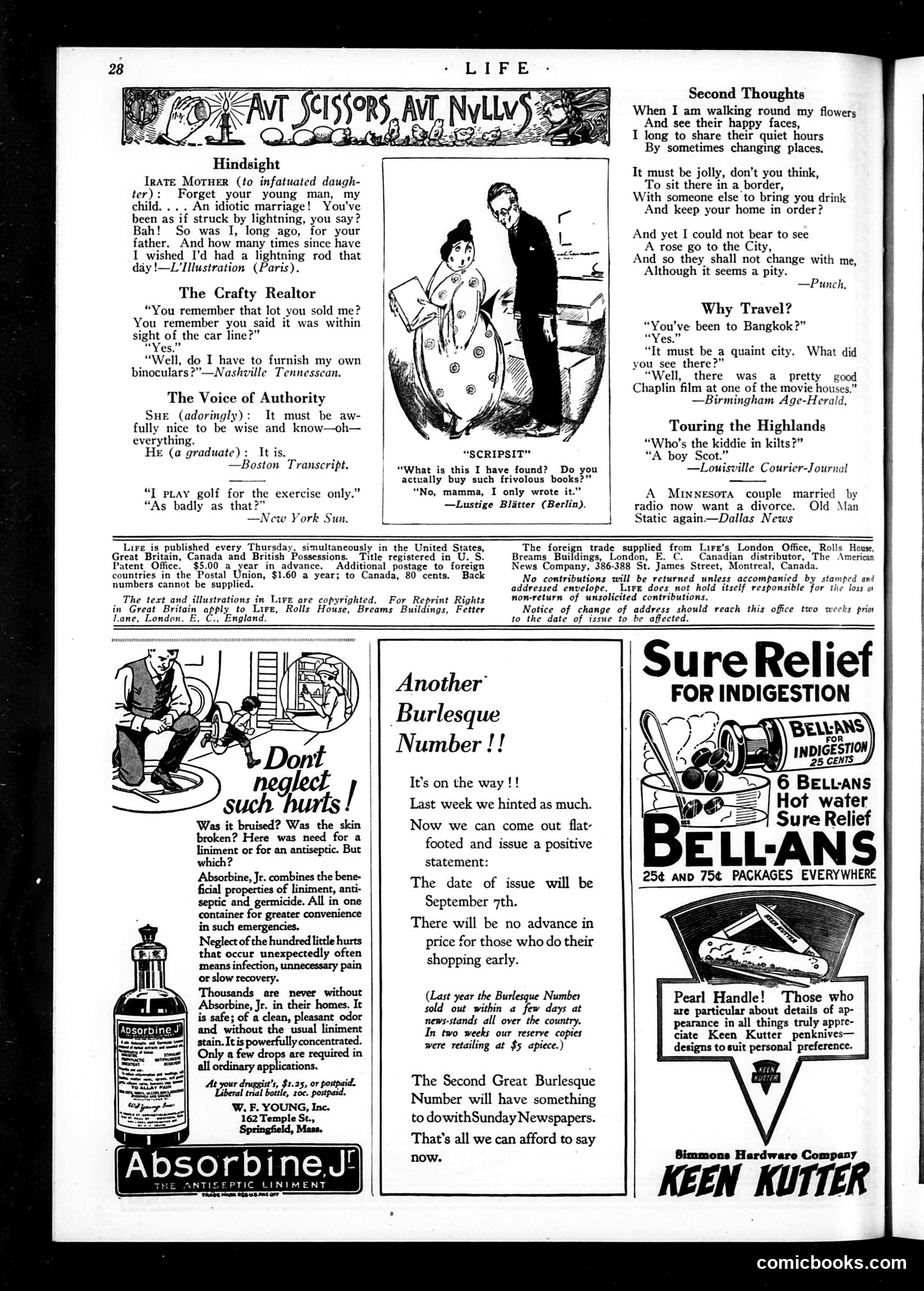
This page from *Life* magazine contains several short satirical jokes reflecting early 20th-century domestic and social humor: **"Hindsight"** depicts a mother warning her daughter against marriage, ironically admitting she herself was "struck by lightning" in love with the girl's father—then wishing she'd had a lightning rod. The joke mocks romantic idealism versus marital reality. **"The Crafty Realtor"** satirizes deceptive real-estate sales: a buyer complains the property was promised to be "within sight of the car line," implying he'd need binoculars to actually see it. **"Scripsit"** plays on a mother discovering her daughter writes frivolous books—the daughter admits she didn't buy them, she *authored* them, turning the shame back on the mother's snobbery. Other brief items joke about golf mediocrity, travel disappointments (a Bangkok visitor only saw a Chaplin film), and contemporary oddities (radio weddings). The page also advertises period products: Absorbine Jr. liniment and Bellans indigestion remedy, typical of vintage magazine advertising.
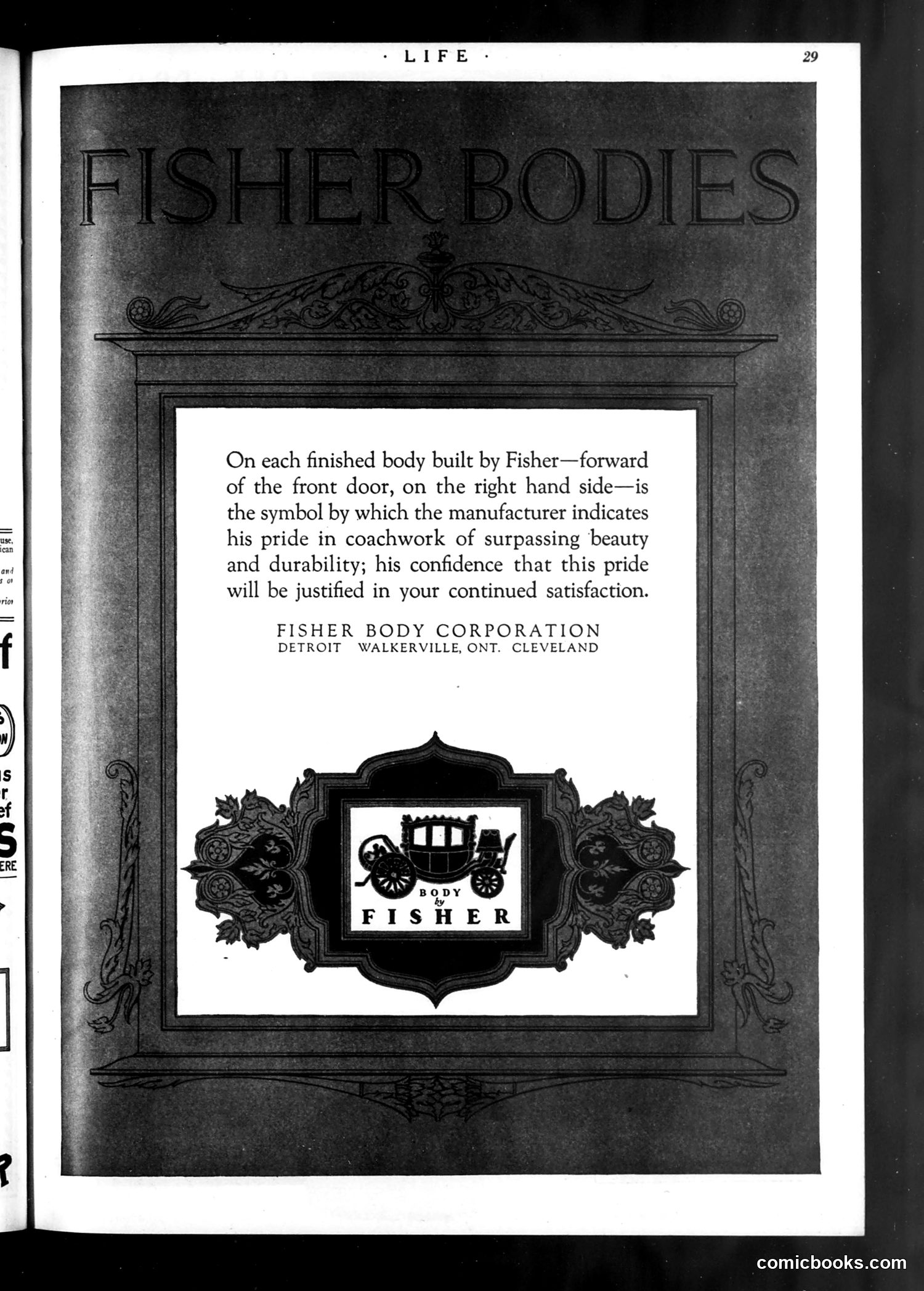
This is an advertisement, not a cartoon. It promotes Fisher Body Corporation, an automotive coachbuilder that supplied car bodies to major manufacturers (notably General Motors). The ad explains that Fisher places a manufacturer's badge on vehicles as a mark of quality and pride in craftsmanship. The ornate badge shown features a horse-drawn carriage, referencing the company's origins in carriage-building before automobiles. The text appeals to consumer confidence—suggesting the Fisher name guarantees "surpassing beauty and durability." This appears from an early automotive era when custom coachwork was a selling point. The three factory locations listed (Detroit, Walkerville Ontario, Cleveland) reflect Fisher's regional manufacturing presence.
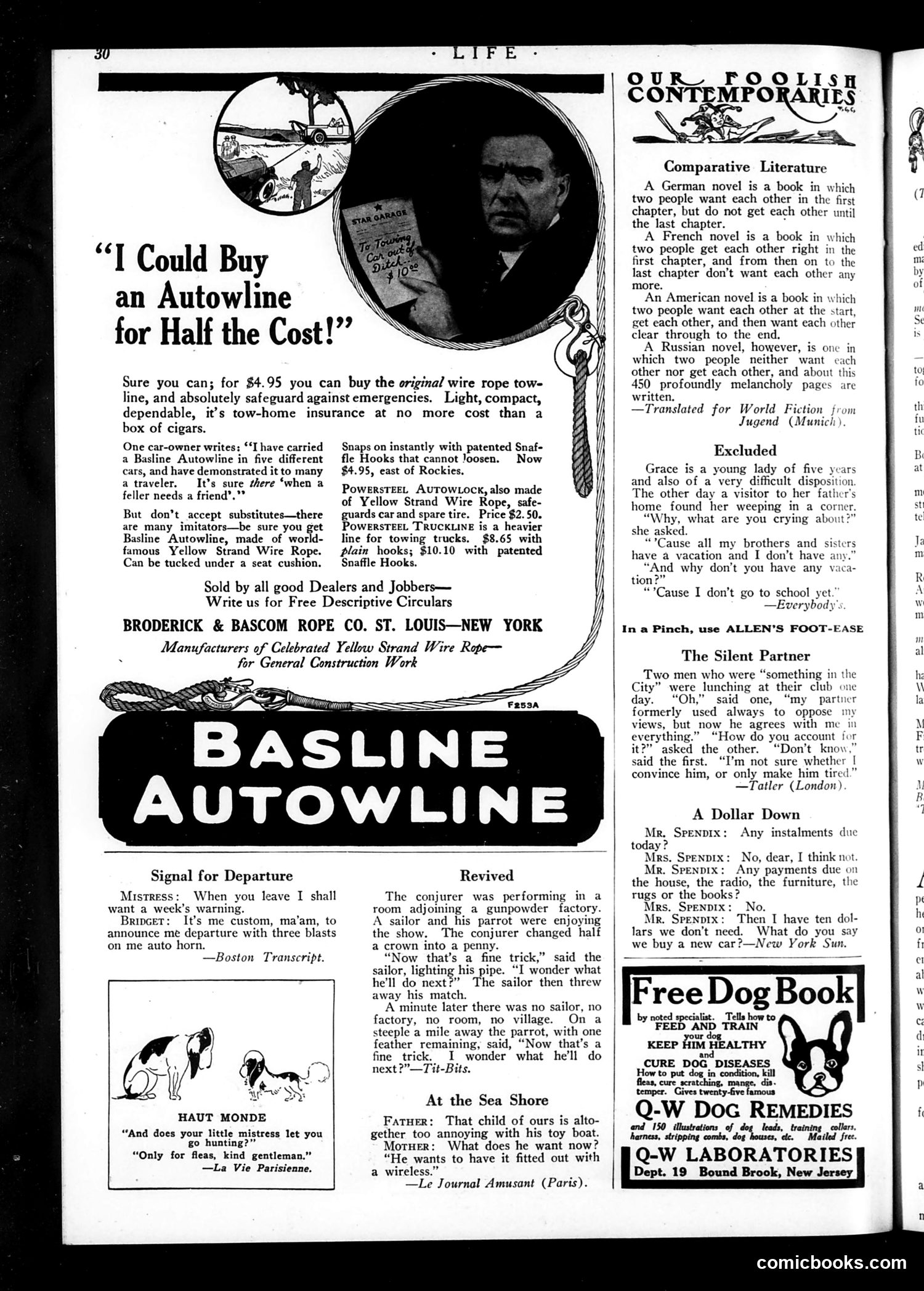
This page is primarily **advertising** for Basline Autowline (a wire rope tow-line for automobiles), supplemented by humor pieces and small advertisements. The **cartoons and jokes** are brief, unrelated anecdotes typical of early 20th-century satirical magazines: - "Signal for Departure" mocks working-class speech patterns (Irish servant announcing departure via car horn) - "Haut Monde" is a simple pun about a lady's small dog hunting fleas - "Revived" presents dark humor: a sailor's match-tossing causes an explosion near a gunpowder factory - "At the Sea Shore" jokes about modern technology (wireless radio) obsessing children - The "Comparative Literature" section stereotypes national character through novel-writing: Germans are slow-burn romantics, French are quick affairs, Americans sustain desire throughout, Russians are melancholic and circular These reflect common period prejudices and tastes. The page captures advertising-heavy magazine culture circa 1920s-1930s, mixing product promotion with light international humor targeting educated, middle-class readers.
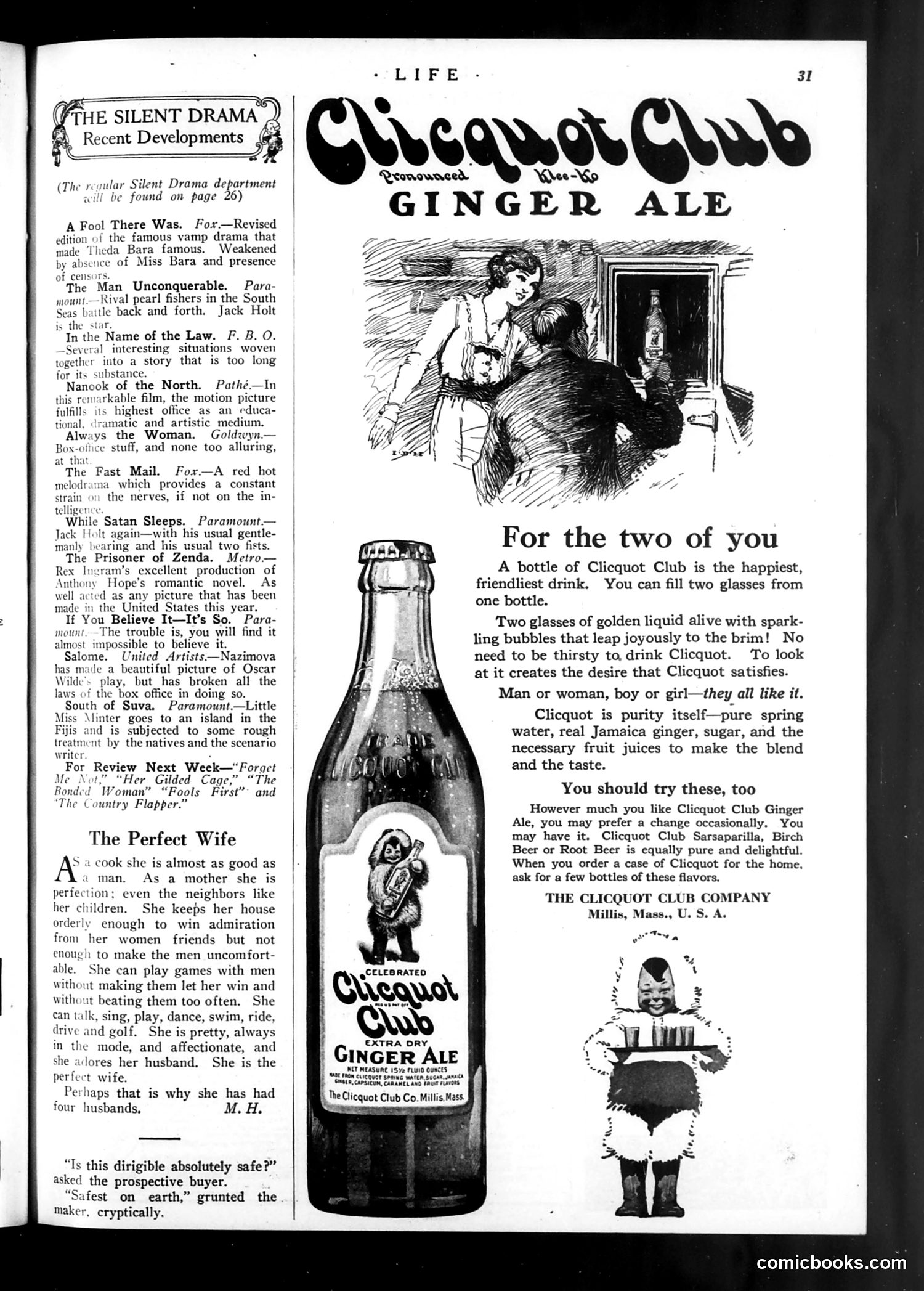
This page combines film reviews with a Clicquot Club ginger ale advertisement. The left column reviews silent films from major studios (Fox, Paramount, Metro), discussing stars like Jack Holt and discussing narrative quality. Notable is praise for "Nanook of the North" as educational cinema. Below the reviews sits "The Perfect Wife" — a satirical piece describing the "ideal" woman as a cook, mother, and companion who entertains her husband without challenging him, who "can play games with men without making them let her win." The humor is gently critical: she's won her four husbands through perfect compliance rather than substance. The right side features a full-page Clicquot Club advertisement with illustrations of a couple sharing drinks and a mascot figure. The copy emphasizes the drink as social lubricant for romance ("for the two of you"). The page reflects 1920s consumer culture: domesticity idealized for women, while advertising sells leisure and romance to couples. The advertisement's prominence suggests the magazine's commercial orientation.
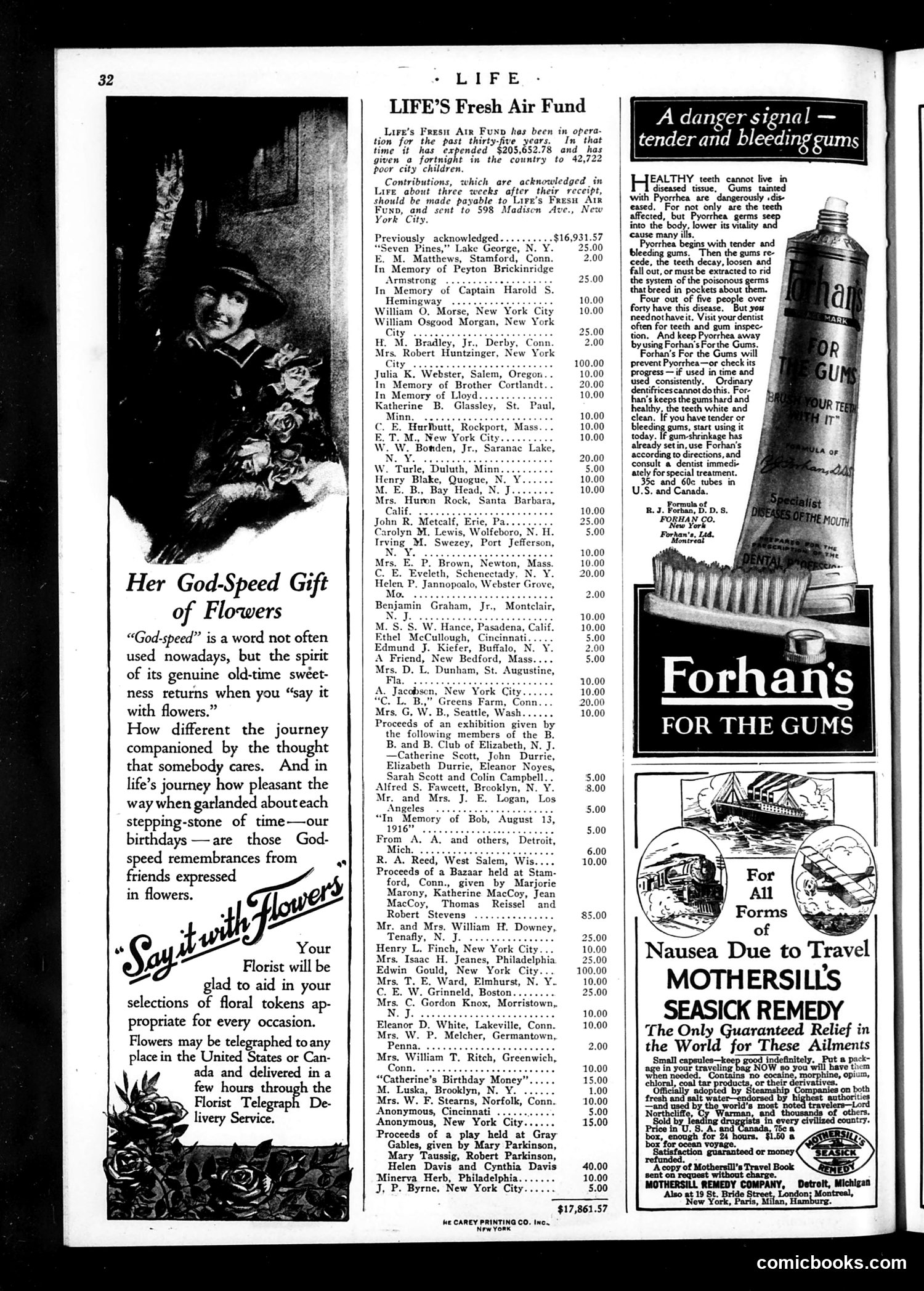
This page contains **no political cartoon or satirical content**—it is primarily **advertising and charitable fundraising**. The left side features a sentimental advertisement for flower delivery, emphasizing flowers as meaningful "God-speed" gifts for life's milestones. The image shows a woman with flowers, accompanying prose about the emotional value of floral remembrances. The center column lists donations to **Life's Fresh Air Fund**, a genuine 35-year-old charity providing country vacations to poor city children. Donations ranged from $2 to $100, with a total of $17,861.57. The right side contains two advertisements: one for **Forhan's For the Gums** (a dental product addressing pyorrhea/gum disease) and another for **Mothersill's Seasick Remedy**. This is a typical early 20th-century magazine page mixing commercial advertising with charitable fundraising announcements—not satirical content.
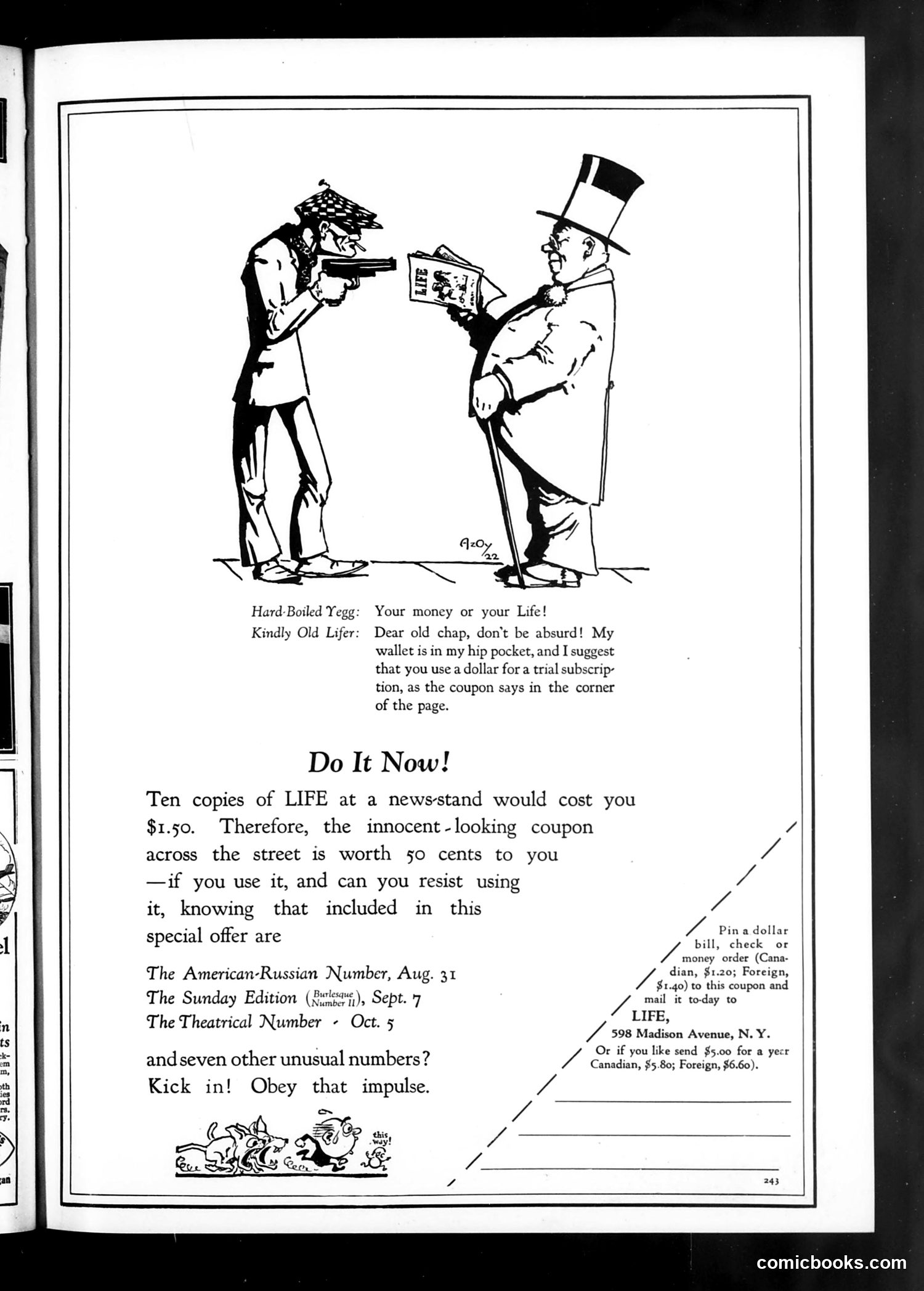
This is primarily a **subscription advertisement** for *Life* magazine, using humor to encourage readers to subscribe. The cartoon depicts a humorous confrontation: a "Hard-Boiled Yegg" (criminal/mugger) demands "Your money or your life!" from a "Kindly Old Lifer" (experienced person). Rather than comply fearfully, the older man cleverly deflects by suggesting the mugger use a dollar for a trial *Life* magazine subscription instead. The satire works on two levels: it jokes about aggressive sales tactics (the mugging metaphor) while simultaneously employing that same aggressive pitch itself—the ad copy literally tells readers they "can't resist" the coupon offer and commands "Kick in! Obey that impulse." The page promotes special upcoming issues (American-Russian Number, Sunday Edition, Theatrical Number) available through this discounted subscription offer. The smaller subscription coupon appears on the right side of the page. Essentially, *Life* is humorously acknowledging—and mimicking—high-pressure sales techniques.

This appears to be an **advertisement page**, not a political cartoon. The page features a tire branded "GOODRICH SILVERTORK" photographed at a dramatic angle against a stark black and white background. The headline reads "Best in the Long Run." This is a **product advertisement** for Goodrich tires, using modernist photographic styling popular in early-to-mid 20th century advertising. The phrase "Best in the Long Run" is a pun playing on both durability (tires lasting long) and the literal "run" of a tire rolling forward. There is no political satire, caricature, or social commentary visible here—just commercial marketing for an automotive product using sophisticated visual design to convey quality and reliability to potential customers.