
Life, 1922-08-17 · page 11 of 36
Life — August 17, 1922 — page 11: what you’re looking at
What you’re looking at
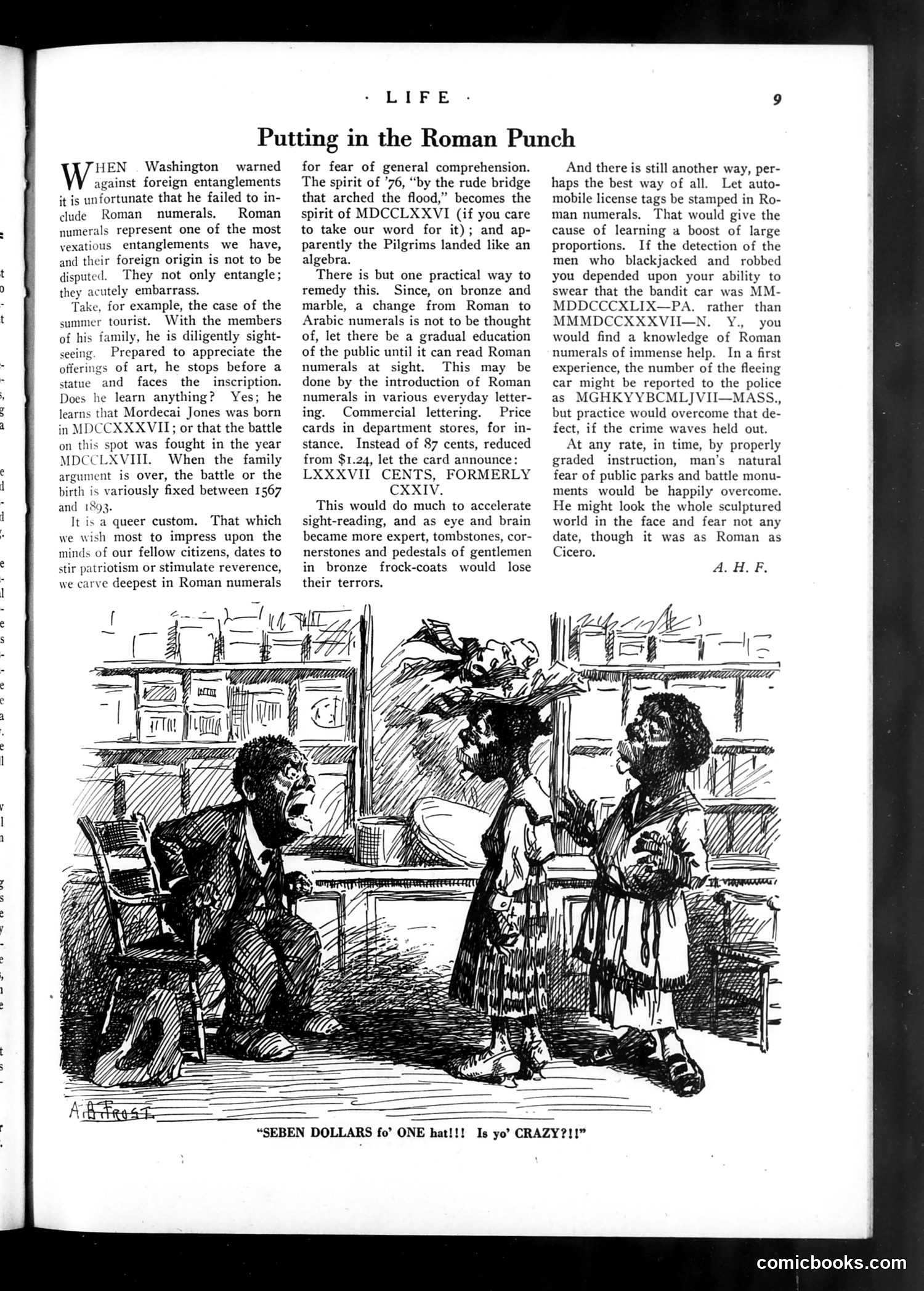
The article discusses Washington's warning against Roman numerals in official contexts, arguing they create confusion and embarrassment. It proposes gradual public education through everyday uses—price cards, commercial lettering—to improve numeracy. The cartoon illustrates the absurdity through a domestic scene: a shopkeeper or merchant appears to be quoting an inflated price ("SEVEN DOLLARS for ONE hat!!!") to two working-class customers (likely a woman and child). The caption "Is yo' CRAZY?!!" suggests the customers' incredulous reaction to what seems an unreasonable price. The satire connects Roman numerals to commercial fraud—if citizens cannot read "LXXVII CENTS" properly, merchants could exploit them with inflated, disguised pricing. The joke exposes both public mathematical illiteracy and the dishonest practices it enables.
📄 Transcribed text from this page (OCR, searchable)
Machine-transcribed from the original scan — historical spelling and the odd misread are preserved.
LIFE Putting in the Roman Punch HEN Washington warned against foreign entanglements it is unfortunate that he failed to in- clude Roman numerals. Roman numerals represent one of the most vexatious entanglements we have, and their foreign origin is not to be disputed. They not only entangle; they acutely embarrass. Take, for example, the case of the summer tourist. With the members of his family, he is diligently sight- seeing. Prepared to appreciate the offerings of art, he stops before a statue and faces the inscription. Does he learn anything? Yes; he learns that Mordecai Jones was born in MDCCXXXVII; or that the battle on this spot was fought in the year MDCCLXVIII. When the family argument is over, the battle or the birth is variously fixed between 1567 and 1893. It is a queer custom, That which we wish most to impress upon the minds of our fellow citizens, dates to stir patriotism or stimulate reverence, we carve deepest in Roman numerals for fear of general comprehension. The spirit of ’76, “by the rude bridge that arched the flood,’ becomes the spirit of MDCCLXXVI (if you care to take our word for it); and ap- parently the Pilgrims landed like an algebra. There is but one practical way to remedy this. Since, on bronze and marble, a change from Roman to Arabic numerals is not to be thought of, let there be a gradual education of the public until it can read Roman numerals at sight. This may be done by the introduction of Roman numerals in various everyday letter- ing. Commercial lettering. Price cards in department stores, for in- stance. Instead of 87 cents, reduced from $1.24, let the card announce: LXXXVII CENTS, FORMERLY CXXIV. This would do much to accelerate sight-reading, and as eye and brain became more expert, tombstones, cor- nerstones and pedestals of gentlemen in bronze frock-coats would lose their terrors, And there is still another way, per- haps the best way of all. Let auto- mobile license tags be stamped in Ro- man numerals, That would give the cause of learning a boost of large proportions. If the detection of the men who bDlackjacked and robbed you depended upon your ability to swear that the bandit car was MM- MDDCCCXLIX—PA. rather than MMMDCCXXXVII—N. Y., you would find a knowledge of Roman numerals of immense help. In a first experience, the number of the fleeing car might be reported to the police as MGHKYYBCMLJVII—MASS., but practice would overcome that de- fect, if the crime waves held out. At any rate, in time, by properly graded instruction, man’s natural fear of public parks and battle monu- ments would be happily overcome. He might look the whole sculptured world in the face and fear not any date, though it was as Roman as Cicero, OAL, “SEBEN DOLLARS fo’ ONE hat!!! Is yo? CRAZY?!1” comicbooks.com