
Life, 1922-08-17 · page 28 of 36
Life — August 17, 1922 — page 28: what you’re looking at
What you’re looking at
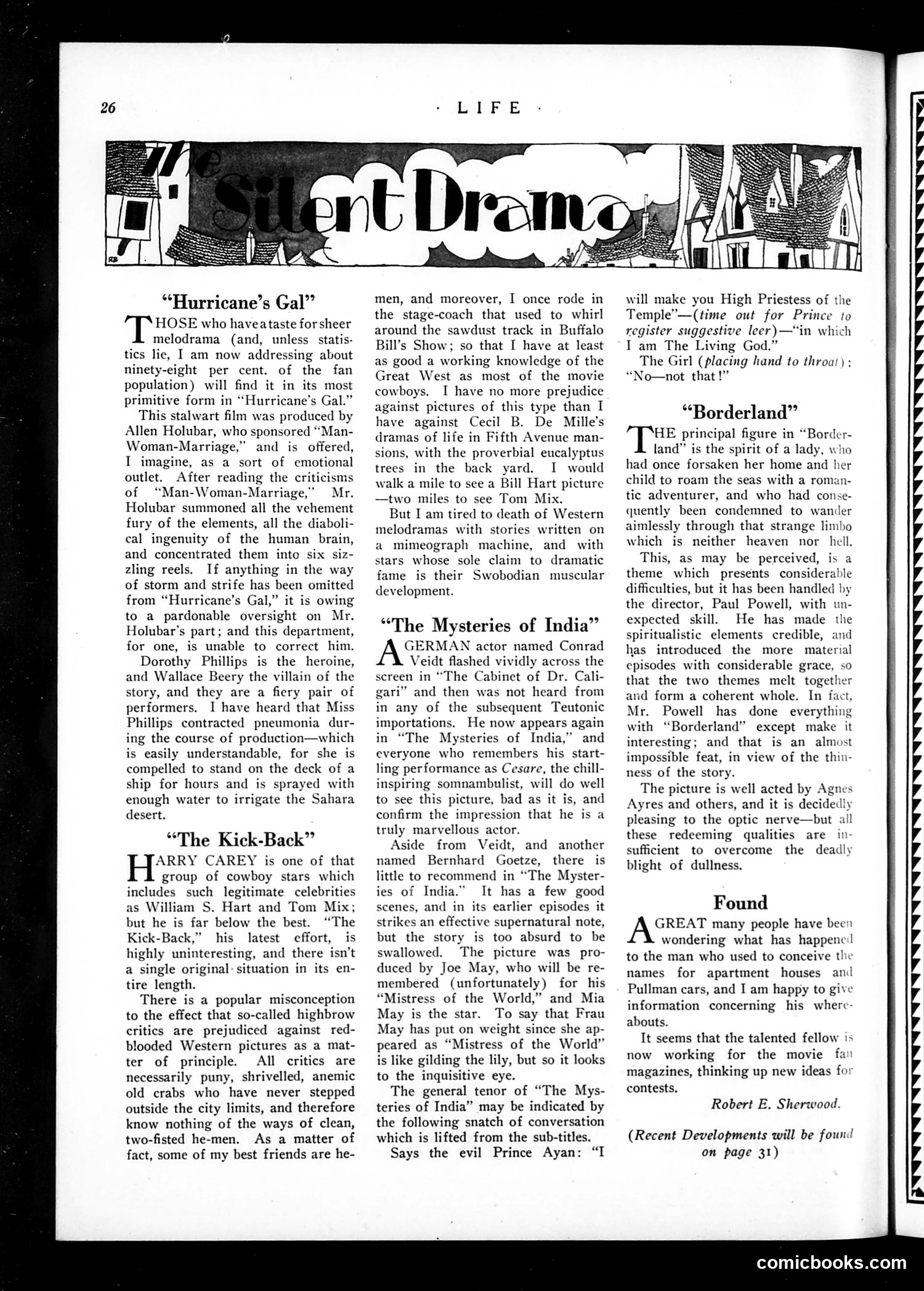
This page reviews three silent films for modern readers unfamiliar with early cinema: **"Hurricane's Gal"** stars Dorothy Phillips and Wallace Beery in melodrama so extreme the reviewer sarcastically notes Phillips endured actual pneumonia during production—suggesting the film prioritizes spectacle (storms, water scenes) over plot subtlety. **"The Kick-Back"** features cowboy star Harry Carey. The critic defends Western pictures against "highbrow" dismissal, claiming he's no urban snob (he rode in Buffalo Bill's stage show). However, he condemns formulaic Westerns with muscular stars but no real acting talent—a jab at the genre's reliance on physicality over dramatic skill. **"The Mysteries of India"** stars German actor Conrad Veidt (famous from *The Cabinet of Dr. Caligari*). The reviewer praises Veidt as genuinely talented but criticizes the film's absurd plot and jokes about co-star Mia May's weight gain since her previous starring role.
📄 Transcribed text from this page (OCR, searchable)
Machine-transcribed from the original scan — historical spelling and the odd misread are preserved.
“Hurricane’s Gal” HOSE who haveataste for sheer melodrama (and, unless. statis- tics lie, I am now addressing about ninety-eight per cent. of the fan population) will find it in its most primitive form in “Hurricane’s Gal.” This stalwart film was produced by Allen Holubar, who sponsored “Man- Woman-Marriage,” and is offered, I imagine, as a sort of emotional outlet. After reading the criticisms of ‘“Man-Woman-Marriage,” Mr. Holubar summoned all the vehement fury of the elements, all the diaboli- cal ingenuity of the human brain, and concentrated them into six siz- zling reels. If anything in the way of storm and strife has been omitted from “Hurricane’s Gal,” it is owing to a pardonable oversight on Mr. Holubar’s part; and this department, for one, is unable to correct him. Dorothy Phillips is the heroine, and Wallace Beery the villain of the story, and they are a fiery pair of performers. I have heard that Miss Phillips contracted pneumonia dur- ing the course of production—which is easily understandable, for she is compelled to stand on the deck of a ship for hours and is sprayed with enough water to irrigate the Sahara desert. “The Kick-Back” ARRY CAREY is one of that group of cowboy stars which includes such legitimate celebrities as William S. Hart and Tom Mix; but he is far below the best. “The Kick-Back,” his latest effort, is highly uninteresting, and there isn’t a single original- situation in its en- tire length. There is a popular misconception to the effect that so-called highbrow critics are prejudiced against red- blooded Western pictures as a mat- ter of principle. All critics are necessarily puny, shrivelled, anemic old crabs who have never stepped outside the city limits, and therefore know nothing of the ways of clean, two-fisted he-men. As a matter of fact, some of my best friends are he- men, and moreover, I once rode in the stage-coach that used to whirl around the sawdust track in Buffalo Bill’s Show; so that I have at least as good a working knowledge of the Great West as most of the movie cowboys. I have no more prejudice against pictures of this type than I have against Cecil B. De Mille’s dramas of life in Fifth Avenue man- sions, with the proverbial eucalyptus trees in the back yard. I would walk a mile to see a Bill Hart picture —two miles to see Tom Mix. But I am tired to death of Western melodramas with stories written on a mimeograph machine, and with stars whose sole claim to dramatic fame is their Swobodian muscular development. “The Mysteries of India” GERMAN actor named Conrad Veidt flashed vividly across the screen in “The Cabinet of Dr. Cali- gari” and then was not heard from in any of the subsequent Teutonic importations. He now appears again in “The Mysteries of India,” and everyone who remembers his start- ling performance as Cesare, the chill- inspiring somnambulist, will do well to see this picture, bad as it is, and confirm the impression that he is a truly marvellous actor. Aside from Veidt, and another named Bernhard Goetze, there is little to recommend in “The Myster- ies of India.” It has a few good scenes, and in its earlier episodes it strikes an effective supernatural note, but the story is too absurd to be swallowed. The picture was pro- duced by Joe May, who will be re- membered (unfortunately) for his “Mistress of the World,” and Mia May is the star. To say that Frau May has put on weight since she ap- peared as “Mistress of the World” is like gilding the lily, but so it looks to the inquisitive eye. The general tenor of “The Mys- teries of India” may be indicated by the following snatch of conversation which is lifted from the sub-titles. Says the evil Prince Ayan: “I will make you High Priestess of the Temple’—(time out for Prince to register suggestive leer)—“in which I am The Living God.” The Girl (placing hand to throat): —not that!” “Borderland” HE principal figure in “Border- land” is the spirit of a lady, who had once forsaken her home and her child to roam the seas with a roman- tic adventurer, and who had conse- quently been condemned to wander aimlessly through that strange limbo which is neither heaven nor hell. This, as may be perceived, is a theme which presents considerable difficulties, but it has been handled by the director, Paul Powell, with un- expected skill. He has made the spiritualistic elements credible, and has introduced the more material episodes with considerable grace, so that the two themes melt together and form a coherent whole. In fact, Mr. Powell has done everything with “Borderland” except make it interesting; and that is an almost impossible feat, in view of the thin- ness of the story. The picture is well acted by Agnes Ayres and others, and it is decidedly pleasing to the optic nerve—but all these redeeming qualities are in sufficient to overcome the deadly blight of dullness. Found GREAT many people have been wondering what has happenc:! to the man who used to conceive the names for apartment houses and Pullman cars, and I am happy to give information concerning his where abouts. It seems that the talented fellow is now working for the movie fa magazines, thinking up new ideas fo contests. Robert E. Sherwood. (Recent Developments will be found on page 31) comicbooks.com B