
Life, 1922-08-17 · page 16 of 36
Life — August 17, 1922 — page 16: what you’re looking at
What you’re looking at
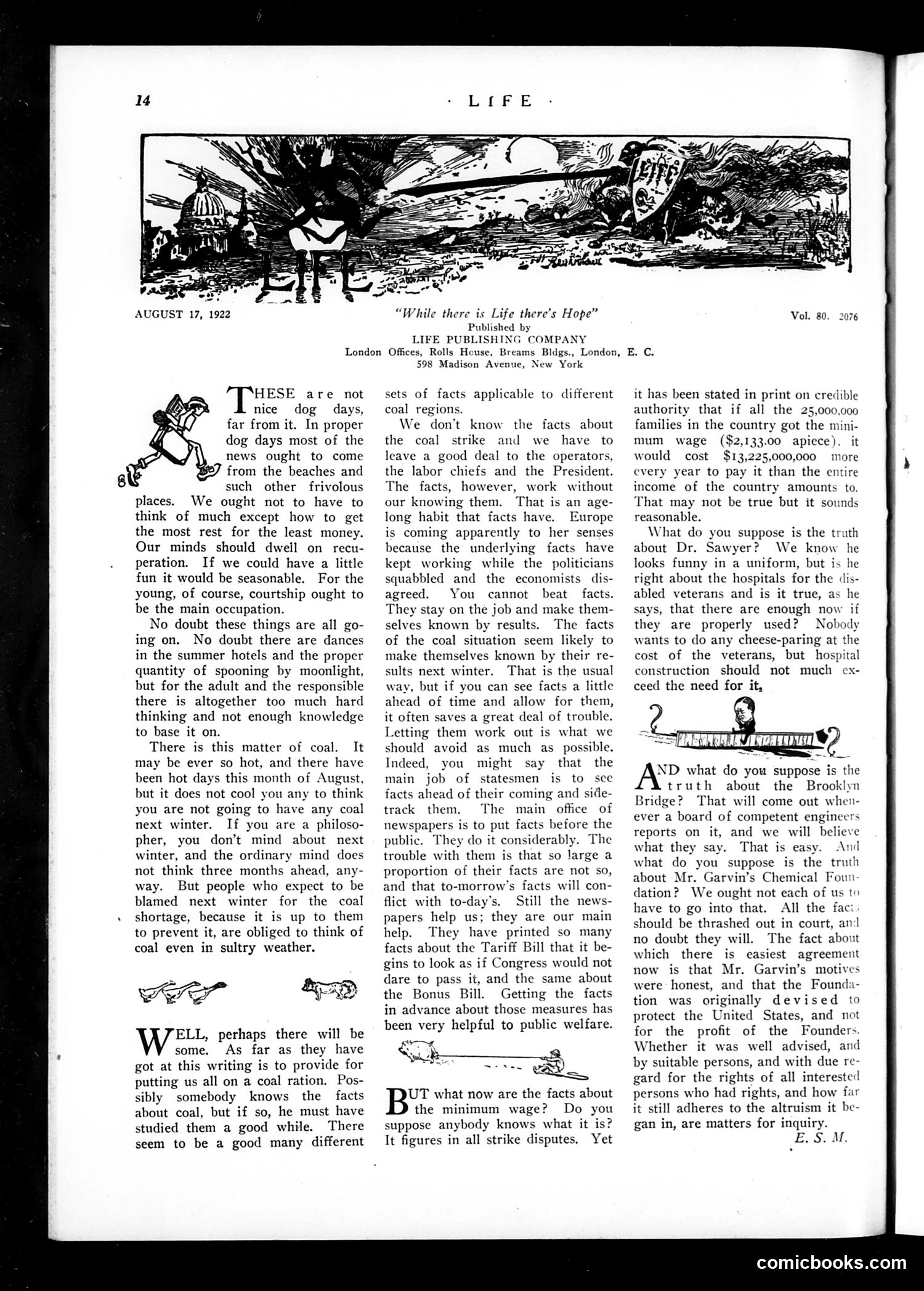
The editorial content discusses contemporary labor and political disputes—specifically the coal shortage, strikes, tariff bills, and the minimum wage. The accompanying cartoon(s) at the top appear to use allegorical or symbolic imagery related to these economic issues, though specific figure identification is unclear from the image quality. The text argues for facts-based public discourse on these contentious issues rather than political rhetoric. It references the "Tariff Bill" and "Home Bill" as measures Congress debated, and mentions "Mr. Garvin's Chemical Foundation" in context of institutional credibility during labor disputes. The overall point: satire of how politicians and newspapers obscure economic realities (coal shortages, wage disputes) behind ideology, when citizens need straightforward factual information to understand strikes and industrial policy.
📄 Transcribed text from this page (OCR, searchable)
Machine-transcribed from the original scan — historical spelling and the odd misread are preserved.
AUGUST 17, 1922 “While there is Life there's Hope” Published by LIFE PUBLISHING COMPANY Vol. 80. 2076 London Offices, Rolls House, Breams Bldgs., London, E. C. HESE are not nice dog days, far from it. In proper dog days most of the news ought to come from the beaches and 8 such other frivolous places. We ought not to have to think of much except how to get the most rest for the least money. Our minds should dwell on recu- peration. If we could have a little fun it would be seasonable. For the young, of course, courtship ought to be the main occupation. No doubt these things are all go- ing on. No doubt there are dances in the summer hotels and the proper quantity of spooning by moonlight, but for the adult and the responsible there is altogether too much hard thinking and not enough knowledge to base it on. There is this matter of coal. It may be ever so hot, and there have been hot days this month of August, but it does not cool you any to think you are not going to have any coal next winter. If you are a philoso- pher, you don’t mind about next winter, and the ordinary mind does not think three months ahead, any- way. But people who expect to be blamed next winter for the coal » shortage, because it is up to them to prevent it, are obliged to think of coal even in sultry weather. ELL, perhaps there will be some. As far as they have got at this writing is to provide for putting us all on a coal ration. Pos- sibly somebody knows the facts about coal, but if so, he must have studied them a good while. There seem to be a good many different 598 Madison Avenue, New York sets of facts applicable to different coal regions. We don’t know the facts about the coal strike and we have to leave a good deal to the operators, the labor chiefs and the President. The facts, however, work without our knowing them. That is an age- long habit that facts have. Europe is coming apparently to her senses because the underlying facts have kept working while the politicians squabbled and the economists dis agreed. You cannot beat facts. They stay on the job and make them- selves known by results. The facts of the coal situation seem likely to make themselves known by their re- sults next winter. That is the usual way, but if you can see facts a little ahead of time and allow for them, it often saves a great deal of trouble. Letting them work out is what we should avoid as much as possible. Indeed, you might say that the main job of statesmen is to see facts ahead of their coming and side- track them, The main office of newspapers is to put facts before the public. They do it considerably. The trouble with them is that so large a proportion of their facts are not so, and that to-morrow’s facts will con- flict with to-day’s. Still the news- papers help us; they are our main help. They have printed so many facts about the Tariff Bill that it be- gins to look as if Congress would not dare to pass it, and the same about the Bonus Bill. Getting the facts in advance about those measures has been very helpful to public welfare. <b-—$ 8 UT what now are the facts about the minimum wage? Do you suppose anybody knows what it is? It figures in all strike disputes, Yet it has been stated in print on credible authority that if all the 25,000,000 families in the country got the mini- mum wage ($2,133.00 apiece), it would cost $13,225,000,000 more every year to pay it than the entire income of the country amounts to. That may not be true but it sounds reasonable. What do you suppose is the truth about Dr. Sawyer? We know he looks funny in a uniform, but is he right about the hospitals for the dis- abled veterans and is it true, as he says, that there are enough now if Nobody they are properly used? wants to do any cheese-paring at the cost of the veterans, but hospital construction should not much ex- ceed the need for it, YD what do you suppose is the truth about the Brooklyn 3ridge? That will come out when- ever a board of competent engineers reports on it, and we will believe what they say. That is easy. And what do you suppose is the truth about Mr. Garvin’s Chemical Foun dation? We ought not each of us to have to go into that. All the fac should be thrashed out in court, an: no doubt they will. The fact about which there is easiest agreement now is that Mr. Garvin’s motives were honest, and that the Founda- tion was originally devised to protect the United States, and not for the profit of the Founders. Whether it was well advised, and by suitable persons, and with due re- gard for the rights of all interested persons who had rights, and how far it still adheres to the altruism it be- gan in, are matters for inquiry. E. S. M. comicbooks.com