
Life, 1922-08-17 · page 20 of 36
Life — August 17, 1922 — page 20: what you’re looking at
What you’re looking at
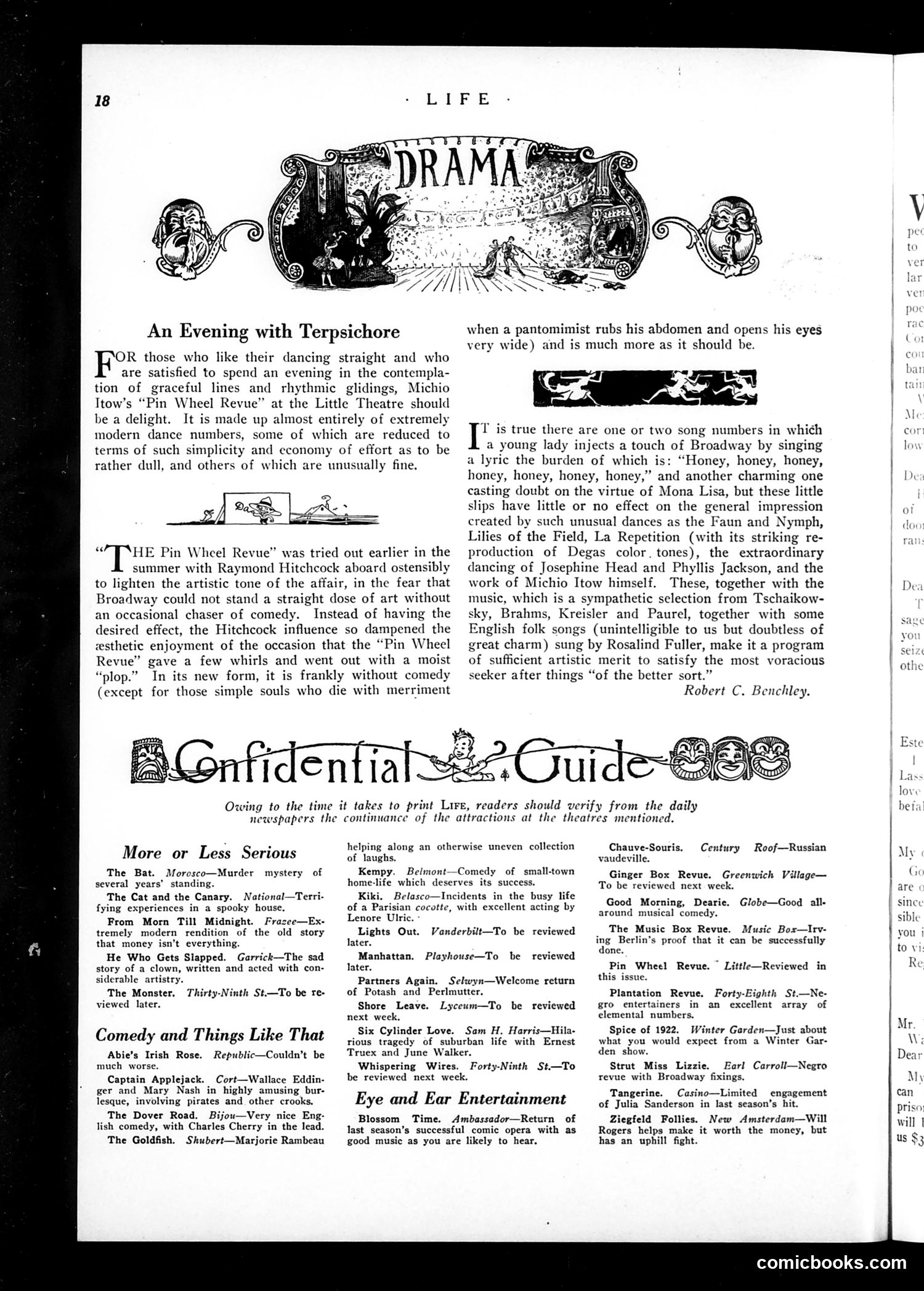
This page from *Life* magazine contains theater reviews, not political cartoons. The main content is Robert C. Benchley's critique of Michio Itow's "Pin Wheel Revue" at the Little Theatre—a modern dance production. The satire targets Broadway's commercial demands. Initially, comedian Raymond Hitchcock was added to make "straight" modern dance palatable to mass audiences, but his presence actually dampened artistic appreciation. Benchley praises the revised version for abandoning comedy entirely, mocking lowbrow tastes (those "simple souls who die with merriment" at crude physical humor). The review also pokes fun at the show's few Broadway-style song numbers, particularly one endlessly repeating "honey, honey, honey" and another casting aspersions on the Mona Lisa's virtue—presented as unnecessary compromises with popular taste. The remainder lists current theatrical attractions, categorized as "serious" or comedic productions.
📄 Transcribed text from this page (OCR, searchable)
Machine-transcribed from the original scan — historical spelling and the odd misread are preserved.
An Evening with Terpsichore ‘OR those who like their dancing straight and who are satisfied to spend an evening in the contempla- tion of graceful lines and rhythmic glidings, Michio Itow’s “Pin Wheel Revue” at the Little Theatre should be a delight. It is made up almost entirely of extremely modern dance numbers, some of which are reduced to terms of such simplicity and economy of effort as to be rather dull, and others of which are unusually fine. sf HE Pin Wheel Revue” was tried out earlier in the summer with Raymond Hitchcock aboard ostensibly to lighten the artistic tone of the affair, in the fear that Broadway could not stand a straight dose of art without an occasional chaser of comedy. Instead of having the desired effect, the Hitchcock influence so dampened the zsthetic enjoyment of the occasion that the “Pin Wheel Revue” gave a few whirls and went out with a moist “plop.” In its new form, it is frankly without comedy (except for those simple souls who die with merriment when a pantomimist rubs his abdomen and opens his eyes very wide) and is much more as it should be. | is true there are one or two song numbers in which a young lady injects a touch of Broadway by singing a lyric the burden of which is: “Honey, honey, honey, honey, honey, honey, honey,” and another charming one casting doubt on the virtue of Mona Lisa, but these little slips have little or no effect on the general impression created by such unusual dances as the Faun and Nymph, Lilies of the Field, La Repetition (with its striking re- production of Degas color, tones), the extraordinary dancing of Josephine Head and Phyllis Jackson, and the work of Michio Itow himself. These, together with the music, which is a sympathetic selection from Tschaikow- sky, Brahms, Kreisler and Paurel, together with some English folk songs (unintelligible to us but doubtless of great charm) sung by Rosalind Fuller, make it a program of sufficient artistic merit to satisfy the most voracious seeker after things “of the better sort.” Robert C. Benchley. to the time it takes to print Lire, readers should verify from the daily newspapers the continuance of the attractions at the theatres mentioned. More or Less Serious The Bat. Morosco—Murder mystery of several years’ standing. The Cat and the Canary. National—Terri- fying experiences in a spooky house. From Morn Till Midnight. Frazee—Ex- tremely modern rendition of the old story that money isn’t everything. He Who Gets Slapped. Garrick—The sad story of a clown, written and acted with con- siderable artistry. The Monster. Thirty-Ninth St.—To be re- viewed later. Comedy and Things Like That Abie’s Irish Rose. Republic—Couldn’t be much worse. Captain Applejack. Cort—Wallace Eddin- ger and Mary Nash in highly amusing bur- lesque, involving pirates and other crooks. The Dover Road. Bijou—Very nice Eng- lish comedy, with Charles Cherry in the lead. The Goldfish. Shubert—Marjorie Rambeau helping along an otherwise uneven collection of laughs. Kempy. Belmont—Comedy of small-town home-life which deserves its success. Kiki. Belasco—Incidents in the busy life of a Parisian cocotte, with excellent acting by Lenore Ulric. Lights Out. Vanderbilt—To be reviewed later. Manhattan. Playhouse—To be reviewed later. Partners Again. Selwyn—Welcome return of Potash and Perlmutter. Shore Leave. Lyceum—To be reviewed next week. Six Cylinder Love. Sam H. Harris—Hila- rious tragedy of suburban life with Ernest Truex and June Walker. Whispering Wires. Forty-Ninth St—To be reviewed next week. Eye and Ear Entertainment Blossom Time. Ambassador—Return of last season’s successful comic opera with as good music as you are likely to hear. Chauve-Souris. vaudeville. Century Roof—Russian Ginger Box Revue. Greenwich Village— To be reviewed next week. Good Morning, Dearie. Globe—Good all- around musical comedy. The Music Box Revue. Music Box—Irv- 's proof that it can be successfully Pin Wheel Revue. ~ Litthe—Reviewed in this issue. Plantation Revue. Forty-Eighth St.—Ne- gro entertainers in an excellent array of elemental numbers. Spice of 1922. Winter Garden—Just about what you would expect from a Winter Gar- den show. Strut Miss Lizzie. Earl Carroll—Negro revue with Broadway fixings. Tangerine. Casino—Limited engagement of Julia Sanderson in last season’s hit. Ziegfeld Follies. New Amsterdam—Will Rogers helps make it worth the money, but has an uphill fight. My are since sible you i tov Dear can Priso: will | us $3 comicbooks.com